


prEN IEC 62321-10:2025
(Main)Determination of certain substances in electrotechnical products - Part 10: Polycyclic aromatic hydrocarbons (PAHs) in polymers and electronics by gas chromatography-mass spectrometry (GC-MS)
General Information
- Abstract
- Status
- Not Published
- Publication Date
- 04-Apr-2027
- Technical Committee
- CLC/TC 111X - Environment
- Current Stage
- 4060 - Enquiry results established and sent to TC, SR, BTTF - Enquiry
- Start Date
- 28-Nov-2025
- Completion Date
- 28-Nov-2025

Overview
prEN IEC 62321-10:2025 defines a normative test method for the determination of polycyclic aromatic hydrocarbons (PAHs) in polymers and electronic components using gas chromatography–mass spectrometry (GC‑MS). Part of the IEC 62321 series on substances in electrotechnical products, this edition updates the extraction solvent (from dichloromethane to toluene) to reduce worker exposure and aligns laboratory practice and reporting for PAH analysis in plastics and rubbers used in electrical and electronic devices.
Key topics and technical requirements
- Scope and applicability: Test method for PAHs present as impurities in polymeric and rubber parts (e.g., from extender oils or carbon black). Evaluated for high‑impact polystyrene (HIPS) and various rubbers (example measurement ranges reported for HIPS < 0.5 mg/kg and rubbers 8–221 mg/kg).
- Analytical principle: Extraction of PAHs from polymer/rubber matrices followed by separation and quantification using GC‑MS.
- Sample preparation: Normative sample handling and extraction procedures including ultrasonic extraction, Soxhlet extraction, and alternative procedures for soluble polymers.
- Solvent change: Use of toluene as the preferred extraction solvent to reduce health risks compared with dichloromethane.
- Instrumental parameters: Annexes provide recommended GC‑MS conditions, column options and example chromatograms for reliable PAH separation.
- Calibration and quantification: Requirements for stock/calibration standards, internal standards, reference masses and calculation methods (including LOD/LOQ and method detection limits).
- Quality control: Precision (repeatability and reproducibility) data, QA/QC practices, labware cleaning procedures and interlaboratory study results to support method performance.
- Reporting: Minimum content for the test report and performance statements.
Practical applications and users
This standard is intended for:
- Test laboratories performing compliance and product screening for PAHs in electronic and electrical product components.
- Manufacturers and suppliers of plastics, rubbers and electronic assemblies to demonstrate material safety and supply‑chain conformity.
- Regulatory and compliance professionals assessing environmental and human‑health risks associated with electrotechnical products.
- Product designers and procurement teams seeking to identify and limit PAH content in materials.
Benefits include standardized, reproducible PAH measurement by GC‑MS, reduced solvent hazards, and harmonized reporting useful for regulatory compliance and product stewardship.
Related standards
- IEC 62321 series - other parts cover different regulated substances and alternative test methods used in the electrotechnical sector.
- Guidance on laboratory safety and general test method validation best practices (referenced within the standard).
Note: prEN IEC 62321-10:2025 is a Committee Draft for Vote (CDV) edition with a proposed stability date through 2029. Users should follow normal laboratory safety protocols when applying this method.
Get Certified
Connect with accredited certification bodies for this standard

TÜV Rheinland
TÜV Rheinland is a leading international provider of technical services.

TÜV SÜD
TÜV SÜD is a trusted partner of choice for safety, security and sustainability solutions.

BSI Group
BSI (British Standards Institution) is the business standards company that helps organizations make excellence a habit.
Sponsored listings
Frequently Asked Questions
prEN IEC 62321-10:2025 is a draft published by CLC. Its full title is "Determination of certain substances in electrotechnical products - Part 10: Polycyclic aromatic hydrocarbons (PAHs) in polymers and electronics by gas chromatography-mass spectrometry (GC-MS)". This standard covers: Determination of certain substances in electrotechnical products - Part 10: Polycyclic aromatic hydrocarbons (PAHs) in polymers and electronics by gas chromatography-mass spectrometry (GC-MS)
Determination of certain substances in electrotechnical products - Part 10: Polycyclic aromatic hydrocarbons (PAHs) in polymers and electronics by gas chromatography-mass spectrometry (GC-MS)
prEN IEC 62321-10:2025 is classified under the following ICS (International Classification for Standards) categories: 13.020.01 - Environment and environmental protection in general; 43.040.10 - Electrical and electronic equipment. The ICS classification helps identify the subject area and facilitates finding related standards.
prEN IEC 62321-10:2025 is available in PDF format for immediate download after purchase. The document can be added to your cart and obtained through the secure checkout process. Digital delivery ensures instant access to the complete standard document.
Standards Content (Sample)
SLOVENSKI STANDARD
01-oktober-2025
Določevanje posameznih snovi v elektrotehničnih izdelkih - 10. del.: Policiklični
aromatski ogljikovodiki (PAH) v polimerih in elektroniki s plinsko kromatografijo in
masno spektrometrijo (GC-MS)
Determination of certain substances in electrotechnical products - Part 10: Polycyclic
aromatic hydrocarbons (PAHs) in polymers and electronics by gas chromatography-
mass spectrometry (GC-MS)
Verfahren zur Bestimmung von bestimmten Substanzen in Produkten der Elektrotechnik
- Teil 10: Polyzyklische aromatische Kohlenwasserstoffe (PAK) in Polymeren und
Elektronik mittels Gaschromatographie-Massenspektrometrie (GC-MS)
Détermination de certaines substances dans les produits électrotechniques - Partie 10:
Hydrocarbures aromatiques polycycliques (HAP) dans les polymères et les produits
électroniques par chromatographie en phase gazeuse-spectrométrie de masse (GC-MS)
Ta slovenski standard je istoveten z: prEN IEC 62321-10:2025
ICS:
29.020 Elektrotehnika na splošno Electrical engineering in
general
31.020 Elektronske komponente na Electronic components in
splošno general
71.040.50 Fizikalnokemijske analitske Physicochemical methods of
metode analysis
2003-01.Slovenski inštitut za standardizacijo. Razmnoževanje celote ali delov tega standarda ni dovoljeno.
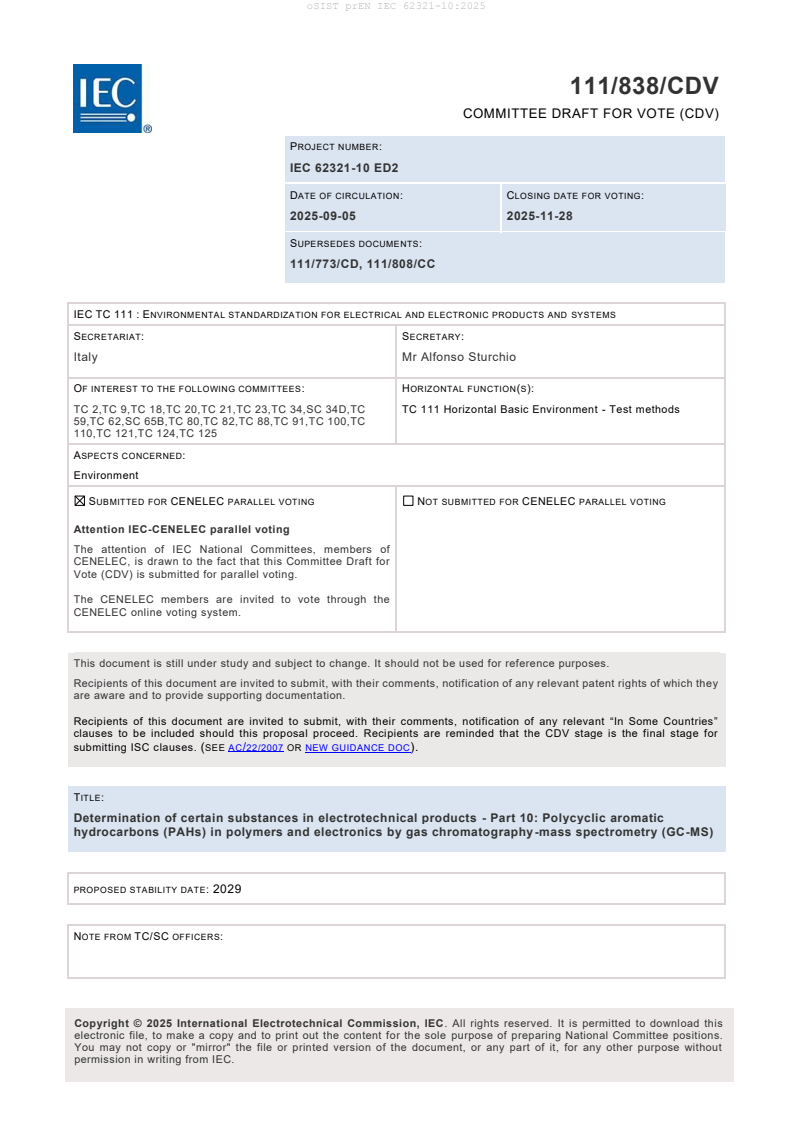
111/838/CDV
COMMITTEE DRAFT FOR VOTE (CDV)
PROJECT NUMBER:
IEC 62321-10 ED2
DATE OF CIRCULATION: CLOSING DATE FOR VOTING:
2025-09-05 2025-11-28
SUPERSEDES DOCUMENTS:
111/773/CD, 111/808/CC
IEC TC 111 : ENVIRONMENTAL STANDARDIZATION FOR ELECTRICAL AND ELECTRONIC PRODUCTS AND SYSTEMS
SECRETARIAT: SECRETARY:
Italy Mr Alfonso Sturchio
OF INTEREST TO THE FOLLOWING COMMITTEES: HORIZONTAL FUNCTION(S):
TC 2,TC 9,TC 18,TC 20,TC 21,TC 23,TC 34,SC 34D,TC TC 111 Horizontal Basic Environment - Test methods
59,TC 62,SC 65B,TC 80,TC 82,TC 88,TC 91,TC 100,TC
110,TC 121,TC 124,TC 125
ASPECTS CONCERNED:
Environment
SUBMITTED FOR CENELEC PARALLEL VOTING NOT SUBMITTED FOR CENELEC PARALLEL VOTING
Attention IEC-CENELEC parallel voting
The attention of IEC National Committees, members of
CENELEC, is drawn to the fact that this Committee Draft for
Vote (CDV) is submitted for parallel voting.
The CENELEC members are invited to vote through the
CENELEC online voting system.
This document is still under study and subject to change. It should not be used for reference purposes.
Recipients of this document are invited to submit, with their comments, notification of any relevant patent rights of which they
are aware and to provide supporting documentation.
Recipients of this document are invited to submit, with their comments, notification of any relevant “In Some Countries”
clauses to be included should this proposal proceed. Recipients are reminded that the CDV stage is the final stage for
submitting ISC clauses. (SEE AC/22/2007 OR NEW GUIDANCE DOC).
TITLE:
Determination of certain substances in electrotechnical products - Part 10: Polycyclic aromatic
hydrocarbons (PAHs) in polymers and electronics by gas chromatography-mass spectrometry (GC-MS)
PROPOSED STABILITY DATE: 2029
NOTE FROM TC/SC OFFICERS:
electronic file, to make a copy and to print out the content for the sole purpose of preparing National Committee positions.
You may not copy or "mirror" the file or printed version of the document, or any part of it, for any other purpose without
permission in writing from IEC.
IEC CDV 62321-10 ED2 © IEC 2025
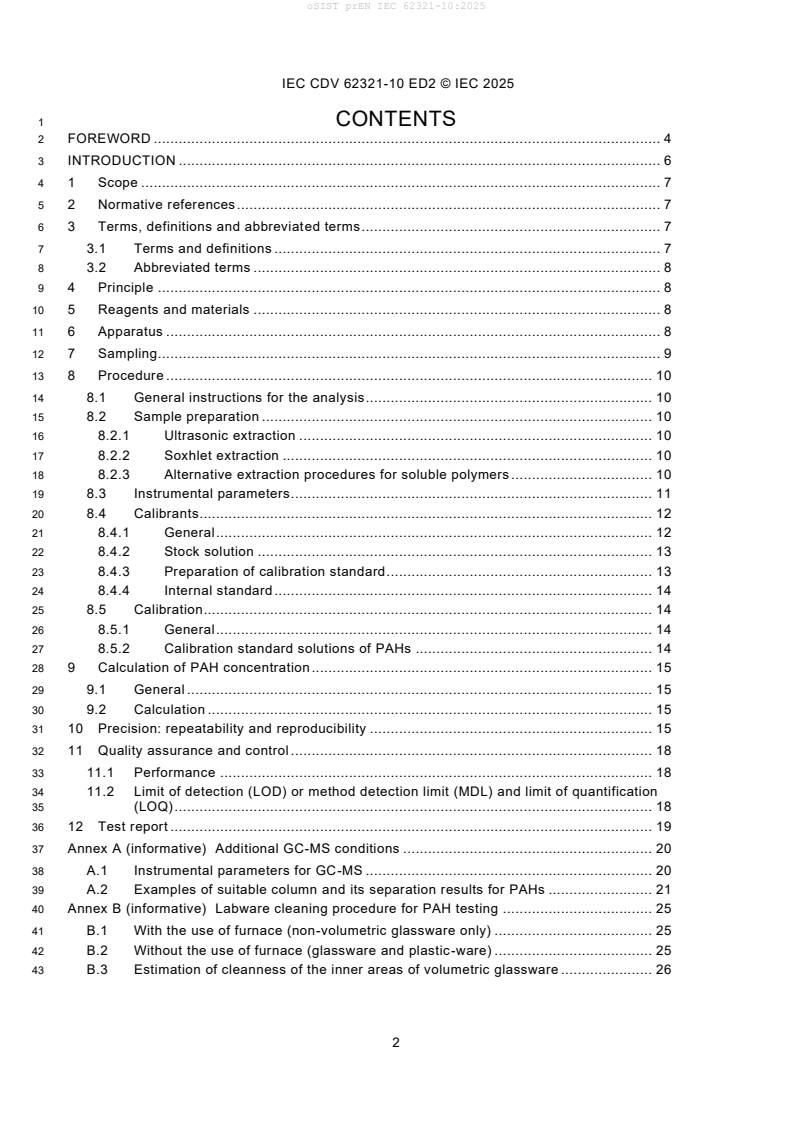
1 CONTENTS
2 FOREWORD . 4
3 INTRODUCTION . 6
4 1 Scope . 7
5 2 Normative references . 7
6 3 Terms, definitions and abbreviated terms . 7
7 3.1 Terms and definitions . 7
8 3.2 Abbreviated terms . 8
9 4 Principle . 8
10 5 Reagents and materials . 8
11 6 Apparatus . 8
12 7 Sampling. 9
13 8 Procedure . 10
14 8.1 General instructions for the analysis. 10
15 8.2 Sample preparation . 10
16 8.2.1 Ultrasonic extraction . 10
17 8.2.2 Soxhlet extraction . 10
18 8.2.3 Alternative extraction procedures for soluble polymers . 10
19 8.3 Instrumental parameters . 11
20 8.4 Calibrants. 12
21 8.4.1 General . 12
22 8.4.2 Stock solution . 13
23 8.4.3 Preparation of calibration standard. 13
24 8.4.4 Internal standard . 14
25 8.5 Calibration. 14
26 8.5.1 General . 14
27 8.5.2 Calibration standard solutions of PAHs . 14
28 9 Calculation of PAH concentration . 15
29 9.1 General . 15
30 9.2 Calculation . 15
31 10 Precision: repeatability and reproducibility . 15
32 11 Quality assurance and control . 18
33 11.1 Performance . 18
34 11.2 Limit of detection (LOD) or method detection limit (MDL) and limit of quantification
35 (LOQ) . 18
36 12 Test report . 19
37 Annex A (informative) Additional GC-MS conditions . 20
38 A.1 Instrumental parameters for GC-MS . 20
39 A.2 Examples of suitable column and its separation results for PAHs . 21
40 Annex B (informative) Labware cleaning procedure for PAH testing . 25
41 B.1 With the use of furnace (non-volumetric glassware only) . 25
42 B.2 Without the use of furnace (glassware and plastic-ware) . 25
43 B.3 Estimation of cleanness of the inner areas of volumetric glassware . 26
IEC CDV 62321-10 ED2 © IEC 2025
44 Annex C (informative) Results of international interlaboratory study of PAHs (Pre-IIS10-PAHs)
45 . 27
46 Bibliography . 30
48 Figure A.1 – Examples of total ion chromatograms of PAHs for each suitable PAH column,
49 naphthalene to benzo[ghi]perylene . 23
51 Table 1 – List of reference masses for quantification of PAHs . 11
52 Table 2 – Example list of commercially available calibration chemicals considered suitable for
53 this analysis . 12
54 Table 3 – Example list of calibration chemicals (standard solution and internal standards) for
55 this analysis . 13
56 Table 4 – Pre-IIS10-PAHs repeatability and reproducibility . 15
57 Table A.1 – Instrument parameters for GC-MS . 20
58 Table A.2 – Examples of suitable columns and its separation conditions/parameters for PAHs
59 21
60 Table A.3 – Information of each PAH substance and numbers of aromatic rings . 23
61 Table C.1 – Statistical data for GC-MS (Pre-IIS10-PAHs) . 27
62 Table C.2 – Samples information of Pre-IIS10-PAHs . 28
IEC CDV 62321-10 ED2 © IEC 2025
65 INTERNATIONAL ELECTROTECHNICAL COMMISSION
66 ____________
68 DETERMINATION OF CERTAIN SUBSTANCES
69 IN ELECTROTECHNICAL PRODUCTS –
71 Part 10: Polycyclic aromatic hydrocarbons (PAHs) in polymers and electronics
72 by gas chromatography-mass spectrometry (GC-MS)
74 FOREWORD
75 1) The International Electrotechnical Commission (IEC) is a worldwide organization for standardization comprising all national
76 electrotechnical committees (IEC National Committees). The object of IEC is to promote international co -operation on all
77 questions concerning standardization in the electrical and electronic fields. To this end and in addition to other activities ,
78 IEC publishes International Standards, Technical Specifications, Technical Reports, Publicly Available Specifications (PAS)
79 and Guides (hereafter referred to as "IEC Publication(s)"). Their preparation is entrusted to technical committees; any IEC
80 National Committee interested in the subject dealt with may participate in this preparatory work. International, governmental
81 and non-governmental organizations liaising with the IEC also participate in this preparation. IEC collaborates closely with
82 the International Organization for Standardization (ISO) in accordance with conditions determined by agreement between
83 the two organizations.
84 2) The formal decisions or agreements of IEC on technical matters express, as nearly as possible, an international consensus
85 of opinion on the relevant subjects since each technical committee has representation from all interested IEC National
86 Committees.
87 3) IEC Publications have the form of recommendations for international use and are accepted by IEC National Committees in
88 that sense. While all reasonable efforts are made to ensure that the technical content of IEC Publications is accurate, IEC
89 cannot be held responsible for the way in which they are used or for any misinterpretation by any end user.
90 4) In order to promote international uniformity, IEC National Committees undertake to apply IEC Publications transparently to
91 the maximum extent possible in their national and regional publications. Any divergence between any IEC Publication and
92 the corresponding national or regional publication shall be clearly indicated in the latter.
93 5) IEC itself does not provide any attestation of conformity. Independent certification bodies provide conformity assessment
94 services and, in some areas, access to IEC marks of conformity. IEC is not responsible for any services carried out by
95 independent certification bodies.
96 6) All users should ensure that they have the latest edition of this publication.
97 7) No liability shall attach to IEC or its directors, employees, servants or agents including individual experts and members of
98 its technical committees and IEC National Committees for any personal injury, property damage or other damage of any
99 nature whatsoever, whether direct or indirect, or for costs (including legal fees) and expenses arising out of the publicatio n,
100 use of, or reliance upon, this IEC Publication or any other IEC Publications.
101 8) Attention is drawn to the Normative references cited in this publication. Use of the referenced publications is indispensable
102 for the correct application of this publication.
103 9) Attention is drawn to the possibility that some of the elements of this IEC Publication may be the subject of patent rights.
104 IEC shall not be held responsible for identifying any or all such patent rights.
105 International Standard IEC 62321-10 has been prepared by IEC technical committee 111:
106 Environmental standardization for electrical and electronic products and systems.
107 The changes in the 2nd ED test method compared to the existing 1st ED test method in this standard
108 are as follows:
109 The extraction solvent was changed from "DCM (dichloromethane)" to "Toluene", which was revised to
110 change it from the DCM solvent, which is harmful to the human body internationally, to a relatively safe
111 extraction solvent.
112 The text of this International Standard is based on the following documents:
FDIS Report on voting
111/***/FDIS 111/***/RVD
IEC CDV 62321-10 ED2 © IEC 2025
114 Full information on the voting for the approval of this International Standard can be found in the report
115 on voting indicated in the above table.
116 This document has been drafted in accordance with the ISO/IEC Directives, Part 2.
117 A list of all parts in the IEC 62321 series published under the general title Determination of certain
118 substances in electrotechnical products can be found on the IEC website.
119 The committee has decided that the contents of this document will remain unchanged until the stability
120 date indicated on the IEC website under "http://webstore.iec.ch" in the data related to the specific
121 document. At this date, the document will be
122 • reconfirmed,
123 • withdrawn,
124 • replaced by a revised edition, or
125 • amended.
IEC CDV 62321-10 ED2 © IEC 2025
128 INTRODUCTION
129 The widespread use of electrotechnical products has drawn increased attention to their impact on the
130 environment. In many countries this has resulted in the adoption of regulations affecting wastes,
131 substances and energy use of electrotechnical products.
132 The use of certain substances (e.g. lead (Pb), cadmium (Cd) and polybrominated diphenyl ethers
133 (PBDEs)) in electrotechnical products is a source of concern in current and proposed regional legislation.
134 The purpose of the IEC 62321 series is therefore to provide test methods that will allow the
135 electrotechnical industry to determine the levels of certain substances of concern in electrotechnical
136 products on a consistent global basis.
137 The second edition of IEC 62321-10 introduces the topics covering polycyclic aromatic hydrocarbons
138 (PAHs) in the IEC 62321 series.
139 The main purpose of this revision is to consider the possible work safety risks associated with the used
140 extraction solvents dichloromethane (used in the first edition) and toluene.
141 WARNING – Persons using this document should be familiar with normal laboratory practice.
142 This document does not purport to address all of the safety problems, if any, associated with its
143 use. It is the responsibility of the user to establish appropriate safety and health practices and
144 to ensure compliance with any national regulatory conditions.
IEC CDV 62321-10 ED2 © IEC 2025
147 DETERMINATION OF CERTAIN SUBSTANCES
148 IN ELECTROTECHNICAL PRODUCTS –
150 Part 10: Polycyclic aromatic hydrocarbons (PAHs) in polymers and electronics
151 by gas chromatography-mass spectrometry (GC-MS)
154 1 Scope
155 This part of IEC 62321 specifies one normative technique for the determination of polycyclic aromatic
156 hydrocarbons (PAHs) in polymers including rubber of electrotechnical products. These PAHs can
157 especially be found in the plastic and rubber parts of a wide range of consumer articles. They are
158 present as impurities in some of the raw materials used in the production of such articles, in particular
159 in extender oils and in carbon black. They are not added intentionally to the articles and do not perform
160 any specific function as constituents of the plastic or rubber parts.
161 The gas chromatography-mass spectrometry (GC-MS) test method is suitable for the determination of
162 polycyclic aromatic hydrocarbons (PAHs).
163 This test method has been evaluated for use with plastics and rubbers. These test methods have been
164 evaluated for use with high impact polystyrene (HIPS) containing individual PAH less than 0,5 mg/kg
165 and rubbers containing individual PAH ranging from 8 mg/kg to 221 mg/kg.
166 This horizontal standard is primarily intended for use by technical committees in the preparation of
167 standards in accordance with the principles laid down in IEC Guide 108.
168 One of the responsibilities of a technical committee is, wherever applicable, to make use of horizontal
169 standards in the preparation of its publications. The contents of this horizontal standard will not apply
170 unless specifically referred to or included in the relevant publications.
171 2 Normative references
172 The following documents are referred to in the text in such a way that some or all of their content
173 constitutes requirements of this document. For dated references, only the edition cited applies. For
174 undated references, the latest edition of the referenced document (including any amendments) applies.
175 IEC 62321-1:2013, Determination of certain substances in electrotechnical products – Part 1:
176 Introduction and overview
177 IEC 62321-2, Determination of certain substances in electrotechnical products – Part 2: Disassembly,
178 disjointment and mechanical sample preparation
179 ISO 3696, Water for analytical laboratory use – Specification and test methods
180 3 Terms, definitions and abbreviated terms
181 3.1 Terms and definitions
182 No terms and definitions are listed in this document.
183 ISO and IEC maintain terminological databases for use in standardization at the following addresses:
184 • IEC Electropedia: available at http://www.electropedia.org/
185 • ISO Online browsing platform: available at http://www.iso.org/obp
IEC CDV 62321-10 ED2 © IEC 2025
186 3.2 Abbreviated terms
ACN acrylonitrile
BaP benzo[a]pyrene
CCC continuing calibration check standard
EPA Environmental Protection Agency
EI electron ionization
GC-MS gas chromatography-mass spectrometry
HIPS high impact polystyrene
IS internal standard
IUPAC International Union of Pure and Applied Chemistry
LOD limit of detection
LOQ limit of quantification
MDL method detection limit
PAH polycyclic aromatic hydrocarbon
PTFE polytetrafluoroethylene
QC quality control
RSD relative standard deviation
SIM selected ion monitoring
TICS tentatively identified compounds
US EPA United States Environmental Protection Agency
UV ultraviolet
188 4 Principle
189 PAH compounds are quantitatively determined using ultrasonic extraction or Soxhlet extraction followed
190 by gas chromatography-mass spectrometry (GC-MS) using single (or "selected") ion monitoring (SIM).
191 5 Reagents and materials
192 Use reagents of at least analytical quality. Use only reagents with negligibly low concentrations of PAH
193 and verify by blank determinations and, if necessary, apply additional cleaning steps (for calibrants, see
194 8.4):
195 a) Helium (purity of greater than a volume fraction of 99,999 %).
196 b) Toluene (GC grade or higher).
197 c) Internal standards:
198 internal standard (to correct for injection errors, according to 8.4.2 a)), (e.g. naphthalene-d8, pyrene-
199 d10, anthracene-d10, phenanthrene-d10, benzo(a)pyrene-d12, perylene-d12), at least three internal
200 standards are preferably used to be mixed with toluene as extraction agent ;
201 NOTE The standards are acceptable when using a quadrupole-type mass spectrometer. A high-resolution mass spectrometer
202 will require the use of other suitable standard substances having a mass and elution time similar to that of the analyte (see
203 8.4). Other stock solution concentrations can be utilized providing the standard solution concentrations given in 8.5.2 Table 3
204 can be achieved.
205 6 Apparatus
206 The following items shall be used for the analysis:
207 a) 0,45 μm polytetrafluoroethylene (PTFE) filter membrane.
208 b) 1 ml, 5 ml, 10 ml, 100 ml volumetric flasks.
209 c) Aluminium foil.
210 d) Analytical balance capable of measuring accurately of 0,000 1 g.
IEC CDV 62321-10 ED2 © IEC 2025
211 e) 40 ml brown or amber vessel.
212 f) Extraction thimble (cellulose 30 ml, ID 22 mm, height 80 mm or glass fibre can also be applied).
213 g) Glass wool (for extraction thimble).
214 h) Microlitre syringe or automatic pipettes.
215 i) Mini-shaker (also known as vortexer or vortex mixer).
216 j) Pasteur pipette.
217 k) Rotary evaporator.
218 l) Soxhlet extractors:
219 – 30 ml Soxhlet extractors,
220 – 250 ml round-bottomed flasks,
221 – ground-in stopper NS 29/32,
222 – Dimroth condenser NS 29/32,
223 – boiling stones (e.g. glass pearls or Raschig rings).
224 m) Ultrasonic extractors.
225 n) Vial for GC-MS:
226 2 ml sample vials with 100 μl glass insert and a screw cap with polytetrafluoroethylene (PTFE)
227 gasket or depending on the analytical system, a comparable sample receptacle. Brown or amber
228 vessels must be used as indicated in the text of the procedure.
229 o) GC-MS:
230 A gas chromatograph with a capillary column coupled to a mass spectrometric detector (electron
231 ionization, EI) is used for the analysis. The mass spectrometric detector shall be able to perform
232 selective ion monitoring and have an upper mass range of at least 550 m/z. The use of an
233 autosampler is strongly recommended to ensure repeatability. Ferrules used shall not contain more
234 than 40 % graphite (a suitable ferrule is made of 60 % polyimide and 40 % graphite) to decrease the
235 risk that PAHs are absorbed.
236 p) GC column for PAH analysis:
237 A column length of 20 m or longer has sufficient separation efficiency for PAH compounds. An
238 example of suitable column and its separation results is given in Annex A, see Table A.21,
239 Table A.32 and Figure A.1.
240 A capillary column of medium polarity (e.g. such as DB-EUPAH and ZB-PAH-EU) is recommended.
241 The preferred dimensions are 20 m in length, 0,25 mm or 0,18 mm in internal diameter, and 0,25 μm
242 or 0,14 μm in film thickness.
243 NOTE Based on the AfPS GS 2019:01 PAK method, a nonpolar DB-5MS column is not suited for a separation of the different
244 benzofluoranthenes listed in Table 1. HT8 Column introduced in Table A.2 is also not recommended for the same reasons as
245 DB-5MS.
246 7 Sampling
247 As described in IEC 62321-2 unless indicated otherwise (e.g. "using a knife"), the sample is generally
248 cut in 2x2 mm pieces.
249 If samples are not tested immediately, they shall be stored in tightly sealed glass vessels and in a cool
250 and dark place.
251 It shall be confirmed that glassware is thoroughly cleaned and that all new materials that may come into
252 contact with the sample are checked by blank analysis that they give no interference.
253 NOTE Interferences which can affect the results can occur due to contaminations from glassware, solvents and other materials
254 that can come into contact with the sample. Such interferences will form an artifact or will increase the detector baseline.
255 Interferences can also come from components in samples that co-elute with the specific PAHs of interest.
IEC CDV 62321-10 ED2 © IEC 2025
256 8 Procedure
257 8.1 General instructions for the analysis
258 The following general instructions shall be followed:
259 The validation of the instrumentation shall include testing of potential cross contaminations between
260 sequential samples. Additional blanks or an inverted sequence of testing will help to identify cross
261 contaminations.
262 See Annex B for guidance regarding labware cleaning procedures for PAH testing.
263 To avoid decomposition of PAHs by UV light during extraction and analysis, glass equipment made from
264 brown or amber glass must be used.
265 NOTE If no brown or amber glass is available, aluminium foil can be used for protection from light.
267 8.2 Sample preparation
268 8.2.1 Ultrasonic extraction
269 The following steps shall be followed for sample extraction:
270 a) Weigh 1,00 g ± 0,01 g of the sample into a vessel, e.g. 40 ml (Clause 6 e)).
271 b) Transfer 9,9 ml of toluene (Clause 5 b)) and 100 μl of internal standard (8.4.4 c)) (100 μg/ml) to the
272 vessels (Clause 6 e)).
273 c) Place it in an ultrasonic extractor (Clause 6 l)) and sonicate it for about 1 h ± 5 min at 60 °C and
274 then allow to cool at room temperature after the extraction of the sample.
275 d) Allow the polymer to settle or filter the mixture through a 0,45 µm PTFE membrane (Clause 6 e)) if
276 the extract is turbid.
277 8.2.2 Soxhlet extraction
278 For the Soxhlet extraction step the following procedure is applied:
279 a) Quantitatively transfer 500 mg ± 10 mg of the sample into a cellulose extraction thimble (Clause
280 6 e)) for Soxhlet extraction.
281 b) Add 50 μl of the internal standard (8.4.4 c)) (100 μg/ml).
282 c) Cover the thimble with glass wool (Clause 6 g)) to prevent the sample from floating.
283 d) Approximately 120 ml of toluene is used for extraction under reflux. Allow the sample to be extracted
284 for at least 6 h with 6 to 8 cycles per hour. Shorter extraction times may result in lower recoveries
285 of the analyses.
286 e) After 6 h of reflux, the extract is concentrated to about 2 ml using a vacuum rotary evaporator (Clause
287 6 k)) and fill up to 5 ml volume with toluene.
288 f) The extract is transferred into a 2 ml GC sample/auto sample vial (Clause 6 e)) with a PTFE coated
289 seal.
290 8.2.3 Alternative extraction procedures for soluble polymers
291 As an alternative to Soxhlet extraction, ultrasonic solutions can also be used for soluble polymers,
292 following the steps described below:
293 Weigh 500 mg ± 10 mg of sample and transfer it into in 40 ml vessel (Clause 6 e)). Record the mass to
294 the nearest 0,1 mg.
295 Add 50 µl of internal standard (8.4.4 c)) (100 µg/ml).
296 Transfer 10 ml of toluene to the vial.
IEC CDV 62321-10 ED2 © IEC 2025
297 Tightly capped vial was placed in an ultrasonic bath and sonicate it for 1 h until the plastic sample was
298 completely dissolved.
299 After the sample is dissolved, allow the vial to cool to ambient temperature.
300 Add accurately 20 ml of ACN drop wise into the vial to precipitate the sample matrix.
301 Centrifuge the vial at 4 000 r/min for 5 min.
302 Filter the supernatant liquid through a 0,45 μm PTFE filter (Clause 6 a)) and transferred into a conical
303 tube.
304 Evaporate the filtrate to dryness at 45 °C, and the residue was dissolved in 5 ml of toluene.
305 If the concentration is high, dilute appropriately before use.
306 NOTE Concentration might be adapted if it is too high.
308 8.3 Instrumental parameters
309 Different conditions might be necessary to optimize a specific GC-MS system to achieve effective
310 separation of all calibration congeners and meet the QC and limits of detection (LOD) requirements.
311 The following parameters have been found suitable and are provided as an example:
312 a) GC column: a column length of approximately 20 m or longer has sufficient separation efficiency for
313 PAH compounds (see Clause A.2 for an example of suitable column and its separation results). For
314 the capillary column, 5 % phenyl, 95 % methyl polysiloxane (e.g. such as DB-EUPAH and ZB-PAH-
315 EU) is recommended. The preferred dimensions are length 20 m, internal diameter 0,25 mm or
316 0,18 mm, and film thickness 0,25 μm or 0,14 μm.
317 b) Carrier: helium (see Clause 5 a)), 1,0 ml/min, constant flow.
318 c) Oven: 50 °C (initial temperature), 300 °C (final temperature), 10 °C/min ramp to 300 °C.
319 d) Injection temperature: 280 °C.
320 e) Injection volume: 1 μl.
321 A full scan run using a total ion current ("full scan") MS method for each sample is also recommended
322 for checking for the existence of peaks/congeners not present in the calibration (tentatively identified
323 compounds or "TICS") or not seen in the SIM window. If present, identify the peak and determine the
324 class of compound (e.g. benzo[e]pyrene, benzo[a]pyrene) by evaluation of the total ion spectra.
325 Table 1 lists GC-MS parameters related to reference masses for the quantification of PAHs. Additional
326 detailed GC-MS instrument parameters are described in Table A.1.
327 Table 1 – List of reference masses for quantification of PAHs
Type of PAHs Ions (m/z) monitored in the extract Internal standard
Target ions (m/z) Qualifier ions (m/z)
Internal standard
Naphthalene-d8 136 108 137 1
Anthracene-d10 188 178 187 2
Benzo[a]pyrene-d12 264 260 265 3
Substances Usage for
quantification
Naphthalene 128 102 129 1
Acenaphthylene 152 76 151 2
Acenaphthene 154 76 153 2
Fluorene 166 83 165 2
Phenanthrene 178 76 179 2
IEC CDV 62321-10 ED2 © IEC 2025
Type of PAHs Ions (m/z) monitored in the extract Internal standard
Target ions (m/z) Qualifier ions (m/z)
Anthracene 178 89 176 2
Fluoranthene 202 101 200 2
Pyrene 202 101 200 2
Benzo[a]anthracene 228 114 226 2
Chrysene 228 114 226 2
Benzo[b]fluoranthene 252 126 253 3
Benzo[j]fluoranthene 252 126 253 3
Benzo[k]fluoranthene 252 126 253 3
Benzo[e]pyrene 252 126 253 3
Benzo[a]pyrene 252 126 253 3
Indeno[1,2,3cd]pyrene 276 138 274 3
Dibenzo[a,h]anthracene 278 139 276 3
Benzo[ghi]perylene 276 138 274 3
329 8.4 Calibrants
330 8.4.1 General
331 All PAH species from Naphthalene- to Benzo(g,h,i)perylene can be included in the calibration. The
332 availability of calibration standards for a particular PAH (e.g. benzo(a)pyrene) may vary from region to
333 region.
334 Table 2 provides an example list of typically available calibration chemicals which are suitable for this
335 analysis.
336 Table 2 – Example list of commercially available calibration chemicals
337 considered suitable for this analysis
Abbreviation Compound name CAS number Formula Molecular mass
(g/mol)
C H
ACE Acenaphthene 83-32-9 154,20
12 10
C H
ACY Acenaphthylene 208-96-8 152,20
12 8
C H
ANT Anthracene 120-12-7 178,24
14 10
C H
BaA Benzo[a]anthracene 56-55-3 228,30
18 12
C H
BaP Benzo[a]pyrene 50-32-8 252,32
20 12
C H
BeP Benzo[e]pyrene 192-97-2 252,32
20 12
C H
BbF Benzo[b]fluoranthene 205-99-2 252,32
20 12
C H
BjF Benzo[j]fluoranthene 205-82-3 252,32
20 12
C H
BkF Benzo[k]fluoranthene 207-08-9 252,32
20 12
C H
BghiP Benzo[ghi]perylene 191-24-2 276,34
22 12
C H
CHR Chrysene 218-01-9 228,30
18 12
C H
DBahA Dibenzo[a,h]anthracene 53-70-3 278,35
22 14
C H
FLU Fluoranthene 206-44-0 202,26
16 10
IEC CDV 62321-10 ED2 © IEC 2025
Abbreviation Compound name CAS number Formula Molecular mass
(g/mol)
C H
FLN Fluorene 86-73-7 166,23
13 10
C H
IcdP Indeno[1,2,3cd]pyrene 193-39-5 276,34
22 12
C H
NP Naphthalene 91-20-3 128,18
10 8
C H
PHE Phenanthrene 85-01-8 178,24
14 10
C H
PYR Pyrene 129-00-0 202,26
16 10
339 8.4.2 Stock solution
340 The following stock solutions shall be prepared:
341 a) Internal standard (to correct for injection error and to monitor analyte recovery): 100 μg/ml in toluene
342 (e.g. naphthalene-d8, anthracene-d10 and benzo[a]pyrene-d12).
343 b) A PAH solution can be utilized providing the standard solution concentrations given in Table 3 can
344 be achieved.
346 8.4.3 Preparation of calibration standard
347 a) 1 000 mg/l each standard mixed stock solution:
348 The standards of
349 Table 2 are respectively weighed to 0,1 g (100 mg) with an accuracy of 0,000 1 g, then placed in a
350 100 ml volumetric flask, dissolved in a small amount of toluene (Clause 5 b)), and measuring the
351 volume of 100 ml after they are filled up with toluene graduated to the mark and transferred to a
352 flask (Clause 6 b)) in order to well shake the mix. (If necessary, it may be homogenised
353 ultrasonically.)
354 b) Intermediate standard mixed solution of 10 mg/l for GC-MS analysis:
355 Pipet 1 ml from each stock standard solution (8.4.3 a)) into a 100 ml volumetric flask and fill with
356 toluene up to the mark.
357 c) Intermediate standard mixed solution of 1 mg/l for GC-MS analysis:
358 Pipet 1 ml from Intermediate standard mixed solution (8.4.3 a)) into a 10 ml volumetric flask and fill
359 with toluene up to the mark.
360 Table 3 – Example list of calibration chemicals (standard solution and internal standards) for
361 this analysis
Concentration PAH
0,02 0,05 0,1 0,2 0,5 1 2 5 7,5
in mg/l
Intermediate PAH-
solution (10 mg/l)
-- -- -- 200 500 1 000 2 000 5 000 7 500
in µl
Intermediate PAH-
solution (1 mg/l)
200 500 1 000 -- -- -- -- -- --
in µl
Internal standards
100 100 100 100 100 100 100 100 100
(each 100 mg/l) in µl
With Toluene to 10 ml
IEC CDV 62321-10 ED2 © IEC 2025
363 Due to the concentrations the standard range can be varied with 4 levels minimum.
365 8.4.4 Internal standard
366 a) Working internal standard mixed solution:
367 To analyse by GC-MS methods, using a naphthalene-d8, anthracene-d10 and benzo[a]pyrene-d12
368 as an internal standard.
369 b) 1 000 mg/l working internal standard mixed solution:
370 Put 0,1 g (100 mg) of three internal standards (naphthalene-d8, anthracene-d10 and
371 benzo[a]pyrene-d12) into a 100 ml volumetric flask and fill with toluene up to the mark. (If necessary,
372 ultrasonic homogenisation may be used).
373 c) 100 mg/l working internal standard mixed solution:
374 Pipet 10 ml from the 1 000 mg/l working internal standard mixed solution into a 100 ml volumetric
375 flask and fill with toluene up to the mark.
377 8.5 Calibration
378 8.5.1 General
379 Wherever possible, the solvent used for the sample and standard solutions shall be the same to avoid
380 any potential solvent effects. An internal calibration curve shall be developed for quantitative analysis.
381 At least four calibration solutions shall be prepared. Quantification is made on the basis of the
382 measurement of the specified peak areas taken from the GC chromatogram. The linear regression fit of
383 each calibration curve is required to have a relative standard deviation (RSD) of less than or equal to
384 15 % of the linear calibration function.
385 8.5.2 Calibration standard solutions of PAHs
386 For PAHs, the calibration range suggested in Table 3 may have to be modified. When establishing a
387 calibration curve for PAHs, the lower range should be set according to the instrument’s sensitivity. A
388 higher concentration may be used for the upper range to account for the generally high levels of PAHs
389 normally found in samples.
390 Formula 1, which is the form of a linear formula, can be written in the form of formula (1):
C
A
IS
C = ( − b)( )
(1)
A a
IS
392 where
393 A is the peak area of 1 PAH substance;
394 A is the peak area of the internal standard;
IS
395 C is the (intermediate) concentration of 1 PAH substance, expressed in mg/l;
396 CIS is the concentration of the internal standard, expressed in mg/l;
397 α is the slope of the line that best fits the calibration obtained in formula (2);
398 b is the y intercept or the concentration when the response factor equals 0, obtained from formula
399 (2).
IEC CDV 62321-10 ED2 © IEC 2025
400 9 Calculation of PAH concentration
401 9.1 General
402 Only determined PAH compounds over the limit of quantification shall be included in a total summation.
403 When there are no PAHs detected in the sample, the total PAHs shall be reported as a function of the
404 chemicals with the highest method detection limits. For example, if the method detection limit is 0,2
405 mg/kg for BaP and no PAHs are found in the sample, the total PAHs shall be reported as less than 0,2
406 mg/kg.
407 9.2 Calculation
408 Formula 1 does not give the final concentration as the volume of the organic solvent, the mass of the
409 sample and the volume of the extract and any dilution factor need to be taken in account. A conversion
410 factor (F) to convert the units from mg to µg is also needed. The final concentration of 1 PAH substance
411 in the sample can be calculated by using the formula 2:
𝐴 𝐶 𝑉
𝐼𝑆
𝐶 =( −𝑏)×( )× (2)
𝑓𝑖𝑛𝑎𝑙
𝐴 𝑎 𝑚
𝐼𝑆
413 where
414 Cfinal is the concentration of 1 PAH substance in sample, expressed in mg/kg;
415 V is the final extraction volume, expressed in ml;
416 m is the mass of the sample, expressed in grams;
417 NOTE The calculation example shown above is for linear regression calibration only. A separate calculation is required if
418 polynomial regression calibration is utilized.
420 10 Precision: repeatability and reproducibility
421 When the values of two independent single test results, obtained using the same method on identical
422 test material in the same laboratory by the same operator using the same equipment within a short
423 interval of time, lie within the range of the mean values cited in Table , the absolute difference between
424 the two test results obtained should not exceed the repeatability limit r and reproducibility limit R
425 deduced by statistical analysis of the international interlaboratory study PAHs (Pre-IIS10-PAHs) results
426 in more than 5 % of cases.
427 When the values of two single test results, obtained using the same method on identical test material
428 in different laboratories by different operators using different equipment, lie within the range of the
429 values cited in Table 4, the absolute difference between the two results should not be greater than the
430 reproducibility limit R by statistical analysis of interlaboratory study PAHs (Pre-IIS10-PAHs) results in
431 more than 5 % of cases.
432 Table 4 – Pre-IIS10-PAHs repeatability and reproducibility
Mean value (m) r R
Number of test
Parameter
result (N)
mg/kg mg/kg mg/kg
Naphthalene 51 0,2 0,19 1,25
Naphthalene 50 0,6 0,44 0,88
Naphthalene 50 0,6 0,15 1,29
Naphthalene 50 7,2 1,99 7,32
Acenaphthylene 48 0,0 0,00 0,00
IEC CDV 62321-10 ED2 © IEC 2025
Mean value (m) r R
Number of test
Parameter
result (N)
mg/kg mg/kg mg/kg
Acenaphthylene 50 0,5 0,23 0,65
Acenaphthylene 50 0,3 0,34 0,96
Acenaphthylene 50 8,9 5,61 15,71
Acenaphthene 50 0,0 0,04 0,12
Acenaphthene 44 0,5 0,30 0,83
Acenaphthene 50 0,4 0,64 1,80
Acenaphthene 50 12,2 4,07 11,41
Fluorene 47 0,0 0,07 0,20
Fluorene 50 0,4 0,29 0,81
Fluorene 50 1,1 0,56 1,57
Fluorene 47 41,3 7,32 20,51
Phenanthrene 50 0,1 0,17 0,48
Phenanthrene 50 0,5 0,45 1,25
Phenanthrene 50 9,1 2,19 6,14
Phenanthrene 47 238 36,87 103,25
Anthracene 50 0,0 0,00 0,00
Anthracene 50 0,4 0,16 1,23
Anthracene 50 1,9 0,29 2,24
Anthracene 47 59,9 8,48 27,24
Fluoranthene 50 0,0 0,00 0,00
Fluoranthene 50 0,5 0,13 0,41
Fluoranthene 50 5,6 0,55 4,82
Fluoranthene 50 190 18,08 125,93
Pyrene 50 0,1 0,04 0,62
Pyrene 50 0,4 0,11 0,44
Pyrene 50 22,8 3,10 18,14
Pyrene 50 151 13,94 103,04
Benz[a]anthracene 50 0,0 0,01 0,01
Benz[a]anthracene 30 0,4 0,09 0,24
Benz[a]anthracene 50 32,2 5,21 23,38
Benz[a]anthracene 50 75,0 10,19 47,31
Chrysene 50 0,0 0,02 0,02
Chrysene 38 0,4 0,05 0,19
Chrysene 47 54,4 5,16 50,99
Chrysene 50 74,3 9,87 59,17
Benzo[b]fluoranthene 44 0,0 0,00 0,00
Benzo[b]fluoranthene 44 0,4 0,19 0,46
Benzo[b]fluoranthene 44 16,8 59,36 64,58
Benzo[b]fluoranthene 41 62,3 12,33 92,08
Benzo[j]fluoranthene 41 0,0 0,00 0,00
IEC CDV 62321-10 ED2 © IEC 2025
Mean value (m) r R
Number of test
Parameter
result (N)
mg/kg mg/kg mg/kg
Benzo[j]fluoranthene 44 0,1 0,07 0,50
Benzo[j]fluoranthene 44 2,5 0,66 5,36
Benzo[j]fluoranthene 41 26,8 6,48 32,49
Benzo[k]fluoranthene 47 0,0 0,00 0,00
Benzo[k]fluoranthene 36 0,4 0,09 0,64
Benzo[k]fluoranthene 47 2,8 0,77 5,43
Benzo[k]fluoranthene 47 23,8 5,24 19,87
Benzo[b,j,k]fluoranthene 47 0,1 0,18 1,4
Benzo[b,j,k]fluoranthene 50 0,8 0,19 1,09
Benzo[b,j,k]fluoranthene 44 16,1 2,40 14,66
Benzo[b,j,k]fluoranthene 50 108 18,85 122,65
Benzo[a]pyrene 50 0,0 0,00 0,00
Benzo[a]pyrene 42 0,4 0,19 0,47
Benzo[a]pyrene 50 21,9 4,01 28,95
Benzo[a]pyrene 50 50,2 7,89 48,94
Benzo[e]pyrene 50 0,0 0,00 0,00
Benzo[e]pyrene 50 0,0 0,04 0,23
Benzo[e]pyrene 50 24,9 4,38 16,32
Benzo[e]pyrene 50 47,7 7,62 38,41
Indeno[1,2,3-cd]pyrene 50 0,0 0,00 0,00
Indeno[1,2,3-cd]pyrene 41 0,4 0,13 0,38
Indeno[1,2,3-cd]pyrene 50 3,3 0,91 4,97
Indeno[1,2,3-cd]pyrene 50 33,6 6,38 63,34
Dibenzo[a,h]anthracene 50 0,0 0,00 0,00
Dibenzo[a,h]anthracene 47 0,3 0,13 0,47
Dibenzo[a,h]anthracene 38 3,9 1,04 3,80
Dibenzo[a,h]anthracene 50 9,7 2,14 19,37
Benzo[ghi]perylene 50 0,0 0,00 0,00
Benzo[ghi]perylene 41 0,4 0,12 0,47
Benzo[ghi]perylene 50 13,3 3,95 19,19
Benzo[ghi]perylene 50 38,3 8,23 50,93
8 PAHs (s
...