


EN 50436-4:2022
(Main)Alcohol interlocks - Test methods and performance requirements - Part 4: Connection and digital interface between the alcohol interlock and the vehicle
General Information
- Abstract
This document specifies the interface between an alcohol interlock for production and aftermarket installation and a vehicle. It details the modes of electrical connections, the assignment of electrical connection lines as well as the information to be exchanged between the vehicle and the alcohol interlock. This document is applicable to alcohol interlocks for drink-driving-offender programmes (as in EN 50436 1) as well as to alcohol interlocks for general preventive use (as in EN 50436 2). This document is mainly directed at manufacturers of alcohol interlocks and at vehicle manufacturers. This document is referenced in EN 50436 7 and provides details of the preferred data bus connection suggested therein. NOTE This document describes the information exchange using a LIN or a CAN (J1939) connection.
- Status
- Published
- Publication Date
- 21-Jul-2022
- Technical Committee
- TC 220 - Alcohol interlocks
- Drafting Committee
- CLC/BTTF 116-2 - Alkohol-Interlocks
- Current Stage
- 6060 - Document made available - Publishing
- Start Date
- 22-Jul-2022
- Due Date
- 10-Aug-2022
- Completion Date
- 22-Jul-2022


Overview
EN 50436-4:2022 - "Alcohol interlocks: Connection and digital interface between the alcohol interlock and the vehicle" - defines the electrical and digital interface between alcohol interlocks (production and aftermarket) and road vehicles. The standard specifies connection modes, connector properties, signal assignments and the information exchanged over vehicle data buses. It applies to devices used in drink‑driving‑offender programmes and to alcohol interlocks for general preventive use.
Key topics and technical requirements
- Data bus support: Defines communication over LIN (Local Interconnect Network) or CAN (J1939). The vehicle acts as the LIN master; the interlock is the LIN slave. CAN/J1939 support and DBC/LDF description files are addressed.
- Connector and wiring: Requirements for connector behaviour, pin assignments and labelling to support safe, reliable installations (production and aftermarket).
- Power management: Rules for activation, deactivation, shutdown requests and options to maintain or switch off power to the interlock.
- Communication states & messaging: Defined vehicle and interlock communication states, message frames, state transitions, signal coding, validation and error handling.
- Safety & cybersecurity considerations: System safety analysis, hazard analysis (Annex C references ISO 26262), and recommendations that data exchange respects vehicle cybersecurity protocols (ISO/SAE 21434 noted).
- Testability and conformance: Test plans, LIN/CAN conformance testing and an informative test plan (Annex H, Annex G). Examples of LIN LDF, LIN 2.0/2.2 and J1939 DBC files are included as informative annexes.
- Documentation & marking: Installation documentation requirements (per EN 50436-7) and mandatory marking of interface versions and applied standards.
Applications and who uses this standard
- Alcohol interlock manufacturers - to design devices that integrate with modern vehicle buses, implement correct messaging, power handling and provide installation files (LDF/DBC).
- Vehicle manufacturers / OEMs - to implement vehicle-side LIN/CAN services, connectors and installation documentation that support aftermarket or factory-fit interlocks.
- Installers and fleet operators - to follow standardized installation procedures and ensure compatibility and safety.
- Regulators and programme managers - for procurement and compliance in offender rehabilitation and preventive safety programmes.
Related standards
- EN 50436‑1 (offender‑programme interlocks) and EN 50436‑2 (general preventive use)
- EN 50436‑7 (installation document)
- ISO 17987 series (LIN specifications)
- SAE J1939 (CAN heavy‑vehicle network)
- ISO 26262 (functional safety) - referenced for hazard analysis
- ISO/SAE 21434 (vehicle cybersecurity) - noted as relevant for secure data exchange
Keywords: EN 50436-4:2022, alcohol interlock interface, LIN, CAN J1939, vehicle data bus, LDF, DBC, installation document, alcohol interlock manufacturers, aftermarket installation.
Relations
- Effective Date
- 26-Jul-2022
- Effective Date
- 03-Feb-2026
- Effective Date
- 03-Feb-2026
- Effective Date
- 03-Feb-2026
Get Certified
Connect with accredited certification bodies for this standard

TÜV Rheinland
TÜV Rheinland is a leading international provider of technical services.

TÜV SÜD
TÜV SÜD is a trusted partner of choice for safety, security and sustainability solutions.

DEKRA Certification Inc.
DEKRA US certification services.
Sponsored listings
Frequently Asked Questions
EN 50436-4:2022 is a standard published by CLC. Its full title is "Alcohol interlocks - Test methods and performance requirements - Part 4: Connection and digital interface between the alcohol interlock and the vehicle". This standard covers: This document specifies the interface between an alcohol interlock for production and aftermarket installation and a vehicle. It details the modes of electrical connections, the assignment of electrical connection lines as well as the information to be exchanged between the vehicle and the alcohol interlock. This document is applicable to alcohol interlocks for drink-driving-offender programmes (as in EN 50436 1) as well as to alcohol interlocks for general preventive use (as in EN 50436 2). This document is mainly directed at manufacturers of alcohol interlocks and at vehicle manufacturers. This document is referenced in EN 50436 7 and provides details of the preferred data bus connection suggested therein. NOTE This document describes the information exchange using a LIN or a CAN (J1939) connection.
This document specifies the interface between an alcohol interlock for production and aftermarket installation and a vehicle. It details the modes of electrical connections, the assignment of electrical connection lines as well as the information to be exchanged between the vehicle and the alcohol interlock. This document is applicable to alcohol interlocks for drink-driving-offender programmes (as in EN 50436 1) as well as to alcohol interlocks for general preventive use (as in EN 50436 2). This document is mainly directed at manufacturers of alcohol interlocks and at vehicle manufacturers. This document is referenced in EN 50436 7 and provides details of the preferred data bus connection suggested therein. NOTE This document describes the information exchange using a LIN or a CAN (J1939) connection.
EN 50436-4:2022 is classified under the following ICS (International Classification for Standards) categories: 43.040.10 - Electrical and electronic equipment; 71.040.40 - Chemical analysis. The ICS classification helps identify the subject area and facilitates finding related standards.
EN 50436-4:2022 has the following relationships with other standards: It is inter standard links to EN 50436-4:2019, EN 50436-1:2014, EN 50436-7:2016, EN 50436-1:2023. Understanding these relationships helps ensure you are using the most current and applicable version of the standard.
EN 50436-4:2022 is available in PDF format for immediate download after purchase. The document can be added to your cart and obtained through the secure checkout process. Digital delivery ensures instant access to the complete standard document.
Standards Content (Sample)
SLOVENSKI STANDARD
01-september-2022
Nadomešča:
SIST EN 50436-4:2019
Alkoholne zapore - Preskusne metode in zahtevane lastnosti - 4. del: Konektor in
digitalni vmesnik med alkoholno zaporo in vozilom
Alcohol interlocks - Test methods and performance requirements - Part 4: Connection
and digital interface between the alcohol interlock and the vehicle
Alkohol-Interlocks - Prüfverfahren und Anforderungen an das Betriebsverhalten - Teil 4:
Verbindung und digitale Schnittstelle zwischen dem Alkohol-Interlock und dem Fahrzeug
Ethylotests antidémarrage - Méthodes d'essais et exigences de performance - Partie 4:
Connexion et interface numérique entre l'éthylotest antidémarrage et le véhicule
Ta slovenski standard je istoveten z: EN 50436-4:2022
ICS:
13.200 Preprečevanje nesreč in Accident and disaster control
katastrof
43.040.80 Sistemi za zaščito pri trku in Crash protection and
sistemi za zadrževanje restraint systems
potnikov
2003-01.Slovenski inštitut za standardizacijo. Razmnoževanje celote ali delov tega standarda ni dovoljeno.
EUROPEAN STANDARD EN 50436-4
NORME EUROPÉENNE
EUROPÄISCHE NORM July 2022
ICS 71.040.40; 43.040.10 Supersedes EN 50436-4:2019
English Version
Alcohol interlocks - Test methods and performance requirements
- Part 4: Connection and digital interface between the alcohol
interlock and the vehicle
Ethylotests antidémarrage - Méthodes d'essais et Alkohol-Interlocks - Prüfverfahren und Anforderungen an
exigences de performance - Partie 4: Connexion et das Betriebsverhalten - Teil 4: Verbindung und digitale
interface numérique entre l'éthylotest antidémarrage et le Schnittstelle zwischen dem Alkohol-Interlock und dem
véhicule Fahrzeug
This European Standard was approved by CENELEC on 2022-06-20. CENELEC members are bound to comply with the CEN/CENELEC
Internal Regulations which stipulate the conditions for giving this European Standard the status of a national standard without any alteration.
Up-to-date lists and bibliographical references concerning such national standards may be obtained on application to the CEN-CENELEC
Management Centre or to any CENELEC member.
This European Standard exists in three official versions (English, French, German). A version in any other language made by translation
under the responsibility of a CENELEC member into its own language and notified to the CEN-CENELEC Management Centre has the
same status as the official versions.
CENELEC members are the national electrotechnical committees of Austria, Belgium, Bulgaria, Croatia, Cyprus, the Czech Republic,
Denmark, Estonia, Finland, France, Germany, Greece, Hungary, Iceland, Ireland, Italy, Latvia, Lithuania, Luxembourg, Malta, the
Netherlands, Norway, Poland, Portugal, Republic of North Macedonia, Romania, Serbia, Slovakia, Slovenia, Spain, Sweden, Switzerland,
Türkiye and the United Kingdom.
European Committee for Electrotechnical Standardization
Comité Européen de Normalisation Electrotechnique
Europäisches Komitee für Elektrotechnische Normung
CEN-CENELEC Management Centre: Rue de la Science 23, B-1040 Brussels
© 2022 CENELEC All rights of exploitation in any form and by any means reserved worldwide for CENELEC Members.
Ref. No. EN 50436-4:2022 E
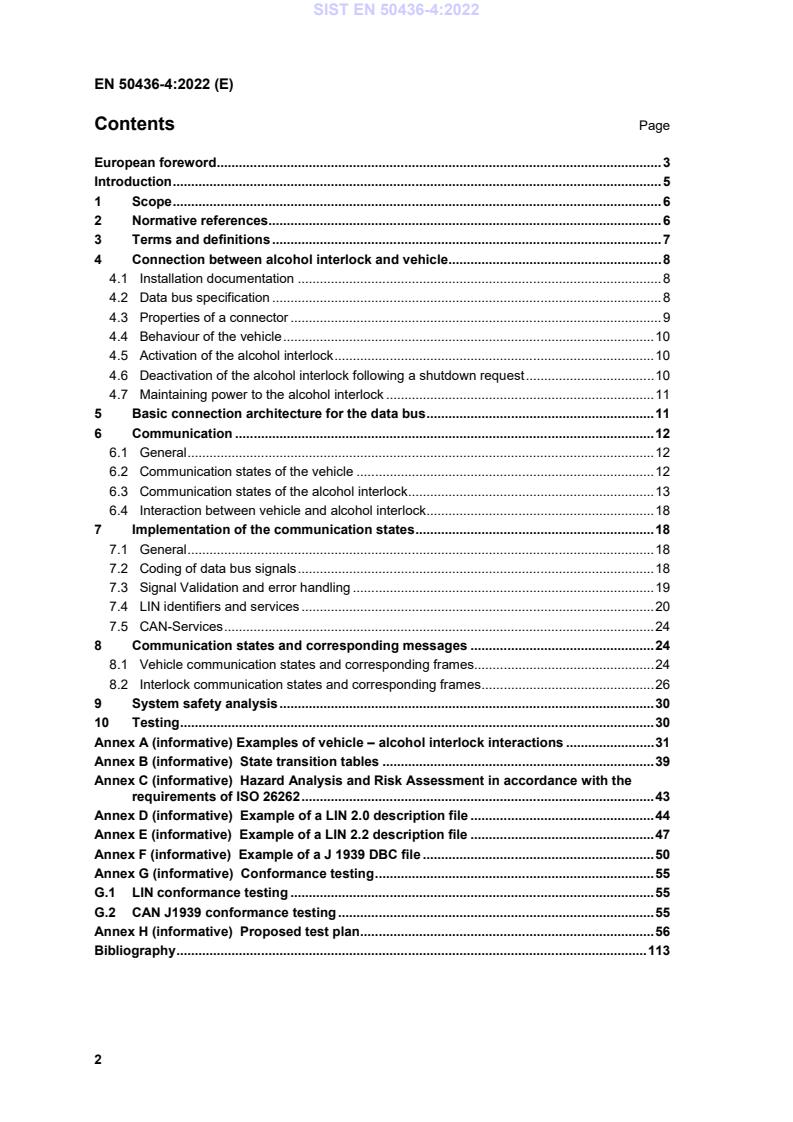
Contents Page
European foreword . 3
Introduction . 5
1 Scope . 6
2 Normative references. 6
3 Terms and definitions . 7
4 Connection between alcohol interlock and vehicle . 8
4.1 Installation documentation . 8
4.2 Data bus specification . 8
4.3 Properties of a connector . 9
4.4 Behaviour of the vehicle . 10
4.5 Activation of the alcohol interlock . 10
4.6 Deactivation of the alcohol interlock following a shutdown request . 10
4.7 Maintaining power to the alcohol interlock . 11
5 Basic connection architecture for the data bus . 11
6 Communication . 12
6.1 General . 12
6.2 Communication states of the vehicle . 12
6.3 Communication states of the alcohol interlock . 13
6.4 Interaction between vehicle and alcohol interlock . 18
7 Implementation of the communication states . 18
7.1 General . 18
7.2 Coding of data bus signals . 18
7.3 Signal Validation and error handling . 19
7.4 LIN identifiers and services . 20
7.5 CAN-Services . 24
8 Communication states and corresponding messages . 24
8.1 Vehicle communication states and corresponding frames. 24
8.2 Interlock communication states and corresponding frames . 26
9 System safety analysis . 30
10 Testing . 30
Annex A (informative) Examples of vehicle – alcohol interlock interactions . 31
Annex B (informative) State transition tables . 39
Annex C (informative) Hazard Analysis and Risk Assessment in accordance with the
requirements of ISO 26262 . 43
Annex D (informative) Example of a LIN 2.0 description file . 44
Annex E (informative) Example of a LIN 2.2 description file . 47
Annex F (informative) Example of a J 1939 DBC file . 50
Annex G (informative) Conformance testing . 55
G.1 LIN conformance testing . 55
G.2 CAN J1939 conformance testing . 55
Annex H (informative) Proposed test plan . 56
Bibliography . 113
European foreword
This document (EN 50436-4:2022) has been prepared by CLC/BTTF 116-2 “Alcohol Interlocks”.
The following dates are fixed:
• latest date by which this document has to be (dop) 2023-06-20
implemented at national level by publication of
an identical national standard or by
endorsement
• latest date by which the national standards (dow) 2025-06-20
conflicting with this document have to be
withdrawn
This document will supersede EN 50436-4:2019 and all of its amendments and corrigenda (if any).
— Clause 3, terms and definitions, definitions were added for CAN and DBC;
— Clause 4.2, the CAN data bus was added as new data bus connection;
— Clause 4.3.3, the option to switch off the power supply to the alcohol interlock was included;
— Clause 4.5, the activation of the alcohol interlock was specified;
— Clause 4.6, the deactivation of the alcohol interlock was specified;
— Clause 5, the clause was simplified and updated;
— Clause 6, the alcohol interlock communication state Service was deleted;
— Clause 7.5, the specification of CAN services was added;
— Clause 8, the clause was updated and some communication state parameters were updated and
clarified;
— Clause 9, the clause was updated;
— Clause 10, new clause was added to provide a link to the test plan in Annex H;
— Annex A, figures were updated to meet communication states;
— Annex B, tables were updated to meet new transition requirements;
— Annex C, the annex was reworked completely;
— Annex D, the annex was updated;
— Annex E, the annex was updated;
— Annex F, a sample DBC file was added as Annex;
— Annex G, the annex was updated;
— Annex H, the proposed test plan was added as an informative Annex.
Attention is drawn to the possibility that some of the elements of this document may be the subject of
patent rights. CENELEC shall not be held responsible for identifying any or all such patent rights.
Any feedback and questions on this document should be directed to the users’ national committee. A
complete listing of these bodies can be found on the CENELEC website.
Introduction
The purpose of alcohol interlocks is to enhance traffic safety by preventing persons with alcohol
concentrations exceeding a set limit value from driving a motor vehicle. The EN 50436 series specifies
test methods and essential performance requirements for alcohol interlocks and gives guidance for
decision makers, purchasers and users.
There are several areas in which alcohol interlocks may be used:
— installed in a vehicle as a general preventive measure for the promotion of traffic safety, on a
voluntary base or required legally in certain vehicles (e.g. vehicles for children transport), or
— in vehicles as ordered by a court or an administrative authority as part of a drink-driving offender
programme, or
— for persons subject to a medical or rehabilitation programme.
Alcohol interlocks are often intended for after-market installation. For this purpose they have to be
connected to the electrical circuits of the vehicle.
This installation of an alcohol interlock is expected not to interfere with the proper performance of the
vehicle, nor to impair the safety and security of the vehicle; and to be as easy and as fast as possible.
Additionally, the installation costs should be low in relation to the total cost of the alcohol interlock.
Therefore, it is desirable to have a standardised interface between alcohol interlocks and vehicles.
The alcohol interlock suppliers are expected to detail all the information that they will use/send. All used
data/information is expected to respect the cyber security protocol and rules of the vehicle.
NOTE A new standard ISO/SAE 21434 to define requirements for cybersecurity engineering is under
preparation.
All data required by the alcohol interlock from the vehicle is expected to be defined clearly and not be
transferred outside the vehicle if this digital communication is used.
1 Scope
This document specifies the interface between an alcohol interlock for production and aftermarket
installation and a vehicle. It details the modes of electrical connections, the assignment of electrical
connection lines as well as the information to be exchanged between the vehicle and the alcohol
interlock.
This document is applicable to alcohol interlocks for drink-driving-offender programmes (as in
EN 50436-1) as well as to alcohol interlocks for general preventive use (as in EN 50436-2).
This document is mainly directed at manufacturers of alcohol interlocks and at vehicle manufacturers.
This document is referenced in EN 50436-7 and provides details of the preferred data bus connection
suggested therein.
NOTE This document describes the information exchange using a LIN or a CAN (J1939) connection.
2 Normative references
The following documents are referred to in the text in such a way that some or all of their content
constitutes requirements of this document. For dated references, only the edition cited applies. For
undated references, the latest edition of the referenced document (including any amendments) applies.
EN 50436-1:2014, Alcohol interlocks — Test methods and performance requirements — Part 1:
Instruments for drink-driving-offender programs
EN 50436-2, Alcohol interlocks — Test methods and performance requirements — Part 2: Instruments
having a mouthpiece and measuring breath alcohol for general preventive use
EN 50436-7:2016, Alcohol interlocks — Test methods and performance requirements — Part 7:
Installation document
ISO 17987-1:2016, Road vehicles — Local Interconnect Network (LIN) — Part 1: General information
and use case definition
ISO 17987-2:2016, Road vehicles — Local Interconnect Network (LIN) — Part 2: Transport protocol and
network layer services
ISO 17987-3:2016, Road vehicles — Local Interconnect Network (LIN) — Part 3: Protocol specification
ISO 17987-4:2016, Road vehicles — Local Interconnect Network (LIN) — Part 4: Electrical physical
layer (EPL) specification 12 V/24 V
ISO/TR 17987-5:2016, Road vehicles — Local Interconnect Network (LIN) — Part 5: Application
programmers interface (API)
ISO 17987-6:2016, Road vehicles — Local Interconnect Network (LIN) — Part 6: Protocol conformance
test specification
ISO 17987-7:2016, Road vehicles — Local Interconnect Network (LIN) — Part 7: Electrical Physical
Layer (EPL) conformance test specification
ISO 17987-8:2019, Road vehicles — Local Interconnect Network (LIN) — Part 8: Electrical physical
layer (EPL) specification: LIN over DC powerline (DC-LIN)
SAE J1939 (series), Serial Control and Communications Heavy Duty Vehicle Network
3 Terms and definitions
For the purposes of this document, the terms and definitions given in EN 50436-1:2014 and
EN 50436-7:2016 apply.
ISO and IEC maintain terminological databases for use in standardization at the following addresses:
— IEC Electropedia: available at https://www.electropedia.org/
— ISO Online browsing platform: available at https://www.iso.org.obp
3.1
motor
includes combustion engine, electric motor or hybrid power unit
3.2
odometer
instrument that indicates the distance travelled by the vehicle
3.3
passed breath test
breath test for which the user provided an accepted breath sample having a breath alcohol concentration
below the breath alcohol concentration limit
3.4
failed breath test
breath test for which the user did not provide an accepted breath sample or has provided an accepted
breath sample with an alcohol concentration equal to or above the breath alcohol concentration limit
3.5
lockout
condition in which the alcohol interlock will not accept a breath test and thereby prevents the user from
starting the vehicle motor for a predetermined period of time
Note 1 to entry: Lockout could be required by regulatory requirements.
3.6
Local Interconnect Network
LIN
serial network protocol used for digital communication between components in vehicles
3.7
LIN description file
LDF
file that is created in the LIN cluster design and parsed in the LIN cluster generation or by debugging
tools
Note 1 to entry: It contains LIN nodes, signals, frames and schedule table and other parameters relevant for
LIN communication in a LIN network.
3.8
Controller Area Network
CAN
vehicle bus standard designed to allow microcontrollers and devices to communicate with each other in
applications without a host computer
3.9
Database Container File
DBC
CAN data description file format
Note 1 to entry: It is a text file that contains information for decoding raw CAN bus data to physical values.
3.10
ADR
1957 United Nations treaty that governs transnational transport of hazardous materials
Note 1 to entry: The treaty of 30 September 1957 concerns the International Carriage of Dangerous Goods
by Road.
4 Connection between alcohol interlock and vehicle
4.1 Installation documentation
4.1.1 Installation document of the vehicle
The installation of an alcohol interlock shall be described in an installation document according to
EN 50436-7.
All extra parts that are required for the installation of an alcohol interlock according to this document
shall be specified by at least name and part number in the referring installation document according to
EN 50436-7.
4.1.2 Labelling and marking of the alcohol interlock
In addition to the labelling and marking according to EN 50436-1:2014, the alcohol interlock shall be
marked legibly with the following minimum requirements:
— used interface or used interfaces and versions,
— used protocol version of EN 50436-4,
— reference to other applied technical standards (if applicable).
4.2 Data bus specification
4.2.1 General
The information exchange between the alcohol interlock and the vehicle shall be performed via a LIN
data bus or a CAN Data bus.
NOTE For the information exchange between the alcohol interlock and the vehicle, a gateway can be used to
adapt to the requested communication standards (LIN or CAN). Both the alcohol interlock and gateway are handled
in the following standard as single units.
4.2.2 LIN Data Bus
The LIN master is on the vehicle side.
The alcohol interlock system shall act as a LIN slave.
The LIN Master and the interlock as a LIN slave shall conform to at least one of the following
specifications: LIN Revision 2.0, LIN revision 2.1, LIN revision 2.2, LIN revision 2.2A, LIN according to
ISO 17987-1:2016, ISO 17987-2:2016, ISO 17987-3:2016, ISO 17987-4:2016, ISO/TR 17987-5:2016,
ISO 17987-6:2016, ISO 17987-7:2016, ISO 17987-8:2019 or later.
4.2.3 CAN Data Bus
The CAN data bus shall conform with the SAE J1939 series network protocol with a data rate of at least
250 kBit/s.
4.3 Properties of a connector
4.3.1 Systems using a LIN data bus
If the vehicle provides a connector at the end of cable harnesses or another specific location for the
connection to the alcohol interlock, the connector shall have at least 3 connections with the assignments
given in Table 1.
The exact type of the connector and pinout shall be specified in the installation document according to
EN 50436-7.
It is recommended to propose 6-pin connectors.
NOTE The ground pin can be separated into two independent pins within a 4 pin connector.
4.3.2 Systems using a CAN data bus
If the vehicle provides a connector at the end of cable harnesses or another specific location for the
connection to the alcohol interlock, the connector shall have at least 4 connections with the assignments
given in Table 1.
The exact type of the connector and pinout shall be specified in the installation document according to
EN 50436-7.
It is recommended to propose 6-pin connectors.
4.3.3 Minimum pin assignments
Table 1 gives the minimum pin assignments of a connector for LIN and CAN SAE J1939 series. It is to
the discretion of the manufacturer to provide one or both data bus options on the connector.
Table 1 — Minimum pin assignments of a connector for LIN and CAN SAE J1939 series
Purpose Details
Battery feed of the +9 V to + 36 V
alcohol interlock
battery feed (terminal +30)
as specified in EN 50436-7:2016, Annex C, with the exception that
in the low power consumption mode of the alcohol interlock, the
vehicle may switch off the power supply to the alcohol interlock.
Ground for the voltage 0 V
supply of the alcohol
ground (terminal −30)
interlock and
data bus ground
Data bus high LIN High (ISO 17987 series)
CAN_H CAN High (SAE J1939 series)
CAN_L CAN Low (SAE J1939 series)
NOTE 1 The sequence of pin listing is arbitrary, e.g. lines are not necessarily in adjacent cavities. The exact pin
numbering is specified in the installation document according to EN 50436-7:2016, Annex C, 3c.
NOTE 2 The ground pin can be separated into two independent pins within a 4 pin connector.
4.4 Behaviour of the vehicle
4.4.1 General
The vehicle that is equipped with an alcohol interlock which is installed according to this document shall
not enable the start of the motor or vehicle movement if it receives the information that the interlock is
in the blocking state or communication to the interlock is not possible or not plausible/unexpected.
The vehicle shall not cause a running vehicle motor to stop, even in the case of receiving a blocking
information from the interlock after a missed or a failed retest.
NOTE National regulation or special requirements can modify this requirement.
4.4.2 Installation
The vehicle shall conform to the behaviour of 4.4.1 after the first successful communication with the
alcohol interlock with a confirmed protocol validation.
The installation could require specified sequence of actions in order to install the alcohol interlock, that
shall be documented according to 4.1.
The installation procedure shall include a test that provides evidence for the successful installation of
the alcohol interlock.
4.4.3 Removal
The removal of the alcohol interlock could require a specified sequence of actions in order to remove
the alcohol interlock, that shall be documented in the installation document according to EN 50436-7.
4.5 Activation of the alcohol interlock
The alcohol interlock shall be activated when the vehicle is activated.
Vehicles that communicate with the alcohol interlock via LIN Bus shall make use of the LIN WAKE UP
procedure.
The LIN WAKE UP procedure shall not be performed by the alcohol interlock.
NOTE 1 This is not a requirement for a breath test with each activation of the vehicle.
NOTE 2 LIN WAKE UP is a procedure described in reference [1] of the bibliography.
NOTE 3 The wake up procedure for CAN systems as is required by the vehicle manufacturer is described in the
installation documentation according to EN 50436-7.
4.6 Deactivation of the alcohol interlock following a shutdown request
The alcohol interlock shall go into its low power consumption mode where it can be switched off by the
vehicle without error no longer than 10 s after the vehicle goes into its shutdown state and the alcohol
interlock has acknowledged this.
NOTE National regulations could require different timings, examples could be vehicles that comply with ADR.
Vehicles that communicate with the alcohol interlock via LIN Bus shall transmit the go to sleep command
after receiving the shutdown acknowledgement of the alcohol interlock.
The maximum time period between a not acknowledged shutdown and an acknowledged shutdown
shall be 5 min.
4.7 Maintaining power to the alcohol interlock
The vehicle shall maintain uninterrupted power for the alcohol interlock if this is requested by the alcohol
interlock.
The alcohol interlock shall only request power maintenance if the vehicle is stationary and in a service
environment.
The minimum time period during which power supply to the alcohol interlock shall be maintained after it
has entered into a communication state that requests this shall be 5 min.
After the alcohol interlock has communicated that it is in a state where power maintenance is required,
the digital connection to the vehicle could be lost e.g. due to a restart of the alcohol interlock. In such
cases the alcohol interlock shall restart by entering its initial communication state as described in 6.3.2.
NOTE Power maintenance is designed e.g. software maintenance and update, where complete resets under
power could be needed. Complete resets can cause breaks in the communication, which will not lead to a
disconnection of power if the alcohol interlock has requested power maintenance. Updates will always be type
tested and preferably be performed in a workshop environment.
5 Basic connection architecture for the data bus
There are two basic options for the connection architecture between the vehicle and the alcohol
interlock:
a) Direct connection to a LIN bus or a CAN bus of the vehicle or
b) Indirect connection to a digital bus of the vehicle via a LIN or CAN gateway.
The specifications of 4.2 apply.
The principle of the connection is shown in Figure 1.
Figure 1 — Direct connection of alcohol interlock and vehicle bus
6 Communication
6.1 General
The communication between the vehicle and the alcohol interlock shall use communication states.
Respective state transition tables are provided in Annex B.
6.2 Communication states of the vehicle
6.2.1 General
The vehicle shall have the following communication states:
a) Protocol Validation;
b) Set Mode;
c) Unset Mode;
d) Shutdown.
6.2.2 Vehicle communication state Protocol Validation
The vehicle shall be in the communication state if it requests the protocol
validation from the alcohol interlock. The communication state shall be
the initial communication state of the vehicle.
The additional entry action is:
a) the vehicle requests a protocol validation from the alcohol interlock.
The exit actions are:
b) the alcohol interlock has successfully validated the protocol;
c) the vehicle shuts down.
The vehicle shall not allow the driver to start the motor or enable the motion of the vehicle if the vehicle
is in the communication state .
6.2.3 Vehicle communication state Set Mode
The vehicle shall be in the communication state when the vehicle is in a state in which
it cannot be driven normally under its own power. This state shall last until the start of the motor or the
motion of the vehicle.
The entry actions are:
a) the interlock has authenticated itself and the vehicle cannot be driven normally under its own power;
b) transitions in accordance to 6.2.6.
The exit actions are:
c) the vehicle shuts down;
d) the vehicle goes into the state in which it can be driven normally under its own power;
e) the vehicle goes into bypass mode.
NOTE The most usual way that the vehicle goes into the state in which it can be driven normally under its own
power is that the motor is started.
6.2.4 Vehicle communication state Unset Mode
The vehicle shall be in the communication state when the vehicle is in the state in
which it can be driven normally under its own power.
The entry action is:
a) the vehicle goes into the state in which it can be driven normally under its own power;
The exit actions are:
b) the vehicle shuts down;
c) transitions in accordance to 6.2.6.
6.2.5 Vehicle communication state Shutdown
The vehicle shall feature the communication state .
The entry action is:
a) the vehicle shuts down.
The exit action is:
b) the vehicle ends its shut down procedure.
6.2.6 Transitions from Unset Mode to Set Mode
The vehicle shall enter in the communication state without supplementary action from
the driver by at least one of the following means:
a) at rotation of the ignition key into the “0” position in the ignition lock or equivalent and activation of
a door; in addition, vehicles that enter the communication state immediately
before or during the normal starting procedure of the vehicle are permitted to enter the
on turning the ignition off;
b) at a maximum of 1 min after the motor has turned off and is not in stop while the vehicle is stationary.
If there is no ignition key the equivalent to the rotation of the ignition key into the “0” position shall be
described in the installation document according to EN 50436-7.
Within the transition period from UNSET to SET, changing ignition states without starting the motor shall
not affect the timers or conditions.
6.3 Communication states of the alcohol interlock
6.3.1 General
The alcohol interlock shall have the following communication states:
a) Activated;
b) Protocol Validation;
c) Service Information;
d) Warm Up;
e) Test Request;
f) Analysing;
g) Result;
h) Wait Ignition;
i) Idle;
j) Lockout;
k) Error.
6.3.2 Alcohol interlock communication state Activated
The alcohol interlock shall feature the communication state . The communication state
shall be the initial communication state of the alcohol interlock.
The entry action is:
a) the alcohol interlock is activated.
NOTE The procedure of activating the alcohol interlock is left to the discretion of the vehicle manufacturer unless
specified elsewhere in this standard.
The exit action is:
b) the alcohol interlock receives the vehicle message request .
6.3.3 Alcohol interlock communication state Protocol Validation
The alcohol interlock shall feature the communication state .
In the communication state the alcohol interlock shall transmit protocol
related information.
The entry action is:
a) the reception of the vehicle message request .
The exit action is:
b) the vehicle message request under the condition that the protocol version is
supported.
If the protocol is not supported, the alcohol interlock shall stay in its communication state
until it receives the vehicle message request and then is
deactivated.
NOTE According to 6.3.10, the alcohol interlock always transits into the communication state after
leaving the communication state .
6.3.4 Alcohol interlock communication state Service Information
The alcohol interlock shall feature the communication state .
In the communication state the alcohol interlock transmits service related
information.
The entry action is:
a) that the alcohol interlock needs to send service information.
The exit actions are:
b) the alcohol interlock has sent the service information;
c) an error not related to a breath sample occurs;
d) the reception of the vehicle message request ;
e) the alcohol interlock receives the request.
NOTE According to 6.3.10 the alcohol interlock always transits into the communication state after
leaving the communication state .
6.3.5 Alcohol interlock communication state Warm Up
The alcohol interlock shall feature the communication state .
In the communication state the alcohol interlock transmits that it is preparing for a breath
test.
The entry action is
a) the interlock communicates that it is preparing for a breath test.
The exit actions are:
b) the alcohol interlock is prepared for a breath test;
c) an error not related to a breath sample occurs;
d) the reception of the vehicle message request .
e) the alcohol interlock receives the request.
NOTE Alcohol interlocks that do not need a preparation period cannot enter the communication state
.
6.3.6 Alcohol interlock communication state Test Request
The alcohol interlock shall feature the communication state .
In the communication state the alcohol interlock requests a breath test.
The entry action is:
a) the alcohol interlock is prepared for a breath test and requests the test;
The exit actions are:
b) a breath sample was provided;
c) an error related to a breath sample occurs;
d) an error not related to a breath sample occurs;
e) the reception of the vehicle message request ,
f) the alcohol interlock receives the request.
NOTE The condition that no breath sample was provided is considered an error related to a breath sample in
the context of this clause, i.e. the expiration of the test request period.
6.3.7 Alcohol interlock communication state Analysing
The alcohol interlock shall feature the communication state .
In the communication state the alcohol interlock analyses a breath sample.
The entry actions are:
a) a breath sample was provided;
b) an error related to a breath sample occurred;
The exit actions are:
c) the result of an accepted breath sample analysis is available;
d) an error related to a breath sample is recognised;
e) an error not related to a breath sample occurred;
f) the reception of the vehicle message request ;
g) the alcohol interlock receives the request.
NOTE The condition that no breath sample was provided is considered an error related to a breath sample in
the context of this clause, i.e. the expiration of the test request period.
6.3.8 Alcohol interlock communication state Result
The alcohol interlock shall feature the communication state .
In the communication state the alcohol interlock communicates the results of the analysis.
The entry actions are:
a) the interlock has analysed an accepted breath sample;
b) the interlock has recognised the reason for an error related to a breath sample.
The exit actions are:
c) alcohol interlock has transmitted the result information;
d) an error not related to a breath sample occurred;
e) the reception of the vehicle message request ;
f) the alcohol interlock receives the request.
NOTE The condition that no breath sample was provided is considered an error related to a breath sample in
the context of this clause, i.e. the expiration of the test request period.
6.3.9 Alcohol interlock communication state Wait Ignition
The alcohol interlock shall feature the communication state .
In the communication state the alcohol interlock communicates that it waits for the
driver to start, or equivalent, the motor of the vehicle.
The entry action is the beginning or the continuation of a start or restart period.
The exit actions are:
a) the start, or equivalent, of the motor;
b) the end of the start or restart period;
c) an error not related to a breath sample occurs;
d) the reception of the vehicle message request ;
e) the alcohol interlock receives the request.
6.3.10 Alcohol interlock communication state Idle
The alcohol interlock shall feature the communication state .
In the communication state the alcohol interlock communicates that it is idle, which means that
the alcohol interlock does not request a specific action like e.g. the provision of a breath sample, but
nevertheless is operational. In the communication state the alcohol interlock can additionally
communicate certain general parameters. The alcohol interlock may also be in the communication state
while being serviced.
The entry actions are:
a) leaving the state ;
b) leaving the state ;
c) leaving the state ;
d) leaving the state ;
e) leaving the state ;
f) leaving the state ;
g) the alcohol interlock receives the request.
The exit actions are:
h) the preparation for a breath test;
i) the alcohol interlock is prepared and requests a breath test;
j) the beginning or the continuation of a start or restart period;
k) the alcohol interlock goes into lockout;
l) an error not related to a breath sample occurs;
m) entering the state ;
n) the reception of the vehicle message request ;
o) the alcohol interlock is deactivated.
If the alcohol interlock is in the communication state after the reception of a
message from the vehicle, it shall indicate whether it is ready to enter the low power consumption state
where the power may be switched off in total by the vehicle.
NOTE An option for the alcohol interlock to be deactivated is for it to enter low power consumption mode.
6.3.11 Alcohol interlock communication state Lockout
The alcohol interlock shall feature the communication state .
In the communication state the alcohol interlock shall communicate that it is in the lockout
state.
The entry action is:
a) the alcohol interlock goes into lockout state.
The exit actions are:
b) the alcohol interlock leaves the lockout state;
c) an error not related to a breath sample occurs;
d) the reception of the vehicle message request ;
e) the alcohol interlock receives the request.
6.3.12 Alcohol interlock communication state Error
The alcohol interlock shall feature the communication state .
In the communication state the alcohol interlock shall communicate that an error not related
to a breath sample has occurred, provided the interlock is operational (in the sense that it can
communicate the error).
The entry action is:
a) the occurrence of a detected error.
The exit actions are:
b) the disappearance of the error;
c) the reception of the vehicle message request ;
d) the alcohol interlock receives the request.
6.4 Interaction between vehicle and alcohol interlock
When using a vehicle with an alcohol interlock a certain sequence of operational events will occur. A
typical example is shown in Annex A.
7 Implementation of the communication states
7.1 General
The communication states shall be implemented such that the signals and messages can be transmitted
using the Local Interconnect Network (LIN) or Controller Area Network (CAN) serial network protocol.
7.2 Coding of data bus signals
7.2.1 General
Data bus signals shall have a data length of 8 bytes.
Vehicle request and interlock response message shall be transmitted at least every 200 ms to allow
useful communication. Messages shall not be transmitted more frequently than every 20 ms to avoid an
inadequate bus traffic.
Frames are sent with unchanged contents until a state transition occurs.
7.2.2 Vehicle to alcohol interlock
The message request from the vehicle to the alcohol interlock shall consist of 8 bytes of data as given
in Table 2.
The first byte Data 1 shall be the status byte that contains the value that represents the vehicle
communication state.
The second to the eighth byte Data 2 to Data 8 shall contain additional information as payload or be set
to 0xFF.
Table 2 — Structure of a frame from the vehicle to the alcohol interlock
Status Payload
Data 1 Data 2 Data 3 Data 4 Data 5 Data 6 Data 7 Data 8
payload payload payload payload payload payload payload
Status
byte 1 byte 2 byte 3 byte 4 byte 5 byte 6 byte 7
7.2.3 Alcohol interlock to vehicle
The message response from the alcohol interlock to the vehicle shall consist of 8 bytes of data as given
in Table 3.
The first byte Data 1 shall be the status byte that contains the value that represents the interlock
communication state.
The second and the third byte Data 2 and Data 3 shall provide the blocking information coded as little-
endian.
The fourth to the eighth byte Data 4 to Data 8 shall contain additional information as payload or be set
to 0xFF.
Table 3 — Structure of a frame from the alcohol interlock to the vehicle
Status Payload
Data 1 Data 2 Data 3 Data 4 Data 5 Data 6 Data 7 Data 8
Blocking Blocking payload payload payload payload payload
Status
byte 1 byte 2 byte 1 byte 2 byte 3 byte 4 byte 5
7.3 Signal Validation and error handling
7.3.1 General
Reserved signal values and implausible data values shall lead to the termination of the current interlock
communication process by the vehicle, unless specified differently. After termination the interlock
communication process shall restart. The interlock shall check the consistency of the interlock
communication process.
7.3.2 Bus Wake up
The alcohol interlock shall not wake up the data bus of the vehicle.
7.3.3 Restart by the vehicle
A restart of the communication process without an electrical restart of the alcohol interlock, i.e. without
switching the support lines of the alcohol interlock off and on again, is performed by the vehicle by
entering its communication state .
The alcohol interlock shall be capable to record such restarts by the vehicle in the memory of the alcohol
interlock.
NOTE The behaviour after an electrical restart of the alcohol interlock is identical to a normal start-up
procedure.
7.3.4 Restart by the alcohol interlock
A restart of the communication process is performed by the alcohol interlock by entering its initial
communication state .
The alcohol interlock shall be capable to log such restarts in the data memory.
7.4 LIN identifiers and services
7.4.1 Identifiers
Data frames for the communication between the vehicle and the interlock shall have unique identifiers.
The default identifier for data frames from the vehicle to the alcohol interlock shall be 0x3A and the
default identifier frames from the alcohol interlock to the vehicle shall be 0x3B. The default identifier for
the alcohol interlock status frame shall be 0x39.
NOTE 1 For interlock protocol communication on LIN either one schedule table can be defined containing both
messages (0x3A and 0x3B) or alternatively at least two schedule tables are defined containing request and
response message and the vehicle LIN master node is changing between those schedule tables so each message
is repeated fre
...