


EN 13481-5:2012+A1:2017
(Main + Amendment)Railway applications - Track - Performance requirements for fastening systems - Part 5: Fastening systems for slab track with rail on the surface or rail embedded in a channel
General Information
- Abstract
This European Standard is applicable to fastening systems in Categories A - D as specified in EN 13481 1:2012, 3.1, for attaching rails to the uppermost surface of concrete or asphalt slabs and for embedded rails in non-ballasted tracks with maximum axle loads and minimum curve radii in accordance with Table 1.
Table 1 - Fastening category criteria
Category
Maximum design axle load
kN Minimum curve radius
m
A 130 40
B 180 80
C 260 150
D 260 400
NOTE The maximum axle load for Categories A and B does not apply to maintenance vehicles.
The requirements apply to:
- fastening systems which act on the foot and/or web of the rail including direct fastening systems and indirect fastening systems;
- adhesive and mechanical fastening systems for embedded rail, but excluding rail cast into road pavements.
In track forms in which there are resiliently supported concrete elements with only one supporting element per rail (e.g. rail seat blocks or sleepers mounted in elastomeric - "boots") the concrete element and its resilient support are considered to be parts of the elastic fastening system. If the track form includes resiliently supported concrete elements with more than one supporting element per rail (e.g. floating slabs) those concrete elements and their resilient supports are considered to be parts of the slab and not of the fastening system.
This standard is only applicable to fastening systems for rail sections in EN 13674-1 (excluding 49E4) or EN 13674 4. It is not applicable to fastening systems for other rail sections, rigid fastening systems or special fastening systems used at bolted joints or glued joints.
This standard should only be used for type approval of complete fastening systems.
- Status
- Withdrawn
- Publication Date
- 24-Jan-2017
- Withdrawal Date
- 22-Sep-2026
- Technical Committee
- CEN/TC 256 - Railway applications
- Drafting Committee
- CEN/TC 256/SC 1/WG 17 - Fastening systems
- Current Stage
- 9960 - Withdrawal effective - Withdrawal
- Start Date
- 13-Jul-2022
- Completion Date
- 23-Sep-2026
- Directive
- Not Harmonized2008/57/EC - DIRECTIVE 2008/57/EC OF THE EUROPEAN PARLIAMENT AND OF THE COUNCIL of 17 June 2008 on the interoperability of the rail system within the Community (Recast)OJ Ref: C, C 435 OJ Date: 15-Dec-2017

Relations
- Effective Date
- 18-Jan-2023
- Effective Date
- 18-May-2016
- Effective Date
- 20-Jul-2022
- Effective Date
- 28-Jan-2026
- Effective Date
- 28-Jan-2026
- Effective Date
- 28-Jan-2026
- Effective Date
- 28-Jan-2026
- Effective Date
- 28-Jan-2026
- Effective Date
- 28-Jan-2026
- Effective Date
- 28-Jan-2026
- Effective Date
- 28-Jan-2026
- Effective Date
- 28-Jan-2026
- Effective Date
- 28-Jan-2026
Get Certified
Connect with accredited certification bodies for this standard

Zavod za gradbeništvo Slovenije (ZAG) - Inšpekcija
ZAG inspection body for construction products, structures, and materials.
Sponsored listings
Frequently Asked Questions
EN 13481-5:2012+A1:2017 is a standard published by the European Committee for Standardization (CEN). Its full title is "Railway applications - Track - Performance requirements for fastening systems - Part 5: Fastening systems for slab track with rail on the surface or rail embedded in a channel". This standard covers: This European Standard is applicable to fastening systems in Categories A - D as specified in EN 13481 1:2012, 3.1, for attaching rails to the uppermost surface of concrete or asphalt slabs and for embedded rails in non-ballasted tracks with maximum axle loads and minimum curve radii in accordance with Table 1. Table 1 - Fastening category criteria Category Maximum design axle load kN Minimum curve radius m A 130 40 B 180 80 C 260 150 D 260 400 NOTE The maximum axle load for Categories A and B does not apply to maintenance vehicles. The requirements apply to: - fastening systems which act on the foot and/or web of the rail including direct fastening systems and indirect fastening systems; - adhesive and mechanical fastening systems for embedded rail, but excluding rail cast into road pavements. In track forms in which there are resiliently supported concrete elements with only one supporting element per rail (e.g. rail seat blocks or sleepers mounted in elastomeric - "boots") the concrete element and its resilient support are considered to be parts of the elastic fastening system. If the track form includes resiliently supported concrete elements with more than one supporting element per rail (e.g. floating slabs) those concrete elements and their resilient supports are considered to be parts of the slab and not of the fastening system. This standard is only applicable to fastening systems for rail sections in EN 13674-1 (excluding 49E4) or EN 13674 4. It is not applicable to fastening systems for other rail sections, rigid fastening systems or special fastening systems used at bolted joints or glued joints. This standard should only be used for type approval of complete fastening systems.
This European Standard is applicable to fastening systems in Categories A - D as specified in EN 13481 1:2012, 3.1, for attaching rails to the uppermost surface of concrete or asphalt slabs and for embedded rails in non-ballasted tracks with maximum axle loads and minimum curve radii in accordance with Table 1. Table 1 - Fastening category criteria Category Maximum design axle load kN Minimum curve radius m A 130 40 B 180 80 C 260 150 D 260 400 NOTE The maximum axle load for Categories A and B does not apply to maintenance vehicles. The requirements apply to: - fastening systems which act on the foot and/or web of the rail including direct fastening systems and indirect fastening systems; - adhesive and mechanical fastening systems for embedded rail, but excluding rail cast into road pavements. In track forms in which there are resiliently supported concrete elements with only one supporting element per rail (e.g. rail seat blocks or sleepers mounted in elastomeric - "boots") the concrete element and its resilient support are considered to be parts of the elastic fastening system. If the track form includes resiliently supported concrete elements with more than one supporting element per rail (e.g. floating slabs) those concrete elements and their resilient supports are considered to be parts of the slab and not of the fastening system. This standard is only applicable to fastening systems for rail sections in EN 13674-1 (excluding 49E4) or EN 13674 4. It is not applicable to fastening systems for other rail sections, rigid fastening systems or special fastening systems used at bolted joints or glued joints. This standard should only be used for type approval of complete fastening systems.
EN 13481-5:2012+A1:2017 is classified under the following ICS (International Classification for Standards) categories: 93.100 - Construction of railways. The ICS classification helps identify the subject area and facilitates finding related standards.
EN 13481-5:2012+A1:2017 has the following relationships with other standards: It is inter standard links to EN 13481-5:2012, EN 13481-5:2012/FprA1:2016, EN 13481-5:2022, EN 13146-9:2009+A1:2011, EN 13146-4:2012, EN 13230-1:2009, EN 13146-1:2012, EN 13146-6:2012, EN ISO 22074-3:2024, EN 13674-1:2011, EN 13146-8:2012, EN 13146-5:2012, EN 13481-1:2012. Understanding these relationships helps ensure you are using the most current and applicable version of the standard.
EN 13481-5:2012+A1:2017 is associated with the following European legislation: EU Directives/Regulations: 2008/57/EC; Standardization Mandates: M/483. When a standard is cited in the Official Journal of the European Union, products manufactured in conformity with it benefit from a presumption of conformity with the essential requirements of the corresponding EU directive or regulation.
EN 13481-5:2012+A1:2017 is available in PDF format for immediate download after purchase. The document can be added to your cart and obtained through the secure checkout process. Digital delivery ensures instant access to the complete standard document.
Standards Content (Sample)
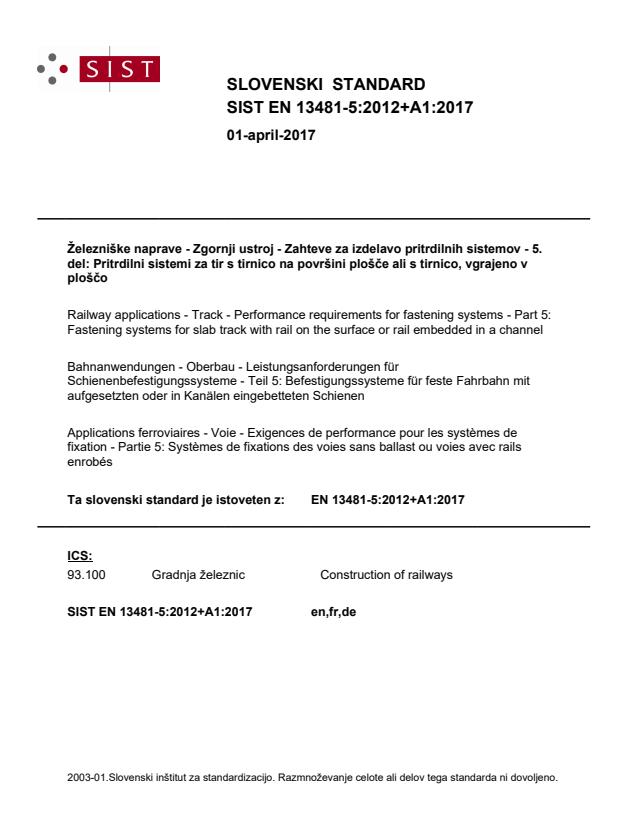
2003-01.Slovenski inštitut za standardizacijo. Razmnoževanje celote ali delov tega standarda ni dovoljeno.SORãþRBahnanwendungen - Oberbau - Leistungsanforderungen für Schienenbefestigungssysteme - Teil 5: Befestigungssysteme für feste Fahrbahn mit aufgesetzten oder in Kanälen eingebetteten SchienenApplications ferroviaires - Voie - Exigences de performance pour les systèmes de fixation - Partie 5: Systèmes de fixations des voies sans ballast ou voies avec rails enrobésRailway applications - Track - Performance requirements for fastening systems - Part 5: Fastening systems for slab track with rail on the surface or rail embedded in a channel93.100Gradnja železnicConstruction of railwaysICS:Ta slovenski standard je istoveten z:EN 13481-5:2012+A1:2017SIST EN 13481-5:2012+A1:2017en,fr,de01-april-2017SIST EN 13481-5:2012+A1:2017SLOVENSKI
STANDARD
EUROPEAN STANDARD NORME EUROPÉENNE EUROPÄISCHE NORM
EN 13481-5:2012+A1
January
t r s y ICS
{ uä s r r Supersedes EN
s u v z sæ wã t r s tEnglish Version
Railway applications æ Track æ Performance requirements for fastening systems æ Part
wã Fastening systems for slab track with rail on the surface or rail embedded in a channel Applications ferroviaires æ Voie æ Exigences de performance pour les systèmes de fixation æ Partie
wã Systèmes de fixations des voies sans ballast ou voies avec rails enrobés
Bahnanwendungen æ Oberbau æ Leistungsanforderungen für Schienenbefestigungssysteme æ Teil
wã Befestigungssysteme für feste Fahrbahn mit aufgesetzten oder in Kanälen eingebetteten SchienenThis European Standard was approved by CEN on
t y April
t r s t and includes Amendment
s approved by CEN on
w June
t r s xä
egulations which stipulate the conditions for giving this European Standard the status of a national standard without any alterationä Upætoædate lists and bibliographical references concerning such national standards may be obtained on application to the CENæCENELEC Management Centre or to any CEN memberä
translation under the responsibility of a CEN member into its own language and notified to the CENæCENELEC Management Centre has the same status as the official versionsä
CEN members are the national standards bodies of Austriaá Belgiumá Bulgariaá Croatiaá Cyprusá Czech Republicá Denmarká Estoniaá Finlandá Former Yugoslav Republic of Macedoniaá Franceá Germanyá Greeceá Hungaryá Icelandá Irelandá Italyá Latviaá Lithuaniaá Luxembourgá Maltaá Netherlandsá Norwayá Polandá Portugalá Romaniaá Serbiaá Slovakiaá Sloveniaá Spainá Swedená Switzerlandá Turkey and United Kingdomä
EUROPEAN COMMITTEE FOR STANDARDIZATION COMITÉ EUROPÉEN DE NORMALISATION EUROPÄISCHES KOMITEE FÜR NORMUNG
CEN-CENELEC Management Centre:
Avenue Marnix 17,
B-1000 Brussels
t r s y CEN All rights of exploitation in any form and by any means reserved worldwide for CEN national Membersä Refä Noä EN
s u v z sæ wã t r s t ªA sã t r s y ESIST EN 13481-5:2012+A1:2017
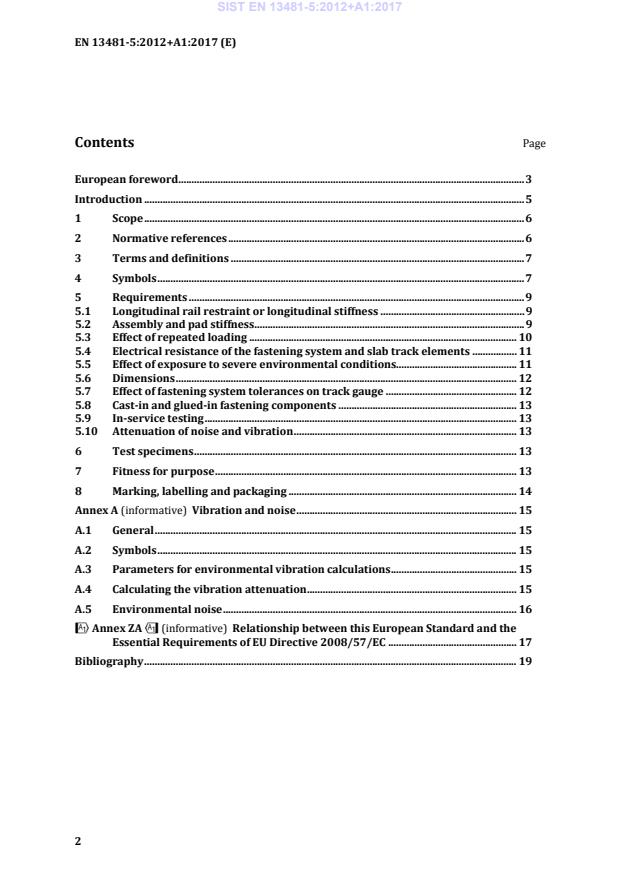
Vibration and noise . 15 A.1 General . 15 A.2 Symbols . 15 A.3 Parameters for environmental vibration calculations . 15 A.4 Calculating the vibration attenuation . 15 A.5 Environmental noise . 16 !Annex ZA" (informative)
Relationship between this European Standard and the Essential Requirements of EU Directive 2008/57/EC . 17 Bibliography . 19
Maximum design axle load kN Minimum curve radius m A 130 40 B 180 80 C 260 150 D 260 400 NOTE The maximum axle load for Categories A and B does not apply to maintenance vehicles. The requirements apply to: — fastening systems which act on the foot and/or web of the rail including direct fastening systems and indirect fastening systems; — adhesive and mechanical fastening systems for embedded rail, but excluding rail cast into road pavements. In track forms in which there are resiliently supported concrete elements with only one supporting element per rail (e.g. rail seat blocks or sleepers mounted in elastomeric “boots”) the concrete element and its resilient support are considered to be parts of the elastic fastening system. If the track form includes resiliently supported concrete elements with more than one supporting element per rail (e.g. floating slabs) those concrete elements and their resilient supports are considered to be parts of the slab and not of the fastening system. This standard is only applicable to fastening systems for rail sections in EN 13674-1 (excluding 49E4) or EN 13674-4. It is not applicable to fastening systems for other rail sections, rigid fastening systems or special fastening systems used at bolted joints or glued joints. This standard should only be used for type approval of complete fastening systems." 2 Normative references The following documents, in whole or in part, are normatively referenced in this document and are indispensable for its application. For dated references, only the edition cited applies. For undated references, the latest edition of the referenced document (including any amendments) applies. EN 13146-1:2012, Railway applications — Track — Test methods for fastening systems — Part 1: Determination of longitudinal restraint EN 13146-4:2012, Railway applications — Track — Test methods for fastening systems — Part 4: Effect of repeated loading SIST EN 13481-5:2012+A1:2017
angle between the load line and a line normal to the running surface of the rails as shown in Figure 1, in °. NOTE α==tαnVLPPVL SIST EN 13481-5:2012+A1:2017
Key 1 line of load application 2 centre of gauge corner radius Figure 1 — Load application position 5 Requirements 5.1 Longitudinal rail restraint or longitudinal stiffness For discrete fastening systems, the longitudinal rail restraint shall be not less than 7 kN when measured by the procedure in EN 13146-1. For use in category D tracks (> 250 km/h), the longitudinal rail restraint shall be not less than 9 kN. For embedded rail with an adhesive fastening system, the longitudinal stiffness kL shall be measured in accordance with EN 13146-1, between 0 mm and 7 mm (i.e. Dr = 7) relative displacement per equivalent length of support without visible damage. On structures such as long bridges, the longitudinal force transmitted between the track and the structure may be calculated by the method in EN 1991-2. The value of Fmax measured in accordance with EN 13146-1 may be used in the calculation. In such cases and subject to agreement between the purchaser and manufacturer, the minimum requirement for longitudinal restraint may be reduced. 5.2 Assembly and pad stiffness As required by EN 13146-4, the assembly static stiffness and assembly low frequency dynamic stiffness shall be measured in accordance with EN 13146-9+A1. Measurement of the rail pad static stiffness is required at the purchaser’s discretion in accordance with EN 13146-8. If the purchaser requires any of the following it shall be measured in accordance with EN 13146-9+A1: — pad low frequency dynamic stiffness; SIST EN 13481-5:2012+A1:2017
...