


EN 15470:2007
(Main)Liquefied petroleum gases - Determination of dissolved residues - High temperature Gas chromatographic method
General Information
- Abstract
This European Standard specifies a method for determining the dissolved residual matter in liquefied petroleum gases (LPG), in the range of 40 mg/kg to 100 mg/kg. Higher concentrations can be determined by adjusting the sample size.
The dissolved residue is the amount of organic compounds that are detectable by gas chromatography after evaporation of the sample at ambient temperature and then in an oven at 105 °C.
This method is not suitable for detecting solid materials or for possibly high molecular weight polymers
(> 1 000 g).
The advantages of this method are that a small quantity of LPG (50 g to 75 g) is required and the qualitative data available may indicate the origin of the residues (gas-oil, lubricants, plasticizers, etc.).
This method has been developed as a potential replacement of the commonly used method described in EN ISO 13757 [1], but is safer and more environmentally friendly. In addition, this new method is more accurate.
The precision data of the method have been determined from 20 mg/kg to 100 mg/kg. For a higher content of residue, the precision has not been tested, but remains of lesser interest as typical specifications are in the range of 20 mg/kg to 100 mg/kg.
NOTE An alternative European Standard, EN 15471 [2], specifies a gravimetric method, which has the same scope and slightly worst fidelity data.
WARNING — Use of this method involves hazardous materials and operations. It is the responsibility of the user to establish appropriate safety and health precautions. All handling must be performed in a fume hood.
- Status
- Withdrawn
- Publication Date
- 13-Nov-2007
- Withdrawal Date
- 22-Sep-2026
- Technical Committee
- CEN/TC 19 - Petroleum products, lubricants and related products
- Current Stage
- 9960 - Withdrawal effective - Withdrawal
- Start Date
- 05-Jul-2017
- Completion Date
- 23-Sep-2026

Relations
- Effective Date
- 18-Feb-2015
- Effective Date
- 28-Jan-2026
- Effective Date
- 28-Jan-2026
Get Certified
Connect with accredited certification bodies for this standard

Element Materials Technology
Materials testing and product certification.

ABS Group Brazil
ABS Group certification services in Brazil.

ABS Quality Evaluations Inc.
American Bureau of Shipping quality certification.
Sponsored listings
Frequently Asked Questions
EN 15470:2007 is a standard published by the European Committee for Standardization (CEN). Its full title is "Liquefied petroleum gases - Determination of dissolved residues - High temperature Gas chromatographic method". This standard covers: This European Standard specifies a method for determining the dissolved residual matter in liquefied petroleum gases (LPG), in the range of 40 mg/kg to 100 mg/kg. Higher concentrations can be determined by adjusting the sample size. The dissolved residue is the amount of organic compounds that are detectable by gas chromatography after evaporation of the sample at ambient temperature and then in an oven at 105 °C. This method is not suitable for detecting solid materials or for possibly high molecular weight polymers (> 1 000 g). The advantages of this method are that a small quantity of LPG (50 g to 75 g) is required and the qualitative data available may indicate the origin of the residues (gas-oil, lubricants, plasticizers, etc.). This method has been developed as a potential replacement of the commonly used method described in EN ISO 13757 [1], but is safer and more environmentally friendly. In addition, this new method is more accurate. The precision data of the method have been determined from 20 mg/kg to 100 mg/kg. For a higher content of residue, the precision has not been tested, but remains of lesser interest as typical specifications are in the range of 20 mg/kg to 100 mg/kg. NOTE An alternative European Standard, EN 15471 [2], specifies a gravimetric method, which has the same scope and slightly worst fidelity data. WARNING — Use of this method involves hazardous materials and operations. It is the responsibility of the user to establish appropriate safety and health precautions. All handling must be performed in a fume hood.
This European Standard specifies a method for determining the dissolved residual matter in liquefied petroleum gases (LPG), in the range of 40 mg/kg to 100 mg/kg. Higher concentrations can be determined by adjusting the sample size. The dissolved residue is the amount of organic compounds that are detectable by gas chromatography after evaporation of the sample at ambient temperature and then in an oven at 105 °C. This method is not suitable for detecting solid materials or for possibly high molecular weight polymers (> 1 000 g). The advantages of this method are that a small quantity of LPG (50 g to 75 g) is required and the qualitative data available may indicate the origin of the residues (gas-oil, lubricants, plasticizers, etc.). This method has been developed as a potential replacement of the commonly used method described in EN ISO 13757 [1], but is safer and more environmentally friendly. In addition, this new method is more accurate. The precision data of the method have been determined from 20 mg/kg to 100 mg/kg. For a higher content of residue, the precision has not been tested, but remains of lesser interest as typical specifications are in the range of 20 mg/kg to 100 mg/kg. NOTE An alternative European Standard, EN 15471 [2], specifies a gravimetric method, which has the same scope and slightly worst fidelity data. WARNING — Use of this method involves hazardous materials and operations. It is the responsibility of the user to establish appropriate safety and health precautions. All handling must be performed in a fume hood.
EN 15470:2007 is classified under the following ICS (International Classification for Standards) categories: 75.160.20 - Liquid fuels. The ICS classification helps identify the subject area and facilitates finding related standards.
EN 15470:2007 has the following relationships with other standards: It is inter standard links to EN 15470:2017, EN ISO 4257:2001, EN 589:2008+A1:2012. Understanding these relationships helps ensure you are using the most current and applicable version of the standard.
EN 15470:2007 is available in PDF format for immediate download after purchase. The document can be added to your cart and obtained through the secure checkout process. Digital delivery ensures instant access to the complete standard document.
Standards Content (Sample)
2003-01.Slovenski inštitut za standardizacijo. Razmnoževanje celote ali delov tega standarda ni dovoljeno.Liquefied petroleum gases - Determination of dissolved residues - Gas chromatographic methodNURPDWRJUDILMHGaz de pétrole liquéfié - Détermination des résidus dissous - Méthode par chromatographie en phase gazeuseFlüssiggase - Bestimmung des gelösten Rückstandes - Gaschromatographisches VerfahrenTa slovenski standard je istoveten z:EN 15470:2007SIST EN 15470:2008en,de75.160.30ICS:SLOVENSKI
STANDARDSIST EN 15470:200801-februar-2008
EUROPEAN STANDARDNORME EUROPÉENNEEUROPÄISCHE NORMEN 15470November 2007ICS 75.160.20 English VersionLiquefied petroleum gases - Determination of dissolved residues- High temperature Gas chromatographic methodGaz de pétrole liquéfié - Détermination des résidus dissous- Méthode par chromatographie en phase gazeuse, à hautetempératureFlüssiggase - Bestimmung der gelösten Rückstände -Hochtemperatur-Gaschromatographie-VerfahrenThis European Standard was approved by CEN on 7 October 2007.CEN members are bound to comply with the CEN/CENELEC Internal Regulations which stipulate the conditions for giving this EuropeanStandard the status of a national standard without any alteration. Up-to-date lists and bibliographical references concerning such nationalstandards may be obtained on application to the CEN Management Centre or to any CEN member.This European Standard exists in three official versions (English, French, German). A version in any other language made by translationunder the responsibility of a CEN member into its own language and notified to the CEN Management Centre has the same status as theofficial versions.CEN members are the national standards bodies of Austria, Belgium, Bulgaria, Cyprus, Czech Republic, Denmark, Estonia, Finland,France, Germany, Greece, Hungary, Iceland, Ireland, Italy, Latvia, Lithuania, Luxembourg, Malta, Netherlands, Norway, Poland, Portugal,Romania, Slovakia, Slovenia, Spain, Sweden, Switzerland and United Kingdom.EUROPEAN COMMITTEE FOR STANDARDIZATIONCOMITÉ EUROPÉEN DE NORMALISATIONEUROPÄISCHES KOMITEE FÜR NORMUNGManagement Centre: rue de Stassart, 36
B-1050 Brussels© 2007 CENAll rights of exploitation in any form and by any means reservedworldwide for CEN national Members.Ref. No. EN 15470:2007: E
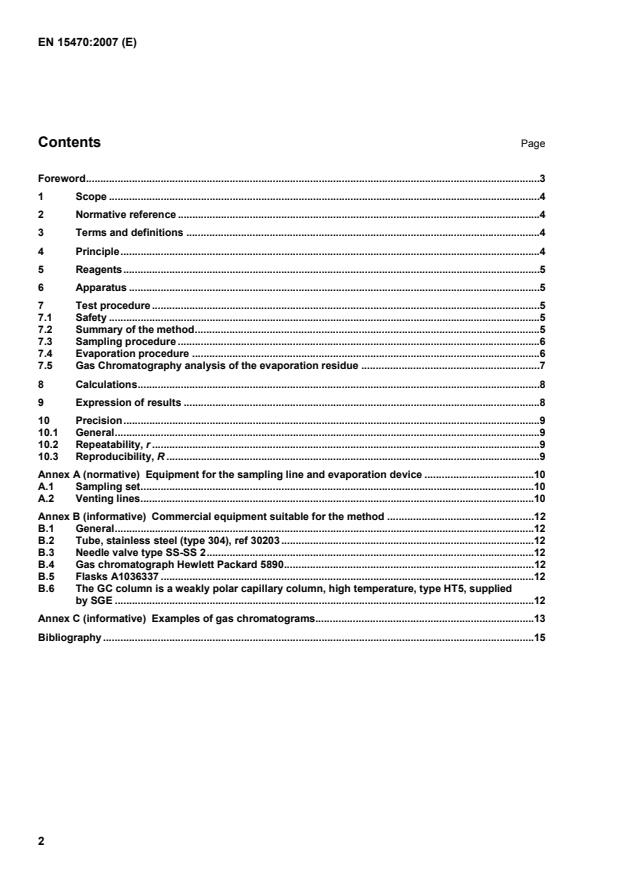
Equipment for the sampling line and evaporation device.10 A.1 Sampling set.10 A.2 Venting lines.10 Annex B (informative)
Commercial equipment suitable for the method.12 B.1 General.12 B.2 Tube, stainless steel (type 304), ref 30203.12 B.3 Needle valve type SS-SS 2.12 B.4 Gas chromatograph Hewlett Packard 5890.12 B.5 Flasks A1036337.12 B.6 The GC column is a weakly polar capillary column, high temperature, type HT5, supplied by SGE.12 Annex C (informative)
Examples of gas chromatograms.13 Bibliography.15
(> 1 000 g/mol). The advantages of this method are that a small quantity of LPG (50 g to 75 g) is required and the qualitative data available may indicate the origin of the residues (gas-oil, lubricants, plasticizers, etc.). This method has been developed as a potential replacement of the commonly used method described in EN ISO 13757 [1], but is safer and more environmentally friendly. In addition, this new method is more accurate. The precision data of the method have been determined from 20 mg/kg to 100 mg/kg. For a higher content of residue, the precision has not been tested, but remains of lesser interest as typical specifications are in the range of 20 mg/kg to 100 mg/kg. NOTE An alternative European Standard, EN 15471 [2], specifies a gravimetric method, which has the same scope and slightly worst fidelity data. WARNING — Use of this method involves hazardous materials and operations. It is the responsibility of the user to establish appropriate safety and health precautions. All handling must be performed in a fume hood. 2 Normative reference The following referenced documents are indispensable for the application of this document. For dated references, only the edition cited applies. For undated references, the latest edition of the referenced document (including any amendments) applies. EN ISO 4257, Liquefied petroleum gases - Method of sampling (ISO 4257:2001) 3 Terms and definitions For the purposes of this document, the following term and definition applies. 3.1
liquefied petroleum gas (LPG) petroleum gas that can be stored and/or handled in the liquid phase under moderate conditions of pressure and at ambient temperature, consisting predominantly of propane, butanes, with small proportions of propene, butenes and pentanes/pentenes 4 Principle A known mass of LPG, between 50 g and 75 g, is sampled and evaporated in a standard small glass flask. The residue is heated in an oven at 105 °C for 1 h. It is then diluted with a solvent and one internal standard is added. The mixture is then analyzed by a capillary gas chromatography and quantified by the internal standard method.
...