


EN 15470:2017
(Main)Liquefied petroleum gases - Determination of dissolved residues - High temperature Gas chromatographic method
General Information
- Abstract
This European Standard specifies a method for determining the dissolved residual matter in liquefied petroleum gases (LPG), in the range of 40 mg/kg to 100 mg/kg. Higher concentrations can be determined by adjusting the sample size.
The dissolved residue is the amount of organic compounds that are detectable by gas chromatography after evaporation of the sample at ambient temperature and then in an oven at 105 °C.
This method is not suitable for detecting solid materials or for possibly high molar mass polymers (>1 000 g/mol).
From the analysis of a limited LPG sample size (50 g to 75 g) this method allows obtaining information on the potential origin of the residue (gasoil, lubricants, plasticizers, etc.).
The precision data of the method have been determined from 20 mg/kg to 100 mg/kg. For a higher content of residue, the precision has not been tested.
NOTE An alternative European Standard, EN 1547113[1], specifies a gravimetric method.
WARNING - The use of this Standard can involve hazardous materials, operations and equipment. This Standard does not purport to address all of the safety problems associated with its use. It is the responsibility of users of this standard to take appropriate measures to ensure the safety and health of personnel prior to application of the standard, and fulfil statutory and regulatory requirements for this purpose.
- Status
- Published
- Publication Date
- 04-Jul-2017
- Withdrawal Date
- 30-Jan-2018
- Technical Committee
- CEN/TC 19 - Petroleum products, lubricants and related products
- Current Stage
- 9093 - Decision to confirm - Review Enquiry
- Start Date
- 17-Mar-2023
- Completion Date
- 23-Sep-2026



Overview
EN 15470:2017 - Liquefied petroleum gases (LPG) - specifies a high temperature gas chromatographic method for the determination of dissolved residues in LPG. The method quantifies organic residues detectable by gas chromatography after controlled evaporation (ambient then oven at 105 °C) and is validated for the range 40 mg/kg to 100 mg/kg (precision data determined from 20 mg/kg to 100 mg/kg). Higher residue concentrations can be measured by adjusting sample size. The method is not suitable for solids or very high molar mass polymers (>1 000 g/mol).
Key topics and technical requirements
- Sample size and sampling: typical LPG test sample 50 g to 75 g; sampling in accordance with EN ISO 4257.
- Evaporation procedure: controlled evaporation at ambient temperature followed by heating in an oven at 105 °C for 1 hour to remove volatile LPG and concentrate dissolved residues.
- Extraction and internal standard: residue is dissolved in solvent (carbon disulfide, CS2) and quantified using an internal standard (normal octane / n‑C8).
- Gas chromatography: capillary GC with high‑temperature column (suggested HT5 type programmable to 400 °C) and FID detection; integration covers peaks from n‑C8 to end of run.
- Quantification and calculation: internal standard method used to calculate evaporation residue (ER) expressed in mg/kg; blank checks and baseline stability required.
- Precision: repeatability and reproducibility established from inter-laboratory studies for residues between 20–100 mg/kg.
- Safety: work in explosion‑proof hood, control of static electricity, safe handling of volatile and hazardous reagents (CS2), adherence to statutory safety regulations.
Practical applications and users
- Quality control laboratories testing LPG batches for contamination or compliance.
- LPG producers and distributors monitoring dissolved residues that may indicate contamination with gasoil, lubricants, plasticizers or other sources.
- Regulatory bodies and certification labs performing standardized checks for fuel specifications.
- Automotive and appliance fuel testing where trace organic residues can affect performance or safety.
- Forensic or failure‑analysis teams seeking to identify potential origin of residues from small sample sizes.
Benefits: provides a repeatable, GC‑based analytical route for identifying and quantifying organic contamination in LPG and offers diagnostic insight into residue origin (e.g., lubricants or fuel oils).
Related standards
- EN 15471 - alternative gravimetric method for evaporation residues.
- EN ISO 4257 - LPG sampling method referenced by EN 15470 for correct sample collection.
Keywords: EN 15470:2017, LPG, liquefied petroleum gases, dissolved residues, high temperature gas chromatographic method, gas chromatography, internal standard, evaporation residue, residue mg/kg, fuel quality testing.
Relations
- Effective Date
- 18-Feb-2015
- Effective Date
- 28-Jan-2026
- Effective Date
- 28-Jan-2026
- Effective Date
- 28-Jan-2026
- Effective Date
- 28-Jan-2026
Get Certified
Connect with accredited certification bodies for this standard

Element Materials Technology
Materials testing and product certification.

ABS Group Brazil
ABS Group certification services in Brazil.

ABS Quality Evaluations Inc.
American Bureau of Shipping quality certification.
Sponsored listings
Frequently Asked Questions
EN 15470:2017 is a standard published by the European Committee for Standardization (CEN). Its full title is "Liquefied petroleum gases - Determination of dissolved residues - High temperature Gas chromatographic method". This standard covers: This European Standard specifies a method for determining the dissolved residual matter in liquefied petroleum gases (LPG), in the range of 40 mg/kg to 100 mg/kg. Higher concentrations can be determined by adjusting the sample size. The dissolved residue is the amount of organic compounds that are detectable by gas chromatography after evaporation of the sample at ambient temperature and then in an oven at 105 °C. This method is not suitable for detecting solid materials or for possibly high molar mass polymers (>1 000 g/mol). From the analysis of a limited LPG sample size (50 g to 75 g) this method allows obtaining information on the potential origin of the residue (gasoil, lubricants, plasticizers, etc.). The precision data of the method have been determined from 20 mg/kg to 100 mg/kg. For a higher content of residue, the precision has not been tested. NOTE An alternative European Standard, EN 1547113[1], specifies a gravimetric method. WARNING - The use of this Standard can involve hazardous materials, operations and equipment. This Standard does not purport to address all of the safety problems associated with its use. It is the responsibility of users of this standard to take appropriate measures to ensure the safety and health of personnel prior to application of the standard, and fulfil statutory and regulatory requirements for this purpose.
This European Standard specifies a method for determining the dissolved residual matter in liquefied petroleum gases (LPG), in the range of 40 mg/kg to 100 mg/kg. Higher concentrations can be determined by adjusting the sample size. The dissolved residue is the amount of organic compounds that are detectable by gas chromatography after evaporation of the sample at ambient temperature and then in an oven at 105 °C. This method is not suitable for detecting solid materials or for possibly high molar mass polymers (>1 000 g/mol). From the analysis of a limited LPG sample size (50 g to 75 g) this method allows obtaining information on the potential origin of the residue (gasoil, lubricants, plasticizers, etc.). The precision data of the method have been determined from 20 mg/kg to 100 mg/kg. For a higher content of residue, the precision has not been tested. NOTE An alternative European Standard, EN 1547113[1], specifies a gravimetric method. WARNING - The use of this Standard can involve hazardous materials, operations and equipment. This Standard does not purport to address all of the safety problems associated with its use. It is the responsibility of users of this standard to take appropriate measures to ensure the safety and health of personnel prior to application of the standard, and fulfil statutory and regulatory requirements for this purpose.
EN 15470:2017 is classified under the following ICS (International Classification for Standards) categories: 75.160.20 - Liquid fuels. The ICS classification helps identify the subject area and facilitates finding related standards.
EN 15470:2017 has the following relationships with other standards: It is inter standard links to EN 15470:2007, EN ISO 4257:2001, EN 589:2018+A1:2022, EN 589:2024, EN 589:2018. Understanding these relationships helps ensure you are using the most current and applicable version of the standard.
EN 15470:2017 is available in PDF format for immediate download after purchase. The document can be added to your cart and obtained through the secure checkout process. Digital delivery ensures instant access to the complete standard document.
Standards Content (Sample)
2003-01.Slovenski inštitut za standardizacijo. Razmnoževanje celote ali delov tega standarda ni dovoljeno.Flüssiggas - Bestimmung der gelösten Rückstände - Hochtemperatur-Gaschromatographie-VerfahrenGaz de pétrole liquéfié - Détermination des résidus dissous - Méthode par chromatographie en phase gazeuse, à haute températureLiquefied petroleum gases - Determination of dissolved residues - High temperature Gas chromatographic method75.160.30Plinska gorivaGaseous fuels71.040.50Fizikalnokemijske analitske metodePhysicochemical methods of analysisICS:Ta slovenski standard je istoveten z:EN 15470:2017SIST EN 15470:2017en,fr,de01-oktober-2017SIST EN 15470:2017SLOVENSKI
STANDARDSIST EN 15470:20081DGRPHãþD
EUROPEAN STANDARD NORME EUROPÉENNE EUROPÄISCHE NORM
EN 15470
July
t r s y ICS
y wä s x rä t r Supersedes EN
s w v y rã t r r yEnglish Version
Liquefied petroleum gases æ Determination of dissolved residues æ High temperature Gas chromatographic methodGaz de pétrole liquéfié æ Détermination des résidus dissous æ Méthode par chromatographie en phase gazeuseá à haute température
Flüssiggas æ Bestimmung der gelösten Rückstände æ HochtemperaturæGaschromatographieæVerfahren This European Standard was approved by CEN on
t v April
t r s yä
egulations which stipulate the conditions for giving this European Standard the status of a national standard without any alterationä Upætoædate lists and bibliographical references concerning such national standards may be obtained on application to the CENæCENELEC Management Centre or to any CEN memberä
translation under the responsibility of a CEN member into its own language and notified to the CENæCENELEC Management Centre has the same status as the official versionsä
CEN members are the national standards bodies of Austriaá Belgiumá Bulgariaá Croatiaá Cyprusá Czech Republicá Denmarká Estoniaá Finlandá Former Yugoslav Republic of Macedoniaá Franceá Germanyá Greeceá Hungaryá Icelandá Irelandá Italyá Latviaá Lithuaniaá Luxembourgá Maltaá Netherlandsá Norwayá Polandá Portugalá Romaniaá Serbiaá Slovakiaá Sloveniaá Spainá Swedená Switzerlandá Turkey and United Kingdomä
EUROPEAN COMMITTEE FOR STANDARDIZATION COMITÉ EUROPÉEN DE NORMALISATION EUROPÄISCHES KOMITEE FÜR NORMUNG
CEN-CENELEC Management Centre:
Avenue Marnix 17,
B-1000 Brussels
t r s y CEN All rights of exploitation in any form and by any means reserved worldwide for CEN national Membersä Refä Noä EN
s w v y rã t r s y ESIST EN 15470:2017
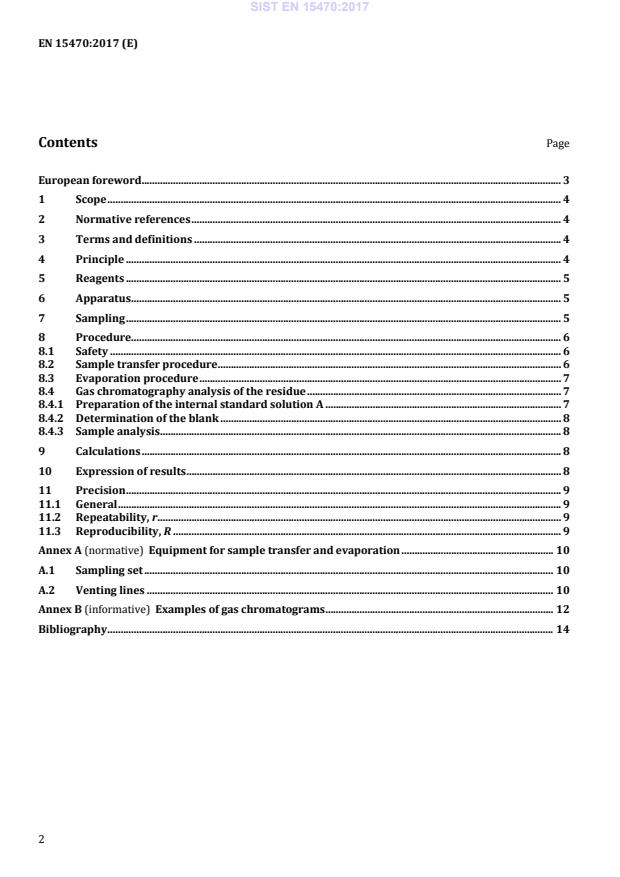
Equipment for sample transfer and evaporation . 10 A.1 Sampling set . 10 A.2 Venting lines . 10 Annex B (informative)
Examples of gas chromatograms . 12 Bibliography . 14
...