


EN 16485:2014
(Main)Round and sawn timber - Environmental Product Declarations - Product category rules for wood and wood-based products for use in construction
General Information
- Abstract
This European Standard provides general Product Category Rules (PCR) for Type III environmental declarations for wood and wood-based products for use in construction and related construction and in-service processes.
This European Standard complements the core rules for the product category of construction products as defined in EN 15804 and is intended to be used in conjunction with EN 15804.
NOTE The assessment of social and economic performances at product level is not covered by this standard.
The core PCR:
— define the parameters to be declared and the way in which they are collated and reported;
— describe which stages of a product’s life cycle are considered in the EPD and which processes are to be included in the life cycle stages;
— define rules for the development of scenarios;
— include the rules for calculating the Life Cycle Inventory and the Life Cycle Impact Assessment underlying the EPD, including the specification of the data quality to be applied;
— include the rules for reporting predetermined, environmental and health information, that is not covered by LCA for a product, construction process and construction service where necessary;
— define the conditions under which construction products can be compared based on the information provided by EPD.
For the EPD of construction services, the same rules and requirements apply as for the EPD of construction products.
Additionally to the common parts of EN 15804, this European Standard for wood and wood-based products:
— defines the system boundaries;
— defines the rules for modelling and assessment of material-specific characteristics such as carbon storage and energy content of wood;
— defines allocation procedures for multi-output processes along the wood chain;
— defines allocation procedures for reuse, recycling and energy recovery;
— includes the rules for calculating the Life Cycle Inventory and the Life Cycle Impact Assessment underlying the EPD, including the assessment of carbon and energy content of wood;
— provides guidance/specific rules for the determination of the Reference Service Life (RSL).
This European Standard is intended to be used for cradle to gate or cradle to grave assessment, provided the intention is properly stated in the system boundary description.
- Status
- Withdrawn
- Publication Date
- 25-Mar-2014
- Withdrawal Date
- 16-Sep-2026
- Technical Committee
- CEN/TC 175 - Round and sawn timber
- Drafting Committee
- CEN/TC 175/WG 5 - Environmental topics
- Current Stage
- 9960 - Withdrawal effective - Withdrawal
- Start Date
- 08-Apr-2026
- Completion Date
- 17-Sep-2026

Overview
EN 16485:2014 - "Round and sawn timber - Environmental Product Declarations (EPD) - Product category rules (PCR) for wood and wood‑based products for use in construction" - is a CEN European Standard that defines the rules for producing Type III Environmental Product Declarations for wood and wood‑based construction products. It complements the core PCR in EN 15804 and is intended to be used together with that standard to ensure consistent, comparable EPDs across the construction sector.
Key topics and requirements
- Scope and purpose: PCR for Type III EPDs covering wood and wood‑based products used in construction; social/economic assessment is excluded.
- Life cycle coverage: Guidance for producing EPDs on a cradle‑to‑gate or cradle‑to‑grave basis, with clear system boundary declarations.
- LCA rules and modules: Defines required life cycle stages and information modules (A1–A3 product stage, A4–A5 construction processes, B1–B7 use stage, C1–C4 end‑of‑life, D benefits).
- Material‑specific modelling: Rules for modelling carbon storage, energy content of wood and material‑specific characteristics.
- Allocation procedures: Procedures for multi‑output processes along the wood chain and for reuse, recycling and energy recovery.
- Reference Service Life (RSL): Guidance and specific rules for determining RSL for declared units and scenario development.
- Data and quality: Life Cycle Inventory (LCI) and Life Cycle Impact Assessment (LCIA) rules, data quality specifications, selection and exclusion criteria, and documentation requirements.
- Reporting & verification: Requirements for EPD content, additional environmental information (indoor emissions, soil/water releases), scenario descriptions, project report and third‑party verification/validity.
Applications and who uses it
- Timber and wood product manufacturers preparing verified EPDs for product marketing, green procurement or sustainability claims.
- LCA practitioners and EPD programme operators applying PCRs to ensure compliant, comparable declarations.
- Architects, specifiers and building consultants using EPD data for material selection, building LCA and sustainability assessments.
- Green building schemes and public procurers requiring standardized, verifiable environmental product information.
- Certification bodies and policy makers referencing standardized PCRs for regulation and incentive schemes.
Related standards
- EN 15804 - Core PCR for construction products (mandatory companion).
- EN ISO 14025, EN ISO 14044 - Principles for Type III EPDs and LCA requirements.
- Relevant CEN/TR and EN standards for sustainability and building LCA (e.g., EN 15978).
By following EN 16485:2014, stakeholders produce consistent, transparent EPDs for timber products that support lifecycle‑based decision making, carbon accounting and compliance with green building and procurement criteria.
Relations
- Effective Date
- 19-Jan-2023
- Effective Date
- 15-Jul-2026
- Effective Date
- 28-Jan-2026
- Effective Date
- 28-Jan-2026
- Effective Date
- 28-Jan-2026
- Effective Date
- 28-Jan-2026
- Effective Date
- 28-Jan-2026
- Effective Date
- 28-Jan-2026
Get Certified
Connect with accredited certification bodies for this standard

DIBt (Deutsches Institut für Bautechnik)
German Institute for Building Technology.
DIN CERTCO
DIN Group product certification.

Aboma Certification B.V.
Specialized in construction, metal, and transport sectors.
Sponsored listings
Frequently Asked Questions
EN 16485:2014 is a standard published by the European Committee for Standardization (CEN). Its full title is "Round and sawn timber - Environmental Product Declarations - Product category rules for wood and wood-based products for use in construction". This standard covers: This European Standard provides general Product Category Rules (PCR) for Type III environmental declarations for wood and wood-based products for use in construction and related construction and in-service processes. This European Standard complements the core rules for the product category of construction products as defined in EN 15804 and is intended to be used in conjunction with EN 15804. NOTE The assessment of social and economic performances at product level is not covered by this standard. The core PCR: — define the parameters to be declared and the way in which they are collated and reported; — describe which stages of a product’s life cycle are considered in the EPD and which processes are to be included in the life cycle stages; — define rules for the development of scenarios; — include the rules for calculating the Life Cycle Inventory and the Life Cycle Impact Assessment underlying the EPD, including the specification of the data quality to be applied; — include the rules for reporting predetermined, environmental and health information, that is not covered by LCA for a product, construction process and construction service where necessary; — define the conditions under which construction products can be compared based on the information provided by EPD. For the EPD of construction services, the same rules and requirements apply as for the EPD of construction products. Additionally to the common parts of EN 15804, this European Standard for wood and wood-based products: — defines the system boundaries; — defines the rules for modelling and assessment of material-specific characteristics such as carbon storage and energy content of wood; — defines allocation procedures for multi-output processes along the wood chain; — defines allocation procedures for reuse, recycling and energy recovery; — includes the rules for calculating the Life Cycle Inventory and the Life Cycle Impact Assessment underlying the EPD, including the assessment of carbon and energy content of wood; — provides guidance/specific rules for the determination of the Reference Service Life (RSL). This European Standard is intended to be used for cradle to gate or cradle to grave assessment, provided the intention is properly stated in the system boundary description.
This European Standard provides general Product Category Rules (PCR) for Type III environmental declarations for wood and wood-based products for use in construction and related construction and in-service processes. This European Standard complements the core rules for the product category of construction products as defined in EN 15804 and is intended to be used in conjunction with EN 15804. NOTE The assessment of social and economic performances at product level is not covered by this standard. The core PCR: — define the parameters to be declared and the way in which they are collated and reported; — describe which stages of a product’s life cycle are considered in the EPD and which processes are to be included in the life cycle stages; — define rules for the development of scenarios; — include the rules for calculating the Life Cycle Inventory and the Life Cycle Impact Assessment underlying the EPD, including the specification of the data quality to be applied; — include the rules for reporting predetermined, environmental and health information, that is not covered by LCA for a product, construction process and construction service where necessary; — define the conditions under which construction products can be compared based on the information provided by EPD. For the EPD of construction services, the same rules and requirements apply as for the EPD of construction products. Additionally to the common parts of EN 15804, this European Standard for wood and wood-based products: — defines the system boundaries; — defines the rules for modelling and assessment of material-specific characteristics such as carbon storage and energy content of wood; — defines allocation procedures for multi-output processes along the wood chain; — defines allocation procedures for reuse, recycling and energy recovery; — includes the rules for calculating the Life Cycle Inventory and the Life Cycle Impact Assessment underlying the EPD, including the assessment of carbon and energy content of wood; — provides guidance/specific rules for the determination of the Reference Service Life (RSL). This European Standard is intended to be used for cradle to gate or cradle to grave assessment, provided the intention is properly stated in the system boundary description.
EN 16485:2014 is classified under the following ICS (International Classification for Standards) categories: 91.010.99 - Other aspects; 91.080.20 - Timber structures. The ICS classification helps identify the subject area and facilitates finding related standards.
EN 16485:2014 has the following relationships with other standards: It is inter standard links to EN 16485:2026, EN ISO 14025:2026, EN ISO 14025:2010, EN 15804:2012, EN ISO 14044:2006, EN 14081-1:2016+A1:2019, EN 16810:2017, EN 14081-1:2016. Understanding these relationships helps ensure you are using the most current and applicable version of the standard.
EN 16485:2014 is available in PDF format for immediate download after purchase. The document can be added to your cart and obtained through the secure checkout process. Digital delivery ensures instant access to the complete standard document.
Standards Content (Sample)
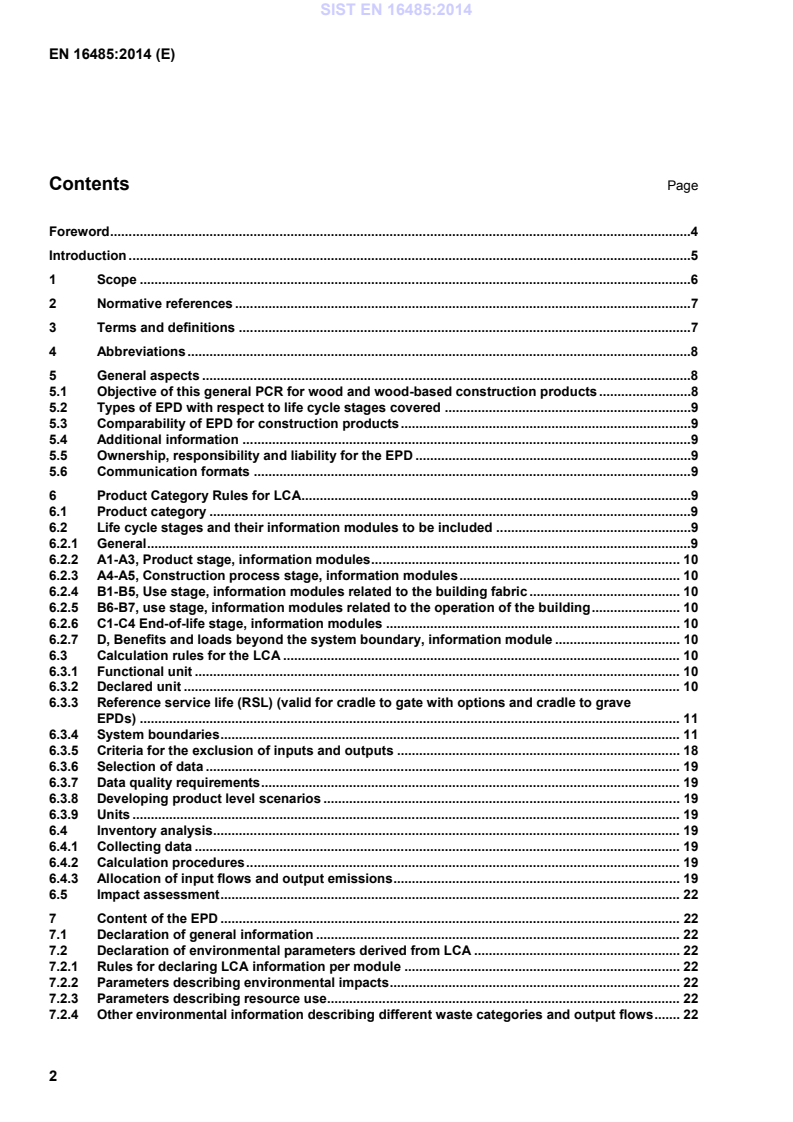
2003-01.Slovenski inštitut za standardizacijo. Razmnoževanje celote ali delov tega standarda ni dovoljeno.Okrogli in žagani les - Okoljske deklaracije za proizvode - Pravila za opredelitev vrste izdelka za les in lesne kompozite za uporabo v gradbeništvuRund- und Schnittholz - Produkt-Kategorie-Regeln für Holz und Holz-Werkstoffe zur Umwelt-Produkt-DeklarationBois ronds et sciages - Déclarations environnementales de produits - Règles de définition des catégories de produits en bois et à base de bois pour l'utilisation en constructionRound and sawn timber - Environmental Product Declarations - Product category rules for wood and wood-based products for use in construction91.080.20Lesene konstrukcijeTimber structures79.040Les, hlodovina in žagan lesWood, sawlogs and sawn timber13.020.99Drugi standardi v zvezi z varstvom okoljaOther standards related to environmental protectionICS:Ta slovenski standard je istoveten z:EN 16485:2014SIST EN 16485:2014en,fr,de01-julij-2014SIST EN 16485:2014SLOVENSKI
STANDARD
EUROPEAN STANDARD NORME EUROPÉENNE EUROPÄISCHE NORM
EN 16485
March 2014 ICS 91.010.99; 91.080.20 English Version
Round and sawn timber - Environmental Product Declarations - Product category rules for wood and wood-based products for use in construction
Bois ronds et sciages - Déclarations environnementales de produits - Règles de définition des catégories de produits en bois et à base de bois pour l'utilisation en construction
Rund- und Schnittholz - Umweltproduktdeklarationen - Produktkategorieregeln für Holz und Holzwerkstoffe im Bauwesen This European Standard was approved by CEN on 3 February 2014.
CEN members are bound to comply with the CEN/CENELEC Internal Regulations which stipulate the conditions for giving this European Standard the status of a national standard without any alteration. Up-to-date lists and bibliographical references concerning such national standards may be obtained on application to the CEN-CENELEC Management Centre or to any CEN member.
This European Standard exists in three official versions (English, French, German). A version in any other language made by translation under the responsibility of a CEN member into its own language and notified to the CEN-CENELEC Management Centre has the same status as the official versions.
CEN members are the national standards bodies of Austria, Belgium, Bulgaria, Croatia, Cyprus, Czech Republic, Denmark, Estonia, Finland, Former Yugoslav Republic of Macedonia, France, Germany, Greece, Hungary, Iceland, Ireland, Italy, Latvia, Lithuania, Luxembourg, Malta, Netherlands, Norway, Poland, Portugal, Romania, Slovakia, Slovenia, Spain, Sweden, Switzerland, Turkey and United Kingdom.
EUROPEAN COMMITTEE FOR STANDARDIZATION
COMITÉ EUROPÉEN DE NORMALISATION EUROPÄISCHES KOMITEE FÜR NORMUNG
CEN-CENELEC Management Centre:
Avenue Marnix 17,
B-1000 Brussels © 2014 CEN All rights of exploitation in any form and by any means reserved worldwide for CEN national Members. Ref. No. EN 16485:2014 ESIST EN 16485:2014
Foreword .4 Introduction .5 1 Scope .6 2 Normative references .7 3 Terms and definitions .7 4 Abbreviations .8 5 General aspects .8 5.1 Objective of this general PCR for wood and wood-based construction products .8 5.2 Types of EPD with respect to life cycle stages covered .9 5.3 Comparability of EPD for construction products .9 5.4 Additional information .9 5.5 Ownership, responsibility and liability for the EPD .9 5.6 Communication formats .9 6 Product Category Rules for LCA .9 6.1 Product category .9 6.2 Life cycle stages and their information modules to be included .9 6.2.1 General .9 6.2.2 A1-A3, Product stage, information modules . 10 6.2.3 A4-A5, Construction process stage, information modules . 10 6.2.4 B1-B5, Use stage, information modules related to the building fabric . 10 6.2.5 B6-B7, use stage, information modules related to the operation of the building . 10 6.2.6 C1-C4 End-of-life stage, information modules . 10 6.2.7 D, Benefits and loads beyond the system boundary, information module . 10 6.3 Calculation rules for the LCA . 10 6.3.1 Functional unit . 10 6.3.2 Declared unit . 10 6.3.3 Reference service life (RSL) (valid for cradle to gate with options and cradle to grave EPDs) . 11 6.3.4 System boundaries . 11 6.3.5 Criteria for the exclusion of inputs and outputs . 18 6.3.6 Selection of data . 19 6.3.7 Data quality requirements . 19 6.3.8 Developing product level scenarios . 19 6.3.9 Units . 19 6.4 Inventory analysis. 19 6.4.1 Collecting data . 19 6.4.2 Calculation procedures . 19 6.4.3 Allocation of input flows and output emissions . 19 6.5 Impact assessment . 22 7 Content of the EPD . 22 7.1 Declaration of general information . 22 7.2 Declaration of environmental parameters derived from LCA . 22 7.2.1 Rules for declaring LCA information per module . 22 7.2.2 Parameters describing environmental impacts . 22 7.2.3 Parameters describing resource use. 22 7.2.4 Other environmental information describing different waste categories and output flows . 22 SIST EN 16485:2014
The assessment of social and economic performances at product level is not covered by this standard. The core PCR: — define the parameters to be declared and the way in which they are collated and reported; — describe which stages of a product’s life cycle are considered in the EPD and which processes are to be included in the life cycle stages; — define rules for the development of scenarios; — include the rules for calculating the Life Cycle Inventory and the Life Cycle Impact Assessment underlying the EPD, including the specification of the data quality to be applied; — include the rules for reporting predetermined, environmental and health information, that is not covered by LCA for a product, construction process and construction service where necessary; — define the conditions under which construction products can be compared based on the information provided by EPD. For the EPD of construction services, the same rules and requirements apply as for the EPD of construction products. Additionally to the common parts of EN 15804, this European Standard for wood and wood-based products: — defines the system boundaries; — defines the rules for modelling and assessment of material-specific characteristics such as carbon storage and energy content of wood; — defines allocation procedures for multi-output processes along the wood chain; — defines allocation procedures for reuse, recycling and energy recovery; — includes the rules for calculating the Life Cycle Inventory and the Life Cycle Impact Assessment underlying the EPD, including the assessment of carbon and energy content of wood; —
provides guidance/specific rules for the determination of the Reference Service Life (RSL). This European Standard is intended to be used for cradle to gate or cradle to grave assessment, provided the intention is properly stated in the system boundary description. SIST EN 16485:2014
Life Cycle Assessment LCI
Life Cycle Inventory analysis LCIA
Life Cycle Impact Assessment RSL Reference Service Life ESL
Estimated Service Life EPBD Energy Performance of Buildings Directive GWP Global Warming Potential GHG Greenhouse Gas CHP Combined Heat and Power
General aspects 5.1 Objective of this general PCR for wood and wood-based construction products An EPD according to this standard provides quantified environmental information for wood and wood-based construction product or related service on a harmonized and scientific basis. It also provides information on health related emissions to indoor air, soil and water during the use stage of the building. The purpose of an EPD in the construction sector is to provide the basis for assessing buildings and other construction works and identifying those which cause less stress to the environment. Thus the objective of this general PCR for wood and wood-based products is to ensure: — the provision of verifiable and consistent data for an EPD, based on LCA; SIST EN 16485:2014
Mass (kg), e.g. wood chips, recovered wood; — Length (m), e.g. 1 m of wood moulding; — Area (m2), e.g. 1m2 of wall elements; 1 m2 of wood flooring; 1 m2 of wood-based panel. If the declared unit is not expressed in mass, then a conversion factor, e.g. to 1 kg of material shall be provided. For the development of, for example, transport and disposal scenarios, conversion factors to mass per declared unit shall be provided. For the development of, e.g. transport and disposal scenarios, the apparent density and moisture content shall be part of the declared unit provided. NOTE 1 Reasons for declaring units other than those listed include the need to use units normally used for design, planning, procurement and sale. NOTE 2 CEN Technical Committees for product standards are expected to harmonize the declared unit to be used for their product families. 6.3.3 Reference service life (RSL) (valid for cradle to gate with options and cradle to grave EPDs) As in EN 15804. 6.3.4 System boundaries 6.3.4.1 General As in EN 15804. 6.3.4.2 Product stage As in EN 15804 with the following addition: The product stage is an information module required to be included in the EPD. As illustrated in Figure 1 of EN 15804:2012 it includes the information modules A1 to A3. The system boundary with nature is set to include those technical processes that provide the material and energy inputs into the system and the following manufacturing, and transport processes up to the factory gate as well as the processing of any waste arising from those processes. NOTE 1 In accordance with European policies forests are understood as a natural system with multiple functions, the production function of timber being one of them. The existence of forests as natural systems is protected by European and national legislation. Therefore, natural growth and decay processes including natural disturbances etc. are not attributable to the production function of forests and are therefore - and as common practice - not considered in LCA. NOTE 2 Harvesting operations lead to temporal decreases in forest carbon pools in the respective stand. Impacts on forest carbon pools resulting from the sustainable or unsustainable management of forests, however, cannot be defined or assessed on stand level but requires the consideration of carbon pool changes on landscape level, i.e. the level based on which management decisions are made. Resulting from the fundamental principle of sustainable forest management to preserve the production function of forest, total forest carbon pools can be considered stable (or increasing) under sustainable forest management. This is due to the fact that temporal decreases of forest carbon pools resulting from harvesting on one site are compensated by increases of carbon pools on the other sites, forming together the forest area under sustainable forest management. SIST EN 16485:2014
Key 1 transfer of biogenic carbon from the forest to the product system 5 subsequent product system, receiving recycled wood 2 product system under study 6 co-product 3 emission into atmosphere 7 emission into atmosphere 4 recycled wood 8 parallel product system, receiving co-products as input NOTE
For all product systems over the wood chain: — Biogenic carbon balance over life cycle = 0; — Contribution of biogenic CO2 to GWP over life cycle =0. Figure 1 — Characterization of biogenic carbon fluxes in cases where carbon neutrality can be assumed (in CO2-eq./kg C as CO2-eq stored in wood) EXAMPLE 1 1 m3 of wood at an oven-dry density of 450 kg/m3 is imported from a forest into the product system under condition where carbon neutrality can be assumed. This import of wood is quantified as part of the GWP for module A1-A3 as 450 kg of wood x 0,5 kg C/kg dry matter x 44/12 x (-1 kg CO2-eq/kg CO2 in wood) = - 825 kg CO2 eq. In line with the rules established in 6.4.3.2 of EN 15804:2012, 100 kg oven-dry matter of co-products from processing in module A1-A3 are quantified as part of the GWP for module A1-A3 as 100 kg of wood x 0,5 kg C/kg dry matter x 44/12 x (1 kg CO2-eq/kg CO2 in wood) = 183 kg CO2 eq. In module C3, 200 kg of wood is burned, resulting in the emission of 367 kg CO2 (neglecting the contribution of other emissions to the GWP for the sake of the example) and 150 kg of wood is recovered for recycling in another product system, resulting in the export of 150 kg of wood x 0,5 kg C/kg dry matter x 44/12 x (1 kg CO2-eq/kg CO2 in wood) = 275 kg CO2 eq. The result is that over the life cycle of the product, the biogenic carbon balance and the contribution of biogenic CO2 to the GWP are zero (neglecting the contribution of other emissions to the GWP for the sake of the example). The input of recycled wood or of wood stemming from co-production processes are treated in analogy to wood being imported into the product system from a forest for which carbon neutrality can be assumed. Under all other circumstances, the characterization factors to be applied when calculating the global warming potential (GWP) are detailed in Figure 2: SIST EN 16485:2014
Key 1 transfer of biogenic carbon from the forest to the product system 5 subsequent product system, receiving recycled wood 2 product system under study 6 co-product 3 emission into atmosphere 7 emission into atmosphere 4 recycled wood 8 parallel product system, receiving co-products as input NOTE
For all product systems over the wood chain: — Biogenic carbon balance over life cycle = 0; — Contribution of biogenic CO2 to GWP over life cycle > 0. Figure 2 — Characterization of biogenic carbon fluxes in cases where carbon neutrality cannot be assumed (in CO2-eq./kg C as CO2-eq stored in wood) EXAMPLE 2 1 m3 of wood at an oven.dry density of 450 kg/m3 is imported from a forest into the product system under condition where carbon neutrality cannot be assumed. This import of wood is quantified as part of the GWP for module A1-A3 as 450 kg of wood x 0,5 kg C/kg dry matter x 44/12 x (0 kg CO2-eq/kg CO2 in wood) = 0 kg CO2 eq. In line with the rules established in 6.4.3.2 of EN 15804:2012, 100 kg oven-dry matter of co-products from processing in module A1-A3 are quantified as part of the GWP for module A1-A3 as 100 kg of wood x 0,5 kg C/kg dry matter x 44/12 x (1 kg CO2-eq/kg CO2 in wood) = 183 kg CO2 eq. In module C3, 200 kg of wood is burned, resulting in the emission of 367 kg CO2 (neglecting the contribution of other emissions to the GWP for the sake of the example) and 150 kg of wood is recovered for recycling in another product system, resulting in the export of 150 kg of wood x 0,5 kg C/kg dry matter x 44/12 x (1 kg CO2-eq/kg CO2 in wood) = 275 kg CO2 eq. The result is that over the life cycle of the product, the biogenic carbon balance is zero but the contribution of biogenic CO2 to the GWP is > 0 (neglecting the contribution of other emissions to the GWP for the sake of the example). In this way, the first product system is held liable for the sourcing of wood from forests for which carbon neutrality cannot be assumed. In subsequent product systems and in line with the “polluter pays principle”, the input of recycled wood or of wood stemming from co-production processes are treated in analogy to the procedure outlined in Example 1. In addition and when significant, the GHG emissions occurring in forest carbon pools as a result of the land use change ‘deforestation’ resulting from harvesting operations should be assessed in accordance with internationally recognised methods such as the Intergovernmental Panel on Climate Change (IPCC) Guidelines for National Greenhouse Gas Inventories. These GHG emissions shall be documented separately in the report. Double-counting shall be avoided. SIST EN 16485:2014
...