


EN 18007-1:2024
(Main)Electromagnetic pulse welding - Part 1: Welding knowledge, terminology and vocabulary
General Information
- Abstract
This document defines terms and definitions related to the electromagnetic pulse welding process. In this document, the term “aluminium” refers to aluminium and its alloys.
- Status
- Published
- Publication Date
- 30-Jul-2024
- Technical Committee
- CEN/TC 121 - Welding
- Drafting Committee
- CEN/TC 121/WG 22 - Electromagnetic pulse welding
- Current Stage
- 6060 - Definitive text made available (DAV) - Publishing
- Start Date
- 31-Jul-2024
- Due Date
- 05-Nov-2024
- Completion Date
- 31-Jul-2024

Overview
EN 18007-1:2024 - "Electromagnetic pulse welding - Part 1: Welding knowledge, terminology and vocabulary" (CEN) is the foundational vocabulary and knowledge standard for electromagnetic pulse welding (EPW). Published July 2024 and approved by CEN, this Part 1 document defines core terms, process principles and basic parameters used across electromagnetic pulse forming, crimping and welding. In this standard the term aluminium explicitly covers aluminium and its alloys.
Key topics and technical requirements
EN 18007-1:2024 standardizes terminology and explains essential process concepts to ensure consistent communication and effective implementation of EPW. Major technical topics include:
- Process principles - overview of solid‑state electromagnetic pulse welding: capacitor discharge, coil-induced eddy currents, Lorentz forces, high‑velocity impact welding without external heat.
- Terms and definitions - precise definitions (e.g., flyer sheet/tube, target sheet/tube, impact velocity, collision point velocity, impact angle, jetting critical angle, stand‑off distance, free length, overlap).
- Electrical and pulse parameters - discharge energy (E = 1/2 · C · V^2), discharge current, current rise time, pulse repetition rate, significant discharge frequency, skin effect and skin depth.
- Coil and equipment types - flat coil, single‑turn coil, bitter coil, helix coil, Rogowski coil, field shaper, and high pulsed power generators.
- Process variants - electromagnetic pulse welding for sheets and tubes, plus electromagnetic pulse crimping and forming (interference‑fit and form‑fit joints).
- Welding window, materials and combinations - parameters affecting successful solid‑state welds and an informative annex listing material combinations weldable by EPW.
- Health & safety - identification of safety aspects associated with high pulsed power equipment and process control.
- Normative references - alignment with ISO 25901 vocabulary series.
Practical applications and users
This Part 1 standard is intended for professionals involved with EPW who need consistent terminology and fundamental process knowledge:
- Welding and joining engineers specifying EPW processes
- Design engineers developing joint geometries for tubes and sheets
- Process planners and weld setters developing procedures
- Equipment manufacturers (pulse generators, coils, field shapers)
- Quality, inspection and certification personnel
- Training organizations and standards bodies
EN 18007-1 supports product design, material selection (including aluminium alloys), procedure development and inter‑disciplinary communication needed to reduce production risks and ensure quality EPW joints.
Related standards
Part 1 is the vocabulary foundation for the EN 18007 series. Related parts in the series (to be consulted for applied requirements) include:
- Part 2: Design of welded joints
- Part 3: Qualification of welding operators and weld setters
- Part 4: Specification and qualification of welding procedures
- Part 5: Quality and inspection requirements
Keywords: electromagnetic pulse welding, EPW, electromagnetic pulse forming, flyer, target, discharge energy, coil, pulse generator, welding window, aluminium alloys.
Relations
- Effective Date
- 28-Jan-2026
- Effective Date
- 28-Jan-2026
- Referred By
EN 18007-5:2024 - Electromagnetic pulse welding - Part 5: Quality and inspection requirements - Effective Date
- 28-Jan-2026
- Effective Date
- 28-Jan-2026
Get Certified
Connect with accredited certification bodies for this standard

DVS-ZERT GmbH
German welding certification society.
CARES (UK Certification Authority for Reinforcing Steels)
UK certification for reinforcing steels and construction.
EWF/IIW (European/International Welding Federation)
International welding personnel certification.
Sponsored listings
Frequently Asked Questions
EN 18007-1:2024 is a standard published by the European Committee for Standardization (CEN). Its full title is "Electromagnetic pulse welding - Part 1: Welding knowledge, terminology and vocabulary". This standard covers: This document defines terms and definitions related to the electromagnetic pulse welding process. In this document, the term “aluminium” refers to aluminium and its alloys.
This document defines terms and definitions related to the electromagnetic pulse welding process. In this document, the term “aluminium” refers to aluminium and its alloys.
EN 18007-1:2024 is classified under the following ICS (International Classification for Standards) categories: 01.040.25 - Manufacturing engineering (Vocabularies); 25.160.10 - Welding processes. The ICS classification helps identify the subject area and facilitates finding related standards.
EN 18007-1:2024 has the following relationships with other standards: It is inter standard links to EN 18007-3:2024, EN 18007-4:2024, EN 18007-5:2024, EN 18007-2:2024. Understanding these relationships helps ensure you are using the most current and applicable version of the standard.
EN 18007-1:2024 is available in PDF format for immediate download after purchase. The document can be added to your cart and obtained through the secure checkout process. Digital delivery ensures instant access to the complete standard document.
Standards Content (Sample)
SLOVENSKI STANDARD
01-september-2024
Elektromagnetno utripno varjenje - 1. del: Znanje o varjenju, terminologija in
slovar
Electromagnetic pulse welding - Part 1: Welding knowledge, terminology and vocabulary
Schweißen und verwandte Verfahren - Elektromagnetisches Pulsschweißen - Teil 1:
Schweißwissen, Terminologie und Begriffe
Soudage par impulsion électromagnétique - Partie 1 : Connaissance, terminologie et
vocabulaire du soudage
Ta slovenski standard je istoveten z: EN 18007-1:2024
ICS:
01.040.25 Izdelavna tehnika (Slovarji) Manufacturing engineering
(Vocabularies)
25.160.10 Varilni postopki in varjenje Welding processes
2003-01.Slovenski inštitut za standardizacijo. Razmnoževanje celote ali delov tega standarda ni dovoljeno.
EN 18007-1
EUROPEAN STANDARD
NORME EUROPÉENNE
July 2024
EUROPÄISCHE NORM
ICS 01.040.25; 25.160.10
English Version
Electromagnetic pulse welding - Part 1: Welding
knowledge, terminology and vocabulary
Soudage par impulsion électromagnétique - Partie 1 : Elektromagnetisches Pulsschweißen - Teil 1:
Connaissance, terminologie et vocabulaire du soudage Schweißwissen, Terminologie und Begriffe
This European Standard was approved by CEN on 7 June 2024.
CEN members are bound to comply with the CEN/CENELEC Internal Regulations which stipulate the conditions for giving this
European Standard the status of a national standard without any alteration. Up-to-date lists and bibliographical references
concerning such national standards may be obtained on application to the CEN-CENELEC Management Centre or to any CEN
member.
This European Standard exists in three official versions (English, French, German). A version in any other language made by
translation under the responsibility of a CEN member into its own language and notified to the CEN-CENELEC Management
Centre has the same status as the official versions.
CEN members are the national standards bodies of Austria, Belgium, Bulgaria, Croatia, Cyprus, Czech Republic, Denmark, Estonia,
Finland, France, Germany, Greece, Hungary, Iceland, Ireland, Italy, Latvia, Lithuania, Luxembourg, Malta, Netherlands, Norway,
Poland, Portugal, Republic of North Macedonia, Romania, Serbia, Slovakia, Slovenia, Spain, Sweden, Switzerland, Türkiye and
United Kingdom.
EUROPEAN COMMITTEE FOR STANDARDIZATION
COMITÉ EUROPÉEN DE NORMALISATION
EUROPÄISCHES KOMITEE FÜR NORMUNG
CEN-CENELEC Management Centre: Rue de la Science 23, B-1040 Brussels
© 2024 CEN All rights of exploitation in any form and by any means reserved Ref. No. EN 18007-1:2024 E
worldwide for CEN national Members.
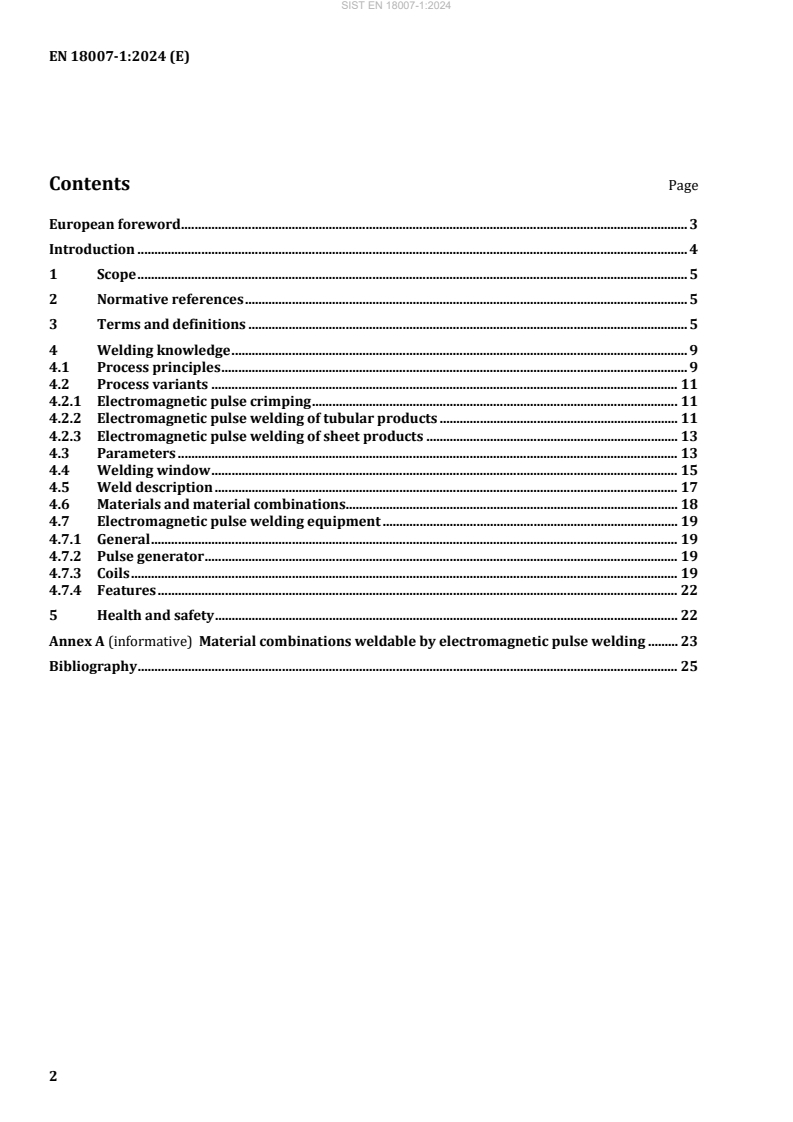
Contents Page
European foreword . 3
Introduction . 4
1 Scope . 5
2 Normative references . 5
3 Terms and definitions . 5
4 Welding knowledge . 9
4.1 Process principles . 9
4.2 Process variants . 11
4.2.1 Electromagnetic pulse crimping . 11
4.2.2 Electromagnetic pulse welding of tubular products . 11
4.2.3 Electromagnetic pulse welding of sheet products . 13
4.3 Parameters . 13
4.4 Welding window . 15
4.5 Weld description . 17
4.6 Materials and material combinations. 18
4.7 Electromagnetic pulse welding equipment . 19
4.7.1 General . 19
4.7.2 Pulse generator . 19
4.7.3 Coils . 19
4.7.4 Features . 22
5 Health and safety . 22
Annex A (informative) Material combinations weldable by electromagnetic pulse welding . 23
Bibliography . 25
European foreword
This document (EN 18007-1:2024) has been prepared by Technical Committee CEN/TC 121 “Welding
and allied processes”, the secretariat of which is held by AFNOR.
This European Standard shall be given the status of a national standard, either by publication of an
identical text or by endorsement, at the latest by January 2025, and conflicting national standards shall
be withdrawn at the latest by January 2025.
Attention is drawn to the possibility that some of the elements of this document may be the subject of
patent rights. CEN shall not be held responsible for identifying any or all such patent rights.
The EN 18007 series of standards, under the general title Electromagnetic pulse welding, consists of the
following parts:
— Part 1: Welding knowledge, terminology and vocabulary,
— Part 2: Design of welded joints,
— Part 3: Qualification of welding operators and weld setters,
— Part 4: Specification and qualification of welding procedures,
— Part 5: Quality and inspection requirements.
Any feedback and questions on this document should be directed to the users’ national standards body.
A complete listing of these bodies can be found on the CEN website.
According to the CEN-CENELEC Internal Regulations, the national standards organisations of the
following countries are bound to implement this European Standard: Austria, Belgium, Bulgaria, Croatia,
Cyprus, Czech Republic, Denmark, Estonia, Finland, France, Germany, Greece, Hungary, Iceland, Ireland,
Italy, Latvia, Lithuania, Luxembourg, Malta, Netherlands, Norway, Poland, Portugal, Republic of North
Macedonia, Romania, Serbia, Slovakia, Slovenia, Spain, Sweden, Switzerland, Türkiye and the United
Kingdom.
Introduction
Electromagnetic pulse welding is an innovative solid-state welding technology that belongs to the group
of pressure welding processes and is based on the use of electromagnetic forces to deform, accelerate
and weld workpieces. No external heat source is used, the connection is only created by a high-velocity
impact.
The increasing use of the electromagnetic pulse welding process has created the need for a standard, to
ensure that the welding operations are carried out in the most effective manner and that appropriate
controls are performed on all aspects of the implementation.
To be effective, welded products should be free from problems in production and in service. To achieve
this goal, it is recommended to provide controls from the design phase through material selection, choice
of parameters, the fabrication itself, and inspection. For example, poor design can create serious and
costly difficulties in the workshop or in service. Incorrect process parameters and/or material selection
can result in welding defects. Welding procedures should be correctly formulated and approved to avoid
weld discontinuities. To ensure the manufacture of a quality product, management should understand
the causes of potential problems and implement appropriate inspection procedures and subsequent
quality measures. Supervision should be implemented to ensure that the specified quality is achieved.
1 Scope
This document defines terms and definitions related to the electromagnetic pulse welding process. In this
document, the term “aluminium” refers to aluminium and its alloys.
2 Normative references
The following documents are referred to in the text in such a way that some or all of their content
constitutes requirements of this document. For dated references, only the edition cited applies. For
undated references, the latest edition of the referenced document (including any amendments) applies.
ISO 25901 (all parts), Welding and allied processes — Vocabulary
3 Terms and definitions
For the purposes of this document, the terms and definitions given in the ISO 25901 series and the
following apply.
ISO and IEC maintain terminology databases for use in standardization at the following addresses:
— ISO Online browsing platform: available at https://www.iso.org/obp
— IEC Electropedia: available at https://www.electropedia.org/
3.1
electromagnetic pulse welding
creation of a welded joint by impact using a pulsed electromagnetic field
3.2
electromagnetic pulse sheet welding
creation of a welded joint of sheets by impact using a pulsed electromagnetic field
3.3
electromagnetic pulse tube welding
creation of a welded joint of tubes by impact using a pulsed electromagnetic field
3.4
electromagnetic pulse crimping
creation of a crimp connection (mechanical joint) using electromagnetic forming
3.5
flyer sheet
flyer tube
sheet or tube that is accelerated by electromagnetic forces during the process (see Figure 1)
3.6
target sheet
target tube
sheet or tube that is stationary during the process (see Figure 1)
3.7
driver
auxiliary workpiece used for efficient acceleration of workpieces with low electrical conductivity
3.8
impact velocity
normal component (according to target sheet/tube surface) of the velocity of the flyer sheet/tube velocity
when it impacts with the target workpiece (see Figure 1)
3.9
collision point velocity
mean velocity parallel to the target workpiece at which the weld is created (see Figure 1)
Key
1 flyer
2 target
dd2− 1
Mean collision point velocity v = .
collision,mean
∆t
Figure 1 — Definition of characteristic velocities
3.10
impact angle
angle between flyer’s and target’s impact surface during the complete duration of the impact event (see
Figure 1)
3.11
jetting critical angle
angle at which a jet is created at the collision front
3.12
stand-off distance
gap
initial gap between the joining partners
Note 1 to entry: It is the distance by which the metals to be welded are separated from each other prior to the
welding process (see Figure 2).
3.13
free length
length between the flyer tube/sheet and the internal workpiece
Note 1 to entry: It is the part of the flyer (tube or sheet) that can freely move under the effect of the magnetic
forces (not obstructed by the support or a part of the target workpiece) (see Figure 2).
3.14
overlap of flyer and tool coil
work length [4]
length of work zone
distance that the flyer workpiece overlaps with the coil or field shaper (see Figure 2)
Key
1 Cu 1 mm
2 spacer 2
3 spacer 1
4 Al 1 mm
5 flat coil
a stand-off
b overlap
c free-length
Figure 2 — Schematic representation of the geometrical parameters of the electromagnetic
pulse welding process (sheet applications)
3.15
discharge energy
energy discharged into the coil as a result of the discharge of the capacitors, characterized as follows:
E= CV
where
𝐸𝐸 is the discharge energy (J)
𝐶𝐶 is the capacitance (F)
𝑉𝑉 is the charging voltage (V)
3.16
discharge current
current discharged into the coil as a result of the discharge of the capacitors
3.17
discharge current frequency
significant frequency of the current induced in the coil from 𝑡𝑡 until 𝑡𝑡 ; where the duration 𝑡𝑡
0 max,1 max,1
corresponds to the quarter of the period (noted T/4)
Note 1 to entry: Figure 3 illustrates this concept and presents the current discharge frequency equation.
Key
X time
Y current
Significant frequency f =
significant
4×∆t
max,l
Figure 3 — Pulsed current parameters
3.18
pulse repetition rate
number of pulses per unit of time
3.19
current rise time
time taken by the electromagnetic pulse to change from a specified low value to a specified maximum
value (Δ𝑡𝑡 in Figure 3)
max,l
3.20
skin effect
tendency of alternating current to distribute itself inside a conductor in such a way that the current
density is highest near the surface of the conductor
3.21
skin depth
depth at which eddy currents penetrate a material, defined as the depth at which their intensity decreases
to 1/e (about 37 %) of their maximum intensity
3.22
bitter coil
coil formed by stacking alternating conductors and insulating discs, each foreseen with a radial cut
3.23
single turn coil
one turn coil
coil consisting of one turn
3.24
helix coil
coil with the turns arranged in a helical shape
3.25
flat coil
coil with the turns arranged in a single plane, either single or multi-turn
3.26
Rogowski coil
toroidal coil without a ferromagnetic core to measure the discharge current in an electrical circuit
3.27
pitch of the coil
number of turns per unit of length, parallel to the flyer direction
3.28
high pulsed power generator
device that charges capacitors, stores electrical energy, and discharges it in the forming or welding coil
in a very short time interval
Note 1 to entry: It is the machine supplying the discharge energy needed for the electromagnetic pulse welding
process.
3.29
field shaper
field concentrator
component that concentrates the magnetic field onto the welding zone
Note 1 to entry: It essentially increases the amplitude of the magnetic field, onto a smaller region (axially).
4 Welding knowledge
4.1 Process principles
The electromagnetic pulse technology (also known as electromagnetic pulse forming, crimping and
welding) is an automatic production technique that uses electromagnetic forces to deform and join
similar or dissimilar materials. Electromagnetic pulse forming is a high-speed deformation process that
uses a pulsed electromagnetic field for contactless forming of metals. The energy stored in a capacitor
bank is discharged rapidly through a tool coil. The alternating electromagnetic field produced by the coil
generates eddy currents in the adjacent workpiece made of a metallic material with good electrical
conductivity. The varying currents cause a varying magnetic field that generates the eddy currents. These
currents, in turn, produce their own magnetic field. The forces generated by the two magnetic fields
oppose each other. Consequently, a repelling force (Lorentz force) between coil and workpiece is created.
The forces generated can for example be used to plastically deform a flyer tube or sheet with high velocity
onto an internal or external workpiece (target sheet/tube), to form, cut or perforate a sheet using a
special-shaped die. Under precisely controlled conditions and process parameters, a solid-state weld can
be realized (electromagnetic pulse welding) after plastic deformation of materials. The configuration for
joining tubular products is shown in Figure 5. Depending on the arrangement of the tool coil and
workpiece, tubular profiles can be expanded or compressed, or sheet metals can be formed (see Figure 4).
A principle sketch of the welding process is shown in Figure 6.
Due to the solid-state nature, this process can be used for joints of similar and dissimilar materials (with
very different melting temperatures).
Expansion Compression Flat coil
Key
1 coil
2 workpiece
3 die or joining partner
Figure 4 — Possible process variants of electromagnetic pulse forming and joining [5]
Key
1 AC power supply
2 charger
3 bank of capacitors
4 high current switch
5 coil
6 magnetic field
7 outer workpiece
8 inner workpiece
Figure 5 — Process layout for joining of tubular workpieces [6]
During the pulse After the pulse
Key
1 coil
2 induced eddy current
3 capacitor bank discharged current
magnetic field pressure
electric current
Figure 6 — Principle sketch of electromagnetic pulse welding
4.2 Process variants
4.2.1 Electromagnetic pulse crimping
Joints manufactured by electromagnetic pulse forming (also known as electromagnetic pulse crimping)
can be classified into 2 categories according to the dominating mechanism against an external load:
— Interference fit joints are manufactured by plastic deformation of one and an elastic deformation of
the other joining partner. As a result, friction and interference stresses between both joining partners
are generated, that in turn creates a mechanical joint.
— Form fit joints are manufactured by forming one joining partner’s material into an undercut (for
example a groove) of the other joining partner, so that the joint is locked against an external load
(mechanical interlock).
Electromagnetic pulse crimping is not a variant of the electromagnetic pulse welding process, but for
clarity, this has been added.
4.2.2 Electromagnetic pulse welding of tubular products
If the flyer workpiece impacts the target workpiece with high velocity and under a certain angle, a jet is
created along the materials’ surfaces before they impact. This jet can remove surface contaminants such
as oxide films, which reduces the need for pre-process cleaning. Also, due to the intense plastic
deformation, mostly in the more ductile material, microscopic roughness isn’t necessarily an obstacle
when bringing the workpieces together. A wavy or a flat bond interface is created like in explosion
welding [7,8] (see Figure 7). If an intermetallic layer is formed, this is caused by intensive plastic
deformation, mechanical mixing and local heating. The temperature increase occurs due to Joule effects,
the collision itself, the jet, compression of the air and by combustion of the base material. Because the
process takes place in a very short lapse of time, heating is not enough to generate a temperature increase
in a wide area, so there is no significant heat affected zone.
Key
1 workpiece 1
2 workpiece 2
3 contact point and speed
Figure 7 — Impact welding parameters [9] [10]
Figure 8 and Figure 9 show the typical part geometries before and after welding, for both hermetically
sealed capsules (Figure 8) and tubes (Figure 9) [11,12,13,14]. In all cases, the weld is an overlap weld, in
which there is an initial mandatory gap (stand-off distance) between the surfaces to be welded. Note that
the weld is always accompanied by deformation in the weld area, as shown in the figures.
Solid Cap Hollow Cap
Figure 8 — Capsule weld geometry
Simple Overlap Flared Overlap
Figure 9 — Tube weld geometry
4.2.3 Electromagnetic pulse welding of sheet products
In this process variant [15,16,17,18,19], a flat coil is used instead of a circular coil. The flyer sheet is
accelerated by the Lorentz forces induced by a pulsed electromagnetic field towards the target sheet. A
principle sketch is shown in Figure 10.
Key
1 parent plate
2 flyer plate
3 coil
4 discharge pulse
5 electro magnetic force
6 eddy current
7 magnetic flux
Figure 10 — Working principle of electromagnetic pulse sheet welding [20]
4.3 Parameters
Like in explosive welding, the quality of electromagnetic pulse welds is dependent on the impact angle
and the impact velocity during coalescence, which are governed by other process parameters. These
include the workpiece material properties, the electrical properties of the equipment, the geometry of
workpieces and field shaper [21,22]. The majority of these parameters are invariable, either because they
are inherent to the electromagnetic pulse welding equipment, or because they are defined by the material
selection to fulfil the requirements of the assembly.
The parameters which influence the process and the welding result are:
— material properties of the workpieces:
— mechanical properties (for example strain (rate) hardening, yield strength),
— magnetic permeability,
— electrical conductivity,
— density,
— thermal conductivity,
— metallurgical properties of materials,
— melting and vaporization temperatures;
— impact welding parameters (see definitions in section 3.3):
— impact angle (γ in Figure 7),
— impact velocity (V in Figure 7),
r
— collision point velocity (V in Figure 7),
C
— jetting critical angle;
— geometrical parameters:
— shape of workpieces,
— stand-off distance (g in Figure 11),
initial
— free length between the flyer tube/sheet and the internal workpiece (O in Figure 11),
flyer/target
— overlap of flyer and tool (O in Figure 11),
flyer/tool
— overlap of flyer and target,
— gap between the coil/field shaper and the flyer
...