


EN 1886:2025
(Main)Ventilation for buildings - Air handling units - Mechanical performance
General Information
- Abstract
This document specifies laboratory test methods, test requirements and classifications for the casings of non-residential air handling units (AHU). For the leakage tests, a method for on-site testing is also included.
The test methods and requirements are applicable to both model boxes and real units, except for the thermal and acoustic performance of the casing.
The test method for the thermal performance of the casing is applicable to the comparison of different casing constructions, but not for the calculation of thermal losses through casing or the risk of condensation.
The test method for the acoustic performance of the casing is applicable for the comparison of different constructions, but not for the provision of accurate acoustic data for specific units.
This document is not applicable for fan-coil units and similar products.
The filter bypass test specified in this document is not applicable to high efficiency particulate air (HEPA) filter installations.
- Status
- Published
- Publication Date
- 24-Jun-2025
- Technical Committee
- CEN/TC 156 - Ventilation for buildings
- Drafting Committee
- CEN/TC 156/WG 5 - Air handling units
- Current Stage
- 6060 - Definitive text made available (DAV) - Publishing
- Start Date
- 25-Jun-2025
- Due Date
- 28-May-2025
- Completion Date
- 25-Jun-2025

Overview
EN 1886:2025 - "Ventilation for buildings - Air handling units - Mechanical performance" (CEN) specifies laboratory test methods, test requirements and classification rules for the casings of non‑residential air handling units (AHUs). The standard covers mechanical strength, external leakage, filter bypass leakage, thermal transmittance and acoustic insulation of AHU casings. It applies to both model boxes and real units (with some exceptions) and includes an on‑site leakage test method.
Key topics and technical requirements
- Scope and applicability
- Targets non‑residential AHU casings; excludes fan‑coil units and similar products.
- Filter bypass test not applicable to HEPA installations.
- Mechanical strength
- Introduces pressure classes for casing strength and requires declaration of the tested pressure class.
- Test procedures and classification criteria for maximum pressure and casing deflection included.
- External casing leakage
- Laboratory and on‑site testing methods specified; test pressures aligned with legal requirements (±400 Pa).
- Classification of allowable leakage rates and detailed test apparatus/procedures.
- Filter bypass leakage
- Specifies test arrangement using blanking plates (foil option removed) and acceptable leakage criteria for filter sections.
- Thermal performance
- Test method intended for comparison of casing constructions, not for precise calculation of thermal losses or condensation risk.
- New classification of thermal transmittance (previous T1–T5 updated to U1–U3) and requirement to declare casing materials.
- Acoustic performance
- Test setup and execution detailed for comparative acoustic insulation assessment; not intended to provide exact acoustic data for specific installed units.
- Documentation and guidance
- Normative Annex B defines required test report content.
- Informative Annexes provide internal leakage measurement (Annex E) and AHU design advice for fire/mechanical safety (Annex F).
Practical applications and users
EN 1886:2025 is essential for:
- AHU manufacturers - product development, factory testing and declaration of casing classes.
- HVAC test laboratories - standardized test methods and reporting requirements.
- Building services engineers and specifiers - selecting AHUs, writing procurement specifications and ensuring compliance.
- Facilities managers and compliance officers - verifying on‑site leakage and performance claims.
- Consultants and integrators - comparing casing constructions for thermal and acoustic characteristics.
Using EN 1886:2025 helps ensure consistent, comparable AHU casing performance data for procurement, regulatory compliance and quality assurance in ventilation for buildings.
Related standards
- EN 13053 - Air handling units: rating and performance for units, components and sections
- EN 12792 - Symbols, terminology and graphical symbols for ventilation
- EN ISO 3743‑1, EN ISO 3744 - Acoustics test methods referenced for sound power measurements
Relations
- Effective Date
- 31-May-2023
- Effective Date
- 10-Jun-2026
- Effective Date
- 28-Jan-2026
- Effective Date
- 28-Jan-2026
- Effective Date
- 28-Jan-2026
- Effective Date
- 28-Jan-2026
- Effective Date
- 28-Jan-2026
- Effective Date
- 28-Jan-2026
- Effective Date
- 28-Jan-2026
- Effective Date
- 28-Jan-2026
- Effective Date
- 28-Jan-2026
- Effective Date
- 28-Jan-2026
- Effective Date
- 28-Jan-2026
- Effective Date
- 28-Jan-2026
- Effective Date
- 28-Jan-2026
Get Certified
Connect with accredited certification bodies for this standard

DIBt (Deutsches Institut für Bautechnik)
German Institute for Building Technology.
DIN CERTCO
DIN Group product certification.

Aboma Certification B.V.
Specialized in construction, metal, and transport sectors.
Sponsored listings
Frequently Asked Questions
EN 1886:2025 is a standard published by the European Committee for Standardization (CEN). Its full title is "Ventilation for buildings - Air handling units - Mechanical performance". This standard covers: This document specifies laboratory test methods, test requirements and classifications for the casings of non-residential air handling units (AHU). For the leakage tests, a method for on-site testing is also included. The test methods and requirements are applicable to both model boxes and real units, except for the thermal and acoustic performance of the casing. The test method for the thermal performance of the casing is applicable to the comparison of different casing constructions, but not for the calculation of thermal losses through casing or the risk of condensation. The test method for the acoustic performance of the casing is applicable for the comparison of different constructions, but not for the provision of accurate acoustic data for specific units. This document is not applicable for fan-coil units and similar products. The filter bypass test specified in this document is not applicable to high efficiency particulate air (HEPA) filter installations.
This document specifies laboratory test methods, test requirements and classifications for the casings of non-residential air handling units (AHU). For the leakage tests, a method for on-site testing is also included. The test methods and requirements are applicable to both model boxes and real units, except for the thermal and acoustic performance of the casing. The test method for the thermal performance of the casing is applicable to the comparison of different casing constructions, but not for the calculation of thermal losses through casing or the risk of condensation. The test method for the acoustic performance of the casing is applicable for the comparison of different constructions, but not for the provision of accurate acoustic data for specific units. This document is not applicable for fan-coil units and similar products. The filter bypass test specified in this document is not applicable to high efficiency particulate air (HEPA) filter installations.
EN 1886:2025 is classified under the following ICS (International Classification for Standards) categories: 91.140.30 - Ventilation and air-conditioning systems. The ICS classification helps identify the subject area and facilitates finding related standards.
EN 1886:2025 has the following relationships with other standards: It is inter standard links to EN 1886:2007, ISO 12001:1996, EN 12792:2003, EN ISO 9614-2:1996, EN ISO 9614-1:2009, EN ISO 3744:2010, EN ISO 9614-3:2009, EN ISO 3743-1:2010, EN ISO 11546-2:2009, ENV 1187:2002, CEN/TR 16798-4:2017, EN 16798-3:2025, EN 16798-3:2017, EN 16798-5-1:2017, EN ISO 15138:2018. Understanding these relationships helps ensure you are using the most current and applicable version of the standard.
EN 1886:2025 is available in PDF format for immediate download after purchase. The document can be added to your cart and obtained through the secure checkout process. Digital delivery ensures instant access to the complete standard document.
Standards Content (Sample)
SLOVENSKI STANDARD
01-september-2025
Nadomešča:
SIST EN 1886:2008
Prezračevanje stavb - Centralne enote - Mehanske lastnosti in merilni postopki
Ventilation for buildings - Air handling units - Mechanical performance
Lüftung von Gebäuden - Zentrale raumlufttechnische Geräte - Mechanische
Eigenschaften und Messverfahren
Ventilation des bâtiments - Caissons de traitement d'air - Performances mécaniques
Ta slovenski standard je istoveten z: EN 1886:2025
ICS:
91.140.30 Prezračevalni in klimatski Ventilation and air-
sistemi conditioning systems
2003-01.Slovenski inštitut za standardizacijo. Razmnoževanje celote ali delov tega standarda ni dovoljeno.
EN 1886
EUROPEAN STANDARD
NORME EUROPÉENNE
June 2025
EUROPÄISCHE NORM
ICS 91.140.30 Supersedes EN 1886:2007
English Version
Ventilation for buildings - Air handling units - Mechanical
performance
Ventilation des bâtiments - Centrales de traitement Lüftung von Gebäuden - Zentrale raumlufttechnische
d'air - Performances mécaniques Geräte - Mechanische Eigenschaften und
Messverfahren
This European Standard was approved by CEN on 21 April 2025.
CEN members are bound to comply with the CEN/CENELEC Internal Regulations which stipulate the conditions for giving this
European Standard the status of a national standard without any alteration. Up-to-date lists and bibliographical references
concerning such national standards may be obtained on application to the CEN-CENELEC Management Centre or to any CEN
member.
This European Standard exists in three official versions (English, French, German). A version in any other language made by
translation under the responsibility of a CEN member into its own language and notified to the CEN-CENELEC Management
Centre has the same status as the official versions.
CEN members are the national standards bodies of Austria, Belgium, Bulgaria, Croatia, Cyprus, Czech Republic, Denmark, Estonia,
Finland, France, Germany, Greece, Hungary, Iceland, Ireland, Italy, Latvia, Lithuania, Luxembourg, Malta, Netherlands, Norway,
Poland, Portugal, Republic of North Macedonia, Romania, Serbia, Slovakia, Slovenia, Spain, Sweden, Switzerland, Türkiye and
United Kingdom.
EUROPEAN COMMITTEE FOR STANDARDIZATION
COMITÉ EUROPÉEN DE NORMALISATION
EUROPÄISCHES KOMITEE FÜR NORMUNG
CEN-CENELEC Management Centre: Rue de la Science 23, B-1040 Brussels
© 2025 CEN All rights of exploitation in any form and by any means reserved Ref. No. EN 1886:2025 E
worldwide for CEN national Members.
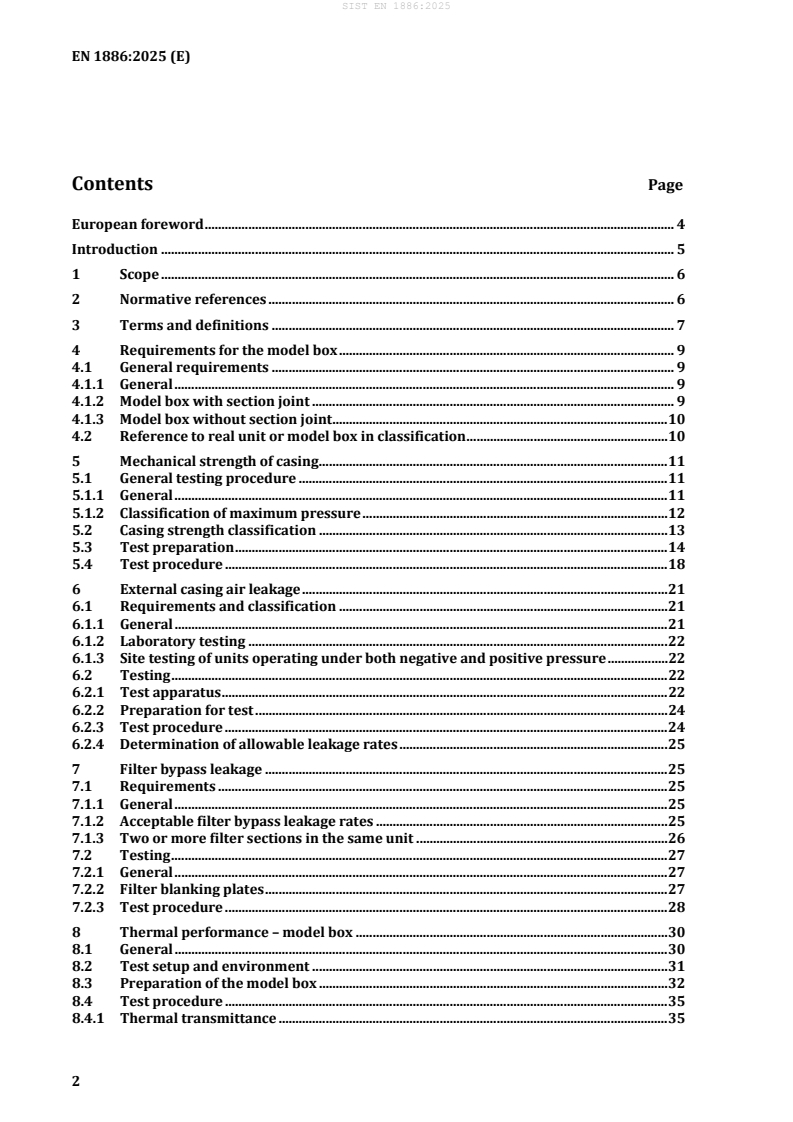
Contents Page
European foreword . 4
Introduction . 5
1 Scope . 6
2 Normative references . 6
3 Terms and definitions . 7
4 Requirements for the model box . 9
4.1 General requirements . 9
4.1.1 General . 9
4.1.2 Model box with section joint . 9
4.1.3 Model box without section joint . 10
4.2 Reference to real unit or model box in classification . 10
5 Mechanical strength of casing . 11
5.1 General testing procedure . 11
5.1.1 General . 11
5.1.2 Classification of maximum pressure . 12
5.2 Casing strength classification . 13
5.3 Test preparation . 14
5.4 Test procedure . 18
6 External casing air leakage . 21
6.1 Requirements and classification . 21
6.1.1 General . 21
6.1.2 Laboratory testing . 22
6.1.3 Site testing of units operating under both negative and positive pressure . 22
6.2 Testing . 22
6.2.1 Test apparatus . 22
6.2.2 Preparation for test . 24
6.2.3 Test procedure . 24
6.2.4 Determination of allowable leakage rates . 25
7 Filter bypass leakage . 25
7.1 Requirements . 25
7.1.1 General . 25
7.1.2 Acceptable filter bypass leakage rates . 25
7.1.3 Two or more filter sections in the same unit . 26
7.2 Testing . 27
7.2.1 General . 27
7.2.2 Filter blanking plates . 27
7.2.3 Test procedure . 28
8 Thermal performance – model box . 30
8.1 General . 30
8.2 Test setup and environment . 31
8.3 Preparation of the model box . 32
8.4 Test procedure . 35
8.4.1 Thermal transmittance . 35
8.4.2 Thermal bridging factor (k ) . 35
b
8.5 Calculation . 36
8.5.1 General . 36
8.5.2 Calculation of the U-value . 36
8.5.3 Calculation of the k -value . 36
b
8.6 Classification . 37
9 Acoustic insulation of casing . 38
9.1 General . 38
9.2 Test requirements . 38
9.3 Test method . 38
9.4 Test procedure . 38
9.5 Sound power insulation procedure . 39
9.6 Uncertainty . 40
9.7 Presentation of the sound reduction . 40
Annex A (informative) Examples of arrangements of circulating fans . 41
A.1 Installation of circulating fans. 41
A.2 Four fans . 41
A.3 Six fans . 41
A.4 Eight fans . 42
Annex B (normative) Test report . 43
B.1 Test report . 43
B.1.1 Requirement for test report . 43
B.1.2 Recommendations for test report . 43
Annex C (informative) Example calculation of the relative deflection D and the AHU casing
r
class . 47
C.1 General . 47
C.2 Calculation of the non-permanent casing deflection and AHU casing class . 47
C.3 Calculation of the permanent casing deflection and AHU casing class . 49
Annex D (informative) Example of determining filter bypass leakage . 51
Annex E (informative) Internal leakage in monoblock and sectional AHUs . 52
Annex F (informative) General design advice for fire and mechanical safety . 54
F.1 General . 54
F.2 AHU materials . 54
F.3 Mechanical safety . 55
Bibliography . 56
European foreword
This document (EN 1886:2025) has been prepared by Technical Committee CEN/TC 156
“Ventilation for buildings”, the secretariat of which is held by BSI.
This European Standard shall be given the status of a national standard, either by publication of an
identical text or by endorsement, at the latest by December 2025, and conflicting national
standards shall be withdrawn at the latest by December 2025.
Attention is drawn to the possibility that some of the elements of this document may be the subject
of patent rights. CEN shall not be held responsible for identifying any or all such patent rights.
This document supersedes EN 1886:2007.
The main changes with respect to the previous edition EN 1886:2007 are:
— a model box definition suitable for air handling unit ranges that are only manufactured using
a single casing without intermediatory casing joint has been included;
— for the mechanical strength of the casing, pressure classes have been introduced with the
requirement that the test pressure class be declared. In addition, the testing procedure has
been clarified;
— for the casing leakage, the test pressure is changed to 400 Pa and -400 Pa to be in line with
legal requirements. In addition, reference to the relevant standard for filters has been updated
and test procedures clarified;
— for the filter bypass leakage, the filter is blanked off by means of a blanking plate and the option
of using a foil to cover the filter has been deleted;
— for the thermal performance of the casing, a classification of the thermal transmittance is
introduced with classes T1 to T5 becoming new classes U1 to U3 and with the requirement
that the casing materials be declared. In addition, the testing procedure is more detailed and
clearer;
— for the acoustic performance, the specification of the test setup and execution is more detailed
and clearer;
— a new Annex B (normative) with requirements for the content of the test report is added;
— a new Annex E (informative) provides a method for measuring the casing related internal
leakage;
— a new Annex F (informative) provides AHU design advice for fire and mechanical safety.
Any feedback and questions on this document should be directed to the users’ national standards
body. A complete listing of these bodies can be found on the CEN website.
According to the CEN-CENELEC Internal Regulations, the national standards organisations of the
following countries are bound to implement this European Standard: Austria, Belgium, Bulgaria,
Croatia, Cyprus, Czech Republic, Denmark, Estonia, Finland, France, Germany, Greece, Hungary,
Iceland, Ireland, Italy, Latvia, Lithuania, Luxembourg, Malta, Netherlands, Norway, Poland,
Portugal, Republic of North Macedonia, Romania, Serbia, Slovakia, Slovenia, Spain, Sweden,
Switzerland, Türkiye and the United Kingdom.
Introduction
This document provides test methods, classifications and requirements for air handling units
(AHU) including mechanical strength, air leakage, thermal insulation and acoustic insulation
properties of the casing.
This document also includes an Annex F with recommendations for fire protection and mechanical
safety for AHUs. It is the intention of CEN/TC 156 that these sections will be later moved to a new
standard.
The performance of AHU components is specified in EN 13053.
1 Scope
This document specifies laboratory test methods, test requirements and classifications for the
casings of non-residential air handling units (AHU). For the leakage tests, a method for on-site
testing is also included.
The test methods and requirements are applicable to both model boxes and real units, except for
the thermal and acoustic performance of the casing.
The test method for the thermal performance of the casing is applicable to the comparison of
different casing constructions, but not for the calculation of thermal losses through casing or the
risk of condensation.
The test method for the acoustic performance of the casing is applicable for the comparison of
different constructions, but not for the provision of accurate acoustic data for specific units.
This document is not applicable for fan-coil units and similar products.
The filter bypass test specified in this document is not applicable to high efficiency particulate air
(HEPA) filter installations.
2 Normative references
The following documents are referred to in the text in such a way that some or all of their content
constitutes requirements of this document. For dated references, only the edition cited applies. For
undated references, the latest edition of the referenced document (including any amendments)
applies.
EN 13053, Ventilation for buildings — Air handling units — Rating and performance for units,
components and sections
EN 12792, Ventilation for buildings — Symbols, terminology and graphical symbols
EN ISO 3743-1, Acoustics — Determination of sound power levels and sound energy levels of noise
sources using sound pressure — Engineering methods for small movable sources in reverberant fields
— Part 1: Comparison method for a hard-walled test room (ISO 3743-1)
EN ISO 3744:2010, Acoustics — Determination of sound power levels of noise sources using sound
pressure — Engineering methods for an essentially free field over a reflecting plane (ISO 3744:2010)
EN ISO 9614 (all parts), Acoustics — Determination of sound power levels of noise sources using
sound intensity (ISO 9614 all parts)
EN ISO 11546-2:2009, Acoustics — Determination of sound insulation performances of enclosures —
Part 2: Measurements in situ (for acceptance and verification purposes) (ISO 11546-2:1995)
ISO 12001, Acoustics — Noise emitted by machinery and equipment — Rules for the drafting and
presentation of a noise test code
3 Terms and definitions
For the purposes of this document, the terms and definitions given in EN 12792, EN 13053 and the
following apply.
ISO and IEC maintain terminology databases for use in standardization at the following addresses:
— ISO Online browsing platform: available at https://www.iso.org/obp
— IEC Electropedia: available at https://www.electropedia.org/
3.1
air handling unit
AHU
factory made encased assembly consisting of sections containing a fan or fans and other necessary
equipment to perform one or more of the following functions: circulation, filtration, heating,
cooling, heat recovery, humidifying, dehumidifying and mixing of air
3.2
modular AHU
AHU that consists of multiple sections where the supply air and extract air are enclosed in separate
casing modules except for the heat recovery function as shown in Figure 1
Figure 1 — Modular AHU
3.3
monoblock AHU
AHU that consists of one section where the supply and extract air are enclosed in the same casing
module with the supply and extract air separated by an internal partition as shown in Figure 2
Figure 2 — Monoblock AHU
3.4
sectional AHU
AHU that consists of multiple sections where the supply and extract air are enclosed in the same
casing module with the supply and extract air separated by an internal partition as shown in
Figure 3
Figure 3— Sectional AHU
3.5
model box
section of casing, as defined in Clause 4, with the same design and materials as the casing of the real
unit to which it represents
Note 1 to entry: The model box is used for testing the performance characteristics as set out in this
document.
3.6
model box with a section joint
model box with a section joint as defined in 4.1.2 used for AHU ranges that include modular and/or
sectional units
3.7
model box without a section joint
model box without a section joint as defined in 4.1.3 may be used for AHU ranges that cannot be
supplied as modular or sectional units but only as monoblock
3.8
real unit
AHUs with the ventilation and air conditioning components needed for specific installations in
buildings
4 Requirements for the model box
4.1 General requirements
4.1.1 General
The construction and finish of the casing of the model box shall be identical to that of the real unit.
Different constructions, material combinations or finish shall not be combined in the same model
box.
4.1.2 Model box with section joint
The model box with section joint shall be manufactured in accordance with the following
specifications:
a) its height and width shall have external dimensions of between 0,9 m and 1,4 m;
2 2
b) its total external surface area shall be between 10 m and 30 m ;
c) it shall consist of at least two casing sections joined in accordance with the normal methods for
the design under test;
d) the manufacturer shall declare which panels are stiffened by means of additional material or
components and which panels are not;
e) its material and finishes used for the internal and external layers shall be declared by the
manufacturer;
f) it shall be mounted on a base frame or feet with a height between 50 mm and 150 mm to allow
free movement of air under the unit and to facilitate handling;
g) the access side of each section shall have at least one hinged door and one fixed panel;
h) the doors shall have standard handles, latches and locks, as used in the real unit;
i) no windows shall be fitted;
j) its casing shall be manufactured using the same components and design as that of the real unit;
k) its screws shall be tightened as in normal production;
l) for the filter bypass test, a filter frame without the filter medium shall be installed. The filter
frame shall be in place during all tests. The filter frame shall be placed away from the section
joints so that negative pressure impinges on the joint during the filter bypass leakage test. In
this way the effect of the joint on the casing air leakage is included in the measurement;
m) the roof or roofing membrane of units intended for outdoor installation shall not be fitted
during testing.
4.1.3 Model box without section joint
The model box without section joint shall be manufactured in accordance with the following
specifications:
a) its height and width shall have external dimensions of between 0,6 m and 1,4 m;
2 2
b) its total external surface area shall be between 5 m and 30 m but the length may be
restricted by the laboratory for practical reasons;
c) it shall consist of one casing section;
d) it shall have a statement regarding which panels are stiffened by means of additional material
or components and which panels are not;
e) its material and material finish used for the internal and external sheet shall be declared;
f) it shall be mounted on a base frame or feet with a height between 50 mm and 150 mm to allow
free movement of air under the unit and to facilitate handling;
g) its access side shall have at least two hinged doors and one fixed panel;
h) its door shall have standard handles, latches and locks, used in the real unit;
i) no windows shall be fitted;
j) its casing shall be manufactured using the same components and design as that of the real unit;
k) its screws shall be tightened as in normal production.
4.2 Reference to real unit or model box in classification
Testing and classification of casing performance shall be according to Table 1.
Table 1 — Testing and classification of casing performance
Type of casing
Test criteria Model box (M) Real unit (R)
Mechanical strength Testing procedures only Testing and classification of casing
construction
External casing air Testing procedures only Testing and classification of casing
leakage construction
Internal casing air Testing procedures only – see –
leakage for monoblock Annex E (informative)
and sectional units
Filter bypass leakage Testing procedures only Testing and classification of casing
construction
Thermal transmittance Testing and classification of casing –
construction
Thermal bridging Testing and classification of casing –
construction
Acoustic insulation Testing of casing construction –
The relevant denotation “M” or “R” shall always be declared in product documentation and
marketing materials when referring to the casing performance class.
Classification for the thermal transmittance and thermal bridging only exist for the model box with
denotation “M”. Classification for the mechanical strength, casing air leakage and filter bypass only
exist for the real unit with denotation “R”.
For the acoustic insulation there is no classification, and the measured values are declared.
5 Mechanical strength of casing
5.1 General testing procedure
5.1.1 General
The procedure measures the relative deflection, which is used to establish the casing strength class.
Relative deflection is defined as the actual deflection in mm divided by the longest unsupported
span of the panel with the longest diagonal dimension.
d
D = (1)
r
L
where
D is the relative deflection, in mm/m;
r
d is the measured deflection;
L is the linear dimension.
Figure 4 — Deflection of panels and frames of air handling units
Figure 4 illustrates the deflection of the casing. Dimension R-R´ and S-S´ is the deflection of the
frame or edge of the panel if there is no frame.
X-X´ is the deflection of the panel caused by the deflection of the frame (or panel edge).
X-X´´ is the total deflection at the center of the panel. It is this dimension that shall be used as d in
Formula (1).
X-X´´ is the deflection of the panel alone.
In some cases, the test pressure can deform the casing so it is recommended that the mechanical
strength test of the casing is performed first. If this test is not to be performed, then, at least, the
steps 14 to 19 in Table 5 shall be performed once.
5.1.2 Classification of maximum pressure
The pressure class of the model box to be tested for the permanent deflection shall be declared by
the manufacturer. The pressure class refers to the maximum allowable difference between ambient
and internal air pressure. See Table 2 for details of the pressure classes.
The pressure class shall be higher than the maximum pressure developed by the fans used in the
real unit.
The test of the model box can be made at a pressure higher than 2 000 Pa, if required, and that
pressure shall then be defined as P , where xxxx is the pressure in Pa.
xxxx
Table 2 — Pressure class
Pressure class
P
P
P
P
5.2 Casing strength classification
AHU casing strength shall be classified according to Table 3.
Table 3 — Casing strength classification of AHU
Casing class Maximum relative deflection
mm/m
D1 ≤ 4
D2 ≤ 10
D3 > 10
The leakage test shall be carried out after the strength test.
Class D1 and Class D2 casings shall be designed and selected so that the maximum relative
deflection of any span of the panels, frames or both does not exceed the limits given in Table 3.
The permanent deflection test shall be made by gradually increasing the pressure up to that of the
declared pressure class. No permanent deflection of the casing is permitted. See Table 4 for further
details of the test pressure for the permanent deflection test.
The casings of class D1, D2 and D3 shall withstand the maximum test pressure achieved by a
gradual increase of pressure. Permanent deflection (hysteresis maximum: 2,0 mm/meter of post
or panel span) of the structural parts (structures and supports) or damage to the casing is not
permitted.
Table 4 — Test pressures
Type of casing
Test criteria Test pressure for Test pressure for Real Test pressure for Real
Model box (M / CM) unit (R) with known unit (R) with unknown
duty point duty point
Deflection 1 000 Pa The pressure related to 1 000 Pa
the selected design fan
speed
Permanent deflection Pressure class Maximum fan pressure at 1 000 Pa
selected design fan speed
The sections of the unit that are designed to operate under positive pressure shall be tested with
positive pressure and vice versa. The test pressure may be applied either to the whole unit or to
the relevant sections. Test pressures shall be in accordance with Table 4 unless otherwise agreed
and indicated.
Deviating test pressures shall be clearly noted in the test report according to Annex B. The
classification described in Table 3 is then not applicable.
Testing on a real unit may include a test at the maximum pressure achievable with the fan(s). This
is achieved by blanking off openings appropriately in the casing and running the fan at its maximum
speed or the speed specified.
Any special requirements, for example the ability to survive shock loading caused by sudden
closure of fire dampers, are not covered by this document.
Deflection shall be measured using an instrument with a measurement uncertainty of ±0,1 mm.
5.3 Test preparation
The model box or real unit shall be placed on a level surface for the measurement.
The locations of the measuring points are shown in Figures 5 to 7, depending on the construction
of the casing.
The deflection of the casing shall be measured on the centre of the vertical corner post and on the
centre of a panel, chosen by the laboratory, with the longest diagonal dimension that is not stiffened
or supported by component parts, for example filter frame, fan or panel stiffener. Because of the
influence of gravity, measurements on the top or bottom panels shall be avoided.
Key
Wp width of the panel
Hcp height of the corner post
Wcp width of the corner post
MP1 measuring point 1
MP2 measuring point 2
Figure 5 — External frame panel construction
Key
Wp width of the panel
Hp height of the panel
MP1 measuring point 1
MP2 measuring point 2
Figure 6 — Frameless (or internal frame) panel construction
The position of MP1 for frameless construction in Figure 6 shall be 50 mm from the edge of the
panel.
Key
1 heat exchanger
2 filter frame
Wp width of the panel
Hcp height of the corner post
Wcp width of the corner post
MP1 measuring point 1
MP2 measuring point 2
Figure 7 — External frame panel construction
If all panels are stiffened by internal components, the measuring point MP2 shall be placed at an
equal distance between the stiffening members of components as shown in Figure 7.
5.4 Test procedure
The steps of the deflection test on the unit shall be carried out as shown in Table 5.
The measurement steps 1 to 4, 7 to 8, 11 to 12, 16 to 17 are only applicable for laboratory
measurements.
Table 5 — Test procedure of the mechanical strength of the casing
Step Test pressure Measuring Measuring Explanation
No Point 1 Point 2
(MP1) (MP2)
1 (500 ± 5) Pa - - Necessary prior to testing to reset any
existing deformation. The
measurement can be stopped as soon
as the test pressure (500 ± 5) Pa has
been achieved.
2 (–500 ± 5) Pa - - Necessary prior to testing to reset any
existing deformation. The
measurement can be stopped as soon
as the test pressure (–500 ± 5) Pa has
been achieved.
3 (500 ± 5) Pa - - Necessary prior to testing to reset any
existing deformation. The
measurement can be stopped as soon
as the test pressure (500 ± 5) Pa has
been achieved.
4 (–500 ± 5) Pa - - Necessary prior to testing to reset any
existing deformation. The
measurement can be stopped as soon
as the test pressure (–500 ± 5) Pa has
been achieved.
5 0 Pa To be To be The measurement of the MP1 and MP2
measured measured deflection at 0 Pa.
6 Model box (M): To be To be The values of the MP1 and MP2
measured measured deflection are measured only if the
(–1 000 ± 5) Pa
values MP1 and MP2 has not changed
for 2 min after the test pressure ±5 Pa
Real unit (R):
was stable for 5 min. The measured
negative
values are deducted from the measured
pressure at
values from step 5.
selected design
fan speed
7 (–500 ± 5) Pa - - To reset any existing deformation
caused by the previous deflection test.
The measurement can be stopped as
soon as the test pressure (–500 ± 5) Pa
has been achieved.
Step Test pressure Measuring Measuring Explanation
No Point 1 Point 2
(MP1) (MP2)
8 (500 ± 5) Pa - - To reset any existing deformation
caused by the previous deflection test.
The measurement can be stopped as
soon as the test pressure (500 ± 5) Pa
has been achieved.
9 0 Pa To be To be The measurement of the MP1 and MP2
measured measured deflection at 0 Pa
10 Model box (M): To be To be The values of the MP1 and MP2
measured measured deflection are measured only if the
1 000 Pa ± 5 Pa
values MP1 and MP2 doesn’t have
changed for 2 min after the test
Real unit (R):
pressure (1 000 ± 5) Pa was stable for
positive
5 min. The measured values are
pressure at
deducted from the measured values
selected design
from step 9.
fan speed
11 (500 ± 5) Pa - - To reset any existing deformation
caused by the previous deflection test.
The measurement can be stopped as
soon as the test pressure (500 ± 5) Pa
has been achieved.
12 (–500 ± 5) Pa - - To reset any existing deformation
caused by the previous deflection test.
The measurement can be stopped as
soon as the test pressure (–500 ± 5) Pa
has been achieved.
13 0 Pa To be To be The measurement of the MP1 and MP2
measured measured deflection at 0 Pa.
14 Model box (M): - - The measurement can be stopped as
soon as the test pressure ±5 Pa was
Negative
stable for 1 min.
Pressure class
±5 Pa
Real unit (R):
The negative
pressure related
to the selected
design fan
speed
Step Test pressure Measuring Measuring Explanation
No Point 1 Point 2
(MP1) (MP2)
15 0 Pa To be To be The values of the MP1 and MP2
measured measured deflection are measured if the values
MP1 and MP2 doesn’t have changed for
2 min after the test pressure 0 Pa was
achieved. The measured values are
deducted from the measured values
from step 13.
16 (–500 ± 5) Pa - - To reset any existing deformation
caused by the previous deflection test.
The measurement can be stopped as
soon as the test pressure (–500 ± 5) Pa
has been achieved.
17 (500 ± 5) Pa - - To reset any existing deformation
caused by the previous deflection test.
The measurement can be stopped as
soon as the test pressure (500 ± 5) Pa
has been achieved.
18 0 Pa To be To be The measurement of the MP1 and MP2
measured measured deflection at 0 Pa.
19 Model box (M): - - The measurement can be stopped as
soon as the test pressure ±5 Pa was
Positive
stable for 1 min.
pressure class
±5Pa
Real unit (R):
positive
maximum
pressure at
selected design
fan speed
20 0 Pa To be To be The values of the MP1 and MP2
measured measured deflection are measured only if the
values MP1 and MP2 doesn’t have
changed for 2 min after the test
pressure 0 Pa was achieved. The
measured values are deducted from the
measured values from step 18.
Evaluation of the AHU casing class
The relative deflection is calculated using Formula (1) for each of the measuring points at positive
and negative pressure. From the relative deflection, the casing class is determined from Table 3.
The AHU casing class is the highest casing class of the four component classes calculated.
An example of the calculation is given in Annex C.
6 External casing air leakage
6.1 Requirements and classification
6.1.1 General
The mechanical strength tests described in Clause 5 shall be performed before the external casing
air leakage test.
If the mechanical strength test is not to be performed, then at least the steps 14 to 19 in Table 5
shall be performed once before conducting the casing leakage test. The purpose of this is to prove
that the casing can withstand the maximum pressure and to reset the casing after deformation
caused during transport and installation.
Leakage classification is given in Table 6. For units with filter sections operating under negative
pressure, the filter efficiency shall not exceed the highest allowable efficiency according to Table 6.
For ePM2.5 and ePM10 filter efficiency classes, the related ePM1 efficiency shall be taken into
consideration, see Table 6.
Table 6 — External casing air leakage classes of AHU, 400 Pa test pressure
Leakage coefficient L
f
a
Leakage rate (f )
Highest allowable
Leakage class of
b
casing
filter efficiency
-1 -2
l · s · m
L1 0,15 any filter efficiency 0,003
L2 0,44 ePM1 80 % 0,009
L3 1,32 ePM1 65 % 0,027
a
The maximal leakage rates given in Table 6 are according to the ductwork leakage classes specified in EN 1507
and EN 12237, (e.g. L2 = B), but the test pressures are different.
b
SOURCE EN ISO 16890-1.
The maximum leakage rate is given by Formula (2):
0,65
f = L × p (2)
f st
where
L is the leakage coefficient as given in Table 6;
f
p is the test pressure.
st
In the case of units tested at a pressure deviating from 400 Pa the measured leakage rate shall be
converted into a value at reference pressure, using Formula (3):
0,65
(3)
ff=
400 m
test pressure
where
f is the measured leakage rate at the actual test pressure;
m
f is the converted leakage rate at 400 Pa.
For a real unit, the leakage class of all under-pressure sections downstream of the filter shall
correspond, at least, to the requirements in Table 6.
6.1.2 Laboratory testing
The whole AHU or Model Box shall be tested under positive and negative pressure.
Real units operating under negative and positive pressures shall be tested at 400 Pa negative and
positive pressure. Real units operating only under negative pressure shall be only tested at 400 Pa
negative pressure.
6.1.3 Site testing of units operating under both negative and positive pressure
AHU with sections operating under positive pressure exceeding 250 Pa shall have the positive
pressure sections tested separately from the rest of the unit, if physically possible. If the positive
pressure does not exceed 250 Pa, a negative pressure test is sufficient. The test pressure applied to
the positive pressure sections shall be 400 Pa positive pressure or the air handling unit's maximum
positive operating pressure, whichever is the greater. The remainder of the unit shall be tested in
accordance with 4.2, with the applicable leakage rate being governed by the efficiency of the filter
immediately upstream of the fan.
Adequate access to the fan wall is needed to make the test possible. If access is not adequate, then
the entire unit shall be tested under positive and negative pressure. This shall be indicated in the
test report according to Annex B.
6.2 Testing
6.2.1 Test apparatus
The test apparatus shall be as shown in Figures 8 and 9, using a fan with a duty at least capable of
meeting the anticipated leakage rate at the respective test pressure(s).
If the air handling unit is too large for the capacity of the leakage test apparatus with a
measurement uncertainty of ±1,5 %, or a restriction of access for delivery requires the unit to be
tested in sections or sub-assemblies, the breakdown shall be agreed by the parties prior to the test
date.
Where heat recovery devices are installed, the supply and extract sections shall be tested together
as a single unit.
Key
1 variable speed fan
2 flow measurement device
3 valve as alternative to variable speed fan
4 pressure measurement device for the negative test pressure
5 pressure measurement device for ambient pressure at 0 Pa
6 blanking plates
7 fan wall
8 leakage measurement area
Figure 8 — Typical example of apparatus for testing the external casing air leakage
(negative pressure test)
Key
1 variable speed fan
2 flow measurement device
3 valve as alternative to variable speed fan
4 pressure measurement device for the positive test pressure
5 blanking plates
6 blanking plates
7 pressure measurement device for ambient pressure at 0 Pa
8 fan wall
9 filter frame
10 leakage measurement area
Figure 9 — Typical example of apparatus for testing the external casing air leakage
(positive pressure test)
6.2.2 Preparation for test
The unit to be tested shall be put up in the plane in which it is intended to operate with its sections
connected or joined by the method given in the manufacturer’s installation instructions.
Where it is necessary to fit blanking plates, the plates shall be fitted by a similar method to that of
the intended installed joint.
Openings for electrical, air, pressure or water services shall be sealed prior to testing. Dampers
shall be removed before testing or fitted with blanking plates if the damper is inside.
The air
...