

prEN 18283
(Main)Artificial Intelligence - Concepts, measures and requirements for managing bias in AI systems
- Abstract
This document defines concepts, measures and requirements for assessment and treatment of bias in AI systems. This includes bias unwanted by the AI Provider and AI Deployer according to their specification of the AI system, in the context of the AI Act.
This encompasses consideration of data bias including any data used to build or assess the AI system, but also system or model bias that can result from algorithmic factors, such as algorithm design choices.
- Status
- Not Published
- Publication Date
- 27-Jul-2027
- Technical Committee
- CEN/CLC/JTC 21 - Artificial Intelligence
- Drafting Committee
- CEN/CLC/JTC 21/WG 3 - Engineering aspects
- Current Stage
- 4020 - Submission to enquiry - Enquiry
- Start Date
- 01-Oct-2026
- Due Date
- 16-Jul-2025
- Completion Date
- 01-Oct-2026
- Directive
- 2024/1689 - EU AI Act


prEN 18283 is a draft European Standard from CEN on concepts, measures and requirements for managing bias in AI systems. It specifies how to assess, measure, evaluate and mitigate unwanted bias in AI systems, including data bias and bias caused by algorithmic or model choices, in the context of the EU AI Act.
What does prEN 18283 specify?
prEN 18283 specifies a bias-management framework for AI systems across the life cycle, from identifying relevant groups and hazards to estimating, evaluating and mitigating bias. The document is aimed at bias that the AI Provider and AI Deployer consider unwanted according to the system specification, including effects on people, groups and fundamental rights.
The document is organized into 13 clauses, followed by informative annexes and a bibliography. Clause 1 gives the scope, Clause 2 lists the normative reference, Clause 3 defines terms, Clause 4 lists abbreviations, Clauses 5 to 13 cover the bias process, metrics, mitigation and consultation, and Annex ZA links the standard to Regulation (EU) 2024/1689.
| Annex | What it covers |
|---|---|
| Annex A | An informative use case on identifying relevant groups for bias testing in an AI-supported consumer-loan eligibility assessment system |
| Annex ZA | The relationship between this European Standard and the requirements of Regulation (EU) 2024/1689 aimed to be covered |
What are the key requirements of prEN 18283?
prEN 18283 turns bias management into a documented process: define the bias profile, analyse and estimate bias, evaluate whether it is acceptable, and then choose and justify mitigation. The document also makes clear that bias can appear in data, AI components, system output and system outcome, so the evidence has to be collected at more than one level.
Bias profile and bias management workflow
Clause 6 defines the bias profile as the set of documents that records the bias-management process for an AI system and is maintained throughout the life cycle. In practice, this means the provider needs traceable records, not just a one-time test result.
Clause 7 describes the overall bias-management process. It includes identifying relevant groups, identifying bias-related hazards, determining metrics, and reviewing and updating the bias profile. This matters because the standard treats bias as something that can change as the system, data or deployment context changes.
Clause 7 also ties the process to the provider’s risk management system. The standard uses the terms QMS (quality management system), RMS (risk management system) and QGD (quality and governance of data sets) in the sense of the EU AI Act, so the bias work is intended to fit into wider governance and risk controls.
Bias estimation, evaluation and metrics
Clause 8 covers bias estimation, including checks on the availability of testing data, analysis of the data set, AI component output analysis, AI system output analysis and AI system outcome analysis. The practical point is that bias can be measured before and after system integration, and the assessment should follow the signal from the data layer up to the operational result.
Clause 9 covers bias evaluation. It uses the results of bias estimation to support a risk assessment of whether the observed bias is acceptable. In practice, this is the decision point where measurements are turned into a judgement about risk, not just performance.
Clause 10 defines the metric families used in the standard: classification, regression, ranking, outcome and data metrics, plus meta-metrics. Clause 11 then requires a common template for defining each metric, including its name, intent, motivation, applicability, limitations, inputs, results, interpretation, algorithm or formula, references and per-use definitions. That structure matters because a bias metric has to be reproducible and interpretable, not just named.
What the metric clauses require in practice
The classification metrics in Clause 10 include demographic disparity difference, demographic disparity ratio, conditional demographic disparity difference, predictive parity, equal opportunity and predictive equality. These metrics compare relevant and comparison groups, and some can be used even when labelled testing data is unavailable. In practice, that lets a provider check both output imbalance and error imbalance, depending on what the use case requires.
The regression metrics include mean output distance and loss difference. The first looks at average prediction differences between groups, while the second compares average loss by group using a chosen loss function. This matters when the AI system predicts continuous values and the provider needs to see whether one group consistently receives higher or lower estimates, or suffers larger prediction errors.
The ranking metrics include averaged representation difference. The outcome metrics include outcome demographic disparity difference and outcome demographic disparity ratio. The data metrics include relevant group information and label imbalance. Together, these clauses let the provider measure bias at the data level, the model level and the downstream outcome level, which is important when human decisions and system outputs both influence results.
Clause 10.8 adds meta-metrics. Stratified conditional measurements and distribution-conditioned measurements are used to compare groups after conditioning on selected features. In practice, this helps separate a disparity caused by different input populations from a disparity that remains under comparable conditions.
Bias mitigation and consultation
Clause 12 covers bias mitigation. It treats unwanted bias as something that can be controlled through methods that may be proactive or reactive, and that may act on data, computation or non-technical aspects of the system. The provider may choose methods from the clause or other suitable methods, but the chosen approach must be documented and justified.
Clause 13 covers information gathering and consultation. It requires collection of information and evidence, and consultation of interested parties. This matters because bias analysis often depends on knowledge from affected persons, internal experts, regulators and other interested parties, not only on model statistics.
What terms does prEN 18283 define?
- Bias - a systematic difference in treatment of certain objects, people or groups compared with others; the document uses this broad sense to cover observation, representation, prediction and decisions.
- Unwanted bias - bias that prevents the AI system from fulfilling its intended purpose, or that can adversely affect health, safety or fundamental rights.
- AI system - a machine-based system with varying levels of autonomy that infers outputs from inputs and can influence physical or virtual environments.
- Intended purpose - the use intended by the provider, including the context and conditions of use stated in the provider’s information and technical documentation.
- Affected person - an individual or group directly or indirectly impacted by an AI system when used as intended or under reasonably foreseeable misuse.
- At-risk group - a group of potentially affected persons that can be adversely affected by unwanted bias in the AI system.
- Bias profile - the set of records that documents the bias-management process for an AI system and is maintained throughout its life cycle.
- Bias-related hazard - a hazard that is a bias itself, or is caused by bias.
Who uses prEN 18283?
prEN 18283 is for AI Providers and AI Deployers who need a structured way to assess bias in AI systems. It is also relevant to teams responsible for risk management, quality management, data governance, testing, validation and post-market monitoring.
In practice, the document supports people who have to decide:
- which groups should be compared
- which bias metrics are appropriate
- what testing data is needed
- whether a measured disparity is acceptable
- what mitigation to apply and how to justify it
It is most useful in organizations that build, deploy or evaluate AI systems that affect people or groups, especially where unwanted bias may lead to discrimination, harm to health or safety, or interference with fundamental rights.
Which standards are used with prEN 18283?
The only normative reference named in prEN 18283 is EN 18284:-, Artificial Intelligence - Quality and Governance of datasets. It contributes dataset quality and governance concepts that underpin the standard’s treatment of application domain specification, proxy sampling, testing data and related data terminology.
The document also cross-refers in definitions and notes to several related standards and technical documents, including EN 18228:-, EN 18229-4:-, EN 18286:2026, CEN/CLC ISO/IEC/TR 24027:2023, CEN/CLC ISO/IEC/TS 12791:2024, EN ISO/IEC 12792:2025, EN ISO/IEC/TR 23281:-, EN 18288:-, ISO/IEC 4213:-, ISO/IEC/IEEE 29119-1:2022, ISO/IEC Guide 51:2014 and ISO/IEC Guide 63:2019. These citations support the document’s terminology for risk, testing, groups, datasets and multiple comparisons.
What does the prEN 18283 document contain?
Clause 10 contains the most technical material: a full set of bias metrics with definitions, formulas, interpretation notes, applicability and limitations. It also includes meta-metrics for conditioning comparisons, plus a table of conditioning methods such as balanced sampling, optimal subsampling, optimal transport, calibration weighting and quota sampling.
Clause 11 gives the metric template that every metric description must follow, which is the basis for reproducible documentation. Clause 12 contains mitigation categories and example methods such as personnel training, personnel diversity and interaction design and user experience requirements.
Annex A provides a worked informational use case for consumer-loan eligibility assessment, including relevant groups, data description, risk scenarios, post-market monitoring information, real-world testing results and intersectionality. Annex ZA states the relationship between the standard and Regulation (EU) 2024/1689, so the document can be used in an EU AI Act context.
Get Certified
Connect with accredited certification bodies for this standard

BSI Group
BSI (British Standards Institution) is the business standards company that helps organizations make excellence a habit.

NYCE
Mexican standards and certification body.
Sponsored listings
Frequently Asked Questions
prEN 18283 is a draft published by the European Committee for Standardization (CEN). Its full title is "Artificial Intelligence - Concepts, measures and requirements for managing bias in AI systems". This standard covers: This document defines concepts, measures and requirements for assessment and treatment of bias in AI systems. This includes bias unwanted by the AI Provider and AI Deployer according to their specification of the AI system, in the context of the AI Act. This encompasses consideration of data bias including any data used to build or assess the AI system, but also system or model bias that can result from algorithmic factors, such as algorithm design choices.
This document defines concepts, measures and requirements for assessment and treatment of bias in AI systems. This includes bias unwanted by the AI Provider and AI Deployer according to their specification of the AI system, in the context of the AI Act. This encompasses consideration of data bias including any data used to build or assess the AI system, but also system or model bias that can result from algorithmic factors, such as algorithm design choices.
prEN 18283 is classified under the following ICS (International Classification for Standards) categories: 35.240.01 - Application of information technology in general. The ICS classification helps identify the subject area and facilitates finding related standards.
prEN 18283 is associated with the following European legislation: EU Directives/Regulations: 2024/1689; Standardization Mandates: M/593, M/593, M/613, M/XXX AI, M/XXX AI. When a standard is cited in the Official Journal of the European Union, products manufactured in conformity with it benefit from a presumption of conformity with the essential requirements of the corresponding EU directive or regulation.
prEN 18283 is available in PDF format for immediate download after purchase. The document can be added to your cart and obtained through the secure checkout process. Digital delivery ensures instant access to the complete standard document.
Standards Content (Sample)
SLOVENSKI STANDARD
01-december-2026
Umetna inteligenca - Koncepti, merila in zahteve za obvladovanje pristranskosti v
sistemih umetne inteligence
Artificial Intelligence - Concepts, measures and requirements for managing bias in AI
systems
Künstliche Intelligenz - Konzepte, Messmethoden und Anforderungen zum
Biasmanagement in KI-Systemen
Intelligence artificielle - Concepts, mesures et exigences pour gérer le biais dans les
systèmes d'IA
Ta slovenski standard je istoveten z: prEN 18283
ICS:
35.240.01 Uporabniške rešitve Application of information
informacijske tehnike in technology in general
tehnologije na splošno
2003-01.Slovenski inštitut za standardizacijo. Razmnoževanje celote ali delov tega standarda ni dovoljeno.
EUROPEAN STANDARD DRAFT
NORME EUROPÉENNE
EUROPÄISCHE NORM
October 2026
ICS 35.240.01
English version
Artificial Intelligence - Concepts, measures and
requirements for managing bias in AI systems
Intelligence artificielle - Concepts, mesures et Künstliche Intelligenz - Konzepte, Messmethoden und
exigences pour gérer le biais dans les systèmes d'IA Anforderungen zum Biasmanagement in KI-Systemen
This draft European Standard is submitted to CEN members for enquiry. It has been drawn up by the Technical Committee
CEN/CLC/JTC 21.
If this draft becomes a European Standard, CEN and CENELEC members are bound to comply with the CEN/CENELEC Internal
Regulations which stipulate the conditions for giving this European Standard the status of a national standard without any
alteration.
This draft European Standard was established by CEN and CENELEC in three official versions (English, French, German). A
version in any other language made by translation under the responsibility of a CEN and CENELEC member into its own language
and notified to the CEN-CENELEC Management Centre has the same status as the official versions.
CEN and CENELEC members are the national standards bodies and national electrotechnical committees of Austria, Belgium,
Bulgaria, Croatia, Cyprus, Czech Republic, Denmark, Estonia, Finland, France, Germany, Greece, Hungary, Iceland, Ireland, Italy,
Latvia, Lithuania, Luxembourg, Malta, Netherlands, Norway, Poland, Portugal, Republic of North Macedonia, Romania, Serbia,
Slovakia, Slovenia, Spain, Sweden, Switzerland, Türkiye and United Kingdom.
Recipients of this draft are invited to submit, with their comments, notification of any relevant patent rights of which they are
aware and to provide supporting documentation.Recipients of this draft are invited to submit, with their comments, notification
of any relevant patent rights of which they are aware and to provide supporting documentation.
Warning : This document is not a European Standard. It is distributed for review and comments. It is subject to change without
notice and shall not be referred to as a European Standard.
CEN-CENELEC Management Centre:
Rue de la Science 23, B-1040 Brussels
© 2026 CEN/CENELEC All rights of exploitation in any form and by any means
Ref. No. prEN 18283:2026 E
reserved worldwide for CEN national Members and for
CENELEC Members.
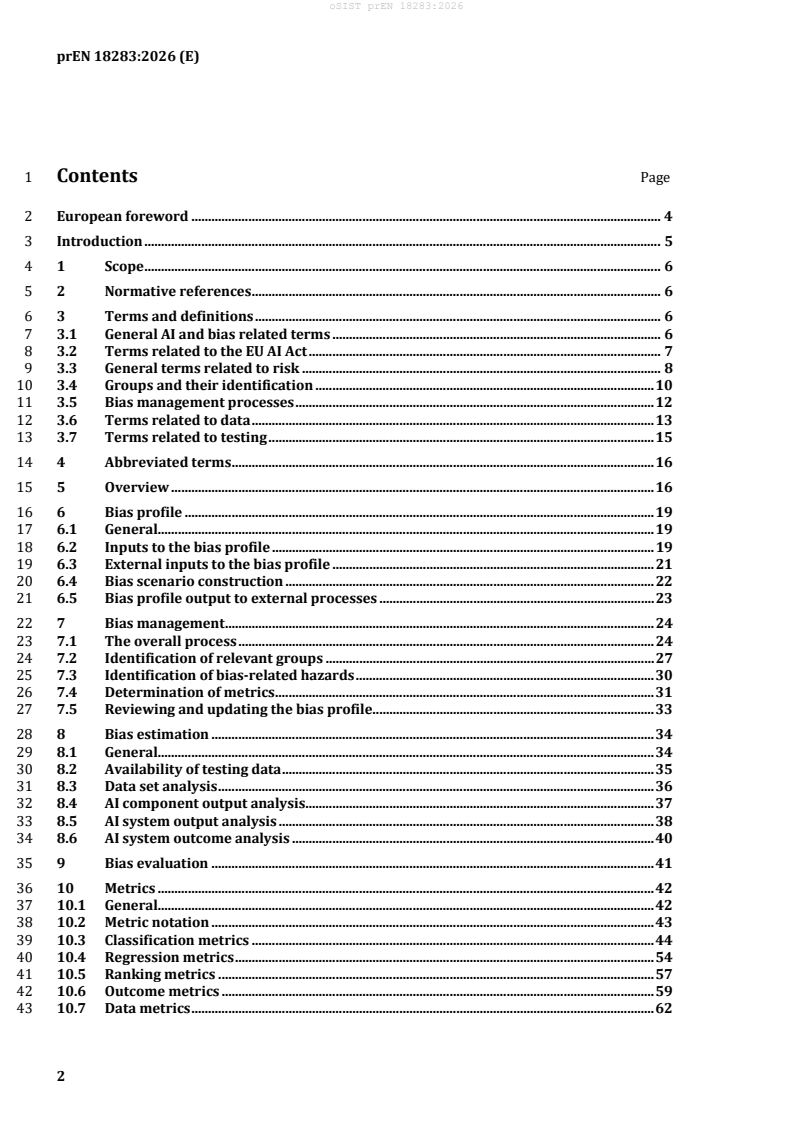
1 Contents Page
2 European foreword . 4
3 Introduction . 5
4 1 Scope . 6
5 2 Normative references . 6
6 3 Terms and definitions . 6
7 3.1 General AI and bias related terms . 6
8 3.2 Terms related to the EU AI Act . 7
9 3.3 General terms related to risk . 8
10 3.4 Groups and their identification . 10
11 3.5 Bias management processes . 12
12 3.6 Terms related to data . 13
13 3.7 Terms related to testing . 15
14 4 Abbreviated terms . 16
15 5 Overview . 16
16 6 Bias profile . 19
17 6.1 General. 19
18 6.2 Inputs to the bias profile . 19
19 6.3 External inputs to the bias profile . 21
20 6.4 Bias scenario construction . 22
21 6.5 Bias profile output to external processes . 23
22 7 Bias management . 24
23 7.1 The overall process . 24
24 7.2 Identification of relevant groups . 27
25 7.3 Identification of bias-related hazards . 30
26 7.4 Determination of metrics . 31
27 7.5 Reviewing and updating the bias profile . 33
28 8 Bias estimation . 34
29 8.1 General. 34
30 8.2 Availability of testing data . 35
31 8.3 Data set analysis . 36
32 8.4 AI component output analysis. 37
33 8.5 AI system output analysis . 38
34 8.6 AI system outcome analysis . 40
35 9 Bias evaluation . 41
36 10 Metrics . 42
37 10.1 General. 42
38 10.2 Metric notation . 43
39 10.3 Classification metrics . 44
40 10.4 Regression metrics . 54
41 10.5 Ranking metrics . 57
42 10.6 Outcome metrics . 59
43 10.7 Data metrics . 62
44 10.8 Meta-metrics . 65
45 11 Metric template . 69
46 12 Bias mitigation . 70
47 12.1 General . 70
48 12.2 Categorizing bias mitigation methods . 71
49 12.3 Template for bias mitigation methods . 72
50 12.4 Bias mitigation methods . 72
51 12.5 Documentation and justification . 77
52 12.6 Bias mitigation and risk management . 78
53 13 Information gathering and consultation . 78
54 13.1 Collection of information and evidence . 78
55 13.2 Consultation of interested parties . 79
56 (informative) Identification of the relevant groups for bias testing Use case: AI-
57 supported consumer-loan eligibility assessment system . 80
58 A.1 Disclaimer . 80
59 A.2 General . 80
60 A.3 Intended purpose of the AI system and potentially affected persons . 80
61 A.4 Data description . 81
62 A.5 Potentially negatively affected persons (including vulnerable groups) . 82
63 A.6 Risk scenarios involving bias-related hazards . 82
64 A.7 Post-market monitoring information . 83
65 A.8 Real-world testing results . 83
66 A.9 Results from previous bias assessments . 83
67 A.10 Categories protected under the EU Charter . 83
68 A.11 Derivation of relevant groups . 84
69 A.12 Identification of intersectionality . 87
70 A.13 State of the art review . 87
71 A.14 Conclusion . 88
72 (informative) Possible causes of bias . 89
73 Annex ZA (informative) Relationship between this European Standard and the requirements
74 of Regulation (EU) 2024/1689 aimed to be covered . 91
75 Bibliography . 92
76 European foreword
77 This document (prEN 18283:2026) has been prepared by Technical Committee CEN/CLC/JTC 21
78 “Artificial Intelligence”, the secretariat of which is held by DS.
79 This document is currently submitted to the CEN Enquiry.
80 This document has been prepared under a standardization request addressed to CEN by the European
81 Commission. The Standing Committee of the EFTA States subsequently approves these requests for its
82 Member States.
83 For the relationship with EU Legislation, see informative Annex ZA, which is an integral part of this
84 document.
85 Introduction
86 This document provides requirements and guidance for the management of bias, in particular unwanted
87 bias, throughout the entire life cycle of an AI system. This document is particularly suitable for bias
88 management in the context of the EU AI Act [1].
89 The document is structured as follows:
90 — Clause 6 defines the bias profile, a set of documents that track the entire bias management process;
91 — Clause 7 describes the bias management process and initiates the bias analysis, describing steps such
92 as identifying the groups to be compared, and the metrics to use;
93 — Clause 8 describes the bias estimation process, going through the testing needed on data, AI
94 components, system output and system outcome;
95 — Clause 9 describes the bias evaluation process, providing details on how to use the results from the
96 bias estimation process for an assessment of the risk arising from observed bias;
97 — Clause 10 defines the various bias metrics that can be used in bias estimation;
98 — Clause 11 describes the template according to which bias metrics are defined;
99 — Clause 12 describes various bias mitigation methods;
100 — Clause 13 describes methods for information collection that can be used throughout the bias
101 management process, as well as providing details on the consultation of interested parties and its use
102 in the bias management process.
103 Throughout this document, quality management system (QMS) is used to refer to the QMS required under
104 Article 17 of the EU AI Act [1], risk management system (RMS) refers to the RMS as required in Article 9,
105 EU AI Act [1], while quality and governance of data sets (QGD) refers to the data governance required
106 under Article 10, EU AI Act [1].
107 1 Scope
108 This document defines concepts, measures and requirements for assessment and treatment of bias in AI
109 systems. This includes bias unwanted by the AI provider and AI deployer according to their specification
110 of the AI system, in the context of the EU AI Act [1].
111 This encompasses consideration of data bias including any data used to build or assess the AI system, but
112 also system or model bias that can result from algorithmic factors, such as algorithm design choices.
113 2 Normative references
114 The following documents are referred to in the text in such a way that some or all of their content
115 constitutes requirements of this document. For dated references, only the edition cited applies. For
116 undated references, the latest edition of the referenced document (including any amendments) applies.
117 EN 18284:—, Artificial Intelligence ̶ Quality and Governance of datasets
118 3 Terms and definitions
119 For the purposes of this document, the following terms and definitions apply.
120 ISO and IEC maintain terminology databases for use in standardization at the following addresses:
121 — ISO Online browsing platform: available at https://www.iso.org/obp/
122 — IEC Electropedia: available at https://www.electropedia.org/
123 3.1 General AI and bias related terms
124 3.1.1
125 bias
126 systematic difference in treatment of certain objects, people or groups (3.4.4) in comparison to others
127 Note 1 to entry: Treatment is any kind of action, including perception, observation, representation, prediction or
128 decision.
129 [SOURCE: EN ISO/IEC 22989:2023, 3.5.4]
130 3.1.2
131 monitoring
132 repeatedly determining the status of a system, a process or an activity using inputs including
133 measurements
134 Note 1 to entry: To determine the status, there can be a need to check, supervise or critically observe.
135 [SOURCE: ISO/IEC Directives Part 1, Consolidated ISO Supplement, Annex SL Appendix 2 (rev 4 2024),
136 3.20 modified – added “repeatedly” and “using inputs including measurements” to the definition]
137 3.1.3
138 outcome
139 consequence of the output (3.1.4) of an activity or process
Under preparation. Stage at the time of publication: prEN 18284:2026
140 3.1.4
141 output
142 data that an information processing system, or any of its parts, transfers outside of that system or part
143 Note 1 to entry: Data includes predictions, content, recommendations, decisions or actions.
144 [SOURCE: ISO/IEC 2382:2015, 2121303, modified — removed domain tag,
145 retained only the admitted term “output”, removed notes to entry, added new note to entry]
146 3.1.5
147 post-market
148 every life cycle stage after putting into service or placing on the market the AI system (3.2.1)
149 [SOURCE: EN 18228:—1 , 3.4.3]
150 3.1.6
151 task
152 function performed by an AI system (3.2.1) that can be independently evaluated
153 Note 1 to entry: Use of different data formats does not constitute a different task.
154 Note 2 to entry: Use of different methods does not warrant delineating different tasks.
155 [SOURCE: EN 18229-4:—1 , 3.4.6]
156 3.1.7
157 unwanted bias
158 bias (3.1.1) that inhibits the AI system (3.2.1) from fulfilling its intended purpose (3.2.2), or that has the
159 potential to adversely affect the health, safety or fundamental rights (3.3.7) of natural persons
160 Note 1 to entry: Unacceptable bias is unwanted bias that fails to meet risk (3.3.4) acceptability criteria (e.g. see
161 EN 18228:— [5], 4.4, for more information on risk (3.3.4) acceptability criteria).
162 3.2 Terms related to the EU AI Act
163 3.2.1
164 AI system
165 artificial intelligence system
166 machine-based system that is designed to operate with varying levels of autonomy and that can exhibit
167 adaptiveness after deployment, and that, for explicit or implicit objectives, infers, from the input it
168 receives, how to generate outputs (3.1.4) such as predictions, content, recommendations, or decisions
169 that can influence physical or virtual environments
170 [SOURCE: Regulation (EU) 2024/1689, Article 3(1), modified — removed “means a”, “may” replaced by
171 “can”]
172 3.2.2
173 intended purpose
174 use for which an AI system (3.2.1) is intended by the provider, including the specific context and
175 conditions of use, as specified in the information supplied by the provider in the instructions for use,
176 promotional or sales materials and statements, as well as in the technical documentation
Under preparation. Stage at the time of publication: prEN 18228:2026
Under preparation. Stage at the time of publication: prEN 18229-4:2026
177 [SOURCE: Regulation (EU) 2024/1689, Article 3(12), modified — removed “means the”, note to entry
178 added]
179 3.2.3
180 reasonably foreseeable misuse
181 use of an AI system (3.2.1) in a way that is not in accordance with its intended purpose (3.2.2), but which
182 can result from reasonably foreseeable human behaviour or interaction with other systems, including
183 other AI systems (3.2.1)
184 Note 1 to entry: Reasonably foreseeable human behaviour includes the behaviour of all types of relevant users
185 Note 2 to entry: Reasonably foreseeable misuse can be intentional or unintentional.
186 [SOURCE: Regulation (EU) 2024/1689, Article 3(13), modified — removed “means the”, “may” replaced
187 by “can”, notes 1 and 2 to entry added]
188 3.2.4
189 real-world conditions testing
190 temporary testing of an AI system (3.2.1) for its intended purpose (3.2.2) in its intended context of use or
191 deployment environment outside a laboratory or otherwise simulated environment
192 [SOURCE: Regulation (EU) 2024/1689, Article 3(57), modified — removed “means the”, replaced “in real-
193 world conditions” with “in its intended context of use or deployment environment”, removed text after
194 “with a view”]
195 3.3 General terms related to risk
196 3.3.1
197 hazard
198 potential source of harm (3.3.3)
199 [SOURCE: ISO/IEC Guide 51:2014, 3.2]
200 3.3.2
201 hazardous situation
202 circumstance in which people, property or the environment is/are exposed to one or more hazards
203 (3.3.1)
204 [SOURCE: ISO/IEC Guide 51:2014, 3.4]
205 3.3.3
206 harm
207 injury or damage to the health of a person or groups (3.4.4) of persons, or interference (3.3.8) with
208 fundamental rights (3.3.7)
209 Note 1 to entry: For the purpose of this document, damage to property or the environment, and the disruption or
210 destruction of critical infrastructure, are considered harms when they can result in injury or damage to the health
211 of a natural person or groups (3.4.4) of persons or interference (3.3.8) with fundamental rights (3.3.7).
212 Note 2 to entry: Interference (3.3.8) with fundamental rights (3.3.7) can be tangible or intangible, physical,
213 psychological, societal or economic, irrespective of the right holder’s awareness, in accordance with EU law,
[10]
214 including the EU Charter on Fundamental Rights.
215 Note 3 to entry: Safety in product safety risk (3.3.4) management standards is understood as the absence of
216 unacceptable risk (3.3.4). In the context of this document, safety refers to the protection from harm (3.3.3) from the
217 use of the AI system (3.2.1).
218 [SOURCE: EN 18228:—, 3.6.3]
219 3.3.4
220 risk
221 combination of the probability of an occurrence of harm (3.3.3) and the severity of that harm (3.3.3)
222 Note 1 to entry: The probability of occurrence includes the exposure to a hazardous situation (3.3.2) and the
223 possibility to avoid or limit the harm (3.3.3).
224 [SOURCE: ISO/IEC Guide 51:2014, 3.9]
225 3.3.5
226 test completion report
227 test summary report
228 report that provides a summary of the testing that was performed
229 [SOURCE: ISO/IEC/IEEE 29119-1:2022, 3.87]
230 3.3.6
231 risk management file
232 set of records and other documents that are produced by risk (3.3.4) management
233 [SOURCE: EN 18228:—, 3.2.11]
234 3.3.7
235 fundamental right
236 basic right(s) and freedom(s) held by every human being irrespective of birth, religion, belief, age, race,
237 ethnicity, sex, gender or any other status
238 Note 1 to entry: For the purposes of this document, fundamental rights and their applicability are those protected
239 by EU law, including the protection of the rights outlined in EU law, including the Charter of Fundamental Rights of
[9] [10]
240 the EU (EU Charter) and the European Convention on Human Rights .
241 Note 2 to entry: Annex C of EN 18228:— [5] provides information about other sources of applicable law governing
242 fundamental rights.
243 [SOURCE: EN 18228:—, 3.5.1, modified – added EN 18228:— reference to Note 2 to entry, removed
244 Note 3 to entry]
245 3.3.8
246 interference
247 impairment of the protection provided
248 Note 1 to entry: An interference does not require any material or immaterial detriment whatsoever. For example, if
249 another person accesses my personal information without my consent, this interferes with my right to privacy
250 irrespective of whether it generated any material detriment to me.
251 Note 2 to entry: The perceptions of affected persons (3.4.1) can correlate with a court’s determination of whether
252 an individual’s fundamental right (3.3.7) has been interfered with. Accordingly, individual and group (3.4.4)
253 perceptions of fundamental rights (3.3.7) adverse impact can be taken into account but are not considered
254 determinative. For example, the use of covert surveillance systems can interfere with an individual's right to
255 privacy, even if the affected person (3.4.1) is not aware of this interference.
256 [SOURCE: EN 18228:—, 3.5.5, modified – Note 2 to entry, replaced persons affected with affected persons]
257 3.4 Groups and their identification
258 3.4.1
259 affected person
260 individual, or group (3.4.4) of individuals, who is or are directly or indirectly impacted by an AI system
261 (3.2.1) when used in accordance with its intended purpose (3.2.2) or in the frame of reasonably foreseeable
262 misuse (3.2.3)
263 Note 1 to entry: Within this document, “potentially affected person” shall mean a person who is potentially affected,
264 i.e. “individual, or group (3.4.4) of individuals, who can potentially be directly or indirectly impacted by an AI system
265 (3.2.1) when used in accordance with its intended purpose (3.2.2) or in the frame of reasonably foreseeable misuse
266 (3.2.3)”.
267 [SOURCE: EN 18286:2026, 3.4.1, modified – Note to entry added to permit the use of “potentially” to
268 modify the noun phrase “affected person”]
269 3.4.2
270 at-risk group
271 group (3.4.4) of potentially affected persons (3.4.1) that can be adversely affected by unwanted bias (3.1.7)
272 in the AI system (3.2.1) when used in accordance with its intended purpose (3.2.2) or in the frame of
273 reasonably foreseeable misuse (3.2.3)
274 Note 1 to entry: Adverse effects include harm (3.3.3) to health or safety, or interference (3.3.8) with fundamental
275 rights (3.3.7).
276 Note 2 to entry: At-risk groups can also emerge from intersections of groups (3.4.4) as described in CEN/CLC
277 ISO/IEC/TR 24027:2023 [12].
278 Note 3 to entry: Unforeseen at-risk groups can emerge due to the use of AI systems (3.2.1), as described in CEN/CLC
279 ISO/IEC/TS 12791:2024 [13], 5.1.5.
280 Note 4 to entry: An at-risk group is not necessarily a vulnerable group (3.4.6).
281 3.4.3
282 category
283 set of one or more related characteristics or circumstances that can be used to delineate or distinguish
284 groups (3.4.4) of people
285 Note 1 to entry: Categories can be quantitative (e.g. height, weight, annual income) or qualitative (e.g. nationality,
286 religion).
287 Note 2 to entry: Categories can be based on demographic criteria (e.g. categories such as age, nationality, ethnicity,
288 gender), socioeconomic criteria (e.g. categories such as class, education level, employment, home ownership), or
289 other criteria related to the person that is the subject of classification (e.g. categories such as language, religion,
290 trade union membership, dress, type of mobile device).
291 Note 3 to entry: For example, within the category of “sex”, one characteristic is “female”, while in the category “age”,
292 “ages 10-18” is a characteristic.
293 Note 4 to entry: Categories can be based on one criterion only (e.g. sex, age, nationality), or on multiple criteria (e.g.
294 sex and age; nationality, age and education level). When based on multiple criteria, this gives rise to
295 intersectionality. Examples of intersectional characteristics include: male over 50 (category sex and age), or
296 Austrian aged 30–45 with university degree (category nationality, age and educational level). See 7.2.
297 3.4.4
298 group
299 subset of objects in a domain that are linked because they have shared characteristics
300 [SOURCE: CEN/CLC ISO/IEC/TR 24027:2023, 3.2.8]
301 3.4.5
302 interested party
303 stakeholder
304 individual, group (3.4.4) or organization that can affect, be affected by or perceive itself to be affected by
305 a decision or activity
306 Note 1 to entry: Affected persons (3.4.1) are a subset of interested parties.
307 Note 2 to entry: Interested party includes relevant regulatory bodies, national public bodies, bodies that enforce the
308 protection of fundamental rights (3.3.7), and market surveillance authorities.
309 [SOURCE: ISO/IEC Directives Part 1, Consolidated ISO Supplement, Annex SL Appendix 2 (rev 4 2024),
310 3.2 – modified to change person to individual in the definition, add group to the definition and add notes
311 to entry]
312 3.4.6
313 vulnerable group
314 group (3.4.4) of persons who, due to socio-economic circumstances or protected characteristics, are more
315 exposed to risk (3.3.4) than they would be without the circumstance or characteristic
316 Note 1 to entry: Vulnerable groups are identified on the basis of the intended purpose (3.2.2) and the reasonably
317 foreseeable misuse (3.2.3) of the AI system (3.2.1). In particular, vulnerability can be linked either to the intended
318 purpose (3.2.2) or to reasonably foreseeable misuse (3.2.3) and does not necessarily occur under both circumstances.
319 Note 2 to entry: Persons under the age of 18 are a vulnerable group.
320 Note 3 to entry: Persons can be in a vulnerable group when they are in socio-economic circumstances that make
321 them dependent on the AI system’s (3.2.1) decisions for their livelihood, or entry to or ability to participate in society.
[9]
322 Note 4 to entry: Protected characteristics are listed in Art. 21 of the EU Charter .
323 Note 5 to entry: Vulnerable groups include persons who are unable take care of themselves or protect themselves
324 against harm (3.3.3) or exploitation, due to their protected characteristics.
325 Note 6 to entry: Vulnerable groups can include persons in power imbalance situations, such as lack of availability
326 or access to individual and collective redress actions available to affected persons (3.4.1), such as the right to
327 compensation, the right to explanation and the right to contest decisions.
328 Note 7 to entry: Circumstances and characteristics can be temporary, for example due to life events such as changes
329 in health status, financial distress or transitional periods such as migration or job loss.
330 Note 8 to entry: A vulnerable group can be an at-risk group (3.4.2).
331 [SOURCE: EN 18228:—, 3.5.10, modified – set replaced by group; clarification added to Note 1 to entry;
332 Note 8 to entry added]
333 3.4.7
334 attribute
335 property or characteristic of an object that can be distinguished quantitatively or qualitatively by human
336 or automated means
337 Note 1 to entry: As used in this document, the term object also includes persons, organizations, and entities, as well
338 as software, data and other immaterial artefacts.
339 [SOURCE: EN 18228:—, 3.5.10, modified – set replaced by group; clarification added to Note 1 to entry;
340 Note 8 to entry added]
341 3.4.8
342 feature
343 quantitative or qualitative representation of an object or event with respect to a set of characteristics
344 Note 1 to entry: A feature can be part of the input data or computed by the AI system (3.2.1).
345 3.5 Bias management processes
346 3.5.1
347 bias management
348 systematic and continuous application of management policies, procedures and practices to the tasks of
349 analysing, evaluating, controlling and monitoring (3.1.2) bias (3.1.1) throughout the entire life cycle of an
350 AI system (3.2.1)
351 [SOURCE: ISO/IEC Guide 63:2019, 3.15, modified — reference to life cycle of the AI system added; “risk”
352 replaced by “bias”]
353 3.5.2
354 bias assessment
355 overall process comprising a bias analysis (3.5.3) and a bias evaluation (3.5.6)
356 Note 1 to entry: Analysing and evaluating bias (3.1.1) supports the examination and detection of bias (3.1.1).
357 [SOURCE: ISO/IEC Guide 51:2014, 3.11, modified — “risk” replaced by “bias”; note to entry added]
358 3.5.3
359 bias analysis
360 systematic use of available information to identify bias-related hazards (3.5.8) and to conduct bias
361 estimation (3.5.4)
362 Note 1 to entry: Identification of bias-related hazards (3.5.8) includes the investigation of possible biases (3.1.1) and
363 their potentially harmful effects that can arise in the context of the AI system’s (3.2.1) intended purpose (3.2.2), as
364 well as the examination of bias (3.1.1) through a variety of approaches, such as data analysis, testing and impact
365 assessments.
366 Note 2 to entry: Available information includes, for example, internal knowledge acquired by the provider in a risk
367 (3.3.4) analysis, as well as information from media, academic publication or incident reporting about similar AI
368 systems (3.2.1).
369 [SOURCE: ISO/IEC Guide 51:2014, 3.10, modified – replaced “hazards” with “bias-related hazards”, and
370 “risk” with “bias-related risk”; notes to entry added]
371 3.5.4
372 bias estimation
373 process used to measure bias (3.1.1)
374 3.5.5
375 bias mitigation
376 bias control
377 process in which decisions are made and actions taken such that risks (3.3.4) associated with unwanted
378 bias (3.1.7) are reduced to, or maintained within, specified levels
379 [SOURCE: ISO/IEC Guide 63:2019, 3.12, modified — inserted “associated with unwanted bias” after
380 “risks”]
381 3.5.6
382 bias evaluation
383 process based on the bias analysis (3.5.3) and in particular the bias estimation (3.5.4), to provide
384 quantitative, statistical means for assessing measured results, which can be used by the risk (3.3.4)
385 assessment to determine whether observed bias (3.1.1) is acceptable or not
386 3.5.7
387 bias profile
388 subset of the risk management file (3.3.6) consisting of a set of documents that are created for recording
389 the bias management (3.5.1) process of an AI system (3.1.1) and that are maintained throughout its life
390 cycle
391 3.5.8
392 bias-related hazard
393 hazard (3.3.1) which is a bias (3.1.1), or which is caused by a bias (3.1.1)
394 Note 1 to entry: biases (3.1.1) that can affect the health and safety of persons, that can have a negative impact on
395 fundamental rights (3.3.7) or that can lead to discrimination are either themselves bias-related hazards, or they are
396 the cause of a bias-related hazard.
397 3.6 Terms related to data
398 3.6.1
399 application domain specification
400 specification which operationalizes the intended purpose (3.2.2) and comprises a description of the real-
401 world process from which samples with the expected occurrence probabilities arise
402 Note 1 to entry: The application domain (3.6.2) specification operationalizes the intended purpose (3.2.2) for data
403 set construction, testing and performance evaluation, and can also be used for risk (3.3.4) assessment.
404 Note 2 to entry: The application domain (3.6.2) specification provides sufficient information for an independent
405 qualified party to understand the relationship between the intended purpose (3.2.2) and the testing data sets (3.6.7)
406 used for evaluation. In particular, it enables that party to derive and justify stochastic proxy sampling approaches
407 used to obtain instances of testing data (3.6.6) and support the interpretation of resulting performance claims.
408 [SOURCE: EN 18284:— , 3.2.9]
409 3.6.2
410 application domain
411 distribution of samples resulting from the execution of the application domain specification (3.6.1)
412 [SOURCE: EN 18284:—, 3.2.10]
Under preparation. Stage at the time of publication: prEN 18284:2026
413 3.6.3
414 proxy sampling process
415 sampling procedure used to obtain data intended to approximate the application domain (3.6.2)
416 Note 1 to entry: Direct sampling from the application domain (3.6.2) is frequently infeasible because of legal, ethical,
417 economic, technical, organizational, geographical, temporal or operational constraints. A proxy sampling process
418 therefore provides a practical mechanism for obtaining testing data (3.6.6) that approximates the application
419 domain (3.6.2) while remaining feasible under the circumstances of data collection.
420 Note 2 to entry: The proxy sampling process induces the distribution from which the testing data set (3.6.7) is
421 actually drawn. Consequently, the testing data set (3.6.7) reflects the proxy sampling process rather than the
422 application domain (3.6.2) directly. The objective of the proxy sampling process is therefore to approximate the
423 application domain (3.6.2) to the greatest extent reasonably achievable and to make any remaining differences
424 explicit and assessable.
425 Note 3 to entry: The validity of functional correctness (3.7.1) estimates depends not only on the quality of the testing
426 data set (3.6.7) itself but also on the degree to which the proxy sampling process approximates the application
427 domain (3.6.2). Material differences between the application domain (3.6.2) and the proxy sampling process can
428 introduce systematic deviations between measured functional correctness (3.7.1) and expected operational
429 functional correctness (3.7.1) and should therefore be identified, justified and documented.
430 [SOURCE: EN 18284:—, 3.2.11]
431 3.6.4
432 process training data
433 data used for training an AI system (3.2.1) through fitting its learnable parameters
434 Note 1 to entry: The purpose of the training data are to provide the AI system (3.2.1) with exposure to the target
435 task (3.1.6), the target population, and the deployment conditions, such that the AI system (3.2.1) learns the
436 generalization of the expected behaviour across the entire application domain (3.6.2).
437 [SOURCE: Regulation (EU) 2024/1689, Article 3(29), modified — “means” removed, Note 1 to entry
438 added]
439 3.6.5
440 validation data
441 data used for providing an evaluation of the trained AI system (3.2.1) and for tuning its non-learnable
442 parameters and its learning process in order, inter alia, to prevent underfitting or overfitting
443 Note 1 to entry: In this document, validation data serves at least two purposes derived from its regulatory definition:
444 tuning of non-learnable parameters and the learning process; and evaluation of the trained AI system (3.2.1) during
445 training to assess whether the system has learned the intended behaviour.
446 [SOURCE: Regulation (EU) 2024/1689, Article 3(30), modified — “means” removed, Note 1 to entry
447 added]
448 3.6.6
449 testing data
450 data used for providing an independent evaluation of the AI system (3.2.1) in order to confirm the
451 expected performance of that system before its placing on the market or putting into service
452 Note 1 to entry: The purpose of the testing data is to provide objective evidence that the performance of the AI
453 system (3.2.1) is fit for the intended purpose (3.2.2) and that performance is acceptable across all risk-relevant
454 groups (3.4.4) and deployment contexts identified in the risk (3.3.4) assessment.
455 [SOURCE: Regulation (EU) 2024/1689, Article 3(32), modified — “means” removed, Note 1 to entry
456 added]
457 3.6.7
458 testing data set
459 data set containing testing data (3.6.6)
460 [SOURCE: EN 18284:—, 3.3.6]
461 3.7 Terms related to testing
462 3.7.1
463 functional correctness
464 degree to which a product or system provides the correct results with the needed degree of precision
465 Note 1 to entry: AI systems (3.2.1), and particularly those using machine learning models, do not usually provide
466 functional correctness in all observed circumstances.
467 Note 2 to entry: Functional correctness relates to the concept of accuracy as referred to in Article 15 of Regulation
468 (EU) 2024/1689.
469 [SOURCE: ISO/IEC 25059:2023, 3.2.3, modified — Note 2 to entry added]
470 3.7.2
471 FWER
472 family-wise error rate
473 maximum probability that one or more true null hypotheses are incorrectly rejected within a specified
474 family of hypothesis tests (3.7.3)
475 Note 1 to entry: The usage of a family-wise error rate guarantees that the overall probability of erroneously
476 accepting an AI system (3.2.1) remains within the preset bounds, even if a larger number of individual hypothesis
477 tests (3.7.3) have to be combined.
478 Note 2 to entry: ISO/IEC 4213: —1 describes accommodating multiple comparisons in 10.10.
479 [SOURCE: EN 18284:—, 3.6.9, modified — FWER added to definition as preferred term; note 1 to entry
480 edited for clarity]
481 3.7.3
482 hypothesis test
483 statistical decision procedure used to determine, on the basis of data obtained from a set of test samples,
484 whether there is sufficient evidence to reject a specified null hypothesis concerning a characteristic of an
485 AI system (3.2.1), while controlling a predefined probability of incorrect rejection
486 Note 1 to entry: For the purposes of this document, the null hypothesis is the a priori assumption that the AI system
487 (3.2.1) is not acceptable according to the given bias testing acceptance criteria. Only if there is positive evidence
488 from a sufficiently large number of samples, can the hypothesis test
...