


EN 15274:2007
(Main)General purpose adhesives for structural assembly - Requirements and test methods
General Information
- Abstract
This European Standard specifies requirements for adhesives intended for use in the creation and general assembly of load-bearing, structural elements used in civil engineering works and the construction of buildings. Other than the exceptions stated, it embraces all combinations of bonded materials, used to create or repair load-bearing elements.
It covers individual adhesives and special purpose kits comprising various combinations of adhesive types and components.
It includes test methods and methods of assessment.
The performance requirements in this standard may not be applicable to highly specialised applications in extreme environmental conditions, e.g. cryogenic use, nor do they cover specialised circumstances such as accidental impact, e.g. due to traffic or ice, or earthquake loading where specific performance requirements will apply.
The intended use is for internal and external construction elements and those cladding and covering elements (excluding ceramic tiles) specifically required, by regulatory authorities, to provide protection from fire in identified building zones, including escape routes.
It does not cover:
Prefabricated, bonded structural components.
Concrete bonded either to itself or steel or a material based on carbon fibre.
Wood, when bonded to itself to form a timber based, laminated beam [of the type known as a ‘Glulam’ beam] intended for use as a major structural, load bearing element.
Thermoplastics [e.g. polyethylene, polypropylene, polyamide and fluorinated polymers in general] unless they have been specifically prepared [usually a specialised oxidative process] for bonded assembly on site.
Co-axial metallic assemblies comprising fasteners- threaded and otherwise, pipes and tubes.
Glass assemblies in structural glazing applications made using silicone adhesives.
Those structural elements that are permanently immersed in water.
- Status
- Withdrawn
- Publication Date
- 31-Oct-2007
- Withdrawal Date
- 22-Sep-2026
- Technical Committee
- CEN/TC 193 - Adhesives
- Drafting Committee
- CEN/TC 193/WG 2 - Structural adhesives
- Current Stage
- 9960 - Withdrawal effective - Withdrawal
- Start Date
- 15-Apr-2015
- Completion Date
- 23-Sep-2026
- Directive
- Harmonized Standard305/2011 - Regulation (eu) No 305/2011 of the European Parliament and of the Council of 9 march 2011 laying down harmonised conditions for the marketing of construction products and repealing council directive 89/106/eecOJ Ref: C, C 259 OJ Date: 08-Aug-2014
Not Harmonized89/106/EEC - Construction productsOJ Ref: C, C 71 OJ Date: 19-Mar-2010

Relations
- Replaced By
EN 15274:2015 - General purpose adhesives for structural assembly - Requirements and test methods - Effective Date
- 22-Apr-2015
- Effective Date
- 28-Jan-2026
- Effective Date
- 28-Jan-2026
- Effective Date
- 28-Jan-2026
- Effective Date
- 28-Jan-2026
- Effective Date
- 28-Jan-2026
- Effective Date
- 28-Jan-2026
- Effective Date
- 28-Jan-2026
- Effective Date
- 28-Jan-2026
- Effective Date
- 28-Jan-2026
- Effective Date
- 28-Jan-2026
- Effective Date
- 28-Jan-2026
- Effective Date
- 28-Jan-2026
- Effective Date
- 28-Jan-2026
- Effective Date
- 28-Jan-2026
Get Certified
Connect with accredited certification bodies for this standard

DIN CERTCO
DIN Group product certification.

Smithers Quality Assessments
US management systems and product certification.
Sponsored listings
Frequently Asked Questions
EN 15274:2007 is a standard published by the European Committee for Standardization (CEN). Its full title is "General purpose adhesives for structural assembly - Requirements and test methods". This standard covers: This European Standard specifies requirements for adhesives intended for use in the creation and general assembly of load-bearing, structural elements used in civil engineering works and the construction of buildings. Other than the exceptions stated, it embraces all combinations of bonded materials, used to create or repair load-bearing elements. It covers individual adhesives and special purpose kits comprising various combinations of adhesive types and components. It includes test methods and methods of assessment. The performance requirements in this standard may not be applicable to highly specialised applications in extreme environmental conditions, e.g. cryogenic use, nor do they cover specialised circumstances such as accidental impact, e.g. due to traffic or ice, or earthquake loading where specific performance requirements will apply. The intended use is for internal and external construction elements and those cladding and covering elements (excluding ceramic tiles) specifically required, by regulatory authorities, to provide protection from fire in identified building zones, including escape routes. It does not cover: Prefabricated, bonded structural components. Concrete bonded either to itself or steel or a material based on carbon fibre. Wood, when bonded to itself to form a timber based, laminated beam [of the type known as a ‘Glulam’ beam] intended for use as a major structural, load bearing element. Thermoplastics [e.g. polyethylene, polypropylene, polyamide and fluorinated polymers in general] unless they have been specifically prepared [usually a specialised oxidative process] for bonded assembly on site. Co-axial metallic assemblies comprising fasteners- threaded and otherwise, pipes and tubes. Glass assemblies in structural glazing applications made using silicone adhesives. Those structural elements that are permanently immersed in water.
This European Standard specifies requirements for adhesives intended for use in the creation and general assembly of load-bearing, structural elements used in civil engineering works and the construction of buildings. Other than the exceptions stated, it embraces all combinations of bonded materials, used to create or repair load-bearing elements. It covers individual adhesives and special purpose kits comprising various combinations of adhesive types and components. It includes test methods and methods of assessment. The performance requirements in this standard may not be applicable to highly specialised applications in extreme environmental conditions, e.g. cryogenic use, nor do they cover specialised circumstances such as accidental impact, e.g. due to traffic or ice, or earthquake loading where specific performance requirements will apply. The intended use is for internal and external construction elements and those cladding and covering elements (excluding ceramic tiles) specifically required, by regulatory authorities, to provide protection from fire in identified building zones, including escape routes. It does not cover: Prefabricated, bonded structural components. Concrete bonded either to itself or steel or a material based on carbon fibre. Wood, when bonded to itself to form a timber based, laminated beam [of the type known as a ‘Glulam’ beam] intended for use as a major structural, load bearing element. Thermoplastics [e.g. polyethylene, polypropylene, polyamide and fluorinated polymers in general] unless they have been specifically prepared [usually a specialised oxidative process] for bonded assembly on site. Co-axial metallic assemblies comprising fasteners- threaded and otherwise, pipes and tubes. Glass assemblies in structural glazing applications made using silicone adhesives. Those structural elements that are permanently immersed in water.
EN 15274:2007 is classified under the following ICS (International Classification for Standards) categories: 83.180 - Adhesives. The ICS classification helps identify the subject area and facilitates finding related standards.
EN 15274:2007 has the following relationships with other standards: It is inter standard links to EN 15274:2015, EN ISO 9664:1995, EN 1242:2013, EN 1067:2005, EN 13999-1:2013, EN ISO 11339:2022, EN 923:2005, EN ISO 14896:2009, EN ISO 10364:2024, EN 13999-3:2007+A1:2009, EN ISO 11909:2025, EN 1877-2:2000, EN ISO 15605:2004, EN ISO 9142:2003, EN 13999-4:2007+A1:2009. Understanding these relationships helps ensure you are using the most current and applicable version of the standard.
EN 15274:2007 is associated with the following European legislation: EU Directives/Regulations: 305/2011, 89/106/EEC; Standardization Mandates: M/127. When a standard is cited in the Official Journal of the European Union, products manufactured in conformity with it benefit from a presumption of conformity with the essential requirements of the corresponding EU directive or regulation.
EN 15274:2007 is available in PDF format for immediate download after purchase. The document can be added to your cart and obtained through the secure checkout process. Digital delivery ensures instant access to the complete standard document.
Standards Content (Sample)
2003-01.Slovenski inštitut za standardizacijo. Razmnoževanje celote ali delov tega standarda ni dovoljeno.Lepila za splošne namene montaže v gradbeništvu - Zahteve in preskusne metodeKlebstoffe für allgemeine Anwendungen bei der Anwendung in strukturellen Fügeteilanordnungen - Anforderungen und PrüfverfahrenAdhésifs structuraux pour applications générales - Exigences et méthodes d'essaiGeneral purpose adhesives for structural assembly - Requirements and test methods83.180LepilaAdhesivesICS:Ta slovenski standard je istoveten z:EN 15274:2007SIST EN 15274:2009en,fr,de01-januar-2009SIST EN 15274:2009SLOVENSKI
STANDARD
EUROPEAN STANDARDNORME EUROPÉENNEEUROPÄISCHE NORMEN 15274November 2007ICS 83.180 English VersionGeneral purpose adhesives for structural assembly -Requirements and test methodsAdhésifs structuraux pour applications générales -Exigences et méthodes d'essaiKlebstoffe für allgemeine Anwendungen in strukturellenKlebverbunden - Anforderungen und PrüfverfahrenThis European Standard was approved by CEN on 8 September 2007.CEN members are bound to comply with the CEN/CENELEC Internal Regulations which stipulate the conditions for giving this EuropeanStandard the status of a national standard without any alteration. Up-to-date lists and bibliographical references concerning such nationalstandards may be obtained on application to the CEN Management Centre or to any CEN member.This European Standard exists in three official versions (English, French, German). A version in any other language made by translationunder the responsibility of a CEN member into its own language and notified to the CEN Management Centre has the same status as theofficial versions.CEN members are the national standards bodies of Austria, Belgium, Bulgaria, Cyprus, Czech Republic, Denmark, Estonia, Finland,France, Germany, Greece, Hungary, Iceland, Ireland, Italy, Latvia, Lithuania, Luxembourg, Malta, Netherlands, Norway, Poland, Portugal,Romania, Slovakia, Slovenia, Spain, Sweden, Switzerland and United Kingdom.EUROPEAN COMMITTEE FOR STANDARDIZATIONCOMITÉ EUROPÉEN DE NORMALISATIONEUROPÄISCHES KOMITEE FÜR NORMUNGManagement Centre: rue de Stassart, 36
B-1050 Brussels© 2007 CENAll rights of exploitation in any form and by any means reservedworldwide for CEN national Members.Ref. No. EN 15274:2007: ESIST EN 15274:2009
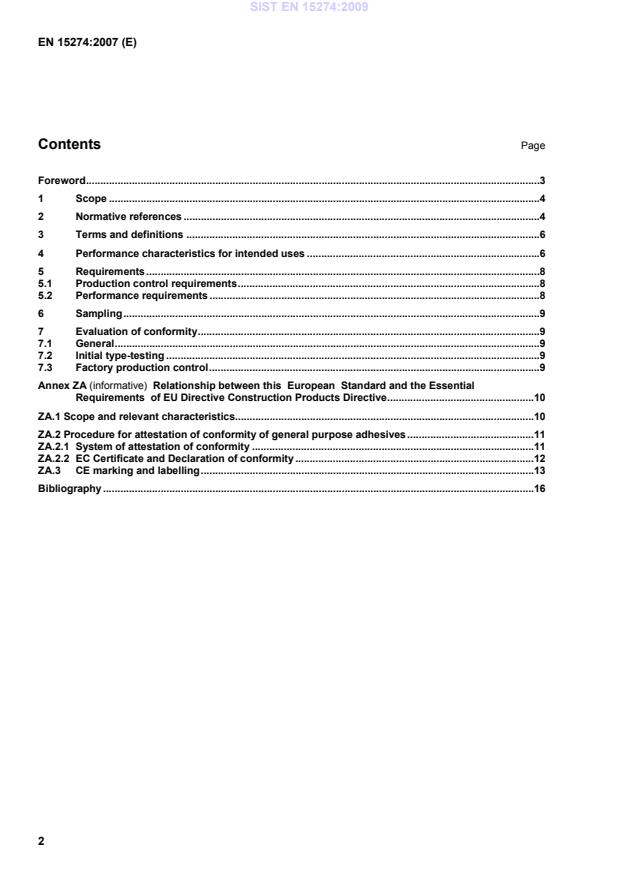
Relationship between this
European
Standard and the Essential Requirements
of EU Directive Construction Products Directive.10 ZA.1 Scope and relevant characteristics.10 ZA.2 Procedure for attestation of conformity of general purpose adhesives.11 ZA.2.1 System of attestation of conformity.11 ZA.2.2 EC Certificate and Declaration of conformity.12 ZA.3 CE marking and labelling.13 Bibliography.16
Glass assemblies in structural glazing applications made using silicone adhesives.
Those structural elements that are permanently immersed in water. 2 Normative references The following referenced documents are indispensable for the application of this document. For dated references, only the edition cited applies. For undated references, the latest edition of the referenced document (including any amendments) applies. EN 923:2005, Adhesives - Terms and definitions EN 1067, Adhesives - Examination and preparation of samples for testing EN 1242, Adhesives - Determination of isocyanate content EN 1465, Adhesives - Determination of tensile lap-shear strength of rigid-to-rigid bonded assemblies (ISO 4587:1979 modified) SIST EN 15274:2009
EN ISO 9142, Adhesives - Guide to the selection of standard laboratory ageing conditions for testing bonded joints (ISO 9142:2003)
EN ISO 9664, Adhesives - Test methods for fatigue properties of structural adhesives in tensile shear (ISO 9664:1993) EN ISO 11339, Adhesives - T-peel test for flexible-to-flexible bonded assemblies (ISO 11339:2003) EN ISO 11909, Binders for paints and varnishes - Polyisocyanate resins - General methods of test (ISO 11909:2007) EN ISO 14896, Plastics - Polyurethane raw materials - Determination of isocyanate content (ISO 14896:2000) EN ISO 15605, Adhesives - Sampling (ISO 15605:2000) SIST EN 15274:2009
Performance characteristics for intended uses The manufacturer shall undertake initial performance tests on the product in accordance with Table 1.
The measurement temperature is (23 ± 2) °C. For measurements obtained at other temperatures, record the temperature with the value. SIST EN 15274:2009
MPa EN 1465 Explain the used adherend material, surface treatment and thickness of adhesive layer in the technical documentation of the product, because this has an influence to the measured value.
2 Tensile strength b) MPa EN ISO 527-2 EN ISO 527-3 3 Young’s modulus
MPa EN ISO 527-2 EN ISO 527-3 For very brittle adhesives it may be more suitable to perform flexural tests instead of tensile, e.g. the EN ISO 178. This is also depending from available test equipment. Especially for production control the test should be easy to perform and show reliable results. 4 Fatigue strength b) MPa EN ISO 9664 Shear stress determined at a specific number of fault test cycles. 5 Heat resistance
°C EN ISO 75-3 Determination of temperature of deflection under load. Heat resistance can also be determined by means of the determination of glass transition temperature according to EN ISO 6721-2. 6 Creep b)
EN 15336
7 Environmental durability
EN ISO 9142
Durability shall be measured by means of the change of the bond shear strength (according to EN 1465) after an ageing test according to EN ISO 9142 conditions. Manufacturer shall declare the relevant ageing conditions for the specific application. 8 Release of dangerous substances µg/m3 EN 13999 (all parts)
9 Impact resistance b) N/mm EN ISO 11339
10 Pot life (working life)
Minutes EN 14022 Only suitable for two component products. a Instead of the reference test method other test methods may be more suitable, depending from the type of adhesive e.g. Therefore additional test methods are possible for factory production control provided that
the producer demonstrates sufficient correlation. b The determination of these additional performance characteristics is only partly needed for specific applications by demand of the user or operator and when subject to regulations.
WARNING — The properties of the bonded joint may be adversely affected by fire and therefore appropriate protection measures will need to be taken where fire is anticipated. SIST EN 15274:2009
Serious errors will be detected by a careful visual judgment of the material. The visual check judges the colour and the colour properties (clear / cloudy) as well as the surface structure (fineness of grind, gloss) of the material. If the material has to fulfil not only functional requirements but esthetic ones as well, the visual aspect of the material and/or application becomes increasingly important. In this case, the material has to be compared to references. References can be colour charts, customer or standard laboratory samples. If there is any doubt, following measurements have to be made.
2 Epoxy equivalent EN 1877-1 Determination of epoxy equivalent (only suitable for two component epoxy) 3 Amine functions EN 1877-2 Deter
...