


prEN 13782
(Main)Temporary structure - Tents - Safety
Temporary structure - Tents - Safety
This document specifies safety requirements which need to be observed at design, calculation, manufacture, installation, maintenance, of mobile, temporary installed tents with more than 50 m2 ground area.
This document applies also to multiple small tents which are normally not covered by this document and will be installed close together and exceed 50 m2 in sum.
NOTE Information is given in Annex C on examination and approval.
Fliegende Bauten - Zelte - Sicherheit
Dieses Dokument legt Sicherheitsanforderungen fest, die bei der Konstruktion, Berechnung, Fertigung, Montage und Wartung von mobilen, vorübergehend aufgebauten Zelten mit einer Grundfläche von mehr als 50 m2 beachtet werden müssen.
Dieses Dokument gilt auch für Gruppen von üblicherweise nicht durch dieses Dokument abgedeckten kleinen Zelten, wenn diese nahe beieinander aufgebaut werden und die Gesamtfläche der Zeltgruppe mehr als 50 m2 beträgt.
ANMERKUNG Informationen zu Prüfung und Zulassung sind in Anhang C angegeben.
Structure temporaire - Tentes - Sécurité
Le présent document spécifie les exigences de sécurité devant être observées lors de la conception, du calcul, de la fabrication, de l'installation et de la maintenance des tentes mobiles installées temporairement ayant une surface au sol supérieure à 50 m2.
Le présent document s’applique également à des tentes de petite taille qui ne sont normalement pas couvertes par le présent document et qui, installées côte à côte, représentent au total une surface supérieure à 50 m2.
NOTE L'Annexe C fournit des informations sur les examens et l’homologation.
Začasne konstrukcije - Šotori - Varnost
General Information
- Status
- Not Published
- Publication Date
- 04-Nov-2026
- Technical Committee
- CEN/TC 152 - Fairground and amusement park machinery and structures - Safety
- Drafting Committee
- CEN/TC 152/WG 2 - Tents
- Current Stage
- 4599 - Dispatch of FV draft to CMC - Finalization for Vote
- Start Date
- 15-May-2026
- Due Date
- 30-Mar-2026
- Completion Date
- 15-May-2026

Relations
- Effective Date
- 28-Jan-2026
- Effective Date
- 28-Jan-2026
- Effective Date
- 28-Jan-2026
- Effective Date
- 28-Jan-2026
- Effective Date
- 28-Jan-2026
- Effective Date
- 28-Jan-2026
- Effective Date
- 26-Jun-2024
Overview
The prEN 13782 standard, developed by the European Committee for Standardization (CEN), specifies comprehensive safety requirements for the design, calculation, manufacture, installation, and maintenance of temporary structures, specifically mobile and temporarily installed tents with a ground area exceeding 50 m². It also applies to clusters of smaller tents installed adjacently that collectively exceed 50 m². The standard aims to ensure structural safety, stability, and usability of temporary tents used in various applications while addressing risks associated with wind, snow, seismic forces, and other environmental loads.
This standard is essential for manufacturers, designers, and installers of temporary tents to comply with the latest safety norms and achieve reliable performance throughout the tent’s lifecycle-from initial design to dismantling.
Key Topics
Design and Analysis
prEN 13782 covers detailed requirements for design documentation, construction drawings, and methods of structural analysis. It mandates careful selection and verification of materials and components, including technical textiles and their connections.Load Calculations
The standard provides guidelines for calculating permanent, live, wind, snow, and seismic loads, alongside the appropriate combination of these dynamic forces for safety verification.Structural Stability
Verification of stability against overturning, sliding, and lifting is included to ensure tents remain anchored and secure under adverse conditions. It also addresses ballast mountings, wind bracing, and membrane prestressing.Anchorage and Foundation
Specifications for ground anchorages, including weight and rod anchors with test protocols for load-bearing capacities, ensure the tent’s secure installation on various terrains.Manufacture and Installation
It highlights quality control requirements during manufacturing, certification, and adherence to design specifications. Installation and operational procedures are described for safe setup and use.Special Design Considerations
Additional criteria address emergency escape routes, fire safety measures, heating and electrical equipment, textile connections, and structural component resistance.Examination and Approval
Annex C offers guidance on examination, testing, approval processes, qualifications of inspectors, and maintenance of a tent book documenting inspections and repairs.
Applications
The prEN 13782 standard is crucial for multiple sectors including:
- Event and exhibition tent installations
- Temporary shelters and emergency relief tents
- Large commercial tents for markets, fairs, and hospitality
- Circus tents and membrane structures requiring specific double-curved design considerations
- Construction sites and sporting events with temporary tented spaces
By adhering to this standard, stakeholders can ensure tents provide adequate safety under environmental stresses, protect occupants, and minimize risk of accidents due to structural failure.
Related Standards
- EN 1991 (Eurocode 1): Actions on Structures - Provides foundational principles for load calculations, particularly wind, snow, and seismic actions referenced in prEN 13782.
- ISO 10855 - Standards related to temporary structures, site safety, and anchorage systems.
- EN 13501 - Fire classification for building materials and components applicable to tent fabric covering.
- EN 1891 / EN 354 - Standards covering synthetic fiber ropes and safety components relevant to tent anchorage and assembly.
Summary
prEN 13782 is a vital European standard establishing safety requirements across the lifecycle of temporary tents larger than 50 m². It integrates structural engineering principles with practical guidelines for materials, design actions, stability verification, anchoring, and maintenance. This standard enhances safety for operators and occupants, ensures compliance across EU member states, and supports reliable, durable temporary structures in diverse applications. Transitioning from EN 13782:2015 to this updated prEN 13782:2025 edition reflects the ongoing commitment to adapt and improve safety standards for mobile and temporary tent structures.
Get Certified
Connect with accredited certification bodies for this standard

DIBt (Deutsches Institut für Bautechnik)
German Institute for Building Technology.
DIN CERTCO
DIN Group product certification.

Aboma Certification B.V.
Specialized in construction, metal, and transport sectors.
Sponsored listings
Frequently Asked Questions
prEN 13782 is a draft published by the European Committee for Standardization (CEN). Its full title is "Temporary structure - Tents - Safety". This standard covers: This document specifies safety requirements which need to be observed at design, calculation, manufacture, installation, maintenance, of mobile, temporary installed tents with more than 50 m2 ground area. This document applies also to multiple small tents which are normally not covered by this document and will be installed close together and exceed 50 m2 in sum. NOTE Information is given in Annex C on examination and approval.
This document specifies safety requirements which need to be observed at design, calculation, manufacture, installation, maintenance, of mobile, temporary installed tents with more than 50 m2 ground area. This document applies also to multiple small tents which are normally not covered by this document and will be installed close together and exceed 50 m2 in sum. NOTE Information is given in Annex C on examination and approval.
prEN 13782 is classified under the following ICS (International Classification for Standards) categories: 91.040.99 - Other buildings. The ICS classification helps identify the subject area and facilitates finding related standards.
prEN 13782 has the following relationships with other standards: It is inter standard links to EN ISO 17635:2025, EN ISO 10855-1:2024, EN 13852-1:2025, EN ISO 11970:2025, EN ISO 10855-3:2024, EN ISO 15614-5:2024, EN 13782:2015. Understanding these relationships helps ensure you are using the most current and applicable version of the standard.
prEN 13782 is available in PDF format for immediate download after purchase. The document can be added to your cart and obtained through the secure checkout process. Digital delivery ensures instant access to the complete standard document.
Standards Content (Sample)
SLOVENSKI STANDARD
01-januar-2026
Začasne konstrukcije - Šotori - Varnost
Temporary structure - Tents - Safety
Fliegende Bauten - Zelte - Sicherheit
Structure temporaire - Tentes - Sécurité
Ta slovenski standard je istoveten z: prEN 13782
ICS:
91.040.99 Druge stavbe Other buildings
2003-01.Slovenski inštitut za standardizacijo. Razmnoževanje celote ali delov tega standarda ni dovoljeno.
DRAFT
EUROPEAN STANDARD
NORME EUROPÉENNE
EUROPÄISCHE NORM
November 2025
ICS 91.040.99 Will supersede EN 13782:2015
English Version
Temporary structure - Tents - Safety
Structure temporaire - Tentes - Sécurité Fliegende Bauten - Zelte - Sicherheit
This draft European Standard is submitted to CEN members for enquiry. It has been drawn up by the Technical Committee
CEN/TC 152.
If this draft becomes a European Standard, CEN members are bound to comply with the CEN/CENELEC Internal Regulations
which stipulate the conditions for giving this European Standard the status of a national standard without any alteration.
This draft European Standard was established by CEN in three official versions (English, French, German). A version in any other
language made by translation under the responsibility of a CEN member into its own language and notified to the CEN-CENELEC
Management Centre has the same status as the official versions.
CEN members are the national standards bodies of Austria, Belgium, Bulgaria, Croatia, Cyprus, Czech Republic, Denmark, Estonia,
Finland, France, Germany, Greece, Hungary, Iceland, Ireland, Italy, Latvia, Lithuania, Luxembourg, Malta, Netherlands, Norway,
Poland, Portugal, Republic of North Macedonia, Romania, Serbia, Slovakia, Slovenia, Spain, Sweden, Switzerland, Türkiye and
United Kingdom.
Recipients of this draft are invited to submit, with their comments, notification of any relevant patent rights of which they are
aware and to provide supporting documentation.
Warning : This document is not a European Standard. It is distributed for review and comments. It is subject to change without
notice and shall not be referred to as a European Standard.
EUROPEAN COMMITTEE FOR STANDARDIZATION
COMITÉ EUROPÉEN DE NORMALISATION
EUROPÄISCHES KOMITEE FÜR NORMUNG
CEN-CENELEC Management Centre: Rue de la Science 23, B-1040 Brussels
© 2025 CEN All rights of exploitation in any form and by any means reserved Ref. No. prEN 13782:2025 E
worldwide for CEN national Members.
Page
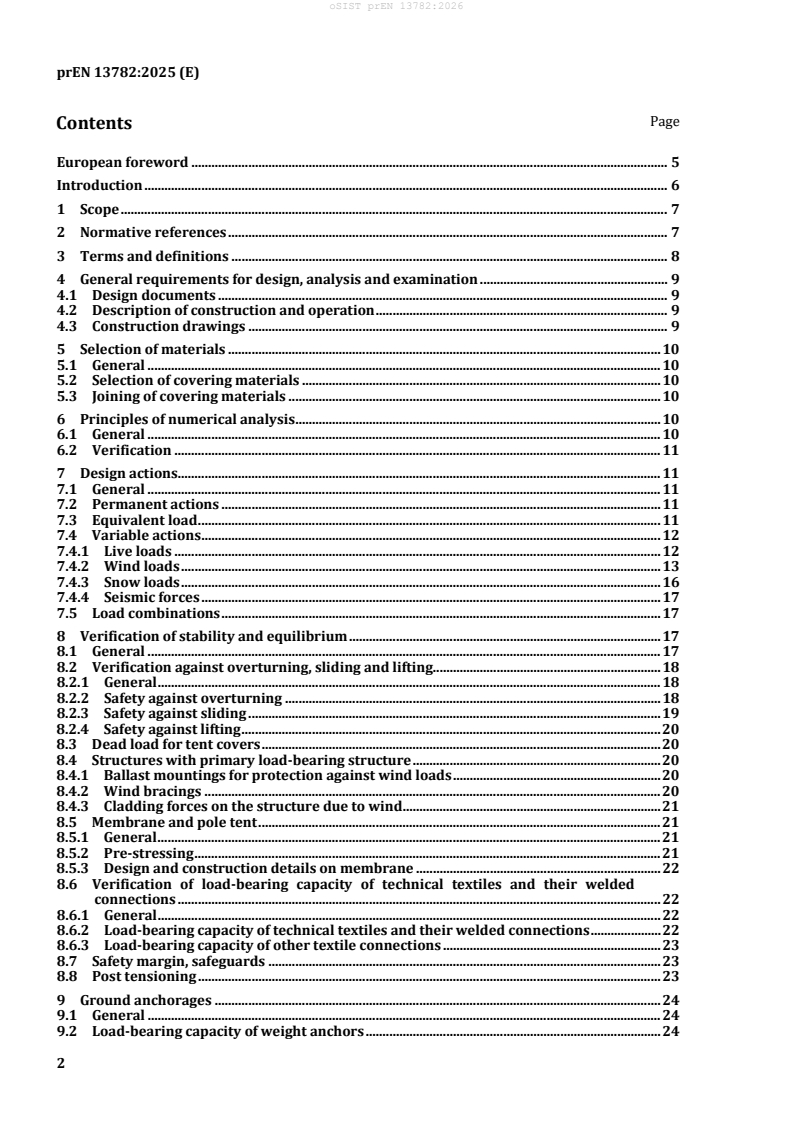
Contents
European foreword . 5
Introduction . 6
1 Scope . 7
2 Normative references . 7
3 Terms and definitions . 8
4 General requirements for design, analysis and examination . 9
4.1 Design documents . 9
4.2 Description of construction and operation . 9
4.3 Construction drawings . 9
5 Selection of materials . 10
5.1 General . 10
5.2 Selection of covering materials . 10
5.3 Joining of covering materials . 10
6 Principles of numerical analysis . 10
6.1 General . 10
6.2 Verification . 11
7 Design actions . 11
7.1 General . 11
7.2 Permanent actions . 11
7.3 Equivalent load . 11
7.4 Variable actions . 12
7.4.1 Live loads . 12
7.4.2 Wind loads . 13
7.4.3 Snow loads . 16
7.4.4 Seismic forces . 17
7.5 Load combinations . 17
8 Verification of stability and equilibrium . 17
8.1 General . 17
8.2 Verification against overturning, sliding and lifting. 18
8.2.1 General . 18
8.2.2 Safety against overturning . 18
8.2.3 Safety against sliding . 19
8.2.4 Safety against lifting . 20
8.3 Dead load for tent covers . 20
8.4 Structures with primary load-bearing structure . 20
8.4.1 Ballast mountings for protection against wind loads . 20
8.4.2 Wind bracings . 20
8.4.3 Cladding forces on the structure due to wind . 21
8.5 Membrane and pole tent . 21
8.5.1 General . 21
8.5.2 Pre-stressing . 21
8.5.3 Design and construction details on membrane . 22
8.6 Verification of load-bearing capacity of technical textiles and their welded
connections . 22
8.6.1 General . 22
8.6.2 Load-bearing capacity of technical textiles and their welded connections . 22
8.6.3 Load-bearing capacity of other textile connections . 23
8.7 Safety margin, safeguards . 23
8.8 Post tensioning . 23
9 Ground anchorages . 24
9.1 General . 24
9.2 Load-bearing capacity of weight anchors . 24
9.3 Load-bearing capacity of rod anchors . 24
9.4 Test loadings on site . 27
9.5 Calculation of loading capacities . 27
9.6 Further requirements . 27
9.7 Ground support for packing . 28
10 Other structural components. 28
10.1 General . 28
10.2 Design resistance . 29
10.3 Synthetic fibre ropes . 29
10.4 Ratchets . 29
11 Manufacture and supply . 30
11.1 General . 30
11.2 Certificates . 30
11.3 Observation of the design specification . 30
11.4 Description of installation and operation procedures. 30
12 Special design and manufacture criteria . 30
Annex A (normative) Use of anti-slip mats . 31
A.1 General . 31
A.2 Discard maturity . 31
Annex B (informative) Special design and manufacture criteria and operation. 32
B.1 General . 32
B.2 Escape routes . 32
B.2.1 Common recommendations. 32
B.2.2 Design of emergency exits . 32
B.2.3 Layout of escape routes . 32
B.3 Stairs . 32
B.4 Burning behaviour . 33
B.5 Textile connection . 33
B.6 Heating and cooking systems . 33
B.7 Electrical equipment . 34
B.8 Fire extinguishers . 34
Annex C (informative) Examination and approval . 35
C.1 Examination . 35
C.1.1 General. 35
C.1.2 Qualification . 35
C.2 Procedures for examination, test and approval . 35
C.2.1 General. 35
C.2.2 Identification . 35
C.2.3 Initial approval of tents . 36
C.2.4 Inspection after repair, modification and accidents . 36
C.2.5 Report . 36
C.3 Tent book . 36
C.3.1 General. 36
C.3.2 Content . 37
C.4 Periodic thorough examination . 37
C.5 Installation examination . 37
C.5.1 General. 37
C.5.2 Extent of installation examination . 37
Annex D (normative) Tents with extended setup duration . 39
D.1 General . 39
D.2 Design method . 39
D.3 Requirements . 39
D.4 Regular inspections . 39
Annex E (informative) Examples of design methodology for closed double curved Big
top tents, non-circular Circus tents and pole tents . 40
E.1 Big top tents . 40
E.2 Double curved circular (Circus) tents . 40
E.3 Single curved pole tents . 40
Bibliography. 41
European foreword
This document (prEN 13782:2025) has been prepared by Technical Committee CEN/TC "Fairground
and amusement park machinery and structures - Safety", the secretariat of which is held by UNI.
This document is currently submitted to the CEN Enquiry.
This document will supersede EN 13782:2015 [1] .
[1] :
— [whole document] editorially revised and adjusted to the spelling of Eurocodes;
— [2] Normative References updated;
— [3.6] new term "anti-slip mat" added;
— [former Annex A] moved to 7.4.2.3.3;
— [8.2.3] Table 3 amended to include "anti-slip mats";
— [8.6] a distinction is made between welded connections (8.6.2) and non-welded connections
(8.6.3);
— [new Annex A] on the use of anti-slip mats added;
— [Annex D] on tents with extended setup durations added;
— [Annex E ] on examples of design methodology for closed double curved Big top tents, non-circular
Circus tents and pole tents added.
Introduction
The object of this document is to provide safety requirements for tents. The safety requirements are
aimed to safe-guard persons and objects against damage caused by design, manufacturing and operation
of these structures.
These guidelines have been drawn up according to past experience and risk analysis.
Existing national rules concerning health and safety of workers remain untouched.
1 Scope
This document specifies safety requirements which need to be observed at design, calculation,
manufacture, installation, maintenance, of mobile, temporary installed tents with more than 50 m
ground area.
This document applies also to multiple small tents which are normally not covered by this document
and will be installed close together and exceed 50 m in sum.
NOTE Information is given in Annex C on examination and approval.
2 Normative references
The following documents are referred to in the text in such a way that some or all of their content
constitutes requirements of this document. For dated references, only the edition cited applies. For
undated references, the latest edition of the referenced document (including any amendments) applies.
ISO 2602, Statistical interpretation of test results — Estimation of the mean — Confidence interval
EN 818-1, Short link chain for lifting purposes - Safety - Part 1: General conditions of acceptance
EN 818-2, Short link chain for lifting purposes - Safety - Part 2: Medium tolerance chain for chain slings -
Grade 8
EN 818-3, Short link chain for lifting purposes - Safety - Part 3: Medium tolerance chain for chain slings -
Grade 4
EN 818-4, Short link chain for lifting purposes - Safety - Part 4: Chain slings - Grade 8
EN 818-5, Short link chain for lifting purposes - Safety - Part 5: Chain slings - Grade 4
EN 818-6, Short link chain for lifting purposes - Safety - Part 6: Chain slings - Specification for information
for use and maintenance to be provided by the manufacturer
EN 818-7, Short link chain for lifting purposes - Safety - Part 7: Fine tolerance hoist chain, Grade T (Types
T, DAT and DT)
EN ISO 1141, Fibre ropes - Polyester - 3-, 4-, 8- and 12-strand ropes (ISO 1141:2021)
EN ISO 1346, Fibre ropes - Polypropylene split film, monofilament and multifilament (PP2) and
polypropylene high-tenacity multifilament (PP3) - 3-, 4-, 8- and 12-strand ropes (ISO 1346:2021)
EN ISO 1969, Fibre ropes - Polyethylene - 3- and 4-strand ropes (ISO 1969:2004)
EN 1990, Eurocode - Basis of structural and geotechnical design
EN 1991-1-1, Eurocode 1: Actions on structures - Part 1-1: General actions - Densities, self-weight, imposed
loads for buildings
EN 1991-1-2, Eurocode 1 - Actions on structures – Part 1-2: Actions on structures exposed to fire
EN 1991-1-3, Eurocode 1 - Actions on structures - Part 1-3: General actions - Snow loads
EN 1991-1-3, Eurocode 1 - Actions on structures - Part 1-3: Snow loads
EN 1991-1-4, Eurocode 1: Actions on structures - Part 1-4: General actions - Wind actions
EN 1991-1-4:2005/AC, Eurocode 1: Actions on structures - Part 1-4: General actions - Wind actions
EN 1991-1-5, Eurocode 1 - Actions on structures - Part 1-5: Thermal actions
EN 1991-1-6, Eurocode 1 - Actions on structures Part 1-6: General actions - Actions during execution
EN 1991-1-7, Eurocode 1 - Actions on structures - Part 1-7: General actions - Accidental actions
EN 1991-1-9, Eurocode 1 - Actions on structures - Part 1-9: Atmospheric icing
EN 1991-2, Eurocode 1 - Actions on structures - Part 2: Traffic loads on bridges and other civil engineering
works
EN 1991-3, Eurocode 1 - Actions on structures - Part 3: Actions induced by cranes and machinery
EN 1991-4, Eurocode 1 - Actions on structures - Part 4: Silos and tanks
EN 1997-1, Eurocode 7 - Geotechnical design - Part 1: General rules
EN ISO 7010, Graphical symbols - Safety colours and safety signs - Registered safety signs (ISO 7010:2019,
Corrected version 2020-06)
EN 12385-1, Steel wire ropes - Safety - Part 1: General requirements
EN 12385-2, Steel wire ropes - Safety - Part 2: Definitions, designation and classification
EN 12385-3, Steel wire ropes - Safety - Part 3: Information for use and maintenance
EN 12385-4, Steel wire ropes - Safety - Part 4: Stranded ropes for general lifting applications
EN 15619, Rubber or plastic coated fabrics - Safety of temporary structures (tents) - Specification for
coated fabrics intended for tents and related structures
Execution of steel structures and aluminium structures
VDI 2700 Part 15:2009, Securing of loads on road vehicles - Slip-inhibiting materials
3 Terms and definitions
For the purposes of this document, the following terms and definitions apply/ the terms and definitions
given in. and the following apply.
— ISO Online browsing platform: available at http://www.iso.org/obp
— IEC Electropedia: available at http://www.electropedia.org/
3.1
tent
mobile, temporary installed structure enclosed with covers (textiles, foils) or partly with rigid elements
Note 1 to entry: It can be built as an enclosed or open building i.e. marquee, tent-hall, booth.
3.1.1
tent with primary load-bearing structure
load-bearing structure with enclosing elements
EXAMPLE Structures with primary load-bearing structure can be roofs, frameworks, post-and-beam
system.
3.1.2
membrane tent
tent (3.1) with a load-bearing pre-stressed textile structure with double curved shape, supported by
masts and/or cables
3.1.3
pole tent
tent (3.1) with centre poles, where guying is used to stabilize the fabric covering
3.2
initial approval
design and calculation review, verification, examinations and tests necessary for tent (3.1) operation
3.3
modification
alteration of a tent (3.1) which results in a departure from the original design specification
3.4
repair
restorations of worn, damaged or decayed parts back to the original design specification
3.5
maintenance
inspection and replacement of components as necessary
3.6
anti-slip mat
slip-inhibiting material with a specific friction coefficient of 𝜇𝜇 = 0,60
[SOURCE: VDI 2700 Part 15:2009 [2]]
4 General requirements for design, analysis and examination
4.1 Design documents
The design documents shall include information for the verification of the stability, resistance and
operating safety, especially a description of the construction and operation, the stability verification and
design drawings as well as relevant documents concerning the burning behaviour.
The documents shall include all the possible configurations of the tent (3.1).
4.2 Description of construction and operation
The tent (3.1), in particular its design and utilization and its static system shall be explained in this
description.
The description shall include details of the particular features of the tents and of any alternative modes
of installation which may exist, also details of the main dimensions, limitations, design particulars and
materials.
4.3 Construction drawings
These shall exist for all sub-assemblies and individual components, the fracture or failure of which might
endanger the stability or operating safety of the tent (3.1).
The construction drawings shall feature all the dimensions and cross-section values required for testing
and approval, also details of materials, structural components, fasteners and connectors.
The construction plans shall comprise the following:
— general drawings in plan view, elevation and sections, to one of the following scales, i.e. 1:100,
1:50 or 1:20. If clearness and readability does not suffice other scales shall be used;
— detail drawings relating to all the structural sub-assemblies not clearly discernible on the general
drawings, also detail plans of connections and of individual items of structural nature that are
likely to affect the safety of the tent (3.1) and of its operation, drawn to a larger scale.
5 Selection of materials
5.1 General
Only materials in respect of which design data are featured in European Standards shall be used for
structural components.
Other materials may only be used on condition that proof of their serviceability has been established.
The designer shall give special consideration to structural joints which are to be welded and the
weldability of the selected metals in accordance with European Standards.
5.2 Selection of covering materials
For rubber and plastic coated fabrics EN 15619 [3] applies. The supplier certification shall be provided.
For other fabric materials and cladding elements of:
— cotton fabrics;
— synthetic fabrics;
— solid covering and sheeting such as sectional metal sheets, wood or plastic panels and multi
components elements,
the following requirements shall be regarded:
— fabric materials designated for structural use shall conform to EN standards or, in absence, to
agreement by the parties involved;
— it shall be ensured that the material and the connections specified provides sufficient weather-
tightness, tensile strength to ensure safe and durable performance of the textile cover. The partial
safety factors for structural use of fabrics shall be according to 8.6;
— standards for textile, membrane and inflatable structures.
5.3 Joining of covering materials
Joints by sewing, welding and by adhesives and zips shall conform to the relevant EN standards or shall
be tested for their ultimate tear and shear properties. The ageing and environmental influences shall be
taken into account by the application of additional partial safety factors.
Zips shall be tested for their strength to withstand the calculated loads of the structure. Effects of
wearing out and influence of UV light on plastic shall be considered.
If suitable structural strength cannot be verified they can only be used in non-safety critical applications.
6 Principles of numerical analysis
6.1 General
If subsequently not determined differently, the verification shall follow the relevant part of the Eurocode
and shall comprise:
st nd
— limit states analysis (according to theory of 1 or 2 order);
— stability limit states analysis, i.e. bar buckling plate and shell buckling;
— if required, verification of deformation limit states;
— verification of safety against overturning, sliding and lifting off.
6.2 Verification
The verification shall include the following details, amongst others:
— design loads, taking into account the possible operating conditions or installations alternatives.
Special loads imposed during erection should be recognized;
— information concerning material and components;
— main dimensions and cross-section values of all load-bearing structural components;
— determination of the most unfavourable stresses and details relating to the strength of the load-
bearing structural components and of the fasteners;
— if calculations are insufficient to evaluate limit states of assemblies the analysis may be substituted
by testing at an independent testing body. There, the testing body shall commit the appropriate
number of tests, samples, the testing procedure, the reporting etc., according to the relevant
EN standards or in absence of the relevant EN standards by agreement with the parties involved;
— details of deformations (flexure, torsion), in as much as such details affect the serviceability or
operating safety of the tent (3.1);
— details of those components which require special examination and inspection.
7 Design actions
7.1 General
All the applicable actions shall be taken into account according to EN 1991-1-1, EN 1991-1-3 and
EN 1991-1-4.
Adaptations due to the special utilization of tents are stated in the following chapters.
7.2 Permanent actions
For tents a very precise assumption of the permanent actions is possible. As far as variation can occur
the values 𝐺𝐺 and 𝐺𝐺 shall be taken into account for assessing the applicable structural response.
𝑘𝑘,𝑠𝑠𝑠𝑠𝑠𝑠 𝑘𝑘,𝑖𝑖𝑖𝑖𝑖𝑖
Elsewhere a single characteristic value 𝐺𝐺 is sufficient:
𝑘𝑘
𝐺𝐺 characteristic value of permanent action;
𝑘𝑘
𝐺𝐺 upper characteristic value of permanent action;
𝑘𝑘,𝑠𝑠𝑠𝑠𝑠𝑠
𝐺𝐺 lower characteristic value of permanent action.
𝑘𝑘,𝑖𝑖𝑖𝑖𝑖𝑖
Included in the above category are the actual dead loads of the load-bearing structure, of the accessories
and of the technical equipment required for operation also the claddings, decoration and the like. The
influence of dry or wet material conditions shall be recognized (𝐺𝐺 , 𝐺𝐺 ).
𝑘𝑘,𝑠𝑠𝑠𝑠𝑠𝑠 𝑘𝑘,𝑖𝑖𝑖𝑖𝑖𝑖
7.3 Equivalent load
The equivalent load is a vertical uniformly distributed load of 𝑞𝑞 = 0,1 kN/m on the roof, which
𝑒𝑒𝑒𝑒
considers additional structural effects. This load shall be applied on the primary structural components.
This load shall only be combined with dead load (including pre-tension, if applicable).
The equivalent load shall not be converted to a live load.
7.4 Variable actions
7.4.1 Live loads
7.4.1.1 Vertical loads for areas with universal, public access
The following vertical imposed loads shall be applied for:
— floors and their stairs, landings, ramps, entrances, exits and the like in facilities (tents, booths):
q = 3,50 kN/m ;
k
— raised floors, platforms and their stairs or, if particularly dense crowds are anticipated for the
above mentioned category:
q = 5,00 kN/m ;
k
— stairs, an area load in accordance with the items above or:
Q = 1,00 kN per step in unfavourable position, whichever is more unfavourable;
k
— seat boards of rows of seats per seat run and for floors between fixed rows of seats, unless higher
= 3,5 kN/m ):
loads results from the application of area loads (qk
q = 1,50 kN/m.
k
7.4.1.2 Vertical loads for areas not open for public access
The following vertical imposed loads shall be applied for:
— all floors, platforms, ramps, stairs, catwalks and the like which are walked over by individual
persons, whatever is more unfavourable:
q = 1,50 kN/m
k
or
Q = 1,50 kN individual load
k
7.4.1.3 Horizontal imposed loads
The following horizontal imposed loads shall be applied for parapets, fences, railings, wall panels etc.
When bounding floors with public access designed for q = 3,50 kN/m :
k
— q = 0,50 kN/m at hand rail height;
k
— q = 0,10 kN/m at intermediate rail height.
k
When bounding floors with public access designed for q = 5,00 kN/m :
k
= 1,00 kN/m at hand rail height;
— qk
— q = 0,15 kN/m at intermediate rail height.
k
When bounding floors without public access designed for q = 1,50 kN/m :
k
— q = 0,30 kN/m at hand rail height;
k
— q = 0,10 kN/m at intermediate rail height.
k
In order to achieve an adequate longitudinal and transverse stiffness in the case of raised floors and
platforms in tents, a horizontal load acting at every floor level in the most unfavourable direction in each
case simultaneously shall be entered in the calculation in addition to any eventual wind force in
accordance with 7.4.2. This horizontal component load shall be taken as 1/20th of the imposed vertical
load in accordance with 7.4.1.1 and 7.4.1.2.
NOTE This horizontal component load (1/20th) does not consider structures subject to dynamic horizontal
imposed loading due to synchronized movement.
7.4.2 Wind loads
7.4.2.1 General
The wind loads shall be based on EN 1991-1-4, assuming that the special nature of the textile covers is
taken into account and regarding:
— location;
— duration and period of installation;
— use under supervision of an operator;
— possibilities of protecting and strengthening.
7.4.2.2 Minimum loads
For any other location where the fundamental value of the basic wind velocity v > 28 m/s, calculations
b,0
shall be provided for the tent (3.1) verifying the stability and resistance with the local conditions. For
the determination of the necessary peak velocity pressure q (z ) EN 1991-1-4 shall apply in conjunction
p e
with the requirements of the national annexes. The values obtained may be reduced by the factor 0,7.
For locations where the fundamental value of the basic wind velocity v ≤ 28 m/s, the wind load per
b,0
unit may be evaluated applying the following minimum values.
The wind pressure acting on the external surfaces, w , should be obtained from the following expression,
e
and applied according to Figure 1:
𝑤𝑤 =𝑞𝑞 (𝑧𝑧 ) ·𝑐𝑐
(1)
𝑒𝑒 𝑠𝑠 𝑒𝑒 𝑠𝑠𝑒𝑒
where
𝑞𝑞 (𝑧𝑧 ) is the peak velocity pressure (as a function of the reference height for the external
𝑠𝑠 𝑒𝑒
pressure), in kN/m ;
𝑧𝑧 is the reference height for the external pressure, in m;
𝑒𝑒
𝑐𝑐 is the pressure coefficient for the external pressure.
𝑠𝑠𝑒𝑒
Table 1 — Peak velocity pressure qp(ze)
Reference height Peak velocity pressure
ze qp(ze)
m kN/m
z ≤ 5 0,50
e
5 < ze ≤ 10 0,60
10 < z ≤ 15 0,66
e
15 < ze ≤ 20 0,71
20 < ze ≤ 25 0,76
Contrary to the pressures specified in Table 1, a reduced peak velocity pressure of 𝑞𝑞 (𝑧𝑧 ) = 0,30 kN/m
𝑠𝑠 𝑒𝑒
may be applied in the case of tents with a width of 10 m or less and height of 5 m or less.
Dimensions in metres
Key
𝑧𝑧 reference height for the external pressure
𝑒𝑒
𝑞𝑞 (𝑧𝑧 ) peak velocity pressure (as a function of the reference height for the external pressure)
𝑠𝑠 𝑒𝑒
Figure 1 — Reference height z and the corresponding peak velocity pressure profile q (z )
e p e
7.4.2.3 Pressure coefficients
7.4.2.3.1 General
In general, the pressure coefficients for various structures and structural members shall be taken from
EN 1991-1-4. The c values given in Figure 2 and Figure 3 are for closed structures only.
p
7.4.2.3.2 Gable roof structures
On the basis of past experience with tents of conventional design, the shape factor for gable roof
structures of the type illustrated in Figure 2 may be determined with the aid of the external pressure
coefficients, c , given there. The internal pressure coefficient, c , need not be taken into account for
pe pi
closed structures.
Key
1 direction of wind
α angle of the roof pitch
c external pressure coefficient
pe
Figure 2 — External pressure coefficient c for closed tents of gable roof shape
pe
7.4.2.3.3 Closed tents of round shape
For round shape tents of conventional design according to Figure 3 the pressure coefficients according
to Figure 4 may be used.
NOTE In general, Figure 3 is used for standard circus tents.
Key
1 direction of wind
𝜑𝜑 peripheral angle
𝛼𝛼 angle of the pitch (45° or 22° or 90° (wall))
Figure 3 — Round shape tent
Key
𝑐𝑐 pressure coefficient
𝑠𝑠
𝜑𝜑 peripheral angle
𝛼𝛼 angle of the pitch (45° or 22° or 90° (wall))
Figure 4 — Pressure coefficients c for round shape tents
p
The pressure coefficients, c , given in Figure 4include a constant internal pressure coefficient, 𝑐𝑐 =
p
𝑠𝑠𝑖𝑖
- 0,25.
The pressure coefficient, c , may be limited to 1,0 for the transverse loading of the perimeter poles.
p
7.4.2.4 Wind on the membrane load-bearing structure
The pressure coefficients may be taken according to EN 1991-1-4 [4], or to wind tunnel test.
Wind tunnel testing shall be done by an experienced laboratory in accordance with EN 1990.
Pressure coefficients are presented in Figure 5.
Key
1 upwards
2 downwards
cp pressure coefficient
Figure 5 — Pressure coefficient cp
7.4.3 Snow loads
Snow loads shall be applied in accordance with EN 1991-1-3.
Snow loads need not to be taken into account for tents:
— where by design snow settling on the tent (3.1) is prevented; or
— erected in areas, where there is no likelihood of snow; or
— operated at a time of the year, where the likelihood of snow can be discounted; or
— where pre-planned operation action or operating conditions prevents snow from settling on the
tent (3.1).
This last condition may be achieved by:
— sufficient heating equipment is installed and is ready for use; and
— heating is started prior to snow fall; and
— tent (3.1) is heated in such a way, that the whole roof cladding has an outside air temperature of
more than +2 °C; and
— cladding is made and tensioned in such a way, that ponding of melt water or any other
deformations of the cladding cannot take place.
If a snow height not exceeding 8 cm is ensured by removing snow, a reduced snow load for tents may
be applied with q = 0,20 kN/m on the overall roof area.
k
7.4.4 Seismic forces
Seismic forces need generally not to be considered because of the flexibility and the light weight of the
tent (3.1).
7.5 Load combinations
Load combinations shall be applied in accordance with EN 1990.
The design values of the actions may be simplified with the following combinations and partial safety
factors:
𝛾𝛾 𝐺𝐺 +𝛾𝛾 𝑄𝑄
𝐺𝐺 𝑘𝑘 𝑄𝑄,1 𝑘𝑘,1
𝛾𝛾 𝐺𝐺 +𝛾𝛾 𝑄𝑄
𝐸𝐸 =� �
𝐺𝐺 𝑘𝑘 𝑄𝑄,𝑖𝑖 𝑘𝑘,𝑖𝑖 (2)
𝑑𝑑
𝛾𝛾 𝐺𝐺 +𝛾𝛾 𝑄𝑄
𝐺𝐺 𝑘𝑘 𝑄𝑄,𝑒𝑒𝑒𝑒 𝑘𝑘,𝑒𝑒𝑒𝑒
where
E is the design value of effect of actions;
d
γ = 1,35 is the partial safety factor for unfavourable permanent actions;
G
γG = 1,00 is the partial safety factor for favourable permanent actions;
γ = 1,50 is the partial safety factor for only one variable action;
Q,1
γ = 1,35 is the partial safety factor for more variable actions;
Q,i
γ = 1,35 is the partial safety factor for equivalent load;
Q,el
G is the characteristic value of permanent action;
k
Q is the characteristic value for only one of the variable actions;
k,1
Q is the characteristic value for more variable actions;
k,i
Q is the characteristic value of vertical equivalent load according to 7.3.
k,el
8 Verification of stability and equilibrium
8.1 General
The limit states due to all different actions shall be determined separately for the individual actions of
Clause 7. The limit states due to the combinations of actions shall be calculated. It shall be verified that
the design value of internal forces or moments does not exceed the corresponding design resistance of
the respective part and the ultimate or serviceability limit state is not exceeded.
Special consideration shall be given to the limit state verification regarding deformation and stability,
nd
as the deformation limit can be a decisive value. Any favourable effect resulting from the 2 order theory
may be taken into account.
All verifications shall be performed for the most unfavourable loading. In this connection, the
permanent, variable and accidental actions shall always be assumed to have the position and magnitude
which result in the most unfavourable limit states for the structural and mechanical components to be
calculated. For structural and mechanical components and items of equipment which are not permanent
fixtures, it shall also be ascertained whether more unfavourable conditions are like
...