


EN 17860-2:2024+A1:2026
(Main + Amendment)Carrier Cycles - Part 2: Lightweight single track carrier cycles - Mechanical aspects
General Information
- Abstract
This document is applicable to single track carrier cycles with or without electric assistance and a maximum gross vehicle weight of:
— 300 kg in case the manufacturer defines the carrier cycle to be intended for !deleted text" commercial use; or
— 250 kg in case the manufacturer defines the carrier cycle to be intended for !deleted text" private use.
NOTE Requirements for electrical power assisted carrier cycles are covered in part 5 of this standard series.
- Status
- Published
- Publication Date
- 16-Jun-2026
- Technical Committee
- CEN/TC 333 - Cycles
- Drafting Committee
- CEN/TC 333/WG 9 - Cargo bikes
- Current Stage
- 6060 - Definitive text made available (DAV) - Publishing
- Start Date
- 17-Jun-2026
- Due Date
- 26-Aug-2027
- Completion Date
- 17-Jun-2026

Overview
EN 17860-2:2024+A1:2026 is a European standard developed by CEN focusing on the mechanical aspects of lightweight single track carrier cycles. This standard applies to carrier cycles with or without electric assistance that are designed for transporting goods, distinguishing between cycles intended for commercial use (up to 300 kg gross vehicle weight) and private use (up to 250 kg gross vehicle weight).
This standard sets out safety and performance requirements, as well as test methods, specifically for mechanical and structural parts of these cargo cycles. EN 17860-2 aims to harmonize quality and safety assessment across Europe for manufacturers, importers, regulators, and users involved with carrier cycles in both private and professional settings. The document forms part of a broader series dedicated to carrier cycle safety and functionality.
Key Topics
EN 17860-2:2024+A1:2026 addresses several critical aspects to ensure the mechanical safety and reliability of lightweight single track carrier cycles:
- General Vehicle Requirements: Structural integrity, configuration options, and risk assessment through defined test protocols.
- Braking Systems: Requirements for both hand-operated and automatic brakes, brake lever grip dimensions, testing methods for performance under a variety of conditions.
- Steering Unit: Handlebar dimensions, ergonomic grip requirements, handlebar and stem strength, and detailed tests for dynamic performance and durability.
- Frame and Forks: Specifications for static and dynamic strength tests, torsional security, impacts, and fatigue testing for the frame, front fork, and all connected assemblies.
- Wheels and Tyres: Tolerances, strength, compatibility, and requirements for different loading and dynamic scenarios.
- Loading Areas and Securing Loads: Requirements for load platforms, tie-down points, and stability during loading/unloading.
- Luggage Carriers, Ergonomics, and Vibration: Design, user comfort, vibration mitigation, and component durability.
- Ancillary Components: Lighting and reflector requirements, rear-view mirrors, pedals, cranks, chains, and protective devices.
- Marking and Manufacturer’s Instructions: Durability and visibility of critical markings, user instructions, and labeling to aid safety and compliance.
These elements ensure that all mechanical and structural risks are addressed for lightweight single track carrier cycles, enhancing user safety and cycle durability.
Applications
The practical application of EN 17860-2:2024+A1:2026 serves multiple sectors:
- Manufacturing and Design: Ensures that carriers are constructed and assembled according to harmonized safety and performance criteria.
- Commercial Fleet Management: Applies to businesses operating cargo bike fleets for last-mile delivery, logistics, and local distribution.
- Urban and Family Transport: Provides guidelines for private users seeking robust, tested solutions for family or personal cargo transport.
- Regulatory Compliance: Supports authorities in setting and enforcing mechanical safety standards for carrier cycles.
- Quality Assurance and Testing: Offers a consistent basis for third-party laboratories and certification bodies to test products.
Adhering to this standard improves product reliability, user trust, and helps ensure safe operation across various real-world scenarios.
Related Standards
EN 17860-2:2024+A1:2026 is part of a coherent series governing carrier cycles. The following related standards provide further requirements:
- EN 17860-1:2024: Terms and definitions for carrier cycles.
- EN 17860-3:2024: Mechanical aspects of lightweight multi track carrier cycles.
- EN 17860-4:2025: Heavyweight carrier cycles - mechanical and functional aspects.
- EN 17860-5:2024: Electrical aspects of carrier cycles (for e-bikes and e-cargo bikes).
- EN 17860-6:2025: Passenger transport by carrier cycles.
- EN 17860-7:2024: Cargo trailers.
By following EN 17860-2 and its related standards, businesses and manufacturers can achieve robust, harmonized compliance, contributing to greater safety, environmental benefits, and sustainable urban mobility.
Relations
- Effective Date
- 15-Apr-2026
- Effective Date
- 01-Jul-2026
- Effective Date
- 01-Jul-2026
- Effective Date
- 01-Jul-2026
- Effective Date
- 01-Jul-2026
- Effective Date
- 01-Jul-2026
- Effective Date
- 01-Jul-2026
- Effective Date
- 01-Jul-2026
- Effective Date
- 01-Jul-2026
- Effective Date
- 01-Jul-2026
- Effective Date
- 01-Jul-2026
- Effective Date
- 01-Jul-2026
- Effective Date
- 01-Jul-2026
- Effective Date
- 01-Jul-2026
- Effective Date
- 01-Jul-2026
Get Certified
Connect with accredited certification bodies for this standard

TÜV Rheinland
TÜV Rheinland is a leading international provider of technical services.

TÜV SÜD
TÜV SÜD is a trusted partner of choice for safety, security and sustainability solutions.

DEKRA Certification Inc.
DEKRA US certification services.
Sponsored listings
Frequently Asked Questions
EN 17860-2:2024+A1:2026 is a standard published by the European Committee for Standardization (CEN). Its full title is "Carrier Cycles - Part 2: Lightweight single track carrier cycles - Mechanical aspects". This standard covers: This document is applicable to single track carrier cycles with or without electric assistance and a maximum gross vehicle weight of: — 300 kg in case the manufacturer defines the carrier cycle to be intended for !deleted text" commercial use; or — 250 kg in case the manufacturer defines the carrier cycle to be intended for !deleted text" private use. NOTE Requirements for electrical power assisted carrier cycles are covered in part 5 of this standard series.
This document is applicable to single track carrier cycles with or without electric assistance and a maximum gross vehicle weight of: — 300 kg in case the manufacturer defines the carrier cycle to be intended for !deleted text" commercial use; or — 250 kg in case the manufacturer defines the carrier cycle to be intended for !deleted text" private use. NOTE Requirements for electrical power assisted carrier cycles are covered in part 5 of this standard series.
EN 17860-2:2024+A1:2026 is classified under the following ICS (International Classification for Standards) categories: 43.150 - Cycles. The ICS classification helps identify the subject area and facilitates finding related standards.
EN 17860-2:2024+A1:2026 has the following relationships with other standards: It is inter standard links to EN 17860-2:2024, EN ISO 4210-3:2023, ISO 5775-1:2023, EN 17860-1:2024, EN ISO 4210-9:2023, EN ISO 11243:2023, ISO 6742-1:2023, ISO 5775-2:2021, EN ISO 4210-6:2023, EN 15194:2017+A1:2023, ISO 9633:2001, EN ISO 4210-8:2023, EN ISO 4210-7:2023, ISO 6742-3:2023, EN ISO 4210-2:2023. Understanding these relationships helps ensure you are using the most current and applicable version of the standard.
EN 17860-2:2024+A1:2026 is available in PDF format for immediate download after purchase. The document can be added to your cart and obtained through the secure checkout process. Digital delivery ensures instant access to the complete standard document.
Standards Content (Sample)
SLOVENSKI STANDARD
01-september-2026
Nadomešča:
SIST EN 17860-2:2024
Tovorna kolesa - 2. del: Lahka enosledna kolesa za prevoz - Mehanski vidiki
(vključno z dopolnilom A1)
Carrier Cycles - Part 2: Lightweight single track carrier cycles - Mechanical aspects
Lastenfahrräder - Teil 2: Leichte einspurige Lastenfahrräder - Mechanische Aspekte
Cycles utilitaires - Partie 2 : Cycles utilitaires légers à 2 roues - Aspects mécaniques
Ta slovenski standard je istoveten z: EN 17860-2:2024+A1:2026
ICS:
43.150 Kolesa Cycles
2003-01.Slovenski inštitut za standardizacijo. Razmnoževanje celote ali delov tega standarda ni dovoljeno.
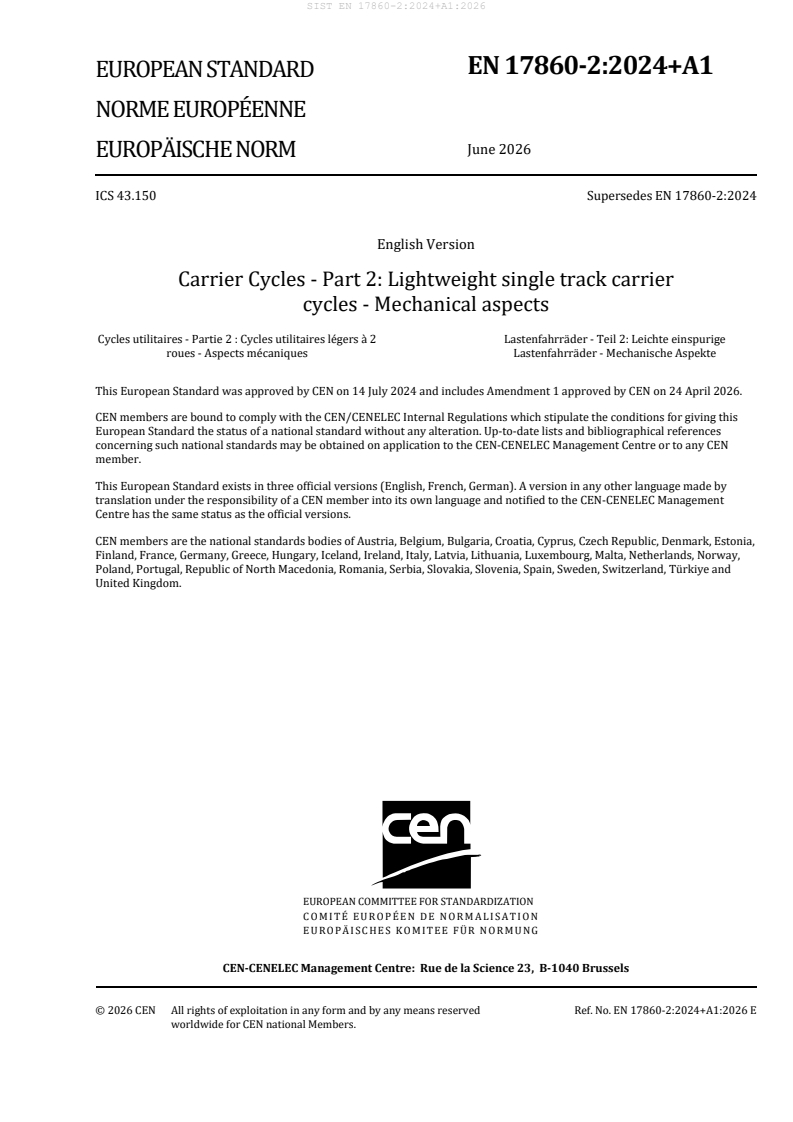
EN 17860-2:2024+A1
EUROPEAN STANDARD
NORME EUROPÉENNE
June 2026
EUROPÄISCHE NORM
ICS 43.150 Supersedes EN 17860-2:2024
English Version
Carrier Cycles - Part 2: Lightweight single track carrier
cycles - Mechanical aspects
Cycles utilitaires - Partie 2 : Cycles utilitaires légers à 2 Lastenfahrräder - Teil 2: Leichte einspurige
roues - Aspects mécaniques Lastenfahrräder - Mechanische Aspekte
This European Standard was approved by CEN on 14 July 2024 and includes Amendment 1 approved by CEN on 24 April 2026.
CEN members are bound to comply with the CEN/CENELEC Internal Regulations which stipulate the conditions for giving this
European Standard the status of a national standard without any alteration. Up-to-date lists and bibliographical references
concerning such national standards may be obtained on application to the CEN-CENELEC Management Centre or to any CEN
member.
This European Standard exists in three official versions (English, French, German). A version in any other language made by
translation under the responsibility of a CEN member into its own language and notified to the CEN-CENELEC Management
Centre has the same status as the official versions.
CEN members are the national standards bodies of Austria, Belgium, Bulgaria, Croatia, Cyprus, Czech Republic, Denmark, Estonia,
Finland, France, Germany, Greece, Hungary, Iceland, Ireland, Italy, Latvia, Lithuania, Luxembourg, Malta, Netherlands, Norway,
Poland, Portugal, Republic of North Macedonia, Romania, Serbia, Slovakia, Slovenia, Spain, Sweden, Switzerland, Türkiye and
United Kingdom.
EUROPEAN COMMITTEE FOR STANDARDIZATION
COMITÉ EUROPÉEN DE NORMALISATION
EUROPÄISCHES KOMITEE FÜR NORMUNG
CEN-CENELEC Management Centre: Rue de la Science 23, B-1040 Brussels
© 2026 CEN All rights of exploitation in any form and by any means reserved Ref. No. EN 17860-2:2024+A1:2026 E
worldwide for CEN national Members.
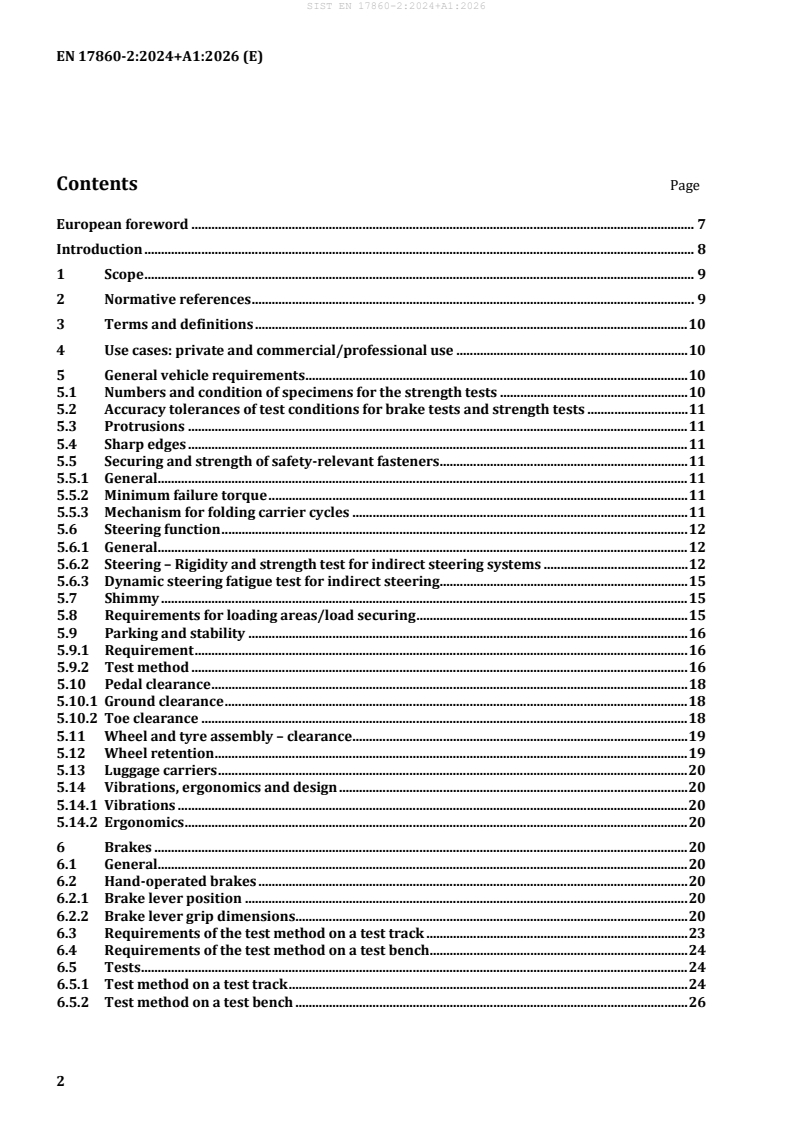
Contents Page
European foreword . 7
Introduction . 8
1 Scope . 9
2 Normative references . 9
3 Terms and definitions . 10
4 Use cases: private and commercial/professional use . 10
5 General vehicle requirements . 10
5.1 Numbers and condition of specimens for the strength tests . 10
5.2 Accuracy tolerances of test conditions for brake tests and strength tests . 11
5.3 Protrusions . 11
5.4 Sharp edges . 11
5.5 Securing and strength of safety-relevant fasteners . 11
5.5.1 General . 11
5.5.2 Minimum failure torque . 11
5.5.3 Mechanism for folding carrier cycles . 11
5.6 Steering function . 12
5.6.1 General . 12
5.6.2 Steering – Rigidity and strength test for indirect steering systems . 12
5.6.3 Dynamic steering fatigue test for indirect steering . 15
5.7 Shimmy . 15
5.8 Requirements for loading areas/load securing . 15
5.9 Parking and stability . 16
5.9.1 Requirement . 16
5.9.2 Test method . 16
5.10 Pedal clearance . 18
5.10.1 Ground clearance . 18
5.10.2 Toe clearance . 18
5.11 Wheel and tyre assembly – clearance . 19
5.12 Wheel retention . 19
5.13 Luggage carriers . 20
5.14 Vibrations, ergonomics and design . 20
5.14.1 Vibrations . 20
5.14.2 Ergonomics . 20
6 Brakes . 20
6.1 General . 20
6.2 Hand-operated brakes . 20
6.2.1 Brake lever position . 20
6.2.2 Brake lever grip dimensions. 20
6.3 Requirements of the test method on a test track . 23
6.4 Requirements of the test method on a test bench . 24
6.5 Tests . 24
6.5.1 Test method on a test track . 24
6.5.2 Test method on a test bench . 26
7 Steering unit . 30
7.1 Handlebar dimensions. 30
7.1.1 General . 30
7.1.2 Handlebar stem – Insertion-depth mark or positive stop . 31
7.1.3 Handlebar stem to fork steerer – Clamping requirements . 31
7.2 Handlebar grips or handlebar plugs . 31
7.2.1 Requirements . 31
7.2.2 Freezing test method . 32
7.2.3 Hot water test method . 32
7.3 Steering unit – Static strength and fastening tests . 33
7.3.1 Steering unit – Lateral bending test . 33
7.3.2 Handlebar stem – Forward bending test . 33
7.3.3 Handlebar to handlebar stem – Torsional security test . 34
7.3.4 Bar end to handlebar – Torsional security test . 35
7.4 Handlebar/stem unit – Dynamic test . 36
7.4.1 General . 36
7.4.2 Test method for stage 1 . 36
7.4.3 Test method for stage 2 . 37
8 Frame . 38
8.1 Suspension frames – Special requirements . 38
8.2 Requirements for all frame types . 38
8.3 Frame – Dynamic test with pedalling forces . 38
8.3.1 General . 38
8.3.2 Test method . 38
8.4 Frame – Dynamic test with horizontal forces . 39
8.4.1 General . 39
8.4.2 Determination of the test loads . 40
8.4.3 Test method . 41
8.5 Frame – Dynamic test with a vertical force onto the seat-post . 41
8.5.1 General . 41
8.5.2 Test method . 42
8.6 Frame – Dynamic test with vertical forces onto the loading area . 43
8.6.1 General . 43
8.6.2 Test method . 43
8.7 Frame and front fork assembly – Impact test (falling frame) . 44
8.7.1 General . 44
8.7.2 Requirement . 44
8.7.3 Test method . 44
9 Front wheel fork. 46
9.1 General . 46
9.2 Installation of the axle and wheel fastening . 46
9.3 Front wheel fork – Static bending test . 46
9.3.1 Requirements . 46
9.3.2 Test method . 46
9.4 Front wheel forks – Dynamic bending test . 47
9.4.1 General . 47
9.4.2 Requirement . 47
9.4.3 Test method . 47
9.5 Front wheel fork – Rearward impact test . 48
9.5.1 Requirement . 48
9.5.2 Test method 1 . 48
9.5.3 Test method 2 . 49
9.6 Front forks for use with hub or disc brakes . 51
9.6.1 Requirement . 51
9.6.2 Front fork for hub/disc brake – Dynamic test of the brake mounting . 51
9.6.3 Front fork for hub/disc brake – Static braking torque test . 51
10 Wheels and wheel/tyre assembly . 52
10.1 Wheels/tyre assembly – Concentricity tolerance and lateral tolerance . 52
10.1.1 Requirements . 52
10.1.2 Test method . 52
10.2 Wheel/tyre assembly – Static strength test . 53
10.2.1 Requirement . 53
10.2.2 Test method . 54
10.3 Wheel and wheel/tyre unit – Dynamic test for carrier cycles . 54
10.3.1 Requirement . 54
10.3.2 Test method . 54
10.4 Tyre inflation pressure . 56
10.5 Tyre and rim compatibility . 56
10.5.1 General . 56
10.5.2 Wheel/ tyre assembly preparation . 56
10.5.3 Test method . 56
11 Front mudguard . 56
11.1 Requirement . 56
11.2 Front mudguard with stays test method . 57
11.2.1 Stage 1: Test method – Tangential obstruction . 57
11.2.2 Stage 2: Test method – Mudguard stays impact test . 57
11.2.3 Stage 3: Test method – Radial force after impact . 58
11.3 Front mudguard without stays test methods . 59
12 Pedals and pedal/crank drive system . 59
12.1 Pedal tread . 59
12.1.1 Tread surface . 59
12.1.2 Toe clips . 59
12.2 Pedal – Static strength test . 59
12.2.1 Requirement . 59
12.2.2 Test method . 59
12.3 Pedal – Impact test. 59
12.3.1 Requirement . 59
12.3.2 Test method . 59
12.4 Pedal – Dynamic durability test . 60
12.4.1 Requirement . 60
12.4.2 Test method . 60
12.5 Drive system – Static strength test . 60
12.6 Crank assembly – Fatigue test . 60
12.6.1 Requirement . 60
12.6.2 Test method . 60
13 Drive-chain and drive belt . 61
13.1 Drive-chain . 61
13.2 Drive belt . 61
14 Chain-wheel and belt-drive protective device . 61
14.1 Requirement . 61
14.2 Chain-wheel disc and drive pulley disc diameter . 61
14.3 Chain and drive belt protective device . 63
14.4 Combined front gear-change guide . 64
15 Saddles/seats and seat-posts . 64
15.1 Limiting dimensions . 64
15.2 Seat-post – Insertion-depth mark or positive stop . 64
15.3 Saddle/seat-post – Security test . 65
15.3.1 Saddles with adjustment-clamps . 65
15.3.2 Saddles without adjustment clamps . 65
15.4 Saddle and saddle rail – Static strength test . 65
15.4.1 Saddle – static strength test . 65
15.4.2 Saddle rail (composite) – Static strength test . 65
15.4.3 Saddle and seat-post assembly – Fatigue test . 65
15.5 Seat-post – Strength tests . 65
15.5.1 General . 65
15.5.2 Test method for step 1 (dynamic test) . 65
15.5.3 Test method for step 2 (static strength test) . 67
16 Lighting systems and reflectors . 67
16.1 General . 67
16.2 Lighting systems. 67
16.3 Reflectors . 67
16.4 Rear reflectors . 67
16.4.1 General . 67
16.4.2 Side reflectors . 67
16.4.3 Front reflectors . 67
16.4.4 Pedal reflectors . 68
17 Warning device . 68
18 Rear-view mirror . 68
19 Structural integrity test . 68
19.1 General . 68
19.2 Requirements . 68
19.3 Verification methods . 68
20 Marking . 69
20.1 Requirements . 69
20.1.1 All markings. 69
20.1.2 Frame markings . 69
20.1.3 Trailer coupling markings . 69
20.1.4 Component markings . 70
20.2 Durability test . 70
20.2.1 Requirement . 70
20.2.2 Test method . 70
21 Manufacturer’s instructions . 70
Annex A (informative) Vehicle configurations . 74
Annex B (informative) Reading Guide . 75
Annex C (normative) Test cycles for professional/commercial use . 76
C.1 General . 76
Annex D (informative) Label . 77
Annex E (informative) Shimmy . 78
E.1 Recommendation . 78
E.2 Test method . 78
E.3 Measurement equipment . 79
Annex F (normative) Front fork mounting device . 80
Annex G (informative) Properties of the dummy forks . 81
Annex H (informative) Calculation of the centre of gravity of cycles or carrier cycles . 83
H.1 Experimental determination of the centre of gravity . 83
Annex I (informative) Rationale for the necessity of a “Complete vehicle test” . 89
I.1 Introduction . 89
I.2 Road test (field test on a test track) . 89
I.3 Complete vehicle test bench . 90
I.4 Virtual testing (calculation) . 90
Annex J (informative) Rationale for the distinction between private and commercial use . 91
Bibliography. 93
European foreword
This document (EN 17860-2:2024+A1:2026) has been prepared by Technical Committee CEN/TC 333
“Cycles”, the secretariat of which is held by UNI.
This European Standard shall be given the status of a national standard, either by publication of an
identical text or by endorsement, at the latest by December 2026, and conflicting national standards shall
be withdrawn at the latest by December 2026.
Attention is drawn to the possibility that some of the elements of this document may be the subject of
patent rights. CEN shall not be held responsible for identifying any or all such patent rights.
This document includes Amendment 1 approved by CEN on 24 April 2026.
The start and finish of text introduced or altered by amendment is indicated in the text by tags !".
This document supersedes EN 17860-2:2024.
This document is part of standard series consisting of the following parts, users are invited to check which
parts are applicable to their situation
— !EN 17860-1:2024, Carrier cycles — Part 1: Terms and definitions
— EN 17860-2:2024+A1:2026, Carrier Cycles — Part 2: Lightweight single track carrier cycles —
Mechanical aspects
— EN 17860-3:2024, Carrier Cycles — Part 3: Lightweight multi track carrier cycles — Mechanical
aspects
— EN 17860-4:2025, Carrier Cycles — Part 4: Heavyweight carrier cycles — Mechanical and functional
aspects
— EN 17860-5:2024, Carrier cycles — Part 5: Electrical aspects
— EN 17860-6:2025, Carrier Cycles — Part 6: Passenger transport
— EN 17860-7:2024, Carrier cycles — Part 7: Cargo trailers"
Examples of carrier cycle configurations can be found in Annex A. Annex B provides a reading guide for
parts 2,3 and 4 of this standard series.
Any feedback and questions on this document should be directed to the users’ national standards body.
A complete listing of these bodies can be found on the CEN website.
According to the CEN-CENELEC Internal Regulations, the national standards organisations of the
following countries are bound to implement this European Standard: Austria, Belgium, Bulgaria, Croatia,
Cyprus, Czech Republic, Denmark, Estonia, Finland, France, Germany, Greece, Hungary, Iceland, Ireland,
Italy, Latvia, Lithuania, Luxembourg, Malta, Netherlands, Norway, Poland, Portugal, Republic of North
Macedonia, Romania, Serbia, Slovakia, Slovenia, Spain, Sweden, Switzerland, Türkiye and the United
Kingdom.
Introduction
This document gives requirements and test methods for mechanical and functional aspects for single
track carrier cycles.
This document has been developed in response to demand throughout Europe. Its aim is to provide a
standard for the assessment of mechanical aspects for single track carrier cycles of a type which are
excluded from type approval by Regulation (EU) No. 168/2013.
Because of the diversity of geometries and solutions of carrier cycles not all requirements and test
methods in this document may apply to every carrier cycle.
— Annex A gives an overview of vehicle configurations.
— Annex B provides a reading guide for the parts of this standard series.
— Annex J contains a rationale explaining the choices made when developing the standard series.
This document is based on a risk analysis, the focus is on mechanical aspects for single track carrier
cycles. This document is a type C standard as specified in EN ISO 12100. The machinery concerned and
the extent to which hazards, hazardous situations and hazardous events are covered are indicated in the
scope of this document.
1 Scope
This document is applicable to single track carrier cycles with or without electric assistance and a
maximum gross vehicle weight of:
— 300 kg in case the manufacturer defines the carrier cycle to be intended for !deleted text"
commercial use; or
— 250 kg in case the manufacturer defines the carrier cycle to be intended for !deleted text"
private use.
NOTE Requirements for electrical power assisted carrier cycles are covered in part 5 of this standard series.
2 Normative references
The following documents are referred to in the text in such a way that some or all of their content
constitutes requirements of this document. For dated references, only the edition cited applies. For
undated references, the latest edition of the referenced document (including any amendments) applies.
!EN 17860-1:2024, Carrier cycles — Part 1: Terms and definitions"
EN ISO 4210-2:2023, Cycles — Safety requirements for bicycles — Part 2: Requirements for city and
trekking, young adult, mountain and racing bicycles (ISO 4210-2:2023)
EN ISO 4210-3:2023, Cycles — Safety requirements for bicycles — Part 3: Common test methods (ISO 4210-
3:2023)
EN ISO 4210-4:2023, Cycles — Safety requirements for bicycles — Part 4: Braking test methods (ISO 4210-
4:2023, Corrected version 2023-08)
EN ISO 4210-6:2023, Cycles — Safety requirements for bicycles — Part 6: Frame and fork test methods
(ISO 4210-6:2023, Corrected version 2023-08)
EN ISO 4210-7:2023, Cycles — Safety requirements for bicycles — Part 7: Wheel and rim test methods
(ISO 4210-7:2023)
EN ISO 4210-8:2023, Cycles — Safety requirements for bicycles — Part 8: Pedal and drive system test
methods (ISO 4210-8:2023)
EN ISO 4210-9:2023, Cycles — Safety requirements for bicycles — Part 9: Saddles and seat-post test
methods (ISO 4210-9:2023)
ISO 5775-1:2023, Bicycle tyres and rims — Part 1: Tyre designations and dimensions
!ISO 5775-2:2021, Bicycle tyres and rims — Part 2: Rims"
EN ISO 11243:2023, Cycles — Luggage carriers for bicycles — Requirements and test methods
(ISO 11243:2023)
EN ISO 12100:2010, Safety of machinery — General principles for design — Risk assessment and risk
reduction (ISO 12100:2010)
ISO 9633:2001, Cycle chains — Characteristics and test methods
!ISO 6742-1:2023, Cycles — Lighting and retro-reflective devices — Part 1: Lighting and light signalling
devices"
!ISO 6742-2:2023, Cycles — Lighting and retro-reflective devices — Part 2: Retro-reflective devices"
!ISO 6742-3:2023, Cycles — Lighting and retro-reflective devices — Part 3: Installation and use of
lighting and retro-reflective devices"
ISO 14878:2015, Cycles — Audible warning devices — Technical specification and test methods
!EN 15194:2017+A1:2023, Cycles — Electrically power assisted cycles — EPAC Bicycles"
3 Terms and definitions
For the purposes of this document the terms and definitions given in EN 17860-1:2024 and
EN ISO 12100:2010 apply.
ISO and IEC maintain terminology databases for use in standardization at the following addresses:
• IEC Electropedia: available at http://www.electropedia.org/
• ISO Online browsing platform: available at http://www.iso.org/obp
4 Use cases: private and commercial/professional use
The requirements in the main part of this standard refer to carrier cycles for private use. In case the
manufacturer defines the carrier cycles to be intended for commercial/professional use, higher test
values for dynamic tests apply. Annex C gives the higher test values for the relevant tests.
Annex D shows proposals for labels for private use and commercial/professional use. Annex J contains a
rationale explaining the choices made when developing the standard series.
5 General vehicle requirements
5.1 Numbers and condition of specimens for the strength tests
In general, for static, impact and fatigue tests, each test shall be conducted on a new test sample, but if
only one sample is available, it is permissible to conduct all of these tests on the same sample with the
sequence of testing being fatigue, static and impact.
When more than one test is conducted on the same sample, the test sequence shall be clearly recorded in
the test report or record of testing.
NOTE It will be noted that if more than one test is conducted on the same sample, earlier tests can influence
the results of subsequent tests. Also, if a sample fails when it has been subjected to more than one test, a direct
comparison with single testing is not possible.
In all strength tests, specimens shall be in the fully-finished condition.
5.2 Accuracy tolerances of test conditions for brake tests and strength tests
Unless stated otherwise, accuracy tolerances based on the nominal values shall be as follows:
Forces and torques 0/+5 %
Masses ±1 %
Dimensions ±1 mm
Angles ±1°
Time duration ±5 s
Temperatures ±2 °C
Pressures ±5 %
5.3 Protrusions
This requirement is intended to address the hazards associated with the users of carrier cycles falling on
projections or rigid components (e.g. handlebars, levers) on a carrier cycle, possibly causing internal
injury or skin puncture. Tubes and rigid components in the form of projections which constitute a
punctu
...