


EN 17860-6:2025
(Main)Carrier Cycles - Part 6: Passenger transport
General Information
- Abstract
This document applies to the transportation of passengers in a forward- and/or rearward-facing position on a carrier cycle as defined in the EN 17860 series, except for Part 7 (carrier cycle trailers).
This document does not apply to the transportation of children in a child seat that is tested according to EN 14344:2022.
This document applies to the intended riding purpose commuting and leisure with moderate effort, in accordance with EN 17406:2020+A1:2021.
NOTE Some European countries have special legislation for transporting children on cycles. Compliance with this document might not meet this legislation.
- Status
- Published
- Publication Date
- 14-Oct-2025
- Technical Committee
- CEN/TC 333 - Cycles
- Drafting Committee
- CEN/TC 333/WG 9 - Cargo bikes
- Current Stage
- 6060 - Definitive text made available (DAV) - Publishing
- Start Date
- 15-Oct-2025
- Due Date
- 20-Nov-2024
- Completion Date
- 15-Oct-2025
- Directive
- Harmonized Standard2001/95/EC - General product safety

Overview
EN 17860-6:2025 - Carrier Cycles: Part 6 Passenger transport is a CEN European Standard that specifies safety, ergonomic and test requirements for transporting passengers on carrier cycles (cargo bikes) in forward- and/or rearward-facing seating positions. It applies to carrier cycles intended for commuting and leisure with moderate effort (in line with EN 17406:2020+A1:2021) and excludes child seats already tested to EN 14344:2022 and carrier cycle trailers covered by Part 7. The standard focuses on passenger protection, restraint systems, seating integrity and relevant test methods.
Key topics and requirements
- Scope & classification: Defines which carrier cycle configurations and passenger positions are covered; excludes trailers and separately certified child seats.
- Hazard analysis: Lists significant hazards for passenger transport (ergonomic, entrapment, thermal, chemical, entanglement).
- General test conditions: Specifies number of passengers, specimens for strength and fatigue testing, test tolerances and crack-detection methods.
- Seat requirements and tests: Dynamic and static load tests for seats, armrests and footrests; seating ergonomics and protected volume definitions.
- Ergonomics: Protected volume determination, shear/compression point control, folding mechanism safety, hazardous edges and openings, child-specific ergonomics for certain classes.
- Restraint systems: Attachment, locking strength, micro-slip/adjuster strength, closure requirements, child-proof retention and strength test methods.
- Ingress/egress and unattended hazards: Tests and requirements for safe entry/exit and risks in unattended situations.
- Connectors for infant carriers: Requirements and tests for downward, upward and horizontal force resistance.
- Marking & instructions: Mandatory marking, warnings and instructions for safe use.
- Annexes: Normative test dummy specification and informative guidance on deviations.
Practical applications and users
- Target users: carrier cycle manufacturers, design and R&D teams, product safety engineers, conformity assessment bodies, test laboratories, regulators and urban fleet operators.
- Typical uses: product design validation, type testing for passenger safety, documentation of compliance, creating user manuals and warning labels, and supporting regulatory approvals.
- Benefits: helps ensure passenger safety, reduces liability risk, and aligns cargo-bike passenger designs with harmonised European test methods.
Related standards
- EN 17860 series (companion parts): Part 1 (Terms & definitions), Part 2–5 (mechanical, multi-track, heavy-duty, electrical aspects), Part 7 (Cargo trailers)
- EN 14344:2022 (child seats - exclusion)
- EN 17406:2020+A1:2021 (intended riding purpose - commuting & leisure)
Keywords: EN 17860-6:2025, Carrier Cycles, passenger transport, passenger safety, restraint system, ergonomics, fatigue test, CEN, cargo bike testing.
Relations
- Effective Date
- 28-Jan-2026
- Refers
EN 14344:2022 - Child care articles - Child seats for cycles - Safety requirements and test methods - Effective Date
- 28-Jan-2026
- Effective Date
- 28-Jan-2026
- Effective Date
- 28-Jan-2026
- Effective Date
- 28-Jan-2026
- Effective Date
- 28-Jan-2026
- Effective Date
- 28-Jan-2026
- Effective Date
- 28-Jan-2026
- Effective Date
- 28-Jan-2026
Get Certified
Connect with accredited certification bodies for this standard

TÜV Rheinland
TÜV Rheinland is a leading international provider of technical services.

TÜV SÜD
TÜV SÜD is a trusted partner of choice for safety, security and sustainability solutions.

DEKRA Certification Inc.
DEKRA US certification services.
Sponsored listings
Frequently Asked Questions
EN 17860-6:2025 is a standard published by the European Committee for Standardization (CEN). Its full title is "Carrier Cycles - Part 6: Passenger transport". This standard covers: This document applies to the transportation of passengers in a forward- and/or rearward-facing position on a carrier cycle as defined in the EN 17860 series, except for Part 7 (carrier cycle trailers). This document does not apply to the transportation of children in a child seat that is tested according to EN 14344:2022. This document applies to the intended riding purpose commuting and leisure with moderate effort, in accordance with EN 17406:2020+A1:2021. NOTE Some European countries have special legislation for transporting children on cycles. Compliance with this document might not meet this legislation.
This document applies to the transportation of passengers in a forward- and/or rearward-facing position on a carrier cycle as defined in the EN 17860 series, except for Part 7 (carrier cycle trailers). This document does not apply to the transportation of children in a child seat that is tested according to EN 14344:2022. This document applies to the intended riding purpose commuting and leisure with moderate effort, in accordance with EN 17406:2020+A1:2021. NOTE Some European countries have special legislation for transporting children on cycles. Compliance with this document might not meet this legislation.
EN 17860-6:2025 is classified under the following ICS (International Classification for Standards) categories: 43.150 - Cycles. The ICS classification helps identify the subject area and facilitates finding related standards.
EN 17860-6:2025 has the following relationships with other standards: It is inter standard links to EN 614-1:2006+A1:2009, EN 14344:2022, EN 17860-1:2024, EN 17860-2:2024, EN 17860-4:2025, EN 71-3:2019+A2:2024, EN 17860-3:2024, EN ISO 12100:2010, EN 71-2:2020. Understanding these relationships helps ensure you are using the most current and applicable version of the standard.
EN 17860-6:2025 is associated with the following European legislation: EU Directives/Regulations: 2001/95/EC. When a standard is cited in the Official Journal of the European Union, products manufactured in conformity with it benefit from a presumption of conformity with the essential requirements of the corresponding EU directive or regulation.
EN 17860-6:2025 is available in PDF format for immediate download after purchase. The document can be added to your cart and obtained through the secure checkout process. Digital delivery ensures instant access to the complete standard document.
Standards Content (Sample)
SLOVENSKI STANDARD
01-december-2025
Tovorna kolesa - 6. del: Prevoz potnikov
Carrier Cycles - Part 6: Passenger transport
Lastenfahrräder - Teil 6: Personentransport
Cycles utilitaires - Partie 6 : Transport de passagers
Ta slovenski standard je istoveten z: EN 17860-6:2025
ICS:
43.150 Kolesa Cycles
2003-01.Slovenski inštitut za standardizacijo. Razmnoževanje celote ali delov tega standarda ni dovoljeno.
EN 17860-6
EUROPEAN STANDARD
NORME EUROPÉENNE
October 2025
EUROPÄISCHE NORM
ICS 43.150
English Version
Carrier Cycles - Part 6: Passenger transport
Cycles utilitaires - Partie 6 : Transport de passagers Lastenfahrräder - Teil 6: Personentransport
This European Standard was approved by CEN on 11 August 2025.
CEN members are bound to comply with the CEN/CENELEC Internal Regulations which stipulate the conditions for giving this
European Standard the status of a national standard without any alteration. Up-to-date lists and bibliographical references
concerning such national standards may be obtained on application to the CEN-CENELEC Management Centre or to any CEN
member.
This European Standard exists in three official versions (English, French, German). A version in any other language made by
translation under the responsibility of a CEN member into its own language and notified to the CEN-CENELEC Management
Centre has the same status as the official versions.
CEN members are the national standards bodies of Austria, Belgium, Bulgaria, Croatia, Cyprus, Czech Republic, Denmark, Estonia,
Finland, France, Germany, Greece, Hungary, Iceland, Ireland, Italy, Latvia, Lithuania, Luxembourg, Malta, Netherlands, Norway,
Poland, Portugal, Republic of North Macedonia, Romania, Serbia, Slovakia, Slovenia, Spain, Sweden, Switzerland, Türkiye and
United Kingdom.
EUROPEAN COMMITTEE FOR STANDARDIZATION
COMITÉ EUROPÉEN DE NORMALISATION
EUROPÄISCHES KOMITEE FÜR NORMUNG
CEN-CENELEC Management Centre: Rue de la Science 23, B-1040 Brussels
© 2025 CEN All rights of exploitation in any form and by any means reserved Ref. No. EN 17860-6:2025 E
worldwide for CEN national Members.
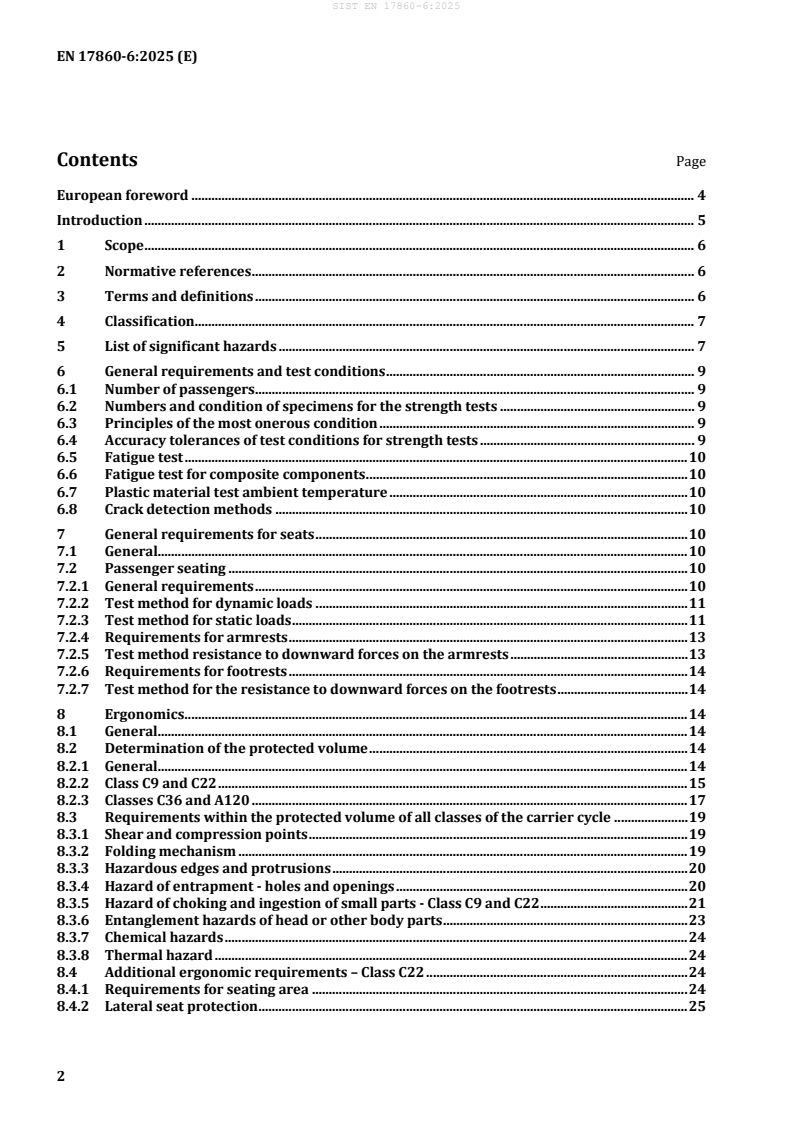
Contents Page
European foreword . 4
Introduction . 5
1 Scope . 6
2 Normative references . 6
3 Terms and definitions . 6
4 Classification. 7
5 List of significant hazards . 7
6 General requirements and test conditions . 9
6.1 Number of passengers . 9
6.2 Numbers and condition of specimens for the strength tests . 9
6.3 Principles of the most onerous condition . 9
6.4 Accuracy tolerances of test conditions for strength tests . 9
6.5 Fatigue test . 10
6.6 Fatigue test for composite components . 10
6.7 Plastic material test ambient temperature . 10
6.8 Crack detection methods . 10
7 General requirements for seats . 10
7.1 General. 10
7.2 Passenger seating . 10
7.2.1 General requirements . 10
7.2.2 Test method for dynamic loads . 11
7.2.3 Test method for static loads . 11
7.2.4 Requirements for armrests . 13
7.2.5 Test method resistance to downward forces on the armrests . 13
7.2.6 Requirements for footrests . 14
7.2.7 Test method for the resistance to downward forces on the footrests . 14
8 Ergonomics . 14
8.1 General. 14
8.2 Determination of the protected volume . 14
8.2.1 General. 14
8.2.2 Class C9 and C22 . 15
8.2.3 Classes C36 and A120 . 17
8.3 Requirements within the protected volume of all classes of the carrier cycle . 19
8.3.1 Shear and compression points . 19
8.3.2 Folding mechanism . 19
8.3.3 Hazardous edges and protrusions . 20
8.3.4 Hazard of entrapment - holes and openings . 20
8.3.5 Hazard of choking and ingestion of small parts - Class C9 and C22 . 21
8.3.6 Entanglement hazards of head or other body parts . 23
8.3.7 Chemical hazards . 24
8.3.8 Thermal hazard . 24
8.4 Additional ergonomic requirements – Class C22 . 24
8.4.1 Requirements for seating area . 24
8.4.2 Lateral seat protection . 25
8.4.3 Requirements for seat and backrest angle . 25
9 Hazards in unattended situations . 25
10 Restraint system . 25
10.1 General . 25
10.2 Attachment of restraint system to the seat . 26
10.2.1 Requirements . 26
10.2.2 Test method . 26
10.3 Strength of the locking component of the restraint system . 26
10.3.1 Requirements . 26
10.3.2 Test method . 26
10.4 Micro-slip and strength of adjusting devices . 27
10.4.1 Requirements . 27
10.4.2 Test method . 27
10.5 Requirements for closure of restraint system . 28
10.6 Requirements and test for child-proof retention . 28
10.7 Strength of the restraint system. 28
10.7.1 Requirements . 28
10.7.2 Test method . 28
11 Hazards from passenger(s) getting in or out of the seat(s). 29
11.1 Requirement . 29
11.2 Test method . 29
11.2.1 Test conditions . 29
11.2.2 Test area . 29
11.2.3 Verification when entering and exiting the carrier cycle . 30
12 Connectors for infant carriers . 32
12.1 General requirements . 32
12.2 Resistance to downward forces . 33
12.2.1 Requirements for the resistance to downward forces . 33
12.2.2 Test method for the resistance to downward forces . 33
12.3 Resistance to upward forces . 33
12.3.1 Requirements for the resistance to upward forces . 33
12.3.2 Test method for the resistance to upward forces . 34
12.4 Test method for the resistance to horizontal forces . 34
12.4.1 Requirements for the resistance to horizontal forces . 34
12.4.2 Test method for the resistance to horizontal forces . 34
13 Requirements for marking . 35
14 Instructions for use . 36
14.1 General . 36
14.2 Warnings . 37
Annex A (normative) Test dummy . 38
Annex B (informative) A-deviations . 40
Bibliography . 41
European foreword
This document (EN 17860-6:2025) has been prepared by Technical Committee CEN/TC 333 “Cycles”, the
secretariat of which is held by UNI.
This European Standard shall be given the status of a national standard, either by publication of an
identical text or by endorsement, at the latest by April 2026, and conflicting national standards shall be
withdrawn at the latest by April 2026.
Attention is drawn to the possibility that some of the elements of this document may be the subject of
patent rights. CEN shall not be held responsible for identifying any or all such patent rights.
This document is part of standard series consisting of the following parts, users are invited to check which
parts are applicable to their situation:
— EN 17860-1:2024, Carrier Cycles — Part 1: Terms and definitions
— EN 17860-2:2024, Carrier Cycles — Part 2: Lightweight single track carrier cycles – Mechanical aspects
— EN 17860-3:2024, Carrier Cycles — Part 3: Lightweight multi track carrier cycles – Mechanical aspects
— EN 17860-4:2025, Carrier Cycles — Part 4: Heavyweight multi track carrier cycles – Mechanical and
functional aspects
— EN 17860-5:2024, Carrier Cycles — Part 5: Electrical aspects
— EN 17860-6:2025, Carrier Cycles — Part 6: Passenger transport
— EN 17860-7:2024, Carrier Cycles — Part 7: Cargo trailers
Any feedback and questions on this document should be directed to the users’ national standards body.
A complete listing of these bodies can be found on the CEN website.
According to the CEN-CENELEC Internal Regulations, the national standards organisations of the
following countries are bound to implement this European Standard: Austria, Belgium, Bulgaria, Croatia,
Cyprus, Czech Republic, Denmark, Estonia, Finland, France, Germany, Greece, Hungary, Iceland, Ireland,
Italy, Latvia, Lithuania, Luxembourg, Malta, Netherlands, Norway, Poland, Portugal, Republic of North
Macedonia, Romania, Serbia, Slovakia, Slovenia, Spain, Sweden, Switzerland, Türkiye and the United
Kingdom.
Introduction
This document gives requirements and test methods for transportation of passengers on a carrier cycle.
Because of the diversity of geometries and solutions of carrier cycles not all requirements and test
methods in this document may apply to every carrier cycle.
Experts in the field of passive safety and ergonomics, especially regarding children, are invited to join the
standardization process and provide input for future improvements of this standard.
Examples of carrier cycle configurations can be found in EN 17860-2:2024, Annex A. EN 17860-2:2024,
Annex B provides a reading guide for parts 2, 3 and 4 of this standard series.
1 Scope
This document applies to the transportation of passengers in a forward- and/or rearward-facing position
on a carrier cycle as defined in the EN 17860 series, except for Part 7 (carrier cycle trailers).
This document does not apply to the transportation of children in a child seat that is tested according to
EN 14344:2022.
This document applies to the intended riding purpose commuting and leisure with moderate effort, in
accordance with EN 17406:2020+A1:2021.
NOTE Some European countries have special legislation for transporting children on cycles. Compliance with
this document might not meet this legislation.
2 Normative references
The following documents are referred to in the text in such a way that some or all of their content
constitutes requirements of this document. For dated references, only the edition cited applies. For
undated references, the latest edition of the referenced document (including any amendments) applies.
EN 71-2:2020, Safety of toys - Part 2: Flammability
EN 71-3:2019+A2:2024, Safety of toys - Part 3: Migration of certain elements
EN 614-1:2006+A1:2009, Safety of machinery - Ergonomic design principles - Part 1: Terminology and
general principles
EN 14344:2022, Child care articles - Child seats for cycles - Safety requirements and test methods
EN ISO 12100:2010, Safety of machinery — General principles for design — Risk assessment and risk
reduction (ISO 12100:2010)
EN 17860-1:2024, Carrier cycles - Part 1: Terms and definitions
EN 17860-2:2024, Carrier Cycles - Part 2: Lightweight single track carrier cycles – Mechanical aspects
EN 17860-3:2024, Carrier Cycles - Part 3: Lightweight multi track carrier cycles – Mechanical aspects
EN 17860-4:2025, Carrier Cycles - Part 4: Heavyweight carrier cycles – Mechanical and functional aspects
3 Terms and definitions
For the purposes of this document, the terms and definitions given in EN 17860-1:2024 and
EN ISO 12100:2010 apply.
ISO and IEC maintain terminology databases for use in standardization at the following addresses:
— ISO Online browsing platform: available at https://www.iso.org/obp/
— IEC Electropedia: available at https://www.electropedia.org/
4 Classification
This standard divides passengers in classes based on mass criteria according to Table 1.
Table 1 — Classification
Class Mass range Typical max. height Typical age
C9 3 – 9 kg NA 3 - 12 months
a
C22 9 – 22 kg 1 100 mm 1 - 5 years
C36 22 – 36 kg 1 400 mm 5 - 8 years
A120 36 – 120 kg NA 8 years and up
a
The child shall be able to sit upright without support.
Children from 3 - 9 kg (Class C9) and children in Class C22 who are unable to sit upright without support
are transported in a rearward-facing position infant carrier.
NOTE Regulation UN ECE R129/03 applies in this case.
5 List of significant hazards
Table 2 gives an overview of the hazards that have been considered in this standard and the clauses that
cover the identified hazards related to the transportation of children.
NOTE: The hazards given in the overview are based on EU Decision 2023/1338 on the safety requirements to
be met by European standards for certain children’s products and related products pursuant to
Directive 2001/95/EC.
Table 2 — List of significant hazards covered in this standard
Significant hazards Clause in this
standard
Chemical hazards 8.3.7
Thermal hazards 8.3.8.2
Flammability hazards 8.3.8.1
Entrapment hazards 8.3.4; 9
Hazards from moving parts – including shearing, cutting 8.3.1
crushing hazards
Hazards from children’s products designed to fold for storage 8.3.2
and transportation
Hazards from children’s products designed to be dismantled for /
storage and transportation
Hazards related to attachment mechanisms and opening and 8.3.2
closing systems
Hazards associated with wheeled products 8.3.1.1; 8.3.1.2
Entanglement hazards 8.3.6
Choking hazards 8.3.5
Suffocation hazards /
Ingestion hazards /
Insertion and aspiration hazards /
Hazardous points, edges and projections 8.3.3
Structural integrity hazards 7.2; 12.2; 12.3; 12.4
Hazards associated with protective functions /
Hazards associated with restraint systems 10
Hazards associated with stability 11
Falling hazards /
Drowning hazards /
Electrical hazards /
Biometric hazards /
Acoustic hazards /
Radiation hazards /
Radioactive hazards /
Hygiene’s hazards /
Hazards associated with information supplied with the product 12.1; 13; 14
6 General requirements and test conditions
6.1 Number of passengers
The number of passengers is not limited but defined by the maximum gross vehicle weight as given in
EN 17860-2, EN 17860-3 and EN 17860-4.
6.2 Numbers and condition of specimens for the strength tests
In general, for static, impact and fatigue tests, each test shall be conducted on a new test sample, but if
only one sample is available, it is permissible to conduct all of these tests on the same sample with the
sequence of testing being fatigue, static and impact. When more than one test is conducted on the same
sample, the test sequence shall be clearly recorded in the test report or record of testing.
If more than one test is conducted on the same sample, earlier tests can influence the results of
subsequent tests. Also, if a sample fails when it has been subjected to more than one test, a direct
comparison with single testing is not possible.
In all strength tests, specimens shall be in the fully-finished condition.
6.3 Principles of the most onerous condition
Unless otherwise stated each test shall be conducted with the carrier cycle in the most onerous condition
for that test in terms of:
— the choice and number of seat(s) and/or infant carrier attached to the chassis stated in the
manufacturer's instructions;
— the addition of any additional seat(s) approved by the manufacturer;
— the weights of the passengers to be transported as specified by the manufacturer;
— the use of test masses: for carrier cycles transporting more than one child, at least one place that a
child can occupy shall be loaded with a test mass;
— the loading (or not) of any receptacle designed for carrying additional load(s) allowed for in the
instructions or otherwise approved by the manufacturer and the placing (or not) of load(s) in any
such facility, up to the maximum mass allowed in the manufacturer's instructions, or 2 kg if nothing
is indicated;
— the addition (or not) of any other accessories supplied or recommended by the manufacturer for use
with the carrier cycle and with accessories loaded according to the manufacturer’s instructions;
— the adjustment of seat(s), handles, infant carrier, and any other adjustable features (e.g. reclined
backrest) or accessories, or any other optional arrangement of the carrier cycle allowed in the
manufacturer's instructions or otherwise approved by the manufacturer.
NOTE The heaviest loads do not always produce the most onerous conditions.
6.4 Accuracy tolerances of test conditions for strength tests
Unless stated otherwise, accuracy tolerances based on the nominal values shall be as follows:
1) Forces and torques 0/+5 %
2) Masses and weights ± 1 %
3) Dimensions ± 1 mm
4) Angles ± 1°
5) Time duration ± 5 s
6) Temperatures ± 2 °C
7) Pressures ± 5 %
6.5 Fatigue test
The force for fatigue tests shall be applied and released progressively, not to exceed 10 Hz. The tightness
of fasteners according to manufacturer's recommended torque can be re-checked not later than
1 000 test cycles to allow for the initial settling of the component assembly. (This is considered applicable
to all components, where fasteners are present for clamping.) The test bench shall be qualified to meet
requirements of 6.4.
6.6 Fatigue test for composite components
For fatigue test for composite components, the initial value of displacement (peak-to-peak value) shall be
taken after 1 000 cycles and before 2 000 cycles.
6.7 Plastic material test ambient temperature
All strength tests involving any plastic materials shall be pre-conditioned for two hours and tested at an
ambient temperature of 23 °C ± 5 °C.
6.8 Crack detection methods
Standardized methods shall be used to emphasize the presence of cracks where visible cracks are
specified as criteria of failure in tests specified in this standard.
NOTE For example, suitable dye-penetrant methods are specified in EN ISO 3452-1:2021, EN ISO 3452-
2:2021 EN ISO 3452-3:2013 and EN ISO 3452-4:1998 In addition, white paint or surface treatment can be used to
aid in detection for composite materials.
7 General requirements for seats
7.1 General
The following requirements and corresponding test methods shall apply to the transportation of
passively transported passengers (i.e. not pedalling).
7.2 Passenger seating
7.2.1 General requirements
For passenger transportation, a suitable seat shall be available for each person to be transported in a
forward- or rearward-facing position.
See 6.3 for the principles of the most onerous conditions.
The seat shall be equipped with footrests. The floor of a transportation container equipped with a seat is
regarded as a footrest. The footrest shall prevent the risk of entrapment (e.g. the risk of a foot getting
stuck underneath the carrier cycle).
When tested by the test method described in 7.2.2 and 7.2.3, no crack in the seat surface and no visible
crack or fracture of another part shall occur in this case.
For Class C9 a suitable connector (Clause 12) shall be fitted for installation of an infant carrier in
rearward-facing position. All infant carriers that meet UN ECE 129/03 can be used for transporting a
Class C9 child. The manufacturer shall publish which models and brands of infant carrier(s) can be used
with the connectors.
7.2.2 Test method for dynamic loads
The test is conducted at all designed seating positions. If a seat is part of a combined construction of two
or more seats, for example a bench, then all seats shall be tested simultaneously.
The loading pad for the seat surface (see Figure 1) is applied centrally on the seat surface. The test load
is applied vertically downwards.
The defined force, F1, is applied by the loading pad for the seat surface(s) as defined in Table 3.
The loads are applied for a corresponding number of cycles as defined in Table 3.
Table 3 — Values for the dynamic seat test
Tests Force F1 Cycles
Fatigue life test on seat(s) permissible maximum specified 25 000
surface(s) (Fz) load in kg × 9,81 m/s
7.2.3 Test method for static loads
All adjustable backrests shall be moved to the most upright position.
The test is conducted at all designed seating positions. If a seat is part of a combined construction of two
or more seats, for example a bench, then these seats shall be tested simultaneously.
The loading pad for the seat surface is positioned centrally on the seat surface(s). The force (Fz) according
to Table 4 shall be applied vertically.
The loading pad for the backrest is applied either centrally onto the backrest or 100 mm beneath the top
edge of the backrest depending on which point is lower (see Figure 2). The force (Fx) according to Table 4
shall be applied horizontally.
The size of the loading pad for the backrest test may be altered when the manufacturer deems it more
suitable.
Table 4 — Values for the static seat tests
Tests Time Forces
Static test on seat Step 1 (preload): 5 × 10 s (±2 s) 1,6 times the permissible
surface (Fz) maximum specified load in
Step 2: 1 × 30 min (±10 s)
kg × 9,81 m/s
Static test on backrest Step 1 (preload): 5 × 10 s (±2 s) 0,5 times the permissible
(forward-facing maximum specified load in
Step 2: 1 × 30 min (±10 s)
position) (Fx) kg × 9,81 m/s
10 times the permissible
Static test on backrest Step 1 (preload): 5 × 10 s (±2 s)
maximum specified load in
(rearward-facing
Step 2: 1 × 30 min (±10 s)
kg × 9,81 m/s
position) (Fx)
Dimensions in millimetres
Key
R Radius
Figure 1 — Loading pad for the seat surface
Dimensions in millimetres
Key
R Radius
Figure 2 — Loading pad for the backrest
7.2.4 Requirements for armrests
If a carrier cycle for Class C22, C36 or Class A120 is equipped with armrests that are likely to be used as
a support for the body weight to enter or exit the carrier cycle the test in 7.2.5 shall be performed. No
visible crack or fracture shall occur.
7.2.5 Test method resistance to downward forces on the armrests
The downward forces to be applied to the armrests are in accordance with Table 5. With the cycle
standing on the horizontal test plane, set up a means for applying a vertical test force for each armrests.
Before commencing the test, set up the means to prevent the cycle from tipping and the means to prevent
the cycle from moving forward and backward.
Apply the load vertically to each armrests with a rectangular or cylindrical loading pad with dimensions
of Ø 50 mm x 150 mm) until the force is reached. Maintain the load for a period of 10 s ± 2 s. After that
remove the load.
Table 5 — Values for the downward forces on the armrests and footrests
Class Force
C22 220 N
C36 360 N
A120 Permissible maximum specified load in
kg × 9,81 m/s
7.2.6 Requirements for footrests
All seats shall be equipped with footrests.
The footrests shall be tested according to 7.2.7. When tested by the test method described in 7.2.7,
permanent deformation shall not exceed 2 mm.
7.2.7 Test method for the resistance to downward forces on the footrests
The downward forces to be applied to the footrest(s) are in accordance with Table 5. With the cycle
standing on the horizontal test plane, set up a means for applying a vertical test force for each footrest.
Before commencing the test, set up the means to prevent the cycle from tipping and the means to prevent
the cycle from moving forward and backward.
Apply the load vertically to each footrest with a rectangular or cylindrical loading pad 100 mm in
diameter, with a flat face and a 12 mm edge radius. Apply a static, pre-loading force of 100 N. Remove and
repeat this loading until a consistent deflection reading is obtained. Adjust the deflection measuring
device to zero.
Increase the static force to force determined in Table 5 and maintain this force for 60 s ± 2 s, then reduce
the force to 100 N and record any permanent deformation.
When it is allowed to transport more than one person that use the same footrest, multiply the test force
with the maximum number of passengers.
8 Ergonomics
8.1 General
The seating position shall be designed to the ergonomic principles set out in EN 614-1:2006+A1:2009.
It is recommended that the shape of the backrest allows for sufficient space for the child’s helmet.
Class C22: a measuring device defined in EN 14344:2022, Annex A shall be used to define the protected
volume for the child, check seat dimensions (see 8.4) and check the minimum angle between the seat and
the horizontal plane and the minimum angle between the seat and the backrest (see 8.4.3).
8.2 Determination of the protected volume
8.2.1 General
Protected volume is defined only for class C9 and class C22. Clause 8.2.2, describes the method to
determine the protected volume.
NOTE For independent child seats, refer to EN 14344:2022 for safety requirements and test methods.
8.2.2 Class C9 and C22
Class C9: the protected volume is defined by the sphere of the carrying handle of the infant carrier when
it is positioned in the connectors.
Class C22: when the paddings can be removed (for example for cleaning), the test shall be done with the
padding. Place the measuring device (EN 14344:2022, Annex A) into the seat then push the measuring
device against the backrest as shown in Figure 3 until it is in contact with the backrest (H). During the
positioning the four pins (G) shall always stay in contact with the seat.
— Mount on the measuring device the appropriate artificial shoulders and arms representing a child of
1 100 mm height in accordance with EN 14344:2022, Annex A Figure A.1.
— The assessment shall be done with the seat mounted in the most onerous positions taking into
account the instruction for use.
— Determine which part of the carrier cycle or any other accessories supplied or recommended by the
manufacturer for use with the carrier cycle can be reached by artificial arms of the measuring device.
If the seating position can be adjusted repeat the measurement in the most extreme seating positions.
A vertical band of 200 mm centred with the restrained system at the external rear surface of the backrest,
from the top of the backrest to the projection of the reference plane, is considered not to be accessible for
the child (see Figure 4 and Figure 5).
Key
c minimum height of backrest including non-removable headrest
d minimum height of the lateral seat protection
f minimum length of the lateral seat protection
G pins in contact with the seating area
H/A contact point with the backrest
The figure is not presented with the additional load.
Figure 3 — Seat dimensions Class C22
Dimensions in millimetres
Figure 4 — Inaccessible area behind the front seats
Dimensions in millimetres
Figure 5 — Inaccessible area behind the rear seats
8.2.3 Classes C36 and A120
If the transportation of larger or heavier passengers is intended, the possibility of contact with the wheel
shall be determined using a test person of the smallest and of the largest size that fits in the seat while
sitting in the intended position with the feet on the foot rest.
The test persons shall be selected based on the size specifications in accordance with Table 6 and Figure 6
according to the 5th percentile female and the 95th percentile male.
Figure 6 — Test person length
Table 6 — Test person dimensions
Age groups Body height (Figure 6)
in years
mm
Males Females
Percentile
5 50 95 5 50 95
18 to 65 1 650 1 750 1 855 1 535 1 625 1 720
18 to 25 1 685 1 790 1 910 1 560 1 660 1 760
26 to 40 1 665 1 765 1 870 1 545 1 635 1 725
1 835 1 525 1 615
41 to 60 1 630 1 735 1 705
1 805 1 510 1 595
61 to 65 1 605 1 710 1 685
8.3 Requirements within the protected volume of all classes of the carrier cycle
8.3.1 Shear and compression points
8.3.1.1 Requirements Class C9 and C22
The roadway and all parts of the carrier cycle that move or rotate relative to it while the carrier cycle is
in motion shall not lie within the protected volume (e.g. drive train, brake, suspension).
Within the protected volume, no shear or squeeze points shall be located between moving parts which
can close to less than 12 mm unless the motion occurs while the carrier cycle is being erected, folded or
adjusted for use, or operated by the rider (e.g. while adjusting the backrest, fixation systems or brake
levers).
8.3.1.2 Requirements Class C36 and A120
The roadway and all parts of the carrier cycle that move or rotate relative to it while the carrier cycle is
in motion shall be prevented to lie within the protected volume.
If inherently to the function of the part a shear or squeeze point of less than 12 mm is inevitable this part
shall be equipped with a warning in the manual (e.g. storage compartment, door, spokes).
8.3.2 Folding mechanism
8.3.2.1 General
Folding mechanisms pose a hazard if parts of the body can enter a gap between parts and be trapped
when the gap is closed.
When operating a carrier cycle the folding mechanism shall stay locked and always fixed to prevent
unwanted movement of the cycle.
8.3.2.2 Requirements
Locking devices are required to prevent a folding mechanism, for frame or passenger compartment, from
folding whilst a passenger is entering, carried in or exiting a carrier cycle.
All locking devices for the folding mechanism shall be positioned so that it is not possible to operate more
than one device in a single action.
There shall be at least one locking mechanism which fulfils one of the following requirements:
1) the locking mechanism shall be released by at least two dependent actions, the second being
dependent on the first having been carried out and maintained, or;
2) the locking mechanism shall not be released or damaged in one single action during testing in
accordance with 8.3.2.3, or;
3) the locking mechanism is positioned outside the protected volume of the carrier cycle.
The locking devices shall not be released during the frame tests according to EN 17860-2:2024,
EN 17860-3:2024 and EN 17860-4:2025.
8.3.2.3 Test method
Place the carrier cycle on a horizontal flat surface.
Apply a force of 60 N (measured at 10 mm at the end in case of a lever) or a torque of 2,2 N m to the
locking mechanism. This force or torque shall be applied to the locking mechanism in the direction most
likely to release the locking mechanism in one single action. The force or torque shall be applied for a
period of 5 s. After this test check whether the locking mechanism has been released or damaged.
During the test and due to the test the folding mechanism shall not fold.
8.3.3 Hazardous edges and protrusions
8.3.3.1 Requirement
All accessible edges and protrusions within the protected volume shall be rounded or chamfered and
burr- free under all circumstances.
NOTE: EN 71-1:2014+A1:2018 8.11 and 8.12, describe test methods to assess sharp edges and protrusions.
8.3.3.2 Test method
All hazardous edges and protrusions shall be subjected to a visual inspection and tactile check.
8.3.4 Hazard of entrapment - holes and openings
8.3.4.1 Requirements
Holes in, and clearances between stationary parts that are accessible within the protected volume shall
be as specified in Table 7. This requirement is not applicable to the restraint system and the buckles of
the restraint system.
Table 7 — Safe distances between stationary parts
Safe distances Class C9 and C22
Finger traps Less than 7 mm or more than 12 mm
Foot traps Less than 25 mm or more than 45 mm
8.3.4.2 Test method
For finger traps check whether the 7 mm probe shown in Figure 7 when applied with a force of up to
30 N, enters 10 mm or more into the opening in any possible orientation. If the 7 mm probe enters 10 mm
or more then the 12 mm probe (see Figure 7) shall also enter 10 mm or more with an applied force of up
to 5 N.
Dimensions in millimetres
Key
1 hemispherical end
2 scribed line around circumference
3 diameter 7 mm and 12 mm
Figure 7 — Hemispherical probes, diameter of 7 mm and 12 mm
Foot traps shall be measured with a round object that has the dimensions referred to in Table 7.
8.3.5 Hazard of choking and ingestion of small parts - Class C9 and C22
8.3.5.1 Requirements
The test applies only to components (including decals) within the protected volume of a Class C9 and
Class C22 seat.
When tested in accordance with 8.3.5.2.1 (ability to grip), 8.3.5.2.2 (torque test) and 8.3.5.2.3 (tension
test), any component or part of a component that is removed, whether intended to be removed without
the use of a tool or not, shall not fit entirely within the small parts cylinder, see Figure 8.
Dimensions in millimetres
Figure 8 — Small parts cylinder
8.3.5.2 Test methods
8.3.5.2.1 Assessment of child’s ability to grip components
If the component to be tested cannot be gripped between thumb and forefinger, establish whether it is
grippable by inserting the feeler gauge, see Figure 9, between the component and the underlying layer or
body of the seat at an angle between 0° and 10° from the surface using a force of (10 ± 1) N. If the gauge
can be inserted more than 2 mm, the component shall be considered as grippable.
Dimensions in millimetres
Key
R Radius
Figure 9 — Feeler gauge
8.3.5.2.2 Torque test
Apply a torque gradually to the component over a period of 5 s ± 2 s in a clockwise direction until either:
a) a rotation of 180° from the original position has been attained; or
b) a torque of 0,34 N m is reached.
The maximum rotation or required torque shall be applied for 10 s ± 2 s.
The component shall then be allowed to return to a relaxed condition and the test procedure is repeated
(from this position) in an anticlockwise direction.
Where projections, components or assemblies are rigidly mounted on an accessible rod or shaft designed
to rotate together with the projections, components or assemblies, during the test, the rod or shaft shall
be clamped to prevent rotation.
If a component which is attached b
...