


EN 15101-2:2013
(Main)Thermal insulation products for buildings - In-situ formed loose fill cellulose (LFCI) products - Part 2: Specification for the installed products
General Information
- Abstract
This European Standard specifies requirements for in-situ formed loose-fill cellulose insulation (LFCI) products when installed as thermal insulation into walls, floors, galleries, roofs, lofts and ceilings.
This Part 2 is a specification for the installation checks for the installed products.It specifies the checks and tests to be used for the declarations made by the installer of the product.
This European Standard does not specify the required level of all properties to be achieved by a product to demonstrate fitness for purpose in a particular application. The required levels are to be found in regulations or non-conflicting standards.
Products with a declared thermal conductivity at 10 °C (mean temperature) greater than 0,060 W/(m × K) or a declared thermal resistance lower than 0,25 m2 × K/W are not covered by this European Standard.
This European Standard does not cover factory made cellulose mats, bats or quilts intended to be used for the insulation of buildings or in-situ cellulose products for the insulation of building equipment and industrial installations. Nor does it specify performance requirements.
- Status
- Published
- Publication Date
- 24-Sep-2013
- Technical Committee
- CEN/TC 88 - Thermal insulating materials and products
- Drafting Committee
- CEN/TC 88/WG 15 - In situ formed insulation products
- Current Stage
- 9093 - Decision to confirm - Review Enquiry
- Start Date
- 03-Jun-2025
- Completion Date
- 23-Sep-2026


Overview
EN 15101-2:2013 - Thermal insulation products for buildings - In-situ formed loose-fill cellulose (LFCI) products - Part 2: Specification for the installed products - is a European Standard from CEN that specifies the installation checks and tests to be used for in-situ loose-fill cellulose insulation after it has been installed. This Part 2 complements EN 15101‑1 (product specification before installation) and focuses on the installer’s obligations for verifying installed insulation thickness, installed density, settlement and other installation-related parameters.
Key topics and requirements
- Scope: Applies to in-situ formed loose-fill cellulose insulation (LFCI) installed in walls, floors, galleries, roofs, lofts and ceilings. Excludes factory-made cellulose mats, bats or quilts and in-situ products for equipment/industrial installations.
- Limits: Products with declared thermal conductivity at 10 °C greater than 0.060 W/(m·K) or declared thermal resistance lower than 0.25 m²·K/W are not covered.
- Installation checks: Specifies measurement methods for:
- Declared installed insulation thickness (open blow applications such as lofts; Annex A includes the pin and plate method).
- Declared installed insulation density (cavity and frame applications; includes frame-method, test-box density checks - Annexes B–D).
- Determination of average cavity width, machine output and coverage for cavity fills.
- Settlement: Defines settlement declarations and classes (symbols SH, SC) and requires installers to assess potential thickness reduction over time.
- Installer’s declaration: Requires documented checks/tests and a declaration by the installer confirming compliance with the declared thickness/density and referencing manufacturer performance charts and national rules (example forms and guidelines in Annex E).
- Reference: Installer must use products that conform to EN 15101‑1 and follow manufacturer technical information and applicable national rules.
Applications and users
Who uses EN 15101-2:2013:
- Insulation installers - for on-site verification, quality control and preparing installer’s declarations.
- Manufacturers and suppliers - to provide performance charts (thickness vs. coverage/density) used by installers.
- Specifiers and architects - to reference installation verification requirements in tender documents.
- Building inspectors / certification bodies / energy assessors - to confirm installed LFCI meets declared properties for building regulations and energy performance compliance.
Practical use cases:
- Post-installation checks in lofts (open blow) and cavity walls or framed roofs/floors.
- Quality assurance during retrofit insulation projects and new builds using in-situ cellulose.
Related standards
- EN 15101-1 - Specification for LFCI products before installation (harmonised part supporting CE marking).
- National installation rules and building regulations that define required performance levels and safety considerations.
Keywords: EN 15101-2:2013, loose-fill cellulose insulation, LFCI, in-situ formed insulation, installed density, installed thickness, installer’s declaration, insulation settlement, cavity fill testing.
Relations
- Effective Date
- 28-Jan-2026
Get Certified
Connect with accredited certification bodies for this standard

DIBt (Deutsches Institut für Bautechnik)
German Institute for Building Technology.
DIN CERTCO
DIN Group product certification.

Aboma Certification B.V.
Specialized in construction, metal, and transport sectors.
Sponsored listings
Frequently Asked Questions
EN 15101-2:2013 is a standard published by the European Committee for Standardization (CEN). Its full title is "Thermal insulation products for buildings - In-situ formed loose fill cellulose (LFCI) products - Part 2: Specification for the installed products". This standard covers: This European Standard specifies requirements for in-situ formed loose-fill cellulose insulation (LFCI) products when installed as thermal insulation into walls, floors, galleries, roofs, lofts and ceilings. This Part 2 is a specification for the installation checks for the installed products.It specifies the checks and tests to be used for the declarations made by the installer of the product. This European Standard does not specify the required level of all properties to be achieved by a product to demonstrate fitness for purpose in a particular application. The required levels are to be found in regulations or non-conflicting standards. Products with a declared thermal conductivity at 10 °C (mean temperature) greater than 0,060 W/(m × K) or a declared thermal resistance lower than 0,25 m2 × K/W are not covered by this European Standard. This European Standard does not cover factory made cellulose mats, bats or quilts intended to be used for the insulation of buildings or in-situ cellulose products for the insulation of building equipment and industrial installations. Nor does it specify performance requirements.
This European Standard specifies requirements for in-situ formed loose-fill cellulose insulation (LFCI) products when installed as thermal insulation into walls, floors, galleries, roofs, lofts and ceilings. This Part 2 is a specification for the installation checks for the installed products.It specifies the checks and tests to be used for the declarations made by the installer of the product. This European Standard does not specify the required level of all properties to be achieved by a product to demonstrate fitness for purpose in a particular application. The required levels are to be found in regulations or non-conflicting standards. Products with a declared thermal conductivity at 10 °C (mean temperature) greater than 0,060 W/(m × K) or a declared thermal resistance lower than 0,25 m2 × K/W are not covered by this European Standard. This European Standard does not cover factory made cellulose mats, bats or quilts intended to be used for the insulation of buildings or in-situ cellulose products for the insulation of building equipment and industrial installations. Nor does it specify performance requirements.
EN 15101-2:2013 is classified under the following ICS (International Classification for Standards) categories: 91.100.60 - Thermal and sound insulating materials. The ICS classification helps identify the subject area and facilitates finding related standards.
EN 15101-2:2013 has the following relationships with other standards: It is inter standard links to EN 15101-1:2013+A1:2019. Understanding these relationships helps ensure you are using the most current and applicable version of the standard.
EN 15101-2:2013 is available in PDF format for immediate download after purchase. The document can be added to your cart and obtained through the secure checkout process. Digital delivery ensures instant access to the complete standard document.
Standards Content (Sample)
2003-01.Slovenski inštitut za standardizacijo. Razmnoževanje celote ali delov tega standarda ni dovoljeno.Toplotnoizolacijski proizvodi za stavbe - Razsuti celulozni proizvodi (LFCI) za oblikovanje na mestu vgradnje - 2. del: Specifikacija za vgrajene proizvodeWärmedämmstoffe für Gebäude - An der Verwendungsstelle hergestellter Wärmedämmstoff aus Zellulosefüllstoff (LFCI) - Teil 2: Spezifikation für die eingebauten ProdukteProduits isolants thermiques destinés aux applications du bâtiment - Isolation thermique formée en place à base de cellulose (LFCI) - Partie 2: Spécifications des produits mis en oeuvreThermal insulation products for buildings - In-situ formed loose fill cellulose (LFCI) products - Part 2: Specification for the installed products91.100.60Thermal and sound insulating materialsICS:Ta slovenski standard je istoveten z:EN 15101-2:2013SIST EN 15101-2:2013en,fr,de01-november-2013SIST EN 15101-2:2013SLOVENSKI
STANDARD
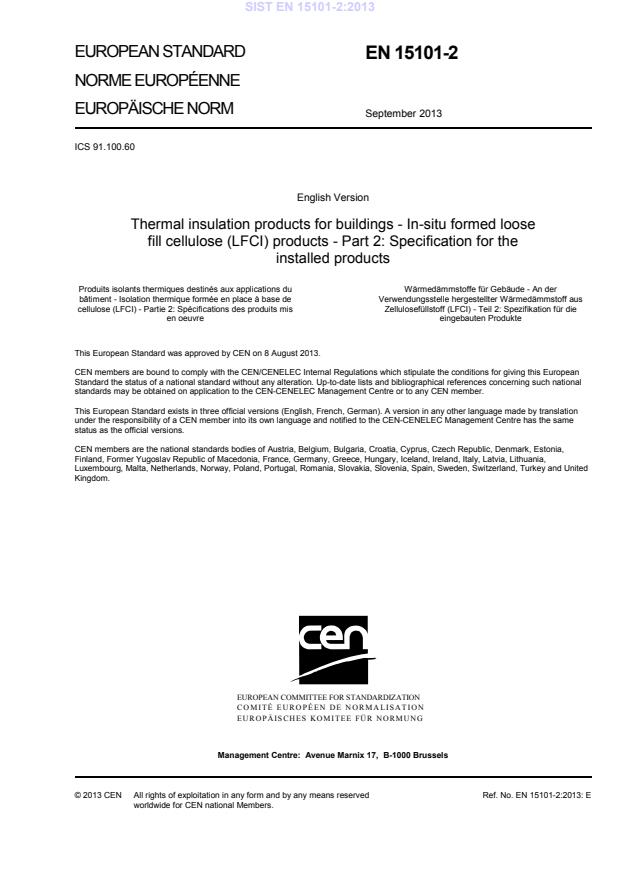
EUROPEAN STANDARD NORME EUROPÉENNE EUROPÄISCHE NORM
EN 15101-2
September 2013 ICS 91.100.60 English Version
Thermal insulation products for buildings - In-situ formed loose fill cellulose (LFCI) products - Part 2: Specification for the installed products
Produits isolants thermiques destinés aux applications du bâtiment - Isolation thermique formée en place à base de cellulose (LFCI) - Partie 2: Spécifications des produits mis en oeuvre
Wärmedämmstoffe für Gebäude - An der Verwendungsstelle hergestellter Wärmedämmstoff aus Zellulosefüllstoff (LFCI) - Teil 2: Spezifikation für die eingebauten Produkte This European Standard was approved by CEN on 8 August 2013.
CEN members are bound to comply with the CEN/CENELEC Internal Regulations which stipulate the conditions for giving this European Standard the status of a national standard without any alteration. Up-to-date lists and bibliographical references concerning such national standards may be obtained on application to the CEN-CENELEC Management Centre or to any CEN member.
This European Standard exists in three official versions (English, French, German). A version in any other language made by translation under the responsibility of a CEN member into its own language and notified to the CEN-CENELEC Management Centre has the same status as the official versions.
CEN members are the national standards bodies of Austria, Belgium, Bulgaria, Croatia, Cyprus, Czech Republic, Denmark, Estonia, Finland, Former Yugoslav Republic of Macedonia, France, Germany, Greece, Hungary, Iceland, Ireland, Italy, Latvia, Lithuania, Luxembourg, Malta, Netherlands, Norway, Poland, Portugal, Romania, Slovakia, Slovenia, Spain, Sweden, Switzerland, Turkey and United Kingdom.
EUROPEAN COMMITTEE FOR STANDARDIZATION
COMITÉ EUROPÉEN DE NORMALISATION EUROPÄISCHES KOMITEE FÜR NORMUNG
Management Centre:
Avenue Marnix 17,
B-1000 Brussels © 2013 CEN All rights of exploitation in any form and by any means reserved worldwide for CEN national Members. Ref. No. EN 15101-2:2013: ESIST EN 15101-2:2013
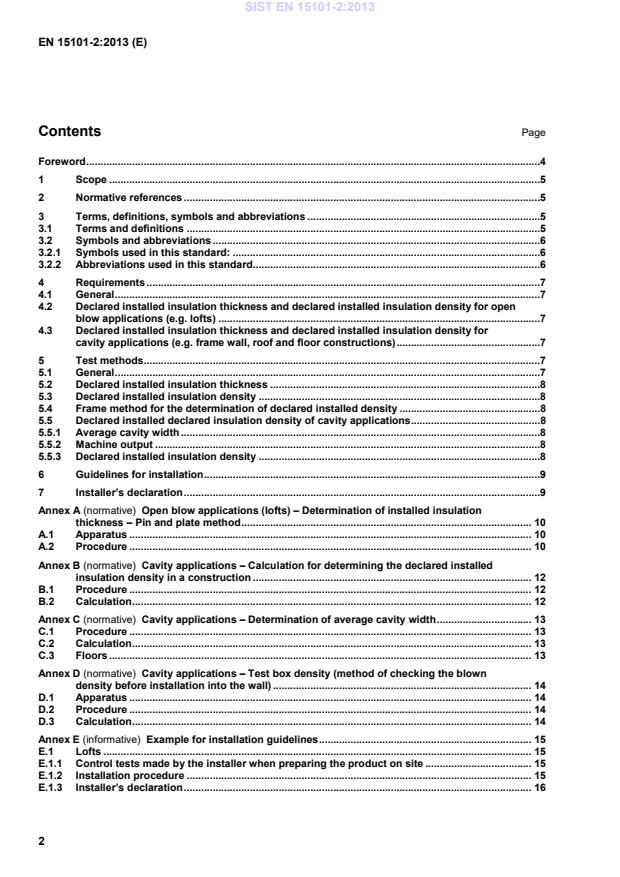
Open blow applications (lofts) – Determination of installed insulation thickness – Pin and plate method . 10 A.1 Apparatus . 10 A.2 Procedure . 10 Annex B (normative)
Cavity applications – Calculation for determining the declared installed insulation density in a construction . 12 B.1 Procedure . 12 B.2 Calculation . 12 Annex C (normative)
Cavity applications – Determination of average cavity width . 13 C.1 Procedure . 13 C.2 Calculation . 13 C.3 Floors . 13 Annex D (normative)
Cavity applications – Test box density (method of checking the blown density before installation into the wall) . 14 D.1 Apparatus . 14 D.2 Procedure . 14 D.3 Calculation . 14 Annex E (informative)
Example for installation guidelines . 15 E.1 Lofts . 15 E.1.1 Control tests made by the installer when preparing the product on site . 15 E.1.2 Installation procedure . 15 E.1.3 Installer’s declaration . 16 SIST EN 15101-2:2013
3.1 Terms and definitions
For the purposes of this document, the following terms and definitions apply. 3.1.1 open blow applications all the horizontal applications where the final upper surface of the installed insulation products remains uncovered EXAMPLE Galleries, lofts, ceilings and floors. 3.1.2 cavity applications applications where the installed insulation product is created in an enclosed space EXAMPLE Frame wall, roof and floor constructions. 3.1.3 floor horizontal division between two storeys, over a crawl space or a floor directly on the ground 3.1.4 settlement decrease of installed insulation thickness in lofts or height in cavities and frame constructions with vibrations, humidity, cyclic climate conditions and time, expressed as a percentage of the initial installed thickness
SC is the declared class of settlement for cavity applications
RD is the declared installed thermal resis
...