


EN 13381-6:2012
(Main)Test methods for determining the contribution to the fire resistance of structural members - Part 6: Applied protection to concrete filled hollow steel columns
General Information
- Abstract
This European Standard specifies a test method for determining the contribution of fire protection systems to the fire resistance of structural concrete filled hollow steel columns. The concrete can be lightweight, normal-weight or heavyweight concrete, and of all the strength classes provided for in EN 1994-1-2. The use of a dry sand is considered to be an alternative, conservative approach to the use of wet concrete. A specification for dry sand is given in 5.6.3.
The method is applicable to all fire protection systems used for the protection of concrete filled hollow columns and includes sprayed fire protection, reactive coatings, cladding protection systems and multi-layer or composite fire protection materials.
If there is no hollow section data from EN 13381-4 or EN 13381-8, this European Standard cannot be used. For passive systems, this data can be derived using the Formula in Annex A of EN 13381-4:2002.
Testing to this European Standard is not required if the fire protection thicknesses for hollow sections derived from EN 13381-4 or EN 13381-8 are to be used for concrete filled hollow sections.
The evaluation is designed to cover a range of thicknesses of the applied fire protection material, a range of steel sections, characterized by their diameters and wall thicknesses, a range of design temperatures and a range of valid fire protection classification periods.
The test method is applicable to fire protection systems which are intimately in contact with the structural column, or which include an airspace between the structural column and the protection system.
This European Standard specifies the fire tests which are carried out to determine the ability of the fire protection system to provide fire protection to composite columns. The tests produce data on the average steel temperatures of the composite column, when exposed to the time/temperature curve according to the procedures defined herein. This European Standard also provides the assessment procedure, which prescribes how the analysis of the test data should be made and gives guidance on the procedures by which interpolation is undertaken.
In special circumstances, where specified in national building regulations, there can be a need to subject reactive protection material to a smouldering curve. The test for this and the special circumstances for its use are detailed in EN 13381-8. This exposure, applicable to reactive fire protection materials, is used only in special circumstances (which are specified in the national building regulations of a member state of the European Union) and is therefore not intended to be mandatory for all fire protection materials applied to concrete filled hollow steel columns.
This European Standard ignores any contribution from the concrete to the structural capability of the hollow column and therefore only deals with thermal performance. The justification for using this approach is given in Annex B.
The fire test methodology makes provision for the collection and presentation of data which can be used as direct input to the calculation of fire resistance of concrete/steel composite members in accordance with the procedures given in EN 1994-1-2.
The limits of applicability of the results of the assessment arising from the fire test are defined together with permitted direct application of the results to different steel/concrete composite columns, steel types and thicknesses, concrete densities, strengths, thicknesses and production techniques over the range of thicknesses of the applied fire protection system tested.
This European Standard details the fire test procedures, which should be carried out to provide data on the thermal characteristics of the fire protection system, when exposed to the European Standard temperature/time curve specified in EN 1363-1.
The assessment procedure is used to establish:
a) on the basis of temperature data derived from testing concrete (...)
- Status
- Published
- Publication Date
- 19-Jun-2012
- Withdrawal Date
- 30-Dec-2012
- Technical Committee
- CEN/TC 127 - Fire safety in buildings
- Drafting Committee
- CEN/TC 127/WG 1 - Structural and separating elements
- Current Stage
- 9093 - Decision to confirm - Review Enquiry
- Start Date
- 07-Nov-2023
- Completion Date
- 23-Sep-2026
- Directive
- Harmonized Standard305/2011 - Regulation (eu) No 305/2011 of the European Parliament and of the Council of 9 march 2011 laying down harmonised conditions for the marketing of construction products and repealing council directive 89/106/eec
Not Harmonized89/106/EEC - Construction products

Overview
EN 13381-6:2012 - Test methods for determining the contribution to the fire resistance of structural members - Part 6: Applied protection to concrete filled hollow steel columns - specifies a fire test and assessment method to determine the thermal contribution of applied fire protection systems to concrete-filled hollow steel columns. The standard covers lightweight, normal-weight and heavyweight concretes (all strength classes in EN 1994-1-2) and allows a specified dry sand infill as a conservative alternative to wet concrete. EN 13381-6:2012 produces average steel temperature data when specimens are exposed to the standard time/temperature curve in EN 1363-1 and provides rules for analysing and interpolating test results.
Key topics and requirements
- Scope of testing: Thermal performance only - the standard ignores any structural contribution from the concrete core (justification in Annex B).
- Applicable protection types: Sprayed fire protection, reactive coatings, cladding systems, multi-layer and composite fire protection materials.
- Test matrix: Covers ranges of protection thicknesses, steel section diameters and wall thicknesses, design temperatures and fire classification periods.
- Specimen conditions: Protection may be in intimate contact with the column or include an airspace; dry sand infill is allowed as a conservative substitute.
- Assessment procedure: Defines how to analyse furnace and steel temperature data, perform interpolation (linear interpolation method in Annex A), apply stickability correction and determine limits of applicability for different steel/concrete combinations.
- Preconditions: EN 13381-6 cannot be used if no hollow-section data exist from EN 13381-4 or EN 13381-8; conversely, testing is not required when hollow-section protection thicknesses are derived from those standards.
- Special exposure: Smouldering curve testing for reactive materials is covered in EN 13381-8 and only required under specified national building regulations.
Applications and users
Who uses EN 13381-6:2012:
- Fire protection manufacturers validating applied protection systems for concrete filled hollow steel columns
- Fire testing laboratories conducting thermal performance tests and producing data for certification
- Structural and fire safety engineers using test outputs as input to fire resistance calculations per EN 1994-1-2
- Certification bodies, product specifiers and building authorities assessing compliance with national/regulatory fire safety requirements
Practical uses:
- Derive allowable protection thicknesses and limits of applicability for product datasheets
- Provide input temperature curves for structural fire design of composite columns
- Support CE marking, product approval and specification in tender documents
Related standards
- EN 1994-1-2 (design of composite steel–concrete structures in fire)
- EN 13381-4 and EN 13381-8 (hollow section data and reactive protections)
- EN 1363-1 (fire resistance tests - time/temperature curve)
Keywords: EN 13381-6:2012, fire resistance, concrete filled hollow steel columns, applied fire protection, fire test method, thermal performance, EN 1994-1-2, EN 13381-4, EN 13381-8, EN 1363-1, reactive coatings, sprayed fire protection.
Relations
- Effective Date
- 08-Jun-2022
- Effective Date
- 25-Aug-2026
- Effective Date
- 11-Mar-2026
- Effective Date
- 28-Jan-2026
- Effective Date
- 28-Jan-2026
- Effective Date
- 28-Jan-2026
- Effective Date
- 28-Jan-2026
- Effective Date
- 28-Jan-2026
- Effective Date
- 28-Jan-2026
- Effective Date
- 28-Jan-2026
- Effective Date
- 28-Jan-2026
- Effective Date
- 28-Jan-2026
- Effective Date
- 28-Jan-2026
- Effective Date
- 28-Jan-2026
- Effective Date
- 28-Jan-2026
Get Certified
Connect with accredited certification bodies for this standard

CIS Institut d.o.o.
Personal Protective Equipment (PPE) certification body. Notified Body NB-2890 for EU Regulation 2016/425 PPE.

Kiwa BDA Testing
Building and construction product certification.
Kmetijski inštitut Slovenije
Agricultural Institute of Slovenia. Soil testing, plant health, agricultural product analysis.
Sponsored listings
Frequently Asked Questions
EN 13381-6:2012 is a standard published by the European Committee for Standardization (CEN). Its full title is "Test methods for determining the contribution to the fire resistance of structural members - Part 6: Applied protection to concrete filled hollow steel columns". This standard covers: This European Standard specifies a test method for determining the contribution of fire protection systems to the fire resistance of structural concrete filled hollow steel columns. The concrete can be lightweight, normal-weight or heavyweight concrete, and of all the strength classes provided for in EN 1994-1-2. The use of a dry sand is considered to be an alternative, conservative approach to the use of wet concrete. A specification for dry sand is given in 5.6.3. The method is applicable to all fire protection systems used for the protection of concrete filled hollow columns and includes sprayed fire protection, reactive coatings, cladding protection systems and multi-layer or composite fire protection materials. If there is no hollow section data from EN 13381-4 or EN 13381-8, this European Standard cannot be used. For passive systems, this data can be derived using the Formula in Annex A of EN 13381-4:2002. Testing to this European Standard is not required if the fire protection thicknesses for hollow sections derived from EN 13381-4 or EN 13381-8 are to be used for concrete filled hollow sections. The evaluation is designed to cover a range of thicknesses of the applied fire protection material, a range of steel sections, characterized by their diameters and wall thicknesses, a range of design temperatures and a range of valid fire protection classification periods. The test method is applicable to fire protection systems which are intimately in contact with the structural column, or which include an airspace between the structural column and the protection system. This European Standard specifies the fire tests which are carried out to determine the ability of the fire protection system to provide fire protection to composite columns. The tests produce data on the average steel temperatures of the composite column, when exposed to the time/temperature curve according to the procedures defined herein. This European Standard also provides the assessment procedure, which prescribes how the analysis of the test data should be made and gives guidance on the procedures by which interpolation is undertaken. In special circumstances, where specified in national building regulations, there can be a need to subject reactive protection material to a smouldering curve. The test for this and the special circumstances for its use are detailed in EN 13381-8. This exposure, applicable to reactive fire protection materials, is used only in special circumstances (which are specified in the national building regulations of a member state of the European Union) and is therefore not intended to be mandatory for all fire protection materials applied to concrete filled hollow steel columns. This European Standard ignores any contribution from the concrete to the structural capability of the hollow column and therefore only deals with thermal performance. The justification for using this approach is given in Annex B. The fire test methodology makes provision for the collection and presentation of data which can be used as direct input to the calculation of fire resistance of concrete/steel composite members in accordance with the procedures given in EN 1994-1-2. The limits of applicability of the results of the assessment arising from the fire test are defined together with permitted direct application of the results to different steel/concrete composite columns, steel types and thicknesses, concrete densities, strengths, thicknesses and production techniques over the range of thicknesses of the applied fire protection system tested. This European Standard details the fire test procedures, which should be carried out to provide data on the thermal characteristics of the fire protection system, when exposed to the European Standard temperature/time curve specified in EN 1363-1. The assessment procedure is used to establish: a) on the basis of temperature data derived from testing concrete (...)
This European Standard specifies a test method for determining the contribution of fire protection systems to the fire resistance of structural concrete filled hollow steel columns. The concrete can be lightweight, normal-weight or heavyweight concrete, and of all the strength classes provided for in EN 1994-1-2. The use of a dry sand is considered to be an alternative, conservative approach to the use of wet concrete. A specification for dry sand is given in 5.6.3. The method is applicable to all fire protection systems used for the protection of concrete filled hollow columns and includes sprayed fire protection, reactive coatings, cladding protection systems and multi-layer or composite fire protection materials. If there is no hollow section data from EN 13381-4 or EN 13381-8, this European Standard cannot be used. For passive systems, this data can be derived using the Formula in Annex A of EN 13381-4:2002. Testing to this European Standard is not required if the fire protection thicknesses for hollow sections derived from EN 13381-4 or EN 13381-8 are to be used for concrete filled hollow sections. The evaluation is designed to cover a range of thicknesses of the applied fire protection material, a range of steel sections, characterized by their diameters and wall thicknesses, a range of design temperatures and a range of valid fire protection classification periods. The test method is applicable to fire protection systems which are intimately in contact with the structural column, or which include an airspace between the structural column and the protection system. This European Standard specifies the fire tests which are carried out to determine the ability of the fire protection system to provide fire protection to composite columns. The tests produce data on the average steel temperatures of the composite column, when exposed to the time/temperature curve according to the procedures defined herein. This European Standard also provides the assessment procedure, which prescribes how the analysis of the test data should be made and gives guidance on the procedures by which interpolation is undertaken. In special circumstances, where specified in national building regulations, there can be a need to subject reactive protection material to a smouldering curve. The test for this and the special circumstances for its use are detailed in EN 13381-8. This exposure, applicable to reactive fire protection materials, is used only in special circumstances (which are specified in the national building regulations of a member state of the European Union) and is therefore not intended to be mandatory for all fire protection materials applied to concrete filled hollow steel columns. This European Standard ignores any contribution from the concrete to the structural capability of the hollow column and therefore only deals with thermal performance. The justification for using this approach is given in Annex B. The fire test methodology makes provision for the collection and presentation of data which can be used as direct input to the calculation of fire resistance of concrete/steel composite members in accordance with the procedures given in EN 1994-1-2. The limits of applicability of the results of the assessment arising from the fire test are defined together with permitted direct application of the results to different steel/concrete composite columns, steel types and thicknesses, concrete densities, strengths, thicknesses and production techniques over the range of thicknesses of the applied fire protection system tested. This European Standard details the fire test procedures, which should be carried out to provide data on the thermal characteristics of the fire protection system, when exposed to the European Standard temperature/time curve specified in EN 1363-1. The assessment procedure is used to establish: a) on the basis of temperature data derived from testing concrete (...)
EN 13381-6:2012 is classified under the following ICS (International Classification for Standards) categories: 13.220.50 - Fire-resistance of building materials and elements. The ICS classification helps identify the subject area and facilitates finding related standards.
EN 13381-6:2012 has the following relationships with other standards: It is inter standard links to ENV 13381-6:2002, ISO 8421-2:1987, EN 206-2:2026, EN 10210-2:2019, EN ISO 13943:2023, EN 10210-1:2006, EN 10219-2:2019, EN 12325-2:1999/AC:1999, EN 206:2013+A2:2021, ENV 13381-4:2002, EN 10025-1:2004, EN 1992-1-1:2023, EN 1363-1:2012, EN 13381-8:2010, EN 13501-2:2016. Understanding these relationships helps ensure you are using the most current and applicable version of the standard.
EN 13381-6:2012 is associated with the following European legislation: EU Directives/Regulations: 305/2011, 89/106/EEC; Standardization Mandates: M/117. When a standard is cited in the Official Journal of the European Union, products manufactured in conformity with it benefit from a presumption of conformity with the essential requirements of the corresponding EU directive or regulation.
EN 13381-6:2012 is available in PDF format for immediate download after purchase. The document can be added to your cart and obtained through the secure checkout process. Digital delivery ensures instant access to the complete standard document.
Standards Content (Sample)
2003-01.Slovenski inštitut za standardizacijo. Razmnoževanje celote ali delov tega standarda ni dovoljeno.RQVWUXNFLMVNLKPrüfverfahren zur Bestimmung des Beitrages zum Feuerwiderstand von tragenden Bauteilen - Teil 6: Brandschutzmaßnahmen für betonverfüllte Stahlverbund-HohlstützenMéthodes d'essai pour déterminer la contribution à la résistance au feu des éléments de construction — Partie 6 : Protection appliquée aux poteaux métalliques creux remplis de bétonTest methods for determining the contribution to the fire resistance of structural members - Part 6: Applied protection to concrete filled hollow steel columns91.080.01Gradbene konstrukcije na splošnoStructures of buildings in general13.220.50Požarna odpornost gradbenih materialov in elementovFire-resistance of building materials and elementsICS:Ta slovenski standard je istoveten z:EN 13381-6:2012SIST EN 13381-6:2012en,fr,de01-november-2012SIST EN 13381-6:2012SLOVENSKI
STANDARD
EUROPEAN STANDARD NORME EUROPÉENNE EUROPÄISCHE NORM
EN 13381-6
June 2012 ICS 13.220.50 Supersedes ENV 13381-6:2002English Version
Test methods for determining the contribution to the fire resistance of structural members - Part 6: Applied protection to concrete filled hollow steel columns
Méthodes d'essai pour déterminer la contribution à la résistance au feu des éléments de construction - Partie 6: Protection appliquée aux poteaux métalliques creux remplis de béton
Prüfverfahren zur Bestimmung des Beitrages zum Feuerwiderstand von tragenden Bauteilen - Teil 6: Brandschutzmaßnahmen für betonverfüllte Stahlverbund-Hohlstützen This European Standard was approved by CEN on 14 April 2012.
CEN members are bound to comply with the CEN/CENELEC Internal Regulations which stipulate the conditions for giving this European Standard the status of a national standard without any alteration. Up-to-date lists and bibliographical references concerning such national standards may be obtained on application to the CEN-CENELEC Management Centre or to any CEN member.
This European Standard exists in three official versions (English, French, German). A version in any other language made by translation under the responsibility of a CEN member into its own language and notified to the CEN-CENELEC Management Centre has the same status as the official versions.
CEN members are the national standards bodies of Austria, Belgium, Bulgaria, Croatia, Cyprus, Czech Republic, Denmark, Estonia, Finland, France, Germany, Greece, Hungary, Iceland, Ireland, Italy, Latvia, Lithuania, Luxembourg, Malta, Netherlands, Norway, Poland, Portugal, Romania, Slovakia, Slovenia, Spain, Sweden, Switzerland, Turkey and United Kingdom.
EUROPEAN COMMITTEE FOR STANDARDIZATION
COMITÉ EUROPÉEN DE NORMALISATION EUROPÄISCHES KOMITEE FÜR NORMUNG
Management Centre:
Avenue Marnix 17,
B-1000 Brussels © 2012 CEN All rights of exploitation in any form and by any means reserved worldwide for CEN national Members. Ref. No. EN 13381-6:2012: ESIST EN 13381-6:2012
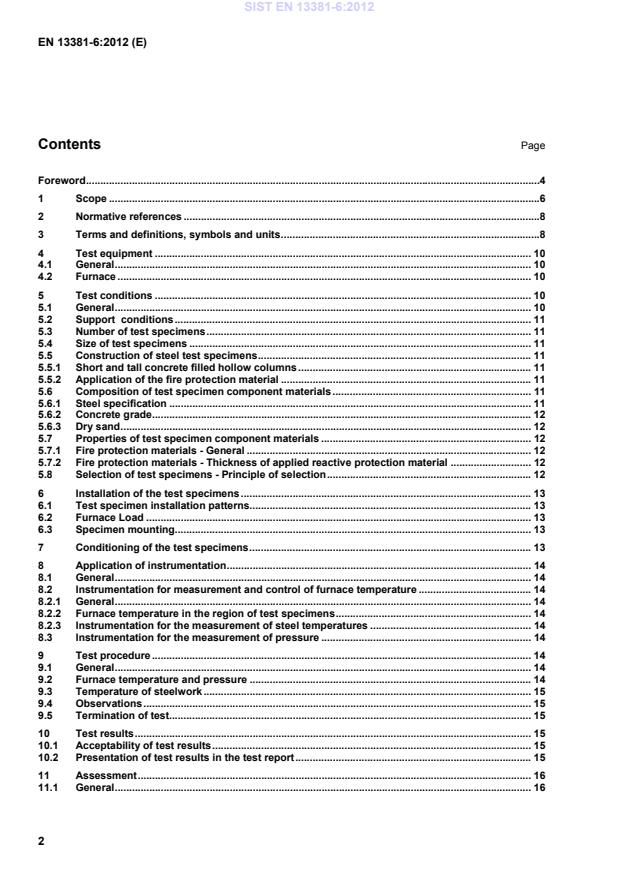
conditions . 115.3 Number of test specimens . 115.4 Size of test specimens . 115.5 Construction of steel test specimens . 115.5.1 Short and tall concrete filled hollow columns . 115.5.2 Application of the fire protection material . 115.6 Composition of test specimen component materials . 115.6.1 Steel specification . 115.6.2 Concrete grade . 125.6.3 Dry sand . 125.7 Properties of test specimen component materials . 125.7.1 Fire protection materials - General . 125.7.2 Fire protection materials - Thickness of applied reactive protection material . 125.8 Selection of test specimens - Principle of selection . 126 Installation of the test specimens . 136.1 Test specimen installation patterns. 136.2 Furnace Load . 136.3 Specimen mounting. 137 Conditioning of the test specimens . 138 Application of instrumentation . 148.1 General . 148.2 Instrumentation for measurement and control of furnace temperature . 148.2.1 General . 148.2.2 Furnace temperature in the region of test specimens . 148.2.3 Instrumentation for the measurement of steel temperatures . 148.3 Instrumentation for the measurement of pressure . 149 Test procedure . 149.1 General . 149.2 Furnace temperature and pressure . 149.3 Temperature of steelwork . 159.4 Observations . 159.5 Termination of test. 1510 Test results . 1510.1 Acceptability of test results . 1510.2 Presentation of test results in the test report . 1511 Assessment . 1611.1 General . 16SIST EN 13381-6:2012
Part 5: Applied protection to concrete/profiled sheet steel and composite members. Part 7: Applied protection to timber members. Part 8: Applied reactive protection to steel members.
Appropriate training should be given to relevant personnel. Laboratory personnel should ensure that they follow written safety instructions at all times. The specific health and safety instructions contained within this European Standard should be followed. This document has been prepared under a mandate given to CEN by the European Commission and the European Free Trade Association.
According to the CEN/CENELEC Internal Regulations, the national standards organizations of the following countries are bound to implement this European Standard: Austria, Belgium, Bulgaria, Croatia, Cyprus, Czech Republic, Denmark, Estonia, Finland, France, Germany, Greece, Hungary, Iceland, Ireland, Italy, Latvia, Lithuania, Luxembourg, Malta, Netherlands, Norway, Poland, Portugal, Romania, Slovakia, Slovenia, Spain, Sweden, Switzerland, Turkey and the United Kingdom.
1 Scope This European Standard specifies a test method for determining the contribution of fire protection systems to the fire resistance of structural concrete filled hollow steel columns. The concrete can be lightweight, normal-weight or heavyweight concrete, and of all the strength classes provided for in EN 1994-1-2. The use of a dry sand is considered to be an alternative, conservative approach to the use of wet concrete. A specification for dry sand is given in 5.6.3.
The method is applicable to all fire protection systems used for the protection of concrete filled hollow columns and includes sprayed fire protection, reactive coatings, cladding protection systems and multi-layer or composite fire protection materials.
If there is no hollow section data from prEN 13381-4 (revision of ENV 13381-4:2002) or prEN 13381-8 (revision of EN 13381-8:2010), this European Standard cannot be used. For passive systems, this data can be derived using the Formula in Annex A of prEN 13381-4 (revision of ENV 13381-4:2002).
Testing to this European Standard is not required if the fire protection thicknesses for hollow sections derived from prEN 13381-4 (revision of ENV 13381-4:2002) or prEN 13381-8 (revision of EN 13381-8:2010) are to be used for concrete filled hollow sections.
The evaluation is designed to cover a range of thicknesses of the applied fire protection material, a range of steel sections, characterized by their diameters and wall thicknesses, a range of design temperatures and a range of valid fire protection classification periods.
The test method is applicable to fire protection systems which are intimately in contact with the structural column, or which include an airspace between the structural column and the protection system.
This European Standard specifies the fire tests which are carried out to determine the ability of the fire protection system to provide fire protection to composite columns. The tests produce data on the average steel temperatures of the composite column, when exposed to the time/temperature curve according to the procedures defined herein. This European Standard also provides the assessment procedure, which prescribes how the analysis of the test data should be made and gives guidance on the procedures by which interpolation is undertaken. In special circumstances, where specified in national building regulations, there can be a need to subject reactive protection material to a smouldering curve. The test for this and the special circumstances for its use are detailed in prEN 13381-8 (revision of EN 13381-8:2010). This exposure, applicable to reactive fire protection materials, is used only in special circumstances (which are specified in the national building regulations of a member state of the European Union) and is therefore not intended to be mandatory for all fire protection materials applied to concrete filled hollow steel columns.
This European Standard ignores any contribution from the concrete to the structural capability of the hollow column and therefore only deals with thermal performance. The justification for using this approach is given in Annex B.
The fire test methodology makes provision for the collection and presentation of data which can be used as direct input to the calculation of fire resistance of concrete/steel composite members in accordance with the procedures given in EN 1994-1-2.
The limits of applicability of the results of the assessment arising from the fire test are defined together with permitted direct application of the results to different steel/concrete composite columns, steel types and thicknesses, concrete densities, strengths, thicknesses and production techniques over the range of thicknesses of the applied fire protection system tested.
b) on the basis of the temperature data derived from testing short hollow steel sections filled with concrete, the thermal properties of the fire protection system, (the thermal performance). The limits of applicability of the results of the assessment arising from the fire test are defined, together with permitted direct application of the results to different steel sections and grades and to the fire protection system. 2 Normative references The following documents, in whole or in part, are normatively referenced in this document and are indispensable for its application. For dated references, only the edition cited applies. For undated references, the latest edition of the referenced document (including any amendments) applies. EN 206-1, Concrete — Part 1: Specification, performance, production and conformity EN 1992-1-1 Eurocode 2: Design of concrete structures — Part 1-1: General rules and rules for buildings EN 1363-1:2012, Fire resistance tests — Part 1: General requirements EN 10025-1, Hot rolled products of structural steels — Part 1: General technical delivery conditions EN 10210-1 Hot finished structural hollow sections of non-alloy and fine grain steels — Part 1: Technical delivery conditions EN 10210-2: Hot finished structural hollow sections of non-alloy and fine grain steels — Part 2: Tolerances, dimensions and sectional properties EN 10219-2 Cold formed welded structural hollow sections of non-alloy and fine grain steels — Part 2: Tolerances, dimensions and sectional properties ENV 13381-4:2002, Test methods for determining the contribution to the fire resistance of structural members — Part 4: Applied passive protection products to steel members EN 13381-8:2010, Test methods for determining the contribution to the fire resistance of structural members — Part 8: Applied reactive protection to steel members EN ISO 13943, Fire safety — Vocabulary (ISO 13943) ISO 8421-2, Fire protection — Vocabulary — Part 2: Structural fire protection
3 Terms and definitions, symbols and units 3.1 Terms and definitions For the purposes of this document, the terms and definitions given in EN 1363-1, EN ISO 13943 and
ISO 8421-2, and the following apply: SIST EN 13381-6:2012
steel member element of building construction which is load-bearing and fabricated from steel Note 1 to entry: For the purpose of this document, the steel used in the testing should be of the same type. 3.1.2
reactive fire protection material reactive materials which are specifically formulated to provide a chemical reaction upon heating such that their physical form changes and, in so doing, provides fire protection by thermal insulative and cooling effects 3.1.3
passive fire protection material materials which do not change their physical form during heating and therefore provide protection by virtue of their physical or thermal properties Note 1 to entry: These may include materials containing water which, during heating, evaporates to produce cooling effects. 3.1.4
fire protection system fire protection material together with any supporting system including mesh reinforcement as tested and a specified primer and top coat if applicable 3.1.5
fire protection protection afforded to the steel member by the fire protection system such that the temperature of the steel member is limited throughout the period of exposure to fire 3.1.6
test specimen steel test section plus the fire protection system under test Note 1 to entry: The steel test section, representative of a steel member, for the purposes of this test, comprises short steel columns, or beams. 3.1.7
fire protection
thickness
thickness of a single layer fire protection system or the combined thickness of all layers of a multi-layer fire protection system or the mean dry film thickness of the fire protection coating, excluding primer and top coat Note 1 to entry: The thickness of the elements of the supporting system or joint cover strips are not included in the fire protection thickness.
3.1.8
stickability
ability of a fire protection material to remain sufficiently coherent and in position throughout a well defined range of deformations, furnace and steel temperatures, such that its ability to provide fire protection is not significantly impaired
3.1.9
characteristic steel temperature temperature of the concrete filled hollow columns which is used for the determination of the correction factor for stickability calculated as (mean temperature + maximum temperature)/2
design temperature
temperature of a steel structural member for structural design purposes
3.1.11
average steel temperature overall mean temperature to be used as input data for the analysis and calculated for concrete filled hollow section columns as the sum of the means of each measuring station
3.2 Symbols and units
dp is the interpolated protection thickness for time, t dpw is the interpolated
protection thickness for wall thickness, W dmin is minimum protection thickness dint is intermediate protection thickness tmin is the time to reach the specified temperature for sections with the minimum protection thickness tint is the time to reach the specified temperature for sections with the intermediate protection thickness t is the required fire performance period Wmin is the minimum wall thickness Wint is the intermediate wall thickness W is the required wall thickness 4 Test equipment 4.1 General The furnace and test equipment shall conform to that specified in EN 1363-1. 4.2 Furnace The furnace shall permit the dimensions of the test specimens to be exposed to heating, as specified in Clause 6 and their installation upon or within the test furnace to be as specified in Clause 7. 5 Test conditions
5.1 General A number of short steel, concrete filled hollow test sections, protected by the fire protection system, are heated in a furnace according to the protocol given in EN 1363-1. It is recommended
...