


EN 12201-3:2003
(Main)Plastics piping systems for water supply - Polyethylene (PE) - Part 3: Fittings
General Information
- Abstract
This Part of prEN 12201 specifies the characteristics of fittings made from polyethylene (PE) intended for the conveyance of water for human consumption including raw water prior to treatment. It also specifies the test parameters for the test methods referred to in this standard. In conjunction with other Parts of prEN 12201 it is applicable to PE fittings, their joints and to joints with components of PE and other materials intended to be used under the following conditions: a) a maximum operating pressure, MOP, up to and including 25 bar; b) an operating temperature of 20°C as a reference temperature.
- Status
- Withdrawn
- Publication Date
- 04-Mar-2003
- Withdrawal Date
- 06-Sep-2011
- Technical Committee
- CEN/TC 155 - Plastics piping systems and ducting systems
- Current Stage
- 9960 - Withdrawal effective - Withdrawal
- Start Date
- 07-Sep-2011
- Completion Date
- 07-Sep-2011
- Directive
- Harmonized Standard305/2011 - Regulation (eu) No 305/2011 of the European Parliament and of the Council of 9 march 2011 laying down harmonised conditions for the marketing of construction products and repealing council directive 89/106/eec
Not Harmonized89/106/EEC - Construction products

Relations
- Effective Date
- 01-Apr-2009
- Effective Date
- 28-Jan-2026
- Effective Date
- 28-Jan-2026
Get Certified
Connect with accredited certification bodies for this standard

DIBt (Deutsches Institut für Bautechnik)
German Institute for Building Technology.
DIN CERTCO
DIN Group product certification.
Zavod za gradbeništvo Slovenije (ZAG) - Inšpekcija
ZAG inspection body for construction products, structures, and materials.
Sponsored listings
Frequently Asked Questions
EN 12201-3:2003 is a standard published by the European Committee for Standardization (CEN). Its full title is "Plastics piping systems for water supply - Polyethylene (PE) - Part 3: Fittings". This standard covers: This Part of prEN 12201 specifies the characteristics of fittings made from polyethylene (PE) intended for the conveyance of water for human consumption including raw water prior to treatment. It also specifies the test parameters for the test methods referred to in this standard. In conjunction with other Parts of prEN 12201 it is applicable to PE fittings, their joints and to joints with components of PE and other materials intended to be used under the following conditions: a) a maximum operating pressure, MOP, up to and including 25 bar; b) an operating temperature of 20°C as a reference temperature.
This Part of prEN 12201 specifies the characteristics of fittings made from polyethylene (PE) intended for the conveyance of water for human consumption including raw water prior to treatment. It also specifies the test parameters for the test methods referred to in this standard. In conjunction with other Parts of prEN 12201 it is applicable to PE fittings, their joints and to joints with components of PE and other materials intended to be used under the following conditions: a) a maximum operating pressure, MOP, up to and including 25 bar; b) an operating temperature of 20°C as a reference temperature.
EN 12201-3:2003 is classified under the following ICS (International Classification for Standards) categories: 23.040.05 - Pipeline and its parts for external sewage systems; 23.040.45 - Plastics fittings; 91.140.60 - Water supply systems; 93.030 - External sewage systems. The ICS classification helps identify the subject area and facilitates finding related standards.
EN 12201-3:2003 has the following relationships with other standards: It is inter standard links to EN 12201-3:2011, CEN/TS 12201-7:2003, EN 12484-2:2000. Understanding these relationships helps ensure you are using the most current and applicable version of the standard.
EN 12201-3:2003 is associated with the following European legislation: EU Directives/Regulations: 305/2011, 89/106/EEC. When a standard is cited in the Official Journal of the European Union, products manufactured in conformity with it benefit from a presumption of conformity with the essential requirements of the corresponding EU directive or regulation.
EN 12201-3:2003 is available in PDF format for immediate download after purchase. The document can be added to your cart and obtained through the secure checkout process. Digital delivery ensures instant access to the complete standard document.
Standards Content (Sample)
2003-01.Slovenski inštitut za standardizacijo. Razmnoževanje celote ali delov tega standarda ni dovoljeno.Cevni sistemi iz polimernih materialov za oskrbo z vodo - Polietilen (PE) - 3. del: FitingiKunststoff-Rohrleitungssysteme für die Wasserversorgung - Polyethylen (PE) - Teil 3: FormstückeSystemes de canalisations en plastique pour l'alimentation en eau - Polyéthylene (PE) - Partie 3 : RaccordsPlastics piping systems for water supply - Polyethylene (PE) - Part 3: Fittings91.140.60Sistemi za oskrbo z vodoWater supply systems23.040.45Fitingi iz polimernih materialovPlastics fittingsICS:Ta slovenski standard je istoveten z:EN 12201-3:2003SIST EN 12201-3:2003en01-oktober-2003SIST EN 12201-3:2003SLOVENSKI
STANDARD
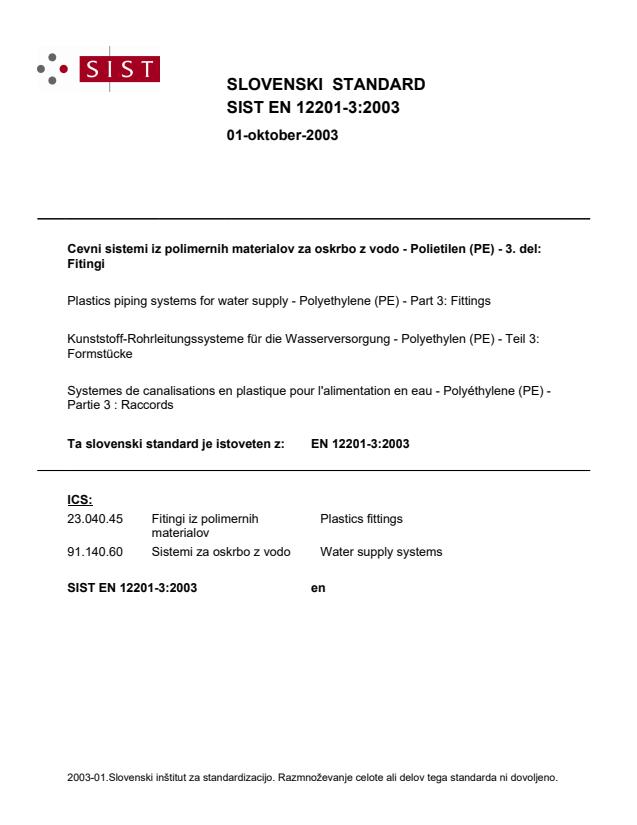
EUROPEAN STANDARDNORME EUROPÉENNEEUROPÄISCHE NORMEN 12201-3March 2003ICS 23.040.45; 91.140.60English versionPlastics piping systems for water supply - Polyethylene (PE) -Part 3: FittingsSystèmes de canalisations en plastique pour l'alimentationen eau - Polyéthylène (PE) - Partie 3: Aptitude à l'emploiKunststoff-Rohrleitungssysteme für die Wasserversorgung- Polyethylen (PE) - Teil 3: FormstückeThis European Standard was approved by CEN on 4 December 2002.CEN members are bound to comply with the CEN/CENELEC Internal Regulations which stipulate the conditions for giving this EuropeanStandard the status of a national standard without any alteration. Up-to-date lists and bibliographical references concerning such nationalstandards may be obtained on application to the Management Centre or to any CEN member.This European Standard exists in three official versions (English, French, German). A version in any other language made by translationunder the responsibility of a CEN member into its own language and notified to the Management Centre has the same status as the officialversions.CEN members are the national standards bodies of Austria, Belgium, Czech Republic, Denmark, Finland, France, Germany, Greece,Hungary, Iceland, Ireland, Italy, Luxembourg, Malta, Netherlands, Norway, Portugal, Slovakia, Spain, Sweden, Switzerland and UnitedKingdom.EUROPEAN COMMITTEE FOR STANDARDIZATIONCOMITÉ EUROPÉEN DE NORMALISATIONEUROPÄISCHES KOMITEE FÜR NORMUNGManagement Centre: rue de Stassart, 36
B-1050 Brussels© 2003 CENAll rights of exploitation in any form and by any means reservedworldwide for CEN national Members.Ref. No. EN 12201-3:2003 ESIST EN 12201-3:2003
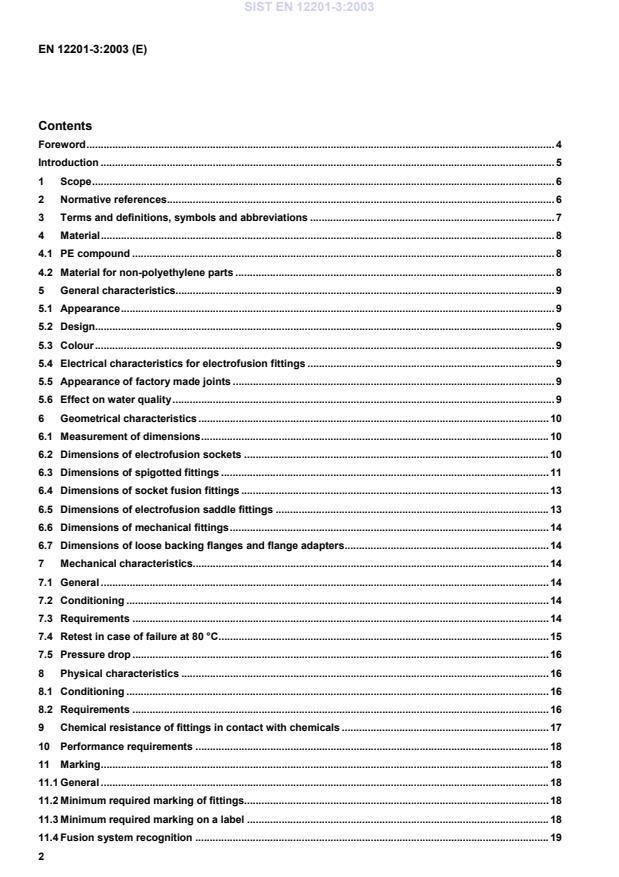
Socket fusion fittings.20Annex B (informative)
Examples of typical terminal connection for electrofusion fittings.22Bibliography.24SIST EN 12201-3:2003
1)
to be published as a CEN/TS.SIST EN 12201-3:2003
Elastomeric seals — Material requirements for pipe joint seals used in water and drainage applications— Part 1: Vulcanized rubber.EN 681-2,
Elastomeric seals — Material requirements for pipe joint seals used in water and drainage applications— Part 2: Thermoplastics elastomers.EN 728,
Plastics piping and ducting systems — Polyolefin pipes and fittings — Determination of the oxidationinduction time.EN 921:1994,
Plastics piping systems — Thermoplastics pipes — Determination of resistance to internal pressureat constant temperature (including corrigendum of 1995).EN 1716,
Plastics piping systems — Polyethylene (PE) tapping tees — Test method for impact resistance of anassembled tapping tee.EN 12201-1:2003,
Plastics piping systems for water supply — Polyethylene (PE) — Part 1: General.
2)1 bar = 105 N/m2SIST EN 12201-3:2003
Plastics piping systems for water supply — Polyethylene (PE) — Part 2: Pipes.EN 12201-5,
Plastics piping systems for water supply — Polyethylene (PE) — Part 5: Fitness for purpose of thesystem.EN ISO 1133:1999,
Plastics — Determination of the melt-mass flow rate (MFR) and the melt-volume flow rate(MVR) of thermoplastics (ISO 1133:1997).prEN ISO 3126:1999,
Plastics piping systems — Plastics piping components — Measurement and determinationof dimensions (ISO/DIS 3126:1999).ISO 4059:1978,
Polyethylene (PE) pipes — Pressure drop in mechanical pipe-jointing systems — Method of testand requirements.ISO 4433-1:1997,
Thermoplastics pipes — Resistance to liquid chemicals — Classification — Part 1: Immersiontest method.ISO 4433-2:1997,
Thermoplastics pipes — Resistance to liquid chemicals — Classification —Part 2: Polyolefinpipes.ISO 9624,
Thermoplastics pipes for fluids under pressure — Mating dimensions of flange adapters and loosebacking flanges.ISO 13953:2001,
Polyethylene (PE) pipes and fittings — Determination of the tensile strength and failure mode oftest pieces from a butt-fused joint.ISO 13954:1997,
Plastics pipes and fittings — Peel decohesion test for polyethylene (PE) electrofusionassemblies of nominal outside diameter greater than or equal to 90 mm.ISO 13955:1997,
Plastics pipes and fittings — Crushing decohesion test for polyethylene (PE) electrofusionassemblies.ISO/DIS 13956:1996,
Plastics pipes and fittings — Determination of cohesive strength — Tear test forpolyethylene (PE) assemblies.3 Terms and definitions, symbols and abbreviationsFor the purposes of this European Standard, the terms and definitions, symbols and abbreviations given inEN 12201-1:2003 and the following apply.3.1electrofusion socket fittingpolyethylene (PE) fitting which contains one or more integrated heating elements, that are capable of transformingelectrical energy into heat to realise a fusion joint with a spigot end or a pipe3.2electrofusion saddle fittingpolyethylene (PE) fitting which contains one or more integrated heating elements, that are capable of transformingelectrical energy into heat to realise a fusion on to a pipe3.2.1tapping teeelectrofusion saddle fitting (top loading or wrap round) which contains an integral cutter, to cut through the wall ofthe main pipe. The cutter remains in the body of the saddle after installation3.2.2branch saddleelectrofusion saddle fitting (top loading or wrap round) which requires an ancillary cutting tool for drilling the hole inthe adjoining main pipeSIST EN 12201-3:2003
...