


prEN 1993-7
(Main)Eurocode 3 - Design of steel structures - Part 7: Sandwich panels
Eurocode 3 - Design of steel structures - Part 7: Sandwich panels
This Standard is applicable for the design of structural or self supporting systems made of sandwich panels with steel faces and core material with a Declaration of Performance (according to EN 14509-1 and -2) used as internal and external walls, roofs and ceilings.
Eurocode 3 - Bemessung und Konstruktion von Stahlbauten - Teil 7: Sandwich-Elemente
Eurocode 3 - Calcul des structures en acier - Partie 7 : Panneaux sandwich
Evrokod 3 - Projektiranje jeklenih konstrukcij - 7.del: Sendvič plošče
General Information
Standards Content (Sample)
SLOVENSKI STANDARD
01-marec-2025
Evrokod 3 - Projektiranje jeklenih konstrukcij - 7.del: Sendvič plošče
Eurocode 3 - Design of steel structures - Part 7: Sandwich panels
Eurocode 3 - Bemessung und Konstruktion von Stahlbauten - Teil 7: Sandwich-Elemente
Eurocode 3 - Calcul des structures en acier - Partie 7 : Panneaux sandwich
Ta slovenski standard je istoveten z: prEN 1993-7
ICS:
91.010.30 Tehnični vidiki Technical aspects
91.080.13 Jeklene konstrukcije Steel structures
2003-01.Slovenski inštitut za standardizacijo. Razmnoževanje celote ali delov tega standarda ni dovoljeno.
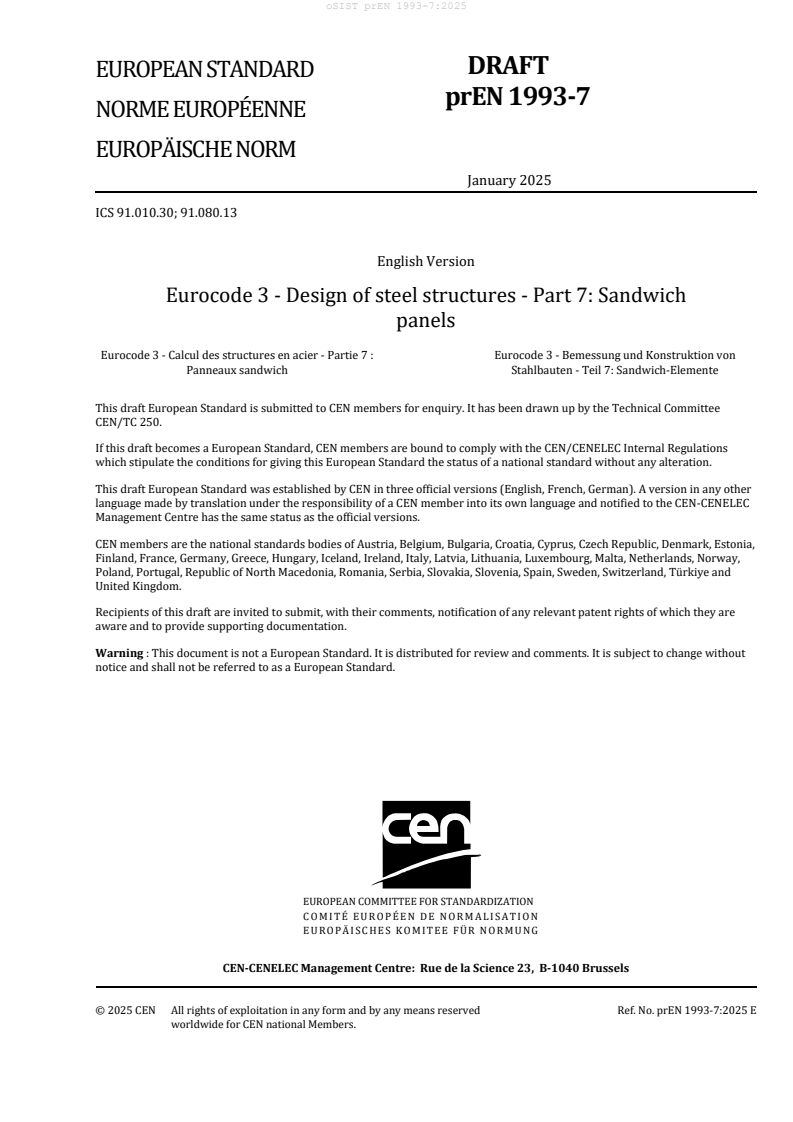
DRAFT
EUROPEAN STANDARD
NORME EUROPÉENNE
EUROPÄISCHE NORM
January 2025
ICS 91.010.30; 91.080.13
English Version
Eurocode 3 - Design of steel structures - Part 7: Sandwich
panels
Eurocode 3 - Calcul des structures en acier - Partie 7 : Eurocode 3 - Bemessung und Konstruktion von
Panneaux sandwich Stahlbauten - Teil 7: Sandwich-Elemente
This draft European Standard is submitted to CEN members for enquiry. It has been drawn up by the Technical Committee
CEN/TC 250.
If this draft becomes a European Standard, CEN members are bound to comply with the CEN/CENELEC Internal Regulations
which stipulate the conditions for giving this European Standard the status of a national standard without any alteration.
This draft European Standard was established by CEN in three official versions (English, French, German). A version in any other
language made by translation under the responsibility of a CEN member into its own language and notified to the CEN-CENELEC
Management Centre has the same status as the official versions.
CEN members are the national standards bodies of Austria, Belgium, Bulgaria, Croatia, Cyprus, Czech Republic, Denmark, Estonia,
Finland, France, Germany, Greece, Hungary, Iceland, Ireland, Italy, Latvia, Lithuania, Luxembourg, Malta, Netherlands, Norway,
Poland, Portugal, Republic of North Macedonia, Romania, Serbia, Slovakia, Slovenia, Spain, Sweden, Switzerland, Türkiye and
United Kingdom.
Recipients of this draft are invited to submit, with their comments, notification of any relevant patent rights of which they are
aware and to provide supporting documentation.
Warning : This document is not a European Standard. It is distributed for review and comments. It is subject to change without
notice and shall not be referred to as a European Standard.
EUROPEAN COMMITTEE FOR STANDARDIZATION
COMITÉ EUROPÉEN DE NORMALISATION
EUROPÄISCHES KOMITEE FÜR NORMUNG
CEN-CENELEC Management Centre: Rue de la Science 23, B-1040 Brussels
© 2025 CEN All rights of exploitation in any form and by any means reserved Ref. No. prEN 1993-7:2025 E
worldwide for CEN national Members.
Contents Page
European foreword . 5
Introduction . 6
0.1 Introduction to the Eurocodes . 6
0.2 Introduction to EN 1993 (all parts) . 6
0.3 Introduction to EN 1993-7 . 7
0.4 Verbal forms used in the Eurocodes . 7
0.5 National annex for EN 1993-7 . 8
1 Scope . 9
Scope of EN 1993-7 . 9
Assumptions . 9
2 Normative references . 9
3 Terms, definitions and symbols . 9
Terms and definitions . 9
Symbols and abbreviations . 11
3.2.1 Latin upper case symbols . 11
3.2.2 Latin lower case symbols . 12
3.2.3 Greek symbols . 13
3.2.4 Abbrevations . 15
3.2.5 Symbols for member axes/Cross-sectional dimensions . 15
3.2.6 Geometrical data . 15
4 Basis of Design . 16
Requirements . 16
Principles of limit state design . 16
Actions and environmental influences . 16
4.3.1 Permanent actions . 16
4.3.2 Variable actions . 16
4.3.3 Temperature actions . 17
4.3.4 Seismic actions . 18
Verification by the partial factor method . 18
4.4.1 Design values of actions . 18
4.4.2 Combination of actions . 18
4.4.3 Design values of material properties . 18
5 Materials . 19
General. 19
Face material . 19
Core material - The influence of time on shear deformations of the core . 20
6 Durability . 20
7 Structural Analysis . 21
Structural modelling for global analysis . 21
7.1.1 General. 21
7.1.2 Elastic global analysis . 21
7.1.3 Plastic global analysis . 21
Specifications for sandwich panels . 21
7.2.1 Sandwich panels with flat or lightly profiled faces . 21
7.2.2 Sandwich panels with one or two profiled faces . 22
General principles for cross-sectional analysis . 22
7.3.1 General . 22
7.3.2 Stresses in sandwich panels subjected to bending . 25
7.3.3 Shear stresses in sandwich panels . 26
7.3.4 Compression stress in the core at the support . 26
Interaction between wrinkling strength and support forces or line load
perpendicular to span . 26
Panels with openings . 27
Axially loaded panels . 27
Panels with line or point loads . 27
Panels with seismic loads . 27
Stiffening effect of sandwich panels stabilizing the supporting structure . 27
Panels subjected to torsion . 28
8 Ultimate Limit States . 28
General . 28
Cross-sectional resistance of sandwich panels . 28
8.2.1 Faces . 28
8.2.2 Core . 30
Point and line loads . 32
8.3.1 Line loads perpendicular to the span . 32
8.3.2 Point loads without reduction of the wrinkling strength of the face . 32
8.3.3 Line or point loads with reduced wrinkling strength of the face . 32
Global buckling of an axially loaded panel . 33
Design of fastening . 35
9 Serviceability Limit States . 35
General . 35
Cross sectional resistance of sandwich panels . 36
9.2.1 Faces . 36
9.2.2 Core . 38
Point and line loads . 39
9.3.1 Wrinkling strengths . 39
9.3.2 Calculation of the deflections . 39
Head displacement of fastener . 40
Limiting of deflection . 40
Annex A (informative) Design formulae for standard cases . 41
Use of this annex . 41
Scope and field of application . 41
Design formulae for standard cases . 41
Annex B (informative) Panels with Line and Point loads . 56
Use of this annex . 56
Scope and field of application . 56
Effective width for point loads and longitudinal line loads . 56
B.3.1 General . 56
B.3.2 Effective width . 57
B.3.3 Reduced effective width due to small distance from load application to longitudinal
joints . 59
B.3.4 Multiple point loads . 59
Annex C (informative) Openings . 62
Use of this annex . 62
Scope and field of application . 62
Determination of the load capacity of a sandwich panel with opening . 62
C.3.1 General. 62
C.3.2 Sandwich panels with flat and lightly profiled faces. 62
C.3.3 Sandwich panels with profiled faces . 63
Annex D (informative) Design assisted by testing of sandwich panels and assemblies under
seismic loading . 66
Use of this annex . 66
Scope and field of application . 66
Seismic actions and limiting conditions . 66
Design of sandwich panels under seismic loads . 67
D.4.1 General. 67
D.4.2 Design of fastening . 68
Determination of the seismic strength capacity of the panels and assemblies by
Testing . 69
D.5.1 General. 69
D.5.2 In plane . 69
D.5.3 Out of plane . 72
D.5.4 Number of tests . 74
D.5.5 Test report . 74
Annex M (informative) Design specification . 76
Use of this annex . 76
Scope and field of application . 76
Material properties . 76
Fastening . 78
Optional manufacturer specification . 79
Bibliography . 80
European foreword
This document (prEN 1993-7:2025) has been prepared by Technical Committee CEN/TC 250 “Structural
Eurocodes”, the secretariat of which is held by BSI. CEN/TC 250 is responsible for all Structural
Eurocodes and has been assigned responsibility for structural and geotechnical design matters by CEN.
This document is currently submitted to the CEN Enquiry.
The first generation of EN Eurocodes was published between 2002 and 2007. This document forms part
of the second generation of the Eurocodes, which have been prepared under Mandate M/515 issued to
CEN by the European Commission and the European Free Trade Association.
The Eurocodes have been drafted to be used in conjunction with relevant execution, material, product
and test standards, and to identify requirements for execution, materials, products and testing that are
relied upon by the Eurocodes.
The Eurocodes recognize the responsibility of each Member State and have safeguarded their right to
determine values related to regulatory safety matters at national level through the use of National
Annexes.
Introduction
0.1 Introduction to the Eurocodes
The Structural Eurocodes comprise the following standards generally consisting of a number of Parts:
— EN 1990 Eurocode — Basis of structural and geotechnical design;
— EN 1991 Eurocode 1 — Actions on structures;
— EN 1992 Eurocode 2 — Design of concrete structures;
— EN 1993 Eurocode 3 — Design of steel structures;
— EN 1994 Eurocode 4 — Design of composite steel and concrete structures;
— EN 1995 Eurocode 5 — Design of timber structures;
— EN 1996 Eurocode 6 — Design of masonry structures;
— EN 1997 Eurocode 7 — Geotechnical design;
— EN 1998 Eurocode 8 — Design of structures for earthquake resistance;
— EN 1999 Eurocode 9 — Design of aluminium structures;
— New parts are under development, e.g. Eurocode for design of structural glass.
The Eurocodes are intended for use by designers, clients, manufacturers, constructors, relevant
authorities (in exercising their duties in accordance with national or international regulations),
educators, software developers, and committees drafting standards for related product, testing and
execution standards.
NOTE Some aspects of design are most appropriately specified by relevant authorities or, where not specified,
can be agreed on a project-specific basis between relevant parties such as designers and clients. The Eurocodes
identify such aspects making explicit reference to relevant authorities and relevant parties.
0.2 Introduction to EN 1993 (all parts)
EN 1993 (all parts) applies to the design of buildings and civil engineering works in steel. It complies with
the principles and requirements for the safety and serviceability of structures, the basis of their design
and verification that are given in EN 1990 — Basis of structural and geotechnical design.
EN 1993 (all parts) is concerned only with requirements for resistance, serviceability, durability and fire
resistance of steel structures. Other requirements, e.g. concerning thermal or sound insulation, are not
covered.
EN 1993 is subdivided in various parts:
EN 1993-1, Design of Steel Structures — Part 1: General rules and rules for buildings;
EN 1993-2, Design of Steel Structures — Part 2: Bridges;
EN 1993-3, Design of Steel Structures — Part 3: Towers, masts and chimneys;
EN 1993-4, Design of Steel Structures — Part 4: Silos and tanks;
EN 1993-5, Design of Steel Structures — Part 5: Piling;
EN 1993-6, Design of Steel Structures — Part 6: Crane supporting structures;
EN 1993-7, Design of steel structures — Part 7: Sandwich panels.
EN 1993-1 in itself does not exist as a physical document, but comprises the following 14 separate parts,
the basic part being EN 1993-1-1:
EN 1993-1-1, Design of Steel Structures — Part 1‐1: General rules and rules for buildings;
EN 1993-1-2, Design of Steel Structures — Part 1‐2: Structural fire design;
EN 1993-1-3, Design of Steel Structures — Part 1‐3: Cold‐formed members and sheeting;
NOTE: Cold formed hollow sections supplied according to EN 10219 are covered in EN 1993-1-1.
EN 1993-1-4, Design of Steel Structures — Part 1‐4: Stainless steel structures;
EN 1993-1-5, Design of Steel Structures — Part 1‐5: Plated structural elements;
EN 1993-1-6, Design of Steel Structures — Part 1‐6: Strength and stability of shell structures;
EN 1993-1-7, Design of Steel Structures — Part 1‐7: Plate assemblies with elements under transverse loads;
EN 1993-1-8, Design of Steel Structures — Part 1‐8: Joints;
EN 1993-1-9, Design of Steel Structures — Part 1‐9: Fatigue;
EN 1993-1-10, Design of Steel Structures — Part 1‐10: Material toughness and through‐thickness
properties;
EN 1993-1-11, Design of Steel Structures — Part 1‐11: Tension components;
EN 1993-1-12, Design of Steel Structures — Part 1‐12: Additional rules for steel grades up to S960;
EN 1993-1-13, Design of Steel Structures — Part 1‐13: Beams with large web openings;
EN 1993-1-14, Design of Steel Structures — Part 1‐14: Design assisted by finite element analysis.
All subsequent parts EN 1993-1-2 to EN 1993-1-14 treat general topics that are independent from the
structural type like structural fire design, cold-formed members and sheeting, stainless steels, plated
structural elements, etc.
All subsequent parts numbered EN 1993-2 to EN 1993-7 treat topics relevant for a specific structural
type like steel bridges, towers, masts and chimneys, silos and tanks, piling, crane supporting structures,
sandwich panels, etc. EN 1993-2 to EN 1993-7 refer to the generic rules in EN 1993-1 and supplement,
modify or supersede them.
0.3 Introduction to EN 1993-7
(1) EN 1993-7 gives supplementary design rules for structural systems and self-supporting systems
made of sandwich panels. The focus in EN 1993-7 is on design methods and design rules for individual
sandwich panels and structural systems comprised of individual sandwich panels regarding resistance,
stability and serviceability.
0.4 Verbal forms used in the Eurocodes
The verb “shall” expresses a requirement strictly to be followed and from which no deviation is permitted
in order to comply with the Eurocodes.
The verb “should” expresses a highly recommended choice or course of action. Subject to national
regulation and /or any relevant contractual provisions, alternative approaches could be used/adopted
where technically justified.
The verb “may” expresses a course of action permissible within the limits of the Eurocodes.
The verb “can” expresses possibility and capability; it is used for statements of fact and clarification of
concepts.
0.5 National annex for EN 1993-7
National choice is allowed in this document where explicitly stated within notes. National choice includes
the selection of values for Nationally Determined Parameters (NDPs).
The national standard implementing EN 1993-7 can have a National Annex containing all national choices
to be used for the design of buildings and civil engineering works to be constructed in the relevant
country.
When no national choice is given, the default choice given in this document is to be used.
When no national choice is made and no default is given in this document, the choice can be specified by
a relevant authority or, where not specified, agreed for a specific project by appropriate parties.
National choice is allowed in EN 1993-7 through notes to the following clauses:
4.1(2) 4.2(2) 4.3.1.3(1) 4.4.1(3)
4.4.2(4) — 3 times 4.4.3(2) 5.3.1(3) 7.1.3(1)
7.7(1) 7.9(1) 7.10(1) 8.2.2.1(4) — 2 times
8.2.2.2(3) 8.3.1(2) 8.3.2(2) 9.5(1)
National choice is allowed in EN 1993-7 on the application of the following informative annexes:
Annex A Annex B Annex C Annex D
Annex M
The National Annex can contain, directly or by reference, non-contradictory complementary information
for ease of implementation, provided it does not alter any provisions of the Eurocodes.
1 Scope
Scope of EN 1993-7
(1) This document is applicable for the design of structural or self supporting systems made of sandwich
panels with steel faces and core material with a Declaration of Performance (according to EN 14509-1
and EN 14509-2) used as internal and external walls, roofs and ceilings.
Assumptions
(1) Unless specifically stated, EN 1990, EN 1991 (all parts) and EN 1993-1 (all parts) apply.
(2) The design methods given in EN 1993-7 are applicable if:
- the construction materials and products are as specified in the relevant parts of EN 14509 (all
parts), or
- in the relevant material and product specifications.
2 Normative references
The following documents are referred to in the text in such a way that some or all of their content
constitutes requirements of this document. For dated references, only the edition cited applies. For
undated references, the latest edition of the referenced document (including any amendments) applies.
NOTE See the Bibliography for a list of other documents cited that are not normative references, including
those referenced as recommendations (i.e. through ‘should’ clauses) and permissions (i.e. through ‘may’ clauses).
EN 1990:2023, Eurocode — Basis of structural and geotechnical design
EN 1991 (all parts), Eurocode 1 — Actions on structures
EN 1993-1 (all parts), Eurocode 3 — Design of steel structures
EN 14509 (all parts) , Factory‐made double skin metal faced insulating sandwich panels
3 Terms, definitions and symbols
Terms and definitions
For the purposes of this document, the terms and definitions given in EN 14509 (all parts) and the
following apply.
3.1.1
bond
adhesion between the face(s) and the core normally provided by an adhesive or by auto-adhesion
3.1.2
ceiling
covering over an internal area
3.1.3
core
layer of material, having thermal insulating properties, which is bonded between two steel faces
At draft stage.
3.1.4
edge
longitudinal edge
side of the panel
3.1.5
face
flat, lightly profiled or profiled steel sheet firmly bonded to the core
3.1.6
flat face
face without any rolled or pressed profiling, or raised strengthening trapezoidal section
3.1.7
global buckling
instability characterized by a translation of the cross-section
Note 1 to entry: Global buckling modes of axially loaded sandwich panels include flexural modes with or without
wrinkling of the face under compression.
3.1.8
joint
interface between two panels where the butt edges have been designed so that the panels can be joined
in the same plane
Note 1 to entry: The joint can incorporate interlocking parts that enhance the mechanical properties of the system
as well as improve the thermal, acoustic and fire performance and restrict air movement.
Note 2 to entry: The term 'joint' does not refer to a junction between cut panels or a junction where the panels are
not installed in the same plane.
3.1.9
lightly profiled face
face with a rolled or pressed profiling not exceeding 5 mm in depth
3.1.10
profiled face
face with a rolled or pressed profiling exceeding 5 mm in depth
3.1.11
sandwich panel
building product consisting of two steel faces positioned on either side of a core
Note 1 to entry: The core is firmly bonded to both faces so that the three components act compositely when under
load.
3.1.12
structural system
structure consisting of sandwich panels
3.1.13
wrinkling
cross-sectional instability in which the face under compression undergoes out-of-plane plate bending
deformations (local buckling)
3.1.14
line loads perpendicular to the span
loads that are applied on the whole width of the panel with a load application length corresponding to
the minimum support width L according to EN 14509 (all parts)
s
3.1.15
point loads
loads applied over a width smaller than the whole panel width and/or a length shorter than the minimum
support width L according to EN 14509 (all parts)
s
Symbols and abbreviations
For the purpose of this document the following symbols apply:
3.2.1 Latin upper case symbols
A cross sectional area of the core
C
A cross-sectional areas of the faces
Fi
A , A cross section of the inner and outer steel face
F1 F2
A cross sectional area of the opening
O
B panel width
B effective width
eff
B effective width for bending moment
eff,w
B effective width for shear forces
eff,v
B minimum effective width for bending and shear respectively
eff,min
B´eff reduced effective width
B bending stiffness
S
C correction factor point loads
w
C correction factor point loads
v
F support reaction
E modulus of elasticity
F force in plane
a,plane
F force perpendicular to the plane
a,perp
F resistance force of the panels and its assemblies
a,Rd
F horizontal seismic force acting on a non-structural element
a,Ed
F (support reaction) force at ULS/SLS
Ed
F characteristic tensile resistance of a fastener
t,Rk
F dynamic shear capacity of each fastener
va,Rd
F seismic shear force of each fastener during the test
va,Ed
F dynamic tension capacity of each fastener
ta,Rd
F seismic tension force of each fastener during the test
ta,Ed
G mean shear modulus of the core
Cm
G time dependent shear modulus of the core material
Ct
G time and load dependent effective shear modulus of the core considering creep
Ct,eff
I second moment of area of the profiled face
F1
L span, member length, length of specimen tested
L buckling length
cr
L width of support
S
L effective width at the support
S,eff
M bending moment in the critical cross section caused by eccentricity of normal force and
Ed
loads perpendicular to the panel
M sandwich bending moment
S
N critical buckling load taking into account the shear deformation
cr,S
N normal force in the critical cross section at ULS
Ed
N normal force caused by medium-term loads (i.e. load duration less than permanent, snow)
mt
N normal force caused by permanent loads
pt
R degree of reflection relative to magnesium oxide = 100 %
G
S Shear Stiffness, soil factor as provided by EN 1998-1-1
(T – T ) thermal gradient
1 2
V design shear force in the considered profiled face in ULS
Fi,Ed
V design value of the shear resistance of the considered profiled face
Fi,Rd
V shear force in the core
S
V design shear force in core in ULS/SLS
S,Ed
3.2.2 Latin lower case symbols
b width of load introduction
e
d continuous core thickness
C
e is the distance of the centroids of the faces
e* geometric eccentricity of N at point of load introduction
Ed
e distance between load introduction and panel edge
y
f yield strength of considered face
y
f compressive strength of the core
Cc
f shear resistance of the core
Cv
f reduced long-term shear strength
Cv,long
f reduced shear strength due to the opening
Cv,O
f nominal ultimate tensile strength
u
fy nominal yield strength
g total mass
k support distribution parameter
kpl reduction factor for load introduction of point loads
ks reduction factor for openings
m mass of a sandwich panel
a
n number of fasteners or number of fasteners of the stressed edge in line with acting force
o overhang of the panel
t design thickness of the steel face
t load duration for actions with other durations as service life of the structure
load
t nominal thickness of the steel face
nom
tN
nominal thickness
negative tolerance
ttol
t total thickness of the zinc layers (or similar protective coating)
zinc
u head displacement
u limitation of head displacement
Cd
q uniformly distributed load
q behaviour factor of a non-structural element
a
3.2.3 Greek symbols
II
α increase factor considering II. order effects
α the design ground acceleration
gr
-6
α = 1,2 ∙ 10 [1/K] for structural steel according to EN 1993-1-1 and EN 1993-1-3
T
β = b/B ratio of opening width b to total width of sandwich panel B
γ partial factor for the yielding of a face at ULS
M0,ULS
γ partial factor for the yielding of a face at SLS, see Table 4.1
M0,SLS
γ partial factor for wrinkling of a face at SLS
M1,SLS
γ partial factor for the failure of a fastener at SLS
M2,SLS
γ partial factor for shear failure of core at SLS
M3,SLS
γ partial factor for the crushing of the core at SLS
M4,SLS
γ partial factor for wrinkling of a face at ULS
M1,ULS
γ partial factor for the failure of a fastener at ULS
M2,ULS
γ partial factor for the shear failure of the core
M3,ULS
γ partial factor for the crushing of the core at ULS
M4,ULS
δ displacement capacity of the panels and its assemblies obtained by testing
a,Rd
δ displacement (e.g. drift between storeys) imposed to the panel and its assemblies by the
a,Ed
deformation of the supporting structure
σ design stress resulting from normal and bending stresses in considered face at ULS/SLS
Fi,Ed
σ reduced wrinkling strength due to the opening
O,Rd
σ wrinkling strength of considered face
w
σ wrinkling strength at an internal support
wR,down
σ wrinkling strength at an internal support at elevated temperature
wR,T,down
σ wrinkling strength at an internal support
wR,up
σ wrinkling strength at an internal support at elevated temperature
wR,T,up
σ wrinkling strength at an internal support with fully used compressive strength
w,s,down
σ wrinkling strength at an internal support with fully used design values for tension forces
w,s,up
for a defined screw type
σ wrinkling strength of considered face at elevated temperature
w,T
τ shear stress in the core in ULS
C,Ed
combination of the additional shear stresses resulting from creeping (additional parts
τ
C,Ed,creep
according to stress redistribution due to long term loads, like self-weight and snow)
combination of all shear stresses resulting from long-term loading (e.g. self-weight and
τC,Ed,long
snow)
combination of all shear stresses resulting from short-term loading (e.g. wind and
τ
C,Ed,short
temperature)
creep coefficient for medium-term loads
ϕ
mt
creep coefficient for permanent loads
ϕ
pt
φ creep coefficient
t
φ creep coefficient at 2 000 h
φ creep coefficient at 100 000 h
θ associated angle of imposed displacement δ
a,Ed a,Ed
θ associated angle of displacement capacity δ
a,Rd a,Rd
3.2.4 Abbrevations
EPS expanded polystyrene foam
DoP declaration of performance
PIR rigid polyisocyanurate foam
PUR rigid polyurethane foam
SLS serviceability limit state
ULS ultimate limit state
XPS extruded polystyrene foam
3.2.5 Symbols for member axes/Cross-sectional dimensions
X axis parallel to the direction of span
Y axis parallel to the direction of panel width
Z axis parallel to the direction of panel thickness
3.2.6 Geometrical data
(1) The cross-section dimensions of a sandwich panel are shown in Figure 3.1. Faces with d ≤ 5 mm are
i
lightly profiled.
Figure 3.1 — Panel cross-section with profiled face
all dimensions in mm
Figure 3.2 — Panel cross-section with examples of lightly profiled faces
NOTE e is the distance of the centroids of the two faces. For di,j see Figure 3.1.
4 Basis of Design
Requirements
(1) The design of sandwich panels shall be in accordance with the general rules given in EN 1990 and
EN 1991 (all parts) and the specific design provisions for steel structures given in EN 1993-1 (all parts).
(2) For other metallic faces the same principles may be used.
NOTE Application of EN 1993-7 for other materials can be given by the National Annex.
(3) EN 1993-7 should be used in conjunction with:
— the parts of EN 1992 (all parts) to EN 1999 (all parts) where steel structures or steel components are
referred to within those documents
— EN standards for construction products relevant to steel structures.
NOTE EADs and ETAs are also for construction products relevant to steel structures.
Principles of limit state design
(1) The design rules defined in EN 1990 apply.
(2) Because of the high effect of the temperature gradient and the creeping of the core material specific
combination factors are defined in 4.4.2.
NOTE Unless the National Annex defines otherwise, the design resistance in SLS and ULS can be expressed in
relation to the span of the panel (e.g. using load-span tables or graphs or calculation notes).
Actions and environmental influences
4.3.1 Permanent actions
(1) The permanent actions to be taken into account in the design shall be obtained from the relevant part
of EN 1991 and from specifications of this document and should include the following:
— self-weight of the panel;
— self-weight of any permanent components of the structure and installation that apply load to the
panel;
— permanent imposed deformations (calculated using nominal values relevant to the specific
application).
(2) Creep of the core material should be taken into account in the design for panels used as a roof, ceiling
or axially loaded wall panel. This may cause a change in both stresses and deformations within time.
NOTE Creeping is also relevant for the variable action “snow”.
4.3.2 Variable actions
(1) The variable actions shall be obtained from the relevant part of EN 1991 and should include the
following, where they are relevant:
— snow loads;
— live loads;
— wind loads;
— execution loads;
— climatic effects (e.g. due to a temperature difference between the faces of a panel).
4.3.3 Temperature actions
(1) The temperature gradients resulting from the difference between the outside temperature T and the
inside temperature T are variable actions, for SLS and ULS both. They can also cause creeping effects.
(2) Depending on the latitude, on the height above sea level and on the distance from the sea, four
different minimum winter temperature levels T are used throughout the continent of Europe: 0°C, −10°C,
−20°C and −30°C. Negative inner and outer environment temperatures are defined in EN 1991-1-5. The
temperature of the external face of a roof panel with a snow load is 0°C.
(3) The temperature T of the outer face has a maximum summer value which depends upon the location
(country), colour and reflectivity of its surface. Values of T , which are minimum for ULS calculations and
which are suitable for serviceability calculations, are given as follows:
Table 4.1: (NDP) Maximum temperature of outer face
Colour Group Colour Reflection degree Temperature T
colour group 1 very light colours RG = 75–90 T1 = +55 °C
colour group 2 light colours R = 40–74 T = +65 °C
G 1
colour group 3 dark colours R = 8–39 T = +80 °C
G 1
RG is the degree of reflection relative to magnesium oxide = 100 %.
(4) In special cases, the maximum temperature of a face exposed to the sun can be determined more
precisely on the basis of the actual colour used.
(5) If national specifications do not give values for internal (ambient) temperatures, the values for the
temperature of th
...
Questions, Comments and Discussion
Ask us and Technical Secretary will try to provide an answer. You can facilitate discussion about the standard in here.