


EN 13001-1:2004+A1:2009
(Main + Amendment)Cranes - General design - Part 1: General principles and requirements
General Information
- Abstract
This European Standard is to be used together with Part 2 and Part 3, and as such, they specify general conditions, requirements and methods to prevent mechanical hazards of cranes by design and theoretical verification. Part 3 is only at pre-drafting stage; the use of Parts 1 and 2 is not conditional to the publication of Part 3.
NOTE Specific requirements for particular types of crane are given in the appropriate European Standard for the particular crane type.
The following is a list of significant hazardous situations and hazardous events that could result in risks to persons during normal use and foreseeable misuse. Clause 4 of this standard is necessary to reduce or eliminate the risks associated with the following hazards:
a) rigid body instability of the crane or its parts (tilting, shifting);
b) exceeding the limits of strength (yield, ultimate, fatigue);
c) elastic instability of the crane or its parts (buckling, bulging);
d) exceeding temperature limits of material or components;
e) exceeding the deformation limits.
This European Standard is applicable to cranes which are manufactured after the date of approval by CEN of this standard and serves as reference base for the European Standards for particular crane types.
- Status
- Withdrawn
- Publication Date
- 14-Apr-2009
- Withdrawal Date
- 22-Sep-2026
- Technical Committee
- CEN/TC 147 - Cranes - Safety
- Drafting Committee
- CEN/TC 147 - Cranes - Safety
- Current Stage
- 9960 - Withdrawal effective - Withdrawal
- Start Date
- 08-Apr-2015
- Completion Date
- 23-Sep-2026
- Directive
- Harmonized Standard2006/42/EC - Directive 2006/42/EC of the European Parliament and of the Council of 17 May 2006 on machinery, and amending Directive 95/16/EC (recast)OJ Ref: C, C 214 OJ Date: 08-Sep-2009
Not Harmonized98/37/EC - Machinery

Relations
- Merged From
EN 13001-1:2004/AC:2008 - Cranes - General design - Part 1: General principles and requirements - Effective Date
- 19-Jan-2023
- Effective Date
- 19-Jan-2023
- Effective Date
- 08-Jun-2022
- Effective Date
- 03-Jun-2026
- Effective Date
- 28-Jan-2026
- Effective Date
- 28-Jan-2026
- Effective Date
- 28-Jan-2026
- Effective Date
- 28-Jan-2026
- Effective Date
- 28-Jan-2026
- Effective Date
- 28-Jan-2026
- Effective Date
- 28-Jan-2026
- Effective Date
- 28-Jan-2026
- Effective Date
- 28-Jan-2026
- Corrected By
EN 13001-1:2004+A1:2009/AC:2009 - Cranes - General design - Part 1: General principles and requirements - Effective Date
- 08-Jun-2022
Frequently Asked Questions
EN 13001-1:2004+A1:2009 is a standard published by the European Committee for Standardization (CEN). Its full title is "Cranes - General design - Part 1: General principles and requirements". This standard covers: This European Standard is to be used together with Part 2 and Part 3, and as such, they specify general conditions, requirements and methods to prevent mechanical hazards of cranes by design and theoretical verification. Part 3 is only at pre-drafting stage; the use of Parts 1 and 2 is not conditional to the publication of Part 3. NOTE Specific requirements for particular types of crane are given in the appropriate European Standard for the particular crane type. The following is a list of significant hazardous situations and hazardous events that could result in risks to persons during normal use and foreseeable misuse. Clause 4 of this standard is necessary to reduce or eliminate the risks associated with the following hazards: a) rigid body instability of the crane or its parts (tilting, shifting); b) exceeding the limits of strength (yield, ultimate, fatigue); c) elastic instability of the crane or its parts (buckling, bulging); d) exceeding temperature limits of material or components; e) exceeding the deformation limits. This European Standard is applicable to cranes which are manufactured after the date of approval by CEN of this standard and serves as reference base for the European Standards for particular crane types.
This European Standard is to be used together with Part 2 and Part 3, and as such, they specify general conditions, requirements and methods to prevent mechanical hazards of cranes by design and theoretical verification. Part 3 is only at pre-drafting stage; the use of Parts 1 and 2 is not conditional to the publication of Part 3. NOTE Specific requirements for particular types of crane are given in the appropriate European Standard for the particular crane type. The following is a list of significant hazardous situations and hazardous events that could result in risks to persons during normal use and foreseeable misuse. Clause 4 of this standard is necessary to reduce or eliminate the risks associated with the following hazards: a) rigid body instability of the crane or its parts (tilting, shifting); b) exceeding the limits of strength (yield, ultimate, fatigue); c) elastic instability of the crane or its parts (buckling, bulging); d) exceeding temperature limits of material or components; e) exceeding the deformation limits. This European Standard is applicable to cranes which are manufactured after the date of approval by CEN of this standard and serves as reference base for the European Standards for particular crane types.
EN 13001-1:2004+A1:2009 is classified under the following ICS (International Classification for Standards) categories: 53.020.20 - Cranes. The ICS classification helps identify the subject area and facilitates finding related standards.
EN 13001-1:2004+A1:2009 has the following relationships with other standards: It is inter standard links to EN 13001-1:2004/AC:2008, EN 13001-1:2004, EN 13001-1:2015, ISO 4306-1:1990, EN 856:1996, EN ISO 12100-1:2003, EN ISO 12100-2:2003, EN 1990:2002, EN 13001-2:2021, EN 13135-2:2004+A1:2010, EN 12999:2011+A1:2012, EN 13852-1:2013, EN 12999:2011+A2:2018, EN 13001-1:2004+A1:2009/AC:2009. Understanding these relationships helps ensure you are using the most current and applicable version of the standard.
EN 13001-1:2004+A1:2009 is associated with the following European legislation: EU Directives/Regulations: 2006/42/EC, 98/37/EC; Standardization Mandates: M/079, M/396, M/BC/CEN/91/1. When a standard is cited in the Official Journal of the European Union, products manufactured in conformity with it benefit from a presumption of conformity with the essential requirements of the corresponding EU directive or regulation.
EN 13001-1:2004+A1:2009 is available in PDF format for immediate download after purchase. The document can be added to your cart and obtained through the secure checkout process. Digital delivery ensures instant access to the complete standard document.
Standards Content (Sample)
2003-01.Slovenski inštitut za standardizacijo. Razmnoževanje celote ali delov tega standarda ni dovoljeno.Krane - Konstruktion allgemein - Teil 1: Allgemeine Prinzipien und AnforderungenAppareils de levage à charge suspendue - Conception générale - Partie 1: Principes généraux et prescriptionsCranes - General design - Part 1: General principles and requirements53.020.20DvigalaCranesICS:Ta slovenski standard je istoveten z:EN 13001-1:2004+A1:2009SIST EN 13001-1:2005+A1:2009en,fr01-junij-2009SIST EN 13001-1:2005+A1:2009SLOVENSKI
STANDARD
EUROPEAN STANDARD NORME EUROPÉENNE EUROPÄISCHE NORM
EN 13001-1:2004+A1
April 2009 ICS 53.020.20 Supersedes EN 13001-1:2004English Version
Cranes - General design - Part 1: General principles and requirements
Appareils de levage à charge suspendue - Conception générale - Partie 1: Principes généraux et prescriptions
Krane - Konstruktion allgemein - Teil 1: Allgemeine Prinzipien und Anforderungen This European Standard was approved by CEN on 2 March 2004 and includes Corrigendum 1 issued by CEN on 12 November 2008 and Amendment 1 approved by CEN on 7 March 2009.
CEN members are bound to comply with the CEN/CENELEC Internal Regulations which stipulate the conditions for giving this European Standard the status of a national standard without any alteration. Up-to-date lists and bibliographical references concerning such national standards may be obtained on application to the CEN Management Centre or to any CEN member.
This European Standard exists in three official versions (English, French, German). A version in any other language made by translation under the responsibility of a CEN member into its own language and notified to the CEN Management Centre has the same status as the official versions.
CEN members are the national standards bodies of Austria, Belgium, Bulgaria, Cyprus, Czech Republic, Denmark, Estonia, Finland, France, Germany, Greece, Hungary, Iceland, Ireland, Italy, Latvia, Lithuania, Luxembourg, Malta, Netherlands, Norway, Poland, Portugal, Romania, Slovakia, Slovenia, Spain, Sweden, Switzerland and United Kingdom.
EUROPEAN COMMITTEE FOR STANDARDIZATION
COMITÉ EUROPÉEN DE NORMALISATION EUROPÄISCHES KOMITEE FÜR NORMUNG
Management Centre:
Avenue Marnix 17,
B-1000 Brussels © 2009 CEN All rights of exploitation in any form and by any means reserved worldwide for CEN national Members. Ref. No. EN 13001-1:2004+A1:2009: ESIST EN 13001-1:2005+A1:2009
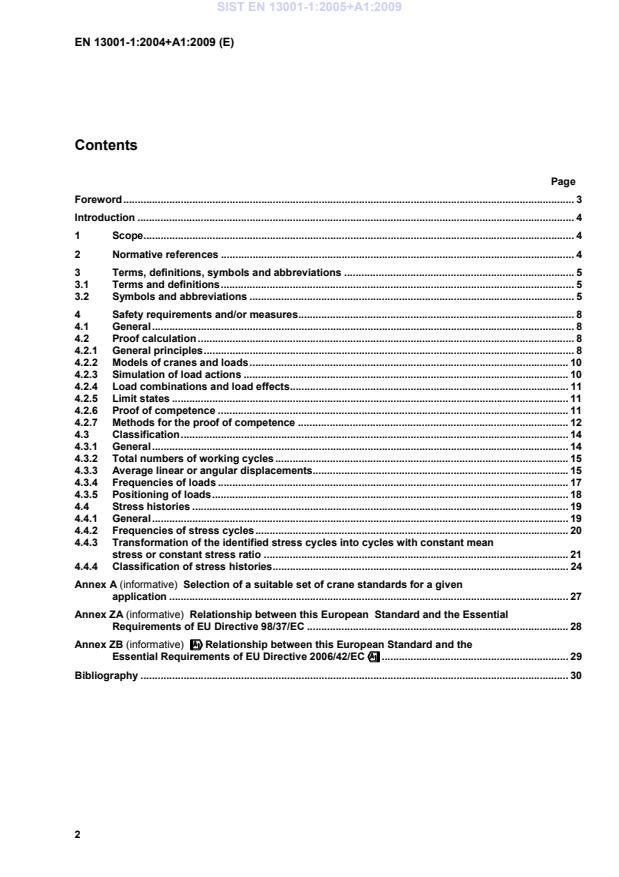
Selection of a suitable set of crane standards for a given application . 27Annex ZA (informative)
Relationship between this European
Standard and the Essential Requirements of EU Directive 98/37/EC . 28Annex ZB (informative)
!!!!Relationship between this European Standard and the Essential Requirements of EU Directive 2006/42/EC"""" . 29Bibliography . 30 SIST EN 13001-1:2005+A1:2009
0angD to 5angD Classes of average angular displacement angX if Characteristic loads jF Combined loads from load combination j (limit state method) jF Combined loads from load combination j (allowable stress method) k Stress spectrum factor
ijn Number of stress cycles of class ij ()rnij Number of stress cycles of class ij occurring each time task r is carried out rjri,nn Service frequency of position i or j
n(R or mσ) Number of stress cycles with stress amplitude aσ(R or mσ) in(R or mσ) Number of stress cycles with amplitude ia,σ(R or mσ) N Number of stress cycles to failure by fatigue DN Number of cycles at reference point p Average number of accelerations P,0P to 3P Classes of average numbers of accelerations p 0Q to 5Q Classes of load spectrum factors kQ Q Maximum value of rQfor all tasks r iQ Magnitude of load i rQ Maximum load for task r dR Characteristic resistance of material, connection or component R Stress ratio s Stress history parameter S,0S, to 9S Classes of stress history parameters s kS Load effect in section k of a member (limit state method) kS Load effect in section k of a member (allowable stress method) 0,UU to 9U Classes of total numbers of working cycles C rjrixx, Displacement of the drive under consideration to serve position i or j
Key a) Models of crane and loads b) Load actions c)
Limit states d) Proof
Figure 1 — Layout of the proof calculation SIST EN 13001-1:2005+A1:2009
...