


EN 13852-1:2013
(Main)Cranes - Offshore cranes - Part 1: General-purpose offshore cranes
General Information
- Abstract
This European Standard specifies the requirements for general-purpose offshore cranes including their supporting pedestals or structures.
The standard is applicable to general-purpose offshore cranes covered by the scope of this European Standard which are manufactured after the date of its publication as EN.
This European Standard is not applicable to general-purpose offshore cranes which are manufactured before the date of its publication as an EN.
This European Standard does not cover use of - or hazards relating to the following:
a) fabrication, transportation, assembly, dismantling, disabling, scrapping or changing the configuration of the crane;
b) lifting accessories, i.e. any item between the hook and the load;
c) minimum design temperature below −20 °C;
d) operations at an ambient temperature above 45 °C;
NOTE: For equipment designed for operation in explosive atmospheres, the normal ambient temperature range is −20 °C to +40 °C, unless otherwise specified and marked. See Annex O and relevant standards indicated for complete information.
e) lifting operations involving more than one crane;
f) accidental loads due to collisions;
g) hand powered cranes and other cranes with a rated capacity less than 2 t or outreach less than 8 m;
h) emergency rescue operations; (except training)
i) subsea lifting operations.
The significant hazards covered by this European standard are identified in Clause 4.
This European Standard includes requirements for the lifting of personnel by a general-purpose offshore crane.
- Status
- Withdrawn
- Publication Date
- 24-Sep-2013
- Withdrawal Date
- 22-Sep-2026
- Technical Committee
- CEN/TC 147 - Cranes - Safety
- Drafting Committee
- CEN/TC 147/WG 15 - Offshore cranes
- Current Stage
- 9960 - Withdrawal effective - Withdrawal
- Start Date
- 30-Apr-2025
- Completion Date
- 23-Sep-2026
- Directive
- Harmonized Standard2006/42/EC - Directive 2006/42/EC of the European Parliament and of the Council of 17 May 2006 on machinery, and amending Directive 95/16/EC (recast)OJ Ref: C, C 348 OJ Date: 28-Nov-2013
Harmonized Standard2014/34/EU - Directive 2014/34/EU Of The European Parliament And Of The Council of 26 February 2014 on the harmonisation of the laws of the Member States relating to equipment and protective systems intended for use in potentially explosive atmospheres (recast)OJ Ref: C, C 126, C 293/52, HARMONIZIRAN OJ Date: 08-Apr-2016
Not Harmonized94/9/EC - Equipment and protective systems intended for use in potentially explosive atmospheres (ATEX)OJ Ref: C, C 319 OJ Date: 05-Nov-2013

Relations
- Replaces
EN 13852-1:2004/AC:2007 - Cranes - Offshore cranes - Part 1: General - purpose offshore cranes - Effective Date
- 02-Oct-2013
- Effective Date
- 22-May-2010
- Effective Date
- 19-Jan-2023
- Effective Date
- 25-Aug-2026
- Effective Date
- 25-Aug-2026
- Effective Date
- 09-Feb-2026
- Refers
EN 60079-15:2010 - Explosive atmospheres - Part 15: Equipment protection by type of protection "n" - Effective Date
- 09-Feb-2026
- Effective Date
- 09-Feb-2026
- Effective Date
- 09-Feb-2026
- Effective Date
- 09-Feb-2026
- Effective Date
- 09-Feb-2026
- Effective Date
- 09-Feb-2026
- Effective Date
- 09-Feb-2026
- Effective Date
- 09-Feb-2026
- Effective Date
- 09-Feb-2026
Get Certified
Connect with accredited certification bodies for this standard

DNV
DNV is an independent assurance and risk management provider.

Lloyd's Register
Lloyd's Register is a global professional services organisation specialising in engineering and technology.

FSC International
Forest Stewardship Council certification.
Sponsored listings
Frequently Asked Questions
EN 13852-1:2013 is a standard published by the European Committee for Standardization (CEN). Its full title is "Cranes - Offshore cranes - Part 1: General-purpose offshore cranes". This standard covers: This European Standard specifies the requirements for general-purpose offshore cranes including their supporting pedestals or structures. The standard is applicable to general-purpose offshore cranes covered by the scope of this European Standard which are manufactured after the date of its publication as EN. This European Standard is not applicable to general-purpose offshore cranes which are manufactured before the date of its publication as an EN. This European Standard does not cover use of - or hazards relating to the following: a) fabrication, transportation, assembly, dismantling, disabling, scrapping or changing the configuration of the crane; b) lifting accessories, i.e. any item between the hook and the load; c) minimum design temperature below −20 °C; d) operations at an ambient temperature above 45 °C; NOTE: For equipment designed for operation in explosive atmospheres, the normal ambient temperature range is −20 °C to +40 °C, unless otherwise specified and marked. See Annex O and relevant standards indicated for complete information. e) lifting operations involving more than one crane; f) accidental loads due to collisions; g) hand powered cranes and other cranes with a rated capacity less than 2 t or outreach less than 8 m; h) emergency rescue operations; (except training) i) subsea lifting operations. The significant hazards covered by this European standard are identified in Clause 4. This European Standard includes requirements for the lifting of personnel by a general-purpose offshore crane.
This European Standard specifies the requirements for general-purpose offshore cranes including their supporting pedestals or structures. The standard is applicable to general-purpose offshore cranes covered by the scope of this European Standard which are manufactured after the date of its publication as EN. This European Standard is not applicable to general-purpose offshore cranes which are manufactured before the date of its publication as an EN. This European Standard does not cover use of - or hazards relating to the following: a) fabrication, transportation, assembly, dismantling, disabling, scrapping or changing the configuration of the crane; b) lifting accessories, i.e. any item between the hook and the load; c) minimum design temperature below −20 °C; d) operations at an ambient temperature above 45 °C; NOTE: For equipment designed for operation in explosive atmospheres, the normal ambient temperature range is −20 °C to +40 °C, unless otherwise specified and marked. See Annex O and relevant standards indicated for complete information. e) lifting operations involving more than one crane; f) accidental loads due to collisions; g) hand powered cranes and other cranes with a rated capacity less than 2 t or outreach less than 8 m; h) emergency rescue operations; (except training) i) subsea lifting operations. The significant hazards covered by this European standard are identified in Clause 4. This European Standard includes requirements for the lifting of personnel by a general-purpose offshore crane.
EN 13852-1:2013 is classified under the following ICS (International Classification for Standards) categories: 47.020.40 - Lifting and cargo handling equipment; 53.020.20 - Cranes. The ICS classification helps identify the subject area and facilitates finding related standards.
EN 13852-1:2013 has the following relationships with other standards: It is inter standard links to EN 13852-1:2004/AC:2007, EN 13852-1:2004, EN 13852-1:2025, ISO 12482-1:1995, ISO 12480-1:1997, EN 61508-5:2010, EN 60079-15:2010, EN 61508-6:2010, ISO 12478-1:1997, EN 60079-0:2009, ISO 8566-1:2010, EN 61508-3:2010, EN 61508-7:2010, EN 61508-2:2010, EN 61000-6-4:2007. Understanding these relationships helps ensure you are using the most current and applicable version of the standard.
EN 13852-1:2013 is associated with the following European legislation: EU Directives/Regulations: 2006/42/EC, 2014/34/EU, 94/9/EC; Standardization Mandates: M/396. When a standard is cited in the Official Journal of the European Union, products manufactured in conformity with it benefit from a presumption of conformity with the essential requirements of the corresponding EU directive or regulation.
EN 13852-1:2013 is available in PDF format for immediate download after purchase. The document can be added to your cart and obtained through the secure checkout process. Digital delivery ensures instant access to the complete standard document.
Standards Content (Sample)
2003-01.Slovenski inštitut za standardizacijo. Razmnoževanje celote ali delov tega standarda ni dovoljeno.Krane - Offshore-Krane - Teil 1: Offshore-Krane für allgemeine VerwendungAppareils de levage à charge suspendue - Grues offshore - Partie 1: Grues offshore pour usage généralCranes - Offshore cranes - Part 1: General purpose offshore cranes53.020.20DvigalaCranes47.020.40Dvigalna oprema in oprema za pretovorLifting and cargo handling equipmentICS:Ta slovenski standard je istoveten z:EN 13852-1:2013SIST EN 13852-1:2013en,fr,de01-december-2013SIST EN 13852-1:2013SLOVENSKI
STANDARDSIST EN 13852-1:2004/AC:2007SIST EN 13852-1:20041DGRPHãþD
EUROPEAN STANDARD NORME EUROPÉENNE EUROPÄISCHE NORM
EN 13852-1
September 2013 ICS 47.020.40; 53.020.20 Supersedes EN 13852-1:2004English Version
Cranes - Offshore cranes - Part 1: General-purpose offshore cranes
Appareils de levage à charge suspendue - Grues off-shore - Partie 1: Grues off-shore pour usage général
Krane - Offshore-Krane - Teil 1: Offshore-Krane für allgemeine Verwendung This European Standard was approved by CEN on 19 July 2013.
CEN members are bound to comply with the CEN/CENELEC Internal Regulations which stipulate the conditions for giving this European Standard the status of a national standard without any alteration. Up-to-date lists and bibliographical references concerning such national standards may be obtained on application to the CEN-CENELEC Management Centre or to any CEN member.
This European Standard exists in three official versions (English, French, German). A version in any other language made by translation under the responsibility of a CEN member into its own language and notified to the CEN-CENELEC Management Centre has the same status as the official versions.
CEN members are the national standards bodies of Austria, Belgium, Bulgaria, Croatia, Cyprus, Czech Republic, Denmark, Estonia, Finland, Former Yugoslav Republic of Macedonia, France, Germany, Greece, Hungary, Iceland, Ireland, Italy, Latvia, Lithuania, Luxembourg, Malta, Netherlands, Norway, Poland, Portugal, Romania, Slovakia, Slovenia, Spain, Sweden, Switzerland, Turkey and United Kingdom.
EUROPEAN COMMITTEE FOR STANDARDIZATION
COMITÉ EUROPÉEN DE NORMALISATION EUROPÄISCHES KOMITEE FÜR NORMUNG
CEN-CENELEC Management Centre:
Avenue Marnix 17,
B-1000 Brussels © 2013 CEN All rights of exploitation in any form and by any means reserved worldwide for CEN national Members. Ref. No. EN 13852-1:2013: ESIST EN 13852-1:2013
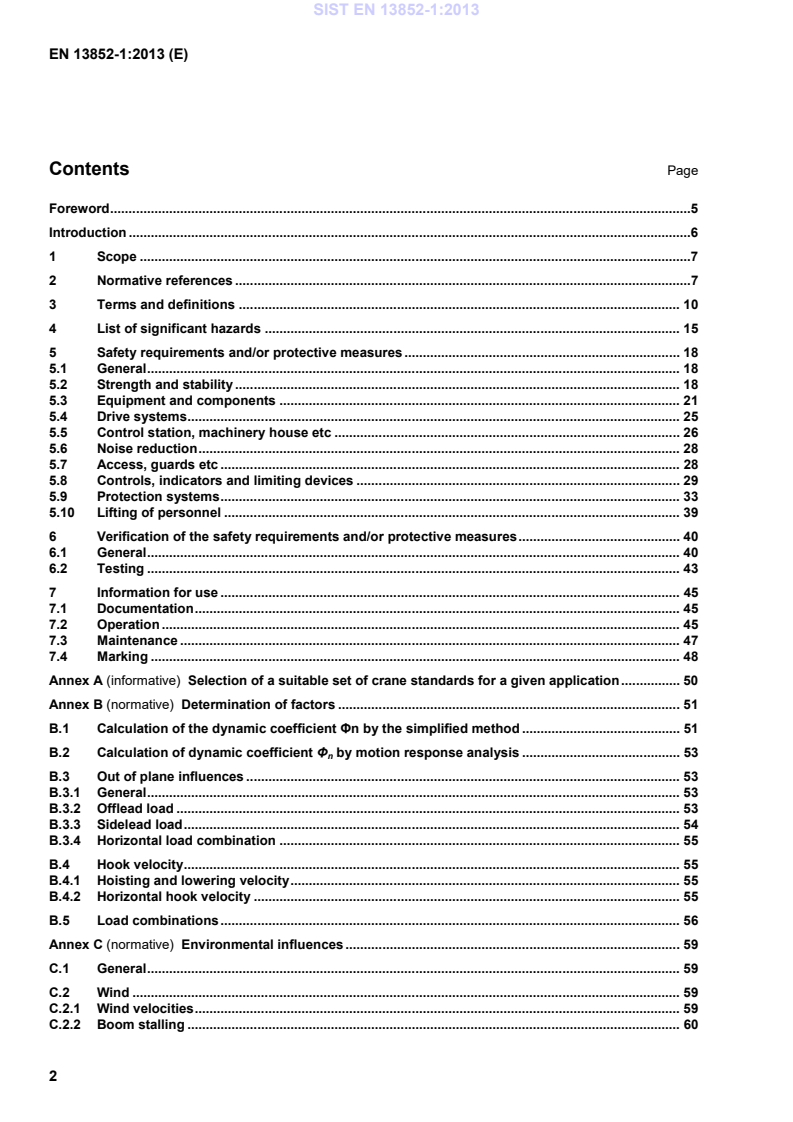
Selection of a suitable set of crane standards for a given application . 50 Annex B (normative)
Determination of factors . 51 B.1 Calculation of the dynamic coefficient -n by the simplified method . 51 B.2 Calculation of dynamic coefficient -n by motion response analysis . 53 B.3 Out of plane influences . 53 B.3.1 General . 53 B.3.2 Offlead load . 53 B.3.3 Sidelead load . 54 B.3.4 Horizontal load combination . 55 B.4 Hook velocity . 55 B.4.1 Hoisting and lowering velocity . 55 B.4.2 Horizontal hook velocity . 55 B.5 Load combinations . 56 Annex C (normative)
Environmental influences . 59 C.1 General . 59 C.2 Wind . 59 C.2.1 Wind velocities . 59 C.2.2 Boom stalling . 60 SIST EN 13852-1:2013
Failure mode analysis . 62 D.1 General . 62 D.2 Failure mode charts . 62 Annex E (normative)
Material selection . 64 E.1 General . 64 E.2 Verification of material quality . 64 E.3 Forged rings for slewing bearings . 64 E.4 Slewing bearing fasteners . 65 E.5 Welded structures . 66 E.6 Non-welded components . 66 Annex F (normative)
Control station instrumentation . 68 F.1 Minimum control station instrumentation . 68 F.2 Optional control station instrumentation . 68 Annex G (normative)
Wire rope safety factors . 69 G.1 General . 69 G.2 Static safety factors . 69 G.2.1 General . 69 G.2.2 Running rigging . 69 G.2.3 Standing rigging . 70 G.3 Dynamic safety factors . 70 G.3.1 General . 70 G.3.2 Load reference factor for running rigging . 71 G.3.3 Load reference factor for standing rigging. 71 G.4 Lifting of personnel . 71 Annex H (normative)
Slewing bearings . 72 Annex I (normative)
Requirements for brakes . 73 Annex J (normative)
Ranking of safety systems . 75 Annex K (normative)
Required performance levels (PLr) for SRP/CS according to EN ISO 13849-1:2008 . 76 Annex L (informative)
Typical general-purpose offshore cranes and terminology . 77 Annex M (normative)
Excursion envelopes . 82 Annex N (normative)
Noise test code . 83 N.1 Introduction . 83 N.2 Sound power level determination . 83 N.2.1 Basic standard to be used . 83 N.2.2 Measurement and calculation procedure . 83 N.3 Emission sound pressure level determination . 84 SIST EN 13852-1:2013
Equipment for use in a hazardous area . 92 O.1 General . 92 O.2 Avoidance or reduction of ignition sources . 92 O.3 Electrical equipment . 92 O.4 Non-electrical equipment . 92 O.5 Electrostatic discharge . 92 Annex ZA (informative)
Relationship between this European Standard and the Essential Requirements of EU Directive 2006/42/EC . 94 Annex ZB (informative)
Relationship between this European Standard and the Essential Requirements of EU Directive 94/9/EC . 95 Bibliography . 96
There are several updates in standard references, and a number of clauses have been redrafted for reasons of clarity and technical and editorial accuracy. EN 13852, Cranes — Offshore cranes, is composed of the following parts: — Part 1: General-purpose offshore cranes (the present document); — Part 2: Floating cranes. According to the CEN-CENELEC Internal Regulations, the national standards organizations of the following countries are bound to implement this European Standard: Austria, Belgium, Bulgaria, Croatia, Cyprus, Czech Republic, Denmark, Estonia, Finland, Former Yugoslav Republic of Macedonia, France, Germany, Greece, Hungary, Iceland, Ireland, Italy, Latvia, Lithuania, Luxembourg, Malta, Netherlands, Norway, Poland, Portugal, Romania, Slovakia, Slovenia, Spain, Sweden, Switzerland, Turkey and the United Kingdom. SIST EN 13852-1:2013
1) This standard is impacted by the corrigendum EN 13001-2:2011/AC:2012. SIST EN 13852-1:2013
2) This text is impacted by the stand-alone amendment EN 61000-6-4:2007/A1:2011 (IEC 61000-6-4:2006/A1:2010). SIST EN 13852-1:2013
3) This standard is impacted by IEC Corrigenda 1 (2003) and 2 (2007). SIST EN 13852-1:2013
00nnRR×Φ≥×Φ+ “Loss” Key X radius Y load 1 design load R0 x Φ0 2 operational load Rn x Φn 3 on-board lift R0 4 off-board lift Rn Figure 1 — Design load and design moment 3.7 design temperature Td lowest mean daily temperature Note 1 to entry: The design temperature is a reference temperature used as a criterion for the selection of materials. 3.8 dynamic coefficient Φn ratio between the maximum dynamic load at the hook and the actual hook load for any given configuration or operating condition 3.9 emergency operation system EOS back-up system for limited operation of the crane, if the normal system of operation is inoperative 3.10 folding motion from a mechanical system, which enable the knuckle boom assembly to be folded or unfolded 3.11 general-purpose offshore crane multipurpose slewing jib type offshore crane SIST EN 13852-1:2013
Key X radius Y rated capacity R0 rated capacity for on-board lifts R1 rated capacity for off-board lifts with wave height H1/3 = 1 m R2 rated capacity for off-board lifts with wave height H1/3 = 2 m Figure 2 — Load chart 3.15 lowest mean daily temperature lowest value on the annual mean daily temperature curve for a specific area 3.16 luffing motion from a mechanical system which enables the boom to be raised or lowered 3.17 manual overload protection system MOPS system activated by the crane operator, that protects the crane against possible overload by limiting the hoist rope pull to a low value and allowing the hook to be pulled away from the crane in any direction 3.18 mean daily temperature statistical 24 hour mean temperature for a specific calendar day, averaged over a number of years of operation SIST EN 13852-1:2013
— machine parts or workpieces 1.3 5.7.4
— accumulation of energy inside the machinery 1.5.3, 1.6.3 5.4.2, 5.4.3 1.1 Crushing hazard 1.3 5.7.2, 5.9.3 1.2 Shearing hazard 1.3 5.7.2, 5.9.3 1.4 Entanglement hazard 1.3 5.3.11, 5.5.2 1.5 Drawing-in or trapping hazard 1.3 5.7.2, 5.9.3 SIST EN 13852-1:2013
Table 1 (continued) No Significant hazards and hazardous events Machinery Directive 2006/42/EC, Annex I Requirement clause(s) in this standard 1.9 High pressure fluid injection or ejection hazard 1.3.2 5.4.3 2 Electrical hazards 1.5.1, 1.5.2, 1.6.3 5.3.1, 5.4.4, 5.9.5 3 Thermal hazards resulting in:
3.1 Burns, scalds and other injuries by a possible contact of persons with objects or materials with an extreme high or low temperature, by flames or explosions and also by the radiation of heat sources 1.5.5, 1.5.6, 1.5.7 C.4, C.5 3.2 Damage to health by hot or cold working environment 1.5.5 C.5 4 Hazards generated by noise, resulting in:
4.1 Hearing loss (deafness), other physiological disorders (e.g. loss of balance, loss of awareness) 1.5.8 5.6.1, 5.6.2 4.2 Interference with speech communication, acoustic signals, etc. 1.5.8 5.6.1, 5.6.2 5 Hazards generated by vibration 1.5.9 5.5.2 7 Hazards generated by materials and substances (and their constituent elements) processed or exhausted by the machinery:
7.1 Hazards from contact with or inhalation of harmful fluids, gases, mists, fumes and dusts 1.1.3, 1.5.13, 1.6.5 5.7.3 7.2 Fire hazard or explosion hazard 1.5.6, 1.5.7 5.3.1, 5.9.4 8 Hazards generated by neglecting ergonomic principles in machinery design as, e.g. hazards from:
8.1 Unhealthy postures or excessive efforts 1.1.2 d), 1.1.5, 1.6.2, 1.6.4 5.5.2, 5.7.1, 5.7.5 8.2 Inadequate consideration of hand-arm or foot-leg anatomy 1.1.2 d), 2.2 5.8.2 8.4 Inadequate local lighting 1.1.4 5.5.9 8.6 Human error, human behaviour 1.1.2 d), 1.2.2, 1.2.5, 1.2.8, 1.5.4, 1.7 7.2.1, 7.2.2, 7.2.3, 7.2.4, 7.2.5 8.7 Inadequate design, location or identification of manual controls 1.2.2 5.8.2 SIST EN 13852-1:2013
5.9.3 10.1 Failure/disorder of the control system 1.2.7, 1.6.3 5.8.1 10.2 Restoration of energy supply after an interruption 1.2.6 5.9.2 10.3 External influences on electrical equipment 1.2.1, 1.5.11, 4.1.2.8 5.4.1 10.4 Other external influences (gravity, wind, etc.) 1.2.1 5.2.1, 5.2.2 14 Failure of the control circuit 1.2.1, 1.2.3, 1.2.4, 1.2.5, 1.2.7, 1.6.3 5.8.1, 5.8.2, 5.9.2 18 Loss of stability/overturning of machinery 1.3.1 5.2.1, 5.9.1 19 Slip, trip and fall of persons (related to machinery) 1.5.15 5.7.1 21.6 Inadequate lighting 3.1.2 5.5.9 21.7 Inadequate seating 3.2.2 5.5.4 21.8 Noise at the work position 3.2.1 5.6.1, 5.6.2 21.9 Vibration at the work position 3.2.1, 3.2.2, 3.6.3 5.5.1, 5.5.2 21.10 Insufficient means for evacuation/emergency exit 3.2.1 5.7.1 22 Additional hazards due to control system:
5.8.2 22.1 Inadequate location of manual controls 3.2.1, 3.3.1, 3.4.5
22.2 Inadequate design of manual controls and their mode of operation 3.2.1, 3.3.1, 3.3.3 5.8.2 23 Additional hazards from handling the machine, lack of stability 3.1.3 5.7.5 24 Additional hazards due to the power source; hazards from the engine and the batteries 3.4.8, 3.5.1 5.7.3 25 Additional hazards from third persons, unauthorised start-up/use 3.3.2 5.8.2 26 Additional hazards from insufficient instructions for the driver/operator 3.6 7.2
Additional hazards due to lifting
27 Mechanical hazards:
27.1 From load falls, collisions, machine tipping caused by:
...