


EN 943-1:2002
(Main)Protective clothing against liquid and gaseous chemicals, including liquid aerosols and solid particles - Part 1: Performance requirements for ventilated and non-ventilated "gas-tight" (Type 1) and "non-gas-tight" (Type 2) chemical protective suits
General Information
- Abstract
This European Standard specifies the minimum requirements, test methods, marking and information supplied by the manufacturer for the following ventilated and non-ventilated limited use and re-usable chemical protective suits, including component parts such as gloves and boots which can be specified elsewhere.
Type 1 - "gas-tight" chemical protective suit
Type 1a - "gas-tight" chemical protective suit with a breathable air supply independent of the ambient atmosphere, e.g. a self-contained open-circuit compressed air breathing apparatus, worn inside the chemical protective suit.
Type 1b - "gas-tight" chemical protective suit with a breathable air supply, e.g. a self-contained open- circuit compressed air breathing apparatus, worn outside the chemical protective suit.
NOTE As chemical protective suits are used with respiratory devices, special attention should be given to the adequate selection of respiratory protective equipment. The limiting factors for the use of respirator filters (e.g. oxygen deficiency) should be taken into consideration.
Type 1c - "gas-tight" chemical protective suit with breathable air providing positive pressure, e.g. air lines.
Type 2 -"non-gas tight" chemical protective suit
"Non-gas-tight" chemical protective suit with breathable air providing positive pressure.
Specifications for total inward leakage test see annex A.
Specifications for test methods and performance classification for materials, seams, joins and assemblages see annex B.
- Status
- Withdrawn
- Publication Date
- 10-Sep-2002
- Withdrawal Date
- 16-Sep-2026
- Current Stage
- 9960 - Withdrawal effective - Withdrawal
- Start Date
- 05-Aug-2015
- Completion Date
- 23-Sep-2026
- Directive
- Not Harmonized89/686/EEC - Personal protective equipment (PPE)OJ Ref: C 203, C 24, C 247, C 306, C 46, C 91 OJ Date: 28-Aug-2003

Relations
- Effective Date
- 12-Aug-2015
- Effective Date
- 06-May-2026
- Effective Date
- 28-Jan-2026
- Effective Date
- 28-Jan-2026
- Effective Date
- 28-Jan-2026
- Effective Date
- 28-Jan-2026
- Refers
EN 136:1998 - Respiratory protective devices - Full face masks - Requirements, testing, marking - Effective Date
- 28-Jan-2026
- Effective Date
- 28-Jan-2026
- Effective Date
- 28-Jan-2026
- Effective Date
- 28-Jan-2026
- Effective Date
- 28-Jan-2026
- Effective Date
- 28-Jan-2026
- Effective Date
- 28-Jan-2026
- Effective Date
- 28-Jan-2026
- Effective Date
- 28-Jan-2026
Get Certified
Connect with accredited certification bodies for this standard

CIS Institut d.o.o.
Personal Protective Equipment (PPE) certification body. Notified Body NB-2890 for EU Regulation 2016/425 PPE.

Kiwa BDA Testing
Building and construction product certification.
Kmetijski inštitut Slovenije
Agricultural Institute of Slovenia. Soil testing, plant health, agricultural product analysis.
Sponsored listings
Frequently Asked Questions
EN 943-1:2002 is a standard published by the European Committee for Standardization (CEN). Its full title is "Protective clothing against liquid and gaseous chemicals, including liquid aerosols and solid particles - Part 1: Performance requirements for ventilated and non-ventilated "gas-tight" (Type 1) and "non-gas-tight" (Type 2) chemical protective suits". This standard covers: This European Standard specifies the minimum requirements, test methods, marking and information supplied by the manufacturer for the following ventilated and non-ventilated limited use and re-usable chemical protective suits, including component parts such as gloves and boots which can be specified elsewhere. Type 1 - "gas-tight" chemical protective suit Type 1a - "gas-tight" chemical protective suit with a breathable air supply independent of the ambient atmosphere, e.g. a self-contained open-circuit compressed air breathing apparatus, worn inside the chemical protective suit. Type 1b - "gas-tight" chemical protective suit with a breathable air supply, e.g. a self-contained open- circuit compressed air breathing apparatus, worn outside the chemical protective suit. NOTE As chemical protective suits are used with respiratory devices, special attention should be given to the adequate selection of respiratory protective equipment. The limiting factors for the use of respirator filters (e.g. oxygen deficiency) should be taken into consideration. Type 1c - "gas-tight" chemical protective suit with breathable air providing positive pressure, e.g. air lines. Type 2 -"non-gas tight" chemical protective suit "Non-gas-tight" chemical protective suit with breathable air providing positive pressure. Specifications for total inward leakage test see annex A. Specifications for test methods and performance classification for materials, seams, joins and assemblages see annex B.
This European Standard specifies the minimum requirements, test methods, marking and information supplied by the manufacturer for the following ventilated and non-ventilated limited use and re-usable chemical protective suits, including component parts such as gloves and boots which can be specified elsewhere. Type 1 - "gas-tight" chemical protective suit Type 1a - "gas-tight" chemical protective suit with a breathable air supply independent of the ambient atmosphere, e.g. a self-contained open-circuit compressed air breathing apparatus, worn inside the chemical protective suit. Type 1b - "gas-tight" chemical protective suit with a breathable air supply, e.g. a self-contained open- circuit compressed air breathing apparatus, worn outside the chemical protective suit. NOTE As chemical protective suits are used with respiratory devices, special attention should be given to the adequate selection of respiratory protective equipment. The limiting factors for the use of respirator filters (e.g. oxygen deficiency) should be taken into consideration. Type 1c - "gas-tight" chemical protective suit with breathable air providing positive pressure, e.g. air lines. Type 2 -"non-gas tight" chemical protective suit "Non-gas-tight" chemical protective suit with breathable air providing positive pressure. Specifications for total inward leakage test see annex A. Specifications for test methods and performance classification for materials, seams, joins and assemblages see annex B.
EN 943-1:2002 is classified under the following ICS (International Classification for Standards) categories: 13.340.10 - Protective clothing. The ICS classification helps identify the subject area and facilitates finding related standards.
EN 943-1:2002 has the following relationships with other standards: It is inter standard links to EN 943-1:2015, EN ISO 13935-2:2026, EN 270:1994, EN 530:2010, EN 16523-1:2015+A1:2018, EN 12021:2014, EN 136:1998, EN ISO 6529:2001, EN 13274-4:2001, EN ISO 11610:2023, EN ISO 13688:2013, EN ISO 13938-1:2019, EN 464:1994, EN ISO 6530:2005, EN ISO 7854:1997. Understanding these relationships helps ensure you are using the most current and applicable version of the standard.
EN 943-1:2002 is associated with the following European legislation: EU Directives/Regulations: 89/686/EEC, 93/68/EEC, 93/95/EEC, 96/58/EC; Standardization Mandates: M/BC/CEN/90/2. When a standard is cited in the Official Journal of the European Union, products manufactured in conformity with it benefit from a presumption of conformity with the essential requirements of the corresponding EU directive or regulation.
EN 943-1:2002 is available in PDF format for immediate download after purchase. The document can be added to your cart and obtained through the secure checkout process. Digital delivery ensures instant access to the complete standard document.
Standards Content (Sample)
2003-01.Slovenski inštitut za standardizacijo. Razmnoževanje celote ali delov tega standarda ni dovoljeno.Protective clothing against liquid and gaseous chemicals, including liquid aerosols and solid particles - Part 1: Performance requirements for ventilated and non-ventilated "gas-tight" (Type 1) and "non-gas-tight" (Type 2) chemical protective suitsVetements de protection contre les produits chimiques liquides et gazeux, y compris les aérosols liquides et les particules solides - Partie 1 : Exigences de performance des combinaisons de protection chimique ventilées et non ventiléesSchutzkleidung gegen flüssige und gasförmige Chemikalien, einschließlich Flüssigkeitsaerosole und feste Partikel - Teil 1: Leistungsanforderungen für belüftete und unbelüftete "gasdichte" (Typ 1) und "nicht-gasdichte" (Typ 2) Chemikalienschutzanzüge13.340.10Varovalna oblekaProtective clothingICS:SIST EN 943-1:2003enTa slovenski standard je istoveten z:EN 943-1:200201-januar-2003SIST EN 943-1:2003SLOVENSKI
STANDARD
EUROPEAN STANDARDNORME EUROPÉENNEEUROPÄISCHE NORMEN 943-1September 2002ICS 13.340.10English versionProtective clothing against liquid and gaseous chemicals,including liquid aerosols and solid particles - Part 1:Performance requirements for ventilated and non-ventilated“gas-tight” (Type 1) and “non-gas-tight” (Type 2) chemicalprotective suitsVêtements de protection contre les produits chimiquesliquides et gazeux, y compris les aérosols liquides et lesparticules solides - Partie 1: Exigences de performance descombinaisons de protection chimique ventilées et nonventilées “étanches aux gaz” (Type 1) et “non étanches auxgaz” (Type 2)Schutzkleidung gegen flüssige und gasförmigeChemikalien, einschließlich Flüssigkeitsaerosole und festePartikel - Teil 1: Leistungsanforderungen für belüftete undunbelüftete “gasdichte” (Typ 1) und “nicht-gasdichte” (Typ2) ChemikalienschutzanzügeThis European Standard was approved by CEN on 20 June 2002.CEN members are bound to comply with the CEN/CENELEC Internal Regulations which stipulate the conditions for giving this EuropeanStandard the status of a national standard without any alteration. Up-to-date lists and bibliographical references concerning such nationalstandards may be obtained on application to the Management Centre or to any CEN member.This European Standard exists in three official versions (English, French, German). A version in any other language made by translationunder the responsibility of a CEN member into its own language and notified to the Management Centre has the same status as the officialversions.CEN members are the national standards bodies of Austria, Belgium, Czech Republic, Denmark, Finland, France, Germany, Greece,Iceland, Ireland, Italy, Luxembourg, Malta, Netherlands, Norway, Portugal, Spain, Sweden, Switzerland and United Kingdom.EUROPEAN COMMITTEE FOR STANDARDIZATIONCOMITÉ EUROPÉEN DE NORMALISATIONEUROPÄISCHES KOMITEE FÜR NORMUNGManagement Centre: rue de Stassart, 36
B-1050 Brussels© 2002 CENAll rights of exploitation in any form and by any means reservedworldwide for CEN national Members.Ref. No. EN 943-1:2002 E
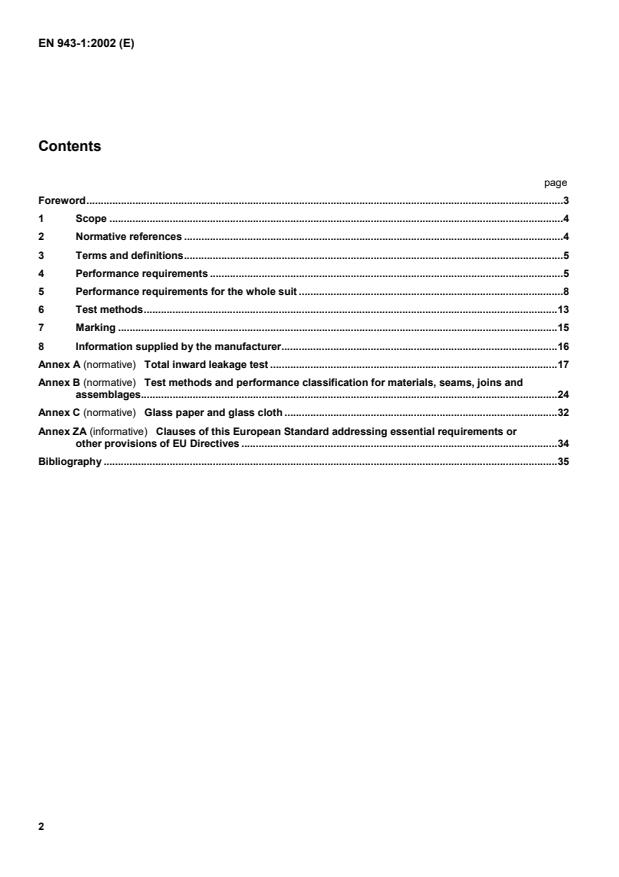
Total inward leakage test.17Annex B (normative)
Test methods and performance classification for materials, seams, joins andassemblages.24Annex C (normative)
Glass paper and glass cloth.32Annex ZA (informative)
Clauses of this European Standard addressing essential requirements orother provisions of EU Directives.34Bibliography.35
chemicals — Resistance of materials
to penetration by liquids.EN 369, Protective clothing for use against liquid chemicals — Test method: Resistance of materials topermeation by liquids.
Inward leakage test is required for Type 1b suits where the facemask is not permanently attached.NOTE 2
Applicable only when the self-contained breathing apparatus is worn outside the suit and air from the cylinder is fedinto the suit for ventilation.NOTE 3
Applicable for suits where air is vented from the facemask into the chemical protective suit and when the self-contained breathing apparatus is worn outside the suit and air from the cylinder is fed into the suit for ventilation.5 Performance requirements for the whole suit5.1 GeneralChemical protective suits shall fulfil the requirements given in Table 2 when tested as a complete suit.The suit shall be made so that the wearer has freedom of movement and is as comfortable as possible,consistent with the protection afforded by the garment when tested in accordance with 6.25.2 ConditioningThe complete suit shall be exposed:a) for not less than 4 h to an atmosphere of (60 ± 3) °C at 95 % relative humidity; followed byb) for not less than 4 h to a temperature of (-30 ± 3) °C and allowed to return to ambient conditions.It shall then be allowed to return to ambient temperature. If these temperatures are incompatible themanufacturer shall state this and state the designed conditions in the instructions.
Distortion of visionDuring the practical performance test (6.2), the test subject shall be asked to read a sign with four letters100 mm high and 20 mm high, selected at random, at a distance of 6 m.5.5.3 Field of visionDuring the practical performance test (6.2), the field of vision shall be satisfactory.5.5.4 Mechanical strengthThe visor shall not be visibly damaged in such a way as to be likely to affect the performance of the completedevice, when tested in accordance with 6.7.
If the answer is "Yes" continue the test.
If theanswer is "No", take the test subject off the panel and report the fact.6.2.1 Work simulation testDuring this test the following activities shall be done in the simulation of the practical use of the suit, the test shallbe completed within a total working time of 30 min.a)Walking on the level at a regular rate of 6 km/h for 5 min.b)Climbing up and down a ladder (total vertical distance 20 m)c)Filling a small basket (see Figure 1, approximate volume 8 l) with 12 mm chippings (e.g. limestonechippings) or other suitable material from a hopper which stands 1,5 m high and has an opening at thebottom to allow the contents to be shovelled out, and a further opening at the top where the chippings maybe returned. The subject stoops or kneels as he/she wishes and fills the basket with chippings. He/shethen lifts the basket and empties the contents back into the hopper. This is repeated 15 to 20 times in10 min.
...