


EN 464:1994
(Main)Protective clothing - Protection against liquid and gaseous chemicals, including aerosols and solid particles - Test method: Determination of leak-tightness of gas-tight suits (Internal pressure test)
General Information
- Abstract
This European Standard describes a test method to assess the resistance of a gas-tight suit to the penetration of gases through, for example, essential openings, fastenings, seams, overlaps between items, pores and any imperfections in the materials of construction.
- Status
- Published
- Publication Date
- 29-Jun-1994
- Withdrawal Date
- 29-Dec-1994
- Current Stage
- 9092 - Decision on results of review/2YR ENQ - revise - Review Enquiry
- Start Date
- 06-Jun-2017
- Completion Date
- 23-Sep-2026
- Directive
- Harmonized Standard2016/425 - Regulation (EU) 2016/425 of the European Parliament and of the Council of 9 March 2016 on personal protective equipment and repealing Council Directive 89/686/EEC
Not Harmonized89/686/EEC - Personal protective equipment (PPE)OJ Ref: C 2, C 203, C 247, C 306, C 359, C 46, C 91 OJ Date: 16-Dec-1994



Overview
EN 464:1994 is a European Standard developed by CEN that specifies a reliable test method for assessing the leak-tightness of gas-tight protective suits. These suits are designed to offer protection against hazardous liquid and gaseous chemicals, including aerosols and solid particles. The standard defines an internal pressure test that measures the suit’s resistance to gas penetration through potential weak points such as seams, fastenings, overlaps, pores, and material imperfections.
This standard is critical for manufacturers and users of chemical protective clothing, ensuring that gas-tight suits meet stringent safety and performance requirements. It supports the evaluation of protective gear used in environments where exposure to toxic gases and chemicals can pose serious health risks.
Key Topics
- Test Methodology: EN 464:1994 outlines the procedure for performing an internal pressure test on gas-tight suits to detect leaks.
- Leak Detection: Focuses on identifying gas penetration through essential openings, seams, and fastenings as well as microscopic pores or material flaws.
- Material Integrity: Evaluates the construction quality, including overlaps between garment items and sealing effectiveness.
- Safety Assurance: Provides benchmarks for protective clothing manufacturers to guarantee performance under chemical exposure.
- Chemical Protection Focus: Covers protection against liquid and gaseous chemicals, aerosols, and solid particulates.
- Standard Compliance: Ensures conformity with European safety regulations for chemical protective equipment.
Applications
- Industrial Safety: Used in industries such as chemical manufacturing, pharmaceuticals, and petrochemicals where workers face exposure to hazardous substances.
- Emergency Response: Essential for suits worn by first responders and hazmat teams dealing with chemical spills or leaks.
- Laboratory Protection: Ensures that protective clothing for laboratory personnel meets leak-tightness requirements.
- Military and Defense: Applicable to protective gear used in defense operations involving chemical warfare agents.
- Quality Control: Utilized by manufacturers for routine quality assurance testing of gas-tight chemical protective suits.
- Regulatory Compliance: Helps organizations comply with occupational health and safety standards in Europe.
Related Standards
- EN 469 - Protective clothing for firefighters, which includes requirements for chemical protection aspects.
- EN 14126 - Protective clothing against infective agents, providing complementary protection testing methods.
- EN 943 - Specifies performance requirements and test methods for gas-tight chemical protective suits.
- ISO 16602 - General requirements for protective clothing against chemicals.
- EN ISO 6529 - Determination of resistance to permeation by liquids and gases, relevant to protective materials.
Conclusion
EN 464:1994 is a fundamental European Standard that ensures the integrity and safety of gas-tight chemical protective suits. By defining a standardized test for leak-tightness through internal pressure measurement, it plays a key role in safeguarding workers and responders operating in hazardous chemical environments. Adopting this standard helps manufacturers maintain high-quality protective clothing, enhances workplace safety, and enables compliance with recognized European regulations for chemical PPE.
Relations
- Effective Date
- 28-Jan-2026
- Effective Date
- 28-Jan-2026
- Effective Date
- 28-Jan-2026
- Effective Date
- 28-Jan-2026
- Effective Date
- 28-Jan-2026
- Referred By
EN ISO 15606:1999 - Dental handpieces - Air-powered scalers and scaler tips (ISO 15606:1999) - Effective Date
- 28-Jan-2026
- Effective Date
- 28-Jan-2026
- Effective Date
- 28-Jan-2026
- Effective Date
- 28-Jan-2026
- Effective Date
- 28-Jan-2026
- Effective Date
- 28-Jan-2026
- Effective Date
- 28-Jan-2026
- Effective Date
- 28-Jan-2026
- Referred By
EN ISO 9168:2009 - Dentistry - Hose connectors for air driven dental handpieces (ISO 9168:2009) - Effective Date
- 28-Jan-2026
- Effective Date
- 28-Jan-2026
Get Certified
Connect with accredited certification bodies for this standard

CIS Institut d.o.o.
Personal Protective Equipment (PPE) certification body. Notified Body NB-2890 for EU Regulation 2016/425 PPE.

Kiwa BDA Testing
Building and construction product certification.
Kmetijski inštitut Slovenije
Agricultural Institute of Slovenia. Soil testing, plant health, agricultural product analysis.
Sponsored listings
Frequently Asked Questions
EN 464:1994 is a standard published by the European Committee for Standardization (CEN). Its full title is "Protective clothing - Protection against liquid and gaseous chemicals, including aerosols and solid particles - Test method: Determination of leak-tightness of gas-tight suits (Internal pressure test)". This standard covers: This European Standard describes a test method to assess the resistance of a gas-tight suit to the penetration of gases through, for example, essential openings, fastenings, seams, overlaps between items, pores and any imperfections in the materials of construction.
This European Standard describes a test method to assess the resistance of a gas-tight suit to the penetration of gases through, for example, essential openings, fastenings, seams, overlaps between items, pores and any imperfections in the materials of construction.
EN 464:1994 is classified under the following ICS (International Classification for Standards) categories: 13.340.10 - Protective clothing. The ICS classification helps identify the subject area and facilitates finding related standards.
EN 464:1994 has the following relationships with other standards: It is inter standard links to EN ISO 15087-1:2001, EN ISO 15087-5:2000, EN ISO 22254:2005, EN ISO 9873:2000, EN ISO 7492:1998, EN ISO 15606:1999, EN ISO 6360-5:2007, EN ISO 4823:2000, EN ISO 14801:2007, EN ISO 9173-1:2006, EN ISO 9997:1999, EN ISO 15087-3:2000, EN ISO 21533:2003, EN ISO 9168:2009, EN ISO 15098-1:2001. Understanding these relationships helps ensure you are using the most current and applicable version of the standard.
EN 464:1994 is associated with the following European legislation: EU Directives/Regulations: 2016/425, 89/686/EEC; Standardization Mandates: M/BC/CEN/90/2. When a standard is cited in the Official Journal of the European Union, products manufactured in conformity with it benefit from a presumption of conformity with the essential requirements of the corresponding EU directive or regulation.
EN 464:1994 is available in PDF format for immediate download after purchase. The document can be added to your cart and obtained through the secure checkout process. Digital delivery ensures instant access to the complete standard document.
Standards Content (Sample)
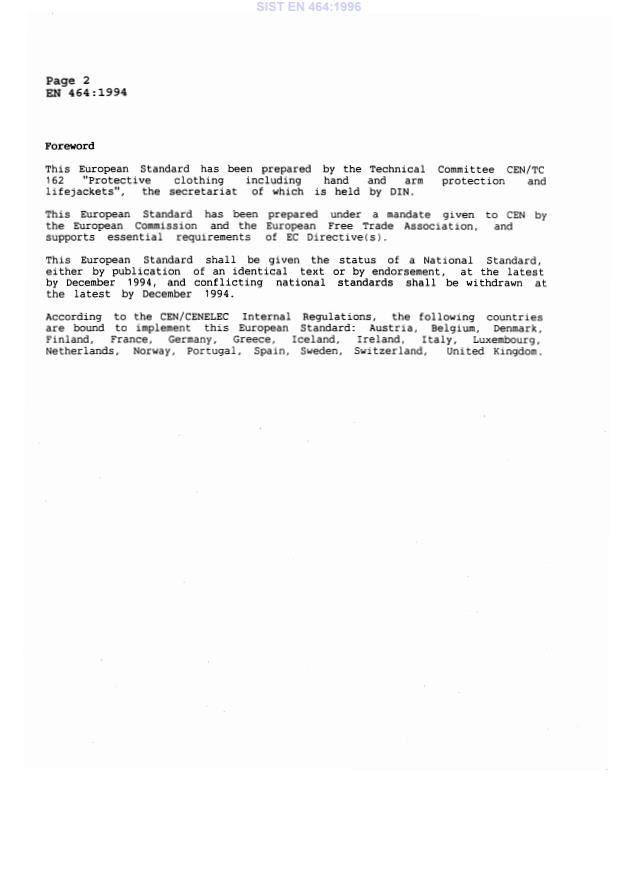
2003-01.Slovenski inštitut za standardizacijo. Razmnoževanje celote ali delov tega standarda ni dovoljeno.QRVWLSchutzkleidung - Schutz gegen flüssige und gasförmige Chemikalien, einschließlich Flüssigkeitsaerosole und feste Partikel - Prüfverfahren: Bestimmung der Leckdichtigkeit von gasdichten Anzügen (Innendruckprüfverfahren)Vetements de protection - Protection contre les produits chimiques liquides et gazeux, y compris les aérosols liquides et les particules solides - Méthode d'essai: Détermination de l'étanchéité
...