


EN 17226:2019
(Main)Beauty Salon Services - Requirements and recommendations for the provision of service
Beauty Salon Services - Requirements and recommendations for the provision of service
Interruption of work due to appeal from UNE against BT Decision 69/2017 (SV on 2018-03-07).
Dienstleistungen in Kosmetiksalons - Anforderungen an und Empfehlungen für die Dienstleistungserbringung
Dieses Dokument enthält Anforderungen an und gibt Empfehlungen für die Erbringung von professionellen Dienstleistungen in Kosmetiksalons. Diese Dienstleistungen beziehen sich auf die Erbringung von kosmetischen Behandlungen unabhängig davon, wo die Dienstleistungen erbracht werden.
Dieses Dokument enthält Anforderungen an und gibt Empfehlungen für die Durchführung von kosmetischen Behandlungen durch eine ausreichend qualifizierte Fachkraft für Kosmetik. Es werden Empfehlungen bezüglich des Kundenmanagements zur Verfügung gestellt, um die Sicherheit von Kunden während jeglicher kosmetischen Behandlung sicherzustellen. Der Dienstleistungsumfang von Kosmetiksalons ist durch die Qualifikation der einzelnen Fachkräfte für Kosmetik begrenzt, die von einem anerkannten Bildungsanbieter erhalten wurde.
Medizinische Verfahren, einschließlich ästhetisch chirurgischer Eingriffe, sowie Verfahren mit kosmetischer Injektion, einschließlich der Sklerotherapie, sind vom Anwendungsbereich dieses Dokuments ausgeschlossen.
Ebenfalls vom Anwendungsbereich dieses Dokuments ausgeschlossen sind Friseur-, Körperkunst- und Tätowierdienstleistungen.
Services des instituts de beauté - Exigences et recommandations relatives à la fourniture de prestations
Storitve kozmetičnih salonov - Zahteve in priporočila za zagotavljanje storitev
Ta dokument določa zahteve in priporočila za zagotavljanje storitev profesionalnih kozmetičnih salonov. Te storitve so povezane z izvajanjem kozmetičnih terapij ne glede na to, kje se storitev izvaja.
Ta dokument podaja zahteve in priporočila za izvajanje kozmetičnih terapij, ki jih opravljajo ustrezno usposobljeni lepotni terapevti. Priporočila so namenjena za upravljanje s strankami, da se zagotovi varnost strank med katerimi koli kozmetičnimi terapijami. Izvajanje storitev kozmetičnih salonov je omejeno na usposobljenost posameznega lepotnega terapevta, ki jih je pridobil pri priznanem ponudniku usposabljanja.
Medicinski postopki, vključno z estetskimi kirurškimi postopki in kozmetičnimi postopki z vbrizgavanjem, vključno s skleroterapijo, niso del tega dokumenta.
Frizerske storitve, britje in tetoviranje ravno tako niso del tega dokumenta.
General Information
- Status
- Published
- Publication Date
- 02-Jul-2019
- Withdrawal Date
- 30-Jan-2020
- Current Stage
- 9060 - Closure of 2 Year Review Enquiry - Review Enquiry
- Start Date
- 04-Mar-2025
- Completion Date
- 04-Mar-2025
Relations
- Effective Date
- 07-Jan-2020
- Splited From
EN 16708:2017 - Beauty salon services - Requirements and recommendations for the provision of service - Effective Date
- 16-Jan-2023
Overview
EN 17226:2019 - Beauty Salon Services is a European Standard published by CEN (Technical Committee CEN/TC 409) that sets out requirements and recommendations for the safe, professional provision of beauty and wellness services. It covers salon organisation, therapist competence, client consultation, hygiene, treatment delivery, risk management and service improvement. The standard applies to treatments performed by qualified beauty therapists whether delivered in a salon or as mobile services. It excludes medical/aesthetic surgical procedures, cosmetic injectables (including sclerotherapy), hairdressing/barbering and body-art tattooing.
Note: national adoption and implementation details may include administrative notes - e.g., a reported interruption in national work due to an appeal - and compliance with national/EU law remains the responsibility of the service provider.
Key Topics and Requirements
- Scope & exclusions: Clarifies services included (beauty/wellness treatments) and explicit exclusions (medical/surgical and other regulated services).
- Competence & qualifications: Therapists must hold nationally recognised qualifications covering anatomy, skin conditions, cosmetic products, hygiene, sterilisation, legislation, consultation and communication. Apprentices must be supervised.
- Continuing Professional Development (CPD): Ongoing training and CPD are required to maintain competence.
- Client management: Pre-treatment consultation, consent, contra-indications, pre‑treatment testing, referrals and client records.
- Risk assessment & insurance: Treatment-specific risk assessments and appropriate insurance arrangements are required; Annex B provides a template.
- Salon setup & hygiene: Requirements for salon layout, reception, treatment areas, equipment maintenance, personal hygiene, sterilisation and scheduling to minimise cross‑contamination.
- Equipment & chemicals: Safe handling, stock control, electrical equipment inspection and procedures for hazardous substances.
- Quality improvement: Service review, staff appraisals, record keeping, complaints handling and planning for continual improvement.
- Supporting annexes: Examples of treatments, risk assessment template, consent form, client consultation form and deviation guidance.
Practical Applications
- Implements a consistent, safety-focused framework for beauty salons and mobile therapists to manage client care, hygiene, and competence.
- Useful for developing salon operating procedures, staff training programs, client consultation and consent processes, maintenance schedules and internal audits.
- Supports salon owners, managers, training providers, insurers and regulators in demonstrating adherence to recognised European good practice.
Who Would Use This Standard
- Beauty salon owners and managers
- Qualified beauty therapists and apprentices (supervisors)
- Training and certification bodies
- Insurers and health & safety officers in the beauty sector
- National standards bodies and regulators when aligning salon practice with European guidance
Related Standards and Notes
- EN 17226:2019 contains no normative references; compliance does not replace national or EU regulatory obligations.
- Designed to be used alongside relevant national legislation, professional-body CPD frameworks and any specific electrical/chemical safety standards applicable in the salon.

Get Certified
Connect with accredited certification bodies for this standard

Great Wall Tianjin Quality Assurance Center
Established 1993, first batch to receive national accreditation with IAF recognition.
Hong Kong Quality Assurance Agency (HKQAA)
Hong Kong's leading certification body.

Innovative Quality Certifications Pvt. Ltd. (IQCPL)
Known for integrity, providing ethical & impartial Assessment & Certification. CMMI Institute Partner.
Sponsored listings
Frequently Asked Questions
EN 17226:2019 is a standard published by the European Committee for Standardization (CEN). Its full title is "Beauty Salon Services - Requirements and recommendations for the provision of service". This standard covers: Interruption of work due to appeal from UNE against BT Decision 69/2017 (SV on 2018-03-07).
Interruption of work due to appeal from UNE against BT Decision 69/2017 (SV on 2018-03-07).
EN 17226:2019 is classified under the following ICS (International Classification for Standards) categories: 03.080.30 - Services for consumers. The ICS classification helps identify the subject area and facilitates finding related standards.
EN 17226:2019 has the following relationships with other standards: It is inter standard links to EN 16708:2017, EN 16708:2017. Understanding these relationships helps ensure you are using the most current and applicable version of the standard.
EN 17226:2019 is available in PDF format for immediate download after purchase. The document can be added to your cart and obtained through the secure checkout process. Digital delivery ensures instant access to the complete standard document.
Standards Content (Sample)
SLOVENSKI STANDARD
01-september-2019
Storitve kozmetičnih salonov - Zahteve in priporočila za zagotavljanje storitev
Beauty Salon Services - Requirements and recommendations for the provision of service
Dienstleistungen in Kosmetiksalons - Anforderungen an und Empfehlungen für die
Dienstleistungserbringung
Services des instituts de beauté - Exigences et recommandations relatives à la fourniture
de prestations
Ta slovenski standard je istoveten z: EN 17226:2019
ICS:
03.080.30 Storitve za potrošnike Services for consumers
2003-01.Slovenski inštitut za standardizacijo. Razmnoževanje celote ali delov tega standarda ni dovoljeno.
EN 17226
EUROPEAN STANDARD
NORME EUROPÉENNE
July 2019
EUROPÄISCHE NORM
ICS 03.080.30
English Version
Beauty Salon Services - Requirements and
recommendations for the provision of service
Services des instituts de beauté - Exigences et Dienstleistungen in Kosmetiksalons - Anforderungen
recommandations relatives à la fourniture de an und Empfehlungen für die
prestations Dienstleistungserbringung
This European Standard was approved by CEN on 28 September 2017.
CEN members are bound to comply with the CEN/CENELEC Internal Regulations which stipulate the conditions for giving this
European Standard the status of a national standard without any alteration. Up-to-date lists and bibliographical references
concerning such national standards may be obtained on application to the CEN-CENELEC Management Centre or to any CEN
member.
This European Standard exists in three official versions (English, French, German). A version in any other language made by
translation under the responsibility of a CEN member into its own language and notified to the CEN-CENELEC Management
Centre has the same status as the official versions.
CEN members are the national standards bodies of Austria, Belgium, Bulgaria, Croatia, Cyprus, Czech Republic, Denmark, Estonia,
Finland, France, Germany, Greece, Hungary, Iceland, Ireland, Italy, Latvia, Lithuania, Luxembourg, Malta, Netherlands, Norway,
Poland, Portugal, Republic of North Macedonia, Romania, Serbia, Slovakia, Slovenia, Spain, Sweden, Switzerland, Turkey and
United Kingdom.
EUROPEAN COMMITTEE FOR STANDARDIZATION
COMITÉ EUROPÉEN DE NORMALISATION
EUROPÄISCHES KOMITEE FÜR NORMUNG
CEN-CENELEC Management Centre: Rue de la Science 23, B-1040 Brussels
© 2019 CEN All rights of exploitation in any form and by any means reserved Ref. No. EN 17226:2019 E
worldwide for CEN national Members.
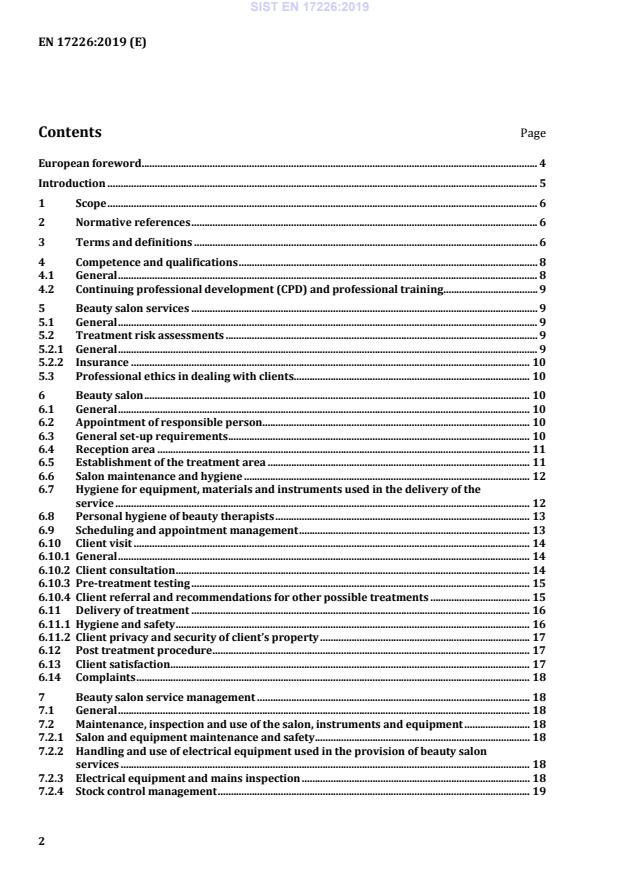
Contents Page
European foreword . 4
Introduction . 5
1 Scope . 6
2 Normative references . 6
3 Terms and definitions . 6
4 Competence and qualifications . 8
4.1 General . 8
4.2 Continuing professional development (CPD) and professional training . 9
5 Beauty salon services . 9
5.1 General . 9
5.2 Treatment risk assessments . 9
5.2.1 General . 9
5.2.2 Insurance . 10
5.3 Professional ethics in dealing with clients. 10
6 Beauty salon . 10
6.1 General . 10
6.2 Appointment of responsible person. 10
6.3 General set-up requirements . 10
6.4 Reception area . 11
6.5 Establishment of the treatment area . 11
6.6 Salon maintenance and hygiene . 12
6.7 Hygiene for equipment, materials and instruments used in the delivery of the
service . 12
6.8 Personal hygiene of beauty therapists . 13
6.9 Scheduling and appointment management . 13
6.10 Client visit . 14
6.10.1 General . 14
6.10.2 Client consultation . 14
6.10.3 Pre-treatment testing . 15
6.10.4 Client referral and recommendations for other possible treatments . 15
6.11 Delivery of treatment . 16
6.11.1 Hygiene and safety . 16
6.11.2 Client privacy and security of client’s property . 17
6.12 Post treatment procedure . 17
6.13 Client satisfaction . 17
6.14 Complaints . 18
7 Beauty salon service management . 18
7.1 General . 18
7.2 Maintenance, inspection and use of the salon, instruments and equipment . 18
7.2.1 Salon and equipment maintenance and safety . 18
7.2.2 Handling and use of electrical equipment used in the provision of beauty salon
services . 18
7.2.3 Electrical equipment and mains inspection . 18
7.2.4 Stock control management . 19
7.3 Handling of chemicals and hazardous substances . 19
8 Review and improvement of service . 20
8.1 General . 20
8.2 Review of service . 20
8.3 Performance and staff appraisals . 20
8.4 Planning for improvements . 21
8.5 Maintenance of records . 21
Annex A (informative) Examples of beauty salon service treatments . 22
Annex B (informative) Template for risk assessment – Beauty salon services . 23
Annex C (informative) Example of consent form . 24
Annex D (informative) Example client consultation form . 25
Annex E (informative) A-deviations . 26
Bibliography . 30
European foreword
This document (EN 17226:2019) has been prepared by Technical Committee CEN/TC 409 “Beauty
Salon Services”, the secretariat of which is held by NSAI.
This European Standard shall be given the status of a national standard, either by publication of an
identical text or by endorsement, at the latest by January 2020, and conflicting national standards shall
be withdrawn at the latest by January 2020.
Attention is drawn to the possibility that some of the elements of this document may be the subject of
patent rights. CEN shall not be held responsible for identifying any or all such patent rights.
This document has been sent to the Enquiry as prEN 16708.
Compliance with national and EU regulations that apply to the establishment and provision of beauty
salon services is the responsibility of the organization offering such services. Compliance with this
European Standard does not ensure in itself compliance with national and EU regulations that may
apply to this service.
This European Standard was drafted by beauty and wellness professionals. The services can be
provided by beauty therapists related to the following NACE codes: 9602 (beauty treatments) and 9604
(body treatments).
An amendment is currently being prepared by CEN/TC 409 "Beauty Salon Services" to add further
clarification of the requirements covering advanced beauty treatments included in sub-clause 4.2 of this
European Standard.
According to the CEN/CENELEC Internal Regulations, the national standards organizations of the
following countries are bound to implement this European Standard: Austria, Belgium, Bulgaria,
Croatia, Cyprus, Czech Republic, Denmark, Estonia, Finland, France, Germany, Greece, Hungary, Iceland,
Ireland, Italy, Latvia, Lithuania, Luxembourg, Malta, Netherlands, Norway, Poland, Portugal, Republic of
North Macedonia, Romania, Serbia, Slovakia, Slovenia, Spain, Sweden, Switzerland, Turkey and the
United Kingdom.
Introduction
The aim of this standard is to set out requirements and recommendations for good practice in
professional beauty salon services where the safety and satisfaction of the client is important.
Some European countries make a distinction between wellness treatments and beauty treatments while
other countries blend these principles. This European Standard applies to all of these services where
they are provided by a beauty therapist.
1 Scope
This document provides requirements and recommendations for the provision of professional beauty
salon services. These services relate to the delivery of beauty treatments regardless of where the
service is delivered.
This document provides requirements and recommendations for the delivery of beauty treatments
performed by a suitably qualified beauty therapist. Recommendations are provided for client
management to ensure client safety during any beauty treatments. The delivery of beauty salon services
is limited to the boundaries of the qualification of the individual beauty therapists obtained through a
recognized education provider.
Medical procedures including aesthetic surgical procedures and cosmetic injectable procedures
including sclerotherapy are excluded from the scope of this document.
Hairdressing, barbering and body art tattooing services are also excluded from the scope of this
document.
2 Normative references
There are no normative references in this document.
3 Terms and definitions
For the purposes of this document, the following terms and definitions apply.
ISO and IEC maintain terminological databases for use in standardization at the following addresses:
• IEC Electropedia: available at http://www.electropedia.org/
• ISO Online browsing platform: available at http://www.iso.org/obp
3.1
beauty salon
establishment offering beauty and wellness treatments and the sale of retail beauty products
Note 1 to entry: In some countries, licensing is required to operate a salon.
Note 2 to entry: Wellness and wellbeing are interchangeable and have the same meaning or intent.
3.2
beauty salon service(s)
beauty and/or wellness treatment(s) and service(s) provided to clients or customers by qualified
beauty therapists
Note 1 to entry: Beauty salon services do not include any surgical or medical treatments.
3.3
beauty treatment
actions applied to the skin, hair and nails by a beauty therapist in order to offer benefits and contribute
to the wellness and/or beauty of the client
Note 1 to entry: Actions can be provided manually and/or with the use of tools and/or equipment and/or
cosmetic products.
3.4
beauty therapist
person holding a qualification obtained and recognised by an educational authority to provide beauty
and/or wellness treatments within a beauty salon
Note 1 to entry: The term beauty therapist may also refer to beautician, aesthetician or other beauty
professional terms used in the industry which meet the necessary qualification requirements of this European
Standard.
3.5
responsible person
appointed person responsible for managing beauty therapy staff in charge of the delivery of beauty
salon services within the beauty salon
Note 1 to entry: The responsible person can be the salon owner or a person appointed by the owner.
3.6
continuing professional development
CPD
set of activities undertaken by an individual professional in order to maintain professional competence,
knowledge and skill
Note 1 to entry: Professional bodies may specify the types of activities suitable for attaining CPD points and can
give guidance on what is approved for CPD nationally.
[SOURCE: ISO/IEC/TR 29154:2013, 3.4, modified — Note 1 to entry has been added.]
3.7
contra-actions
unwanted and/or undesirable reactions that arise from beauty treatment
Note 1 to entry: Contra-actions should not be confused with normal and expected reactions, e.g. hyperaemia
following waxing application.
3.8
contra-indications
known condition of client that prevents a beauty treatment from being offered by a beauty therapist
3.9
mobile beauty treatment
beauty treatment provided by a qualified beauty therapist delivered in an area outside an established
beauty salon
Note 1 to entry: Some beauty treatments can be provided outside an established salon, e.g. in the client's home
provided that the beauty therapist has considered the possible risks relating to the specific beauty treatment.
4 Competence and qualifications
4.1 General
Beauty therapists providing beauty salon services shall obtain qualifications that are recognized and/or
approved by a national authority and/or approved educational authority.
The qualification shall address theory and practical skills in relation to the delivery of beauty salon
services. Theory education and training shall at a minimum address:
— anatomy and physiology;
— understanding common skin conditions;
— the role of cosmetic preparations;
— hygiene and cross contamination safety including sterilization;
— legislation and regulations applicable to beauty salon services.
A minimum competence level for each beauty treatment offered shall be confirmed by an award,
certificate or diploma issued or recognized by a national authority and/or educational authority.
Practical skills and training shall address the following as a minimum:
— communication skills including client care; and
— consultation skills and record keeping which support the provision of beauty salon services.
All beauty therapist’s awards, certificates or diplomas shall be readily available and should be displayed
in the salon.
Apprentice beauty therapists shall only carry out beauty treatments on clients under the supervision of
a qualified beauty therapist and appropriate to the level of their experience, training and/or
qualification.
Where a national qualification framework exists it should be referenced to the European Qualification
Framework (EQF).
Where no national qualifications exist, the qualification should be delivered by an accredited
organization.
Where there is no accredited organization available qualifications should be delivered by an
organization that represents the interest of the professional beauty sector. It is recommended that the
level of qualification should be EQF Level 3 for basic beauty treatments and EQF Level 4 for electrical
beauty treatments and massage.
For the advanced beauty treatments the level of qualification shall be EQF Level 5/6 or equivalent.
EXAMPLE 1 Examples of EQF level 3 beauty treatments can include eyelash and eyebrow treatments, waxing,
manicure, facials.
EXAMPLE 2 Examples of EQF level 4 beauty treatments can include body massage, facials using electrical
equipment, electrolysis.
See Table A.1 in Annex A for a list of possible beauty treatments provided by beauty salon services,
including the recommended EQF level.
NOTE Mapping of national qualifications to the EQF can be determined by national qualification authorities in
each country.
4.2 Continuing professional development (CPD) and professional training
CPD is an activity undertaken to enhance existing professional qualifications.
The responsible person shall appraise all beauty therapists that provide services in the beauty salon in
line with 7.3 and develop training plans to support CPD.
Where beauty therapists operate independently, they shall carry out a self-appraisal of their
performance as per 7.3 and identify their CPD training needs. Beauty therapists shall undertake and
record participation in continuing professional development activities on an annual basis. CPD records
shall demonstrate activities undertaken which may be considered as continuing professional
development. These can include but are not limited to beauty treatment training (e.g. cosmetic training,
product training, equipment training) and non-technical training (e.g. IT or business skills, beauty
seminars, writing an article for a published journal and research activity).
NOTE Manufacturers' training on product/equipment may be considered as part of CPD.
5 Beauty salon services
5.1 General
Beauty therapists shall provide beauty treatments within the scope of their qualification and
competence level in different treatments and in a salon area established in accordance with the
requirements and recommendations of this European Standard.
A beauty therapist can provide beauty treatments outside an established beauty salon i.e. a mobile
service; however, the relevant requirements and recommendations of this European Standard shall
apply to any mobile service.
See Annex A for the recommended level of qualification for example beauty treatments.
5.2 Treatment risk assessments
5.2.1 General
Beauty therapist should know and understand the limits of any beauty treatment offered and the
associated risks. Where necessary the client should be advised to seek the opinion of a health care
professional e.g. a dermatologist or medical practitioner.
A risk assessment shall be carried out for all types of beauty treatments to be provided in the salon. This
shall determine the necessary controls required for the provision of beauty salon services. Assessments
shall address all risks relating to the use of products and equipment. Potential risks relating to contra-
indications for each beauty treatment should also be considered in order to perform personalised
assessment before providing beauty services, see also 5.10.2.
Where a mobile service is being offered, a risk assessment shall be carried out for mobile beauty
treatments. The service shall only be provided where all client safety issues have been addressed.
NOTE Not all beauty salon services are suitable for a mobile service.
A record of all beauty treatment risk assessments shall be maintained.
All beauty therapists shall be aware of the risks associated with each beauty treatment and the control
measures implemented by the salon to address the identified risks.
See Annex B for a sample risk assessment form.
5.2.2 Insurance
The salon shall provide insurance to cover treatment liability and also any other liabilities where the
salon may be responsible.
5.3 Professional ethics in dealing with clients
Beauty salons shall develop and implement a policy regarding professional ethics and confidentiality in
dealing with clients. This policy should address the following as a minimum:
— informing clients of the limits of beauty treatments, contra-indications and contra-actions;
— treatment of minors and other vulnerable persons in accordance with national regulations;
— refusal to provide service when treatment is inappropriate;
— when to seek the opinion of a health care professional;
— identifying which client data shall be considered confidential and the secure storage of such data;
and
— storage and maintenance of client data such as contact details.
This policy should be documented.
6 Beauty salon
6.1 General
The requirements and recommendations for the establishment, maintenance and day-to-day running of
a beauty salon are set out in 6.2 to 6.9 below:
6.2 Appointment of responsible person
The salon service provider shall appoint a named responsible person, responsible for the day-to-day
operation of the salon. This person shall ensure that all requirements of this European Standard are met
and that all applicable national legislation and regulatory requirements are identified and complied
with.
Where the beauty salon service is provided by a sole trader, that individual is deemed to be the
responsible person. The responsible person may appoint others to help in this role but ultimate
responsibility for meeting the requirements of this European Standard lies with the responsible person.
6.3 General set-up requirements
Treatment areas shall be designated and separate from other areas of the salon such as staff, storage,
reception and laundry areas. There shall be adequate toilet facilities for staff and clients. Where
required, shower facilities shall be provided.
Hazardous substances and equipment shall require separate storage. See 7.3 for more information on
handling and storage of chemicals and hazardous waste.
Cosmetic products shall be stored and used in accordance with manufacturer's recommendations.
Where a mobile service is provided it is the responsibility of the beauty therapist to determine if the
treatment area provided by the client is suitable. A risk assessment shall be carried out prior to setting
up the beauty treatment equipment to ensure the safety of the client. Mobile service providers shall be
responsible for ensuring all equipment is suitable for use and is maintained in good working order in
accordance with the requirements of 7.2.
6.4 Reception area
A reception area shall be available to greet clients.
NOTE This can be a segregated or dedicated area depending on the size of the salon.
Where the reception area cannot be manned at all times information shall be provided to the client
about the beauty therapist's availability including any information about delays to appointment times.
The reception area shall have adequate seating for clients who may be waiting for their appointment.
A list of services provided, including prices, opening times and cancellation policies, shall be displayed
in a manner that is accessible to the client. For mobile service providers, such listings shall be made
available to the client on a website or on printed leaflets.
6.5 Establishment of the treatment area
In establishing each treatment area consideration shall be given to the layout, set-up and hygiene
requirements for the beauty treatments to be offered. Before the beauty treatment begins, each
treatment area shall contain the necessary equipment, materials and products. Smoking, eating and
drinking shall not be permitted in the treatment area. Pets, with the exception of guide or assistance
animals, shall not be permitted in the treatment area.
In establishing treatment areas, the following shall be considered in line with the demands of the beauty
treatment:
— supply of water for each treatment room including shower facility where required;
— adequate supply of hand sanitizing and drying facilities for staff and clients;
— adequate electrical supply for all equipment including sufficient sockets;
— ergonomic issues such as positioning and use of adjustable equipment;
— ventilation;
— adequate lighting in line with the demands of the treatment;
— sound and noise;
— temperature;
— privacy for the client;
— suitability of all surfaces for cleaning including work tops, treatment couches, etc.;
— non-slip flooring that is suitable for washing. Carpets shall not be used in the treatment area;
— use of ambient tools that may impact on client comfort, e.g. lighting, music;
— control of possible pests such as rodents and insects; and
— supply of suitable waste containers, including separate containers for potentially hazardous waste
and their appropriate methods of disposal.
The room set up shall be adequate for the planned beauty treatments, equipment requirements and
shall address the beauty treatment risk assessment requirements.
Where a mobile service is offered, the beauty therapist shall inform the client of any treatment area
requirements before agreeing to provide the service.
For mobile services, a review of the risk assessment shall be carried out for that beauty treatment
addressing any new risks related to the treatment area provided by the client. Results of this risk
assessment shall be recorded. Where identified risks are difficult to control a decision may be taken by
the beauty therapist not to provide the beauty treatment and the client shall be informed.
6.6 Salon maintenance and hygiene
In the day-to-day running of a treatment area, all facilities as required in 6.5, shall be adequately
maintained.
All treatments areas shall be maintained in a clean and hygienic manner ensuring decor is in good
repair. A schedule for cleaning all areas of the salon should be documented outlining the frequency of
cleaning required per area and the suitable materials to be used.
Beauty therapists who provide a mobile service shall provide the necessary products, instruments and
equipment for the services offered, ensuring all equipment is adequately and hygienically maintained.
Any working surface required for the provision of a mobile service, whether provided by the beauty
therapist or client, shall be cleaned and disinfected prior to the provision of the service. Following
completion of the beauty treatment, the beauty therapist shall leave the area in a clean and tidy manner
to the satisfaction of the client.
6.7 Hygiene for equipment, materials and instruments used in the delivery of the service
The risk of contact infection should be considered by the beauty therapist following contact with client,
i.e. blood contact and other bodily fluids.
Based on risk assessment for each treatment, controls shall be identified to address cross
contamination risks. Suitable controls shall include cleaning and/or disinfection, and/or sterilization, of
reusable instruments and equipment. In particular, reusable instruments that could potentially become
contaminated with bodily fluids shall be cleaned and sterilized after each use.
NOTE 1 Typical instruments that require sterilization include cuticle nippers, glass electrodes and any other
reusable instrument that has the potential to be abrasive or pierce the skin.
The use of suitable chemical agents, or other suitable methods capable of killing bacteria and blood
borne viruses such as Hepatitis B and C and HIV, shall be used for sterilization. Where chemicals agents
are used the manufacturer's instructions shall be followed. An autoclave shall be used to sterilize
suitable tools and instruments.
NOTE 2 Manufacturers of chemical agents used for sterilization have obligations under Directive 98/8/EC of
the European Parliament and of the Council of 16 February 1998 concerning the placing of biocidal products on
the market (OJ L 123, 1998-04-24, p. 1–63).
In order to prevent mixing soiled and sterilized instruments and ensure each client is treated with
adequately sterilized instruments, a system shall be established to ensure instruments are identified,
tracked and segregated during cleaning and sterilization.
To ensure safety, all needles and equipment used to pierce the skin, e.g. epilation, micropigmentation or
micro needling, shall be sterile packed and for single use. Sterile packs shall be opened in front of the
client and the content suitably disposed of in a ’sharps box’.
Where there is a risk of bodily fluids being present on any disposable material, it shall be placed in a
separate waste disposal unit and disposed of according to national regulations for potentially
hazardous waste. All single use disposable instruments and equipment shall be discarded immediately
after use.
EXAMPLE Examples of single use materials that may become contaminated with bodily fluids can include
gloves, paper, needles, abrasive crystal, etc.
6.8 Personal hygiene of beauty therapists
The beauty salon shall develop and implement good hygiene and personal appearance practices for all
beauty staff and/or mobile service addressing the following as a minimum:
— use of soap and/or hand sanitizing products to sanitize hands and nails prior to treatment;
— supply, use and maintenance of clean and appropriate uniform or professional clothing for beauty
therapists;
— use of appropriate protective equipment such as disposable gloves, aprons, goggles during
treatments, where deemed necessary based on the beauty treatment risk assessment i.e. possible
contact with bodily fluids;
— maintenance and replacement of any protective equipment used;
— appropriate personal appearance for beauty therapists depending on the treatment provided
addressing at a minimum, use of make-up, trimming of nails and limiting use of nail varnish,
limiting the wearing of jewellery, tying up hair, covering cuts and abrasions appropriately, etc.
Good hygiene practices should be documented.
The responsible person shall ensure that all staff members are trained and aware of the good hygiene
practices that apply in the beauty salon or mobile service.
All beauty therapists are responsible for adhering to the hygiene practices established.
The responsible person shall ensure any uniform and protective equipment, as identified by the
treatment risk assessment, is used by the beauty therapist.
6.9 Scheduling and appointment management
The salon shall have a system in place to manage and schedule appointments and to maintain client
contact details. This system should ensure that client/beauty therapist ratios are proportionate to the
level of appointments.
NOTE The system to manage and schedule appointments can be an appointments book, client record cards,
computer system or any other such methods.
Staff shall ensure that client requirements are identified and a recommendation regarding the
appropriate beauty treatment is provided following a review of the client's previous treatment history
at the salon, where it exists. Clients shall be advised of any pre-treatment testing or preparation
necessary in advance of scheduling the beauty treatment. In scheduling an appointment, client
information and contact details shall be recorded and the details of the appointment confirmed with the
client.
In scheduling appointments consideration shall be given to the time needed to prepare and deliver the
beauty treatment including set up, preparation, pre-treatment testing and follow up appointments, if
necessary.
6.10 Client visit
6.10.1 General
Clients should be dealt with in a courteous and professional manner at all times. On arrival, they shall
be welcomed and the details of their beauty treatment confirmed including the name of the beauty
therapist who will be working with them. Any specific client requirements identified at this time shall
be noted and the beauty therapist informed. If the client arrives early or there are any delays, the client
should be brought to a suitable waiting area with seating. The clients shall be informed of any reasons
for the delay and when they can expect to be treated.
6.10.2 Client consultation
A private comfortable area shall be available for the initial consultation with the client. The beauty
therapist shall provide advice or a recommendation on the type of beauty treatment, as well as highlight
any possible contra-indications. The following factors should be considered as part of the client
consultation:
— providing recommendations on the appropriate beauty treatments and explaining what is involved;
— providing an explanation about the beauty treatment to be provided, outlining any possible side
effects or highlighting any known contra-indications;
— providing information on the cost of treatment(s) and any potential after care;
— asking questions about skin care methods used by the client at home and beauty treatments in
beauty salons;
— providing to the client an information sheet related to beauty and/or wellbeing treatments
including each contra-indication and/or finding out about clients health history including previous
beauty treatments, medications and supplements which could interfere with any beauty treatment;
— advising when it is inappropriate for a beauty treatment to proceed;
— discussing client feedback and complaint procedures; and
— ensuring client confidentially.
Other factors that contribute to the client's experience include:
— positioning of the client, ensuring their comfort;
— listening attentively to the client to determine their needs and expectations; and
— asking open questions.
See Annex D for an example client consultation form.
In offering any beauty treatment, the beauty therapist shall ensure that the client understands how
results will be achieved according to individual needs and expectations. Clients should be encouraged to
ask questions.
The client shall be informed by the beauty therapist of all contra-indications that may apply to their
beauty treatment prior to the treatment taking place.
The need for any follow up appointments and aftercare advice where required, shall be explained to the
client before the service is provided.
A record of the consultation with the client addressing all of the above shall be maintained. This record
shall be signed by the client and the beauty therapist where necessary. Where there are changes to
client information that could impact on the safety of the beauty treatment the consultation record shall
be updated and signed by both the client and the beauty therapist.
The client information system shall be updated after every beauty treatment to record relevant client
details such as the treatments and products used, reported adverse reactions post treatment etc.
NOTE See Annex C for a sample general client consent form.
The beauty therapist shall ensure all client records are treated as confidential and maintained in
accordance with relevant data protection legislation.
6.10.3 Pre-treatment testing
Pre-treatment testing shall be carried out where the product manufacturer recommends such a test in
their instructions or where the risk assessment for a beauty treatment specifies pre-treatment testing.
Pre-treatment testing shall take place at least 24 h before the beauty treatment or in accordance with
the manufacturer's instructions. As a minimum, pre-treatment test methods specified by the
manufacturer shall be followed. Pre-treatment testing can include, but is not limited to:
— skin sensitivity tests (product);
— thermal tests to determine reaction to hot and cold stimuli at commencement of the treatment;
— tactile test to determine client reaction to stimuli;
— sample beauty treatments.
Some beauty treatments involve the use of multiple products that are mixed (e.g. tints) or used together
(such as eyelash extensions e.g. glue and lash). Where there is a conflict in the pre-testing times
provided in the manufacturer's instructions of the products, or where insurance requirements have
conflicting pre-treatment testing, the longest pre-testing time or higher testing requirements shall take
priority.
NOTE Sample beauty treatments can include topical skin testing.
The test and the outcome shall be recorded in the client record. Any adverse reaction on the skin is
considered as a positive result, and shall preclude treatment.
Pre-treatment testing based on beauty treatment requirements shall be carried out for each client at
least once annually. Where a change to a client's medical history and/or medication is reported or
where there is a change to the client's beauty treatment programme, pre-treatment testing shall be
repeated to ensure there are no adverse reactions or Serious Undesirable Effects (SUEs), see 6.14.
6.10.4 Client referral and recommendations for other possible treatments
Following an initial consultation the beauty therapist shall determine if the client is suitable for the
beauty treatment. Where necessary, consultation with more experienced beauty therapists should take
place. Where a decision is taken not to provide a beauty treatment the client shall be informed,
outlining the reasons. Where necessary the client should be advised to seek the opinion of a health care
professional. Any decision taken to provide or withhold the beauty treatment including any referrals
shall be recorded in the client record.
Should a contra-indication exist, a suitable alternative treatment should be offered to the client where
possible.
In cases of a recommendation to an alternative beauty services provider or to a health care
professional, an introductory letter should be provided where requested by the client.
Where it is determined that the client is contra-indicated, or where there is any concern of the
suitability of the client for treatment, the beauty therapist shall inform the client of one or more of the
possible options:
— not receiving the beauty treatment;
— choosing an alternative suitable treatment; or
— seeking written consent from an appropriate medical professional before receiving the beauty
treatment.
6.11 Delivery of treatment
6.11.1 Hygiene and safety
Before starting a beauty treatment, the beauty therapist shall check to ensure the electrical equipment
is working and there are no safety issues.
During the delivery of any beauty treatment, safe and hygienic practices shall apply. This shall include
the following:
— provision of clean towels or other types of linen used for covering or protection of the client at the
start of each treatment or provision of disposable coverings for clients in order to minimize the risk
of infection from undiagnosed skin diseases or disorders;
— use of single use applicators or use of separate containers for each client for oils, ointments, cream
or wax or any other cosmetic product used during a treatment;
— wax resin roller applicators shall only be re-used in accordance with the manufacturer's
instructions and following suitable disinfection; and
— washing or sanitizing of hands and nails before starting a treatment and, where a treatment is
interrupted, the beauty therapist shall re-sanitize or re-wash their hands and nails before
resuming.
If the beauty treatment involves skin penetration, the following conditions shall apply:
— topical application of antiseptic to the skin area prior to starting the treatment;
— use of sterile equipment;
— sterile packaging shall be opened just prior to starting the treatment;
— sterile parts of the equipment that penetrate the skin shall not be handled; and
— use of disposable single use gloves.
Where there is a risk of cross contamination as part of a beauty treatment, all waste shall be considered
...
Questions, Comments and Discussion
Ask us and Technical Secretary will try to provide an answer. You can facilitate discussion about the standard in here.
Loading comments...