


EN 16497-1:2015
(Main)Chimneys - Concrete System Chimneys - Part 1: Non-balanced flue applications
General Information
- Abstract
This European Standard specifies the materials and the dimensional and performance requirements for straight concrete system chimneys for non-balanced flue applications comprising a concrete flue liner and a combination of compatible chimney components, which may be concrete flue blocks (see Clause 4), obtained or specified from one manufacturing source with product responsibility for the whole chimney.
This European Standard does not apply to concrete system chimneys with back ventilation.
This European Standard does not cover products designated wet (W) in conjunction with corrosion class 3.
This European Standard also applies to concrete system chimneys constructed from storey-height elements and flue blocks reinforced for handling.
NOTE Any reference to the term flue blocks implies both flue blocks and their fittings, except where otherwise indicated.
- Status
- Published
- Publication Date
- 24-Feb-2015
- Withdrawal Date
- 29-Nov-2016
- Technical Committee
- CEN/TC 166 - Chimneys
- Drafting Committee
- CEN/TC 166/WG 6 - Clay/Ceramic and Concrete chimneys components
- Current Stage
- 9093 - Decision to confirm - Review Enquiry
- Start Date
- 20-Apr-2026
- Completion Date
- 23-Sep-2026
- Directive
- Harmonized Standard305/2011 - Regulation (eu) No 305/2011 of the European Parliament and of the Council of 9 march 2011 laying down harmonised conditions for the marketing of construction products and repealing council directive 89/106/eec
Not Harmonized89/106/EEC - Construction products



Overview
EN 16497-1:2015 (CEN) covers specification, materials, dimensional and performance requirements for straight concrete system chimneys intended for non-balanced flue applications. The standard applies to complete chimneys comprising a concrete flue liner and compatible concrete components (including flue blocks and fittings) supplied from a single manufacturer with product responsibility for the whole chimney system. It excludes chimneys with back ventilation and products designated wet (W) in conjunction with corrosion class 3. The standard also applies to storey‑height elements and flue blocks reinforced for handling.
Key Topics and Requirements
EN 16497-1:2015 defines both design and test requirements including:
- Materials and form: requirements for concrete flue liners, outer elements and fittings supplied as a system.
- Dimensional tolerances: declared dimensions, straightness and squareness of ends.
- Thermal performance: heat stress, heat shock and calculated thermal resistance.
- Tightness and durability: gas tightness, abrasion resistance, compressive strength and flow resistance.
- Corrosion and condensate resistance: performance classes and related test methods.
- Environmental resistance: freeze–thaw resistance and water vapour diffusion resistance.
- Structural performance: bulk density, flexural strength under wind loading, relative movement between liner and outer wall.
- Safety and fire: resistance to fire external-to-external and terminal requirements.
- Assessment & conformity: Type testing, Factory Production Control (FPC), sampling plans (ISO 2859‑1), AVCP procedures and CE marking provisions referenced in Annex ZA.
- Test methods and annexes: normative tests (Annex A), thermal resistance calculation (Annex C), sampling plans (Annex D) and recommended test sequences (Annex E).
Applications and Users
Practical applications and typical users:
- Manufacturers of concrete flue liners, flue blocks and complete chimney systems - to certify product performance and ensure system compatibility.
- Chimney designers and structural engineers - for dimensioning, thermal and fluid-dynamic calculations (use with EN 13384 series) and compliance with performance classes.
- Installers and contractors - to verify correct product selection, handling (reinforced storey‑height elements) and installation compatibility.
- Testing laboratories and certification bodies - to perform required type tests, AVCP and FPC audits.
- Specifiers and building authorities - to reference harmonized European requirements for safety, durability and CE marking.
Related Standards
- EN 1443 (Chimneys - General requirements)
- EN 13216-1 (System chimneys - General test methods)
- EN 13384-1 (Thermal and fluid dynamic calculation for chimneys)
- EN 1857 / EN 1858 / EN 12446 (Concrete flue liners, flue blocks, outer wall elements)
- ISO 2859-1 (Sampling procedures for inspection by attributes)
Keywords: EN 16497-1:2015, concrete system chimneys, non-balanced flue, flue blocks, chimney performance, CEN, thermal resistance, gas tightness, AVCP, CE marking.
Relations
- Effective Date
- 11-Mar-2026
- Effective Date
- 28-Jan-2026
- Effective Date
- 28-Jan-2026
- Effective Date
- 28-Jan-2026
- Effective Date
- 28-Jan-2026
- Effective Date
- 28-Jan-2026
- Effective Date
- 28-Jan-2026
- Effective Date
- 28-Jan-2026
- Effective Date
- 28-Jan-2026
Get Certified
Connect with accredited certification bodies for this standard

DIBt (Deutsches Institut für Bautechnik)
German Institute for Building Technology.
DIN CERTCO
DIN Group product certification.

Aboma Certification B.V.
Specialized in construction, metal, and transport sectors.
Sponsored listings
Frequently Asked Questions
EN 16497-1:2015 is a standard published by the European Committee for Standardization (CEN). Its full title is "Chimneys - Concrete System Chimneys - Part 1: Non-balanced flue applications". This standard covers: This European Standard specifies the materials and the dimensional and performance requirements for straight concrete system chimneys for non-balanced flue applications comprising a concrete flue liner and a combination of compatible chimney components, which may be concrete flue blocks (see Clause 4), obtained or specified from one manufacturing source with product responsibility for the whole chimney. This European Standard does not apply to concrete system chimneys with back ventilation. This European Standard does not cover products designated wet (W) in conjunction with corrosion class 3. This European Standard also applies to concrete system chimneys constructed from storey-height elements and flue blocks reinforced for handling. NOTE Any reference to the term flue blocks implies both flue blocks and their fittings, except where otherwise indicated.
This European Standard specifies the materials and the dimensional and performance requirements for straight concrete system chimneys for non-balanced flue applications comprising a concrete flue liner and a combination of compatible chimney components, which may be concrete flue blocks (see Clause 4), obtained or specified from one manufacturing source with product responsibility for the whole chimney. This European Standard does not apply to concrete system chimneys with back ventilation. This European Standard does not cover products designated wet (W) in conjunction with corrosion class 3. This European Standard also applies to concrete system chimneys constructed from storey-height elements and flue blocks reinforced for handling. NOTE Any reference to the term flue blocks implies both flue blocks and their fittings, except where otherwise indicated.
EN 16497-1:2015 is classified under the following ICS (International Classification for Standards) categories: 91.060.40 - Chimneys, shafts, ducts. The ICS classification helps identify the subject area and facilitates finding related standards.
EN 16497-1:2015 has the following relationships with other standards: It is inter standard links to ISO 2859-1:1999, EN 1443:2003, EN ISO 7500-1:2018, EN 14297:2004, EN 13216-1:2019, EN 13384-1:2015+A1:2019, EN 196-1:1994, EN 15287-1:2023, EN 15287-2:2023. Understanding these relationships helps ensure you are using the most current and applicable version of the standard.
EN 16497-1:2015 is associated with the following European legislation: EU Directives/Regulations: 305/2011, 89/106/EEC; Standardization Mandates: M/105. When a standard is cited in the Official Journal of the European Union, products manufactured in conformity with it benefit from a presumption of conformity with the essential requirements of the corresponding EU directive or regulation.
EN 16497-1:2015 is available in PDF format for immediate download after purchase. The document can be added to your cart and obtained through the secure checkout process. Digital delivery ensures instant access to the complete standard document.
Standards Content (Sample)
2003-01.Slovenski inštitut za standardizacijo. Razmnoževanje celote ali delov tega standarda ni dovoljeno.Abgasanlagen - System-Abgasanlagen aus Beton - Teil 1: Raumluftabhängige AnwendungenConduits de fumée - Conduits-systèmes de fumée en béton - Partie 1: Applications non équilibréesChimneys - Concrete System Chimneys - Part 1: Non-balanced flue applications91.100.30Beton in betonski izdelkiConcrete and concrete products91.060.40Dimniki, jaški, kanaliChimneys, shafts, ductsICS:Ta slovenski standard je istoveten z:EN 16497-1:2015SIST EN 16497-1:2015en,fr,de01-april-2015SIST EN 16497-1:2015SLOVENSKI
STANDARD
EUROPEAN STANDARD NORME EUROPÉENNE EUROPÄISCHE NORM
EN 16497-1
February 2015 ICS 91.060.40 English Version
Chimneys - Concrete System Chimneys - Part 1: Non-balanced flue applications
Conduits de fumée - Conduits-systèmes de fumée en béton - Partie 1: Applications non équilibrées
Abgasanlagen - System-Abgasanlagen aus Beton - Teil 1: Raumluftabhängige Anwendungen This European Standard was approved by CEN on 29 November 2014.
CEN members are bound to comply with the CEN/CENELEC Internal Regulations which stipulate the conditions for giving this European Standard the status of a national standard without any alteration. Up-to-date lists and bibliographical references concerning such national standards may be obtained on application to the CEN-CENELEC Management Centre or to any CEN member.
This European Standard exists in three official versions (English, French, German). A version in any other language made by translation under the responsibility of a CEN member into its own language and notified to the CEN-CENELEC Management Centre has the same status as the official versions.
CEN members are the national standards bodies of Austria, Belgium, Bulgaria, Croatia, Cyprus, Czech Republic, Denmark, Estonia, Finland, Former Yugoslav Republic of Macedonia, France, Germany, Greece, Hungary, Iceland, Ireland, Italy, Latvia, Lithuania, Luxembourg, Malta, Netherlands, Norway, Poland, Portugal, Romania, Slovakia, Slovenia, Spain, Sweden, Switzerland, Turkey and United Kingdom.
EUROPEAN COMMITTEE FOR STANDARDIZATION
COMITÉ EUROPÉEN DE NORMALISATION EUROPÄISCHES KOMITEE FÜR NORMUNG
CEN-CENELEC Management Centre:
Avenue Marnix 17,
B-1000 Brussels © 2015 CEN All rights of exploitation in any form and by any means reserved worldwide for CEN national Members. Ref. No. EN 16497-1:2015 ESIST EN 16497-1:2015
Contents
Page
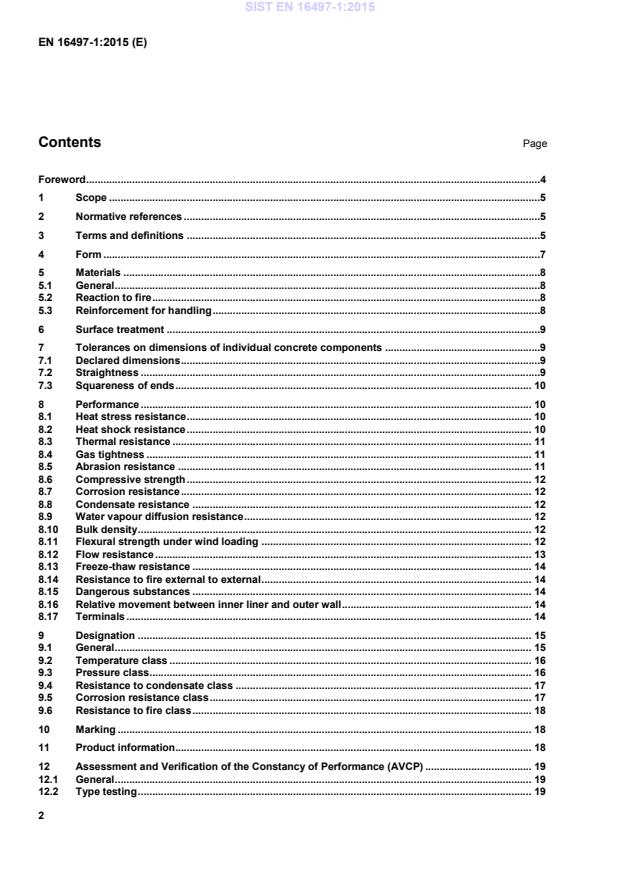
Foreword .4 1 Scope .5 2 Normative references .5 3 Terms and definitions .5 4 Form .7 5 Materials .8 5.1 General .8 5.2 Reaction to fire .8 5.3 Reinforcement for handling .8 6 Surface treatment .9 7 Tolerances on dimensions of individual concrete components .9 7.1 Declared dimensions .9 7.2 Straightness .9 7.3 Squareness of ends . 10 8 Performance . 10 8.1 Heat stress resistance . 10 8.2 Heat shock resistance . 10 8.3 Thermal resistance . 11 8.4 Gas tightness . 11 8.5 Abrasion resistance . 11 8.6 Compressive strength . 12 8.7 Corrosion resistance . 12 8.8 Condensate resistance . 12 8.9 Water vapour diffusion resistance . 12 8.10 Bulk density . 12 8.11 Flexural strength under wind loading . 12 8.12 Flow resistance . 13 8.13 Freeze-thaw resistance . 14 8.14 Resistance to fire external to external . 14 8.15 Dangerous substances . 14 8.16 Relative movement between inner liner and outer wall . 14 8.17 Terminals . 14 9 Designation . 15 9.1 General . 15 9.2 Temperature class . 16 9.3 Pressure class . 16 9.4 Resistance to condensate class . 17 9.5 Corrosion resistance class . 17 9.6 Resistance to fire class . 18 10 Marking . 18 11 Product information. 18 12 Assessment and Verification of the Constancy of Performance (AVCP) . 19 12.1 General . 19 12.2 Type testing . 19 SIST EN 16497-1:2015
Test methods . 27 A.1 Squareness of ends test . 27 A.2 Straightness test . 28 A.3 Thermal performance tests . 29 A.4 Thermal resistance . 30 A.5 Gas tightness test . 30 A.6 Abrasion resistance test . 31 A.7 Compressive strength test . 31 A.8 Corrosion and condensate resistance test . 32 A.9 Water vapour diffusion resistance . 36 A.10 Flexural strength under wind load . 36 A.11 Bulk density . 37 A.12 Ultimate compressive strength . 38 Annex B (informative)
Examples of concrete flue block shapes . 39 B.1 Straight flue blocks . 39 B.2 Flue block fittings - Tee/access/connection unit . 40 Annex C (normative)
Thermal resistance calculation method . 42 C.1 Thermal resistance of the individual element . 42 C.2 Thermal resistance of the chimney and of enclosures . 42 Annex D (normative)
Requirements of sampling plan in accordance with ISO 2859-1 at an Acceptable Quality Level (AQL) of 10 % and inspection level S2 . 43 D.1 Acceptability determination . 43 D.2 Normal inspection . 43 D.3 Reduced Inspection . 45 D.4 Reduced to normal inspection . 45 D.5 Tightened inspection . 45 D.6 Tightened to normal inspection . 46 D.7 Discontinuation of inspection . 46 Annex E (informative)
Recommended test sequence for performance characteristics . 47 Annex ZA (informative)
Clauses of this European Standard addressing the provisions of the EU Construction Products Regulation . 48 ZA.1 Scope and relevant characteristics . 48 ZA.2 Procedure for AVCP of concrete system chimneys . 50 ZA.3 CE marking and labelling . 55 Bibliography . 58
Foreword This document (EN 16497-1:2015) has been prepared by Technical Committee CEN/TC 166 “Chimneys”, the secretariat of which is held by ASI. This European Standard shall be given the status of a national standard, either by publication of an identical text or by endorsement, at the latest by August 2015 and conflicting national standards shall be withdrawn at the latest by November 2016. Attention is drawn to the possibility that some of the elements of this document may be the subject of patent rights. CEN [and/or CENELEC] shall not be held responsible for identifying any or all such patent rights. This document has been prepared under a mandate given to CEN by the European Commission and the European Free Trade Association, and supports essential requirements of EU Regulations. For relationship with EU Regulations, see informative Annex ZA, which is an integral part of this document. This standard is one of a series of co-ordinated standards dealing with specification, design, and testing of chimneys, both single and multi-wall. The co-ordinated package of standards is further divided by material of construction and this European Standard is one of a series of specifications and execution documents dealing with design and installation of concrete chimney products and systems. The standards in this series for concrete chimney products and systems are: — EN 1857, Chimneys — Components — Concrete flue liners — EN 1858, Chimneys — Components — Concrete flue blocks — EN 12446, Chimneys — Components — Concrete outer wall elements — CEN/TS 16134, Chimney terminals — General requirements and material independent test methods — EN 16497-1, Chimneys — Concrete system chimneys — Part 1: Non-balanced flue applications — prEN 16497-2, Chimneys — Concrete system chimneys — Part 2: Balanced flue applications NOTE A chimney in accordance with EN 16497-1 can also be used for room-sealed applications using a separate combustion air supply in a non-balanced flue configuration. According to the CEN-CENELEC Internal Regulations, the national standards organizations of the following countries are bound to implement this European Standard: Austria, Belgium, Bulgaria, Croatia, Cyprus, Czech Republic, Denmark, Estonia, Finland, Former Yugoslav Republic of Macedonia, France, Germany, Greece, Hungary, Iceland, Ireland, Italy, Latvia, Lithuania, Luxembourg, Malta, Netherlands, Norway, Poland, Portugal, Romania, Slovakia, Slovenia, Spain, Sweden, Switzerland, Turkey and the United Kingdom. SIST EN 16497-1:2015
3.3 declared internal transverse dimension internal dimension of the flue block measured perpendicular to the longitudinal axis 3.4 declared height internal height of the flue block Note 1 to entry: Examples of measurement are shown in Figure 1.
a) with rebate b) with plain end Key H internal height Figure 1 — Manufacturer's declared height 3.5 manufacturer's declared structural height maximum constructional height of the flue blocks as declared by the manufacturer 3.6 overall wall thickness dimensions at its thinnest point, between the inside face of the flue and the outside face of the flue block, not measured at any joint feature Note 1 to entry: Joint features include a spigot/socket end etc. 3.7 multi-wall flue block flue block consisting of a flue liner and at least one additional wall 3.8 reinforced flue block flue block having reinforcement to assist handling (not for structural stability) 3.9 solid wall flue block flue block without cavities in the thickness of its walls SIST EN 16497-1:2015
Single wall or multi-wall flue blocks shall be manufactured in one of the following forms: — single flue; — multi-flue; — flue/ventilation combination. See Annex B for examples of typical flue block types. Flue blocks shall have a maximum of four flues or ventilation passages. 5 Materials 5.1 General The wall or walls of concrete flue liners or concrete flue blocks shall be precast concrete. For multi-wall concrete flue blocks the concrete liner and outer wall may be separated by an air space or insulation. Materials used in the manufacture of system chimneys shall be identified for factory production control purposes. When insulation forms part of a system chimney, it shall be of bonded material as specified by the manufacturer. If the insulation is supplied as a separate item, it shall be installed in accordance with the system chimney manufacturer’s installation instructions. The density of any insulation and the bulk density of the concrete elements shall be declared and when tested to A.11 the density shall be within ± 10 % of the declared value (see 8.10). Where a system chimney to this standard comprises CE marked chimney components in accordance with Clause 4, the above requirements are deemed to be satisfied. Products bearing regulatory marking in accordance with appropriate harmonized European specifications may be presumed to have the performances declared in the Declaration of Performance (DoP), although this does not replace the responsibility on the concrete system chimney manufacturer to ensure that the concrete system chimney as a whole is correctly manufactured and its component products have the declared performance values. 5.2 Reaction to fire In accordance with the Commission Decision 96/603/EC, as amended, concrete elements of system chimneys to this standard are classified as reaction to fire class A1 without tests provided they contain no more than a mass or volume fraction of 1 % (whichever is the more onerous) of homogeneously distributed organic materials. 5.3 Reinforcement for handling 5.3.1 Where a concrete element is reinforced for handling, the reinforcement shall have a maximum diameter of 8 mm and a minimum concrete cover of 15 mm on all sides for temperature classes up to and including T250 and a minimum concrete cover of 20 mm on all sides for all other temperature classes. 5.3.2 For concrete elements with a bulk density of less than 2 000 kg/m3, when measured in accordance with A.10, any reinforcement shall be protected against corrosion by one of the following means: a) use of stainless steel; SIST EN 16497-1:2015
7.2.2 When tested as described in A.2, for flue blocks having a manufactured height equal to or greater than 1 000 mm, the limit deviation shall not be greater than 0,5 % of the manufacturer's declared height. 7.3 Squareness of ends When tested in accordance with either procedure described in A.1, the test sample shall not touch the upright for the first procedure and the dimension shall not be greater than 5 mm for the second procedure. 8 Performance 8.1 Heat stress resistance 8.1.1 When concrete system chimneys, including those designated soot fire resistant, are tested for heat stress resistance in accordance with A.3, at the test temperature appropriate to the designation specified in Table 1, the system chimney shall subsequently meet the requirements of 8.4 and 8.5. When a concrete system chimney is multi-flued with an equal wall thickness, the heat stress test shall be carried out on the flue with the highest designation and temperature. 8.1.2 The distance to combustible material, xx, shall be declared. The maximum temperature measured on the surface of adjacent combustible materials shall not exceed 85 °C when related to an ambient temperature of 20 °C. 8.2 Heat shock resistance 8.2.1 Following the heat stress resistance test in 8.1, when a concrete system chimney designated as soot fire resistant is tested for heat shock resistance in accordance with A.3, at a flue gas temperature of 1 000 °C for a period of 30 min ± 1 min, the block shall subsequently meet the requirements of 8.4 and 8.5. 8.2.2 The distance to combustible material, xx, shall be declared. The maximum temperature measured on the surface of adjacent combustible materials shall not exceed 100 °C when related to an ambient temperature of 20 °C, when the test assembly is tested at the test temperature of 1 000 °C over a period of 30 min ± 1 min. Table 1 — Heat stress test temperature Temperature group Temperature of flue gas °C T600 050700+ T450 050500+ T400 050500+ T300 035350+ T250 030300+ T200 025250+ SIST EN 16497-1:2015
8.6 Compressive strength The manufacturer shall declare the structural height. When tested in accordance with A.7, straight flue blocks and straight fittings shall withstand an intensity of loading equivalent to four times the declared structural height. The declared structural height is dependent on the lowest compressive strength of the individual walls of the flue block, and/or any opening element. The value of CE marked chimney components may be used The declared structural height can be derived from the ultimate compressive strength determined by the method in A.12. 8.7 Corrosion resistance When flue blocks designated condensate resistance class W (suitable for use in wet operating conditions) are tested as described in A.8, flue blocks shall be designated corrosion class 1 or class 2 depending on the test solution used, provided that the mass loss of the test pieces is not greater than 0,1 % of the initial mass. Flue blocks designated condensate resistance class D (dry) and which meet the requirements of 8.1 and 8.2, may be assigned corrosion resistance class 3. CE marked chimney components are deemed to satisfy these requirements. 8.8 Condensate resistance When flue blocks designated W (suitable for use in wet operating conditions) are tested as described in A.8, the maximum amount of test solution passing through the wall of the flue block during any 24 (02+)h test period shall not be greater than 0,5 gh-1m-2 of the flue block external surface. Otherwise the flue block shall be designated D (dry). CE marked chimney components are deemed to satisfy these requirements. 8.9 Water vapour diffusion resistance When flue blocks designated W are tested in accordance with A.9 the maximum amount of test solution passing through the wall of the flue block during any 24 (02+)h test period shall not be greater than 0,5 gh-1m-2 of the flue block external surface. The flue block shall show no water vapour saturation in any part of the chimney. 8.10 Bulk density When concrete components are tested as described in A.11, the lowest and highest bulk density value shall be within a limit deviation of ± 10 % of the declared bulk density for the component. 8.11 Flexural strength under wind loading The maximum free standing height of flue blocks shall be no greater than 4,5 times the least lateral overall external dimension of the flue block from the last point of lateral support (see Figure 2). SIST EN 16497-1:2015
Key 1 top of chimney excluding any terminal or chimney pot 2 last point of support l least lateral overall external dimension of the flue block Figure 2 — Explanation of last point of support 8.12 Flow resistance 8.12.1 Flow resistance of straight flue blocks The mean value of roughness for a straight flue block shall be determined either: a) by testing in accordance with EN 13216-1 (being the reference method), or b) from data obtained from EN 13384-1. Where the system chimney comprises of CE marked flue blocks in accordance with Clause 4 the values obtained from the products may be used. 8.12.2 Flow resistance of fittings The coefficient of flow resistance due to a directional and/or cross sectional and/or mass flow change shall be determined either: a) by testing in accordance with EN 13216-1 (being the reference method), or b) from data obtained from EN 13384-1. SIST EN 16497-1:2015
Where the system chimney comprises of CE marked flue blocks in accordance with Clause 4 the values obtained from the products may be used. 8.13 Freeze-thaw resistance Where national regulations require freeze/thaw resistance of flue blocks, they shall be tested in accordance with EN 14297. The product shall not present any damage of type 7, 8, 9 and 10 in accordance with EN 14297:2004, Table 1. A flue block to this standard comprising of CE marked chimney components (see Clause 4) designated freeze/thaw resistant are deemed to satisfy these requirements. 8.14 Resistance to fire external to external Where national regulations require resistance to fire external to external (see EN 1443) of flue blocks, they shall be evaluated and declared in accordance with those regulations. 8.15 Dangerous substances National regulations on dangerous substances, other than those already covered in other clauses of this standard, may require verification and declaration on release, and sometimes content, when construction products covered by this standard are placed on those markets. In the absence of European harmonized test methods, verification and declaration on release/content should be done taking into account national provisions in the place of use. NOTE An informative database covering European and national provisions on dangerous substances is available at the construction web site on EUROPA accessed through: http://ec.europa.eu/enterprise/construction/cpd-ds/
8.16 Relative movement between inner liner and outer wall After thermal testing (heat stress and where appropriate heat shock) in accordance with EN 13216-1, the final position of the upper flue liner after cooling down to room temperature shall be ± 5 mm to the original position. 8.17 Terminals 8.17.1 Types Terminals may consist of two main types. 8.17.1.1 Type I 8.17.1.1.1 Type 1a A terminal for non-balanced flue applications, tested for flow resistance but not for wind velocity pressure (wind influence) and not for rainwater ingress. NOTE The terminal is suitable for non room-sealed and non-balanced flue room-sealed applications. 8.17.1.1.2 Type Ib A terminal for non-balanced flue applications, tested for flow resistance but not for wind velocity pressure (wind influence). This terminal is additionally tested for rainwater ingress. NOTE The terminal is suitable for non room-sealed and non-balanced flue room-sealed applications. SIST EN 16497-1:2015
Figure 3 — Example of a designation system 9.2 Temperature class The temperature class shall be as given in Table 3. Table 3 — Temperature class Temperature class Nominal working temperature
°C T080 ≤ 80 T100 ≤ 100 T120 ≤ 120 T140 ≤ 140 T160 ≤160 T200 ≤ 200 T250 ≤ 250 T300 ≤ 300 T400 ≤ 400 T450 ≤ 450 T600 ≤ 600 9.3 Pressure class The pressure class shall be as follows, with the corresponding test pressure and gas tightness level as given in Table 4: — for flue blocks suitable for negative pressure chimneys: N1, N2; — for flue blocks suitable for positive pressure chimneys: P1, P2; SIST EN 16497-1:2015
Pa l/s/m2 N1 40 2,0 N2 20 3,0 P1 200 0,006 P2 200 0,120 M1 1500 0,006 M2 1500 0,120 H1 5 000 0,006 H2 5 000 0,120 9.4 Resistance to condensate class The resistance to condensate class shall be as follows: — W for flue blocks for chimneys intended to operate under wet conditions; — D for flue blocks for chimneys intended to operate under dry conditions. 9.5 Corrosion resistance class Corrosion resistance classes for chimneys which convey products of combustion from gas or light oils and natural wood or heavy oils and solid mineral fuels shall be as given in Table 5 (see 8.7). Table 5 — Corrosion resistance classes Fuel types 1
Possible fuel types 2 Possible fuel types 3 Possible fuel types Gas gas: sulphur-content ≤ 50 mg/m3 natural gas L + H gas natural gas L + H gas natural gas L + H Liquid kerosene: sulphur-content ≤ 50 mg/m3 oil: sulphur-content ≤ 0,2 mass % oil: sulphur-content > 0,2 mass % kerosene: sulphur-content > 50 mg/m3 kerosene: sulphur-content > 50 mg/m3 Wood
wood in open fire places wood in open fire places wood in closed stoves Coal
coal Peat
peat NOTE Table 5 does not categorize process gases or liquids. SIST EN 16497-1:2015
9.6 Resistance to fire class Resistance to fire class shall be as follows: — O for flue blocks for chimneys without soot fire resistance; — G for flue blocks chimneys with soot fire resistance; — followed by the distance to combustible material (xx). 10 Marking A minimum of 20 % of the flue blocks or fittings in each consignment shall be legibly and indelibly marked with the following information: a) name or trademark of the manufacturer; b) the manufacturer's batch or date code; c) the number of this European Standard; d) designation in accordance with Clause 9; e) an arrow indicating direction of flue gas flow (for rebated components - see 3.4); f) identification of the flue in a multi passage block. NOTE For CE marking and labelling, ZA.3 applies. 11 Product information The manufacturer's printed literature for the product shall include the following: a) product description; b) declared sizes; c) designation; d) distance to combustibles and how it was obtained (i.e. in which test assembly); e) maximum outer surface temperature; f) thermal resistance of the flue blocks; g) manufacturer's declared internal transverse dimensions, height, structural height and overall wall thickness; h) detailed installation instructions including method of jointing and flue identification; i) characteristics of any terminal, e.g. whether rainwater resistant, aerodynamic properties. NOTE For CE marking requirements for information on the product, ZA.3 applies. SIST EN 16497-1:2015
12.2.2 Type testing 12.2.2.1 Initial type testing Type tests relating to material composition shall be performed initially together with factory production control tests as given in Table 6. One test shall be carried out for each requirement. The thermal testing shall be carried out on one size of flue block for each geometrical configuration, e.g. circular, square, rectangular. For circular flue blocks, the size to be tested shall be 200 mm ± 50 mm internal diameter. For other geometrical configurations, the flue block shall have an equivalent cross-sectional area range. 12.2.2.2 Further type tests Type tests shall be performed when a change is made either i
...