


EN 16704-2-2:2016
(Main)Railway applications - Track - Safety protection on the track during work - Part 2-2: Common solutions and technology - Requirements for barriers
General Information
- Abstract
This European Standard deals with requirements for barriers to give users the possibility to prevent workers from entering the danger zone unintentionally by the use of such barriers.
This standard defines minimum requirements and test procedures for these barriers concerning the dimensions, the stability and electrical properties.
This standard also gives recommendations for the marking (visual demarcation line) where a person would enter the danger zone.
For combinations of barriers and TWS see also prEN 16704-2-1:2014.
This standard contains remarks for electrical hazards by a third rail.
This standard does not deal with:
- risk assessment for safety protection on the track during work;
- hierarchy of safety measure for safety protection on the track during work;
- safety measure to provide safe working and safe train operation in the area of a work site;
- national safety regulations to plan and operate barriers in track;
- safety regulations and additional requirements e.g. due to national or operational rules or negotiation between the user and the manufacturer;
- electrical hazards by different potential of different electrified circuits.
- Status
- Published
- Publication Date
- 22-Nov-2016
- Technical Committee
- CEN/TC 256 - Railway applications
- Drafting Committee
- CEN/TC 256/SC 1/WG 39 - Safety protection on the track during work
- Current Stage
- 9093 - Decision to confirm - Review Enquiry
- Start Date
- 13-Jun-2022
- Completion Date
- 23-Sep-2026

Overview
EN 16704-2-2:2016 - "Railway applications - Track - Safety protection on the track during work - Part 2-2: Common solutions and technology - Requirements for barriers" (CEN) specifies minimum technical requirements and test procedures for barriers used to prevent workers from unintentionally entering the danger zone alongside operational track. The standard covers barrier dimensions, stability (static and dynamic), electrical properties and recommendations for visual marking (visual demarcation line). It also addresses specific considerations for third-rail electrical hazards and interfaces with Track Warning Systems (TWS).
Key topics and technical requirements
- Scope and intent: Defines preventive separation (barriers) to limit unintentional access to the danger zone; does not replace risk assessments, national safety regulation or measures for safe train operation.
- Barrier components: Modules typically include posts (vertical components), a principal (upper) guardrail, intermediate guardrail or intermediate protection (e.g., net/plate), and extendable devices for adjustable height or lateral distance.
- Dimensions and modularity:
- Maximum component length indicated (example parameter: lmax ≈ 3.20 m).
- Heights are typically defined by national rules - standard gives recommendations but defers to national/operational requirements.
- Stability and mechanical tests:
- Static and dynamic load tests with defined test loads (e.g., a representative static test load ~0.3 kN) and maximum deflection criteria (example: 50 mm).
- Dynamic performance includes oscillation, vibration and aerodynamic checks; aerodynamic approval may be required for lines >160 km/h.
- Electrical requirements:
- Measures to avoid unintended interference with signalling and traction systems.
- Specific resistance and insulation checks for horizontal (guardrail) and vertical (post) components; special provisions and design options for third-rail protection (e.g., nets with max mesh ~40 mm or other risk-mitigating solutions).
- Marking: Guidance on visual demarcation lines (bands) to indicate where a person would enter the danger zone; marking alone is not an autonomous safety measure.
- Documentation: System approval and user manual requirements for installation, combination with TWS, and maintenance.
Applications and who uses this standard
EN 16704-2-2 is practical for:
- Rail infrastructure managers - specification and procurement of temporary barriers for maintenance works.
- Barrier manufacturers - design, testing and certification of barrier modules and systems.
- Contractors and site safety planners - selecting compliant barrier systems and integrating marking and TWS interfaces.
- Test laboratories and conformity assessors - performing mechanical, aerodynamic and electrical tests per the standard.
Keywords: EN 16704-2-2:2016, railway barriers, track safety, safety protection on the track, barrier requirements, third rail, Track Warning System (TWS).
Related standards
- EN 16704-1, EN 16704-2-1 (TWS) and EN 16704-3 - related parts of the series.
- Normative references used by EN 16704-2-2 include EN 1263-1 (safety nets), EN 13374 (edge protection), EN 14067-4 (aerodynamics), and EN 50122 series (electrical safety).
Relations
- Effective Date
- 09-Feb-2026
- Effective Date
- 09-Feb-2026
- Effective Date
- 09-Feb-2026
- Effective Date
- 09-Feb-2026
- Effective Date
- 09-Feb-2026
- Effective Date
- 09-Feb-2026
- Refers
EN 1263-1:2014 - Temporary works equipment - Safety nets - Part 1: Safety requirements, test methods - Effective Date
- 28-Jan-2026
- Effective Date
- 28-Jan-2026
- Effective Date
- 28-Jan-2026
- Effective Date
- 28-Jan-2026
- Effective Date
- 28-Jan-2026
- Effective Date
- 28-Jan-2026
- Effective Date
- 28-Jan-2026
Get Certified
Connect with accredited certification bodies for this standard

Zavod za gradbeništvo Slovenije (ZAG) - Inšpekcija
ZAG inspection body for construction products, structures, and materials.
Sponsored listings
Frequently Asked Questions
EN 16704-2-2:2016 is a standard published by the European Committee for Standardization (CEN). Its full title is "Railway applications - Track - Safety protection on the track during work - Part 2-2: Common solutions and technology - Requirements for barriers". This standard covers: This European Standard deals with requirements for barriers to give users the possibility to prevent workers from entering the danger zone unintentionally by the use of such barriers. This standard defines minimum requirements and test procedures for these barriers concerning the dimensions, the stability and electrical properties. This standard also gives recommendations for the marking (visual demarcation line) where a person would enter the danger zone. For combinations of barriers and TWS see also prEN 16704-2-1:2014. This standard contains remarks for electrical hazards by a third rail. This standard does not deal with: - risk assessment for safety protection on the track during work; - hierarchy of safety measure for safety protection on the track during work; - safety measure to provide safe working and safe train operation in the area of a work site; - national safety regulations to plan and operate barriers in track; - safety regulations and additional requirements e.g. due to national or operational rules or negotiation between the user and the manufacturer; - electrical hazards by different potential of different electrified circuits.
This European Standard deals with requirements for barriers to give users the possibility to prevent workers from entering the danger zone unintentionally by the use of such barriers. This standard defines minimum requirements and test procedures for these barriers concerning the dimensions, the stability and electrical properties. This standard also gives recommendations for the marking (visual demarcation line) where a person would enter the danger zone. For combinations of barriers and TWS see also prEN 16704-2-1:2014. This standard contains remarks for electrical hazards by a third rail. This standard does not deal with: - risk assessment for safety protection on the track during work; - hierarchy of safety measure for safety protection on the track during work; - safety measure to provide safe working and safe train operation in the area of a work site; - national safety regulations to plan and operate barriers in track; - safety regulations and additional requirements e.g. due to national or operational rules or negotiation between the user and the manufacturer; - electrical hazards by different potential of different electrified circuits.
EN 16704-2-2:2016 is classified under the following ICS (International Classification for Standards) categories: 93.100 - Construction of railways. The ICS classification helps identify the subject area and facilitates finding related standards.
EN 16704-2-2:2016 has the following relationships with other standards: It is inter standard links to EN 50122-1:2022, EN 50125-3:2003, EN 50122-3:2022, EN 50110-1:2023, EN 50110-2:2023, EN 50122-2:2022, EN 1263-1:2014, EN 12811-2:2004, EN 14067-4:2024+A1:2025, EN 12811-3:2002, EN 13374:2013, EN ISO 13857:2019, EN 16704-1:2016. Understanding these relationships helps ensure you are using the most current and applicable version of the standard.
EN 16704-2-2:2016 is associated with the following European legislation: EU Directives/Regulations: 2008/57/EC; Standardization Mandates: M/483. When a standard is cited in the Official Journal of the European Union, products manufactured in conformity with it benefit from a presumption of conformity with the essential requirements of the corresponding EU directive or regulation.
EN 16704-2-2:2016 is available in PDF format for immediate download after purchase. The document can be added to your cart and obtained through the secure checkout process. Digital delivery ensures instant access to the complete standard document.
Standards Content (Sample)
2003-01.Slovenski inštitut za standardizacijo. Razmnoževanje celote ali delov tega standarda ni dovoljeno.Železniške naprave - Zgornji ustroj proge - Zagotavljanje varnosti med delom na progi - 2-2. del: Skupne rešitve in tehnologija - Zahteve za pregradeBahnanwendungen - Oberbau - Sicherungsmaßnahmen während Gleisbauarbeiten - Teil 2-2: Allgemeine Lösungen und Technologie - Anforderungen an AbsperrungenApplications ferroviaires - Voie - Protection et sécurité durant des travaux sur la voie - Partie 2-2: Solutions communes et technologie - Exigences relatives aux barrièresRailway applications - Track - Safety protection on the track during work - Part 2-2: Common solutions and technology - Requirements for barriers93.100Gradnja železnicConstruction of railways13.100Varnost pri delu. Industrijska higienaOccupational safety. Industrial hygieneICS:Ta slovenski standard je istoveten z:EN 16704-2-2:2016SIST EN 16704-2-2:2017en01-januar-2017SIST EN 16704-2-2:2017SLOVENSKI
STANDARD
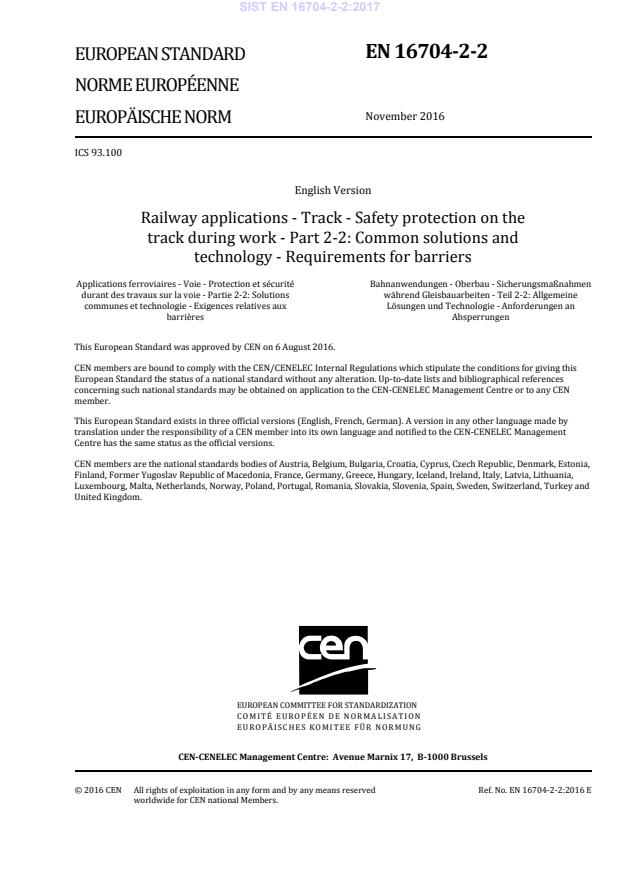
EUROPEAN STANDARD NORME EUROPÉENNE EUROPÄISCHE NORM
EN 16704-2-2
November
t r s x ICS
{ uä s r r English Version
Railway applications æ Track æ Safety protection on the track during work æ Part
tæ tã Common solutions and technology æ Requirements for barriers Applications ferroviaires æ Voie æ Protection et sécurité durant des travaux sur la voie æ Partie
tæ tã Solutions communes et technologie æ Exigences relatives aux barrières
Bahnanwendungen æ Oberbau æ Sicherungsmaßnahmen während Gleisbauarbeiten æ Teil
tæ tã Allgemeine Lösungen und Technologie æ Anforderungen an Absperrungen This European Standard was approved by CEN on
x August
t r s xä
egulations which stipulate the conditions for giving this European Standard the status of a national standard without any alterationä Upætoædate lists and bibliographical references concerning such national standards may be obtained on application to the CENæCENELEC Management Centre or to any CEN memberä
translation under the responsibility of a CEN member into its own language and notified to the CENæCENELEC Management Centre has the same status as the official versionsä
CEN members are the national standards bodies of Austriaá Belgiumá Bulgariaá Croatiaá Cyprusá Czech Republicá Denmarká Estoniaá Finlandá Former Yugoslav Republic of Macedoniaá Franceá Germanyá Greeceá Hungaryá Icelandá Irelandá Italyá Latviaá Lithuaniaá Luxembourgá Maltaá Netherlandsá Norwayá Polandá Portugalá Romaniaá Slovakiaá Sloveniaá Spainá Swedená Switzerlandá Turkey andUnited Kingdomä
EUROPEAN COMMITTEE FOR STANDARDIZATION COMITÉ EUROPÉEN DE NORMALISATION EUROPÄISCHES KOMITEE FÜR NORMUNG
CEN-CENELEC Management Centre:
Avenue Marnix 17,
B-1000 Brussels
t r s x CEN All rights of exploitation in any form and by any means reserved worldwide for CEN national Membersä Refä Noä EN
s x y r væ tæ tã t r s x ESIST EN 16704-2-2:2017
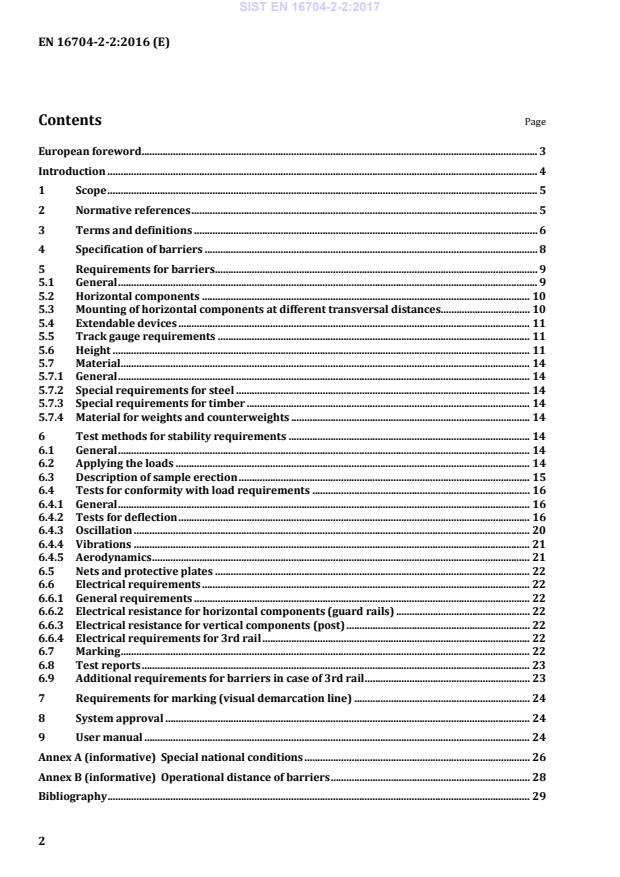
Special national conditions . 26 Annex B (informative)
Operational distance of barriers . 28 Bibliography . 29 SIST EN 16704-2-2:2017
Key 1 vertical 2 longitudinal, horizontal 3 transversal 4 rail 5 sleeper/bearer/slab track Figure 1 — Track section plus position name and three axes SIST EN 16704-2-2:2017
type
barrier marking requirement clause value or objective prevention of unintentional entering into the dangerous zone objective limitative separation only, marking of the border of the danger zone by a visual demarcation line max. length of components 5.1 lmax
¶ 3,20 m not specified min./max height 5.6 defined by national rules (see also Annex A) not specified static stability test-load max. deflection
6.4.2.2.1 6.4.2.2.2 6.4.2.2.3 0,3 kN 50 mm not specified dynamic stability (oscillation) dynamic stability (vibration) 6.4.3 6.4.4 0,3 kN Û 0 kN 2 mm not specified dynamic stability (aerodynamic) 6.4.5 additional approval (calculation or testing) for a speed > 160 km/h not specified electric requirements 6.6 no unintended influence on the signalling resistance between horizontal components: min. 50
V AC resistance between vertical 500 V AC not specified 3rd rail hazards 6.9 structure or net (max 40 mm mesh) or other adequate measures according to the risk analysis not specified marking 7 red/white yellow/black blue see Clause 7 NOTE Separation by marking (visual demarcation line) is not an autonomous and independent measure for safety protection on the track during work (see Clause 7). SIST EN 16704-2-2:2017
a) Rail mounted barrier b) Non-rail mounted barrier Key 1 ballast 2 sleeper and rail fastening 3 rail 4 rail/track mounted fixing 5 extendable device with vertical components 6 principal guardrail 7 intermediate guardrail Figure 2 —Examples for a module and components of a barrier Barriers shall comply with all requirements of Clause 5 up to Clause 8. All values (e.g. for height or distances) refer to straight horizontal tracks with a gauge of 1435 mm without rail cant. For other track gauges it is recommended to use Annex B to convert the distance in Figure 3 to other reference points. NOTE 1 For special situations (e.g. rail cant, 3rd rail) a risk assessment according to EN 16704–1:2016 may be required. As a result other and/or additional measures could be necessary. Barriers shall have no sharp or jagged edges. Barriers shall be usable on switches and crossings (e.g. by special attachment devices). Barriers shall be constructed in a way that the track circuit system is not affected and accidental electrical hazards are minimized (for details see 6.6). SIST EN 16704-2-2:2017
Figure 3 — Necessary possible positions and range of extendable devices NOTE Annex B gives formulae to convert these values to other reference points. 5.4 Extendable devices Extendable devices shall be equipped with a locking device for fixing at the chosen distance [prevention against accidental va
...