


EN 14396:2004
(Main)Fixed ladders for manholes
General Information
- Abstract
This standard applies to permanently fixed ladders in manholes. It specifies the performance criteria for the mechanical stability and resistance providing protection against falling.
The ladders specified in this European Standard are suitable for use in sewage, rainwater, surface water and, subject to the requirements of national regulations, potable water environments.
- Status
- Published
- Publication Date
- 13-Jan-2004
- Technical Committee
- CEN/TC 165 - Waste water engineering
- Drafting Committee
- CEN/TC 165/WG 4 - Gullies and tops a.s.o.
- Current Stage
- 9093 - Decision to confirm - Review Enquiry
- Start Date
- 09-Jun-2022
- Completion Date
- 23-Sep-2026
- Directive
- Harmonized Standard305/2011 - Regulation (eu) No 305/2011 of the European Parliament and of the Council of 9 march 2011 laying down harmonised conditions for the marketing of construction products and repealing council directive 89/106/eecOJ Ref: C, C 259 OJ Date: 08-Aug-2014
Not Harmonized89/106/EEC - Construction productsOJ Ref: C, C 139, C 263, C 319 OJ Date: 26-Oct-2004


Overview
EN 14396:2004, developed by CEN, specifies the requirements and performance criteria for permanently fixed ladders in manholes. The standard is applicable to ladders installed in manholes for sewage, rainwater, surface water, and, where permitted by national regulations, potable water environments. Its primary focus is on the mechanical stability and resistance of fixed ladders, ensuring their safe use by providing protection against falling.
EN 14396:2004 outlines the minimum criteria for materials, design, installation, and testing of fixed ladders, making it an essential reference for manufacturers, specifiers, and contractors operating within civil engineering, waste water management, and public infrastructure sectors in Europe.
Key Topics
Scope and Purpose
- Defines ladders covered: permanently fixed ladders within manholes.
- Emphasizes requirements for safe and stable access within various water management environments.
Material Requirements
- Accepts steel, glass reinforced plastics, stainless steel, and aluminum alloys, with defined specifications regarding their suitability and corrosion resistance.
- Specifies minimum requirements for protective coatings and resistance to environmental factors.
Design and Performance
- Requirements for ladder types (e.g., one or two stringers, fall arrest provisions).
- Dimensional requirements, such as distance between rungs, width, stand-off, handholds, and anchorage.
- Mandates that ladders be free of sharp edges and defects, with safe, slip-resistant surfaces.
Load and Testing
- Load-bearing capacities for rungs, stringers, and anchorage points.
- Procedures for type testing and ongoing factory production control.
- Criteria for vertical loads, strength, and permanent deflection after testing.
Marking and Documentation
- Requirements for durable marking of ladders with manufacturer details, year, type, and key installation data.
- Installation and usage instructions must accompany each product.
Conformity Assessment
- Specifies initial type testing and routine factory production control for ongoing conformity.
- Defines frequency and method of inspection for key characteristics.
Applications
EN 14396:2004 is crucial for ensuring safe access and egress within confined spaces such as:
- Sewage networks
- Surface and rainwater drainage systems
- Potable water chambers, as allowed by local laws
- Other subterranean infrastructure requiring stable permanent access
Organizations and professionals involved in public works, water utility operations, and civil engineering rely on this standard to select, install, and maintain ladder systems that minimize the risk of falls and comply with both local and European safety regulations.
By adhering to EN 14396:2004, clients and contractors demonstrate commitment to worker safety, facilitate regulatory compliance for infrastructure projects, and establish a consistent benchmark for product quality and performance across member states.
Related Standards
- EN 353-1: Personal protective equipment against falls from a height - Guided type fall arresters
- EN 365: General requirements for instructions and marking for fall protection equipment
- EN 10025 / EN 10088-1 / EN 10088-3: Steel and stainless steels for construction
- EN 13706: Reinforced plastic composites – Pultruded profiles
- EN ISO 1461: Hot dip galvanized coatings on iron and steel articles
- EN ISO 179-1: Plastics - Determination of Charpy impact properties
- EN ISO 14125: Fibre-reinforced plastic composites - Flexural properties
Conforming to EN 14396:2004 ensures interoperability across European countries, harmonizes safety expectations, and supports compliance with EU directives for construction products and workplace safety.
For further detailed technical guidance, industry professionals should consult the referenced standards alongside EN 14396:2004 to ensure comprehensive compliance.
Relations
- Effective Date
- 17-Sep-2026
- Effective Date
- 28-Jan-2026
- Effective Date
- 28-Jan-2026
- Effective Date
- 28-Jan-2026
- Effective Date
- 28-Jan-2026
- Effective Date
- 28-Jan-2026
- Effective Date
- 28-Jan-2026
- Effective Date
- 28-Jan-2026
- Effective Date
- 28-Jan-2026
- Effective Date
- 28-Jan-2026
- Refers
EN 10080:2005 - Steel for the reinforcement of concrete - Weldable reinforcing steel - General - Effective Date
- 28-Jan-2026
- Effective Date
- 28-Jan-2026
- Effective Date
- 28-Jan-2026
- Effective Date
- 28-Jan-2026
- Effective Date
- 28-Jan-2026
Frequently Asked Questions
EN 14396:2004 is a standard published by the European Committee for Standardization (CEN). Its full title is "Fixed ladders for manholes". This standard covers: This standard applies to permanently fixed ladders in manholes. It specifies the performance criteria for the mechanical stability and resistance providing protection against falling. The ladders specified in this European Standard are suitable for use in sewage, rainwater, surface water and, subject to the requirements of national regulations, potable water environments.
This standard applies to permanently fixed ladders in manholes. It specifies the performance criteria for the mechanical stability and resistance providing protection against falling. The ladders specified in this European Standard are suitable for use in sewage, rainwater, surface water and, subject to the requirements of national regulations, potable water environments.
EN 14396:2004 is classified under the following ICS (International Classification for Standards) categories: 97.145 - Ladders. The ICS classification helps identify the subject area and facilitates finding related standards.
EN 14396:2004 has the following relationships with other standards: It is inter standard links to EN ISO 9001:2026, EN 13706-2:2002, EN 10088-3:2023, EN ISO 14125:1998, EN ISO 1461:2022, EN 353-1:2014+A1:2017, EN ISO 9001:2015, EN 13706-1:2002, EN ISO 4892-2:1999, EN ISO 179-1:2000, EN 10080:2005, EN 10088-1:2023, EN 365:2004, EN 10204:2004, EN 13706-3:2002. Understanding these relationships helps ensure you are using the most current and applicable version of the standard.
EN 14396:2004 is associated with the following European legislation: EU Directives/Regulations: 305/2011, 89/106/EEC; Standardization Mandates: M/118. When a standard is cited in the Official Journal of the European Union, products manufactured in conformity with it benefit from a presumption of conformity with the essential requirements of the corresponding EU directive or regulation.
EN 14396:2004 is available in PDF format for immediate download after purchase. The document can be added to your cart and obtained through the secure checkout process. Digital delivery ensures instant access to the complete standard document.
Standards Content (Sample)
2003-01.Slovenski inštitut za standardizacijo. Razmnoževanje celote ali delov tega standarda ni dovoljeno.Fixed ladders for manholesPritrjene lestve za vstopne jaškeEchelles fixes pour raccordsOrtsfeste Steigleitern für SchächteTa slovenski standard je istoveten z:EN 14396:2004SIST EN 14396:2004en97.14593.030ICS:SLOVENSKI
STANDARDSIST EN 14396:200401-maj-2004
EUROPEAN STANDARDNORME EUROPÉENNEEUROPÄISCHE NORMEN 14396January 2004ICS 97.145English versionFixed ladders for manholesEchelles fixes pour raccordsOrtsfeste Steigleitern für SchächteThis European Standard was approved by CEN on 28 November 2003.CEN members are bound to comply with the CEN/CENELEC Internal Regulations which stipulate the conditions for giving this EuropeanStandard the status of a national standard without any alteration. Up-to-date lists and bibliographical references concerning such nationalstandards may be obtained on application to the Central Secretariat or to any CEN member.This European Standard exists in three official versions (English, French, German). A version in any other language made by translationunder the responsibility of a CEN member into its own language and notified to the Central Secretariat has the same status as the officialversions.CEN members are the national standards bodies of Austria, Belgium, Cyprus, Czech Republic, Denmark, Estonia, Finland, France,Germany, Greece, Hungary, Iceland, Ireland, Italy, Latvia, Lithuania, Luxembourg, Malta, Netherlands, Norway, Poland, Portugal, Slovakia,Slovenia, Spain, Sweden, Switzerland and United Kingdom.EUROPEAN COMMITTEE FOR STANDARDIZATIONCOMITÉ EUROPÉEN DE NORMALISATIONEUROPÄISCHES KOMITEE FÜR NORMUNGManagement Centre: rue de Stassart, 36
B-1050 Brussels© 2004 CENAll rights of exploitation in any form and by any means reservedworldwide for CEN national Members.Ref. No. EN 14396:2004: E
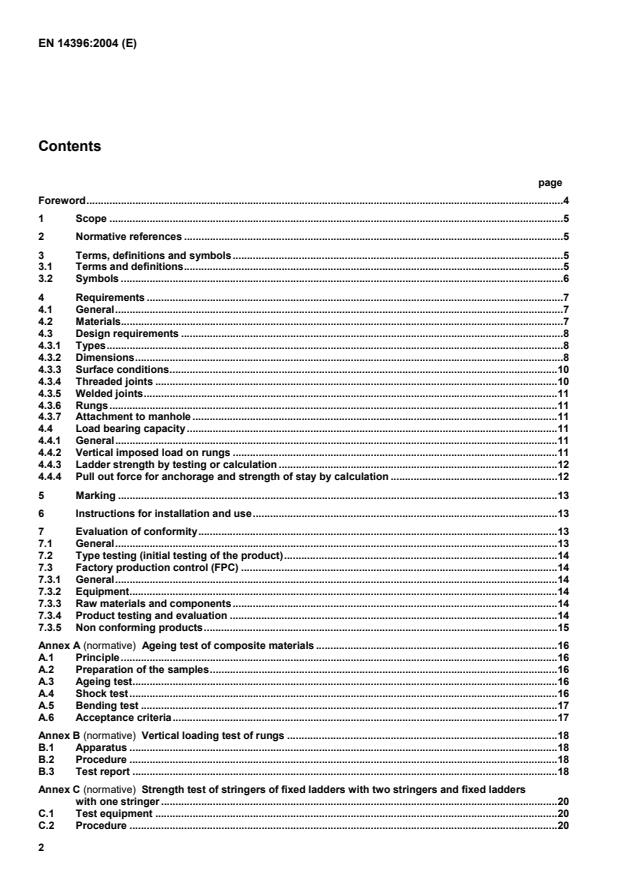
Ageing test of composite materials.16A.1Principle.16A.2Preparation of the samples.16A.3Ageing test.16A.4Shock test.16A.5Bending test.17A.6Acceptance criteria.17Annex B (normative)
Vertical loading test of rungs.18B.1Apparatus.18B.2Procedure.18B.3Test report.18Annex C (normative)
Strength test of stringers of fixed ladders with two stringers and fixed ladderswith one stringer.20C.1Test equipment.20C.2Procedure.20
Strength test of the stringer for fixed ladders with one stringer.21D.1Test procedure.21D.2Test report.22Annex E (normative)
Calculation of strength of anchor points.23E.1Fixed ladders with two stringers without fall arrester.23E.2Fixed ladders with one stringer.24Annex F (normative)
Calculation of the fixed ladder.25Annex ZA (informative)
Clauses of this European Standard addressing the provisions of the EUConstruction Products Directive.27ZA.1Scope and relevant characteristics.27ZA.2Procedure for attestation of conformity of fixed ladders for manholes.28ZA.3CE marking and labelling.29Bibliography.32
It can comprise one or moreunits3.1.5handholdhand grips provided at the top of the ladder or at the point of entry to the manhole3.1.6connectormechanical device as insert or fishplate to join sections together3.1.7sectionmodules consisting of single or double stringers and rungs designed to join together to produce full height ladders3.1.8stringervertical structural element to support rungs3.1.9stayelement to support and distance a ladder from the manhole wall3.1.10rungsolid or tubular element fixed to the stringer(s) to provide a foot or handhold3.1.11treadtop surface of a rung to accommodate a foot or hand3.2 SymbolsL climbing height of ladderF design load for calculation of strength for fixing at anchor pointsF1 vertical load at rungF2 design load for calculation of the fixed ladder systemF3 load for strength test of stringers (0,4 kN)F3'load for strength test of stringers multiplied by the safety factorg safety factor
Maximum distance between two staysL5 Distance from ground level to the top of the first rungL6 Height of handholdL7 Distance from the bottom rung to the benchingFigure 1 — Ladder with two stringers, fall arrester and handholdTable 3 — Dimensions for laddersDimensions in millimetresToleranceL1L2L3L4L5L6L7min.250300150——1000max.300——bL1 a—£ L1aIn special cases (e.g. where the manhole design so requires). For the installation national provisions valid in the place of useshall be taken into account.bTo be stated by the manufacturer (see clauses 5 and 6 and ZA.3), but not more than 3000 mm.
Distance between two staysL5 Distance from ground level to the top of the firstrungL6 Height of handholdL7 Distance from the bottom rung to the bottom of theshaftFigure 2 — Ladder with one stringer4.3.3 Surface conditionsLadders according to this standard shall be free from visible defects, protrusions or sharp edges.The surface of rungs shall conform to 4.3.6.4.3.4 Threaded jointsThreaded joints shall be designed so that fasteners cannot work loose.
1,75 for steel and aluminium,¾ g
= 4 for GRP.When testing ladders as shown in Figure C.1 they shall withstand a test load of F3' = F3
´ g , where F3 is 0,4 kN.The permanent deflection shall not exceed 0,3 % of the relevant length (0,5 L4 ).4.4.3.2.2 Strength test of ladders with one stringerThe strength test of ladders with one stringer shall be verified by torsion testing according to annex D, by fixing theladder on 3 stays with at least one connector at the least favourable point and applying a pair of forces of 0,4 kNeach, as illustrated in Figure D.1.
These loads shall be applied vertically opposed at the least favourable point oneach end of the rungs and at a distance of
...