


EN 15275:2007
(Main)Structural adhesives - Characterisation of anaerobic adhesives for co-axial metallic assembly in building and civil engineering structures
General Information
- Abstract
This European Standard specifies requirements and test methods for the characterisation of anaerobic adhesives intended for the general assembly of co-axial metallic elements in building and civil engineering structures including fasteners- threaded and otherwise, pipes and tubes. It is applicable to single adhesives and systems (kits) comprising adhesives, activators and/or primers for both internal and external construction elements. This European Standard only applies to metallic substrates.
- Status
- Withdrawn
- Publication Date
- 23-Oct-2007
- Withdrawal Date
- 22-Sep-2026
- Technical Committee
- CEN/TC 193 - Adhesives
- Drafting Committee
- CEN/TC 193/WG 2 - Structural adhesives
- Current Stage
- 9960 - Withdrawal effective - Withdrawal
- Start Date
- 15-Apr-2015
- Completion Date
- 23-Sep-2026
- Directive
- Harmonized Standard305/2011 - Regulation (eu) No 305/2011 of the European Parliament and of the Council of 9 march 2011 laying down harmonised conditions for the marketing of construction products and repealing council directive 89/106/eecOJ Ref: C, C 259 OJ Date: 08-Aug-2014
Not Harmonized89/106/EEC - Construction productsOJ Ref: C, C 71 OJ Date: 19-Mar-2010


Relations
- Effective Date
- 22-Apr-2015
- Effective Date
- 28-Jan-2026
- Effective Date
- 28-Jan-2026
- Effective Date
- 28-Jan-2026
- Effective Date
- 28-Jan-2026
- Effective Date
- 28-Jan-2026
- Effective Date
- 28-Jan-2026
- Effective Date
- 28-Jan-2026
- Effective Date
- 28-Jan-2026
- Effective Date
- 08-Jun-2022
Get Certified
Connect with accredited certification bodies for this standard

DIN CERTCO
DIN Group product certification.

Smithers Quality Assessments
US management systems and product certification.
Sponsored listings
Frequently Asked Questions
EN 15275:2007 is a standard published by the European Committee for Standardization (CEN). Its full title is "Structural adhesives - Characterisation of anaerobic adhesives for co-axial metallic assembly in building and civil engineering structures". This standard covers: This European Standard specifies requirements and test methods for the characterisation of anaerobic adhesives intended for the general assembly of co-axial metallic elements in building and civil engineering structures including fasteners- threaded and otherwise, pipes and tubes. It is applicable to single adhesives and systems (kits) comprising adhesives, activators and/or primers for both internal and external construction elements. This European Standard only applies to metallic substrates.
This European Standard specifies requirements and test methods for the characterisation of anaerobic adhesives intended for the general assembly of co-axial metallic elements in building and civil engineering structures including fasteners- threaded and otherwise, pipes and tubes. It is applicable to single adhesives and systems (kits) comprising adhesives, activators and/or primers for both internal and external construction elements. This European Standard only applies to metallic substrates.
EN 15275:2007 is classified under the following ICS (International Classification for Standards) categories: 83.180 - Adhesives. The ICS classification helps identify the subject area and facilitates finding related standards.
EN 15275:2007 has the following relationships with other standards: It is inter standard links to EN 15275:2015, EN 13999-1:2013, EN 923:2005, EN 1504-8:2016, EN ISO 10123:2019, EN 751-1:1996, EN 15865:2009, EN 13999-2:2013, EN ISO 75-3:2025, EN 15275:2007/AC:2010. Understanding these relationships helps ensure you are using the most current and applicable version of the standard.
EN 15275:2007 is associated with the following European legislation: EU Directives/Regulations: 305/2011, 89/106/EEC; Standardization Mandates: M/127. When a standard is cited in the Official Journal of the European Union, products manufactured in conformity with it benefit from a presumption of conformity with the essential requirements of the corresponding EU directive or regulation.
EN 15275:2007 is available in PDF format for immediate download after purchase. The document can be added to your cart and obtained through the secure checkout process. Digital delivery ensures instant access to the complete standard document.
Standards Content (Sample)
2003-01.Slovenski inštitut za standardizacijo. Razmnoževanje celote ali delov tega standarda ni dovoljeno.Konstrukcijska lepila - Karakterizacija anaerobnih lepil za koaksialne metalne konstrukcije v zgradbah in objektihStrukturklebstoffe - Charakterisierung von anaeroben Klebstoffen für koaxiale metallische Baugruppen in Bauwerken des Hoch- und TiefbausAdhésifs structuraux - Caractérisation des adhésifs anaérobies pour assemblages métalliques coaxiaux dans les bâtiments et ouvrages de génie civilStructural adhesives - Characterisation of anaerobic adhesives for co-axial metallic assembly in building and civil engineering structures83.180LepilaAdhesivesICS:Ta slovenski standard je istoveten z:EN 15275:2007SIST EN 15275:2009en,fr,de01-januar-2009SIST EN 15275:2009SLOVENSKI
STANDARD
EUROPEAN STANDARDNORME EUROPÉENNEEUROPÄISCHE NORMEN 15275October 2007ICS 83.180 English VersionStructural adhesives - Characterisation of anaerobic adhesivesfor co-axial metallic assembly in building and civil engineeringstructuresAdhésifs structuraux - Caractérisation des adhésifsanaérobies pour assemblages métalliques coaxiaux dansles bâtiments et ouvrages de génieStrukturklebstoffe - Charakterisierung anaerober Klebstoffefür koaxiale Metallverbindungen im BauwesenThis European Standard was approved by CEN on 16 September 2007.CEN members are bound to comply with the CEN/CENELEC Internal Regulations which stipulate the conditions for giving this EuropeanStandard the status of a national standard without any alteration. Up-to-date lists and bibliographical references concerning such nationalstandards may be obtained on application to the CEN Management Centre or to any CEN member.This European Standard exists in three official versions (English, French, German). A version in any other language made by translationunder the responsibility of a CEN member into its own language and notified to the CEN Management Centre has the same status as theofficial versions.CEN members are the national standards bodies of Austria, Belgium, Bulgaria, Cyprus, Czech Republic, Denmark, Estonia, Finland,France, Germany, Greece, Hungary, Iceland, Ireland, Italy, Latvia, Lithuania, Luxembourg, Malta, Netherlands, Norway, Poland, Portugal,Romania, Slovakia, Slovenia, Spain, Sweden, Switzerland and United Kingdom.EUROPEAN COMMITTEE FOR STANDARDIZATIONCOMITÉ EUROPÉEN DE NORMALISATIONEUROPÄISCHES KOMITEE FÜR NORMUNGManagement Centre: rue de Stassart, 36
B-1050 Brussels© 2007 CENAll rights of exploitation in any form and by any means reservedworldwide for CEN national Members.Ref. No. EN 15275:2007: ESIST EN 15275:2009
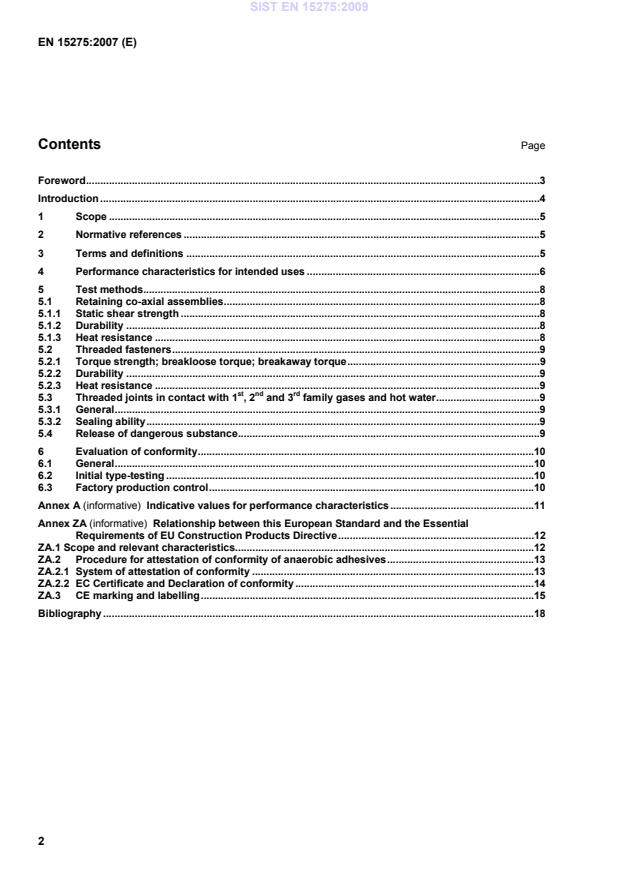
Indicative values for performance characteristics.11 Annex ZA (informative)
Relationship between this European Standard and the Essential Requirements of EU Construction Products Directive.12 ZA.1 Scope and relevant characteristics.12 ZA.2 Procedure for attestation of conformity of anaerobic adhesives.13 ZA.2.1 System of attestation of conformity.13 ZA.2.2 EC Certificate and Declaration of conformity.14 ZA.3 CE marking and labelling.15 Bibliography.18
Introduction Anaerobic adhesives are single component adhesives that cure in absence of oxygen, curing being inhibited by the presence of oxygen and catalysed by metal ions. Polymerisation takes normally place at room temperature. Due to their curing properties these adhesives are well suited for easy assembling threaded and otherwise, pipes and tubes in building and civil engineering structures. By the curing reaction a polymeric material is formed, which fills narrow gaps or micro-imperfections of threads thus sealing and bonding the joint. In addition, anaerobic adhesives may be used to joint load-bearing parts of the structures when used in tubular lap joints or pin-into-bore type joints. The primary aim of the test methods presented herein is for ranking and quality control of anaerobic adhesives and reliance should not be placed on any test results for design purposes. Design data should preferably be obtained from tests using the construction materials and configurations used in the actual design. The requirements to the assemblies are strongly depending on the intended use. Apart from the sealing ability, strength requirements may conflict with the intention to regular or occasional dismantling the joint for maintenance purposes. The values defined in this standard are considered to indicate a general or typical suitability for use of an anaerobic adhesive in a particular application in building and civil engineering structures. SIST EN 15275:2009
5.2.1 Nm EN ISO 10964Only for products intended for use for securing or locking metallic threaded assemblies. The fastener specimen should be preloaded at 5 Nm, otherwise the input torque has to be explicitly mentioned in brackets (Input Torque in Nm). If unseated assemblies have been used, use the expression Unseated Assemblies in brackets. 5 Durability a
5.1.2 N/mm²
or as ratio to shear strength at room temperature, No. 1 EN 15337 Shear Strength after 1000 h exposure to 100 °C
Only for products intended for use for retaining metallic co-axial cylindrical joints such as load bearing tubular or pin-and-collar-type cylindrical assemblies. Expresses durability as shear strength or retention of the shear strength measured in accordance with EN 15337 after 1 000 h exposure to 100 °C (and if required to 150 °C). 6 Durability a
5.2.2 Nm or as ratio to breakaway torque at room temperature, No. 2 EN ISO 10964Breakaway Torque after 1000 h exposure to 100 °C a Only for products intended for use for securing or locking metallic threaded assemblies. Expresses durability as torque strength or retention of the torque strength measured in accordance with EN ISO 10964 after 1 000 h exposure to 100 °C (and if required to 150 °C, after 168 h in boiling water, or after 2 h exposure to -20 °C). 7 Heat resistance 5.1.3
°C EN ISO 75-3 Shear Strength at 100 °C.
8 Heat resistance 5.2.3 °C EN ISO 75-3 Breakloose Torque at 100 °C 4 Sealing ability 5.3 - EN 751-1 Only for products intended for use to seal threaded metallic joints in contact with 1st, 2nd and 3rd family gases and hot water of heating systems. The sealing ability includes the resistance to gas condensates, resistance to hot water, resistance to temperature cycling, and resistance to vibration as defined in EN 751-1 Use the expression Meets the Requirements Accordingly to EN 751-1. 9 Release of dangerous substances 5.4 µg/m3 EN 13999-1 and EN 13999-2
...