


EN 1287:2017
(Main)Sanitary tapware - Low pressure thermostatic mixing valves - General technical specification
General Information
- Abstract
This European Standard specifies general construction, performance and material requirements for PN 10 thermostatic mixing valves (TMV) and includes test methods for the verification of mixed water temperature performance at the point of use below 45 °C. This does not exclude the selection of higher temperatures where available. When these devices are used to provide anti-scald protection for children, elderly and disabled persons the mixed water temperature needs to be set at a suitable bathing temperature (body temperature - 38 °C) as children are at risk to scalding at lower temperatures than adults. This does not obviate the need for supervision of young children during bathing.
It applies to valves intended for use on sanitary appliances in kitchens, washrooms (incl. all rooms with sanitary tapware, e.g. toilet and cloakrooms) and bathrooms operating under the conditions specified in Table 1.
This standard allows TMVs to supply a single outlet or a small number of outlets in a "domestic" application (e.g. one valve, controlling a shower, bath, basin and/or, bidet), excluding valves specifically designed for supplying a large number of outlets (i.e. for institutional use).
The tests described are type tests (laboratory tests) and not quality control tests carried out during manufacture.
Table 1 - Conditions of use
- Status
- Withdrawn
- Publication Date
- 15-Aug-2017
- Withdrawal Date
- 22-Sep-2026
- Technical Committee
- CEN/TC 164 - Water supply
- Drafting Committee
- CEN/TC 164/WG 8 - Sanitary tapware
- Current Stage
- 9960 - Withdrawal effective - Withdrawal
- Start Date
- 01-Apr-2026
- Completion Date
- 23-Sep-2026


Overview
EN 1287:2017 - Sanitary tapware: Low pressure thermostatic mixing valves (TMV) - General technical specification is a European Standard published by CEN. It defines general construction, performance and material requirements for PN 10 low‑pressure TMVs and specifies laboratory type test methods to verify mixed water temperature performance at the point of use (below 45 °C). The standard targets domestic applications where a single TMV supplies one or a small number of outlets (shower, bath, basin, bidet), and is not intended for valves designed to feed many outlets (institutional systems).
Key topics and requirements
EN 1287:2017 covers the practical and testable attributes of TMVs, including:
- Scope and classification for low‑pressure PN 10 TMVs and permitted applications (kitchens, washrooms, bathrooms, toilets, cloakrooms).
- Materials & hygiene: requirements for exposed surfaces and coatings to suit sanitary use.
- Dimensional characteristics: inlet/outlet and mounting dimensions and special cases for installation.
- Marking & identification: essential product marking for traceability and safe use.
- Backflow protection and anti‑contamination considerations.
- Leaktightness tests (upstream, downstream, cross‑flow and diverter leak checks).
- Performance tests: flow rate determination, sensitivity, fidelity and mixed water temperature control.
- Temperature stability: response to cold supply failure, supply pressure and temperature variations, and temperature override protections.
- Mechanical & pressure resistance: pressure tests upstream and downstream of the obturator, torsional resistance of controls and mechanical endurance testing for handles/diverters.
- Testing regime: these are type tests (laboratory verification), not routine factory quality control tests.
The standard also highlights anti‑scald protection requirements - when protecting children, elderly or disabled users the mixed water temperature must be set to a suitable bathing temperature (around 38 °C is noted) and supervision is still required for young children.
Applications and who uses this standard
EN 1287:2017 is primarily used by:
- Manufacturers and product designers of thermostatic mixing valves and sanitary tapware to design compliant products.
- Independent test laboratories performing type testing and certification.
- Specifiers, consultants and building services engineers who select TMVs for domestic and small‑scale residential installations.
- Regulatory bodies and procurement teams ensuring product compliance with European sanitary safety expectations.
- Installers and plumbers referencing installation and marking requirements to ensure correct selection and safe commissioning.
Typical applications: domestic showers, baths, basin mixers and bidet fittings where low‑pressure PN 10 TMVs are required for temperature control and anti‑scald protection.
Related standards
This document is a CEN European Standard. For comprehensive compliance, consult EN 1287:2017 alongside other CEN sanitary tapware standards and applicable national plumbing codes and regulations.
Relations
- Effective Date
- 23-Aug-2017
- Effective Date
- 28-Jan-2023
- Effective Date
- 01-Apr-2026
- Effective Date
- 09-Feb-2026
- Effective Date
- 09-Feb-2026
- Effective Date
- 28-Jan-2026
- Effective Date
- 28-Jan-2026
- Effective Date
- 28-Jan-2026
- Effective Date
- 28-Jan-2026
- Effective Date
- 28-Jan-2026
- Effective Date
- 28-Jan-2026
- Effective Date
- 28-Jan-2026
- Effective Date
- 28-Jan-2026
- Refers
EN 13959:2004 - Anti-pollution check valves - DN 6 to DN 250 inclusive family E, type A, B, C and D - Effective Date
- 28-Jan-2026
- Effective Date
- 28-Jan-2026
Get Certified
Connect with accredited certification bodies for this standard

DIBt (Deutsches Institut für Bautechnik)
German Institute for Building Technology.
DIN CERTCO
DIN Group product certification.

Aboma Certification B.V.
Specialized in construction, metal, and transport sectors.
Sponsored listings
Frequently Asked Questions
EN 1287:2017 is a standard published by the European Committee for Standardization (CEN). Its full title is "Sanitary tapware - Low pressure thermostatic mixing valves - General technical specification". This standard covers: This European Standard specifies general construction, performance and material requirements for PN 10 thermostatic mixing valves (TMV) and includes test methods for the verification of mixed water temperature performance at the point of use below 45 °C. This does not exclude the selection of higher temperatures where available. When these devices are used to provide anti-scald protection for children, elderly and disabled persons the mixed water temperature needs to be set at a suitable bathing temperature (body temperature - 38 °C) as children are at risk to scalding at lower temperatures than adults. This does not obviate the need for supervision of young children during bathing. It applies to valves intended for use on sanitary appliances in kitchens, washrooms (incl. all rooms with sanitary tapware, e.g. toilet and cloakrooms) and bathrooms operating under the conditions specified in Table 1. This standard allows TMVs to supply a single outlet or a small number of outlets in a "domestic" application (e.g. one valve, controlling a shower, bath, basin and/or, bidet), excluding valves specifically designed for supplying a large number of outlets (i.e. for institutional use). The tests described are type tests (laboratory tests) and not quality control tests carried out during manufacture. Table 1 - Conditions of use
This European Standard specifies general construction, performance and material requirements for PN 10 thermostatic mixing valves (TMV) and includes test methods for the verification of mixed water temperature performance at the point of use below 45 °C. This does not exclude the selection of higher temperatures where available. When these devices are used to provide anti-scald protection for children, elderly and disabled persons the mixed water temperature needs to be set at a suitable bathing temperature (body temperature - 38 °C) as children are at risk to scalding at lower temperatures than adults. This does not obviate the need for supervision of young children during bathing. It applies to valves intended for use on sanitary appliances in kitchens, washrooms (incl. all rooms with sanitary tapware, e.g. toilet and cloakrooms) and bathrooms operating under the conditions specified in Table 1. This standard allows TMVs to supply a single outlet or a small number of outlets in a "domestic" application (e.g. one valve, controlling a shower, bath, basin and/or, bidet), excluding valves specifically designed for supplying a large number of outlets (i.e. for institutional use). The tests described are type tests (laboratory tests) and not quality control tests carried out during manufacture. Table 1 - Conditions of use
EN 1287:2017 is classified under the following ICS (International Classification for Standards) categories: 91.140.70 - Sanitary installations. The ICS classification helps identify the subject area and facilitates finding related standards.
EN 1287:2017 has the following relationships with other standards: It is inter standard links to EN 1287:1999, EN 1287:2026, EN 1717:2025+A1:2026, EN IEC 60584-3:2021, EN 60584-1:2013, EN 1113:2015, EN 1717:2025, EN 16145:2012, EN 248:2002, EN 246:2021, EN 1112:2008, EN 1057:2006+A1:2010, EN ISO 5167-1:2022, EN 13959:2004, EN 200:2023. Understanding these relationships helps ensure you are using the most current and applicable version of the standard.
EN 1287:2017 is available in PDF format for immediate download after purchase. The document can be added to your cart and obtained through the secure checkout process. Digital delivery ensures instant access to the complete standard document.
Standards Content (Sample)
2003-01.Slovenski inštitut za standardizacijo. Razmnoževanje celote ali delov tega standarda ni dovoljeno.]DKWHYHSanitärarmaturen - Thermostatische Mischer für die Anwendung im Niederdruckbereich - Allgemeine technische SpezifikationRobinetterie sanitaire - Mitigeurs thermostatiques basse pression - Spécifications techniques généralesSanitary tapware - Low pressure thermostatic mixing valves - General technical specification91.140.70Sanitarne napraveSanitary installationsICS:Ta slovenski standard je istoveten z:EN 1287:2017SIST EN 1287:2017en,fr,de01-oktober-2017SIST EN 1287:2017SLOVENSKI
STANDARDSIST EN 1287:20001DGRPHãþD
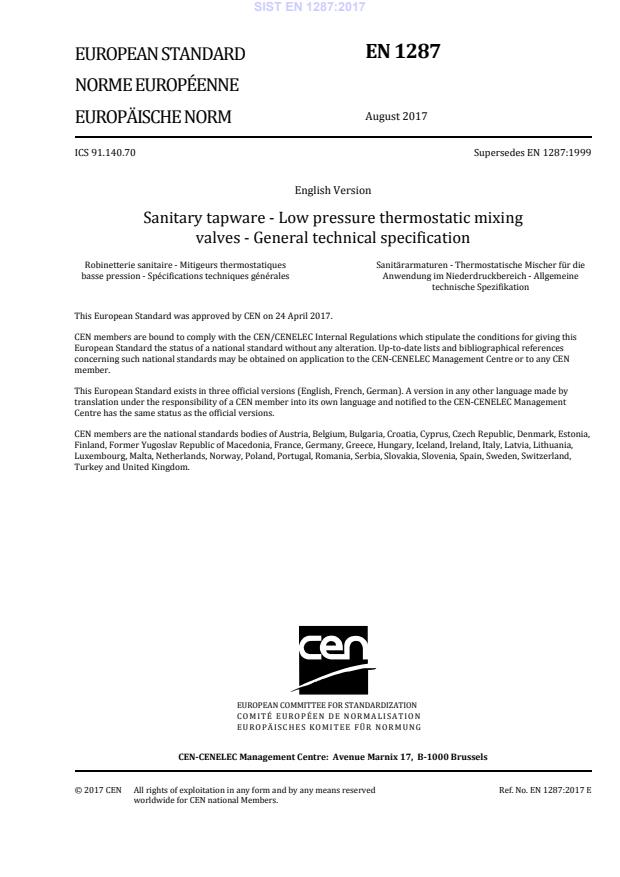
EUROPEAN STANDARD NORME EUROPÉENNE EUROPÄISCHE NORM
EN 1287
August
t r s y ICS
{ sä s v rä y r Supersedes EN
s t z yã s { { {English Version
Sanitary tapware æ Low pressure thermostatic mixing valves æ General technical specification Robinetterie sanitaire æ Mitigeurs thermostatiques basse pression æ Spécifications techniques générales
Sanitärarmaturen æ Thermostatische Mischer für die Anwendung im Niederdruckbereich æ Allgemeine technische Spezifikation This European Standard was approved by CEN on
t v April
t r s yä
egulations which stipulate the conditions for giving this European Standard the status of a national standard without any alterationä Upætoædate lists and bibliographical references concerning such national standards may be obtained on application to the CENæCENELEC Management Centre or to any CEN memberä
translation under the responsibility of a CEN member into its own language and notified to the CENæCENELEC Management Centre has the same status as the official versionsä
CEN members are the national standards bodies of Austriaá Belgiumá Bulgariaá Croatiaá Cyprusá Czech Republicá Denmarká Estoniaá Finlandá Former Yugoslav Republic of Macedoniaá Franceá Germanyá Greeceá Hungaryá Icelandá Irelandá Italyá Latviaá Lithuaniaá Luxembourgá Maltaá Netherlandsá Norwayá Polandá Portugalá Romaniaá Serbiaá Slovakiaá Sloveniaá Spainá Swedená Switzerlandá Turkey and United Kingdomä
EUROPEAN COMMITTEE FOR STANDARDIZATION COMITÉ EUROPÉEN DE NORMALISATION EUROPÄISCHES KOMITEE FÜR NORMUNG
CEN-CENELEC Management Centre:
Avenue Marnix 17,
B-1000 Brussels
t r s y CEN All rights of exploitation in any form and by any means reserved worldwide for CEN national Membersä Refä Noä EN
s t z yã t r s y ESIST EN 1287:2017
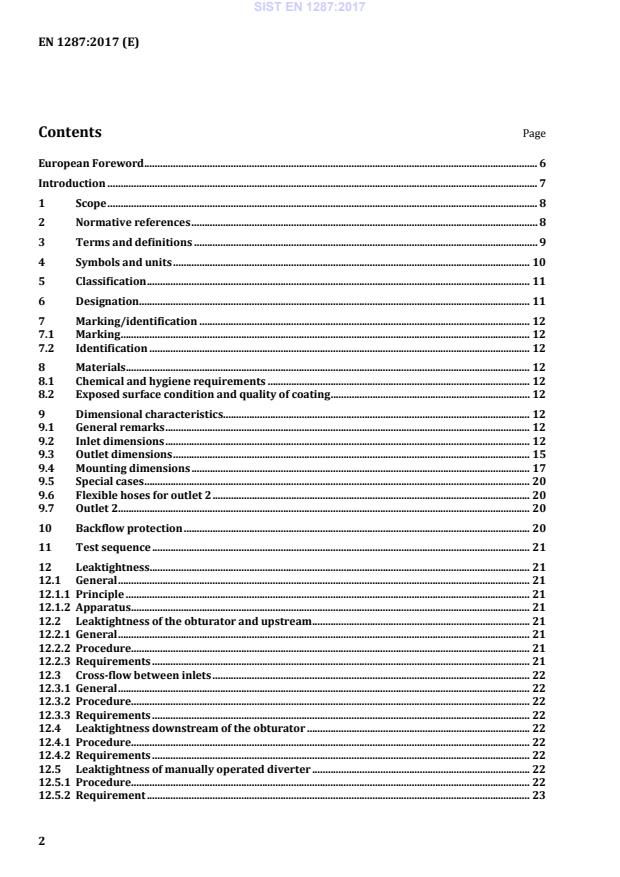
Test set-up descriptions . 43 A.1 General . 43 A.2 Inlet pipework . 43 A.2.1 Thermostat endurance. 43 A.2.2 Performance . 44 A.3 Outlet pipework . 44 A.3.1 General . 44 A.3.2 Outlet for valves except without integral atmospheric discharge spouts . 44 Annex B (normative)
Measurements . 48 B.1 Pressure . 48 B.2 Flow . 48 B.3 Temperature . 48 B.3.1 Mounting . 48 B.3.2 Accuracy . 48 SIST EN 1287:2017
Temperature transit . 51 C.1 Positive temperature transient . 51 C.2 Negative temperature transient . 52 Annex D (normative)
Hydraulic resistance for low pressure diverters with automatic return . 53 Bibliography . 55
¶ 1
Dynamic
· 0,01
(0,02 to 0,1) MPa [(0,2 to 1,0)
Temperature
Hot
¶ 90 °C (55 to 65) °C Cold
¶ 25 °C (5 to 20) °C a For low pressure thermostatic mixing valves complying with this table there are no acoustical requirements. Low pressure thermostatic mixing valves complying with this standard may also be used with inlet supply pressures in the range from 0,1 MPa to 0,2 MPa (1,0 bar to 2,0 bar) on condition that acoustical performance is not a requirement of the installation. NOTE Low pressure thermostatic mixing valves are designed to provide sufficient mechanical strength for operation at 1 MPa (10 bar) static pressure. 2 Normative references The following documents, in whole or in part, are normatively referenced in this document and are indispensable for its application. For dated references, only the edition cited applies. For undated references, the latest edition of the referenced document (including any amendments) applies. EN 200, Sanitary tapware - Single taps and combination taps for water supply systems of type 1 and type 2 - General technical specification EN 246, Sanitary tapware - General specifications for flow rate regulators EN 248, Sanitary tapware - General specification for electrodeposited coatings of Ni-Cr SIST EN 1287:2017
= t1 +1 s s t3
= 5 s s Tc temperature of cold water supply °C Th temperature of hot water supply °C Tm temperature of mixed water °C x1 distance mm x2 distance mm Í0 set temperature °C Íx temperature amplitude °C Íc cold water temperature (Outlet temperature) °C Íh hot water temperature (Outlet temperature) °C Ímix mixed water temperature °C SIST EN 1287:2017
G a (150 ± 1) mm 2 – hole wall mounted Supply connection, Straight unions G 1 (140 to 160) mm — with eccentric unions (extension of this range is permitted) G a (150 ± 1) mm Multi-hole combination tap
G 2 (200 ± 3,5) mm G 3 (180 ± 5) mm Inlet connections N 1 (12,3 + 0,2) mm Type A size 1/2
N 2 5 mm min N 1 (15,2 ± 0,05) mm Type B size 1/2 30° chamfer/flat 0,3 N 2 13 mm min N 1 (14,7 + 0,3) mm Type C size 1/2 N 2 6,4 mm min N 1 (19,9 + 0,3) mm Type C size 3/4 N 2 6,4 mm min SIST EN 1287:2017
G 3/8 Plain end, male or female Copper tube(s) or flexible hose(s) U 350 mm min
Tube(s) or flexible hose(s) Flexible hoses in accordance with EN 13618 a Other dimensions are permissible (for replacement) when market tradition requires it, provided the manufacturer specifies the actual dimension in literature to avoid confusion with the standard dimension – which can be achieved using an eccentric connection.
Key 1 flexible hose 2 plain tube Figure 1 — Inlet dimensions - Single-hole taps SIST EN 1287:2017
Figure 2 — Multi-hole combination taps
Type A Type B Type C Figure 3 — Supply connections for taps and remote outlets 9.3 Outlet dimensions Outlet dimensions shall be as specified in Table 5, Figure 4, Figure 5, Figure 6. When nozzle outlets are used with flow rate regulators conforming with EN 246, the manufacturing tolerances chosen for the connecting threads of the outlets shall be compatible with those of the connecting threads of the flow rate regulators, in order to ensure interchangeability. SIST EN 1287:2017
D 3 115 mm min Wall mounted combination tap Separate spout A G 1/2 B Remote outlet In accordance with EN ISO 228-1 A 1 G 3/4 B A 4 7,5 mm min. Outlet 2 Useful thread length A 5 9,5 mm min.
Free length of connection a Nozzle outlets to accept flow rate regulators shall be in accordance with EN 246. NOTE Nozzle outlets which are not in accordance with EN 246 are covered by 9.5.
Figure 4 — Remote outlet SIST EN 1287:2017
Figure 5 — Single hole combination or remote outlet
Figure 6 — Bath shower combination or remote outlet 9.4 Mounting dimensions Mounting dimensions shall be as specified in Table 6, Figure 7, Figure 8 and Figure 9. SIST EN 1287:2017
H 1 24 mm max Two hole taps size 1/2 Fixed centres H 2 29 mm max separate outlet, side spray, 3 hole tap size 1/2 Adjustable centres H 3 33,5 mm max Single hole tap, 2-hole tap size 1/2 or 3/4 3-hole tap size 1/2
Base or flange
J 1 50 mm min 2-hole tap size 3/4 Dimension of base or flange J 2 45 mm min Bath, Bath/Shower, Basin, Bidet, Sink tap size 1/2 J 3 50 mm max Single and Multi-hole tap Diameter of clamping washer V 32 mm max Basin, Bidet, Sink Flange projection to rear V 1 35 mm max Bath – Two hole tap V 3 47 mm max 3-hole tap L Dimension which allows taps and outlets to be fitted on to supports of thickness between 1 mm and 18 mm Minimum range (mm) of supports, which allows the installation of the TMV SIST EN 1287:2017
Key 1 basin; bidet; sink 2 remote spray attachment Figure 7 — Single hole tap
Figure 8 — Two hole TMV (fixed centres) SIST EN 1287:2017
Figure 9 — Three hole TMV (adjustable centres) 9.5 Special cases TMVs intended for special applications, e.g. for installation on sanitary appliances not conforming with European Standards, or where dimensional interchangeability is not a requirement can incorporate dimensional deviations provided that: a) all other requirements of this European Standard are satisfied; b) secure fixing to the mounting surface is provided with all fixing holes covered; c) thread connections to the supply pipes comply with EN ISO 228-1; d) the D1/D3 dimension shall be coordinated with the appropriate sanitary appliance. 9.6 Flexible hoses for outlet 2 Connecting dimensions for flexible hoses for outlet 2 shall be as specified in EN 1113. 9.7 Outlet 2 Connecting dimensions for outlet 2 shall be as specified in EN 1112. 10 Backflow protection Backflow protection shall be provided using appropriate devices referenced in EN 1717. NOTE Appropriate devices may include the use of an air gap or the specific product design. In the case of a diverter with automatic return being considered to provide backflow prevention, it shall comply with the requirements of EN 14506. Check valves shall comply with EN 13959. In the case of sanitary tapware with extractable outlets, backflow prevention shall be in compliance with EN 16145. SIST EN 1287:2017
...