


EN 13261:2009
(Main)Railway applications - Wheelsets and bogies - Axles - Product requirements
General Information
- Abstract
This European Standard specifies the characteristics of axles for use on European networks.
It defines characteristics of forged or rolled solid and hollow axles, made from vacuum-degassed steel grade
EA1N1 that is the most commonly used grade on European networks. For hollow axles, this standard applies
only to those that are manufactured by machining of a hole in a forged or rolled solid axle
In addition, the particular characteristics for axles in grade EA1T1 and EA4T1 are given in Annex A.
Two categories of axle are defined, category 1 and category 2. Generally, category 1 is chosen when the
operational speed is higher than 200 km/h.
This standard is applicable to axles that are designed in accordance with the requirements of EN 13103 and
EN 13104.
NOTE Different values for some characteristics may be agreed if a particular process of fabrication (e.g. cold rolling,
shot peening) has an influence on them.
- Status
- Withdrawn
- Publication Date
- 24-Mar-2009
- Withdrawal Date
- 19-Oct-2010
- Technical Committee
- CEN/TC 256 - Railway applications
- Drafting Committee
- CEN/TC 256/SC 2/WG 11 - Wheels - Wheelsets
- Current Stage
- 9960 - Withdrawal effective - Withdrawal
- Start Date
- 20-Oct-2010
- Completion Date
- 20-Oct-2010
- Directive
- Not Harmonized2001/16/EC - Directive 2001/16/EC of the European Parliament and of the Council of 19 March 2001 on the interoperability of the trans-European conventional rail systemOJ Ref: C, C 97 OJ Date: 16-Apr-2010
Not Harmonized96/48/EC - Interoperability of the trans-European high-speed rail systemOJ Ref: C, C 97 OJ Date: 16-Apr-2010

Relations
- Effective Date
- 22-Dec-2008
- Merged Into
EN 13261:2009+A1:2010 - Railway applications - Wheelsets and bogies - Axles - Product requirements - Effective Date
- 18-Jan-2023
- Effective Date
- 28-Jan-2026
- Amended By
EN 13261:2009/FprA1 - Railway applications - Wheelsets and bogies - Axles - Product requirements - Effective Date
- 19-Dec-2009
Get Certified
Connect with accredited certification bodies for this standard

IRIS Certification (UNIFE)
International Railway Industry Standard certification.

TÜV SÜD Rail GmbH
TÜV SÜD railway certification services.

Bureau Veritas Railway Certification
Railway and transportation certification.
Sponsored listings
Frequently Asked Questions
EN 13261:2009 is a standard published by the European Committee for Standardization (CEN). Its full title is "Railway applications - Wheelsets and bogies - Axles - Product requirements". This standard covers: This European Standard specifies the characteristics of axles for use on European networks. It defines characteristics of forged or rolled solid and hollow axles, made from vacuum-degassed steel grade EA1N1 that is the most commonly used grade on European networks. For hollow axles, this standard applies only to those that are manufactured by machining of a hole in a forged or rolled solid axle In addition, the particular characteristics for axles in grade EA1T1 and EA4T1 are given in Annex A. Two categories of axle are defined, category 1 and category 2. Generally, category 1 is chosen when the operational speed is higher than 200 km/h. This standard is applicable to axles that are designed in accordance with the requirements of EN 13103 and EN 13104. NOTE Different values for some characteristics may be agreed if a particular process of fabrication (e.g. cold rolling, shot peening) has an influence on them.
This European Standard specifies the characteristics of axles for use on European networks. It defines characteristics of forged or rolled solid and hollow axles, made from vacuum-degassed steel grade EA1N1 that is the most commonly used grade on European networks. For hollow axles, this standard applies only to those that are manufactured by machining of a hole in a forged or rolled solid axle In addition, the particular characteristics for axles in grade EA1T1 and EA4T1 are given in Annex A. Two categories of axle are defined, category 1 and category 2. Generally, category 1 is chosen when the operational speed is higher than 200 km/h. This standard is applicable to axles that are designed in accordance with the requirements of EN 13103 and EN 13104. NOTE Different values for some characteristics may be agreed if a particular process of fabrication (e.g. cold rolling, shot peening) has an influence on them.
EN 13261:2009 is classified under the following ICS (International Classification for Standards) categories: 45.040 - Materials and components for railway engineering. The ICS classification helps identify the subject area and facilitates finding related standards.
EN 13261:2009 has the following relationships with other standards: It is inter standard links to EN 13261:2003, EN 13261:2009+A1:2010, EN 13103:2009+A2:2012, EN 13261:2009/FprA1. Understanding these relationships helps ensure you are using the most current and applicable version of the standard.
EN 13261:2009 is associated with the following European legislation: EU Directives/Regulations: 2001/16/EC, 2008/57/EC, 96/48/EC; Standardization Mandates: M/275, M/334. When a standard is cited in the Official Journal of the European Union, products manufactured in conformity with it benefit from a presumption of conformity with the essential requirements of the corresponding EU directive or regulation.
EN 13261:2009 is available in PDF format for immediate download after purchase. The document can be added to your cart and obtained through the secure checkout process. Digital delivery ensures instant access to the complete standard document.
Standards Content (Sample)
2003-01.Slovenski inštitut za standardizacijo. Razmnoževanje celote ali delov tega standarda ni dovoljeno.Bahnanwendungen - Radsätze und Drehgestelle - Radsatzwellen - ProduktanforderungenApplications ferroviaires - Essieux montés et bogies - Essieux-axes - Prescription pour le produitRailway applications - Wheelsets and bogies - Axles - Product requirements45.040Materiali in deli za železniško tehnikoMaterials and components for railway engineeringICS:Ta slovenski standard je istoveten z:EN 13261:2009SIST EN 13261:2009en,fr01-junij-2009SIST EN 13261:2009SLOVENSKI
STANDARDSIST EN 13261:20041DGRPHãþD
EUROPEAN STANDARDNORME EUROPÉENNEEUROPÄISCHE NORMEN 13261March 2009ICS 45.040Supersedes EN 13261:2003
English VersionRailway applications - Wheelsets and bogies - Axles - ProductrequirementsApplications ferroviaires - Essieux montés et bogies -Essieux-axes - Prescriptions pour le produitBahnanwendungen - Radsätze und Drehgestelle -Radsatzwellen - ProduktanforderungenThis European Standard was approved by CEN on 29 November 2008.CEN members are bound to comply with the CEN/CENELEC Internal Regulations which stipulate the conditions for giving this EuropeanStandard the status of a national standard without any alteration. Up-to-date lists and bibliographical references concerning such nationalstandards may be obtained on application to the CEN Management Centre or to any CEN member.This European Standard exists in three official versions (English, French, German). A version in any other language made by translationunder the responsibility of a CEN member into its own language and notified to the CEN Management Centre has the same status as theofficial versions.CEN members are the national standards bodies of Austria, Belgium, Bulgaria, Cyprus, Czech Republic, Denmark, Estonia, Finland,France, Germany, Greece, Hungary, Iceland, Ireland, Italy, Latvia, Lithuania, Luxembourg, Malta, Netherlands, Norway, Poland, Portugal,Romania, Slovakia, Slovenia, Spain, Sweden, Switzerland and United Kingdom.EUROPEAN COMMITTEE FOR STANDARDIZATIONCOMITÉ EUROPÉEN DE NORMALISATIONEUROPÄISCHES KOMITEE FÜR NORMUNGManagement Centre:
Avenue Marnix 17,
B-1000 Brussels© 2009 CENAll rights of exploitation in any form and by any means reservedworldwide for CEN national Members.Ref. No. EN 13261:2009: ESIST EN 13261:2009
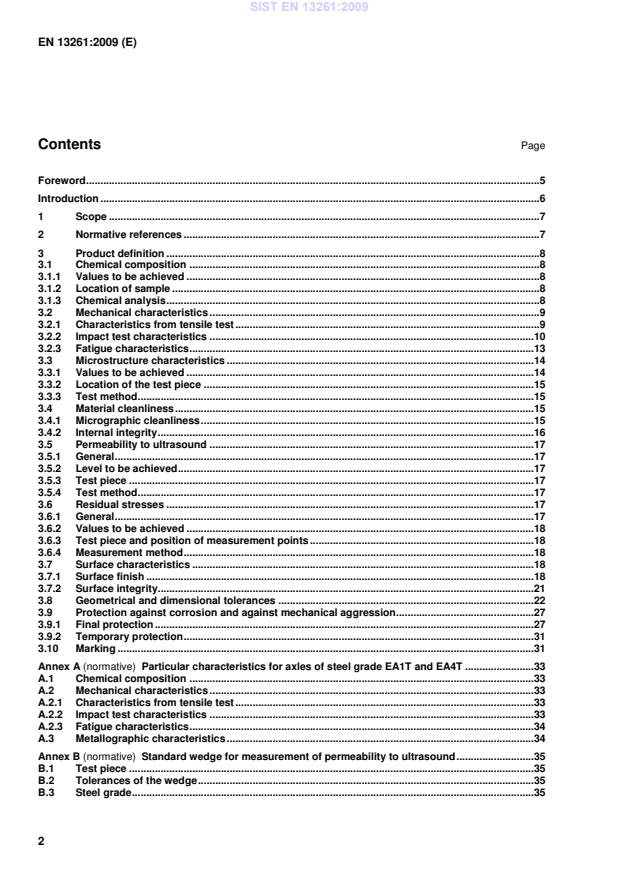
Particular characteristics for axles of steel grade EA1T and EA4T.33 A.1 Chemical composition.33 A.2 Mechanical characteristics.33 A.2.1 Characteristics from tensile test.33 A.2.2 Impact test characteristics.33 A.2.3 Fatigue characteristics.34 A.3 Metallographic characteristics.34 Annex B (normative)
Standard wedge for measurement of permeability to ultrasound.35 B.1 Test piece.35 B.2 Tolerances of the wedge.35 B.3 Steel grade.35 SIST EN 13261:2009
Method to assess resistance to impact of the coating.36 C.1 Principle.36 C.2 Test piece.36 C.3 Apparatus.36 C.4 Procedure.36 C.5 Expression of results.36 Annex D (normative)
Method to assess resistance to gritting of the coating.37 D.1 Principle.37 D.2 Test piece.37 D.3 Apparatus.37 D.4 Procedure.37 D.5 Expression of results.37 Annex E (normative)
...