


prEN 18262
(Main)Precast concrete products - Product specifications
General Information
- Abstract
This document provides specifications for the production of unreinforced, reinforced and prestressed precast concrete products protected from adverse weather conditions during production, and made of compact light-, normal- and heavyweight concrete according to EN 206 with no appreciable amount of entrapped air other than entrained air. Concrete containing fibres for other than mechanical properties (steel, polymer or other fibres) is also covered.
This document also covers clay, EPS, and lightweight formwork blocks for beam-and-blocks floor systems.
It does not cover precast reinforced components of lightweight aggregate concrete with open structure nor glassfibre reinforced concrete.
It can also be used to specify products for which there is no standard.
- Status
- Not Published
- Publication Date
- 26-May-2027
- Technical Committee
- CEN/TC 229 - Precast concrete products
- Current Stage
- 4060 - Closure of enquiry - Enquiry
- Start Date
- 19-Feb-2026
- Due Date
- 05-Mar-2026
- Completion Date
- 19-Feb-2026


Overview
The prEN 18262:2025 standard, developed by CEN Technical Committee CEN/TC 229, establishes comprehensive product specifications for precast concrete products. It applies to a wide range of factory-produced unreinforced, reinforced, and prestressed precast concrete elements made from compact light-, normal-, and heavyweight concrete according to EN 206. This standard covers concrete with fibres added primarily for purposes other than mechanical properties, including steel and polymer fibres, and extends to clay, expanded polystyrene (EPS), and lightweight formwork blocks used in beam-and-block floor systems.
Intended to harmonize and streamline specifications across diverse precast concrete products, prEN 18262 supplements and partially supersedes a series of older EN standards related to individual precast elements, allowing for a consistent approach while maintaining flexibility for product-specific requirements. Although not a harmonized standard for CE marking, it serves as a valuable reference for specifying precast concrete products, especially where no other standard exists.
Key Topics
- Scope and Application: Covers unreinforced, reinforced, and prestressed precast concrete products protected from adverse weather conditions during manufacture, made of compact concrete with controlled air content according to EN 206.
- Materials Specifications: Requirements for concrete types including fibre-reinforced concrete (steel, polymer, etc.), and products incorporating clay, EPS, and other lightweight blocks. Open-structure lightweight aggregates and glass fibre reinforced concrete are excluded.
- Production Process: Guidelines ensure protection against weather during production to maintain durability and quality of precast elements.
- Finished Product Requirements: Specifications for diverse precast product types including floor slabs, foundation piles, fences, poles, stairs, garages, bridge elements, retaining walls, and more.
- Design and Performance: Aligns with Eurocode standards (EN 1992 series, EN 1990) for structural design, incorporating durability, fire resistance, and reliability considerations.
- Product-Specific Provisions: Detailed normative and informative requirements for common precast concrete elements supporting uniformity and quality assurance.
Applications
The prEN 18262 standard is essential for manufacturers, engineers, and specifiers involved in the design, production, and quality control of precast concrete products used in:
- Building Construction: Walls, stairs, garages, and structural floor elements produced off-site for efficient assembly.
- Infrastructure Projects: Foundation piles, bridge elements, retaining walls, and box culverts benefiting from standardized specifications to enhance safety and durability.
- Agricultural and Industrial Use: Floor slats for livestock housing with tailored concrete properties ensuring resilience under specific loading conditions.
- Floor Systems: Beam-and-block floor systems incorporating precast beams, clay/EPS/lightweight blocks, and shuttering blocks for versatile flooring solutions.
- Specialized Elements: Masts, poles, ribbed floor elements, and special roof components that require precise specification for performance and installation compatibility.
Related Standards
prEN 18262 aligns with and partially replaces several previous EN standards on precast concrete products, ensuring a unified framework. Important related standards include:
- EN 206 – Concrete Specification, Performance, Production and Conformity
- EN 1992 (Eurocode 2) – Design of Concrete Structures (General and Bridges)
- prEN 18190 – Performance Assessment and Declaration of Precast Concrete Products
- EN 13670 – Execution of Concrete Structures (Installation Guidance)
- Previous product-specific EN standards for hollow core slabs, foundation piles, fences, floor systems, stairs, retaining walls, and others, which are integrated and updated within prEN 18262.
Additionally, extensive normative references on materials testing, thermal insulation, steel reinforcement, and prestressing steels support comprehensive and consistent precast concrete product manufacturing.
prEN 18262:2025 is an indispensable resource for ensuring high-quality, reliable, and uniform production of precast concrete products across Europe. Its implementation supports streamlined standardization, improved product performance, and effective coordination with related structural and design standards, catering to modern construction and infrastructure needs.
Get Certified
Connect with accredited certification bodies for this standard

DIBt (Deutsches Institut für Bautechnik)
German Institute for Building Technology.
DIN CERTCO
DIN Group product certification.

Aboma Certification B.V.
Specialized in construction, metal, and transport sectors.
Sponsored listings
Frequently Asked Questions
prEN 18262 is a draft published by the European Committee for Standardization (CEN). Its full title is "Precast concrete products - Product specifications". This standard covers: This document provides specifications for the production of unreinforced, reinforced and prestressed precast concrete products protected from adverse weather conditions during production, and made of compact light-, normal- and heavyweight concrete according to EN 206 with no appreciable amount of entrapped air other than entrained air. Concrete containing fibres for other than mechanical properties (steel, polymer or other fibres) is also covered. This document also covers clay, EPS, and lightweight formwork blocks for beam-and-blocks floor systems. It does not cover precast reinforced components of lightweight aggregate concrete with open structure nor glassfibre reinforced concrete. It can also be used to specify products for which there is no standard.
This document provides specifications for the production of unreinforced, reinforced and prestressed precast concrete products protected from adverse weather conditions during production, and made of compact light-, normal- and heavyweight concrete according to EN 206 with no appreciable amount of entrapped air other than entrained air. Concrete containing fibres for other than mechanical properties (steel, polymer or other fibres) is also covered. This document also covers clay, EPS, and lightweight formwork blocks for beam-and-blocks floor systems. It does not cover precast reinforced components of lightweight aggregate concrete with open structure nor glassfibre reinforced concrete. It can also be used to specify products for which there is no standard.
prEN 18262 is classified under the following ICS (International Classification for Standards) categories: 91.100.30 - Concrete and concrete products. The ICS classification helps identify the subject area and facilitates finding related standards.
prEN 18262 is available in PDF format for immediate download after purchase. The document can be added to your cart and obtained through the secure checkout process. Digital delivery ensures instant access to the complete standard document.
Standards Content (Sample)
SLOVENSKI STANDARD
01-januar-2026
Montažni betonski proizvodi - Specifikacije za proizvod
Precast concrete products - Product specifications
Betonfertigteile - Produktspezifikationen
Produits préfabriqués en béton - Spécifications des produits
Ta slovenski standard je istoveten z: prEN 18262
ICS:
91.100.30 Beton in betonski izdelki Concrete and concrete
products
2003-01.Slovenski inštitut za standardizacijo. Razmnoževanje celote ali delov tega standarda ni dovoljeno.
DRAFT
EUROPEAN STANDARD
NORME EUROPÉENNE
EUROPÄISCHE NORM
November 2025
ICS 91.100.30
English Version
Precast concrete products - Product specifications
Produits préfabriqués en béton - Spécifications des Betonfertigteile - Produktspezifikationen
produits
This draft European Standard is submitted to CEN members for enquiry. It has been drawn up by the Technical Committee
CEN/TC 229.
If this draft becomes a European Standard, CEN members are bound to comply with the CEN/CENELEC Internal Regulations
which stipulate the conditions for giving this European Standard the status of a national standard without any alteration.
This draft European Standard was established by CEN in three official versions (English, French, German). A version in any other
language made by translation under the responsibility of a CEN member into its own language and notified to the CEN-CENELEC
Management Centre has the same status as the official versions.
CEN members are the national standards bodies of Austria, Belgium, Bulgaria, Croatia, Cyprus, Czech Republic, Denmark, Estonia,
Finland, France, Germany, Greece, Hungary, Iceland, Ireland, Italy, Latvia, Lithuania, Luxembourg, Malta, Netherlands, Norway,
Poland, Portugal, Republic of North Macedonia, Romania, Serbia, Slovakia, Slovenia, Spain, Sweden, Switzerland, Türkiye and
United Kingdom.
Recipients of this draft are invited to submit, with their comments, notification of any relevant patent rights of which they are
aware and to provide supporting documentation.
Warning : This document is not a European Standard. It is distributed for review and comments. It is subject to change without
notice and shall not be referred to as a European Standard.
EUROPEAN COMMITTEE FOR STANDARDIZATION
COMITÉ EUROPÉEN DE NORMALISATION
EUROPÄISCHES KOMITEE FÜR NORMUNG
CEN-CENELEC Management Centre: Rue de la Science 23, B-1040 Brussels
© 2025 CEN All rights of exploitation in any form and by any means reserved Ref. No. prEN 18262:2025 E
worldwide for CEN national Members.
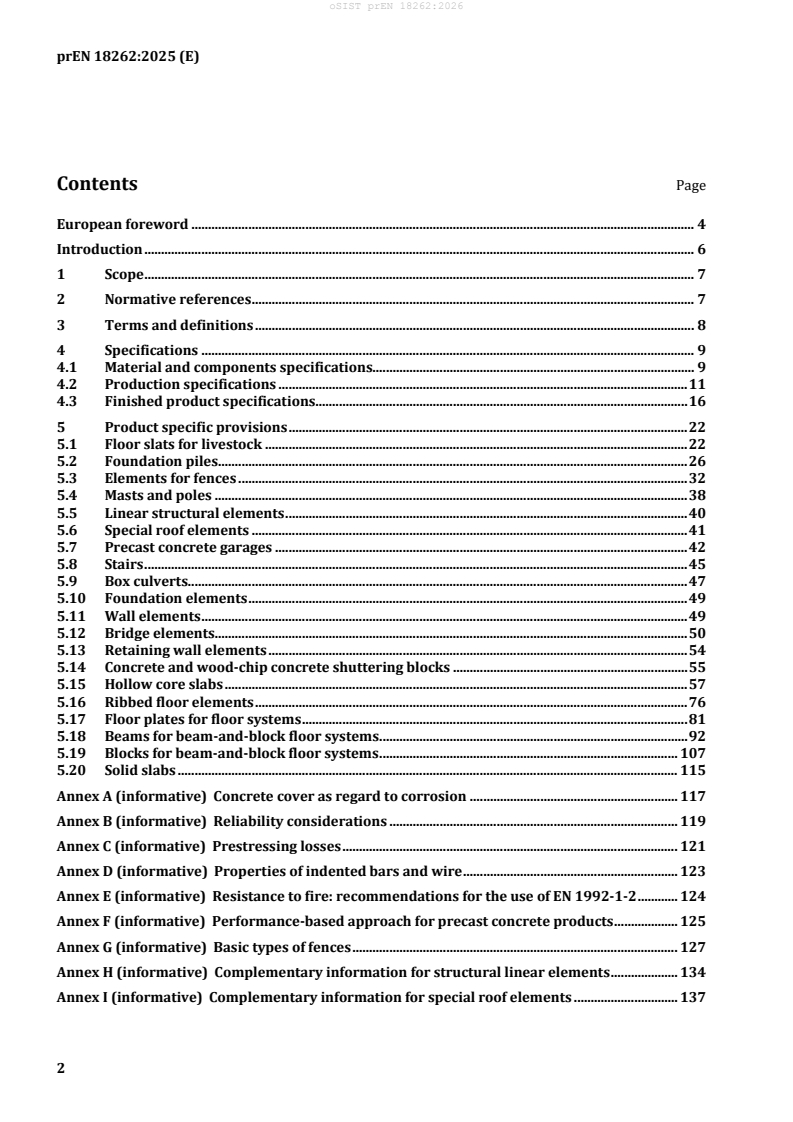
Contents Page
European foreword . 4
Introduction . 6
1 Scope . 7
2 Normative references . 7
3 Terms and definitions . 8
4 Specifications . 9
4.1 Material and components specifications. 9
4.2 Production specifications . 11
4.3 Finished product specifications. 16
5 Product specific provisions . 22
5.1 Floor slats for livestock . 22
5.2 Foundation piles . 26
5.3 Elements for fences . 32
5.4 Masts and poles . 38
5.5 Linear structural elements . 40
5.6 Special roof elements . 41
5.7 Precast concrete garages . 42
5.8 Stairs . 45
5.9 Box culverts. 47
5.10 Foundation elements . 49
5.11 Wall elements . 49
5.12 Bridge elements. 50
5.13 Retaining wall elements . 54
5.14 Concrete and wood-chip concrete shuttering blocks . 55
5.15 Hollow core slabs . 57
5.16 Ribbed floor elements . 76
5.17 Floor plates for floor systems . 81
5.18 Beams for beam-and-block floor systems . 92
5.19 Blocks for beam-and-block floor systems . 107
5.20 Solid slabs . 115
Annex A (informative) Concrete cover as regard to corrosion . 117
Annex B (informative) Reliability considerations . 119
Annex C (informative) Prestressing losses . 121
Annex D (informative) Properties of indented bars and wire . 123
Annex E (informative) Resistance to fire: recommendations for the use of EN 1992-1-2 . 124
Annex F (informative) Performance-based approach for precast concrete products . 125
Annex G (informative) Basic types of fences . 127
Annex H (informative) Complementary information for structural linear elements . 134
Annex I (informative) Complementary information for special roof elements . 137
Annex J (informative) Complementary information for garages . 156
Annex K (informative) Complementary information for stairs . 164
Annex L (informative) Complementary information for box culverts . 174
Annex M (informative) Typical shapes of foundation elements . 177
Annex N (informative) Complementary information for wall elements . 182
Annex O (informative) Complementary information for bridge elements . 187
Annex P (informative) Complementary information for retaining wall elements . 215
Annex Q (informative) Complementary information for shuttering blocks . 222
Annex R (informative) Complementary information for hollow-core slabs . 224
Annex S (informative) Complementary information for ribbed floor elements . 256
Annex T (informative) Complementary information for floor plates for floor systems . 260
Annex U (informative) Complementary information for beam-and-blocks floor systems . 294
Annex V (informative) Complementary information for solid slabs . 331
Bibliography . 332
European foreword
This document (prEN 18262:2025) has been prepared by Technical Committee CEN/TC 229 “Precast
concrete products”, the secretariat of which is held by AFNOR.
This document is currently submitted to the CEN Enquiry.
This document will partially supersede EN 13369:2023, with the addition of product specific normative
and informative provisions related to design and production. These provisions were taken from the
following standards, superseded by harmonised standard prEN 18190:2025:
EN 1168:2005+A3:2011, Precast concrete products – Hollow core slabs
EN 12737:2004+A1:2007, Precast concrete products – Floor slats for livestock
EN 12794:2005+A1:2007, Precast concrete products – Foundation piles
EN 12839:2012, Precast concrete products — Elements for fences
EN 12843:2004, Precast concrete products – Masts and poles
EN 13224:2011, Precast concrete products – Ribbed floor elements
EN 13225:2013, Precast concrete products – Linear structural elements
EN 13693:2004+A1:2009, Precast concrete products – Special roof elements
EN 13747:2005+A2:2010, Precast concrete products – Floor plates for floor systems
EN 13978-1:2005, Precast concrete products – Precast concrete garages
EN 14843:2007, Precast concrete products – Stairs
EN 14844:2006+A2:2011, Precast concrete products – Box culverts
EN 14991:2007, Precast concrete products – Foundation elements
EN 14992:2007+A1:2012, Precast concrete products – Wall elements
EN 15037-1:2008, Precast concrete products – Beam-and-block floor systems – Part 1: Beams
EN 15037-2:2009+A1:2011, Precast concrete products – Beam-and-block floor systems – Part 2: Concrete
blocks
EN 15037-3:2009+A1:2011, Precast concrete products – Beam-and-block floor systems – Part 3: Clay
blocks
EN 15037-4:2010+A1:2013, Precast concrete products – Beam-and-block floor systems – Part 4: Expanded
polystyrene blocks
EN 15037-5:2013, Precast concrete products – Beam-and-block floor systems – Part 5: Lightweight blocks
for simple formwork
EN 15050:2007+A1:2012, Precast concrete products – Bridge elements
EN 15258:2008, Precast concrete products – Retaining wall elements
EN 15435:2008, Precast concrete products — Normal weight and lightweight concrete shuttering blocks
— Product properties and performance
EN 15498:2008, Precast concrete products — Wood-chip concrete shuttering blocks — Product properties
and performance
Introduction
This document is intended to outline the general specifications applicable to a large variety of precast
concrete products manufactured in a factory environment, and also to blocks for beam-and-blocks floor
systems made of other materials. It applies to products covered by prEN 18190:2025 and may be used as
a reference standard for other standards to enable a more consistent approach to standardization in the
field of precast concrete products and to reduce the variations brought about by other standards
produced in parallel by different groups of experts. At the same time, it allows those experts the flexibility
to include variations in specific product standards where they are required.
This document has been produced as part of the total CEN programme for construction and refers to the
relevant specifications of associated standards EN 206 for concrete and the EN 1992 series for the design
of concrete structures. The installation of some precast concrete products is dealt with by EN 13670.
As it is not a harmonized standard, it is not allowed to be used on its own for the purpose of CE marking
of precast concrete products.
The design of precast concrete products should be verified to ensure the fitness of their properties for
the particular application, particular attention being paid to design co-ordination with other parts of the
construction.
1 Scope
This document provides specifications for the production of unreinforced, reinforced and prestressed
precast concrete products protected from adverse weather conditions during production, and made of
compact light-, normal- and heavyweight concrete according to EN 206 with no appreciable amount of
entrapped air other than entrained air. Concrete containing fibres for other than mechanical properties
(steel, polymer or other fibres) is also covered.
This document also covers clay, EPS, and lightweight formwork blocks for beam-and-blocks floor
systems.
It does not cover precast reinforced components of lightweight aggregate concrete with open structure
nor glassfibre reinforced concrete.
It can also be used to specify products for which there is no standard.
2 Normative references
The following documents are referred to in the text in such a way that some or all of their content
constitutes requirements of this document. For dated references, only the edition cited applies. For
undated references, the latest edition of the referenced document (including any amendments) applies.
EN 206:2013+A2:2021, Concrete — Specification, performance, production and conformity
EN 1990:2002 , Eurocode — Basis of structural design
EN 1991-1-2:2002 , Eurocode 1: Actions on structures — Part 1-2: General actions — Actions on structures
exposed to fire
EN 1991-1-6:2005 , Eurocode 1: Actions on structures — Part 1-6: General actions — Actions during
execution
EN 1992-1-1:2004 , Eurocode 2: Design of concrete structures — Part 1-1: General rules and rules for
buildings
EN 1992-2:2005 , Eurocode 2 — Design of concrete structures — Part 2: Concrete bridges — Design and
detailing rules
EN 1997-1:2004 , Eurocode 7 - Geotechnical design - Part 1: General rules
EN 10080, Steel for the reinforcement of concrete - Weldable reinforcing steel - General
EN 12504-1, Testing concrete in structures — Part 1: Cored specimens — Taking, examining and testing in
compression
EN 13162, Thermal insulation products for buildings - Factory made mineral wool (MW) products -
Specification
As impacted by EN 1990:2002/A1:2005 and EN 1990:2002/AC:2010
As impacted by EN 1991-1-2:2002/AC:2013
As impacted by EN 1991-1-6:2005/AC:2013
As impacted by EN 1992-1-1:2004/A1:2014
As impacted by EN 1992-2:2005/AC:2008
As impacted by EN 1997-1:2004/A1:2013.
EN 13163, Thermal insulation products for buildings - Factory made expanded polystyrene (EPS) products
- Specification
EN 13164, Thermal insulation products for buildings - Factory made extruded polystyrene foam (XPS)
products - Specification
EN 13165, Thermal insulation products for buildings - Factory made rigid polyurethane foam (PU) products
- Specification
EN 13166, Thermal insulation products for buildings - Factory made phenolic foam (PF) products -
Specification
EN 13167, Thermal insulation products for buildings - Factory made cellular glass (CG) products -
Specification
EN 13168, Thermal insulation products for buildings - Factory made wood wool (WW) products -
Specification
EN 13169, Thermal insulation products for buildings - Factory made expanded perlite board (EPB) products
- Specification
EN 13170, Thermal insulation products for buildings - Factory made products of expanded cork (ICB) -
Specification
EN 13171, Thermal insulation products for buildings - Factory made wood fibre (WF) products -
Specification
EN 14474, Precast concrete products — Concrete with wood-chips as aggregate — Requirements and test
methods
prEN 18190:2025, Precast concrete products — Performance assessment and declaration
EN ISO 7500-1, Metallic materials - Calibration and verification of static uniaxial testing machines - Part 1:
Tension/compression testing machines - Calibration and verification of the force-measuring system (ISO
7500-1
EN ISO 15630-3, Steel for the reinforcement and prestressing of concrete - Test methods - Part 3:
Prestressing steel (ISO 15630-3)
3 Terms and definitions
For the purposes of this document, the terms and definitions given in prEN 18190:2025 and the following
apply.
ISO and IEC maintain terminology databases for use in standardization at the following addresses:
— ISO Online browsing platform: available at https://www.iso.org/obp/
— IEC Electropedia: available at https://www.electropedia.org/
3.1
reclaimed crushed aggregate
aggregate gained by crushing hardened concrete that has not been previously used in construction
[SOURCE: EN 206:2013+A2:2021]
3.2
recycled aggregate
aggregate resulting from the processing of inorganic material previously used in construction
[SOURCE: EN 206:2013+A2:2021]
3.3
design working life
assumed period for which a structure or part of it is to be used for its intended purpose with anticipated
maintenance but without major repair being necessary
3.4
environmental conditions
physical or chemical impacts to which the precast concrete product is exposed and which result in effects
on the concrete or reinforcement or embedded metal that are not considered as loads in structural design
3.5
minor floor element
ribbed precast floor elements having limited dimensions
3.6
free-standing garage
garage with the floor level being situated maximum 0,5 m below the surrounding soil
4 Specifications
4.1 Material and components specifications
4.1.1 General
Only materials with established suitability shall be used.
For a particular material, the establishment of suitability may be based on a European Standard which
refers specifically to the use of this material in concrete or in precast concrete products; in absence of a
European Standard, it may also result, under the same conditions, from an ISO Standard.
Where this material is not covered by a European or ISO Standard, or if it deviates from the specifications
of these standards, the establishment of suitability may be based on:
— the provisions valid in the place of use of the precast concrete product which refer specifically to the
use of this material in concrete or in precast concrete products; or
— a European Technical Assessment specifically for the use of this material in concrete or precast
concrete products.
4.1.2 Constituent materials of concrete
4.1.2.1 General
EN 206:2013+A2:2021, 5.1 shall apply. When relevant, the following additional provisions may be used.
4.1.2.2 Reclaimed crushed aggregates and recycled coarse aggregates
General
Reclaimed crushed aggregates and recycled aggregates to be used for concrete, mixed with or without
natural aggregates, shall not adversely alter the rate of setting and hardening of concrete, nor shall it be
detrimental to the durability of the precast concrete product in the end-use conditions.
NOTE Other provisions valid in the place of use can apply.
Reclaimed aggregates
Reclaimed aggregates may be used for concrete provided it is only used internally by the manufacturer.
They shall not be added in quantities greater than 5 % by mass of the total aggregate if they aren’t
properly separated in function of their particle size.
Reclaimed aggregates may be used up to 20 % as coarse aggregates and up to 10 % as fine aggregates
provided that:
a) they come from a concrete with strength class at least equal to the required strength class of the new
concrete product;
b) they are properly separated in function of their particle size;
c) they are stored and handled so that their properties do not change significantly and are not subject
to contamination.
Reclaimed aggregates used in higher percentages shall be treated as recycled aggregates.
Recycled aggregates
Fine recycled aggregates coming from an external source shall not be used.
Coarse recycled aggregates may be used following the recommendations given in EN 206:2013+A2:2021,
E.3.
4.1.3 Reinforcing steel
4.1.3.1 Bars, coils and welded fabric
Characteristics of reinforcing steel (bars, coils and welded fabric) can be found in EN 1992-1-1:2004 ,
3.2.
They should be determined using EN 10080.
These characteristics may also be determined according to European Technical Assessments or
provisions valid in the place of use of the product.
NOTE 1 Recommendations on indented bars and wires are given in Annex D.
NOTE 2 Other provisions valid in the place of use can apply.
4.1.3.2 Lattice girders
Bars and coils used in production of lattice girder shall comply with EN 10080.
The weld strength or the mechanical strength of joints of lattice girder shall match the anchorage
requirements in the concrete.
NOTE Other provisions valid in the place of use can apply.
4.1.4 Prestressing steel
Characteristics of prestressing steel (wire, bars and strand) can be found in EN 1992-1-1:2004 , 3.3.
They should be determined using EN ISO 15630-3.
These characteristics may also be determined according to European Technical Assessments or
provisions valid in the place of use of the product.
4.1.5 Inserts and connectors
Mechanical inserts and connectors shall:
a) resist the design actions;
b) have the necessary ductility.
Permanent connecting parts and fasteners shall maintain these properties for the design working life of
the precast concrete product.
Provisions valid in the place of use of the product shall be taken into account.
NOTE Recommendations for the design of some fastenings can be found in EN 1992-4:2018; recommendations
for the design of lifting and handling devices can be found in CEN/TR 15728:2016 and verification method in
EN 13155:2020. When independently placed on the market, lifting devices are covered by Directive 2006/42/EC.
4.2 Production specifications
4.2.1 Concrete production
4.2.1.1 General
For concrete composition, resistance to alkali-silica reaction, chloride content, air content and concrete
temperature, EN 206:2013+A2:2021, 5.2 and 5.3 shall apply.
For specification of concrete EN 206:2013+A2:2021 shall apply. When concrete is specified by the
manufacturer, basic requirements (EN 206:2013+A2:2021, 6.2.2) are given in the design documentation
and additional specifications (EN 206:2013+A2:2021, 6.2.3) are included only when relevant.
Characteristics related to the concrete casting are not relevant for precast concrete elements.
4.2.1.2 Placing and compaction of concrete
Concrete shall be placed and compacted so as to retain no appreciable amount of entrapped air other
than entrained air (e.g. to achieve sufficient frost resistance) to avoid detrimental segregation and to
ensure the proper embedding of the reinforcement.
4.2.1.3 Curing (protection against drying out)
The concrete shall be protected during curing so that loss in strength and cracking due to temperature
and shrinkage and that, if relevant, detrimental effects on durability, are avoided.
All surfaces of newly cast concrete may be protected by one of the methods listed in Table 1 or by any
other method applicable in the place of use, unless it is shown by tests and inspection on the finished
product or on representative samples, that other means are relevant in the production environment.
Table 1 — Protection against drying out
Method Typical means of protection
A - Without addition of — keeping the concrete in an environment with a relative humidity
water above 65 % for CEM I and CEM II/A, above 75 % for all the other types of
binders;
— keeping the formwork in place;
— covering the concrete surface with vapour-resistant sheets
B - Keep the concrete — maintaining wet coverings on the concrete surface;
moist by addition of water
— keeping the concrete surface visibly wet by spraying with water
C – Use of curing Curing compounds used shall conform to provisions valid in the place of
compounds use
Other means than those defined in Table 1 may be employed if the value of the water absorption of the
concrete, measured according to the test procedure defined in prEN 18190:2025, Annex F, does not
exceed 10 % (in relative proportion) of the value of water absorption of the concrete complying with the
specifications in Table 2. The water absorption test is run on (30 ± 1) mm thick samples that include the
surface exposed to the environment.
For methods A and B, the protection shall be maintained until the compressive strength at the end of
curing f related to the surface zone is equal to or greater than the value defined in Table 2 for the
c,cure
corresponding exposure class on the place of use.
NOTE Curing requirements can be subject to other provisions valid in the place of use.
For design working life of more than 50 years, or for specific local environmental conditions, other values
may be given following the provisions valid in the place of use.
The measure of the mean compressive strength f shall be done on concrete samples that are
c,cure
submitted to the same protection against drying out as the product.
The degree of hardening in Table 2 may either be measured by testing a concrete sample or estimated by
calculation using a hardening law based on initial type testing or the maturity concept.
The test result shall be obtained from an individual specimen or the average of the results when two or
more specimens made from one sample are tested at the same age.
Table 2 — Minimum f at the end of protection against drying out
c,cure
Compressive strength Exposure class on the place of use
class
X0, XC1 XC2, XC3, XC4, XD1, XD3, XS2, XS3, XF2,
XD2, XF1, XS1 XF3, XF4, XA1, XA2,
XA3
a b c c
C20/25, C25/30,
12 /15 35 % of f 60 % of f
ck ck
C30/37
a b
C35/45, C40/50,
20 /25
C45/55, C50/60,
C55/67
c
C60/75, C70/85,
35 % of f
ck
C80/95, C90/105,
C100/115
a
cylinder.
b
cube.
c
f characteristic compressive strength of the concrete at the age of 28 days targeted by the manufacturer.
ck
4.2.1.4 Accelerated hydration by heat treatment
Where heat treatment at atmospheric pressure is applied to concrete during production in order to
accelerate its hardening, it shall be demonstrated by initial testing that the required strength is achieved
for each concrete family concerned.
— Depending on material and climatic conditions, more restricting specifications may apply to the
heat treatment of outdoor products in certain areas according to provisions valid in the place of use. The
following conditions shall be fulfilled when the maximum mean temperature T within the concrete
mean
exceeds 40 °C during the curing process unless previous positive experience has shown that special
measures are not necessary to avoid micro cracking and/or durability defects: a preheating period shall
be applied during which T does not exceeds 40 °C;
mean
— the temperature difference between adjacent parts of the product during the heating and the
cooling phases shall be limited to 20 °C.
The duration and heating rate of the full heating and cooling period (if appropriate) shall be documented.
During the full heating and cooling period T shall be limited to the values of Table 3. However higher
mean
temperatures may be accepted provided the durability of concrete under the specified environment is
demonstrated by long term positive experience.
Table 3 — Conditions for accelerated hydration
a
Product environments
Maximum mean concrete temperature T
mean
b
Predominantly dry or moderate
— T ≤ 85 °C
mean
humidity
Wet and cyclic wet — T ≤ 65 °C
mean
a
Individual values may be 5 °C higher.
b
When 70 °C < T ≤ 85 °C initial tests shall have demonstrated that the structural strength at 90 days
mean
corresponds with normal evolution of hardening with respect to the structural strength obtained at 28 days.
For wet and cyclic wet environments, in case of no long-term positive experience, the suitability of the
higher temperature treatment shall be demonstrated; the following limits may be a basis for this
demonstration: for concrete: Na O content ≤ 3,5 kg/m , for cement SO content ≤ 3,5 % by mass.
2 eq 3
The above limits for Na O and SO content may be changed in value, or limits on other constituents may
2 eq 3
be put, according to the results of scientific or technical experience.
4.2.2 Hardened concrete
4.2.2.1 Compressive strength
The compressive strength to verify the strength class of concrete is defined by the potential strength; the
manufacturer may use direct structural strength or indirect structural strength to confirm it. For the
determination of compressive strength, prEN 18190:2025 shall apply. For the statistical methods to be
used, EN 206:2013+A2:2021, 8.2.1.3 shall apply.
Tests of compressive strength may be performed before 28 days in order to evaluate the progression of
compressive strength or to estimate at early age the compressive strength at 28 days by an appropriate
hardening law. When relevant, tests may be performed at an age greater than 28 days.
The relation between the structural strength and the potential strength is established by dividing the
structural strength by η = 0,85.
NOTE The value of 0,85 is the recommended value of conversion factor ƞ given in EN 1992-1-1:2004 , A.2.3.
4.2.2.2 Tensile strength
When used for the calculation of the mechanical resistance, the tensile strength should be determined
according to EN 1992-1-1:2004 , 3.1.2 based on one of the following methods:
— by axial tensile strength test;
— by flexural strength test according to EN 12390-5:2019 at the same age;
— from the compressive strength according to EN 12390-3:2019 at the same age;
— from the splitting tensile strength according to EN 12390-6:2023 at the same age.
4.2.3 Structural reinforcement
4.2.3.1 Processing of reinforcing steel
Reinforcing steel for structural purposes that is straightened, bent or welded in the factory shall remain
in compliance with 4.1.3 after this treatment.
Welded connection of reinforcing bars may only be used when the weldability of the steel is established
and documented.
Indications on welding process can be found in EN 1992-1-1:2004 , 3.2.5.
4.2.3.2 Tensioning and prestressing
General
The following provisions apply only to prestressing by pre-tensioning. For post-tensioning during
manufacturing or on site, EN 13670:2009 applies.
Initial tensioning stresses
The maximum prestressing force applied to a unit immediately after release of tendons shall satisfy the
following conditions:
— absence of uncontrolled longitudinal cracking, spalling or bursting of the concrete;
— the stress in the concrete does not lead to excessive creep or deformation of the product.
When compliance of the product with the relevant specifications of the product standard is demonstrated
by initial type testing and factory production control and the tightened tolerances of 4.2.3.2.3 are met,
the maximum value of tensioning stress σ can be taken as in Formula (1):
Pmax
σ = min(0,85 f or 0,95 f ) category 1 (1)
Pmax pk p0,1k
If the conditions mentioned in the previous paragraph are not met, EN 1992-1-1:2004 , 5.10.2.1, shall
apply as according to Formula (2):
σ = min(0,80 f or 0,90 f ) category 2 (2)
Pmax pk p0,1k
NOTE The values of 0,8 and 0,9 are the recommended values in EN 1992-1-1:2004 , 5.10.2.1.
Accuracy of tensioning
If category 1 according to 4.2.3.2.2 is applied, tightened tolerances on the prestressing force shall be
applied with an accuracy of:
— single tendon/force: ±5 %.
If category 2 according to 4.2.3.2.2 is applied, normal tolerances on the prestressing force shall be applied
with an accuracy of:
— single tendon/force: ±10 %;
— total force: ±5 %.
Minimum concrete strength at transfer
At transfer of the prestressing force, the concrete shall have a minimum strength f of 1,5 times the
cm,p
maximum compressive stress in the concrete and not less than 20 MPa (cylinder strength).
The specifications according to EN 1992-1-1:2004 , 5.10.2.2 (5) shall be considered.
In any case the strength shall be adequate for the anchorage of the strands.
Slippage of tendons
Slippage, which is the shortening of the tendon at each end of the element after transfer of the prestress
force, shall be limited to the following values:
— for individual tendons (strands or wires): 1,3 ΔL ;
— for the mean value of all tendons on one end of an element: ΔL .
For strands the average value of three circumferentially positioned wires shall be taken into account.
The value of ΔL , in millimetres, shall be calculated according to Formula (3):
𝜎𝜎
𝑝𝑝𝑝𝑝𝑝𝑝
𝛥𝛥𝐿𝐿 = 0,4𝑙𝑙 (3)
0 𝑝𝑝𝑝𝑝2
𝐸𝐸
𝑝𝑝
where
l is the upper bound value of transmission length = 1,2 l , in mm according to
pt2 pt
EN 1992-1-1:2004 , 8.10.2.2;
σ is the initial stress in the prestressing steel immediately after release, in MPa;
pm0
E is the modulus of elasticity of the prestressing steel, in MPa.
p
In general, slippage of tendons is measured except for products prestressed one by one in individual
moulds. On sawn products, visual inspection alone may indicate no slippage, and no further measurement
is required.
“Good” bond conditions may be assumed for extruded, slip-formed and cast elements on conditions given
in EN 1992-1-1:2004 , Figure 8.2.
4.3 Finished product specifications
4.3.1 Geometrical properties
4.3.1.1 Production tolerances
Recommendations for maximum deviations of cross-sectional dimensions [width (Δb) and height (Δh)],
and for maximum deviation of concrete cover (Δc /Δc ) to bars, wires and strands are given in
(plus) (minus)
Table 4.
Table 4 — Deviations of cross-sectional dimensions
Dimensions in mm
a b
a
Target dimension Concrete cover Δc /
Deviation Δb, Δh
(plus)
of the cross-section
Δc
(minus)
b or h ≤ 150 +10/−5 +5/-5
b or h = 400 +15/−10 +15/−10
b or h ≥ 2 500 ±30 +25/−10
a
Linear interpolation for intermediate values.
b
With |Δc | ≤ |Δc |; according to EN 1992-1-1:2004 , 4.4.1.1 and as shown in Figure 1:
(minus) dev
c = c +Δc . The allowance in design for deviation Δc is a Nationally Determined Parameter;
nom min dev dev
hence other values may be valid in the place of use. Where permitted, a manufacturer may declare
smaller values for Δc than given in the National Annex by taking the appropriate measures.
dev
a) negative deviation
b) positive deviation
Key
A drawing Δc allowance in design for deviation
dev
B actual product Δc actual deviation of concrete cover
c actual cover Δc maximum deviation for negative values
(minus)
c nominal cover Δc maximum deviation for positive values
nom (plus)
c required minimum cover
min
Figure 1 — Concrete cover
The structural design of the works shall take into account the tolerances on the supports as specified in
the structural design for the works.
EN 1992-1-1:2004 , 10.9.5.2 may be used as guidance to determine the assumed ineffective distances
from the edge of the support and from the end of the precast concrete product.
For slabs and beams, the average deviation of concrete cover may be determined as the mean deviation
of the individual bars, wires or strands in a beam cross-section or over a maximum width of 1 m in a slab.
No single bar, wire or strand shall exceed the recommended negative deviation.
NOTE Guidance on concrete cover can be found in Annex A.
Production tolerances of geometrical properties may be determined by measurements according to
prEN 18190:2025, Annex E.
a) Recommendations for maximum deviations on length
Formula (4) gives the recommended maximum deviation on length:
𝐿𝐿
𝛥𝛥𝑙𝑙 = ±�10 + �≤ ±40 𝑚𝑚𝑚𝑚 (4)
where
L is the nominal length in millimetres.
b) Recommendations for maximum deviations on holes, openings, steel plates, inserts, etc.
1) size of hole or opening ± 10 mm.
2) location of holes, openings, steel plates, inserts, etc. ± 25 mm.
4.3.1.2 Minimum dimensions and detailing
The geometrical characteristics of precast concrete products shall comply with the required minimum
dimensions and detailing.
The values of the minimum dimensions and detailing shall be based on the nominal dimensions and may
be taken from EN 1992-1-1:2004 , 7, 8, 9, 10 and 11.
4.3.1.3 Surface characteristics
For the specification of the surface characteristics of a finished product, reference should be made to
prEN 18190:2025, Annex E.
For identification of concrete finishes, CEN/TR 15739:2008 may be used.
For surfaces for shear at the interface (e.g. the interface between the precast element and cast-on-site
concrete) EN 1992-1-1:2004 , 6.2.5 applies.
4.3.2 Mechanical resistance
4.3.2.1 General
All relevant structural properties of the product shall be considered in both ultimate and serviceability
limit states.
For prestressing losses, reference may be made to Annex C, in cases specified in that annex.
4.3.2.2 Safety factors
1 5
Recommended values for partial safety factors can be found in EN 1990:2002 and EN 1992-1-1:2004 .
These standards also permit lower values under certain conditions. Annex B provides such information.
4.3.2.3 Transient situations
The following transient situations shall be considered:
— demoulding;
— transport to the storage yards;
— storage (support and load conditions);
— transport to site;
— erection (lifting);
— construction (assembly).
When relevant for the type of element, for transient situations a nominal transverse horizontal force to
cover out of plane effects due to dynamic actions or verticality deviations shall be considered. This may
be taken as 1,5 % of the self-weight of the element.
4.3.3 Resistance to fire
4.3.3.1 General
The following provisions apply to products which are not covered by prEN 18190:2025.
Resistance to fire shall be determined when relevant to the intended use of the product.
Recommendations related to the use of EN 1992-1-2:2004 are given in Annex E.
NOTE The required class for standard fire resistance, or alternatively resistance to parametric fire, depends on
the national fire regulations.
4.3.3.2 Classification for standard fire resistance
For the verification of standard fire resistance one of the following methods can be chosen.
a) Classification by testing
Tests previously performed in accordance with the specifications of EN 13501-2:2023 (i.e. same product,
same or more demanding test method) may be taken into account.
The validity of test results can be extended to other spans, cross-sections and loads by appropriate
calculation methods (see e.g. c) below).
b) Classification by tabulated data
Tabulated data can be found in EN 1992-1-2:2004 . When applicable complementary rules can be given
in product standards.
c) Classification by calculation
For classification based on calculation methods, the relevant clauses of EN 1992-1-2:2004 or the rules
valid in the place of use apply. When applicable, complementary rules can be given in product standards.
4.3.3.3 Verification of resistance to parametric fire
Actions due to parametric fire shall be as given in EN 1991-1-2:2002 . Resistance to parametric fire may
be verified either by calculation methods in accordance with EN 1992-1-2:2004 , or by testing.
Complementary information can be found in J.3 for garages.
4.3.4 Durability
4.3.4.1 Durability specifications
The following specifications refer to concrete structural products with a design working life consistent
with EN 1992-1-1:2004 .
The durability of precast concrete products is ensured by the following specifications as relevant:
— adequate content of cement and additions (see 4.2.1.1);
— maximum water/binder ratio (see 4.2.1.1);
— maximum chloride content (see 4.2.1.1);
— maximum alkali content (see 4.2.1.1);
— protection of newly cast concrete against drying out (see 4.2.1.3);
— minimum concrete strength (see 4.2.2.1);
— minimum concrete cover and concrete quality of cover (see 4.3.1.1 and Annex A);
and, where applicable:
— air content (see 4.2.1.1);
— adequate hydration by heat treatment (see 4.2.1.4);
— specific provisions to ensure surface integrity of finished product (see 4.3.4.2);
— water absorption.
A performance-based approach can be used as an alternative approach to ensure durability (see
Annex F).
Durability specifications can be found in EN 1992-1-1:2004 , 4.2.
NOTE Nationally Determined Parameters can apply for the durability specifications.
In case of non-structural concrete products or when the design working life of the concrete product is
shorter or longer than the corresponding value in EN 1992-1-1:2004 , the durability specifications may
be adapted to the specific field of application of the product.
4.3.4.2 Surface integ
...