


EN 15528:2015
(Main)Railway applications - Line categories for managing the interface between load limits of vehicles and infrastructure
General Information
- Abstract
This European Standard describes methods of classification of existing and new railway lines and the categorization of vehicles. The standard specifies the technical requirements for ensuring the compatibility of the interface between a vehicle and infrastructure with respect to the vertical load carrying capacity of a line. The standard is suitable for use on freight, passenger and mixed traffic lines with standard track gauge and wider than standard track gauge. It contains requirements relevant to:
- classification of the vertical load carrying capacity of railway infrastructure;
- design of railway vehicles;
- determination of payload limits of freight wagons.
A summary of the classification of infrastructure and the categorization of vehicles is given in Annex B.
The assessment of the vertical load carrying capacity of civil engineering structures, track, sub-grade and earthworks by the use of the load models defined in Annex A permits the classification of infrastructure into line categories.
This European Standard identifies on which lines vehicles are compatible to the infrastructure for regular traffic regarding vertical load effects.
Line categories are provided for:
- all traffic types;
- heavy freight traffic;
- locomotives;
- multiple units;
- lightweight passenger traffic.
Mobile railway infrastructure construction and maintenance equipment (e.g. rail mounted plant, cranes) in working mode and portable trolleys as defined by EN 13977 are outside the scope of this European Standard.
This European Standard does not cover the system used in Great Britain, where all lines and vehicles are classified in accordance with the RA (Route Availability) System. A guide to the equivalent categories in accordance with this European Standard is given in Annex Q.
This European Standard does not cover requirements relating to the maximum total mass or maximum length of a train.
The requirements of this European Standard do not replace any regulations related to running behaviour of vehicles described by the assessment quantities for running safety, track loading and ride characteristics (see EN 14363).
This Standard does not impose any requirements to vehicles or infrastructure, but gives guidance to a simplified management of the interface between vehicles and infrastructure.
Publication of line categories is outside the scope of this European Standard.
- Status
- Withdrawn
- Publication Date
- 27-Oct-2015
- Withdrawal Date
- 22-Sep-2026
- Technical Committee
- CEN/TC 256 - Railway applications
- Drafting Committee
- CEN/TC 256/WG 10 - Vehicle/Track Interaction
- Current Stage
- 9960 - Withdrawal effective - Withdrawal
- Start Date
- 01-Dec-2021
- Completion Date
- 23-Sep-2026
- Directive
- Not Harmonized2008/57/EC - DIRECTIVE 2008/57/EC OF THE EUROPEAN PARLIAMENT AND OF THE COUNCIL of 17 June 2008 on the interoperability of the rail system within the Community (Recast)OJ Ref: C 249/04 OJ Date: 08-Jul-2016



Relations
- Effective Date
- 11-Nov-2015
- Effective Date
- 08-Dec-2021
- Refers
EN 15877-1:2024 - Railway applications - Markings of railway vehicles - Part 1: Freight wagons - Effective Date
- 28-Jan-2026
- Effective Date
- 28-Jan-2026
- Effective Date
- 28-Jan-2026
- Effective Date
- 28-Jan-2026
- Effective Date
- 15-Aug-2012
Get Certified
Connect with accredited certification bodies for this standard

IRIS Certification (UNIFE)
International Railway Industry Standard certification.

TÜV SÜD Rail GmbH
TÜV SÜD railway certification services.

Bureau Veritas Railway Certification
Railway and transportation certification.
Sponsored listings
Frequently Asked Questions
EN 15528:2015 is a standard published by the European Committee for Standardization (CEN). Its full title is "Railway applications - Line categories for managing the interface between load limits of vehicles and infrastructure". This standard covers: This European Standard describes methods of classification of existing and new railway lines and the categorization of vehicles. The standard specifies the technical requirements for ensuring the compatibility of the interface between a vehicle and infrastructure with respect to the vertical load carrying capacity of a line. The standard is suitable for use on freight, passenger and mixed traffic lines with standard track gauge and wider than standard track gauge. It contains requirements relevant to: - classification of the vertical load carrying capacity of railway infrastructure; - design of railway vehicles; - determination of payload limits of freight wagons. A summary of the classification of infrastructure and the categorization of vehicles is given in Annex B. The assessment of the vertical load carrying capacity of civil engineering structures, track, sub-grade and earthworks by the use of the load models defined in Annex A permits the classification of infrastructure into line categories. This European Standard identifies on which lines vehicles are compatible to the infrastructure for regular traffic regarding vertical load effects. Line categories are provided for: - all traffic types; - heavy freight traffic; - locomotives; - multiple units; - lightweight passenger traffic. Mobile railway infrastructure construction and maintenance equipment (e.g. rail mounted plant, cranes) in working mode and portable trolleys as defined by EN 13977 are outside the scope of this European Standard. This European Standard does not cover the system used in Great Britain, where all lines and vehicles are classified in accordance with the RA (Route Availability) System. A guide to the equivalent categories in accordance with this European Standard is given in Annex Q. This European Standard does not cover requirements relating to the maximum total mass or maximum length of a train. The requirements of this European Standard do not replace any regulations related to running behaviour of vehicles described by the assessment quantities for running safety, track loading and ride characteristics (see EN 14363). This Standard does not impose any requirements to vehicles or infrastructure, but gives guidance to a simplified management of the interface between vehicles and infrastructure. Publication of line categories is outside the scope of this European Standard.
This European Standard describes methods of classification of existing and new railway lines and the categorization of vehicles. The standard specifies the technical requirements for ensuring the compatibility of the interface between a vehicle and infrastructure with respect to the vertical load carrying capacity of a line. The standard is suitable for use on freight, passenger and mixed traffic lines with standard track gauge and wider than standard track gauge. It contains requirements relevant to: - classification of the vertical load carrying capacity of railway infrastructure; - design of railway vehicles; - determination of payload limits of freight wagons. A summary of the classification of infrastructure and the categorization of vehicles is given in Annex B. The assessment of the vertical load carrying capacity of civil engineering structures, track, sub-grade and earthworks by the use of the load models defined in Annex A permits the classification of infrastructure into line categories. This European Standard identifies on which lines vehicles are compatible to the infrastructure for regular traffic regarding vertical load effects. Line categories are provided for: - all traffic types; - heavy freight traffic; - locomotives; - multiple units; - lightweight passenger traffic. Mobile railway infrastructure construction and maintenance equipment (e.g. rail mounted plant, cranes) in working mode and portable trolleys as defined by EN 13977 are outside the scope of this European Standard. This European Standard does not cover the system used in Great Britain, where all lines and vehicles are classified in accordance with the RA (Route Availability) System. A guide to the equivalent categories in accordance with this European Standard is given in Annex Q. This European Standard does not cover requirements relating to the maximum total mass or maximum length of a train. The requirements of this European Standard do not replace any regulations related to running behaviour of vehicles described by the assessment quantities for running safety, track loading and ride characteristics (see EN 14363). This Standard does not impose any requirements to vehicles or infrastructure, but gives guidance to a simplified management of the interface between vehicles and infrastructure. Publication of line categories is outside the scope of this European Standard.
EN 15528:2015 is classified under the following ICS (International Classification for Standards) categories: 03.220.30 - Transport by rail; 45.060.20 - Trailing stock. The ICS classification helps identify the subject area and facilitates finding related standards.
EN 15528:2015 has the following relationships with other standards: It is inter standard links to EN 15528:2008+A1:2012, EN 15528:2021, EN 15877-1:2024, EN 15663:2009, EN 1991-2:2003, EN 15746-3:2020, EN 15528:2008. Understanding these relationships helps ensure you are using the most current and applicable version of the standard.
EN 15528:2015 is associated with the following European legislation: EU Directives/Regulations: 2008/57/EC; Standardization Mandates: M/483. When a standard is cited in the Official Journal of the European Union, products manufactured in conformity with it benefit from a presumption of conformity with the essential requirements of the corresponding EU directive or regulation.
EN 15528:2015 is available in PDF format for immediate download after purchase. The document can be added to your cart and obtained through the secure checkout process. Digital delivery ensures instant access to the complete standard document.
Standards Content (Sample)
2003-01.Slovenski inštitut za standardizacijo. Razmnoževanje celote ali delov tega standarda ni dovoljeno.Železniške naprave - Kategorizacija prog za upravljanje vmesnika med dopustnimi obremenitvami vozil in infrastrukturoBahnanwendungen - Streckenklassen zur Bewerkstelligung der Schnittstelle zwischen Lastgrenzen der Fahrzeuge und InfrastrukturApplications ferroviaires - Catégories de ligne pour la gestion des interfaces entre limites de charges des véhicules et de l'infrastructureRailway applications - Line categories for managing the interface between load limits of vehicles and infrastructure45.060.01Železniška vozila na splošnoRailway rolling stock in general03.220.30Železniški transportTransport by railICS:Ta slovenski standard je istoveten z:EN 15528:2015SIST EN 15528:2016en,fr,de01-januar-2016SIST EN 15528:2016SLOVENSKI
STANDARDSIST EN 15528:2008+A1:20141DGRPHãþD
EUROPEAN STANDARD NORME EUROPÉENNE EUROPÄISCHE NORM
EN 15528
October
t r s w ICS
r uä t t rä u râ
v wä r x rä t r Supersedes EN
s w w t zã t r r z ªA sã t r s tEnglish Version
Railway applications æ Line categories for managing the interface between load limits of vehicles and infrastructure Applications ferroviaires æ Catégories de ligne pour la gestion des interfaces entre limites de charges des véhicules et de l 5infrastructure
Bahnanwendungen æ Streckenklassen zur Behandlung der Schnittstelle zwischen Lastgrenzen der Fahrzeuge und Infrastruktur This European Standard was approved by CEN on
t t August
t r s wä
egulations which stipulate the conditions for giving this European Standard the status of a national standard without any alterationä Upætoædate lists and bibliographical references concerning such national standards may be obtained on application to the CENæCENELEC Management Centre or to any CEN memberä
translation under the responsibility of a CEN member into its own language and notified to the CENæCENELEC Management Centre has the same status as the official versionsä
CEN members are the national standards bodies of Austriaá Belgiumá Bulgariaá Croatiaá Cyprusá Czech Republicá Denmarká Estoniaá Finlandá Former Yugoslav Republic of Macedoniaá Franceá Germanyá Greeceá Hungaryá Icelandá Irelandá Italyá Latviaá Lithuaniaá Luxembourgá Maltaá Netherlandsá Norwayá Polandá Portugalá Romaniaá Slovakiaá Sloveniaá Spainá Swedená Switzerlandá Turkey and United Kingdomä
EUROPEAN COMMITTEE FOR STANDARDIZATION COMITÉ EUROPÉEN DE NORMALISATION EUROPÄISCHES KOMITEE FÜR NORMUNG
CEN-CENELEC Management Centre:
Avenue Marnix 17,
B-1000 Brussels
t r s w CEN All rights of exploitation in any form and by any means reserved worldwide for CEN national Membersä Refä Noä EN
s w w t zã t r s w ESIST EN 15528:2016
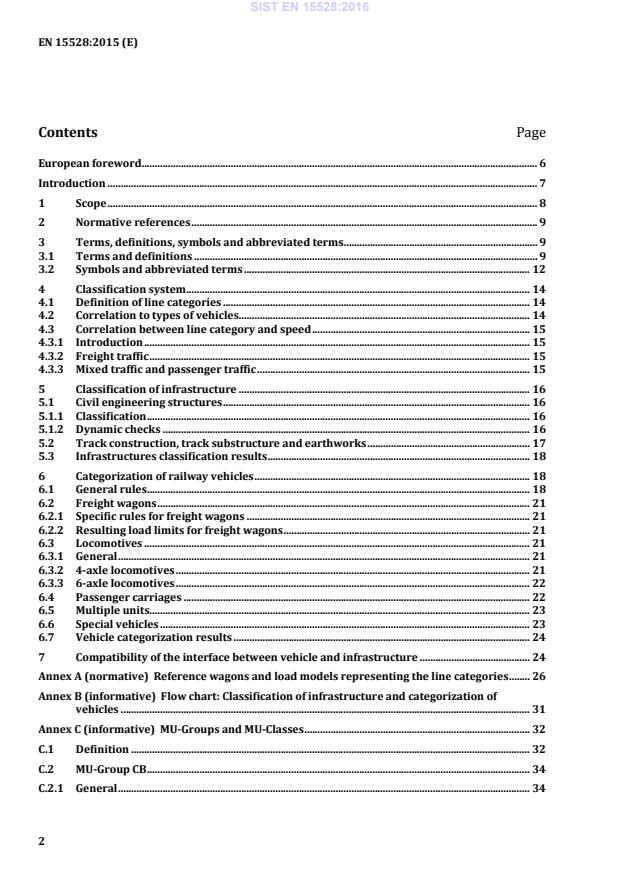
Reference wagons and load models representing the line categories . 26 Annex B (informative)
Flow chart: Classification of infrastructure and categorization of vehicles . 31 Annex C (informative)
MU-Groups and MU-Classes . 32 C.1 Definition . 32 C.2 MU-Group CB . 34 C.2.1 General . 34 SIST EN 15528:2016
Mass definitions for line category and dynamic compatibility check for passenger carriages and multiple units . 39 Annex E (informative)
Load models corresponding to MU-classes . 40 E.1 General . 40 E.2 Geometric axle configuration . 40 E.2.1 General . 40 E.2.2 Axle spacing pattern of MU-Class CB_1 . 41 E.2.3 Axle spacing pattern of MU-Class CB_2 . 42 E.2.4 Axle spacing pattern of MU-Class AB_1 . 43 E.2.5 Axle spacing pattern of MU-Class AB_2 . 44 E.2.6 Axle spacing pattern of MU-Class AB_3 . 45 E.2.7 Axle spacing pattern of MU-Class AB_4 . 46 E.2.8 Axle spacing pattern of MU-Class SA_1 . 47 E.2.9 Axle spacing pattern of MU-Class SA_2 . 48 E.3 Axle load PMUclass . 48 E.4 Results and basic information . 49 Annex F (informative)
Speeds which do not require dynamic compatibility checks . 50 SIST EN 15528:2016
Methods used to determine the load carrying capacity of existing structures . 52 Annex H (informative)
Line classification result . 53 H.1 General . 53 H.2 Example 1 . 53 H.3 Example 2 . 53 H.4 Example 3 . 54 Annex I (informative)
Example of calculation methodology . 55 I.1 General . 55 I.2 Tables of calculation results for example in Annex I . 57 I.3 Diagram of calculation results for example in Annex I . 59 Annex J (informative)
Maximum permissible axle load P – Wagons with two 2-axles bogies . 61 Annex K (informative)
Maximum permissible axle load P – Wagons with two 3-axles bogies . 64 Annex L (informative)
Line categories of 6-axle locomotives . 67 Annex M (informative)
L4 locomotive classes (4-axle locomotives) . 68 Annex N (informative)
L6 locomotive classes (6-axle locomotives) . 69 Annex O (informative)
Example of correspondence between a national track classification system and line categories . 71 Annex P (informative)
Parametric studies for dynamic analysis . 74 P.1 Nature and objective . 74 P.2 Parameters to consider . 74 P.3 Methods and assumptions . 74 P.4 Results . 75 P.5 Example . 75 Annex Q (informative)
Comparison of RA-classification with line categories . 83 Annex R (informative)
Weight note for locomotives . 84 R.1 General . 84 R.2 Example of a weight note for a series A locomotive . 85 R.3 Example of a weight note for a series B locomotive . 86 Annex S (informative)
Examples of axle spacings for locomotives and for a standard passenger carriage . 87 S.1 Introduction . 87 S.2 Typical axle spacing patterns of locomotives with 22,5 t axle load . 87 S.3 Axle spacing pattern and axle load of a 26,4 m carriage . 88 Annex T (informative)
Categorization of MU’s by parameter check. 91 T.1 General . 91 T.2 MU-Group CB . 91 SIST EN 15528:2016
Guidence for categorizing light rail MU’s into line category a10, a12 or a14 . 94 U.1 General . 94 U.2 4 axle light rail MU with 2 bogies . 94 U.3 4 axle light rail MU with 4 single axles . 95 U.4 6 axle light rail MU with 3 bogies . 96 U.5 6 axles light rail MUs with 6 single axles . 98 U.6 6 axles light rail MUs with 2 bogies and 2 single axles . 99 U.7 8 axles light rail MUs or more axles . 101 Annex ZA (informative)
Relationship between this European standard and the Essential Requirements of EU Directive 2008/57/EC of the European Parliament and of the Council of 17 June 2008 on the interoperability of the rail system within the Community (Recast) . 102 Bibliography . 106
P sum of the static vertical wheel forces exerted on the track through a wheelset or a pair of independent wheels divided by g Note 1 to entry: In this standard “load” and “force” are described with units of “mass” (kg or t). 3.1.3 axle load Pi axle load P of the axle i 3.1.4 axle spacing design values of the distances between the centres of adjacent axles 3.1.5 bending moment designation of an internal force of a beam as used in structural design 3.1.6 categorization of vehicles statement of the vertical loading characteristics of a railway vehicle, according to the combination of axle loads and axle spacing, by allocation of a line category
1)
This document is currently impacted by the corrigendum EN 15663:2009/AC:2010. SIST EN 15528:2016
2) European Train Control System. SIST EN 15528:2016
...