


EN 12697-31:2004
(Main)Bituminous mixtures - Test methods for hot mix asphalt - Part 31: Specimen preparation by gyratory compactor
General Information
- Abstract
This European Standard specifies the method for compaction of cylindrical specimens of bituminous mixtures using a gyratory compactor. Such compaction is achieved by combining a rotary shearing action and a vertical resultant force applied by a mechanical head.
The method can be used for
a) determination of the air voids content of a mixture for a given number of gyrations;
b) derivation of a curve density versus number of gyrations;
c) preparation of specimens of given height at a predetermined density, for subsequent testing of their mechanical properties.
For purposes a) and b), the performance based procedure of the annex A specifies a calibration chain so that the result of the test should be independent from the used type of gyratory compactor.
For purpose c), compliance with annex A may be not necessary.
This European Standard applies to bituminous mixtures (both those made up in laboratory and those resulting from work site sampling), with an upper aggregate size not larger than 31,5 mm.
- Status
- Withdrawn
- Publication Date
- 06-Jul-2004
- Withdrawal Date
- 03-Apr-2007
- Technical Committee
- CEN/TC 227 - Road materials
- Drafting Committee
- CEN/TC 227/WG 1 - Bituminous mixtures
- Current Stage
- 9960 - Withdrawal effective - Withdrawal
- Start Date
- 04-Apr-2007
- Completion Date
- 04-Apr-2007
- Directive
- Harmonized Standard305/2011 - Regulation (eu) No 305/2011 of the European Parliament and of the Council of 9 march 2011 laying down harmonised conditions for the marketing of construction products and repealing council directive 89/106/eec
Not Harmonized89/106/EEC - Construction products

Relations
- Effective Date
- 22-Dec-2008
- Referred By
EN 12697-10:2001 - Bituminous mixtures - Test methods for hot mix asphalt - Part 10: Compactability - Effective Date
- 28-Jan-2026
Get Certified
Connect with accredited certification bodies for this standard

Zavod za gradbeništvo Slovenije (ZAG) - Inšpekcija
ZAG inspection body for construction products, structures, and materials.
Sponsored listings
Frequently Asked Questions
EN 12697-31:2004 is a standard published by the European Committee for Standardization (CEN). Its full title is "Bituminous mixtures - Test methods for hot mix asphalt - Part 31: Specimen preparation by gyratory compactor". This standard covers: This European Standard specifies the method for compaction of cylindrical specimens of bituminous mixtures using a gyratory compactor. Such compaction is achieved by combining a rotary shearing action and a vertical resultant force applied by a mechanical head. The method can be used for a) determination of the air voids content of a mixture for a given number of gyrations; b) derivation of a curve density versus number of gyrations; c) preparation of specimens of given height at a predetermined density, for subsequent testing of their mechanical properties. For purposes a) and b), the performance based procedure of the annex A specifies a calibration chain so that the result of the test should be independent from the used type of gyratory compactor. For purpose c), compliance with annex A may be not necessary. This European Standard applies to bituminous mixtures (both those made up in laboratory and those resulting from work site sampling), with an upper aggregate size not larger than 31,5 mm.
This European Standard specifies the method for compaction of cylindrical specimens of bituminous mixtures using a gyratory compactor. Such compaction is achieved by combining a rotary shearing action and a vertical resultant force applied by a mechanical head. The method can be used for a) determination of the air voids content of a mixture for a given number of gyrations; b) derivation of a curve density versus number of gyrations; c) preparation of specimens of given height at a predetermined density, for subsequent testing of their mechanical properties. For purposes a) and b), the performance based procedure of the annex A specifies a calibration chain so that the result of the test should be independent from the used type of gyratory compactor. For purpose c), compliance with annex A may be not necessary. This European Standard applies to bituminous mixtures (both those made up in laboratory and those resulting from work site sampling), with an upper aggregate size not larger than 31,5 mm.
EN 12697-31:2004 is classified under the following ICS (International Classification for Standards) categories: 93.080.20 - Road construction materials. The ICS classification helps identify the subject area and facilitates finding related standards.
EN 12697-31:2004 has the following relationships with other standards: It is inter standard links to EN 12697-31:2007, EN 12697-10:2001. Understanding these relationships helps ensure you are using the most current and applicable version of the standard.
EN 12697-31:2004 is associated with the following European legislation: EU Directives/Regulations: 305/2011, 89/106/EEC. When a standard is cited in the Official Journal of the European Union, products manufactured in conformity with it benefit from a presumption of conformity with the essential requirements of the corresponding EU directive or regulation.
EN 12697-31:2004 is available in PDF format for immediate download after purchase. The document can be added to your cart and obtained through the secure checkout process. Digital delivery ensures instant access to the complete standard document.
Standards Content (Sample)
2003-01.Slovenski inštitut za standardizacijo. Razmnoževanje celote ali delov tega standarda ni dovoljeno.Bituminous mixtures - Test methods for hot mix asphalt - Part 31: Specimen preparation by gyratory compactorMélanges bitumineux - Méthodes d'essai pour mélange hydrocarboné a chaud - Partie 31: Confection d'éprouvettes a la presse a compactage giratoireAsphalt - Prüfverfahren für Heißasphalt - Teil 31: Herstellung von Probekörpern - Gyrator-VerdichterTa slovenski standard je istoveten z:EN 12697-31:2004SIST EN 12697-31:2004en93.080.20Materiali za gradnjo cestRoad construction materialsICS:SLOVENSKI
STANDARDSIST EN 12697-31:200401-september-2004
EUROPEAN STANDARDNORME EUROPÉENNEEUROPÄISCHE NORMEN 12697-31July 2004ICS 93.080.20English versionBituminous mixtures - Test methods for hot mix asphalt - Part31: Specimen preparation by gyratory compactorMélanges bitumineux - Méthodes d'essai pour mélangehydrocarboné à chaud - Partie 31: Confection d'éprouvettesà la presse à compactage giratoireAsphalt - Prüfverfahren für Heißasphalt - Teil 31:Herstellung von Probekörpern - Gyrator-VerdichterThis European Standard was approved by CEN on 2 March 2004.CEN members are bound to comply with the CEN/CENELEC Internal Regulations which stipulate the conditions for giving this EuropeanStandard the status of a national standard without any alteration. Up-to-date lists and bibliographical references concerning such nationalstandards may be obtained on application to the Central Secretariat or to any CEN member.This European Standard exists in three official versions (English, French, German). A version in any other language made by translationunder the responsibility of a CEN member into its own language and notified to the Central Secretariat has the same status as the officialversions.CEN members are the national standards bodies of Austria, Belgium, Cyprus, Czech Republic, Denmark, Estonia, Finland, France,Germany, Greece, Hungary, Iceland, Ireland, Italy, Latvia, Lithuania, Luxembourg, Malta, Netherlands, Norway, Poland, Portugal, Slovakia,Slovenia, Spain, Sweden, Switzerland and United Kingdom.EUROPEAN COMMITTEE FOR STANDARDIZATIONCOMITÉ EUROPÉEN DE NORMALISATIONEUROPÄISCHES KOMITEE FÜR NORMUNGManagement Centre: rue de Stassart, 36
B-1050 Brussels© 2004 CENAll rights of exploitation in any form and by any means reservedworldwide for CEN national Members.Ref. No. EN 12697-31:2004: E
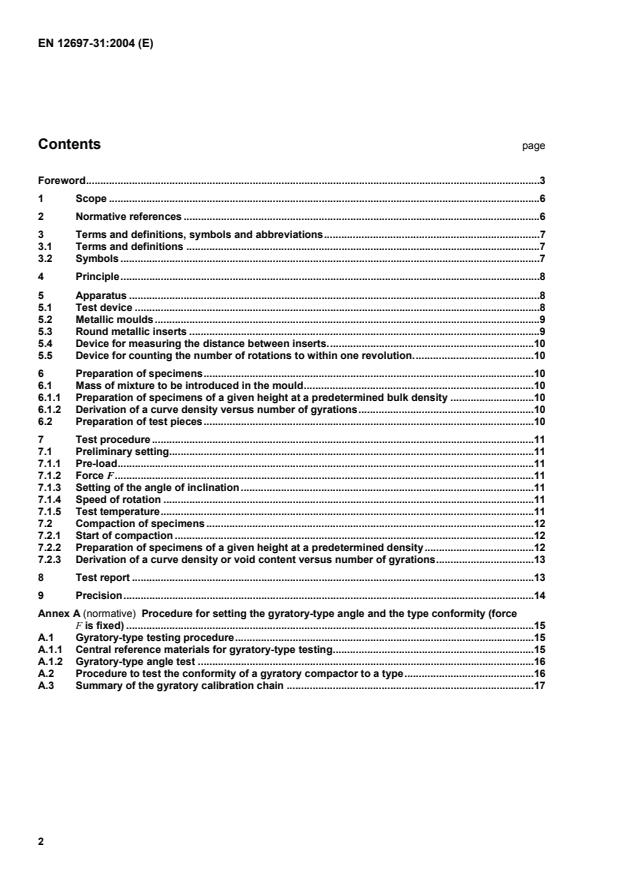
Procedure for setting the gyratory-type angle and the type conformity (force F is fixed).15 A.1 Gyratory-type testing procedure.15 A.1.1 Central reference materials for gyratory-type testing.15 A.1.2 Gyratory-type angle test.16 A.2 Procedure to test the conformity of a gyratory compactor to a type.16 A.3 Summary of the gyratory calibration chain.17
1 Scope This document specifies the method for compaction of cylindrical specimens of bituminous mixtures using a gyratory compactor. Such compaction is achieved by combining a rotary shearing action and a vertical resultant force applied by a mechanical head. The method can be used for a) determination of the air voids content of a mixture for a given number of gyrations; b) derivation of a curve density versus number of gyrations; c) preparation of specimens of given height at a predetermined density, for subsequent testing of their mechanical properties. For purposes a) and b), the performance based procedure of the annex A specifies a calibration chain so that the result of the test should be independent from the used type of gyratory compactor. For purpose c), compliance with annex A may be not necessary. This European Standard applies to bituminous mixtures (both those made up in laboratory and those resulting from work site sampling), with an upper aggregate size not larger than 31,5 mm. 2 Normative references The following referenced documents are indispensable for the application of this document. For dated references, only the edition cited applies. For undated references, the latest edition of the referenced document (including any amendments) applies. EN 12591, Bitumen and bituminous binders - Specifications for paving grade bitumens. EN 12697-5, Bituminous mixtures — Tests methods for hot mix asphalt — Part 5: Determination of the maximum density. EN 12697-6, Bituminous mixtures - Test methods for hot mix asphalt - Part 6: Determination of bulk density of bituminous specimens. EN 12697-8, Bituminous mixtures - Test methods for hot mix asphalt - Part 8: Determination of void characteristics of bituminous specimens. prEN 12697-35, Bituminous mixtures - Test methods for hot mix asphalt - Part 35: Laboratory mixing. prEN 13108-1; Bituminous mixtures - Material specifications - Part 1: Asphalt concrete. EN ISO 4287, Geometrical product specifications (GPS) - Surface texture: Profile method - Terms, definitions and surface texture parameters (ISO 4287:1997). EN ISO 6508-1, Metallic materials - Rockwell hardness test - Part 1: Test method (scales A, B, C, D, E, F, G, H, K, N, T) (ISO 6508-1:1999). ISO 5725-2; Accuracy (trueness and precision) of measurement methods and results -- Part 2: Basic method for the determination of repeatability and reproducibility of a standard measurement method.
is the angle of incline of axis of test piece, in degrees (°); F is the axial resultant force applicable to the ends of the test pieces, in Newton (N); ω is the speed of rotation of the axis of symmetry of revolution of the test piece, in revolutions per minute (rev/min); D is the internal diameter of the mould, in millimetres (mm); M is the mass of the mixture to be introduced in the mould, in kilograms (kg); ρM is the maximum density of the mixture, in kilograms per cubic metre (kg/m3); hmin is the minimum height of compacted specimen, corresponding to a zero percentage of voids, in millimetres (mm); h(ng) is the height of specimen after a number of gyrations ng, in millimetres (mm); ρ(ng) is the bulk density of specimen after a number of gyrations ng, in kilograms per cubic metre (kg/m3); P is the preload, initial value of F, in Newton (N); v % is the void content, in percentage (%).
...