


EN ISO 15974:2000
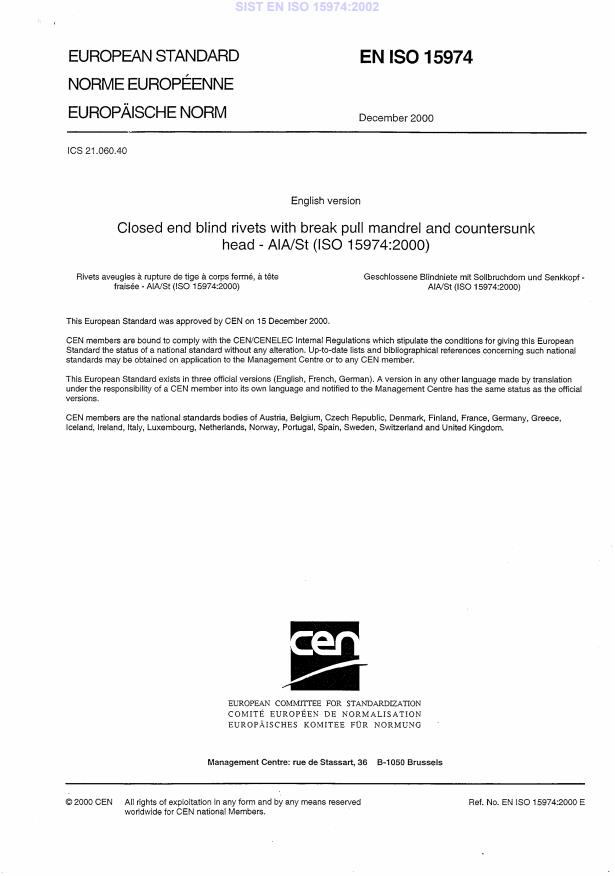
(Main)Closed end blind rivets with break pull mandrel and countersunk head - AIA/St (ISO 15974:2000)
General Information
- Abstract
Migrated from Progress Sheet (TC Comment) (2000-07-10): WIs 189-200 are the result of the splitting of WI 165 (TC res 104/1997)
- Status
- Published
- Publication Date
- 14-Dec-2000
- Technical Committee
- CEN/TC 185 - Threaded and nonthreaded mechanical fasteners and accessories
- Current Stage
- 9093 - Decision to confirm - Review Enquiry
- Start Date
- 28-Feb-2006
- Completion Date
- 28-Feb-2006

Overview
EN ISO 15974:2000 specifies the requirements for closed end blind rivets with break pull mandrel and countersunk head (AIA/St). Developed by CEN and aligned with ISO 15974:2000, this standard ensures consistency and reliability in the design and application of these specific types of blind rivets. These fasteners are extensively used where high strength and flush surface finishes are required, making them crucial for modern manufacturing, construction, and industrial assembly processes.
Key Topics
- Design and Dimensions: The standard covers the structural design of closed end blind rivets, including precise measurements for the countersunk head and break pull mandrel features.
- Material Specifications: EN ISO 15974:2000 applies to rivets made from aluminum alloys and steel, ensuring durability and compatibility with diverse applications.
- Mechanical Properties: Requirements include minimum tensile and shear strength, providing assurances of performance under operational stresses.
- Performance Criteria: Defines the acceptable levels for break load, mandrel retention, and resistance to environmental factors.
- Identification and Marking: Specifies guideline for rivet identification, including head marking for traceability and quality control.
Applications
Closed end blind rivets with break pull mandrel and countersunk head offer widespread industrial advantages due to their strength, ease of installation, and clean finish. Practical applications include:
- Aerospace and Automotive: Securing metal panels or structural parts where a flush finish is critical and access to only one side is possible.
- Construction: Joining metal frameworks, beams, or facades requiring high load-bearing capacity and visual appeal.
- Electronics Enclosures: Assembly of housings and casings, where watertightness or vibration resistance is necessary.
- General Manufacturing: Used in furniture, appliances, and equipment where reliable fastening and aesthetic appearance are both priorities.
These rivets are valued for their secure locking mechanism and sealed end, which prevents ingress of liquids, dust, or gases - vital in harsh environments.
Related Standards
For comprehensive quality management and safety in mechanical joining, the following standards are often referenced alongside EN ISO 15974:2000:
- EN ISO 15973 - Open end blind rivets with break pull mandrel
- EN ISO 14589 - Mechanical testing of blind rivets
- EN ISO 898-1 - Mechanical properties of fasteners made of carbon steel and alloy steel
- ISO 3269 - Fasteners - Acceptance inspection
- ISO 1891 - Terminology of fasteners
These related standards provide additional guidance on fastener mechanical properties, testing protocols, terminology, and quality assurance, supplementing the requirements outlined for closed end blind rivets.
Utilizing EN ISO 15974:2000 ensures that components assembled with closed end blind rivets not only meet high standards of safety and durability but also conform to recognized international practices, facilitating trade and manufacturing efficiency across industries.
Relations
- Effective Date
- 25-Aug-2026
- Effective Date
- 25-Aug-2026
- Effective Date
- 25-Aug-2026
- Effective Date
- 28-Jan-2026
- Effective Date
- 28-Jan-2026
- Effective Date
- 28-Jan-2026
- Consolidated By
ISO 15974:2000 - Closed end blind rivets with break pull mandrel and countersunk head — AlA/St - Effective Date
- 12-Feb-2026
Frequently Asked Questions
EN ISO 15974:2000 is a standard published by the European Committee for Standardization (CEN). Its full title is "Closed end blind rivets with break pull mandrel and countersunk head - AIA/St (ISO 15974:2000)". This standard covers: Migrated from Progress Sheet (TC Comment) (2000-07-10): WIs 189-200 are the result of the splitting of WI 165 (TC res 104/1997)
Migrated from Progress Sheet (TC Comment) (2000-07-10): WIs 189-200 are the result of the splitting of WI 165 (TC res 104/1997)
EN ISO 15974:2000 is classified under the following ICS (International Classification for Standards) categories: 21.060.40 - Rivets. The ICS classification helps identify the subject area and facilitates finding related standards.
EN ISO 15974:2000 has the following relationships with other standards: It is inter standard links to ISO 3269:2000, ISO 14588:2000, ISO 14589:2000, EN 1337-2:2004, EN 1097-9:1998/A1:2005, EN 1999-1-4:2007, ISO 15974:2000. Understanding these relationships helps ensure you are using the most current and applicable version of the standard.
EN ISO 15974:2000 is available in PDF format for immediate download after purchase. The document can be added to your cart and obtained through the secure checkout process. Digital delivery ensures instant access to the complete standard document.
Standards Content (Sample)
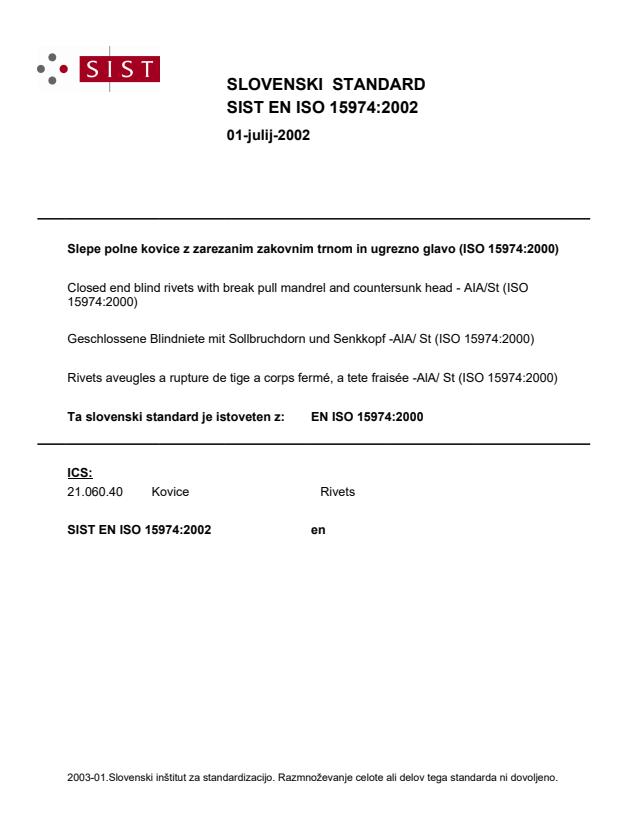
2003-01.Slovenski inštitut za standardizacijo. Razmnoževanje celote ali delov tega standarda ni dovoljeno.Slepe polne kovice z zarezanim zakovnim trnom in ugrezno glavo (ISO 15974:2000)Geschlossene Blindniete mit Sollbruchdorn und Senkkopf -AlA/ St (ISO 15974:2000)Rivets aveugles a rupture de tige a corps fermé, a tete fraisée -AlA/ St (ISO 15974:2000)Closed end blind rivets with break pull mandrel and countersunk head - AIA/St (ISO 15974:2000)21.060.40KoviceRivetsI
...