


FprEN 1991-4
(Main)Eurocode 1 - Actions on structures - Part 4: Silos and tanks
Eurocode 1 - Actions on structures - Part 4: Silos and tanks
1.1 Scope of EN 1991-4
(1) EN 1991-4 provides rules for calculating actions for the structural design of silos and tanks.
NOTE 1 Silos are used for the storage of particulate solids. Tanks are used for the storage of liquids.
NOTE 2 For limitations on rules for silos given in this document, see 1.3.
NOTE 3 For limitations on rules for tanks given in this document, see 1.4.
(2) EN 1991-4 includes some provisions for actions on silo and tank structures that are not only associated with the stored particulate solids or liquids (e.g. the effects of thermal differentials) but substantially affected by them.
NOTE Liquid loads on tanks are very precisely defined. Many loads on silos are not known with great precision. This document provides guidance for many practical situations for which very limited certain knowledge is available, and the information is derived from the limited experimental and analytical information available, coupled with conclusions drawn from failure investigations. The information is not based on a sound statistical treatment of experimental data.
(3) EN 1991-4 is intended for use with concrete, steel, aluminium, timber and FRP storage structures.
NOTE FRP is the standard acronym for fibre reinforced polymer materials.
(4) EN 1991-4 is also applicable for the structural assessment of existing silos and tanks, unless otherwise specified by the relevant authority or, if not specified, agreed between the relevant parties for the specific project.
NOTE 1 Changes in filling or discharge arrangements, changes in the wall friction of inner surfaces, or in the use of the silo, including storage of different particulate solids, can be reasons for assessing existing silos.
NOTE 2 Differentiation of the liquid stored can be a reason for assessing existing tanks.
1.2 Assumptions
(1) The assumptions of EN 1990 apply.
(2) EN 1991-4 is intended to be used in conjunction with EN 1990, with the other parts of EN 1991, EN 1992, EN 1993, EN 1995, EN 1997, EN 1998 and EN 1999 where relevant to the design of silos and tanks.
1.3 Limitations on silos
1.3.1 Geometrical limitations
(1) The following geometrical limitations apply to the design rules for silos and silo batteries (see 3.2.59 and 3.2.60) covered by this document:
- the silo planform cross-section shapes are limited to those shown in Figure 1.1c.
NOTE 1 Further information concerning planform cross-section geometries is given in Clause 7.
NOTE 2 For the determination of the effective diameter dc of the silo see Figure 1.1c;
- the following dimensional limitations on the aspect ratio for free-standing single cell silos hc/dc, the overall height hb and the effective diameter dc apply (see Figure 1.1):
hc/dc < 10 (1.1)
hb < 100 m (1.2)
dc < 60 m (1.3)
NOTE 3 See Figure 1.1 for hc, dc and hb.
- the structural transition lies in a single horizontal plane (see Figure 1.1a);
...
Eurocode 1 - Einwirkungen auf Tragwerke - Teil 4: Einwirkungen auf Silos und Flüssigkeitsbehälter
1.1 Anwendungsbereich von EN 1991-4
(1) EN 1991-4 enthält Regeln für die Berechnung von Einwirkungen auf Silos und Flüssigkeitsbehälter für die Tragwerksplanung.
ANMERKUNG 1 Silos werden für die Lagerung von Schüttgütern verwendet. Flüssigkeitsbehälter werden für die Lagerung von Flüssigkeiten verwendet.
ANMERKUNG 2 Eingrenzungen der in diesem Dokument enthaltenen Regeln für Silos siehe 1.3.
ANMERKUNG 3 Eingrenzungen der in diesem Dokument enthaltenen Regeln für Flüssigkeitsbehälter siehe 1.4.
(2) EN 1991-4 enthält auch einige Bestimmungen für Einwirkungen auf Silos und Flüssigkeitsbehälter, die nicht nur in Zusammenhang mit den gelagerten Schüttgütern oder Flüssigkeiten stehen (z. B. Auswirkungen von Temperaturunterschieden), sondern die wesentlich von ihnen beeinflusst werden.
ANMERKUNG Die von Flüssigkeiten auf Flüssigkeitsbehälter ausgeübten Lasten sind sehr präzise definiert. Viele auf Silos wirkende Lasten sind nicht mit hoher Genauigkeit bekannt. Dieses Dokument bietet einen Leitfaden für zahlreiche praktische Situationen, in denen nur sehr wenig gesichertes Wissen vorhanden ist und die Informationen aus den verfügbaren begrenzten experimentellen und analytischen Informationen in Kombination mit Schlussfolgerungen aus der Untersuchung von Versagensfällen abgeleitet werden. Die Informationen basieren nicht auf einer robusten statistischen Verarbeitung experimenteller Daten.
(3) EN 1991-4 ist für Lagerbauwerke aus Beton, Stahl, Aluminium, Holz und FKV vorgesehen.
ANMERKUNG FKV ist das Standardakronym für Faser-Kunststoff-Verbundwerkstoffe.
(4) EN 1991-4 ist ebenfalls anwendbar für die Tragwerksbewertung bestehender Silos und Flüssigkeitsbehälter, sofern nicht anders von der zuständigen Behörde festgelegt oder, sofern keine Festlegungen getroffen wurden, für das jeweilige Projekt zwischen den beteiligten Parteien vereinbart.
ANMERKUNG 1 Gründe für die Bewertung bestehender Silos können Änderungen der Bedingungen bei Füllen oder Entleeren, der Wandreibung der inneren Oberflächen oder der Verwendung des Silos, einschließlich der Lagerung unterschiedlicher Schüttgüter, sein.
ANMERKUNG 2 Differenzierung der gelagerten Flüssigkeit kann ein Grund für die Bewertung bestehender Flüssigkeitsbehälter sein.
1.2 Annahmen
(1) Es gelten die Annahmen von EN 1990.
(2) EN 1991-4 ist im Zusammenhang mit EN 1990, mit den weiteren Teilen der Reihen EN 1991, EN 1992, EN 1993, EN 1995, EN 1997, EN 1998 und EN 1999, sofern für die Bemessung von Silos und Flüssigkeitsbehältern maßgebend, anwendbar.
1.3 Eingrenzungen bei Silos
1.3.1 Geometrische Eingrenzungen
(1) Für die Anwendung der Bemessungsregeln für die von diesem Dokument behandelten Silos und Silobatterien (siehe 3.2.59 und 3.2.60) gelten folgende geometrische Eingrenzungen:
- die Siloquerschnittsformen sind auf die in Bild 1.1c gezeigten begrenzt.
ANMERKUNG 1 Weitere Informationen zu Querschnittsgeometrien sind in Abschnitt 7 enthalten.
ANMERKUNG 2 Zur Bestimmung des effektiven Silodurchmessers dc siehe Bild 1.1c.
- es gelten die folgenden Maßgrenzen für die Schlankheit bei freistehenden Einzelzellensilos hc/dc, die Gesamthöhe hb und den effektiven Durchmesser dc (siehe Bild 1.1):
hc/dc < 10 (1.1)
hb < 100 m (1.2)
dc < 60 m (1.3)
ANMERKUNG 3 Siehe Bild 1.1 zu hc, dc und hb.
- der Tragwerksübergang vom vertikalen Siloschaft in den Trichter erfolgt in einer einzigen horizontalen Ebene (siehe Bild 1.1a).
...
Eurocode 1 - Actions sur les structures - Partie 4 : Actions sur les silos et les réservoirs
1.1 Domaine d'application de l'EN 1991 4
(1) L'EN 1991 4 donne des recommandations pour calculer les actions pour le calcul structural des silos et des réservoirs.
NOTE 1 Les silos sont utilisés pour le stockage des matières granulaires. Les réservoirs sont utilisés pour le stockage des liquides.
NOTE 2 Pour les limites des règles relatives aux silos données dans le présent document, voir 1.3.
NOTE 3 Pour les limites des règles relatives aux réservoirs données dans le présent document, voir 1.4.
(2) L'EN 1991 4 contient aussi certaines indications concernant les actions sur les structures des silos et réservoirs qui ne sont pas liées aux matières ou aux liquides stockés (par exemple les effets thermiques différentiels), mais qui sont considérablement affectées par eux.
NOTE Les charges de liquides sur les réservoirs sont définies de manière très précise. De nombreuses charges sur les silos ne sont pas connues avec grande précision. La présente norme fournit des recommandations pour de nombreuses situations pratiques pour lesquelles les connaissances certaines sont très limitées, et les informations sont dérivées des informations expérimentales et analytiques limitées disponibles, associées à des conclusions tirées d'analyses de défaillances. Les informations ne sont pas basées sur un traitement statistique solide de données expérimentales.
(3) L'EN 1991 4 est destinée à être utilisée pour les structures de stockage en béton, en acier, en aluminium, en bois et en FRP (« fibre reinforced polymer »).
NOTE FRP est l'acronyme normalisé pour les matériaux polymères renforcés de fibres.
(4) Il est permis d'utiliser l'EN 1991 4 pour l'évaluation structurale d'une construction existante, pour le calcul de réparations et de modifications, et l'appréciation de changements d'utilisation.
NOTE Lorsque l'évaluation structurale d'une structure existante est envisagée, il peut être fait référence à l'Annexe Nationale et au client concernant la pertinence de la norme actuelle.
1.2 Hypothèses
(1) Les hypothèses données dans l'EN 1990 s'appliquent.
(2) L'EN 1991 4 est destinée à être utilisée conjointement avec l'EN 1990, et les autres parties de l'EN 1991, de l'EN 1992, de l'EN 1993, de l'EN 1995, de l'EN 1997, de l'EN 1998 et de l'EN 1999 lorsqu'elles sont pertinentes pour le calcul des silos et des réservoirs.
Evrokod 1 - Vplivi na konstrukcije - 4. del: Silosi in rezervoarji
General Information
Relations
Standards Content (Sample)
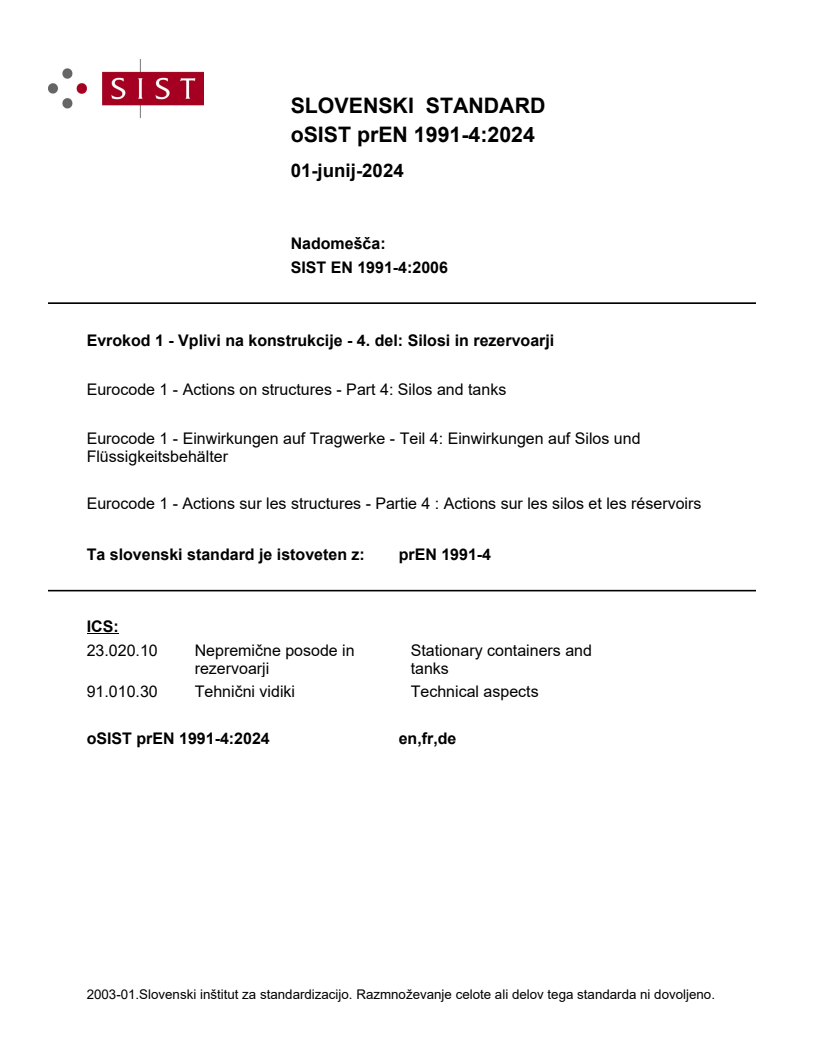
SLOVENSKI STANDARD
oSIST prEN 1991-4:2024
01-junij-2024
Nadomešča:
SIST EN 1991-4:2006
Evrokod 1 - Vplivi na konstrukcije - 4. del: Silosi in rezervoarji
Eurocode 1 - Actions on structures - Part 4: Silos and tanks
Eurocode 1 - Einwirkungen auf Tragwerke - Teil 4: Einwirkungen auf Silos und
Flüssigkeitsbehälter
Eurocode 1 - Actions sur les structures - Partie 4 : Actions sur les silos et les réservoirs
Ta slovenski standard je istoveten z: prEN 1991-4
ICS:
23.020.10 Nepremične posode in Stationary containers and
rezervoarji tanks
91.010.30 Tehnični vidiki Technical aspects
oSIST prEN 1991-4:2024 en,fr,de
2003-01.Slovenski inštitut za standardizacijo. Razmnoževanje celote ali delov tega standarda ni dovoljeno.
oSIST prEN 1991-4:2024
oSIST prEN 1991-4:2024
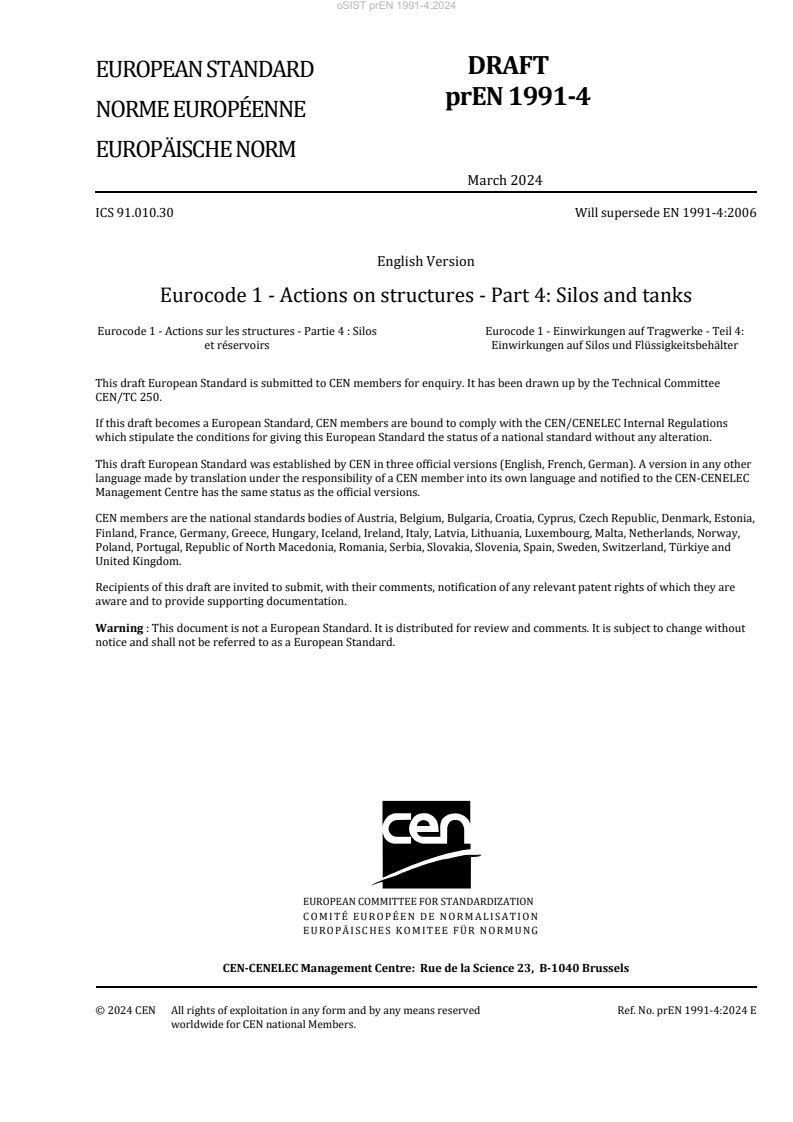
DRAFT
EUROPEAN STANDARD
prEN 1991-4
NORME EUROPÉENNE
EUROPÄISCHE NORM
March 2024
ICS 91.010.30 Will supersede EN 1991-4:2006
English Version
Eurocode 1 - Actions on structures - Part 4: Silos and tanks
Eurocode 1 - Actions sur les structures - Partie 4 : Silos Eurocode 1 - Einwirkungen auf Tragwerke - Teil 4:
et réservoirs Einwirkungen auf Silos und Flüssigkeitsbehälter
This draft European Standard is submitted to CEN members for enquiry. It has been drawn up by the Technical Committee
CEN/TC 250.
If this draft becomes a European Standard, CEN members are bound to comply with the CEN/CENELEC Internal Regulations
which stipulate the conditions for giving this European Standard the status of a national standard without any alteration.
This draft European Standard was established by CEN in three official versions (English, French, German). A version in any other
language made by translation under the responsibility of a CEN member into its own language and notified to the CEN-CENELEC
Management Centre has the same status as the official versions.
CEN members are the national standards bodies of Austria, Belgium, Bulgaria, Croatia, Cyprus, Czech Republic, Denmark, Estonia,
Finland, France, Germany, Greece, Hungary, Iceland, Ireland, Italy, Latvia, Lithuania, Luxembourg, Malta, Netherlands, Norway,
Poland, Portugal, Republic of North Macedonia, Romania, Serbia, Slovakia, Slovenia, Spain, Sweden, Switzerland, Türkiye and
United Kingdom.
Recipients of this draft are invited to submit, with their comments, notification of any relevant patent rights of which they are
aware and to provide supporting documentation.
Warning : This document is not a European Standard. It is distributed for review and comments. It is subject to change without
notice and shall not be referred to as a European Standard.
EUROPEAN COMMITTEE FOR STANDARDIZATION
COMITÉ EUROPÉEN DE NORMALISATION
EUROPÄISCHES KOMITEE FÜR NORMUNG
CEN-CENELEC Management Centre: Rue de la Science 23, B-1040 Brussels
© 2024 CEN All rights of exploitation in any form and by any means reserved Ref. No. prEN 1991-4:2024 E
worldwide for CEN national Members.
oSIST prEN 1991-4:2024
prEN 1991-4:2024 (E)
Contents Page
European foreword . 7
0 Introduction . 8
1 Scope .10
1.1 Scope of EN 1991-4 .10
1.2 Assumptions .10
1.3 Limitations on silos.10
1.3.1 Geometrical limitations . 10
1.3.2 Limitations on the stored solids . 13
1.3.3 Limitations on filling and discharge arrangements . 14
1.4 Limitations on tanks .15
2 Normative references .16
3 Terms, definitions and symbols .16
3.1 General .16
3.2 Terms and definitions.16
3.3 Symbols and abbreviations.25
3.3.1 Roman upper-case letters . 25
3.3.2 Roman lower-case letters . 26
3.3.3 Greek upper-case letters . 29
3.3.4 Greek lower-case letters . 29
4 Classification of silos .30
4.1 Action Assessment Classes for silos . 30
4.2 Silo usage classes . 33
5 Design situations and modelling of actions .33
5.1 General .33
5.2 Representation of loads on silos .33
5.2.1 Genera l . 33
5.2.2 Representation of loads on silo inside surfaces . 34
5.2.3 Classification of actions on silos . 34
5.2.4 Evaluation of loads on silos . 35
5.2.5 Silo Fundamental and Special load cases . 36
5.2.6 Design situations for specific silo construction forms . 37
5.3 Evaluation of filling and discharge conditions for silos .38
5.3.1 General . 38
5.3.2 Prediction of symmetrical flow patterns . 41
5.3.3 Assessment of the filling and discharge eccentricities . 43
5.3.4 Silos storing powders . 46
5.4 Silo Fundamental Load Cases (SFLC) .46
5.4.1 Common failure modes . 46
5.4.2 Eccentricity limits for Silo Fundamental Load Cases . 47
5.4.3 Uncertainty and variability of solid properties . 47
5.4.4 Types of Silo Fundamental Load Cases . 48
5.5 Silo Special Load Cases (SSLC) .49
5.5.1 General . 49
5.5.2 Situations that require Silo Special Load Cases . 50
5.5.3 Unsymmetrical discharge . 50
5.5.4 Eccentricity limits . 53
5.5.5 Large eccentricity filling loads in slender and very slender circular silos . 54
5.5.6 Large eccentricity filling loads in squat and intermediate slenderness circular silos . 54
5.5.7 Moderate eccentricity discharge loads in slender and very slender circular silos . 54
5.5.8 Moderate eccentricity discharge loads in squat and intermediate slenderness circular silos54
5.5.9 Large eccentricity pipe flow in circular and rectangular silos . 55
oSIST prEN 1991-4:2024
prEN 1991-4:2024 (E)
5.5.10 Silos containing solids with entrained air . 55
5.5.11 Thermal differences between stored solids and the silo structure . 55
5.5.12 Suction due to inadequate venting . 56
5.5.13 Loads on the vertical walls of special rectangular silos . 56
5.5.14 Internal inverted cone . 56
5.5.15 Oblique conical hoppers . 56
5.5.16 Eccentric pipe flow in steep concentric or oblique hoppers . 57
5.5.17 Principles for design of silos against dust explosions . 57
5.6 Load modifying factors for direct use in load evaluations . 58
5.7 Representation of loads on tanks . 59
6 Properties of particulate solids . 60
6.1 General. 60
6.1.1 Flow Group . 60
6.1.2 Properties of solids for design calculations . 60
6.1.3 Wall Friction Category . 60
6.1.4 Characteristic values of material properties . 62
6.1.5 Applications of the effective modulus . 63
6.2 Particulate solid properties: principles and background . 64
6.2.1 General . 64
6.2.2 Obtaining appropriate solids properties for design . 65
6.3 Testing particulate solids . 66
6.3.1 Test procedures . 66
6.3.2 Bulk unit weight γ . 66
6.3.3 Coefficient of wall friction μ . 66
6.3.4 Angle of internal friction ϕi . 67
6.3.5 Lateral pressure ratio K . 67
6.3.6 Cohesion c . 67
6.3.7 Porosity n . 68
7 Symmetrical loads on vertical walls (Silo Fundamental Load Cases) . 68
7.1 General. 68
7.2 Slender and very slender silos (h /d ≥ 2,0) . 69
c c
7.2.1 Symmetrical filling loads on slender and very slender silo vertical walls. 69
7.2.2 Symmetrical discharge loads on slender and very slender silo vertical walls unloaded from
the top . 71
7.2.3 Symmetrical discharge loads on slender and very slender silo vertical walls under mass flow
..................................................................................................................................................................... 71
7.2.4 Symmetrical discharge loads on slender and very slender silo vertical walls under mixed
flow . 73
7.3 Squat and intermediate slenderness silos (0,4 ≤ h /d < 2,0) . 75
c c
7.3.1 Symmetrical filling loads on squat and intermediate slenderness silo vertical walls . 75
7.3.2 Symmetrical discharge loads on squat and intermediate slenderness silo vertical walls under
internal pipe flow or unloaded from the top . 77
7.3.3 Symmetrical discharge loads on squat and intermediate slenderness silo vertical walls under
mass or mixed flow . 77
7.4 Retaining silos (h /d < 0,4) . 78
c c
7.4.1 Filling loads on retaining silo vertical walls . 78
7.4.2 Discharge loads on retaining silo vertical walls . 79
8 Silo Special Load Cases for vertical walls . 80
8.1 General. 80
8.2 Unsymmetrical pressures in slender and very slender silos treated by proxy loads 80
8.2.1 General . 80
8.2.2 Proxy load: thick-walled circular silos (dc/t < 200) . 80
8.2.3 Proxy load: thin-walled circular silos (dc/t ≥ 200) . 82
8.3 Large eccentricity filling loads in squat and intermediate slenderness silos . 83
8.4 Pipe flow in all silos with large flow channel eccentricities . 85
oSIST prEN 1991-4:2024
prEN 1991-4:2024 (E)
8.4.1 General . 85
8.4.2 Pipe flow eccentric discharge in very slender and slender circular silos . 85
8.4.3 Large eccentricity discharge loads in squat and intermediate slenderness circular silos . 89
8.4.4 Large eccentricity discharge loads in rectangular silos . 89
8.5 Silos containing solids with entrained air .91
8.5.1 General . 91
8.5.2 Loads in silos containing fluidized solids . 91
8.6 Thermal differences between stored solids and the silo structure .92
8.6.1 General . 92
8.6.2 Pressures due to reduction in ambient atmospheric temperature or product swelling . 92
8.6.3 Pressures due to filling a silo with hot solids . 93
8.7 Suction due to inadequate venting .94
8.8 Loads on the vertical walls of special rectangular silos .94
8.8.1 Rectangular silos . 94
8.8.2 Rectangular silos with internal ties . 94
8.8.3 Rectangular silos with flexible walls. 94
9 Symmetrical loads on silo hoppers and bottoms (Silo Fundamental Load Cases) .96
9.1 General .96
9.1.1 Physical properties . 96
9.1.2 General rules . 99
9.2 Steep hoppers . 100
9.2.1 Mobilized friction . 100
9.2.2 Filling loads under symmetrical conditions. 100
9.2.3 Discharge loads under symmetrical conditions . 101
9.3 Shallow hoppers . 102
9.3.1 Mobilized friction . 102
9.3.2 Filling loads . 103
9.3.3 Discharge loads . 103
9.4 Flat bottoms . 103
9.4.1 Vertical pressures on flat bottoms in slender silos . 103
9.4.2 Vertical pressure distribution on a flat bottom in a squat or intermediate slenderness silo
................................................................................................................................................................... 104
10 Silo Special Load Cases for hoppers and silo bases . 105
10.1 Circular silos with internal inverted cone . 105
10.1.1 General . 105
10.1.2 Pressures on the vertical wall and bottom of the silo . 105
10.1.3 Symmetrical loads on the cone . 107
10.1.4 Unsymmetrical loads on the cone . 108
10.2 Oblique conical hoppers . 109
10.3 Discharge loads for eccentric pipe flow in steep concentric or oblique hoppers . 111
10.3.1 General . 111
10.3.2 Steep hopper pipe flow eccentric discharge in conical hoppers . 112
10.4 Hoppers in silos containing solids with entrained air . 113
11 Loads on tanks . 113
11.1 General . 113
11.2 Loads due to stored liquids . 114
11.3 Liquid properties . 114
11.4 Loads due to air, gas or vapour pressures . 114
11.5 Temperatures of the content of the tank . 115
11.6 Assessment of fatigue loading events . 115
Annex A (informative) Actions and combinations of actions on silos . 116
A.1 Use of this annex . 116
A.2 Scope and field of application . 116
oSIST prEN 1991-4:2024
prEN 1991-4:2024 (E)
A.3 General . 116
A.4 Actions on silos . 116
A.5 Design service life . 119
A.6 Design situations for silos . 119
Annex B (informative) Actions and combinations of actions on tanks . 120
B.1 Use of this annex . 120
B.2 Scope and field of application . 120
B.3 General . 120
B.4 Actions on tanks . 120
B.5 Design service life . 124
Annex C (normative) Values of the properties of particulate solids . 125
C.1 Use of this annex . 125
C.2 Scope and field of application . 125
C.3 Defined values . 125
Annex D (normative) Measurement of properties of solids for silo load evaluation . 129
D.1 Use of this annex . 129
D.2 Scope and field of application . 129
D.3 Classification of granular particulate solids . 129
D.4 Flow Group and different particulate solids behaviour when in silos . 130
D.5 Object of the property measurement test processes . 132
D.6 Field of application . 132
D.7 Notation . 132
D.8 Definitions . 133
D.9 Sampling and preparation of samples . 133
D.10 Bulk unit weight γ . 134
D.11 Wall friction . 135
D.12 Coefficient of wall friction μ for the determination of pressures . 136
D.13 Angle of wall friction ϕ for the evaluation of flow . 137
wh
D.14 Lateral pressure ratio K . 137
D.15 Strength parameters: cohesion c and internal friction angle ϕ . 139
i
D.16 Angle of repose ϕ . 143
r
D.17 Effective elastic moduli E . 143
s
D.18 Assessment of the upper and lower characteristic values of a property and
determination of the conversion factor a . 146
Annex E (informative) Evaluation of properties of solids for certain conditions . 149
E.1 Use of this annex . 149
E.2 Scope and field of application . 149
oSIST prEN 1991-4:2024
prEN 1991-4:2024 (E)
E.3 Evaluation of the wall friction coefficient for a corrugated wall . 149
E.4 Internal and wall friction for coarse-grained solids without fines . 150
E.5 Effective wall friction evaluation for silo walls with internal stiffeners . 151
Annex F (informative) Actions due to dust explosions . 152
F.1 Use of this annex . 152
F.2 Scope and field of application . 152
F.3 Explosive dusts and relevant properties . 152
F.4 Ignition sources . 153
F.5 Protective precautions . 153
F.6 Design of structural elements . 154
F.7 Design for the consequences of a dust explosion . 154
Annex G (informative) Flow charts to aid in the use of this standard . 155
G.1 Use of this annex . 155
G.2 Scope and field of application . 155
Bibliography . 162
oSIST prEN 1991-4:2024
prEN 1991-4:2024 (E)
European foreword
This document (prEN 1991-4:2024) has been prepared by Technical Committee CEN/TC 250 “Structural
Eurocodes”, the secretariat of which is held by BSI. CEN/TC 250 is responsible for all Structural
Eurocodes and has been assigned responsibility for structural and geotechnical design matters by CEN.
This document is currently submitted to the CEN Enquiry.
This document will supersede EN 1991-4:2006 and AC:2012.
The first generation of EN Eurocodes was published between 2002 and 2007. This document forms part
of the second generation of the Eurocodes, which have been prepared under Mandate M/515 issued to
CEN by the European Commission and the European Free Trade Association.
The Eurocodes have been drafted to be used in conjunction with relevant execution, material, product
and test standards, and to identify requirements for execution, materials, products and testing that are
relied upon by the Eurocodes.
The Eurocodes recognize the responsibility of each Member State and have safeguarded their right to
determine values related to regulatory safety matters at national level through the use of National
Annexes.
oSIST prEN 1991-4:2024
prEN 1991-4:2024 (E)
0 Introduction
0.1 Introduction to the Eurocodes
The Structural Eurocodes comprise the following standards generally consisting of a number of Parts:
• EN 1990 Eurocode — Basis of structural and geotechnical design
• EN 1991 Eurocode 1 — Actions on structures
• EN 1992 Eurocode 2 — Design of concrete structures
• EN 1993 Eurocode 3 — Design of steel structures
• EN 1994 Eurocode 4 — Design of composite steel and concrete structures
• EN 1995 Eurocode 5 — Design of timber structures
• EN 1996 Eurocode 6 — Design of masonry structures
• EN 1997 Eurocode 7 — Geotechnical design
• EN 1998 Eurocode 8 — Design of structures for earthquake resistance
• EN 1999 Eurocode 9 — Design of aluminium structures
• New parts are under development, e.g. Eurocode for design of structural glass
The Eurocodes are intended for use by designers, clients, manufacturers, constructors, relevant
authorities (in exercising their duties in accordance with national or international regulations),
educators, software developers, and committees drafting standards for related product, testing and
execution standards.
NOTE Some aspects of design are most appropriately specified by relevant authorities or, where not specified,
can be agreed on a project-specific basis between the relevant parties such as designers and clients. The Eurocodes
identify such aspects making explicit reference to relevant authorities and relevant parties.
0.2 Introduction to the EN 1991 series
(1) The EN 1991 series specifies actions for the structural and geotechnical design of buildings, bridges
and other civil engineering works, or parts thereof, including temporary structures, in conjunction with
EN 1990 and the other Eurocodes.
(2) The EN 1991 series does not cover the specific requirements of actions for seismic regions. Provisions
related to such requirements are given in the EN 1998 series, which complement and are consistent with
the EN 1991 series.
(3) The EN 1991 series is also applicable to existing structures for:
— structural assessment,
— strengthening or repair,
— change of use.
NOTE In these cases additional or amended provisions can be necessary.
oSIST prEN 1991-4:2024
prEN 1991-4:2024 (E)
(4) The EN 1991 series is also applicable for the design of structures where materials or actions outside
the scope of the other Eurocodes are involved.
NOTE In this case additional or amended provisions can be necessary.
0.3 Introduction to EN 1991-4
EN 1991-4 gives guidance for the evaluation of actions for the structural design of silos and tanks.
0.4 Verbal forms used in the Eurocodes
The verb “shall” expresses a requirement strictly to be followed and from which no deviation is permitted
in order to comply with the Eurocodes.
The verb “should” expresses a highly recommended choice or course of action. Subject to national
regulation and/or any relevant contractual provisions, alternative approaches could be used/adopted
where technically justified.
The verb “may” expresses a course of action permissible within the limits of the Eurocodes.
The verb “can” expresses possibility and capability; it is used for statements of fact and clarification of
concepts.
0.5 National annex for prEN 1991-4
National choice is allowed in this standard where explicitly stated within notes. National choice includes
the selection of values for Nationally Determined Parameters (NDPs).
The national standard implementing prEN 1991-4 can have a National Annex containing all national
choices to be used for the design of buildings and civil engineering works to be constructed in the relevant
country.
When no national choice is given, the default choice given in this standard is to be used.
When no national choice is made and no default is given in this standard, the choice can be specified by a
relevant authority or, where not specified, agreed for a specific project by appropriate parties.
National choice is allowed in EN 1991-4 through notes to the following clauses:
1.1(4) 4.1(2) 5.5.16(2) 5.7(7)
National choice is allowed in EN 1991-4 on the application of the following informative annexes:
Annex A Annex B Annex F Annex G
The National Annex can contain, directly or by reference, non-contradictory complementary information
for ease of implementation, provided it does not alter any provisions of the Eurocodes.
oSIST prEN 1991-4:2024
prEN 1991-4:2024 (E)
1 Scope
1.1 Scope of EN 1991-4
(1) EN 1991-4 provides guidance for calculating actions for the structural design of silos and tanks.
NOTE 1 Silos are used for the storage of particulate solids: tanks are used for the storage of liquids.
NOTE 2 For limitations on rules for silos given in this document, see 1.3.
NOTE 3 For limitations on rules for tanks given in this document, see 1.4.
(2) EN 1991-4 includes some provisions for actions on silo and tank structures that are not only
associated with the stored solids or liquids (e.g. the effects of thermal differentials) but substantially
affected by them.
NOTE Liquid loads on tanks are very precisely defined. Many loads on silos are not known with great precision.
This standard provides guidance for many practical situations for which very limited certain knowledge is available,
and the information is derived from the limited experimental and analytical information available, coupled with
conclusions drawn from failure investigations. The information is not based on a sound statistical treatment of
experimental data.
(3) EN 1991-4 is intended for use with concrete, steel, aluminium, timber and FRP storage structures.
NOTE FRP is the standard acronym for fibre reinforced polymer materials.
(4) EN 1991-4 may be used for the structural assessment of existing construction, in developing the
design of repairs and alterations or for assessing changes of use.
NOTE Where the structural appraisal of an existing structure is being considered, reference can be made to the
National Annex and to the client concerning the relevance of the current standard.
1.2 Assumptions
(1) The assumptions of EN 1990 apply.
(2) EN 1991-4 is intended to be used in conjunction with EN 1990, with the other parts of EN 1991,
EN 1992, EN 1993, EN 1995, EN 1997, EN 1998 and EN 1999 where relevant to the design of silos and
tanks.
1.3 Limitations on silos
1.3.1 Geometrical limitations
(1) The following geometrical limitations apply to the design rules for silos covered by this document:
• the silo here defined is either an isolated structure or can be part of a battery of silos. For a silo
battery, the term silo is used throughout this standard to refer to a single cell within the battery;
• the silo planform cross-section shapes are limited to those shown in Figure 1.1c.
NOTE 1 Minor variations to these shapes can be accepted provided the structural consequences of the resulting
changes in pressure are expected to be considered. Further information concerning planform cross-section
geometries is given in 7;
NOTE 2 Further information concerning planform cross-section geometries is given in Clause 7.
oSIST prEN 1991-4:2024
prEN 1991-4:2024 (E)
• the relevant overall height of the silo h (Figure 1.1a) is measured from the level of the equivalent
b
surface of the stored solid (see 3.2.17) when the silo is filled to its maximum capacity, down to the
apex of the cone of the hopper or to the flat base where there is no hopper;
NOTE For the evaluation of ho to calculate hb, see (2).
• the effective diameter d of the silo should be determined as indicated in Figure 1.1c;
c
• the following dimensional limitations on the overall height h and aspect ratio h /d apply (see
b b c
Figure 1.1):
h /d < 10 (1.1)
b c
h < 100 m (1.2)
b
d < 60 m (1.3)
c
• the structural transition lies in a single horizontal plane (see Figure 1.1a);
• the relevant cylindrical section height of the silo h (Figure 1.1a) should be measured from the level
c
of the equivalent surface of the stored solid (see 3.2.17) when the silo is filled to its maximum
capacity, down to the structural transition (see Figure 1.1a) or to the flat base where there is no
hopper;
(2) For a symmetrically filled circular silo of diameter d , h should be determined as:
c 0
d
c
h = tanφ (1.4)
o r
and for a symmetrically filled rectangular silo of characteristic dimension d , h should be determined as:
c 0
d
c
h = tanφ (1.5)
o r
where:
ϕ is the angle of repose of the solid (see Table C.1).
r
NOTE For solids that can become fluidised on filling, the value of ϕ can also be zero.
r
(3) The value of h for a powder may normally be taken as h = 0 because the solid is naturally aerated on
o o
deposition. Silo design for storing powders should allow for higher filling levels arising from this effect.
oSIST prEN 1991-4:2024
prEN 1991-4:2024 (E)
a) Geometry b) Pressures and frictional
tractions
c) Cross-section planform shapes and definition of d
c
Key
1 Equivalent surface
2 Transition
A Circular
B Square
C Rectangular
D Interstitial
E Hexagonal
Figure 1.1 — Silo forms showing dimensions and pressu
...
Questions, Comments and Discussion
Ask us and Technical Secretary will try to provide an answer. You can facilitate discussion about the standard in here.