


EN 1645-1:2025
(Main)Leisure accommodation vehicles - Caravans - Part 1: Habitation requirements relating to health and safety
General Information
- Abstract
This document specifies requirements intended to ensure the safety and health of people when they use caravans for temporary or seasonal habitation.
It also specifies the corresponding test methods.
Requirements applicable to road safety are not included in the scope of this document.
This document is applicable exclusively to rigid and rigid folding caravans as defined in EN 13878.
- Status
- Published
- Publication Date
- 09-Dec-2025
- Technical Committee
- CEN/TC 245 - Leisure accommodation vehicles
- Current Stage
- 6060 - Definitive text made available (DAV) - Publishing
- Start Date
- 10-Dec-2025
- Due Date
- 24-May-2025
- Completion Date
- 10-Dec-2025

Overview
EN 1645-1:2025 is a CEN European standard that specifies habitation requirements relating to health and safety for leisure accommodation vehicles - specifically rigid and rigid folding caravans (as defined in EN 13878). Approved in October 2025, this Part 1 document focuses on protecting occupants during temporary or seasonal habitation and includes the corresponding test methods. Road safety requirements are explicitly excluded from its scope.
Key topics and technical requirements
The standard addresses design, construction and testing across habitation systems. Major technical topics include:
- Structural integrity and rigidity (tests for caravan stiffness and corner steadies)
- Entrance and escape - entrance steps, door dimensions, emergency exits and escape paths, and specific requirements for escape windows and step sizes
- Internal equipment safety - bunks (mattresses, clearances, fall protection, strength and access to high-level bunks), cupboards, and work surfaces
- Steps and anti-slip - minimum tread, mechanical strength, slip-resistance and separate step stability tests
- Water systems - drinking water fittings, tanks, materials and marking, plus waste water and toilet waste disposal requirements
- Appliances and installations - installation restrictions, electrical systems (low and extra-low voltage), LPG and liquid fuel installations
- Thermal performance - classification of thermal insulation and test methods for thermal transmittance
- Ventilation and fire precautions - ventilation requirements, means of escape, protection of combustible elements, hotplate safety
- User information and warnings - mandatory warning notices and a user’s handbook
- Normative test annexes - detailed test methods for rigidity, grab handles, step strength, slip resistance, bunk strength, thermal tests and test equipment
Notable updates versus the 2018 edition include requirements for larger caravans (>6.5 m), amended escape path rules, revised step and door dimensions, and terminology change from “flammable” to “combustible”.
Practical applications
EN 1645-1:2025 is used to:
- Guide caravan design and product development to meet occupant health and safety expectations
- Provide type testing and verification protocols for manufacturers and testing laboratories
- Support compliance documentation, technical files and CE / national conformity where applicable
- Inform campsite operators, rental companies and procurement teams about safety features and user instructions
Who should use this standard
- Caravan manufacturers and component suppliers
- Design engineers and safety specialists for leisure accommodation vehicles
- Notified bodies and independent test laboratories
- National standards bodies and regulatory authorities
- Fleet owners, rental companies and campsite operators evaluating safety compliance
Related standards
- EN 13878 (definition of rigid and rigid folding caravans)
- Other parts of the EN 1645 series (see CEN listings for related Parts)
Keywords: EN 1645-1:2025, caravans, leisure accommodation vehicles, habitation requirements, health and safety, CEN, testing, ventilation, fire precautions, bunks, entrance steps.
Relations
- Effective Date
- 20-Feb-2023
- Effective Date
- 09-Feb-2026
- Effective Date
- 09-Feb-2026
- Effective Date
- 28-Jan-2026
- Effective Date
- 28-Jan-2026
- Effective Date
- 28-Jan-2026
- Effective Date
- 28-Jan-2026
- Effective Date
- 28-Jan-2026
- Effective Date
- 28-Jan-2026
- Effective Date
- 28-Jan-2026
- Effective Date
- 28-Jan-2026
- Effective Date
- 28-Jan-2026
Get Certified
Connect with accredited certification bodies for this standard

TÜV Rheinland
TÜV Rheinland is a leading international provider of technical services.

TÜV SÜD
TÜV SÜD is a trusted partner of choice for safety, security and sustainability solutions.

DEKRA Certification Inc.
DEKRA US certification services.
Sponsored listings
Frequently Asked Questions
EN 1645-1:2025 is a standard published by the European Committee for Standardization (CEN). Its full title is "Leisure accommodation vehicles - Caravans - Part 1: Habitation requirements relating to health and safety". This standard covers: This document specifies requirements intended to ensure the safety and health of people when they use caravans for temporary or seasonal habitation. It also specifies the corresponding test methods. Requirements applicable to road safety are not included in the scope of this document. This document is applicable exclusively to rigid and rigid folding caravans as defined in EN 13878.
This document specifies requirements intended to ensure the safety and health of people when they use caravans for temporary or seasonal habitation. It also specifies the corresponding test methods. Requirements applicable to road safety are not included in the scope of this document. This document is applicable exclusively to rigid and rigid folding caravans as defined in EN 13878.
EN 1645-1:2025 is classified under the following ICS (International Classification for Standards) categories: 43.100 - Passenger cars. Caravans and light trailers. The ICS classification helps identify the subject area and facilitates finding related standards.
EN 1645-1:2025 has the following relationships with other standards: It is inter standard links to EN 1645-1:2018, HD 60364-7-721:2019, ISO 4649:2024, EN ISO 8936:2017, EN 1648-1:2018, EN 722-1:2004, EN 3-7:2004+A1:2007, EN 13878:2019, EN 721:2019, EN 13501-1:2018, EN 1949:2021, EN 1648-1:2012. Understanding these relationships helps ensure you are using the most current and applicable version of the standard.
EN 1645-1:2025 is available in PDF format for immediate download after purchase. The document can be added to your cart and obtained through the secure checkout process. Digital delivery ensures instant access to the complete standard document.
Standards Content (Sample)
SLOVENSKI STANDARD
01-februar-2026
Bivalna počitniška vozila - Prikolice - 1. del: Zdravstvene in varnostne zahteve za
bivanje
Leisure accommodation vehicles - Caravans - Part 1: Habitation requirements relating to
health and safety
Bewohnbare Freizeitfahrzeuge - Caravans - Teil 1: Anforderungen an den Wohnbereich
hinsichtlich Gesundheit und Sicherheit
Véhicules habitables de loisirs - Caravanes - Partie 1 : Exigences d'habitation relatives à
la santé et à la sécurité
Ta slovenski standard je istoveten z: EN 1645-1:2025
ICS:
43.100 Osebni avtomobili. Bivalne Passenger cars. Caravans
prikolice in lahke prikolice and light trailers
2003-01.Slovenski inštitut za standardizacijo. Razmnoževanje celote ali delov tega standarda ni dovoljeno.
EN 1645-1
EUROPEAN STANDARD
NORME EUROPÉENNE
December 2025
EUROPÄISCHE NORM
ICS 43.100 Supersedes EN 1645-1:2018
English Version
Leisure accommodation vehicles - Caravans - Part 1:
Habitation requirements relating to health and safety
Véhicules habitables de loisirs - Caravanes - Partie 1 : Bewohnbare Freizeitfahrzeuge - Caravans - Teil 1:
Exigences d'habitation relatives à la santé et à la Anforderungen an den Wohnbereich hinsichtlich
sécurité Gesundheit und Sicherheit
This European Standard was approved by CEN on 12 October 2025.
CEN members are bound to comply with the CEN/CENELEC Internal Regulations which stipulate the conditions for giving this
European Standard the status of a national standard without any alteration. Up-to-date lists and bibliographical references
concerning such national standards may be obtained on application to the CEN-CENELEC Management Centre or to any CEN
member.
This European Standard exists in three official versions (English, French, German). A version in any other language made by
translation under the responsibility of a CEN member into its own language and notified to the CEN-CENELEC Management
Centre has the same status as the official versions.
CEN members are the national standards bodies of Austria, Belgium, Bulgaria, Croatia, Cyprus, Czech Republic, Denmark, Estonia,
Finland, France, Germany, Greece, Hungary, Iceland, Ireland, Italy, Latvia, Lithuania, Luxembourg, Malta, Netherlands, Norway,
Poland, Portugal, Republic of North Macedonia, Romania, Serbia, Slovakia, Slovenia, Spain, Sweden, Switzerland, Türkiye and
United Kingdom.
EUROPEAN COMMITTEE FOR STANDARDIZATION
COMITÉ EUROPÉEN DE NORMALISATION
EUROPÄISCHES KOMITEE FÜR NORMUNG
CEN-CENELEC Management Centre: Rue de la Science 23, B-1040 Brussels
© 2025 CEN All rights of exploitation in any form and by any means reserved Ref. No. EN 1645-1:2025 E
worldwide for CEN national Members.
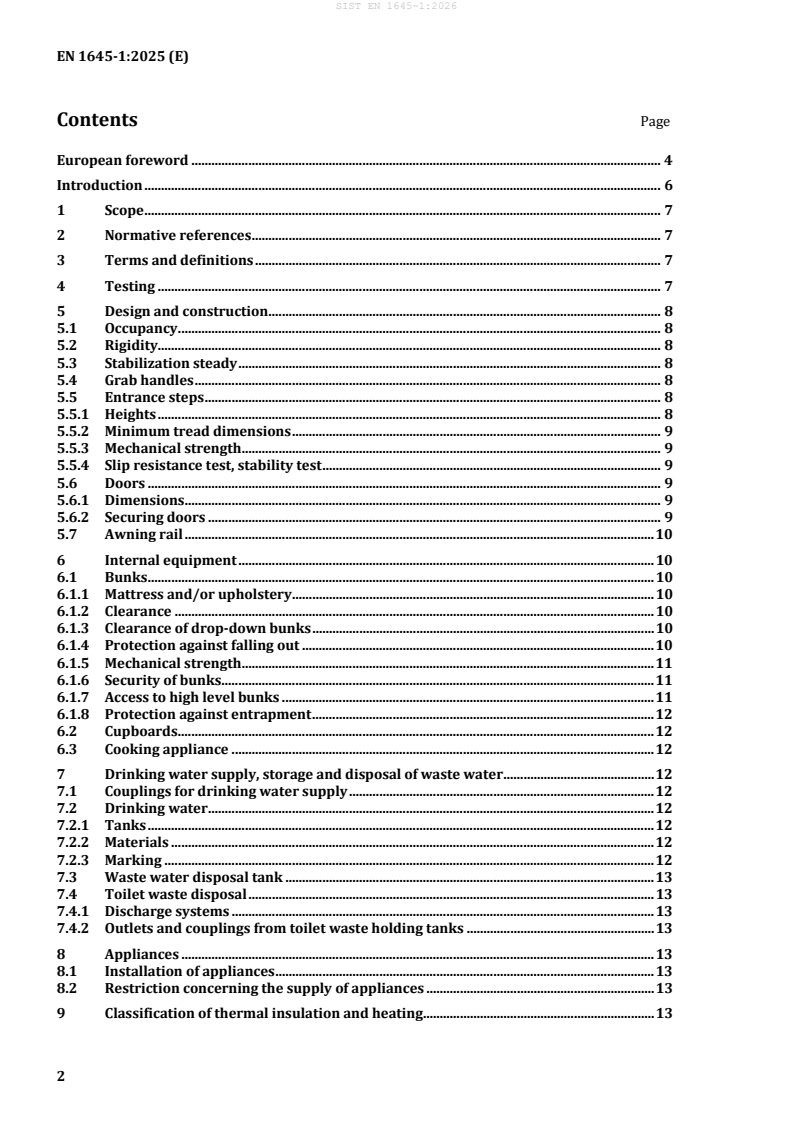
Contents Page
European foreword . 4
Introduction . 6
1 Scope . 7
2 Normative references . 7
3 Terms and definitions . 7
4 Testing . 7
5 Design and construction . 8
5.1 Occupancy . 8
5.2 Rigidity. 8
5.3 Stabilization steady . 8
5.4 Grab handles . 8
5.5 Entrance steps . 8
5.5.1 Heights . 8
5.5.2 Minimum tread dimensions . 9
5.5.3 Mechanical strength . 9
5.5.4 Slip resistance test, stability test . 9
5.6 Doors . 9
5.6.1 Dimensions. 9
5.6.2 Securing doors . 9
5.7 Awning rail . 10
6 Internal equipment . 10
6.1 Bunks . 10
6.1.1 Mattress and/or upholstery . 10
6.1.2 Clearance . 10
6.1.3 Clearance of drop-down bunks . 10
6.1.4 Protection against falling out . 10
6.1.5 Mechanical strength . 11
6.1.6 Security of bunks . 11
6.1.7 Access to high level bunks . 11
6.1.8 Protection against entrapment . 12
6.2 Cupboards . 12
6.3 Cooking appliance . 12
7 Drinking water supply, storage and disposal of waste water . 12
7.1 Couplings for drinking water supply . 12
7.2 Drinking water . 12
7.2.1 Tanks . 12
7.2.2 Materials . 12
7.2.3 Marking . 12
7.3 Waste water disposal tank . 13
7.4 Toilet waste disposal . 13
7.4.1 Discharge systems . 13
7.4.2 Outlets and couplings from toilet waste holding tanks . 13
8 Appliances . 13
8.1 Installation of appliances . 13
8.2 Restriction concerning the supply of appliances . 13
9 Classification of thermal insulation and heating . 13
10 Installations . 14
10.1 Electricity . 14
10.1.1 Low voltage . 14
10.1.2 Extra low voltage (DC) . 14
10.2 Liquefied petroleum gas (LPG) . 14
10.3 Liquid fuel . 14
11 Ventilation . 15
12 Fire precautions . 15
12.1 Means of escape . 15
12.1.1 Emergency exits . 15
12.1.2 Escape path . 15
12.1.3 Sanitation compartments . 15
12.1.4 Emergency doors . 15
12.1.5 Interior doors . 16
12.1.6 Emergency windows and emergency panels . 16
12.1.7 Work surfaces . 18
12.1.8 Heating and cooking equipment . 18
12.2 Protection of combustible elements . 18
12.2.1 Rigid or guided elements . 18
12.2.2 Non-guided elements . 18
12.3 Hotplates . 19
13 Warning notice . 19
13.1 Provision of warning notice . 19
13.2 Content of warning notice . 19
14 User's handbook . 20
Annex A (normative) Rigidity test (see 5.2) . 22
Annex B (normative) Grab handle test (see 5.4) . 24
Annex C (normative) Strength of steps (see 5.5.3, 12.1.6) . 26
Annex D (normative) Slip resistance test (see 5.5.4.1) . 28
Annex E (normative) Separate entrance step stability test (see 5.5.4.2) . 30
Annex F (normative) Clear height over bunks (see 6.1.2) . 32
Annex G (normative) Strength of protection against falling out of bunks (see 6.1.4) . 33
Annex H (normative) Mechanical strength of bunks (see 6.1.5) . 34
Annex I (normative) Security of folding bunks (see 6.1.6) . 35
Annex J (normative) Safety of access to high level bunks (see 6.1.7) . 36
Annex K (normative) Measurement of gaps (see 6.1.8) . 38
Annex L (normative) Thermal insulation – Method of calculation (see Clause 9) . 40
Annex M (normative) Determination of the thermal transmittance for caravans — Test
method (see Clause 9) . 46
Annex N (normative) Test equipment . 48
Annex O (informative) Environmental aspects. 51
Bibliography . 52
European foreword
This document (EN 1645-1:2025) has been prepared by Technical Committee CEN/TC 245 “Leisure
accommodation vehicles”, the secretariat of which is held by AFNOR.
This European Standard shall be given the status of a national standard, either by publication of an
identical text or by endorsement, at the latest by June 2026, and conflicting national standards shall be
withdrawn at the latest by June 2027.
Attention is drawn to the possibility that some of the elements of this document may be the subject of
patent rights. CEN shall not be held responsible for identifying any or all such patent rights.
This document supersedes EN 1645-1:2018.
a) requirements for caravans with a plan area greater than 6,5 m included throughout the document;
b) requirements for escape path (12.1.2) modified;
c) requirement for size of step under escape window included in 12.1.6;
d) change from “flammable” to “combustible”;
e) amendment of 5.2 “rigidity”;
f) amendment of 5.3 “Corner steadies”;
g) amendment of 5.5.1 “Heights”;
h) amendment of 5.6 “Doors” referring the dimensions;
i) 6.1.3 “Clearance of drop-down bunks” added;
j) amendment of 6.1.4.3 “Protection by curtains or nets”;
k) amendment of 6.1.7 “Access to high level bunks”;
l) amendment of Clause 7 “Drinking water supply, storage and disposal of waste water”;
m) amendment of 8.1 “Installation of appliances”;
n) amendment of 12.2.1 “Rigid or guided elements”;
o) amendment of Annex A “Rigidity test”
p) amendment of Annex C “Strength of entrance steps”;
q) amendment of Annex F “Clear height over bunks”;
r) amendment of test equipment for load spreading platform for bunks (N.5).
EN 1645, Leisure accommodation vehicles — Caravans, is currently composed of the following parts:
— Part 1: Habitation requirements relating to health and safety.
Any feedback and questions on this document should be directed to the users’ national standards body.
A complete listing of these bodies can be found on the CEN website.
According to the CEN-CENELEC Internal Regulations, the national standards organisations of the
following countries are bound to implement this European Standard: Austria, Belgium, Bulgaria, Croatia,
Cyprus, Czech Republic, Denmark, Estonia, Finland, France, Germany, Greece, Hungary, Iceland, Ireland,
Italy, Latvia, Lithuania, Luxembourg, Malta, Netherlands, Norway, Poland, Portugal, Republic of North
Macedonia, Romania, Serbia, Slovakia, Slovenia, Spain, Sweden, Switzerland, Türkiye and the United
Kingdom.
Introduction
Figure 1 gives an overview of the relevant standards for caravans, motor caravans and caravan holiday
homes.
Figure 1 — Overview of relevant standards applying to leisure accommodation vehicles
1 Scope
This document specifies requirements intended to ensure the safety and health of people when they use
caravans for temporary or seasonal habitation.
It also specifies the corresponding test methods.
Requirements applicable to road safety are not included in the scope of this document.
This document is applicable exclusively to rigid and rigid folding caravans as defined in EN 13878.
2 Normative references
The following documents are referred to in the text in such a way that some or all of their content
constitutes requirements of this document. For dated references, only the edition cited applies. For
undated references, the latest edition of the referenced document (including any amendments) applies.
EN 3-7, Portable fire extinguishers — Part 7: Characteristics, performance requirements and test methods
EN 721, Leisure accommodation vehicles - Safety ventilation requirements
EN 722-1, Leisure accommodation vehicles - Liquid fuel heating systems - Part 1: Caravans and caravan
holiday homes
EN 1648-1, Leisure accommodation vehicles - 12 V direct current extra low voltage electrical installations -
Part 1: Caravans
EN 1949, Specification for the installation of LPG systems for habitation purposes in leisure accommodation
vehicles and accommodation purposes in other vehicles
EN 13878, Leisure accommodation vehicles - Terms and definitions
EN 13501-1:2018, Fire classification of construction products and building elements - Part 1: Classification
using data from reaction to fire tests
EN ISO 8936, Awnings for leisure accommodation vehicles - Requirements and test methods (ISO 8936)
HD 60364-7-721, Low-voltage electrical installations - Part 7-721: Requirements for special installations
or locations - Electrical installations in caravans and motor caravans(IEC 60364-7-121)
ISO 4649:2024, Rubber, vulcanized or thermoplastic — Determination of abrasion resistance using a
rotating cylindrical drum device
3 Terms and definitions
For the purposes of this document, the terms and definitions given in EN 13878 apply.
ISO and IEC maintain terminology databases for use in standardization at the following addresses:
— ISO Online browsing platform: available at https://www.iso.org/obp/
— IEC Electropedia: available at https://www.electropedia.org/
4 Testing
The tests described in Annex A to Annex M are intended to verify that a caravan representative of a given
model, including its fixtures and fittings, meets the requirements of this document.
These tests are intended to simulate the most onerous conditions for the relevant characteristics.
It is recommended to take environmental aspects into account during development, production and
disposal of caravans based on established knowledge and within the respective technical possibilities
(see also Annex O).
5 Design and construction
5.1 Occupancy
The manufacturer shall designate the occupancy as the number of berths, both standard berths and
additional berths provided by the manufacturer and shall include it in the user's handbook. The
occupancy is also needed to determine the ventilation requirements (see EN 721).
5.2 Rigidity
When stationary uncoupled from a towing vehicle, with the floor horizontal, an upward thrust of 1 500 N
applied to one rear corner steady for a duration of 15 min shall not cause the caravan to distort to an
extent that would make any door or window difficult to open.
Rigidity shall be tested in accordance with Annex A.
5.3 Stabilization steady
Each caravan with a floor area > 6,5 m shall be equipped with four steadies, one at each of its four
corners. Each steady shall be retractable and adjustable in height.
Each caravan ≤ 6,5 m plan area shall be equipped with at least 2 rear steadies and one steady device at
the front of the caravan. Each steady device shall be retractable and adjustable in height. The total loading
capacity of all the steady devices installed shall be at least equal to or greater than the maximum
technically permissible laden mass of the caravan.
Each steady shall be capable, when extended, of carrying a load of not less than 25 % of the maximum
technically permissible laden mass of the caravan.
Where necessary, an appropriate operating tool shall be provided.
5.4 Grab handles
Four external grab handles for manoeuvring the caravan shall be located externally to the body work, one
on each side at the front and one on each side at the rear.
For those caravans with a maximum technically permissible laden mass not exceeding 750 kg, two grab
handles at the front of the caravan (one on each side) are sufficient.
The hand clearance aperture of each grab handle shall be not less than 30 mm × 120 mm.
The grab handles and their fixings shall be tested according to Annex B.
There shall be no visible permanent deformation or loosening of the grab handle and/or of its fixings.
5.5 Entrance steps
5.5.1 Heights
When the entrance height of the caravan, measured at maximum technically permissible laden mass, and
standing on horizontal ground with the floor level, exceeds 400 mm, the caravan shall either be fitted
with an entrance step, attachable or integral with the structure of the caravan, or a separate entrance
step(s) shall be provided. An integral entrance step can be either retractable, folding or fixed.
The rise of the first tread shall not exceed 400 mm. The rise of any other tread shall not exceed 300 mm.
5.5.2 Minimum tread dimensions
The minimum tread dimensions shall be:
a) attachable or integral entrance steps: 150 mm going over a minimum, uninterrupted width of
320 mm;
b) separate steps: 270 mm going over a minimum, uninterrupted width of 450 mm.
5.5.3 Mechanical strength
An entrance step and any fixing devices shall be capable of withstanding a load of 200 kg applied to any
surface area of 100 mm × 150 mm of the tread.
After application of this load for a period of 5 min, any permanent deformation caused shall not exceed
5 mm.
The strength of each step shall be tested in accordance with Annex C.
5.5.4 Slip resistance test, stability test
5.5.4.1 Attachable or integral step
An attachable or integral step shall have a slip resistant surface.
The slip resistance surface shall pass the test in Annex D.
5.5.4.2 Separate entrance step
A separate step shall have a slip resistant surface. The slip resistant surface shall be tested in accordance
with Annex D after having fixed the feet or base of the step.
In addition, the stability of a separate entrance step shall be tested in accordance with Annex E.
5.6 Doors
5.6.1 Dimensions
Each exterior door opening for rigid caravans shall have a minimum clear height of 1 590 mm and
a minimum clear width of 480 mm and corners of maximum radius of 90 mm. The locking system may
intrude on the minimum width up to 30 mm and for a maximum height of 150 mm, regardless of the
number of locks.
Each exterior door opening for rigid folding caravans shall have a minimum clear height of 1 300 mm and
a minimum clear width of 480 mm and corners of maximum radius of 90 mm. The locking system may
intrude on the minimum width up to 30 mm and for a maximum height of 150 mm, regardless of the
number of locks.
Each exterior door opening for caravans equal to or less than 6,5 m plan area whose body does not allow
a higher door, then a minimum clear height of 1 140 mm and a minimum clear width of 480 mm and
corners of maximum radius of 90 mm. The locking system may intrude on the minimum width up to
30 mm and for a maximum height of 150 mm, regardless of the number of locks.
5.6.2 Securing doors
Each exterior door shall be fitted with a locking device capable of keeping it closed when subjected to all
forces caused by the movement of the vehicle in normal traffic conditions.
Interior doors shall be capable of being kept in a fixed position, open or closed, in the above conditions.
5.7 Awning rail
Any awning rail shall permit the correct fitting of an awning complying with EN ISO 8936.
6 Internal equipment
6.1 Bunks
6.1.1 Mattress and/or upholstery
Bunks shall be provided with mattresses or be upholstered.
6.1.2 Clearance
For caravans over 6,5 m plan area a clear height over 2/3 of the surface area of the bunk shall be not less
than 500 mm when measured from the compressed surface of the mattress or upholstery in accordance
with the test in Annex F.
For caravans equal to or less than 6,5 m plan area a clear height over half of the surface area of the bunk
shall not be less than 400 mm when measured from the compressed surface of the mattress or upholstery
in accordance with Annex F.
6.1.3 Clearance of drop-down bunks
Where it is possible for a drop-down bunk to be lowered so that the clear height is not according to 6.1.2,
then a label according to Figure 2, shall be affixed in a visible position close to the switch or operating
mechanism to advise the customer of the risk of lowering the bunk when the lower bunk is in use.
Key
1 minimum clear height
Figure 2 — Bunk information
6.1.4 Protection against falling out
6.1.4.1 General
High level bunks shall be protected on all sides to prevent the occupant from falling out. Any gap between
one element of protection and another shall conform to 6.1.8. No gap shall exceed 75 mm.
All protections shall be secured against unintentional loosening.
High level bunks shall be provided with a label written in a language which can be easily understood by
consumers and other end-users, where the caravan is to be first sold with the following wording:
“Not suitable for children under 6 years old without supervision”.
6.1.4.2 Rigid protection
A protection is considered as rigid if it is not deformed more than 10 mm under a force of 100 N applied
horizontally in the middle of the protection, this may be tested in accordance with Annex G.
For rigid protection, the minimum height of the protection shall be at least 150 mm above the
uncompressed upper surface of the mattress or upholstery. To allow entry, an access gap of 350 mm to
550 mm measured at its narrowest point shall be provided.
6.1.4.3 Protection by curtains or nets
Alternatively, the protection may be obtained by means of curtains or nets. The minimum height of the
protection shall be at least 160 mm at any point above the uncompressed upper surface of the mattress
or upholstery, when the upper edge is loaded with 100 N in vertical direction downward.
To allow access to the bunk, the curtains or nets on at least one side of the bunk may be detachable, to
enable an opening of at least 350 mm. If a permanent opening is provided for access, this opening shall
be between 350 mm to 550 mm.
The curtains or nets shall be capable of resisting a force of 100 N applied horizontally towards the outside
of the bunk for 15 s to any point and this shall not result in any tearing nor detaching nor creating any
gap larger than 60 mm at the lower edge of the protection.
The strength of the curtains or nets shall be tested in accordance with Annex G.
Any gap created during the resistance test shall be measured in accordance with Annex K.
6.1.5 Mechanical strength
A load of 100 kg applied vertically downwards, for 1 h, from the midpoint of each side member of any
bunk where the upper surface of the compressed mattress or upholstery is placed at a height of more
than 500 mm from the floor, shall neither cause permanent deformation of more than 5 mm of the frame
of the bunk nor damage the fixing of the bunk to the structure of the caravan.
The mechanical strength shall be tested in accordance with Annex H.
6.1.6 Security of bunks
All bunks shall not unintentionally move.
If a bunk is designed to fold away, it shall be secured against unintentional folding away.
If a bunk is designed to be stored during transportation, it shall be secured against unintentional
movement when stored.
All folding bunks shall be tested in accordance with Annex I.
6.1.7 Access to high level bunks
A means of access to a high level bunk shall be provided, such as surfaces of furniture, foot holes in a solid
component, handles or a permanent or attachable ladder.
The width of the treads between supports shall be at least 250 mm.
The distance between the top foothold and of the unloaded surface of the mattress, at the point of access,
shall not be more than 400 mm.
When a ladder is used, the upper surfaces of the treads shall be equally spaced within a tolerance
of ± 12 mm, and the unobstructed distance between consecutive treads shall be (225 ± 25) mm.
There shall be an unobstructed distance of ≥ 100 mm from the front surface of the tread to any
obstruction and a clear height of 75 mm.
The safety of the ladder shall be tested in accordance with Annex J. When tested, the ladder shall not move
when subjected to a downward static load of 1 000 N and a horizontal static load of 500 N; nor shall the
ladder or its treads break or deflect permanently by more than 5 mm.
Where it is impractical to test the bunk ladder in the caravan, it is acceptable to test an identical
configuration of the ladder, its method of fixing and its range of positions of use, outside the caravan
according to Annex J.
6.1.8 Protection against entrapment
When ready for use, a bunk and its means of access shall not contain any open-ended tubing; nor shall
there be projections, holes, loose washers, speed fixing nuts or crevices on which clothing or any part of
the body could become snagged or trapped. Tension springs in the base structure are excluded. All edges,
corners and projecting parts that are accessible shall be free from burrs and sharp edges.
If the base of a bunk is not covered by permanently fixed upholstery, any gap in the base not covered by
the mattress shall not permit the passage of the cone (see K.1) beyond the point at which the diameter of
the cone is 75 mm, when measured in accordance with K.2.
Any other gap or space within the structure of the bunk which is accessible from the upper surface of the
bunk, including mattress where applicable, shall be between 12 mm and 25 mm or between 60 mm and
75 mm, (tested in accordance with K.3) or equal to or larger than 200 mm.
When a gap cannot be tested because a constructional feature prevents proper positioning of the cone,
the constructional feature may be removed to the extent necessary to allow the tests to be carried out.
6.2 Cupboards
Bases of cupboards and shelves in cupboards at more than 1 000 mm from the floor of the vehicle at the
place of measurement shall be provided with means to prevent their contents from sliding off.
Protection shall be appropriate for the items likely to be stored in the cupboards. Where an up-stand or
lip is used as the method of protection, then this should be a minimum height of 5 mm.
6.3 Cooking appliance
A cooking appliance shall be installed according to the installation instructions.
7 Drinking water supply, storage and disposal of waste water
7.1 Couplings for drinking water supply
If couplings for drinking water supply are installed, they shall be accessible from the outside of a caravan.
Access can be through an opening door or flap. A sealing off cover secured to the coupling or adjacent to
it shall be supplied for each coupling.
7.2 Drinking water
7.2.1 Tanks
Water tanks shall be capable of being completely drained and cleaned.
7.2.2 Materials
All materials in contact with water intended for human consumption shall not impair the drinking water
quality.
NOTE For all materials that are designed to come into contact with water intended for human consumption,
attention is drawn to the requirements of Article 11 of Directive (EU) 2020/2184 on the quality of water intended
for human consumption and local and national requirements for the country of first destination.
7.2.3 Marking
The drinking water filling points shall be clearly identified in blue.
7.3 Waste water disposal tank
When a drinking water tank is fixed in the caravan, one (or more) waste water tank(s) of total capacity
at least equal to 50 % of the drinking water tank capacity shall be provided. Any waste water tank shall
be either fixed or moveable and it shall be capable of being flushed and cleaned. If moveable, a storage
area shall be provided.
7.4 Toilet waste disposal
7.4.1 Discharge systems
Discharge from a toilet shall be collected in a closed system and shall not be discharged into a waste water
disposal system. Any fixed tank intended to receive discharge from a toilet shall be fitted with a level
indicator or early warning device that will indicate to the user that the tank will require emptying after a
further three or four uses.
7.4.2 Outlets and couplings from toilet waste holding tanks
The internal diameter of a coupling taking discharge from a toilet-holding tank shall be a minimum of
70 mm. It shall have a secure detachable connection to receive a 75 mm minimum internal diameter hose
and a 1 500 mm minimum length of such hose shall be provided.
When a macerator is fitted the internal diameter may be reduced to 32 mm.
These requirements do not apply to toilets with removable toilet waste holding tanks.
8 Appliances
8.1 Installation of appliances
Appliances shall be installed in accordance with the appliance manufacturer’s instructions.
NOTE Regarding appliances fitted within the caravan, local and national requirements for the country of first
destination can apply.
8.2 Restriction concerning the supply of appliances
Portable appliances producing heat and non-room-sealed space heating appliances shall not be supplied
with the caravan by the caravan manufacturer.
9 Classification of thermal insulation and heating
The thermal insulation and heating levels for specific climatic conditions shall be classified as follows:
a) Grade 1: a caravan, including windows, doors and roof lights in which the average thermal
transmittance
(U) of the elements of construction shall not exceed 1,7 W/(m ·K).
There is no heating requirement for this grade.
b) Grade 2: a caravan, including windows, doors and roof lights in which the average thermal
transmittance
(U) of the elements of construction shall not exceed 1,7 W/(m ·K).
An average temperature difference of at least 20 K between inside and outside temperatures shall be
achieved when the outside temperature is 0 °C.
c) Grade 3: a caravan, including windows, doors and roof lights in which the average thermal
transmittance
(U) of the elements of construction shall not exceed 1,2 W/(m ·K).
An average temperature difference of at least 35 K between inside and outside temperatures shall be
achieved when the outside temperature is −15 °C.
Precautions shall be taken to ensure that the fresh-water supply can be filled at the end of the
stabilizing time of one hour according to Annex M. Then the fresh-water service shall operate when
the outside temperature is −15 °C.
Grades 1 and 2 shall be calculated in accordance with Annex L or tested in accordance with Annex M.
Grade 3 shall be tested in accordance with Annex M.
To ensure compliance with this clause, it is sufficient to test only one caravan with the largest overall plan
area of a specified number of similar caravans. This caravan shall fulfil the following conditions:
1) the bodywork, materials used and cross sectional dimensions in similar positions for the walls, floor,
roof and windows are identical (except for colour);
2) the caravan tested shall have the largest total window area;
3) the space heater shall have the smallest output;
4) all caravans shall have the same space heating system (convicted air, blown air, hot water, etc.);
5) the caravan shall have the least number of heating outlets (air outlets, heat exchangers, radiators,
etc.) of the smallest dimensions of the caravans;
6) all caravans shall have the same hot and cold water supply system and any tank(s) shall have the
same method of protection against freezing.
10 Installations
10.1 Electricity
10.1.1 Low voltage
Low voltage electrical installations shall conform to HD 60364-7-721.
10.1.2 Extra low voltage (DC)
Direct current extra low voltage installations shall conform to EN 1648-1.
10.2 Liquefied petroleum gas (LPG)
LPG installations shall conform to EN 1949.
10.3 Liquid fuel
Installations of liquid fuel heating systems shall conform to EN 722-1.
11 Ventilation
Safety ventilation shall be provided and shall conform to EN 721.
12 Fire precautions
12.1 Means of escape
12.1.1 Emergency exits
Each separate living compartment, which can be closed off from the rest of a caravan other than by means
of a loose textile curtain, shall be provided with an emergency exit (emergency door, emergency panel or
emergency window) giving direct access to the outside of the caravan in accordance with 12.1.4 or 12.1.6,
as appropriate.
Means of emergency exit from the bunk shall be accessible from the upper surface of the bunk.
12.1.2 Escape path
It shall be possible to reach an emergency exit by means of an unobstructed escape path.
Objects such as drawers, furniture doors, bunk ladders, oven doors etc. that can be moved quickly and
easily with a single operation shall not be considered as obstructions. One operation is a train of
movements effected without removing the hand(s) from the element(s) on which it is acting (e.g. 1, 2 and
3 successively). See Figure 5.
An escape path shall be at least 450 mm wide except for caravans equal to or below 6,5 m plan area
where a limited restriction to this escape path is permitted provided that the following conditions are
met:
1) the width of the escape path over a maximum length of 500 mm may be restricted below 450 mm;
2) the minimum dimensions of the restriction shall be 300 mm up to a maximum height of 950 mm and
450 mm above this height;
3) there shall be no doors, drawers, etc. that could temporarily obstruct the escape path within the zone
where the escape path is restricted.
When the access to an emergency exit door is temporarily obstructed, the escape path to it may be limited
to a height of 1 140 mm from the floor. When the height is restricted, the escape path shall have a
minimum width of 480 mm and a maximum length of 750 mm. The length distance or sum of distances
is measured from the start of the reduced height to the nearest door handle of the emergency exit door
passing through the escape path.
Access to the emergency door handle shall be maintained.
12.1.3 Sanitation compartments
Sanitation compartments shall be equipped with an emergency exit unless the external handle of the
compartment door is situated less than 2 000 mm from an emergency exit of the caravan. This distance
or sum of distances is measured from the door handle of the sanitation compartment with the door of the
sanitation compartment closed to the nearest part of the emergency exit aperture passing through the
escape path.
12.1.4 Emergency doors
Emergency doors shall open outwards or slide horizontally, and shall provide a clear opening, free from
obstruction, of the sizes specified in 5.6.1. The door lock(s), even if locked from the outside, shall be
capable of being immediately opened from the inside. This requirement is considered as fulfilled if
opening of the emergency doors can be performed in not more than two operations, in addition to
opening curtains blinds or fly screens. The use of two hands for a simultaneous operation shall be
considered as one operation.
12.1.5 Interior doors
Opening mechanisms for interior doors shall be capable of being operated from both sides. When fitted,
lever handles shall open interior doors by being pushed downwards.
Where an interior door between compartments is fitted with a locking mechanism on one side, an
emergency unlocking system shall be fitted on the other side.
12.1.6 Emergency windows and emergency panels
Emergency windows and emergency panels shall open outwards or slide horizontally and shall provide
a clear opening, free from obstruction, of not less than 0,25 m , with a minimum dimension in any one
direction of 450 mm.
For compartments exclusively for the use of children and in which there are two bunks above the lower
bunk, the minimum dimension in any one direction may be reduced to 350 mm so long as the clear
opening shall be not less than 0,25 m . See Figure 3. Any projecting element should be deducted from the
total area of the aperture (e.g. catches, locks, fixing for window stays, blinds).
Key
1 disc o
...