


EN 16836-1:2016
(Main)Communication systems for meters - Wireless mesh networking for meter data exchange - Part 1: Introduction and standardization framework
General Information
- Abstract
This European Standard gives the standardization framework of communication systems applicable to the exchange of data from metering devices to other devices within a mesh network.
This European Standard specifies how to interpret prEN 16836-2:2015 and prEN 16836-3:2015 which give a list of references to the ZigBee documents. This series is applicable to communications systems that involve messages and networking between a meter or multiple meters and other devices in a mesh network, such as in home displays (IHDs) and communications hubs. This European Standard allows routing between devices and also allows channel agility to avoid contention with other networks of the same type, or indeed networks of other types operating in the same frequency bands.
This European Standard is designed to support low power communications for devices such as gas and water meters which can make data from such devices available on the mesh network at any time through a proxy capability within a permanently powered device.
- Status
- Withdrawn
- Publication Date
- 15-Nov-2016
- Withdrawal Date
- 16-Sep-2026
- Technical Committee
- CEN/TC 294 - Communication systems for meters and remote reading of meters
- Current Stage
- 9960 - Withdrawal effective - Withdrawal
- Start Date
- 08-Nov-2023
- Completion Date
- 17-Sep-2026

Relations
- Effective Date
- 28-Jan-2026
- Effective Date
- 28-Jan-2026
Get Certified
Connect with accredited certification bodies for this standard

BSI Group
BSI (British Standards Institution) is the business standards company that helps organizations make excellence a habit.

NYCE
Mexican standards and certification body.

ANCE
Mexican certification and testing association.
Sponsored listings
Frequently Asked Questions
EN 16836-1:2016 is a standard published by the European Committee for Standardization (CEN). Its full title is "Communication systems for meters - Wireless mesh networking for meter data exchange - Part 1: Introduction and standardization framework". This standard covers: This European Standard gives the standardization framework of communication systems applicable to the exchange of data from metering devices to other devices within a mesh network. This European Standard specifies how to interpret prEN 16836-2:2015 and prEN 16836-3:2015 which give a list of references to the ZigBee documents. This series is applicable to communications systems that involve messages and networking between a meter or multiple meters and other devices in a mesh network, such as in home displays (IHDs) and communications hubs. This European Standard allows routing between devices and also allows channel agility to avoid contention with other networks of the same type, or indeed networks of other types operating in the same frequency bands. This European Standard is designed to support low power communications for devices such as gas and water meters which can make data from such devices available on the mesh network at any time through a proxy capability within a permanently powered device.
This European Standard gives the standardization framework of communication systems applicable to the exchange of data from metering devices to other devices within a mesh network. This European Standard specifies how to interpret prEN 16836-2:2015 and prEN 16836-3:2015 which give a list of references to the ZigBee documents. This series is applicable to communications systems that involve messages and networking between a meter or multiple meters and other devices in a mesh network, such as in home displays (IHDs) and communications hubs. This European Standard allows routing between devices and also allows channel agility to avoid contention with other networks of the same type, or indeed networks of other types operating in the same frequency bands. This European Standard is designed to support low power communications for devices such as gas and water meters which can make data from such devices available on the mesh network at any time through a proxy capability within a permanently powered device.
EN 16836-1:2016 is classified under the following ICS (International Classification for Standards) categories: 33.200 - Telecontrol. Telemetering; 35.100.10 - Physical layer. The ICS classification helps identify the subject area and facilitates finding related standards.
EN 16836-1:2016 has the following relationships with other standards: It is inter standard links to EN 16836-3:2016, EN 16836-2:2016. Understanding these relationships helps ensure you are using the most current and applicable version of the standard.
EN 16836-1:2016 is associated with the following European legislation: Standardization Mandates: M/441, M/462, M/463. When a standard is cited in the Official Journal of the European Union, products manufactured in conformity with it benefit from a presumption of conformity with the essential requirements of the corresponding EU directive or regulation.
EN 16836-1:2016 is available in PDF format for immediate download after purchase. The document can be added to your cart and obtained through the secure checkout process. Digital delivery ensures instant access to the complete standard document.
Standards Content (Sample)
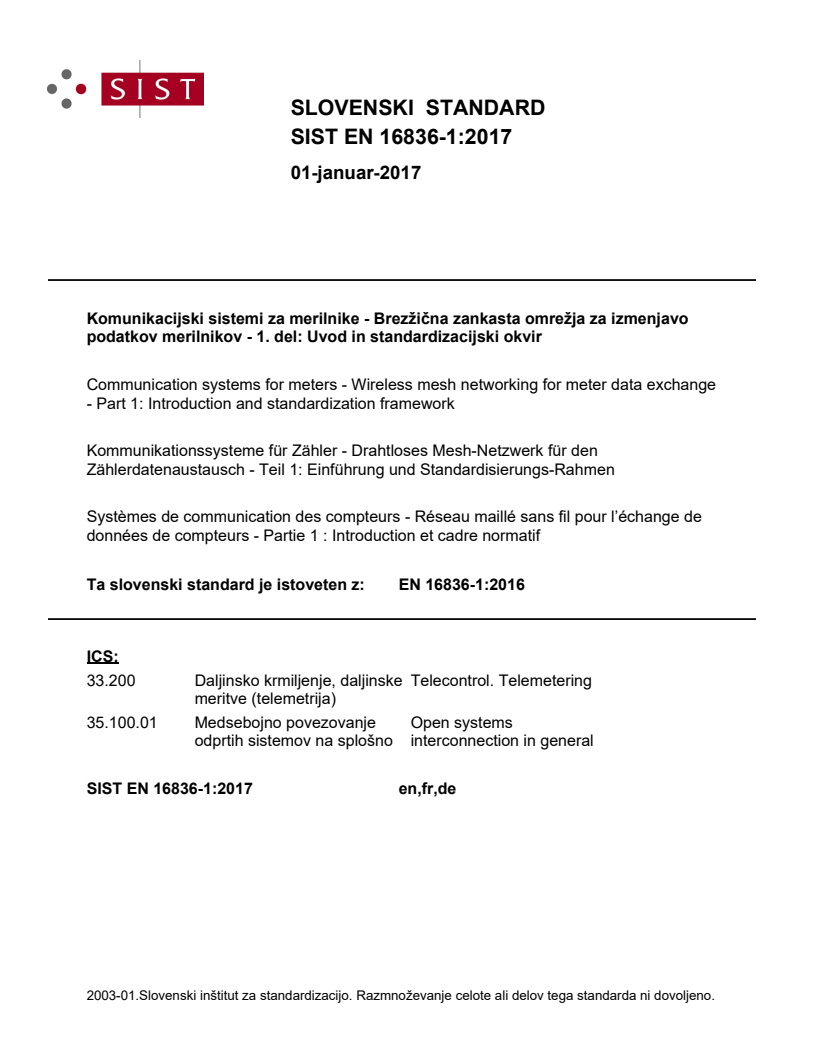
2003-01.Slovenski inštitut za standardizacijo. Razmnoževanje celote ali delov tega standarda ni dovoljeno.Kommunikationssysteme für Zähler - Drahtloses Mesh-Netzwerk für den Zählerdatenaustausch - Teil 1: Einführung und Standardisierungs-RahmenSystèmes de communication des compteurs - Réseau maillé sans fil pour l’échange de données de compteurs - Partie 1 : Introduction et cadre normatifCommunication systems for meters - Wireless mesh networking for meter data exchange - Part 1: Introduction and standardization framework35.100.01Medsebojno povezovanje odprtih sistemov na splošnoOpen systems interconnection in general33.200Daljinsko krmiljenje, daljinske meritve (telemetrija)Telecontrol. TelemeteringICS:Ta slovenski standard je istoveten z:EN 16836-1:2016SIST EN 16836-1:2017en,fr,de01-januar-2017SIST EN 16836-1:2017SLOVENSKI
STANDARD
EUROPEAN STANDARD NORME EUROPÉENNE EUROPÄISCHE NORM
EN 16836-1
November
t r s x ICS
u uä t r râ
u wä s r rä s r English Version
Communication systems for meters æ Wireless mesh networking for meter data exchange æ Part
sã Introduction and standardization framework Systèmes de communication des compteurs æ Réseau maillé sans fil pour l 5échange de données de compteurs æ Partie
s ã Introduction et cadre normatif
Kommunikationssysteme für Zähler æ Drahtloses MeshæNetzwerk für den Zählerdatenaustausch æ Teil
sã Einführung und StandardisierungsæRahmen This European Standard was approved by CEN on
u September
t r s xä
egulations which stipulate the conditions for giving this European Standard the status of a national standard without any alterationä Upætoædate lists and bibliographical references concerning such national standards may be obtained on application to the CENæCENELEC Management Centre or to any CEN memberä
translation under the responsibility of a CEN member into its own language and notified to the CENæCENELEC Management Centre has the same status as the official versionsä
CEN members are the national standards bodies of Austriaá Belgiumá Bulgariaá Croatiaá Cyprusá Czech Republicá Denmarká Estoniaá Finlandá Former Yugoslav Republic of Macedoniaá Franceá Germanyá Greeceá Hungaryá Icelandá Irelandá Italyá Latviaá Lithuaniaá Luxembourgá Maltaá Netherlandsá Norwayá Polandá Portugalá Romaniaá Slovakiaá Sloveniaá Spainá Swedená Switzerlandá Turkey andUnited Kingdomä
EUROPEAN COMMITTEE FOR STANDARDIZATION COMITÉ EUROPÉEN DE NORMALISATION EUROPÄISCHES KOMITEE FÜR NORMUNG
CEN-CENELEC Management Centre:
Avenue Marnix 17,
B-1000 Brussels
t r s x CEN All rights of exploitation in any form and by any means reserved worldwide for CEN national Membersä Refä Noä EN
s x z u xæ sã t r s x ESIST EN 16836-1:2017
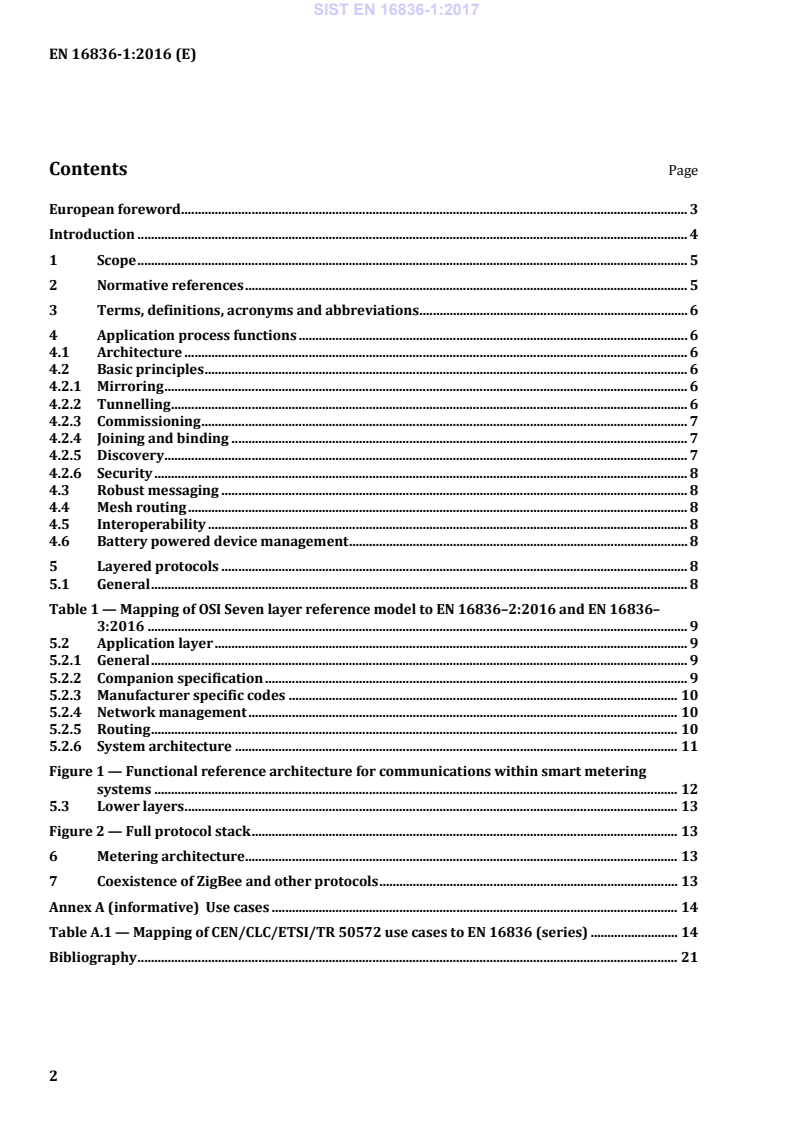
Use cases . 14 Table A.1 — Mapping of CEN/CLC/ETSI/TR 50572 use cases to EN 16836 (series) . 14 Bibliography . 21
ZigBee Specification – 05-3474 Rev 20,
ZigBee Pro Stack Profile – 07-4855 Rev 05,
ZigBee Cluster Library – 07-5123 Rev 04,
ZigBee Smart Energy Profile Specification 07-5356 Rev 19, and
OTA Cluster Specification 09-5264 Rev 19 4 Application process functions 4.1 Architecture The ZigBee Protocol operates using a concept of a client server relationship between logical devices in a network and uses a concept of clusters to exchange information. A cluster is a related collection of commands and attributes, which together define an interface to specific functionality. Typically, the entity that stores the attributes of a cluster is referred to as the server of that cluster, and an entity that affects or manipulates those attributes is referred to as the client of that cluster. In general terms all clusters have a server and a client side, meaning that all information either published or requested on the network is owned by the device attached to the server side of a cluster and received or requested by the device attached to the client side of that particular cluster. 4.2 Basic principles 4.2.1 Mirroring Mirroring is described in detail in Annex D of the ZigBee Smart Energy Profile Specification 07-5356 Rev 19. The concept of this functionality is to allow data from a battery operated, sleepy device to be available all of the time to other devices on the network by allowing another 'always on' device to hold a copy of the device's data in a proxy or mirror. This proxy or mirror can also be used to allow commands or instructions from an AMI Head End System to be issued to a sleepy device without necessitating the sleepy device to be awake at the time of transmitting the command. This functionality is commonly used in the case of a gas meter that wakes up every so often to check for commands awaiting it, and to publish its own meter readings, status, alarms etc. The principle is that the gas meter will awaken and query the mirror that is supported in the 'always on' device to determine what commands are awaiting it. The 'always on' device will inform the sleepy device that there are instructions or commands awaiting it and tell the gas meter to stay awake to receive them. The gas meter will then have the chance to write its own cluster data to the mirror ready for other devices on the network to read this data or be sent it (depending on the device and data item). 4.2.2 Tunnelling This functionality is discussed in detail in ZigBee Smart Energy Profile Specification, D.6, and allows the transport of another protocol over a ZigBee smart energy network without the need for any other device on the network having to understand or interpret the payload of the other protocols packets. Fragmentation functionality within the ZigBee Protocol allows the packets of the tunnelled protocol to be broken down and transported across the smart energy (SE) network in packets that are of appropriate size to be managed by the SE Network. Once packets have been transported from one SIST EN 16836-1:2017
...