


EN 1294:2000
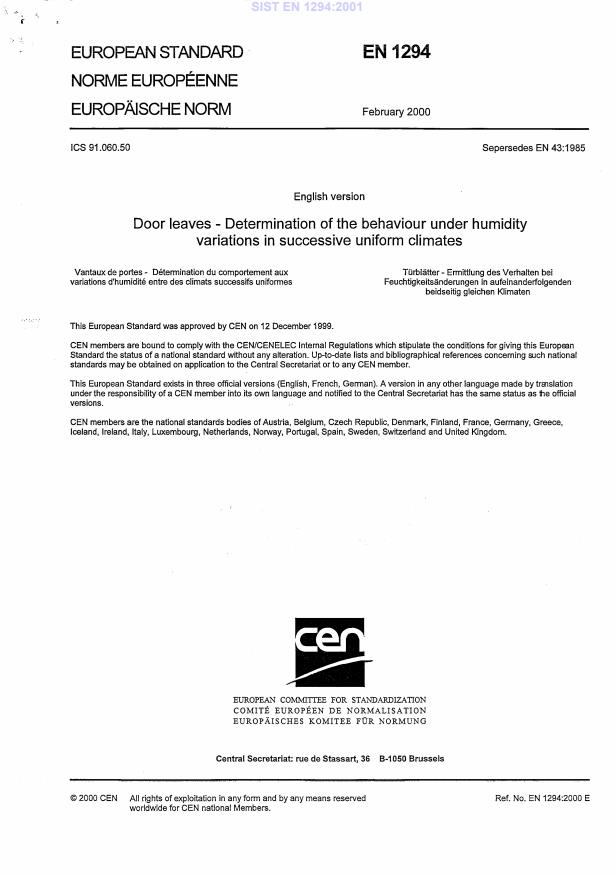
(Main)Door leaves - Determination of the behaviour under humidity variations in successive uniform climates
General Information
- Abstract
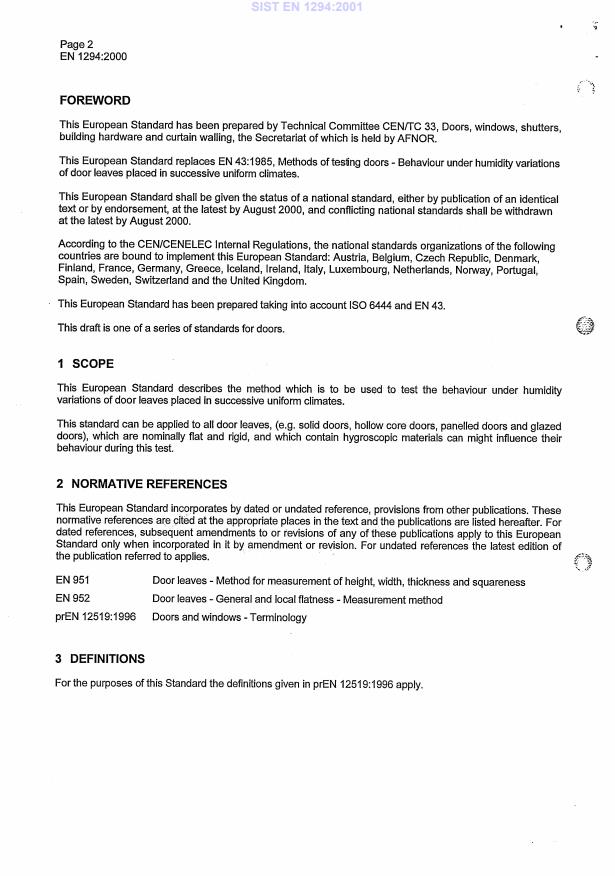
This European Standard describes the method which is to be used to test the behaviour under humidity variations of door leaves placed in successive uniform climates. This standard can be applied to all door leaves(e.g.solid, hollow core, panelled and glazed doors ), which are nominally flat and rigid, and which contain hygroscopic materials which might influence their behaviour during this test.
- Status
- Published
- Publication Date
- 15-Feb-2000
- Withdrawal Date
- 30-Aug-2000
- Technical Committee
- CEN/TC 33 - Doors, windows, shutters and building hardware
- Drafting Committee
- CEN/TC 33/WG 2 - Windows
- Current Stage
- 9093 - Decision to confirm - Review Enquiry
- Start Date
- 10-Jan-2023
- Completion Date
- 23-Sep-2026
- Directive
- Harmonized Standard305/2011 - Regulation (eu) No 305/2011 of the European Parliament and of the Council of 9 march 2011 laying down harmonised conditions for the marketing of construction products and repealing council directive 89/106/eec
Not Harmonized89/106/EEC - Construction products

Overview
EN 1294:2000 (CEN) specifies a method to determine the behaviour of door leaves when exposed to humidity variations in successive uniform climates. The standard applies to all door leaves that are nominally flat and rigid and contain hygroscopic materials that may influence behaviour during the test. Typical door types covered include solid, hollow-core, panelled and glazed doors.
The primary objective of EN 1294:2000 is to provide a repeatable laboratory procedure for assessing how moisture changes affect dimensional stability and overall performance of door leaves. This helps stakeholders make informed decisions about design, materials selection and quality control without prescribing specific manufacturing tolerances or acceptance criteria.
Key Topics
- Scope and applicability: Addresses door leaves with hygroscopic components and nominally flat, rigid construction.
- Test purpose: Evaluate behaviour under humidity variations across successive uniform climates to reveal dimensional movement, warping tendencies and other moisture-induced effects.
- Specimen types: Applicable to solid, hollow-core, panelled and glazed doors, as long as they meet the nominal flat/rigid criteria.
- Relevance of hygroscopic materials: Recognises that internal materials (cores, veneers, glues) can influence moisture response and therefore are considered in the test context.
- Repeatability and comparability: Establishes a consistent method to enable comparison between products, batches and suppliers.
Applications
EN 1294:2000 is valuable across the supply chain and in quality assurance processes:
- Manufacturers: Use the method to evaluate material choices, construction methods and finishing systems for moisture resilience.
- Test laboratories: Provide standardized test reports that support performance claims and product development.
- Specifiers and architects: Reference the standard when assessing suitability of door leaves for environments with variable humidity.
- Quality control: Incorporate test results into acceptance checks and production monitoring to reduce field failures related to moisture movement.
Benefits include improved product reliability, clearer communication of performance expectations, and support for compliance with contractual or regulatory requirements.
Related Standards
While EN 1294:2000 focuses specifically on door leaves and humidity variation in successive uniform climates, related standards may cover broader topics such as door and window performance, fire resistance, or specific material testing for hygroscopic components. Users should consult CEN catalogues and national adoptions for adjacent standards and implementation guidance.
For implementers, EN 1294:2000 serves as a practical, repeatable method to understand and mitigate humidity-related risks in door leaf performance.
Relations
- Effective Date
- 28-Jan-2026
- Effective Date
- 28-Jan-2026
- Effective Date
- 28-Jan-2026
- Effective Date
- 28-Jan-2026
- Effective Date
- 28-Jan-2026
- Effective Date
- 28-Jan-2026
- Effective Date
- 28-Jan-2026
- Effective Date
- 28-Jan-2026
Get Certified
Connect with accredited certification bodies for this standard

DIBt (Deutsches Institut für Bautechnik)
German Institute for Building Technology.
DIN CERTCO
DIN Group product certification.

Aboma Certification B.V.
Specialized in construction, metal, and transport sectors.
Sponsored listings
Frequently Asked Questions
EN 1294:2000 is a standard published by the European Committee for Standardization (CEN). Its full title is "Door leaves - Determination of the behaviour under humidity variations in successive uniform climates". This standard covers: This European Standard describes the method which is to be used to test the behaviour under humidity variations of door leaves placed in successive uniform climates. This standard can be applied to all door leaves(e.g.solid, hollow core, panelled and glazed doors ), which are nominally flat and rigid, and which contain hygroscopic materials which might influence their behaviour during this test.
This European Standard describes the method which is to be used to test the behaviour under humidity variations of door leaves placed in successive uniform climates. This standard can be applied to all door leaves(e.g.solid, hollow core, panelled and glazed doors ), which are nominally flat and rigid, and which contain hygroscopic materials which might influence their behaviour during this test.
EN 1294:2000 is classified under the following ICS (International Classification for Standards) categories: 91.060.50 - Doors and windows. The ICS classification helps identify the subject area and facilitates finding related standards.
EN 1294:2000 has the following relationships with other standards: It is inter standard links to EN 952:1999, EN 12519:2018, EN 951:1998, EN 16580:2015, EN 12219:1999, EN 15644:2008, CEN/TS 16526:2013, EN ISO 11904-1:2002. Understanding these relationships helps ensure you are using the most current and applicable version of the standard.
EN 1294:2000 is associated with the following European legislation: EU Directives/Regulations: 305/2011, 89/106/EEC. When a standard is cited in the Official Journal of the European Union, products manufactured in conformity with it benefit from a presumption of conformity with the essential requirements of the corresponding EU directive or regulation.
EN 1294:2000 is available in PDF format for immediate download after purchase. The document can be added to your cart and obtained through the secure checkout process. Digital delivery ensures instant access to the complete standard document.
Standards Content (Sample)
2003-01.Slovenski inštitut za standardizacijo. Razmnoževanje celote ali delov tega standarda ni dovoljeno.Türblätter - Ermittlung des Verhalten bei Feuchtigkeitsänderungen in aufeinanderfolgenden beidseitig gleichen KlimatenVantaux de portes - Détermination du comportement aux variations d'humidité entre des climats successifs uniformesDoor leaves - Determinatio
...