


prEN 14015
(Main)Specification for the design and manufacture of site built, vertical, cylindrical, flat-bottomed, above ground, welded, steel tanks for the storage of liquids at ambient temperature and above
General Information
- Abstract
This document specifies the requirements for the materials, design, fabrication, erection, testing and inspection of site built, vertical, cylindrical, flat bottomed, above ground, welded, steel tanks for the storage of liquids at ambient temperatures and above.
It is concerned with the structural design of the basic tank structure and does not provide requirements for considering process design, operational issues, safety and firefighting facilities, in-service inspection, maintenance, or repair.
This document is intended for use in conjunction with EN 1993-4-2 and so adheres the general principles and performance requirements for the structural design and serviceability limit states of those tank components. Specific requirements are addressed in EN 14015.
It is applicable to:
– closed-top tanks, with and without internal floating roofs;
– open-top tanks, with and without floating roofs;
– tanks for which:
a) the design pressure is not greater than 60 mbar;
b) the design internal negative pressure is not lower than 6,0 mbar;
c) the design metal temperature is between –40 °C and +300 °C;
d) the maximum design liquid level is not higher than the top of the cylindrical shell;
e) the maximum allowable stress does not exceed 260 N/mm2.
The limits of application of this document terminate at the following locations:
– face of the first flange in a bolted flange connection;
– first threaded joint on the pipe or coupling outside of the tank shell, roof or bottom;
– first circumferential joint in a pipe not having a flange connection.
This document does not apply to tanks where the product is refrigerated to maintain it as a liquid at atmospheric pressure.
- Status
- Not Published
- Publication Date
- 11-Feb-2027
- Technical Committee
- CEN/TC 265 - Site built metallic tanks for the storage of liquids
- Drafting Committee
- CEN/TC 265/WG 9 - Site built tanks for liquids at ambient temperatures
- Current Stage
- 4060 - Closure of enquiry - Enquiry
- Start Date
- 27-Nov-2025
- Due Date
- 10-Dec-2024
- Completion Date
- 27-Nov-2025

Overview
prEN 14015 is the CEN draft specification for the structural design and manufacture of site-built, vertical, cylindrical, flat-bottomed, above-ground welded steel tanks for storing liquids at ambient temperature and above. It specifies requirements covering materials, design, fabrication, erection, testing and inspection of the basic tank structure. The standard is intended to be used together with EN 1993-4-2 and aligns with Eurocode principles for structural performance and serviceability.
Key application limits stated in the scope include:
- Closed-top and open-top tanks, with or without internal floating roofs
- Design internal pressure ≤ 60 mbar and internal negative pressure ≥ -6.0 mbar
- Design metal temperature between −40 °C and +300 °C
- Maximum design liquid level no higher than the top of the cylindrical shell
- Maximum allowable stress not exceeding 260 N/mm²
The document excludes process design, operational issues, firefighting provisions, in-service inspection, maintenance or repair and does not apply to refrigerated tanks maintained as liquids at atmospheric pressure.
Key Topics
- Materials: requirements for carbon, carbon-manganese and stainless steels, plates, sections, forgings, pipes and welding consumables, including impact energy provisions and thickness tolerances.
- Design loads: liquid-induced loads, internal pressure, thermal loads, dead loads, wind, snow, rainfall and seismic actions, plus load combinations and emergency loads.
- Tank bottom and shell design: structural design principles for flat bottoms and cylindrical shells, including stiffening rings, shell axial compression and elevated temperature effects on material properties.
- Roof and floating roof design: fixed roofs, membrane roofs, roof plating and supporting structures, and internal floating roof guidance.
- Fabrication and testing: welding, joint efficiency, inspection and testing practices relevant to site-built tanks.
Applications
prEN 14015 is practical for:
- Tank manufacturers and fabricators designing and constructing site-built above-ground storage tanks
- Structural and mechanical engineers applying Eurocode-based structural rules (EN 1993-4-2) to liquid storage tanks
- Project specifiers and purchasers who require harmonised requirements for materials, fabrication, testing and inspection
Benefits include a consistent framework for structural safety, material selection, and quality assurance during manufacture and erection of vertical welded steel tanks.
Related Standards
- EN 1993-4-2 (Eurocode 3) - used in conjunction with prEN 14015 for structural design principles
- National implementations and other CEN/CENELEC documents referenced within prEN 14015 for loadings, materials and testing
For compliance and procurement, prEN 14015 provides the structural requirements and testing/inspection checkpoints that support safe, consistent construction of site-built steel storage tanks.
Relations
- Effective Date
- 01-Nov-2023
Get Certified
Connect with accredited certification bodies for this standard

Institut za varilstvo d.o.o. (Welding Institute)
Slovenia's leading welding institute since 1952. ISO 3834, EN 1090, pressure equipment certification, NDT personnel, welder qualification. Only IIW Au
Sponsored listings
Frequently Asked Questions
prEN 14015 is a draft published by the European Committee for Standardization (CEN). Its full title is "Specification for the design and manufacture of site built, vertical, cylindrical, flat-bottomed, above ground, welded, steel tanks for the storage of liquids at ambient temperature and above". This standard covers: This document specifies the requirements for the materials, design, fabrication, erection, testing and inspection of site built, vertical, cylindrical, flat bottomed, above ground, welded, steel tanks for the storage of liquids at ambient temperatures and above. It is concerned with the structural design of the basic tank structure and does not provide requirements for considering process design, operational issues, safety and firefighting facilities, in-service inspection, maintenance, or repair. This document is intended for use in conjunction with EN 1993-4-2 and so adheres the general principles and performance requirements for the structural design and serviceability limit states of those tank components. Specific requirements are addressed in EN 14015. It is applicable to: – closed-top tanks, with and without internal floating roofs; – open-top tanks, with and without floating roofs; – tanks for which: a) the design pressure is not greater than 60 mbar; b) the design internal negative pressure is not lower than 6,0 mbar; c) the design metal temperature is between –40 °C and +300 °C; d) the maximum design liquid level is not higher than the top of the cylindrical shell; e) the maximum allowable stress does not exceed 260 N/mm2. The limits of application of this document terminate at the following locations: – face of the first flange in a bolted flange connection; – first threaded joint on the pipe or coupling outside of the tank shell, roof or bottom; – first circumferential joint in a pipe not having a flange connection. This document does not apply to tanks where the product is refrigerated to maintain it as a liquid at atmospheric pressure.
This document specifies the requirements for the materials, design, fabrication, erection, testing and inspection of site built, vertical, cylindrical, flat bottomed, above ground, welded, steel tanks for the storage of liquids at ambient temperatures and above. It is concerned with the structural design of the basic tank structure and does not provide requirements for considering process design, operational issues, safety and firefighting facilities, in-service inspection, maintenance, or repair. This document is intended for use in conjunction with EN 1993-4-2 and so adheres the general principles and performance requirements for the structural design and serviceability limit states of those tank components. Specific requirements are addressed in EN 14015. It is applicable to: – closed-top tanks, with and without internal floating roofs; – open-top tanks, with and without floating roofs; – tanks for which: a) the design pressure is not greater than 60 mbar; b) the design internal negative pressure is not lower than 6,0 mbar; c) the design metal temperature is between –40 °C and +300 °C; d) the maximum design liquid level is not higher than the top of the cylindrical shell; e) the maximum allowable stress does not exceed 260 N/mm2. The limits of application of this document terminate at the following locations: – face of the first flange in a bolted flange connection; – first threaded joint on the pipe or coupling outside of the tank shell, roof or bottom; – first circumferential joint in a pipe not having a flange connection. This document does not apply to tanks where the product is refrigerated to maintain it as a liquid at atmospheric pressure.
prEN 14015 is classified under the following ICS (International Classification for Standards) categories: 23.020.10 - Stationary containers and tanks. The ICS classification helps identify the subject area and facilitates finding related standards.
prEN 14015 has the following relationships with other standards: It is inter standard links to EN 14015:2004. Understanding these relationships helps ensure you are using the most current and applicable version of the standard.
prEN 14015 is available in PDF format for immediate download after purchase. The document can be added to your cart and obtained through the secure checkout process. Digital delivery ensures instant access to the complete standard document.
Standards Content (Sample)
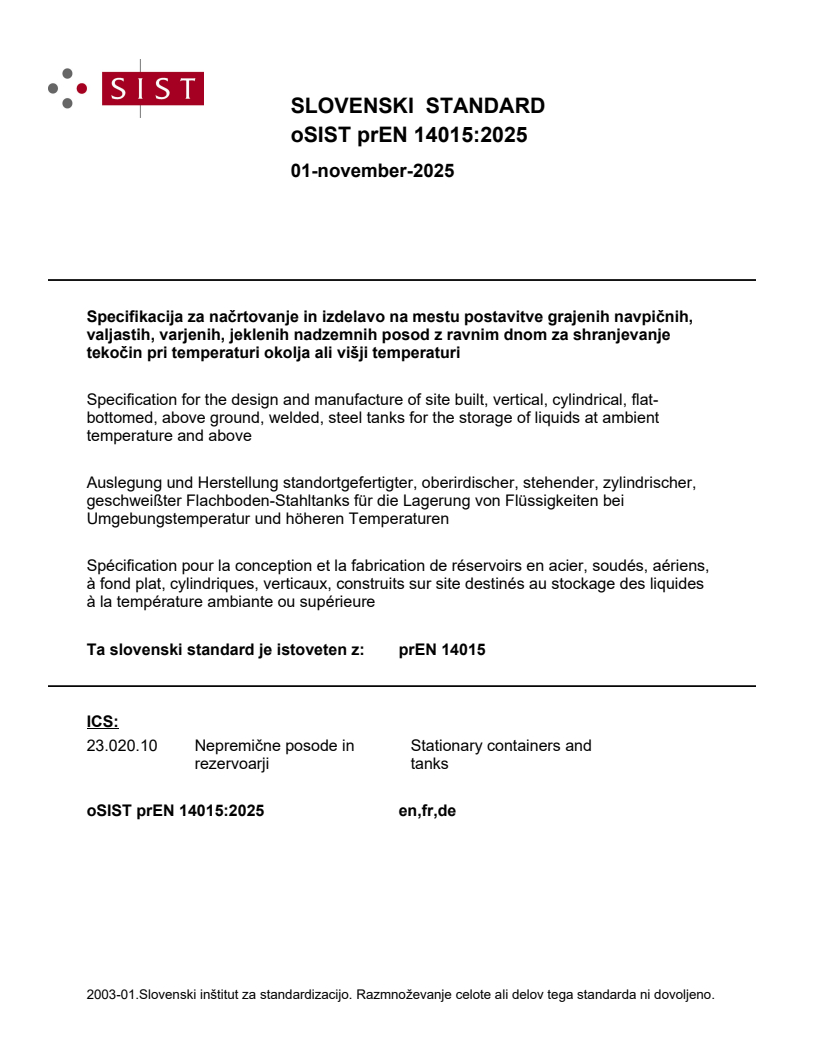
SLOVENSKI STANDARD
01-november-2025
Specifikacija za načrtovanje in izdelavo na mestu postavitve grajenih navpičnih,
valjastih, varjenih, jeklenih nadzemnih posod z ravnim dnom za shranjevanje
tekočin pri temperaturi okolja ali višji temperaturi
Specification for the design and manufacture of site built, vertical, cylindrical, flat-
bottomed, above ground, welded, steel tanks for the storage of liquids at ambient
temperature and above
Auslegung und Herstellung standortgefertigter, oberirdischer, stehender, zylindrischer,
geschweißter Flachboden-Stahltanks für die Lagerung von Flüssigkeiten bei
Umgebungstemperatur und höheren Temperaturen
Spécification pour la conception et la fabrication de réservoirs en acier, soudés, aériens,
à fond plat, cylindriques, verticaux, construits sur site destinés au stockage des liquides
à la température ambiante ou supérieure
Ta slovenski standard je istoveten z: prEN 14015
ICS:
23.020.10 Nepremične posode in Stationary containers and
rezervoarji tanks
2003-01.Slovenski inštitut za standardizacijo. Razmnoževanje celote ali delov tega standarda ni dovoljeno.
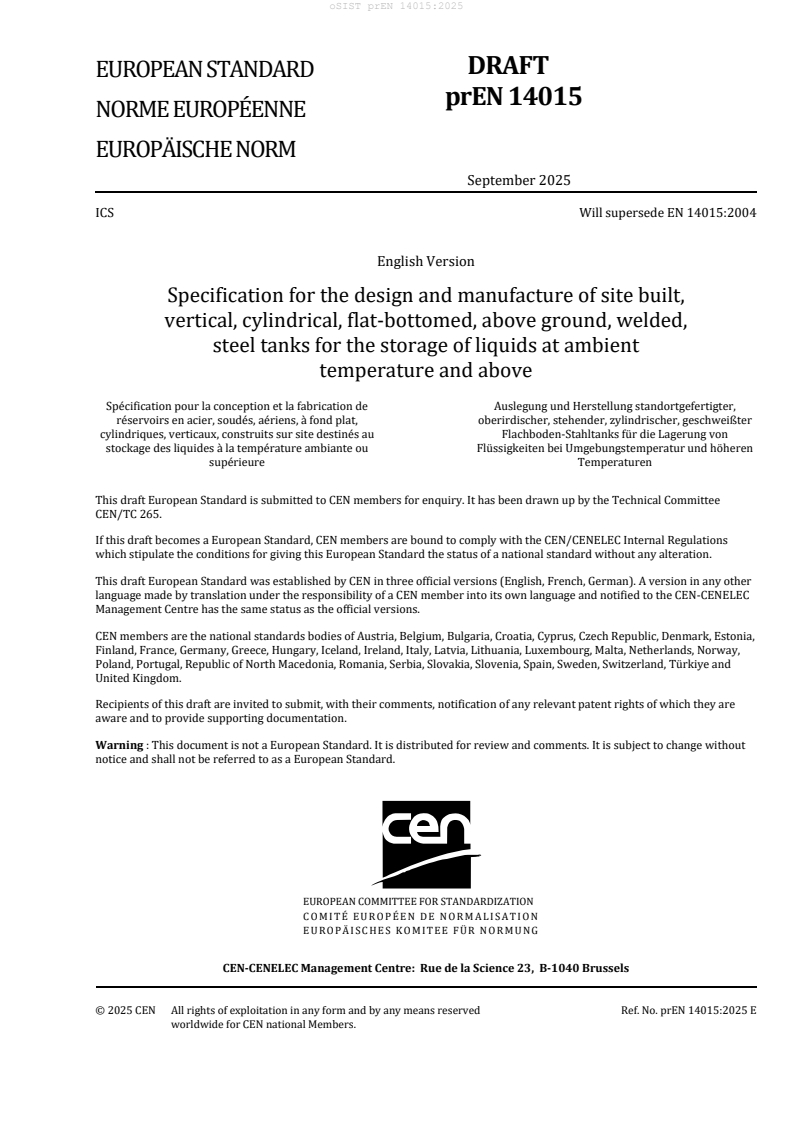
DRAFT
EUROPEAN STANDARD
NORME EUROPÉENNE
EUROPÄISCHE NORM
September 2025
ICS Will supersede EN 14015:2004
English Version
Specification for the design and manufacture of site built,
vertical, cylindrical, flat-bottomed, above ground, welded,
steel tanks for the storage of liquids at ambient
temperature and above
Spécification pour la conception et la fabrication de Auslegung und Herstellung standortgefertigter,
réservoirs en acier, soudés, aériens, à fond plat, oberirdischer, stehender, zylindrischer, geschweißter
cylindriques, verticaux, construits sur site destinés au Flachboden-Stahltanks für die Lagerung von
stockage des liquides à la température ambiante ou Flüssigkeiten bei Umgebungstemperatur und höheren
supérieure Temperaturen
This draft European Standard is submitted to CEN members for enquiry. It has been drawn up by the Technical Committee
CEN/TC 265.
If this draft becomes a European Standard, CEN members are bound to comply with the CEN/CENELEC Internal Regulations
which stipulate the conditions for giving this European Standard the status of a national standard without any alteration.
This draft European Standard was established by CEN in three official versions (English, French, German). A version in any other
language made by translation under the responsibility of a CEN member into its own language and notified to the CEN-CENELEC
Management Centre has the same status as the official versions.
CEN members are the national standards bodies of Austria, Belgium, Bulgaria, Croatia, Cyprus, Czech Republic, Denmark, Estonia,
Finland, France, Germany, Greece, Hungary, Iceland, Ireland, Italy, Latvia, Lithuania, Luxembourg, Malta, Netherlands, Norway,
Poland, Portugal, Republic of North Macedonia, Romania, Serbia, Slovakia, Slovenia, Spain, Sweden, Switzerland, Türkiye and
United Kingdom.
Recipients of this draft are invited to submit, with their comments, notification of any relevant patent rights of which they are
aware and to provide supporting documentation.
Warning : This document is not a European Standard. It is distributed for review and comments. It is subject to change without
notice and shall not be referred to as a European Standard.
EUROPEAN COMMITTEE FOR STANDARDIZATION
COMITÉ EUROPÉEN DE NORMALISATION
EUROPÄISCHES KOMITEE FÜR NORMUNG
CEN-CENELEC Management Centre: Rue de la Science 23, B-1040 Brussels
© 2025 CEN All rights of exploitation in any form and by any means reserved Ref. No. prEN 14015:2025 E
worldwide for CEN national Members.
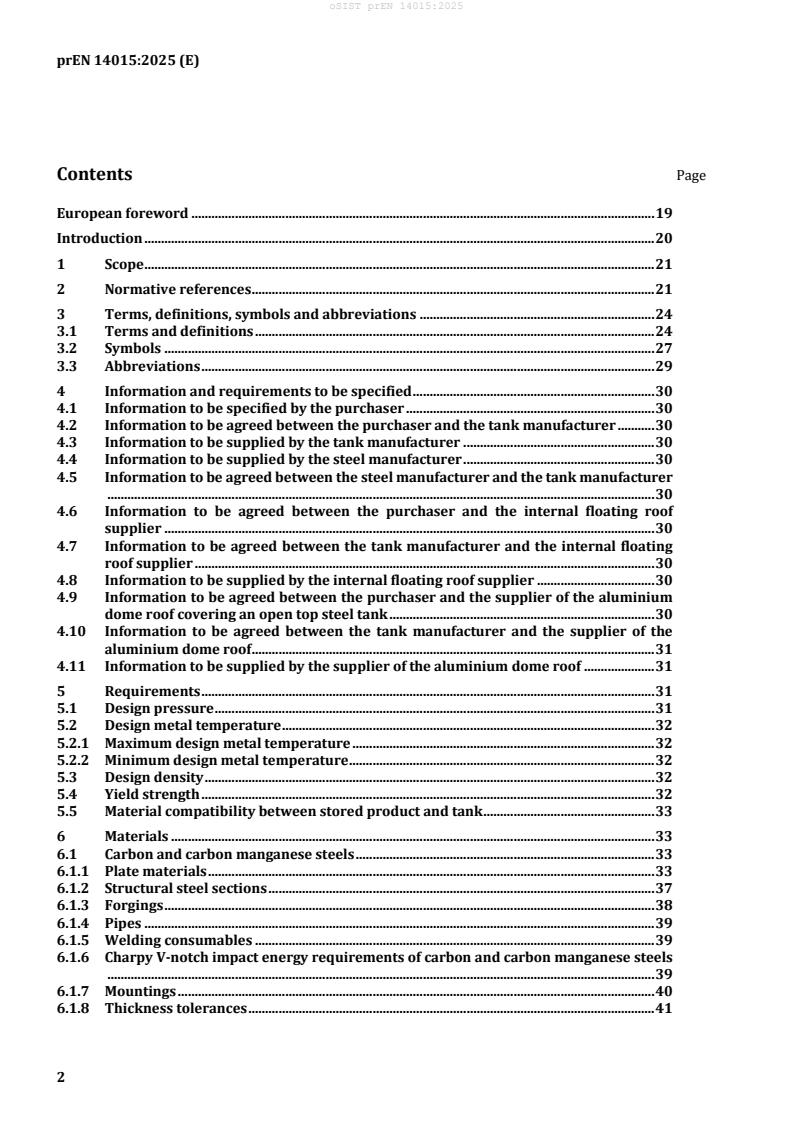
Contents Page
European foreword . 19
Introduction . 20
1 Scope . 21
2 Normative references . 21
3 Terms, definitions, symbols and abbreviations . 24
3.1 Terms and definitions . 24
3.2 Symbols . 27
3.3 Abbreviations . 29
4 Information and requirements to be specified . 30
4.1 Information to be specified by the purchaser . 30
4.2 Information to be agreed between the purchaser and the tank manufacturer . 30
4.3 Information to be supplied by the tank manufacturer . 30
4.4 Information to be supplied by the steel manufacturer . 30
4.5 Information to be agreed between the steel manufacturer and the tank manufacturer
................................................................................................................................................................... 30
4.6 Information to be agreed between the purchaser and the internal floating roof
supplier . 30
4.7 Information to be agreed between the tank manufacturer and the internal floating
roof supplier . 30
4.8 Information to be supplied by the internal floating roof supplier . 30
4.9 Information to be agreed between the purchaser and the supplier of the aluminium
dome roof covering an open top steel tank . 30
4.10 Information to be agreed between the tank manufacturer and the supplier of the
aluminium dome roof . 31
4.11 Information to be supplied by the supplier of the aluminium dome roof . 31
5 Requirements . 31
5.1 Design pressure . 31
5.2 Design metal temperature . 32
5.2.1 Maximum design metal temperature . 32
5.2.2 Minimum design metal temperature . 32
5.3 Design density . 32
5.4 Yield strength . 32
5.5 Material compatibility between stored product and tank . 33
6 Materials . 33
6.1 Carbon and carbon manganese steels . 33
6.1.1 Plate materials . 33
6.1.2 Structural steel sections . 37
6.1.3 Forgings . 38
6.1.4 Pipes . 39
6.1.5 Welding consumables . 39
6.1.6 Charpy V-notch impact energy requirements of carbon and carbon manganese steels
................................................................................................................................................................... 39
6.1.7 Mountings . 40
6.1.8 Thickness tolerances . 41
6.2 Stainless steels . 41
6.2.1 Selection of materials . 41
6.2.2 Plates and drawn products . 43
6.2.3 Forgings . 43
6.2.4 Pipes . 44
6.2.5 Welding consumables . 44
6.3 Anchors and structural bolts . 44
7 Design loads . 46
7.1 Loads . 46
7.2 Load values . 47
7.2.1 Liquid induced loads . 47
7.2.2 Internal pressure loads . 47
7.2.3 Thermally induced loads . 47
7.2.4 Dead loads . 47
7.2.5 Insulation loads . 47
7.2.6 Distributed live load . 47
7.2.7 Concentrated live load . 47
7.2.8 Snow loads. 47
7.2.9 Rainfall loads . 47
7.2.10 Wind . 48
7.2.11 Seismic loads . 56
7.2.12 Loads resulting from connected piping and attachments . 56
7.2.13 Foundation settlement loads . 57
7.2.14 Emergency loads . 57
7.2.15 Load combinations . 57
8 Tank bottoms . 59
8.1 General . 59
8.2 Materials . 59
8.3 Design . 61
8.1 Fabrication . 62
9 Shell design . 65
9.1 Design and test stress. 65
9.2 Internal loads . 67
9.3 Wind and vacuum loads . 69
9.3.1 Stiffening rings . 69
9.3.2 Primary stiffening rings . 69
9.3.3 Secondary stiffening ring (wind girder) design . 73
9.3.4 Shell axial compression . 75
9.4 Design of tanks at elevated temperatures . 76
9.4.1 Effect of elevated temperature to minimum specified Yield Strength or 0.2% Proof
Strength of steels . 76
9.4.2 Effect of elevated temperature to Young’s moduli of steels . 77
9.5 Additional use of Eurocode . 77
10 Fixed roof design . 78
10.1 Loads . 78
10.2 Type of roof . 78
10.3 Roof plating with supporting structure . 78
10.3.1 Design of roof supporting structure . 78
10.3.2 Design of roof plates . 79
10.3.3 Roof plate thickness. 79
10.3.4 Roof structural member construction materials . 79
10.3.5 Roof plate welding . 79
10.3.6 Joint efficiency. 79
10.3.7 Roof framing . 80
10.4 Roof plate without supporting structure (membrane roofs) . 80
10.5 Compression area at the junction of the shell and roof . 81
10.6 Internal floating roofs . 85
11 Floating roof design . 85
11.1 General. 85
11.2 Roof types . 85
11.2.1 General. 85
11.2.2 Single deck metallic floating roof . 86
11.2.3 Double deck metallic floating roof . 87
11.2.4 A non-metallic composite low profile floating roof . 88
11.3 Design . 89
11.3.1 General. 89
11.3.2 Buoyancy . 90
11.3.3 Structural design . 94
11.3.4 Roof stability under wind load . 95
11.3.5 Pontoon manholes . 95
11.3.6 Roof manhole . 95
11.3.7 Centring and anti-rotation devices . 95
11.3.8 Main roof drains . 96
11.3.9 Emergency drains . 98
11.3.10 Drain plugs . 99
11.3.11 Automatic bleeder vents and rim vents . 99
11.3.12 Seals . 100
11.3.13 Support legs . 100
11.3.14 Gauging device . 102
11.3.15 Rolling ladder . 102
11.3.16 Earthing cables . 102
11.3.17 Foam dam . 103
11.4 Prefabrication in the workshop . 103
11.5 Marking, packing, handling, transport . 103
11.5.1 General. 103
11.5.2 Repair after damage during handling operations . 103
11.6 Assembly . 103
11.7 Welding . 104
11.7.1 General. 104
11.7.2 Support legs . 104
11.7.3 Bulkheads . 104
11.8 Inspection and testing . 104
11.8.1 Welds . 104
11.8.2 Pontoons . 104
11.8.3 Checks . 104
11.8.4 Drains . 105
11.9 Documentation . 105
12 Tank anchorage . 105
12.1 General. 105
12.1.1 Conditions for provision of tank anchorage. 105
12.1.2 Tank Contents that contributes to the resistance weight of the tank . 106
12.1.3 Stability Formula. 107
12.1.4 Sliding friction . 109
12.1.5 Compressive loads in shell due to overturning . 109
12.2 Anchorage attachment . 109
12.3 Anchor bolt or strap. 110
12.3.1 Allowable tensile stress . 110
12.3.2 Cross-sectional area. 110
12.3.3 Anchor load to resist uplift. 110
13 Mountings . 111
13.1 Nozzles and manholes . 111
13.1.1 General . 111
13.1.2 Shell nozzles (excluding manholes) . 112
13.1.3 Roof nozzles (excluding manholes) . 113
13.1.4 Shell and roof manholes . 115
13.2 Nozzle reinforcements . 116
13.3 Studded pad connections . 123
13.4 Nozzle loads . 123
13.5 Flush type clean-out doors and water draw-off sumps . 123
13.5.1 General . 123
13.5.2 Flush type clean-out doors . 123
13.5.3 Water draw-off sumps . 123
13.5.4 Combined water draw-off and clean-out sump . 124
13.6 Nozzle welding details . 124
13.7 Flanges . 124
13.8 Post-weld heat treatment of nozzles . 125
13.9 Heating and/or cooling systems . 125
13.10 Stairways and walkways . 127
13.11 Handrailing . 127
13.12 Ladders . 128
13.13 Earthing connections. 128
13.14 Permanent attachments . 129
13.15 Temporary attachments . 129
13.16 Insulation . 129
14 Venting requirements . 129
14.1 General . 129
14.2 Scope of venting provided . 129
14.3 Venting capacity . 130
14.3.1 General . 130
14.3.2 Set pressure of pressure /vacuum relief valves in relation to design and test pressure
of tanks (see 5.1 and 9.1.1) . 130
14.4 Requirements to design/install Emergency pressure relief venting systems . 130
14.4.1 Malfunction of blanketing system . 130
14.4.2 Other possible causes . 130
14.5 Requirements to design/install Emergency vacuum relief venting systems. 131
15 Shop fabrication of tank components . 131
15.1 General . 131
15.2 Reception and identification of materials . 131
15.3 Handling and storage of materials . 131
15.4 Material markings . 131
15.5 Plate preparation and tolerances . 132
15.6 Preparation of nozzle components . 132
15.7 Plate forming and tolerances . 132
15.8 Openings . 133
15.8.1 Nozzles . 133
15.8.2 Inspection windows . 133
15.8.3 Nozzles for mixers . 133
15.8.4 Clean-out doors . 133
15.8.5 Reinforcement plates . 133
15.8.6 Insert plates . 134
15.9 Welding . 134
15.10 Surface condition . 134
15.11 Marking for erection purposes . 134
15.12 Packing, handling and transport to site. 134
16 Site erection and tolerances . 135
16.1 General. 135
16.2 Foundations . 135
16.2.1 General. 135
16.2.2 Peripheral tolerance . 136
16.2.3 Foundation surface tolerance . 136
16.2.4 Tolerances after the hydro test . 136
16.3 Anchor points . 137
16.4 Handling and storage . 137
16.5 Rectification of parts damaged during transportation and handling . 137
16.6 Bottom plates . 137
16.7 Shell tolerances . 138
16.7.1 Assembly tolerances of first shell course on flat bottom . 138
16.7.2 Tolerance on shell geometry . 138
16.7.3 Vertical tolerance . 139
16.7.4 Tolerances on alignment of plates . 139
16.7.5 Tolerances on shape of welded joints . 139
16.7.6 Primary and secondary stiffening rings (wind girders) . 140
16.8 Fixed roofs . 140
16.8.1 General. 140
16.8.2 Support framework . 140
16.8.3 Roof plates . 140
16.8.4 Roof plating and roof structure . 141
16.8.5 Frangible roofs . 141
16.9 Nozzles . 141
16.10 External attachments . 141
16.11 Internal attachments . 141
16.12 Temporary attachments . 141
17 Approval of welding procedures and welders . 141
17.1 General. 141
17.2 Welding procedure approval . 142
17.2.1 General. 142
17.2.2 Welding of test pieces . 142
17.2.3 Examination and testing of test pieces . 142
17.2.4 Measuring Ferrite Content in austenitic‐ferritic steels . 142
17.3 Welding Procedure Qualification Record (WPQR) . 143
17.3.1 Preparation . 143
17.3.2 Range of approval . 143
17.4 Welders and welding operators approval . 143
17.5 Production control test plates . 143
17.5.1 Horizontal welds . 143
17.5.2 Vertical welds . 143
18 Welding . 144
18.1 General . 144
18.2 Welding sequences . 144
18.3 Welding of bottoms . 144
18.3.1 Removal of coatings . 144
18.3.2 Annular ring plates . 144
18.3.3 Bottom plates . 144
18.4 Welding of shell to bottom . 144
18.5 Welding of shell . 145
18.6 Welding of roof . 145
18.7 Temporary welds . 145
18.8 Atmospheric conditions . 145
18.9 Preheating . 145
18.10 Post-weld heat treatment . 145
18.1 Repair welding . 147
19 Testing and inspection. 147
19.1 General . 147
19.2 Qualification of NDT personnel . 147
19.3 Test procedures . 147
19.4 Type of inspections and examinations . 148
19.4.1 Inspection of materials . 148
19.4.2 Examinations of edges to be welded and joint preparations. 148
19.4.3 Visual examination during fabrication and erection. 148
19.4.4 Type and extent of examination and test of welds . 148
19.4.6 Additional examinations if imperfections are found. 155
19.4.7 Ge
...