


EN 15153-1:2007
(Main)Railway applications - External visible and audible warning devices for high speed trains - Part 1: Head, marker and tail lamps
General Information
- Abstract
This European Standard defines the functional, operational and technical requirements for head, marker and tail lamps for high speed trains, including the requirements for testing and conformity assessment.
- Status
- Withdrawn
- Publication Date
- 29-May-2007
- Withdrawal Date
- 15-Jan-2013
- Technical Committee
- CEN/TC 256 - Railway applications
- Drafting Committee
- CEN/TC 256/WG 9 - Lighting
- Current Stage
- 9960 - Withdrawal effective - Withdrawal
- Start Date
- 16-Jan-2013
- Completion Date
- 16-Jan-2013
- Directive
- Not Harmonized96/48/EC - Interoperability of the trans-European high-speed rail systemOJ Ref: C, C 97 OJ Date: 16-Apr-2010

Relations
- Effective Date
- 08-Jun-2022
Get Certified
Connect with accredited certification bodies for this standard

IRIS Certification (UNIFE)
International Railway Industry Standard certification.

TÜV SÜD Rail GmbH
TÜV SÜD railway certification services.

Bureau Veritas Railway Certification
Railway and transportation certification.
Sponsored listings
Frequently Asked Questions
EN 15153-1:2007 is a standard published by the European Committee for Standardization (CEN). Its full title is "Railway applications - External visible and audible warning devices for high speed trains - Part 1: Head, marker and tail lamps". This standard covers: This European Standard defines the functional, operational and technical requirements for head, marker and tail lamps for high speed trains, including the requirements for testing and conformity assessment.
This European Standard defines the functional, operational and technical requirements for head, marker and tail lamps for high speed trains, including the requirements for testing and conformity assessment.
EN 15153-1:2007 is classified under the following ICS (International Classification for Standards) categories: 45.060.10 - Tractive stock. The ICS classification helps identify the subject area and facilitates finding related standards.
EN 15153-1:2007 has the following relationships with other standards: It is inter standard links to EN 15153-1:2013. Understanding these relationships helps ensure you are using the most current and applicable version of the standard.
EN 15153-1:2007 is associated with the following European legislation: EU Directives/Regulations: 96/48/EC; Standardization Mandates: M/275. When a standard is cited in the Official Journal of the European Union, products manufactured in conformity with it benefit from a presumption of conformity with the essential requirements of the corresponding EU directive or regulation.
EN 15153-1:2007 is available in PDF format for immediate download after purchase. The document can be added to your cart and obtained through the secure checkout process. Digital delivery ensures instant access to the complete standard document.
Standards Content (Sample)
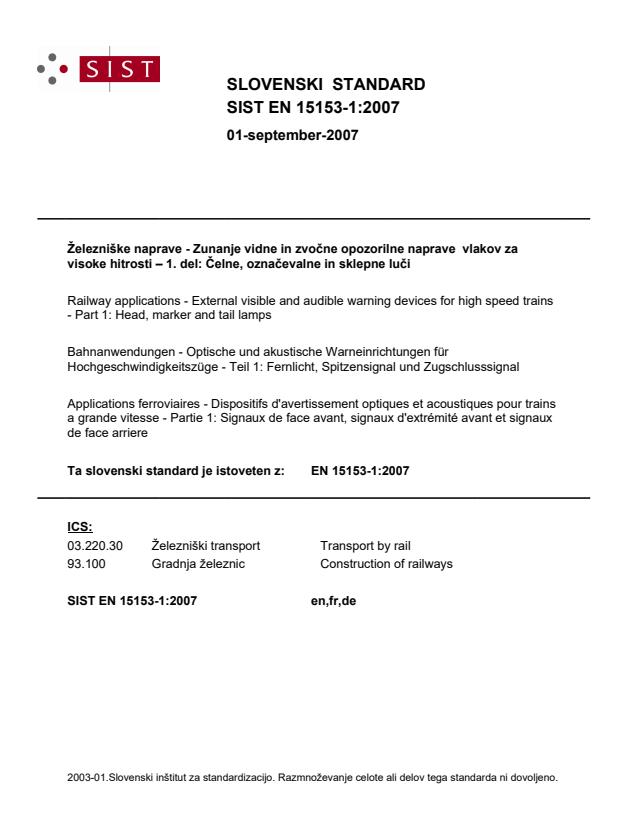
2003-01.Slovenski inštitut za standardizacijo. Razmnoževanje celote ali delov tega standarda ni dovoljeno.Bahnanwendungen - Optische und akustische Warneinrichtungen für Hochgeschwindigkeitszüge - Teil 1: Fernlicht, Spitzensignal und ZugschlusssignalApplications ferroviaires - Dispositifs d'avertissement optiques et acoustiques pour trains a grande vitesse - Partie 1: Signaux de face avant, signaux d'extrémité avant et signaux de face arriereRailway applications - External visible and audible warning devices for high speed trains - Part 1: Head, marker and tail lamps93.100Gradnja železnicConstruction of railways03.220.30Železniški transportTransport by railICS:Ta slovenski standard je istoveten z:EN 15153-1:2007SIST EN 15153-1:2007en,fr,de01-september-2007SIST EN 15153-1:2007SLOVENSKI
STANDARD
EUROPEAN STANDARDNORME EUROPÉENNEEUROPÄISCHE NORMEN 15153-1May 2007ICS 45.060.10 English VersionRailway applications - External visible and audible warningdevices for high speed trains - Part 1: Head, marker and taillampsApplications ferroviaires - Dispositifs d'avertissementoptiques et acoustiques pour trains à grande vitesse -Partie 1: Signaux de face avant, signaux d'extrémité avantet signaux de face arrièreBahnanwendungen - Optische und akustischeWarneinrichtungen für Hochgeschwindigkeitszüge - Teil 1:Fernlicht, Spitzensignal und ZugschlusssignalThis European Standard was approved by CEN on 15 March 2007.CEN members are bound to comply with the CEN/CENELEC Internal Regulations which stipulate the conditions for giving this EuropeanStandard the status of a national standard without any alteration. Up-to-date lists and bibliographical references concerning such nationalstandards may be obtained on application to the CEN Management Centre or to any CEN member.This European Standard exists in three official versions (English, French, German). A version in any other language made by translationunder the responsibility of a CEN member into its own language and notified to the CEN Management Centre has the same status as theofficial versions.CEN members are the national standards bodies of Austria, Belgium, Bulgaria, Cyprus, Czech Republic, Denmark, Estonia, Finland,France, Germany, Greece, Hungary, Iceland, Ireland, Italy, Latvia, Lithuania, Luxembourg, Malta, Netherlands, Norway, Poland, Portugal,Romania, Slovakia, Slovenia, Spain, Sweden, Switzerland and United Kingdom.EUROPEAN COMMITTEE FOR STANDARDIZATIONCOMITÉ EUROPÉEN DE NORMALISATIONEUROPÄISCHES KOMITEE FÜR NORMUNGManagement Centre: rue de Stassart, 36
B-1050 Brussels© 2007 CENAll rights of exploitation in any form and by any means reservedworldwide for CEN national Members.Ref. No. EN 15153-1:2007: ESIST EN 15153-1:2007
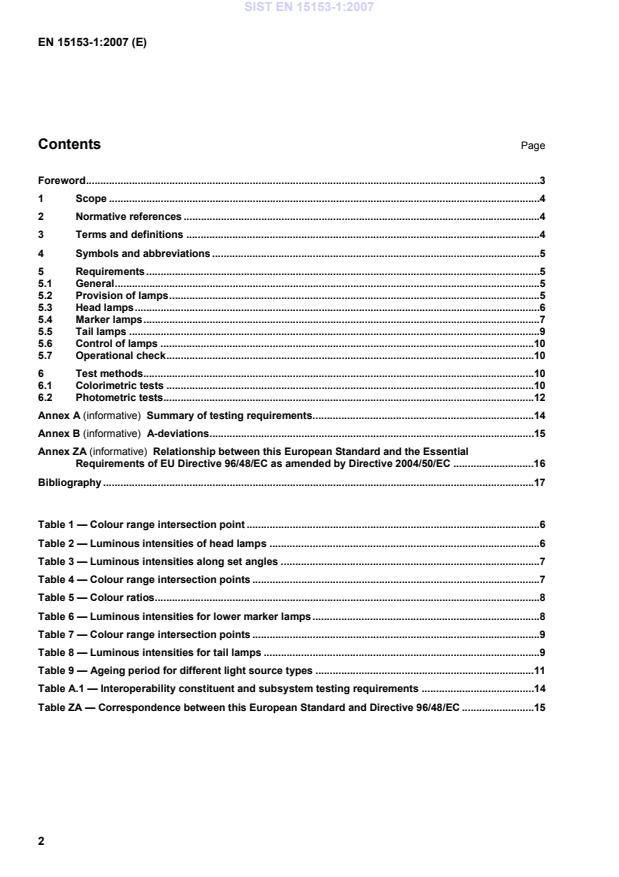
Summary of testing requirements.14 Annex B (informative)
A-deviations.15 Annex ZA (informative)
Relationship between this European Standard and the Essential Requirements of EU Directive 96/48/EC as amended by Directive 2004/50/EC.16 Bibliography.17
Table 1 — Colour range intersection point.6 Table 2 — Luminous intensities of head lamps.6 Table 3 — Luminous intensities along set angles.7 Table 4 — Colour range intersection points.7 Table 5 — Colour ratios.8 Table 6 — Luminous intensities for lower marker lamps.8 Table 7 — Colour range intersection points.9 Table 8 — Luminous intensities for tail lamps.9 Table 9 — Ageing period for different light source types.11 Table A.1 — Interoperability constituent and subsystem testing requirements.14 Table ZA — Correspondence between this European Standard and Directive 96/48/EC.15
This European Standard shall be given the status of a national standard, either by publication of an identical text or by endorsement, at the latest by November 2007, and conflicting national standards shall be withdrawn at the latest by November 2007. This document has been prepared under a mandate given to CEN by the European Commission and the European Free Trade Association, and supports essential requirements of EU Directive(s). For relationship with EU Directive(s), see informative Annex ZA, which is an integral part of this document. This series of documents Railway applications — External visible and audible warning devices for high speed trains consists of the following parts: Part 1: Head, marker and tail lamps Part 2: Warning horns According to the CEN/CENELEC Internal Regulations, the national standards organizations of the following countries are bound to implement this European Standard: Austria, Belgium, Bulgaria, Cyprus, Czech Republic, Denmark, Estonia, Finland, France, Germany, Greece, Hungary, Iceland, Ireland, Italy, Latvia, Lithuania, Luxembourg, Malta, Netherlands, Norway, Poland, Portugal, Romania, Slovakia, Slovenia, Spain, Sweden, Switzerland and United Kingdom. SIST EN 15153-1:2007
1) To be purchased from: International Commission of Illumination, CIE Central Bureau, Kegelgasse 27, A-1030 Wien SIST EN 15153-1:2007
5.3.5 Intensity of head lamps The luminous intensities of individual head lamps shall be as shown in Table 2. Table 2 — Luminous intensities of head lamps Head lamp function Reduced head lamp Full-beam head lamp Luminous intensity (cd) measured along the optical axis of the head lamp 12 000 to 16 000 40 000 to 70 000 Luminous intensity (cd) at all angles within 5° on either side of the optical axis in the horizontal plane > 3 000 > 10 000
Secondary maxima of luminous intensities within ± 5° of the optical axis in the horizontal plane are not allowed. SIST EN 15153-1:2007
5.4 Marker lamps 5.4.1 Arrangement of marker lamps The two lower marker lamps shall be located on the same horizontal axis such that their centres are between 1 500 mm and 2 000 mm above rail level. The arrangement of the two lower marker lamps shall be such that the distance between their centres is not less than 1 000 mm and that the lamp centres are symmetrical about the centre-line of track. The upper marker lamp shall be located centrally above the lower marker lamps with a minimum vertical separation of 600 mm. 5.4.2 Dimensions of marker lamps Each individual marker lamp shall have a maximum lit area of 22 700 mm2 and a minimum dimension of the lit area of 90 mm. 5.4.3 Colour of marker lamps 5.4.3.1 General The colour of light emitted by marker lamps, measured in accordance with 6.1 of this European Standard, shall comply with the requirements of CIE S 004, as shown in Table 4. Table 4 — Colour range intersection points Colour of light CIE (1931) colour coordinates of the intersection points Intersection point I J K L x 0,300 0,440 0,440 0,300 White Class A y 0,342 0,432 0,382 0,276
...