


EN 1303:2015
(Main)Building hardware - Cylinders for locks - Requirements and test methods
General Information
- Abstract
This European Standard applies to cylinders and their keys for such locks as are normally used in buildings and are designed to be used with cylinders, where the locks have an operational torque of maximum 1,2 Nm.
This European Standard specifies performance and other requirements for the strength, security, durability, performance and corrosion resistance of cylinders and their original keys. It establishes one category of use, three grades of durability, three grades for fire and four grades corrosion resistance all based on performance tests as well as six grades of key related security based on design requirements and five grades on performance tests that simulate attack.
This European Standard includes tests of satisfactory operation at a range of temperatures. It specifies test methods to be used on cylinders and their protective measures linked with these cylinders and recommended by the manufacturer.
Corrosion resistance is specified by reference to the requirements of EN 1670 on corrosion resistance of building hardware.
The suitability of cylinders for use on fire or smoke-door assemblies is determined by fire performance tests conducted in addition to the performance testing required by this standard. Since suitability for use on fire doors is not essential in every situation the manufacturer has the option to state if the cylinder conforms to these additional requirements or not. If so claimed, cylinders will comply with the requirements in Annex A.
Assessment of fire resistance of grade 1 doors is beyond the scope of this document.
On occasions there may be a need for additional functions within the design of the cylinder. Purchasers should satisfy themselves that the products are suitable for their intended use.
- Status
- Withdrawn
- Publication Date
- 02-Jun-2015
- Withdrawal Date
- 16-Sep-2026
- Technical Committee
- CEN/TC 33 - Doors, windows, shutters and building hardware
- Drafting Committee
- CEN/TC 33/WG 4 - Building hardware
- Current Stage
- 9960 - Withdrawal effective - Withdrawal
- Start Date
- 13-May-2026
- Completion Date
- 17-Sep-2026
- Directive
- Not Harmonized89/106/EEC - Construction products

Overview
EN 1303:2015 - "Building hardware - Cylinders for locks - Requirements and test methods" is a European Standard (CEN) that defines performance, durability and security requirements plus test methods for lock cylinders and their original keys used in buildings. It applies to cylinders for locks with an operational torque up to 1.2 Nm and covers strength, corrosion resistance, operation at extreme temperatures and resistance to physical attack. Manufacturers may optionally declare conformity for use on fire or smoke doors (see Annex A).
Key topics and technical requirements
- Scope & application: Cylinders for building locks designed for use with removable cylinders; intended test methods and performance criteria.
- Performance classifications: An 8‑digit classification system covering attributes such as category of use, durability, door mass, fire suitability, safety, corrosion/temperature resistance, key‑related security and attack resistance.
- Grades and categories:
- One category of use
- Durability: 3 grades
- Fire suitability: 3 grades (manufacturer may claim compliance; Annex A)
- Corrosion resistance: 4 grades (referenced to EN 1670)
- Key‑related security: 6 design‑based grades and additional performance grades for simulated attack
- Attack resistance: New grading (0, A–D) covering drilling, chisel, twisting and plug/cylinder extraction; plug extraction grades include A, B (and higher grades C/D with defined force)
- Test methods: Standardised procedures for key strength, durability cycles, operation at extreme temperatures (tested over a range, revised to −25 °C to +65 °C), torque resistance of plug/cylinder, and specific attack simulations (drilling, chisel blows, twisting, extraction).
- Corrosion tests: Specified by reference to EN 1670; also includes tests for operation after corrosion exposure.
- Marking and product information: Requirements for classification marking and manufacturer declarations (Annexes C & D).
Applications and who uses this standard
- Manufacturers of cylinders and lock hardware - to design, test and declare performance levels.
- Lock and door hardware specifiers, architects and consultants - to select cylinders with the required durability, corrosion and attack resistance for buildings.
- Testing laboratories and certification bodies - to perform reproducible tests and classify products.
- Door assemblers, installers and building owners/ facility managers - to verify suitability for fire/smoke doors and intended use environments (external doors, high‑traffic areas, corrosive environments).
Practical uses include specifying cylinder grades for residential, commercial or industrial doors, ensuring compliance for fire‑rated assemblies (when claimed), and matching key‑security and attack resistance levels to risk profiles.
Related standards
- EN 1670 - Corrosion resistance of building hardware (referenced)
- EN 1634‑1 / EN 1634‑2 / EN 1634‑3 - Fire resistance and smoke control tests (used for fire/smoke door suitability)
- EN 1906, ISO/EN screw and drill standards - referenced for test apparatus and components
Keywords: EN 1303:2015, cylinders for locks, building hardware, test methods, durability, corrosion resistance, key related security, attack resistance, fire doors.
Relations
- Replaces
EN 1303:2005/AC:2008 - Building hardware - Cylinders for locks - Requirements and test methods - Effective Date
- 08-Jun-2022
- Effective Date
- 08-Jun-2015
- Effective Date
- 19-Jan-2023
- Effective Date
- 20-May-2026
- Effective Date
- 28-Jan-2026
- Effective Date
- 28-Jan-2026
- Effective Date
- 28-Jan-2026
- Effective Date
- 28-Jan-2026
- Effective Date
- 28-Jan-2026
- Effective Date
- 28-Jan-2026
- Effective Date
- 28-Jan-2026
- Effective Date
- 28-Jan-2026
- Effective Date
- 28-Jan-2026
- Effective Date
- 28-Jan-2026
- Effective Date
- 28-Jan-2026
Get Certified
Connect with accredited certification bodies for this standard

DIBt (Deutsches Institut für Bautechnik)
German Institute for Building Technology.
DIN CERTCO
DIN Group product certification.

Aboma Certification B.V.
Specialized in construction, metal, and transport sectors.
Sponsored listings
Frequently Asked Questions
EN 1303:2015 is a standard published by the European Committee for Standardization (CEN). Its full title is "Building hardware - Cylinders for locks - Requirements and test methods". This standard covers: This European Standard applies to cylinders and their keys for such locks as are normally used in buildings and are designed to be used with cylinders, where the locks have an operational torque of maximum 1,2 Nm. This European Standard specifies performance and other requirements for the strength, security, durability, performance and corrosion resistance of cylinders and their original keys. It establishes one category of use, three grades of durability, three grades for fire and four grades corrosion resistance all based on performance tests as well as six grades of key related security based on design requirements and five grades on performance tests that simulate attack. This European Standard includes tests of satisfactory operation at a range of temperatures. It specifies test methods to be used on cylinders and their protective measures linked with these cylinders and recommended by the manufacturer. Corrosion resistance is specified by reference to the requirements of EN 1670 on corrosion resistance of building hardware. The suitability of cylinders for use on fire or smoke-door assemblies is determined by fire performance tests conducted in addition to the performance testing required by this standard. Since suitability for use on fire doors is not essential in every situation the manufacturer has the option to state if the cylinder conforms to these additional requirements or not. If so claimed, cylinders will comply with the requirements in Annex A. Assessment of fire resistance of grade 1 doors is beyond the scope of this document. On occasions there may be a need for additional functions within the design of the cylinder. Purchasers should satisfy themselves that the products are suitable for their intended use.
This European Standard applies to cylinders and their keys for such locks as are normally used in buildings and are designed to be used with cylinders, where the locks have an operational torque of maximum 1,2 Nm. This European Standard specifies performance and other requirements for the strength, security, durability, performance and corrosion resistance of cylinders and their original keys. It establishes one category of use, three grades of durability, three grades for fire and four grades corrosion resistance all based on performance tests as well as six grades of key related security based on design requirements and five grades on performance tests that simulate attack. This European Standard includes tests of satisfactory operation at a range of temperatures. It specifies test methods to be used on cylinders and their protective measures linked with these cylinders and recommended by the manufacturer. Corrosion resistance is specified by reference to the requirements of EN 1670 on corrosion resistance of building hardware. The suitability of cylinders for use on fire or smoke-door assemblies is determined by fire performance tests conducted in addition to the performance testing required by this standard. Since suitability for use on fire doors is not essential in every situation the manufacturer has the option to state if the cylinder conforms to these additional requirements or not. If so claimed, cylinders will comply with the requirements in Annex A. Assessment of fire resistance of grade 1 doors is beyond the scope of this document. On occasions there may be a need for additional functions within the design of the cylinder. Purchasers should satisfy themselves that the products are suitable for their intended use.
EN 1303:2015 is classified under the following ICS (International Classification for Standards) categories: 91.190 - Building accessories. The ICS classification helps identify the subject area and facilitates finding related standards.
EN 1303:2015 has the following relationships with other standards: It is inter standard links to EN 1303:2005/AC:2008, EN 1303:2005, EN 1303:2026, ISO 10899:1996, EN ISO 15481:1999, EN ISO 10666:1999, EN 1634-1:2014+A1:2018, EN ISO 12217-2:2002, EN 1634-3:2004, EN ISO 15482:1999, EN ISO 15480:2019, EN 636:2012+A1:2015, EN 1634-2:2008, EN 1670:2007, EN ISO 15483:1999. Understanding these relationships helps ensure you are using the most current and applicable version of the standard.
EN 1303:2015 is associated with the following European legislation: EU Directives/Regulations: 89/106/EEC. When a standard is cited in the Official Journal of the European Union, products manufactured in conformity with it benefit from a presumption of conformity with the essential requirements of the corresponding EU directive or regulation.
EN 1303:2015 is available in PDF format for immediate download after purchase. The document can be added to your cart and obtained through the secure checkout process. Digital delivery ensures instant access to the complete standard document.
Standards Content (Sample)
2003-01.Slovenski inštitut za standardizacijo. Razmnoževanje celote ali delov tega standarda ni dovoljeno.Baubeschläge - Schließzylinder für Schlösser - Anforderungen und PrüfverfahrenQuincaillerie pour le bâtiment - Cylindres de serrures - Exigences et méthodes d'essaiBuilding hardware - Cylinders for locks - Requirements and test methods91.190Stavbna opremaBuilding accessoriesICS:Ta slovenski standard je istoveten z:EN 1303:2015SIST EN 1303:2015en,fr,de01-september-2015SIST EN 1303:2015SLOVENSKI
STANDARDSIST EN 1303:2005/AC:2008SIST EN 1303:20051DGRPHãþD
EUROPEAN STANDARD NORME EUROPÉENNE EUROPÄISCHE NORM
EN 1303
June 2015 ICS 91.190 Supersedes EN 1303:2005English Version
Building hardware - Cylinders for locks - Requirements and test methods
Quincaillerie pour le bâtiment - Cylindres de serrures - Exigences et méthodes d'essai
Schlösser und Baubeschläge - Schließzylinder für Schlösser - Anforderungen und Prüfverfahren This European Standard was approved by CEN on 19 March 2015.
CEN members are bound to comply with the CEN/CENELEC Internal Regulations which stipulate the conditions for giving this European Standard the status of a national standard without any alteration. Up-to-date lists and bibliographical references concerning such national standards may be obtained on application to the CEN-CENELEC Management Centre or to any CEN member.
This European Standard exists in three official versions (English, French, German). A version in any other language made by translation under the responsibility of a CEN member into its own language and notified to the CEN-CENELEC Management Centre has the same status as the official versions.
CEN members are the national standards bodies of Austria, Belgium, Bulgaria, Croatia, Cyprus, Czech Republic, Denmark, Estonia, Finland, Former Yugoslav Republic of Macedonia, France, Germany, Greece, Hungary, Iceland, Ireland, Italy, Latvia, Lithuania, Luxembourg, Malta, Netherlands, Norway, Poland, Portugal, Romania, Slovakia, Slovenia, Spain, Sweden, Switzerland, Turkey and United Kingdom.
EUROPEAN COMMITTEE FOR STANDARDIZATION
COMITÉ EUROPÉEN DE NORMALISATION EUROPÄISCHES KOMITEE FÜR NORMUNG
CEN-CENELEC Management Centre:
Avenue Marnix 17,
B-1000 Brussels © 2015 CEN All rights of exploitation in any form and by any means reserved worldwide for CEN national Members. Ref. No. EN 1303:2015 ESIST EN 1303:2015
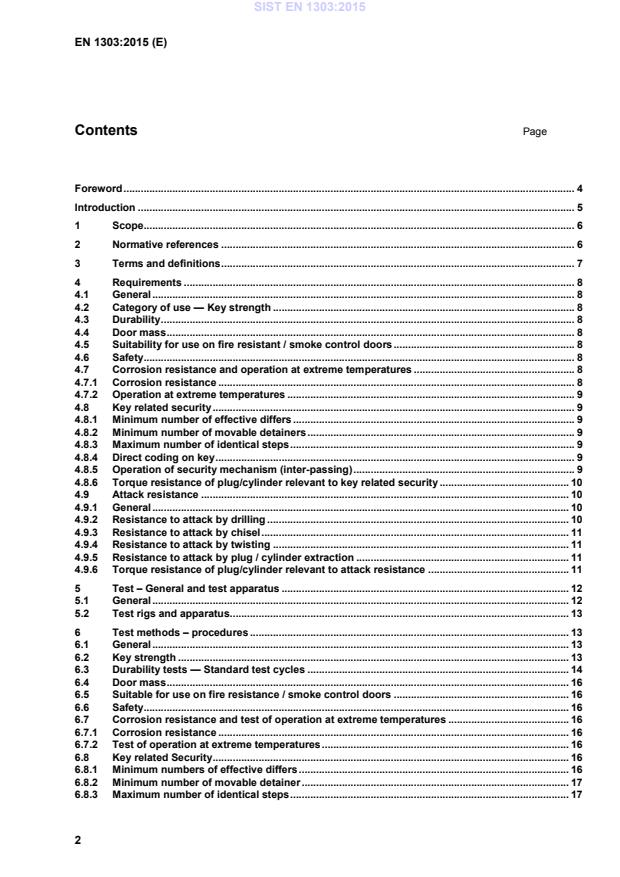
Foreword . 4 Introduction . 5 1 Scope. 6 2 Normative references . 6 3 Terms and definitions . 7 4 Requirements . 8 4.1 General . 8 4.2 Category of use — Key strength . 8 4.3 Durability . 8 4.4 Door mass . 8 4.5 Suitability for use on fire resistant / smoke control doors . 8 4.6 Safety. 8 4.7 Corrosion resistance and operation at extreme temperatures . 8 4.7.1 Corrosion resistance . 8 4.7.2 Operation at extreme temperatures . 9 4.8 Key related security . 9 4.8.1 Minimum number of effective differs . 9 4.8.2 Minimum number of movable detainers . 9 4.8.3 Maximum number of identical steps . 9 4.8.4 Direct coding on key . 9 4.8.5 Operation of security mechanism (inter-passing) . 9 4.8.6 Torque resistance of plug/cylinder relevant to key related security . 10 4.9 Attack resistance . 10 4.9.1 General . 10 4.9.2 Resistance to attack by drilling . 10 4.9.3 Resistance to attack by chisel . 11 4.9.4 Resistance to attack by twisting . 11 4.9.5 Resistance to attack by plug / cylinder extraction . 11 4.9.6 Torque resistance of plug/cylinder relevant to attack resistance . 11 5 Test – General and test apparatus . 12 5.1 General . 12 5.2 Test rigs and apparatus. 13 6 Test methods – procedures . 13 6.1 General . 13 6.2 Key strength . 13 6.3 Durability tests — Standard test cycles . 14 6.4 Door mass . 16 6.5 Suitable for use on fire resistance / smoke control doors . 16 6.6 Safety. 16 6.7 Corrosion resistance and test of operation at extreme temperatures . 16 6.7.1 Corrosion resistance . 16 6.7.2 Test of operation at extreme temperatures . 16 6.8 Key related Security . 16 6.8.1 Minimum numbers of effective differs . 16 6.8.2 Minimum number of movable detainer . 17 6.8.3 Maximum number of identical steps . 17 SIST EN 1303:2015
Cylinders suitable for use on fire resistant / smoke control doors . 27 Annex B (informative)
Tables of test sequence . 28 Annex C (informative)
Product information . 29 Annex D (informative)
Manufacturer’s declaration of compliance . 30 Annex E (informative)
Comparison table between EN 1303:2005 and EN 1303:2015 . 32 Bibliography . 33
4.4 Door mass There is no requirement on the cylinder related to the door mass. 4.5 Suitability for use on fire resistant / smoke control doors The cylinder shall conform to the requirements of Annex A. Verified in accordance with 6.5. 4.6 Safety There is no requirement on the cylinder related to safety. 4.7 Corrosion resistance and operation at extreme temperatures 4.7.1 Corrosion resistance It shall be possible to operate the cylinder with its proper key using a maximum torque of 1,5 Nm after tested according to grade 3 of EN 1670. This corrosion test shall apply to the functionality only. No distinction is made between the inside and the outside of cylinder and/or door. SIST EN 1303:2015
4.9 Attack resistance 4.9.1 General The cylinders, including any reinforcement or protection device supplied with them shall be tested as one unit. In case of a double cylinder, it is assumed that the grades for the attack resistance apply to the attack side / outside of the cylinder. This side shall have a proper indication, either on the product or on the documents with the product. If both sides are identical, it is not necessary to put an indication on the product. 4.9.2 Resistance to attack by drilling It shall not be possible to rotate the cam using a maximum torque of 5 Nm without the correct key, after the drilling time specified in Table 3. It is not necessary for the correct key to operate the cylinder after testing. SIST EN 1303:2015
4.9.2 Resistance to drilling 6.9.1 Time Net/Total - 3/5 5/10 3/5 5/10 Min. 4.9.3 Resistance to attack by chisel 6.9.2 Blows - 30 40 30 40 No 4.9.4 Resistance to attack by twisting 6.9.3 Twists - 20 30 20 30 No 4.9.5 Resistance to attack by plug/cylinder extraction 6.9.4 Force Net/Total - - - 10 5/15 15 5/15 kN min 4.9.6 Torque resistance of plug/cylinder 6.9.5 Torque - a 20 30 20 30 Nm a See requirement of key related security 4.8.6.
5 Test – General and test apparatus 5.1 General In order to minimize the number of samples to be tested some samples may be used for several tests. In the event of a test failure it shall not, at that point, be considered a failure to meet the standard. Two further cylinders, with the same design, shall be tested according to the failed test and both of them shall pass the test. In case of a double cylinder, it is assumed that the grades for key related security apply to the attack side / outside of the cylinder. This side shall have a proper indication, either on the product or on the documents with the product. If both sides are identical it is not necessary to put an indication on the product. Where a product range is submitted for evaluation the test authority shall consider each individual test for each cylinder type. Where (by engineering judgement) it can be shown that a weaker or equivalent cylinder type is to be evaluated then no further testing needs to be carried out. Check the cylinders and keys conform to 4.8.1 to 4.8.6 before commencing the performance tests. An example of a test sequence is shown in Annex B. If additional instructions for testing are required, the manufacturer shall supply such additional instructions. These additional instructions shall be documented in the test report. SIST EN 1303:2015
...