


EN 1015-6:1998
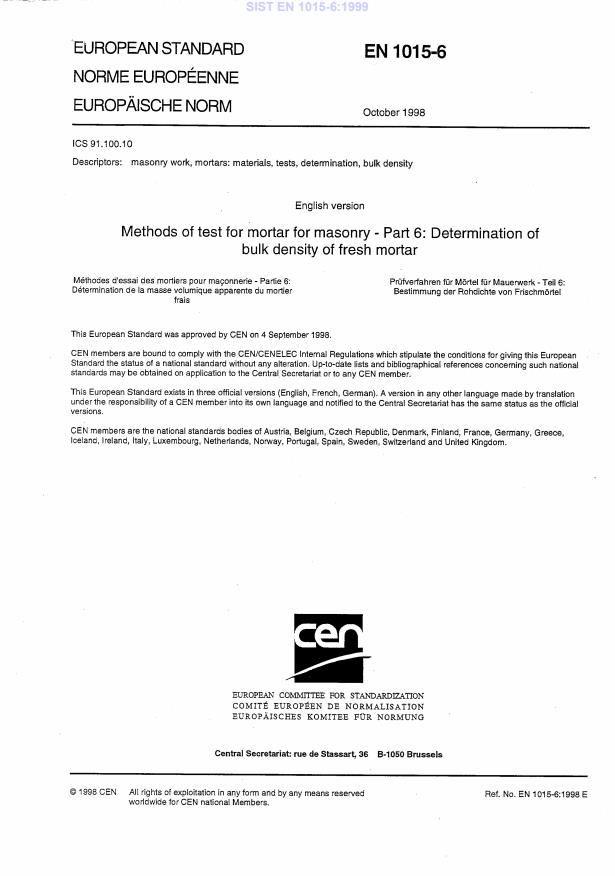
(Main)Methods of test for mortar for masonry - Part 6: Determination of bulk density of fresh mortar
General Information
- Abstract
This European Standard specifies a method for the determining the bulk density of fresh mortars including those containing mineral binders and both dense and lightweight aggregates.
- Status
- Published
- Publication Date
- 20-Oct-1998
- Technical Committee
- CEN/TC 125 - Masonry
- Drafting Committee
- CEN/TC 125/WG 4 - Test methods
- Current Stage
- 9093 - Decision to confirm - Review Enquiry
- Start Date
- 23-Jan-2025
- Completion Date
- 17-Sep-2026
- Directive
- Harmonized Standard305/2011 - Regulation (eu) No 305/2011 of the European Parliament and of the Council of 9 march 2011 laying down harmonised conditions for the marketing of construction products and repealing council directive 89/106/eec
Not Harmonized89/106/EEC - Construction products

Overview
EN 1015-6:1998 (CEN) specifies a standardized method for the determination of bulk density of fresh mortar used in masonry. The scope explicitly includes mortars that contain mineral binders and covers both dense and lightweight aggregates. This standard provides a repeatable approach for laboratories and site personnel to assess the apparent bulk density of fresh mortar mixes as part of quality assurance and mix validation.
EN 1015-6:1998 has been adopted nationally (for example as SIST EN 1015-6:1999) and forms part of the wider EN 1015 series for methods of test for mortar for masonry.
Key Topics
- Bulk density of fresh mortar: Measurement objective covered by the standard.
- Material scope: Includes mortars with mineral binders and both dense and lightweight aggregates.
- Consistency and repeatability: The method ensures comparable results between laboratories and sites when performed according to the standard.
- Quality assurance: The standard is intended to support routine testing for production and construction control.
Applications
The determination of bulk density of fresh mortar under EN 1015-6:1998 supports several practical uses:
- Quality control on-site and in production facilities to verify that delivered or produced mortar matches expected properties.
- Mix design evaluation to confirm changes in aggregate grading, binder content or the inclusion of lightweight aggregates affect bulk density as intended.
- Comparative testing between batches or supplier materials to detect inconsistencies that could affect workability, yield and hardened properties.
- Documentation for compliance with project specifications and national regulations where bulk density is a specified parameter.
Benefits of applying this standardized method include improved mix reproducibility, better estimating of yield and coverage, and more reliable input data for structural and thermal calculations when lightweight mortars are used.
Related Standards
- EN 1015 series - Methods of test for mortar for masonry (other parts address consistency, strength, water retention and more).
- National adoptions such as SIST EN 1015-6:1999 reflect the standard's status in specific countries.
For practitioners, engineers and quality managers, EN 1015-6:1998 is an essential reference for consistent measurement of fresh mortar bulk density. Implementing the method helps ensure reliable mix performance, accurate material accounting and compliance with contract or regulatory requirements.
Relations
- Effective Date
- 28-Jan-2026
- Effective Date
- 28-Jan-2026
- Effective Date
- 28-Jan-2026
- Effective Date
- 28-Jan-2026
- Effective Date
- 28-Jan-2026
- Effective Date
- 28-Jan-2026
- Effective Date
- 22-Dec-2008
Get Certified
Connect with accredited certification bodies for this standard

DIBt (Deutsches Institut für Bautechnik)
German Institute for Building Technology.
DIN CERTCO
DIN Group product certification.

Aboma Certification B.V.
Specialized in construction, metal, and transport sectors.
Sponsored listings
Frequently Asked Questions
EN 1015-6:1998 is a standard published by the European Committee for Standardization (CEN). Its full title is "Methods of test for mortar for masonry - Part 6: Determination of bulk density of fresh mortar". This standard covers: This European Standard specifies a method for the determining the bulk density of fresh mortars including those containing mineral binders and both dense and lightweight aggregates.
This European Standard specifies a method for the determining the bulk density of fresh mortars including those containing mineral binders and both dense and lightweight aggregates.
EN 1015-6:1998 is classified under the following ICS (International Classification for Standards) categories: 91.100.10 - Cement. Gypsum. Lime. Mortar. The ICS classification helps identify the subject area and facilitates finding related standards.
EN 1015-6:1998 has the following relationships with other standards: It is inter standard links to EN 998-2:2016, EN 1015-2:1998, EN 1015-3:1999, EN 16506:2014, EN 1504-2:2004, EN ISO 11296-9:2022, EN 1015-6:1998/A1:2006. Understanding these relationships helps ensure you are using the most current and applicable version of the standard.
EN 1015-6:1998 is associated with the following European legislation: EU Directives/Regulations: 305/2011, 89/106/EEC. When a standard is cited in the Official Journal of the European Union, products manufactured in conformity with it benefit from a presumption of conformity with the essential requirements of the corresponding EU directive or regulation.
EN 1015-6:1998 is available in PDF format for immediate download after purchase. The document can be added to your cart and obtained through the secure checkout process. Digital delivery ensures instant access to the complete standard document.
Standards Content (Sample)
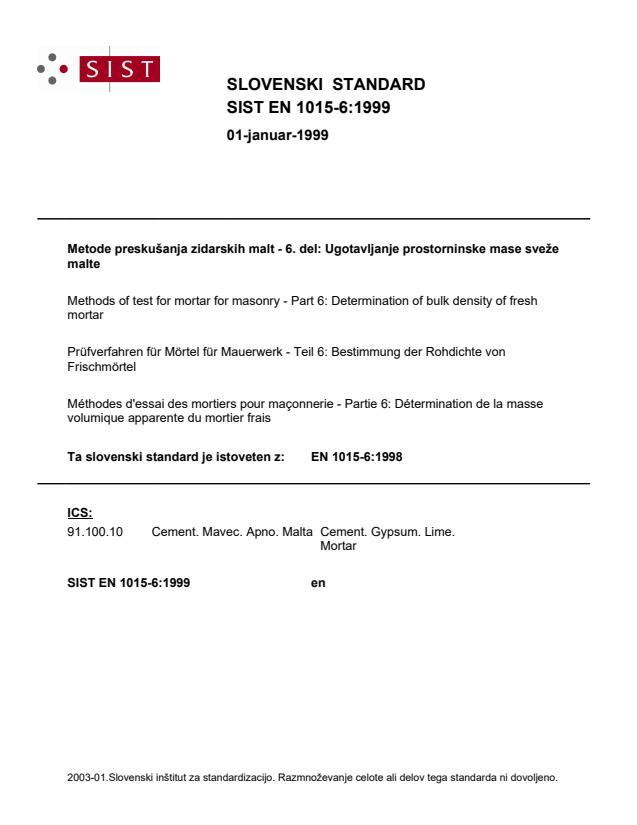
2003-01.Slovenski inštitut za standardizacijo. Razmnoževanje celote ali delov tega standarda ni dovoljeno.Metode preskušanja zidarskih malt - 6. del: Ugotavljanje prostorninske mase sveže maltePrüfverfahren für Mörtel für Mauerwerk - Teil 6: Bestimmung der Rohdichte von FrischmörtelMéthodes d'essai des mortiers pour maçonnerie - Partie 6: Détermination de la masse volumique apparente du mortier fraisMethods of test for mortar for masonry - Part 6: Deter
...