


EN 14351-2:2018
(Main)Windows and doors - Product standard, performance characteristics - Part 2: Internal pedestrian doorsets
General Information
- Abstract
This European Standard identifies material independent performance characteristics, except resistance to fire and smoke control characteristics, which are applicable to internal pedestrian doorsets.
Fire resisting and/or smoke control characteristics for pedestrian doorsets and openable windows are covered by EN 16034.
This European Standard applies to doorsets intended to be used internally for construction works as:
- intended use a) in escape routes;
- intended use b) for specific uses with specific requirements;
- intended use c) for communication only.
NOTE 1 These above intended uses can be combined, for example escape routes with specific requirements.
For internal pedestrian doorsets with resistance to fire and /or smoke control characteristics, this standard should only apply in conjunction with EN 16034.
Products covered by this European Standard are power operated hinged or manually operated internal pedestrian doorsets and screens with flush or panelled leaves, single or double leaf, which could be completed with:
- related building hardware;
- door closing devices;
- integral fanlights;
- adjacent parts that are contained within a single frame for inclusion in a single aperture.
NOTE 2 Manually operated doors with door closing devices are not considered to be power operated doors.
Products covered by this European Standard are not assessed for structural applications.
This European Standard does not apply to:
- industrial, commercial and garage doors and gates according to EN 13241;
- external pedestrian doorsets according to EN 14351-1;
- door leaves placed on the market as a single unit;
- door frames placed on the market as a single unit;
- power operated pedestrian doorsets, other than swing type, according to EN 16361.
Doorsets can be placed on the market with their component (leaf and frame) separate when each of these components are clearly identified.
This European Standard does not deal with any specific requirements on noise emitted from internal power operated hinged doorsets as their noise emission is not considered to be a relevant hazard.
- Status
- Published
- Publication Date
- 06-Nov-2018
- Withdrawal Date
- 30-Aug-2021
- Technical Committee
- CEN/TC 33 - Doors, windows, shutters and building hardware
- Drafting Committee
- CEN/TC 33/WG 1/2 - Windows and doors
- Current Stage
- 9093 - Decision to confirm - Review Enquiry
- Start Date
- 04-Jun-2024
- Completion Date
- 17-Sep-2026
Harmonized Standard2006/42/EC - Directive 2006/42/EC of the European Parliament and of the Council of 17 May 2006 on machinery, and amending Directive 95/16/EC (recast)
Not Harmonized89/106/EEC - Construction products


Overview
EN 14351-2:2018 - issued by CEN - is the European product standard for internal pedestrian doorsets. It specifies material‑independent performance characteristics for internal doorsets used in buildings, excluding resistance to fire and smoke control (those characteristics are covered by EN 16034). The standard applies to power‑operated hinged and manually operated internal pedestrian doorsets and screens (single or double leaf) and addresses usability in escape routes, communication openings and specific uses with particular requirements.
Key topics and requirements
The standard covers a comprehensive set of performance characteristics and associated testing, including:
- Scope and intended uses: escape routes (intended use a), specific uses with special requirements (b), and communication only (c). These uses can be combined.
- Product types: power‑operated hinged and manually operated doorsets, flush or panelled leaves, with associated hardware, door closing devices, integral fanlights and adjacent frame parts contained in a single aperture.
- Excluded items: external pedestrian doorsets (EN 14351‑1), industrial/commercial doors (EN 13241), single door leaves or frames marketed separately, and certain power‑operated types (EN 16361).
- Performance characteristics: reaction to fire of components and doorsets, release of dangerous substances, impact resistance for glazed doors, height/width/dimensions, direct airborne sound insulation, operating and manual forces, thermal transmittance, air permeability, ability to release (for locked doors in escape routes), durability, mechanical strength, resistance to repeated opening/closing, burglar/bullet/explosion resistance, safety of power‑operated hinged doorsets, ventilation.
- Testing and certification: detailed testing, assessment and sampling methods; Assessment and Verification of Constancy of Performance (AVCP); type testing; Factory Production Control (FPC) requirements; marking, labelling and packaging rules.
Applications and who uses this standard
EN 14351‑2:2018 is primarily used by:
- Manufacturers of internal doorsets to define design/performance and demonstrate compliance.
- Product testing laboratories for type testing and reporting.
- Architects, specifiers and consultants to select doorsets meeting acoustic, thermal, safety and accessibility requirements.
- Building owners, contractors and installers to ensure installed doorsets meet required performance in escape routes and special use areas.
- Certification bodies and regulators for CE marking and market surveillance when products fall under the Construction Products Regulation (CPR).
Related standards
- EN 16034 - Fire resistance and smoke control for pedestrian doorsets and openable windows (use in conjunction where fire/smoke properties are required)
- EN 14351‑1 - External pedestrian doorsets
- EN 13241 - Industrial, commercial and garage doors and gates
- EN 16361 - Other power‑operated pedestrian doors
EN 14351‑2:2018 is essential for consistent specification, testing and market placement of safe, durable and performance‑rated internal pedestrian doorsets across Europe.
Relations
- Effective Date
- 05-Aug-2026
- Effective Date
- 28-Jan-2026
- Effective Date
- 28-Jan-2026
- Effective Date
- 28-Jan-2026
- Effective Date
- 28-Jan-2026
- Effective Date
- 28-Jan-2026
- Effective Date
- 28-Jan-2026
- Effective Date
- 28-Jan-2026
- Effective Date
- 28-Jan-2026
- Effective Date
- 28-Jan-2026
- Effective Date
- 28-Jan-2026
- Effective Date
- 28-Jan-2026
- Effective Date
- 28-Jan-2026
- Effective Date
- 28-Jan-2026
- Effective Date
- 28-Jan-2026
Get Certified
Connect with accredited certification bodies for this standard

DIBt (Deutsches Institut für Bautechnik)
German Institute for Building Technology.
DIN CERTCO
DIN Group product certification.

Aboma Certification B.V.
Specialized in construction, metal, and transport sectors.
Sponsored listings
Frequently Asked Questions
EN 14351-2:2018 is a standard published by the European Committee for Standardization (CEN). Its full title is "Windows and doors - Product standard, performance characteristics - Part 2: Internal pedestrian doorsets". This standard covers: This European Standard identifies material independent performance characteristics, except resistance to fire and smoke control characteristics, which are applicable to internal pedestrian doorsets. Fire resisting and/or smoke control characteristics for pedestrian doorsets and openable windows are covered by EN 16034. This European Standard applies to doorsets intended to be used internally for construction works as: - intended use a) in escape routes; - intended use b) for specific uses with specific requirements; - intended use c) for communication only. NOTE 1 These above intended uses can be combined, for example escape routes with specific requirements. For internal pedestrian doorsets with resistance to fire and /or smoke control characteristics, this standard should only apply in conjunction with EN 16034. Products covered by this European Standard are power operated hinged or manually operated internal pedestrian doorsets and screens with flush or panelled leaves, single or double leaf, which could be completed with: - related building hardware; - door closing devices; - integral fanlights; - adjacent parts that are contained within a single frame for inclusion in a single aperture. NOTE 2 Manually operated doors with door closing devices are not considered to be power operated doors. Products covered by this European Standard are not assessed for structural applications. This European Standard does not apply to: - industrial, commercial and garage doors and gates according to EN 13241; - external pedestrian doorsets according to EN 14351-1; - door leaves placed on the market as a single unit; - door frames placed on the market as a single unit; - power operated pedestrian doorsets, other than swing type, according to EN 16361. Doorsets can be placed on the market with their component (leaf and frame) separate when each of these components are clearly identified. This European Standard does not deal with any specific requirements on noise emitted from internal power operated hinged doorsets as their noise emission is not considered to be a relevant hazard.
This European Standard identifies material independent performance characteristics, except resistance to fire and smoke control characteristics, which are applicable to internal pedestrian doorsets. Fire resisting and/or smoke control characteristics for pedestrian doorsets and openable windows are covered by EN 16034. This European Standard applies to doorsets intended to be used internally for construction works as: - intended use a) in escape routes; - intended use b) for specific uses with specific requirements; - intended use c) for communication only. NOTE 1 These above intended uses can be combined, for example escape routes with specific requirements. For internal pedestrian doorsets with resistance to fire and /or smoke control characteristics, this standard should only apply in conjunction with EN 16034. Products covered by this European Standard are power operated hinged or manually operated internal pedestrian doorsets and screens with flush or panelled leaves, single or double leaf, which could be completed with: - related building hardware; - door closing devices; - integral fanlights; - adjacent parts that are contained within a single frame for inclusion in a single aperture. NOTE 2 Manually operated doors with door closing devices are not considered to be power operated doors. Products covered by this European Standard are not assessed for structural applications. This European Standard does not apply to: - industrial, commercial and garage doors and gates according to EN 13241; - external pedestrian doorsets according to EN 14351-1; - door leaves placed on the market as a single unit; - door frames placed on the market as a single unit; - power operated pedestrian doorsets, other than swing type, according to EN 16361. Doorsets can be placed on the market with their component (leaf and frame) separate when each of these components are clearly identified. This European Standard does not deal with any specific requirements on noise emitted from internal power operated hinged doorsets as their noise emission is not considered to be a relevant hazard.
EN 14351-2:2018 is classified under the following ICS (International Classification for Standards) categories: 91.060.50 - Doors and windows. The ICS classification helps identify the subject area and facilitates finding related standards.
EN 14351-2:2018 has the following relationships with other standards: It is inter standard links to EN 13238:2026, EN 1630:2021, EN 12046-2:2025, EN 12219:1999, EN 12519:2018, EN ISO 717-1:2020, EN 12365-3:2003, EN 12365-1:2003, EN 13124-1:2025, EN 1125:2008, EN 1026:2016, EN 12365-4:2003, EN 12217:2015, EN ISO 12567-1:2010, EN 1121:2000. Understanding these relationships helps ensure you are using the most current and applicable version of the standard.
EN 14351-2:2018 is associated with the following European legislation: EU Directives/Regulations: 2004/108/EU, 2006/42/EC, 2014/30/EU, 305/2011, 89/106/EEC; Standardization Mandates: M/101. When a standard is cited in the Official Journal of the European Union, products manufactured in conformity with it benefit from a presumption of conformity with the essential requirements of the corresponding EU directive or regulation.
EN 14351-2:2018 is available in PDF format for immediate download after purchase. The document can be added to your cart and obtained through the secure checkout process. Digital delivery ensures instant access to the complete standard document.
Standards Content (Sample)
2003-01.Slovenski inštitut za standardizacijo. Razmnoževanje celote ali delov tega standarda ni dovoljeno.Okna in vrata - Standard za proizvod, zahtevane lastnosti - 2. del: Notranja vrataFenster und Türen - Produktnorm, Leistungseigenschaften - Teil 2: InnentürenPortes et fenêtres - Norme produit, caractéristiques de performances - Partie 2: Blocs-portes intérieurs pour piétonsWindows and doors - Product standard, performance characteristics - Part 2: Internal pedestrian doorsets91.060.50Vrata in oknaDoors and windowsICS:Ta slovenski standard je istoveten z:EN 14351-2:2018SIST EN 14351-2:2019en,fr,de01-januar-2019SIST EN 14351-2:2019SLOVENSKI
STANDARD
EUROPEAN STANDARD NORME EUROPÉENNE EUROPÄISCHE NORM
EN 14351-2
November
t r s z ICS
{ sä r x rä w r English Version
Windows and doors æ Product standardá performance characteristics æ Part
tã Internal pedestrian doorsets Portes et fenêtres æ Norme produitá caractéristiques de performances æ Partie
tã Blocsæportes intérieurs pour piétons
Fenster und Türen æ Produktnormá Leistungseigenschaften æ Teil
tã Innentüren This European Standard was approved by CEN on
u April
t r s zä
egulations which stipulate the conditions for giving this European Standard the status of a national standard without any alterationä Upætoædate lists and bibliographical references concerning such national standards may be obtained on application to the CENæCENELEC Management Centre or to any CEN memberä
translation under the responsibility of a CEN member into its own language and notified to the CENæCENELEC Management Centre has the same status as the official versionsä
CEN members are the national standards bodies of Austriaá Belgiumá Bulgariaá Croatiaá Cyprusá Czech Republicá Denmarká Estoniaá Finlandá Former Yugoslav Republic of Macedoniaá Franceá Germanyá Greeceá Hungaryá Icelandá Irelandá Italyá Latviaá Lithuaniaá Luxembourgá Maltaá Netherlandsá Norwayá Polandá Portugalá Romaniaá Serbiaá Slovakiaá Sloveniaá Spainá Swedená Switzerlandá Turkey and United Kingdomä
EUROPEAN COMMITTEE FOR STANDARDIZATION COMITÉ EUROPÉEN DE NORMALISATION EUROPÄISCHES KOMITEE FÜR NORMUNG
CEN-CENELEC Management Centre:
Rue de la Science 23,
B-1040 Brussels
t r s z CEN All rights of exploitation in any form and by any means reserved worldwide for CEN national Membersä Refä Noä EN
s v u w sæ tã t r s z ESIST EN 14351-2:2019
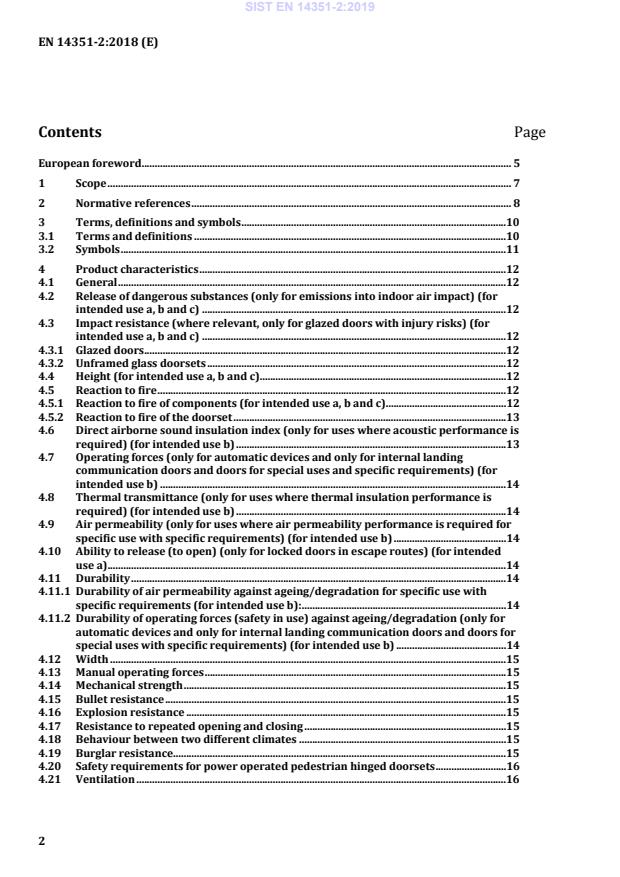
Product characteristics possibly affected by change of components .30 A.1 General .30 Annex B (normative)
Tabulated values and extension of test results following size and design variations .32 B.1 Characteristics of internal pedestrian doorsets .32 B.2 Sound insulation index of internal pedestrian doorsets .34 B.3 Thermal transmittance for Internal pedestrian doorsets UD in accordance to constructive details .35 Annex C (informative)
Example of performance and requirement profile of an Internal pedestrian doorsets .36 Annex D (informative)
Examples for opening dimensions of internal pedestrian doorsets 37 Annex E (informative)
Handling, installation, maintenance and care .39 Annex F (normative)
Selection, preparation, mounting and fixing of test sample(s) for reaction to fire tests and field of direct application .40 F.1 General .40 F.2 EN ISO 11925-2 (Single flame test) .40 F.2.1 Profile .40 F.2.2 Infill or door leaf .42 F.2.3 Sealant between infill and profile .42 F.2.4 Organic coating/top layers .43 F.3 Mounting and fixing for EN 13823 (SBI-test) .44 F.3.1 Testing of the individual components .44 F.3.2 Testing of the doorset .45 F.4 EN ISO 1182 (Non-combustibility test) .46 F.5 EN ISO 1716 (Determination of the heat of combustion) .46 F.6 Field of direct application .47 Annex ZA (informative)
Relationship of this European Standard with Regulation (EU) N°.305/2011 .48 ZA.1 Scope and relevant characteristics .48 ZA.2 System of assessment and Verification of Constancy of Performance (AVCP) .50 ZA.3 Assignment of AVCP tasks .50 Bibliography .53
Figure 1 — Relationship between various standards SIST EN 14351-2:2019
External width of frame "RB" External height of frame "RH" Figure 2 — External width and height of frame 3.1.3 similar design internal pedestrian doorset in which the replacement of components (e.g. glazing, building hardware, seals), and/or a change of material specification and/or dimensional change of profile section and/or methods and means of assembly does not change the classification and/or declared value of a performance characteristic 3.1.4 unframed glass doorset doorset where the leaf (leaves) with/without adjacent part(s) is (are) made of glass (single or insulating glass unit) 3.1.5 adjacent part additional lateral and/or above mounted elements, glazed or not, as parts of the complete doorset construction 3.1.6 glazed door with injury risk doors on which the lower 1500mm is more than 30 % glass and of which at least one sheet of glass is greater than 0,2m2 3.1.7 closing face face of a door leaf which is the first to move into the closed position [SOURCE: EN 12519:2018, 3.8] 3.2 Symbols For the purposes of this document, the following symbol applies. UD is the thermal transmittance for (internal pedestrian) doorsets SIST EN 14351-2:2019
Durability of air permeability against ageing/degradation for specific use with specific requirements (for intended use b): The durability of this characteristic depends on the gaskets. When assessed in accordance to 5.11.1, results shall comply with EN 12365-1:2003, 4.4, 4.6 and 4.7, and expressed as classes according to EN 12365-1:2003, 4.1. 4.11.2 Durability of operating forces (safety in use) against ageing/degradation (only for automatic devices and only for internal landing communication doors and doors for special uses with specific requirements) (for intended use b) Only when power operated doorsets are safeguarded by limitation of forces against impact hazards the durability of operating forces against ageing and degradation shall be tested according to 5.11.2. SIST EN 14351-2:2019
Manual operating forces Determination of manual operating forces is the determination of the opening or closing forces needed to start the motion of the door leaf. The manual operating forces shall be tested according to 5.13 and the result is expressed as given in EN 12217:2015, Table 1. 4.14
Mechanical strength Internal pedestrian doorsets shall mechanically withstand wear and tear in the intended use for the designed working life. The mechanical strength has to be tested according to 5.14 and the results shall be expressed in accordance with EN 1192. 4.15 Bullet resistance The bullet resistance of an internal pedestrian doorset has to be tested according to 5.15 and it shall be classified in accordance with EN 1522. NOTE Not all types of ammunition given in this standard can be used in all countries. 4.16 Explosion resistance The explosion resistance of an internal pedestrian doorset shall be tested according to 5.16 and classified in accordance with EN 13123-1 for shock tube. 4.17 Resistance to repeated opening and closing Internal pedestrian doorsets shall withstand opening and closing for their designed working life. The resistance of an internal pedestrian doorset to repeated opening and closing shall be tested in accordance with 5.17 and shall be expressed in accordance with EN 12400. 4.18 Behaviour between two different climates Internal pedestrian doorsets installed between two different climates shall remain stable for their designed working life to avoid operational problems due to possible deformations. The behaviour of the doorset between two different climates shall be tested according to 5.18 and the result expressed in accordance with EN 12219. Depending on the orientation of the specimen during the test the result may differ. The manufacturer shall mention either both results or the orientation used. 4.19 Burglar resistance The burglar resistance of an internal pedestrian doorset is the ability to resist intrusion. SIST EN 14351-2:2019
...