


EN 14319-2:2013
(Main)Thermal insulating products for building equipment and industrial installations - In-situ formed dispensed rigid polyurethane (PUR) and polyisocyanurate foam (PIR) products - Part 2: Specification for the installed insulation products
General Information
- Abstract
This European Standard specifies requirements for in-situ formed dispensed polyurethane (PUR) and polyisocyanurate (PIR) foam products for the insulation of building equipment industrial installations, for example storage vessels, pipes and ducts used for the supply of fuels, oil, other liquids, hot and cold water, air and other gases.
Depending on the type of foam products complying with this standard, they may have service temperature ranges which lie within the limits of ± 200 °C.
This Part 2 of this European Standard is a specification for the installed insulation product.
This Part 2 of this European Standard describes, when taken together with Part 1 of EN 14319, the product characteristics that are linked to the essential requirements of the EU Construction Products Directive. It also specifies the checks and tests to be used for the declarations made by the installer of the product.
This European Standard does not specify the required levels of all properties to be achieved by a product to demonstrate fitness for purpose in a particular application. The required levels are to be found in regulations or non-conflicting standards.
This European Standard does not cover factory made rigid polyurethane (PUR) or polyisocyanurate (PIR) foam products or in-situ products intended to be used for the insulation of buildings.
The products are not intended for use for direct airborne sound insulation or acoustic absorption applications.
NOTE Foam products are either called flexible or rigid. The flexible products are used in upholstery and mattresses and are characterised by their ability to deflect, support and recover to their original thickness continually during their in-use phase. Those that are not flexible are termed rigid and do not possess these flexible characteristics. They are mostly used for thermal insulation purposes and vary widely in their compression strength values. Once the cell structure is crushed in a rigid foam, it does not recover its thickness fully. Some of these rigid foams are very low in density with very low compression strengths and are sometimes described “commercially” as “soft foams” or “semi-rigid” foams. This note has been included to clarify that all foams with such descriptions are covered by this standard’s used of the term rigid foam.
- Status
- Published
- Publication Date
- 15-Jan-2013
- Technical Committee
- CEN/TC 88 - Thermal insulating materials and products
- Drafting Committee
- CEN/TC 88/WG 15 - In situ formed insulation products
- Current Stage
- 9093 - Decision to confirm - Review Enquiry
- Start Date
- 07-Apr-2025
- Completion Date
- 23-Sep-2026
- Directive
- Harmonized Standard305/2011 - Regulation (eu) No 305/2011 of the European Parliament and of the Council of 9 march 2011 laying down harmonised conditions for the marketing of construction products and repealing council directive 89/106/eec
Not Harmonized89/106/EEC - Construction products

Overview
EN 14319-2:2013 is the CEN European Standard that specifies requirements for in‑situ formed dispensed rigid polyurethane (PUR) and polyisocyanurate (PIR) foam as installed thermal insulation for building equipment and industrial installations. It covers installation, on‑site checks and the declarations the installer must provide for applications such as storage vessels, pipes and ducts conveying fuels, oils, liquids, hot and cold water, air and other gases. Together with EN 14319‑1:2013 (the product/system specification), Part 2 links product characteristics to the essential requirements of the EU Construction Products Directive for installed insulation products.
Key topics and requirements
- Scope & exclusions: Applies to in‑situ dispensed rigid PUR/PIR used for technical building equipment and industrial plant. Does not cover factory‑made rigid foam products, in‑situ products for building envelope insulation, or direct airborne sound/acoustic applications.
- System compliance: Installer must use a foam system that complies with EN 14319‑1 (the dispensed foam system specification).
- Suitability checks: Site inspection and suitability assessment of the equipment or installation are required (see Annex B).
- Declared installed thickness (d): Measurement procedure for the installed insulation thickness is specified (Annex A); installer must ensure installed thickness is not less than client or manufacturer minimums.
- Declared installed aged thermal resistance (RD): RD is declared based on the manufacturer’s thermal conductivity vs temperature data (λ vs T) and relevant procedures in EN 14319‑1; moisture and temperature corrections can use EN ISO 10456 where applicable.
- On‑site foam quality checks: Installer performs manufacturer‑defined site checks and generates test samples per EN 14319‑1 (e.g., Annex G) and any national rules.
- Installation guidance: Annex C provides dispensing and installation guidelines; national regulations or manufacturer technical information may define additional requirements (mixing ratio, dispensing conditions).
- Installer declaration: The installer must provide a declaration to the customer including date, declared thickness, declared RD, product trade name/designation code, and EC certificate number.
Practical applications and users
Who uses EN 14319‑2:2013:
- Insulation installers and applicators of in‑situ PUR/PIR foam
- Specifiers, design and project engineers for industrial plant and technical building services
- Facility managers, energy auditors and asset owners seeking compliance and declared thermal performance
- Manufacturers and conformity assessors working with the harmonised Part 1 for CE marking
Typical applications:
- Thermal insulation of process pipes, ducts, storage vessels, fuel/oil lines, HVAC distribution in industrial and commercial settings, where service temperatures may range (depending on product) up to ±200 °C.
Related standards
- EN 14319‑1:2013 (rigid foam dispensed system - harmonised/product part)
- EN ISO 9229 (thermal insulation vocabulary)
- EN ISO 10456 (moisture/temperature correction)
- EN ISO 6946 (thermal resistance calculation methods)
Keywords: EN 14319-2:2013, in-situ polyurethane insulation, PUR, PIR, declared installed insulation thickness, declared aged thermal resistance, installed insulation, thermal insulating products, building equipment, industrial installations.
Relations
- Effective Date
- 28-Jan-2026
- Effective Date
- 28-Jan-2026
Get Certified
Connect with accredited certification bodies for this standard

DIBt (Deutsches Institut für Bautechnik)
German Institute for Building Technology.
DIN CERTCO
DIN Group product certification.

Aboma Certification B.V.
Specialized in construction, metal, and transport sectors.
Sponsored listings
Frequently Asked Questions
EN 14319-2:2013 is a standard published by the European Committee for Standardization (CEN). Its full title is "Thermal insulating products for building equipment and industrial installations - In-situ formed dispensed rigid polyurethane (PUR) and polyisocyanurate foam (PIR) products - Part 2: Specification for the installed insulation products". This standard covers: This European Standard specifies requirements for in-situ formed dispensed polyurethane (PUR) and polyisocyanurate (PIR) foam products for the insulation of building equipment industrial installations, for example storage vessels, pipes and ducts used for the supply of fuels, oil, other liquids, hot and cold water, air and other gases. Depending on the type of foam products complying with this standard, they may have service temperature ranges which lie within the limits of ± 200 °C. This Part 2 of this European Standard is a specification for the installed insulation product. This Part 2 of this European Standard describes, when taken together with Part 1 of EN 14319, the product characteristics that are linked to the essential requirements of the EU Construction Products Directive. It also specifies the checks and tests to be used for the declarations made by the installer of the product. This European Standard does not specify the required levels of all properties to be achieved by a product to demonstrate fitness for purpose in a particular application. The required levels are to be found in regulations or non-conflicting standards. This European Standard does not cover factory made rigid polyurethane (PUR) or polyisocyanurate (PIR) foam products or in-situ products intended to be used for the insulation of buildings. The products are not intended for use for direct airborne sound insulation or acoustic absorption applications. NOTE Foam products are either called flexible or rigid. The flexible products are used in upholstery and mattresses and are characterised by their ability to deflect, support and recover to their original thickness continually during their in-use phase. Those that are not flexible are termed rigid and do not possess these flexible characteristics. They are mostly used for thermal insulation purposes and vary widely in their compression strength values. Once the cell structure is crushed in a rigid foam, it does not recover its thickness fully. Some of these rigid foams are very low in density with very low compression strengths and are sometimes described “commercially” as “soft foams” or “semi-rigid” foams. This note has been included to clarify that all foams with such descriptions are covered by this standard’s used of the term rigid foam.
This European Standard specifies requirements for in-situ formed dispensed polyurethane (PUR) and polyisocyanurate (PIR) foam products for the insulation of building equipment industrial installations, for example storage vessels, pipes and ducts used for the supply of fuels, oil, other liquids, hot and cold water, air and other gases. Depending on the type of foam products complying with this standard, they may have service temperature ranges which lie within the limits of ± 200 °C. This Part 2 of this European Standard is a specification for the installed insulation product. This Part 2 of this European Standard describes, when taken together with Part 1 of EN 14319, the product characteristics that are linked to the essential requirements of the EU Construction Products Directive. It also specifies the checks and tests to be used for the declarations made by the installer of the product. This European Standard does not specify the required levels of all properties to be achieved by a product to demonstrate fitness for purpose in a particular application. The required levels are to be found in regulations or non-conflicting standards. This European Standard does not cover factory made rigid polyurethane (PUR) or polyisocyanurate (PIR) foam products or in-situ products intended to be used for the insulation of buildings. The products are not intended for use for direct airborne sound insulation or acoustic absorption applications. NOTE Foam products are either called flexible or rigid. The flexible products are used in upholstery and mattresses and are characterised by their ability to deflect, support and recover to their original thickness continually during their in-use phase. Those that are not flexible are termed rigid and do not possess these flexible characteristics. They are mostly used for thermal insulation purposes and vary widely in their compression strength values. Once the cell structure is crushed in a rigid foam, it does not recover its thickness fully. Some of these rigid foams are very low in density with very low compression strengths and are sometimes described “commercially” as “soft foams” or “semi-rigid” foams. This note has been included to clarify that all foams with such descriptions are covered by this standard’s used of the term rigid foam.
EN 14319-2:2013 is classified under the following ICS (International Classification for Standards) categories: 91.100.60 - Thermal and sound insulating materials. The ICS classification helps identify the subject area and facilitates finding related standards.
EN 14319-2:2013 has the following relationships with other standards: It is inter standard links to EN 14319-1:2013, EN ISO 9229:2007. Understanding these relationships helps ensure you are using the most current and applicable version of the standard.
EN 14319-2:2013 is associated with the following European legislation: EU Directives/Regulations: 305/2011, 89/106/EEC; Standardization Mandates: M/103. When a standard is cited in the Official Journal of the European Union, products manufactured in conformity with it benefit from a presumption of conformity with the essential requirements of the corresponding EU directive or regulation.
EN 14319-2:2013 is available in PDF format for immediate download after purchase. The document can be added to your cart and obtained through the secure checkout process. Digital delivery ensures instant access to the complete standard document.
Standards Content (Sample)
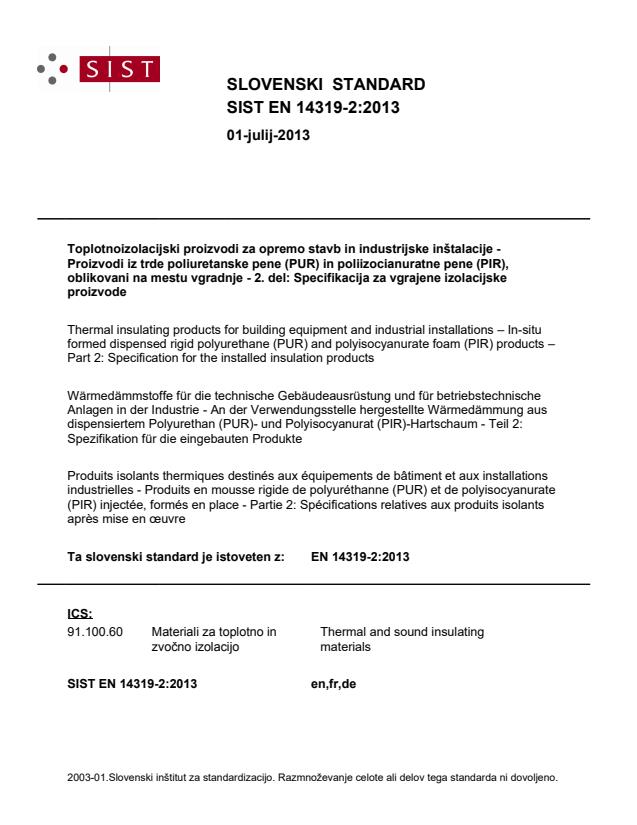
2003-01.Slovenski inštitut za standardizacijo. Razmnoževanje celote ali delov tega standarda ni dovoljeno.Toplotnoizolacijski proizvodi za opremo stavb in industrijske inštalacije - Proizvodi iz trde poliuretanske pene (PUR) in poliizocianuratne pene (PIR), oblikovani na mestu vgradnje - 2. del: Specifikacija za vgrajene izolacijske proizvodeWärmedämmstoffe für die technische Gebäudeausrüstung und für betriebstechnische Anlagen in der Industrie - An der Verwendungsstelle hergestellte Wärmedämmung aus dispensiertem Polyurethan (PUR)- und Polyisocyanurat (PIR)-Hartschaum - Teil 2: Spezifikation für die eingebauten ProdukteProduits isolants thermiques destinés aux équipements de bâtiment et aux installations industrielles - Produits en mousse rigide de polyuréthanne (PUR) et de polyisocyanurate (PIR) injectée, formés en place - Partie 2: Spécifications relatives aux produits isolants après mise en œuvreThermal insulating products for building equipment and industrial installations – In-situ formed dispensed rigid polyurethane (PUR) and polyisocyanurate foam (PIR) products – Part 2: Specification for the installed insulation products91.100.60Thermal and sound insulating materialsICS:Ta slovenski standard je istoveten z:EN 14319-2:2013SIST EN 14319-2:2013en,fr,de01-julij-2013SIST EN 14319-2:2013SLOVENSKI
STANDARD
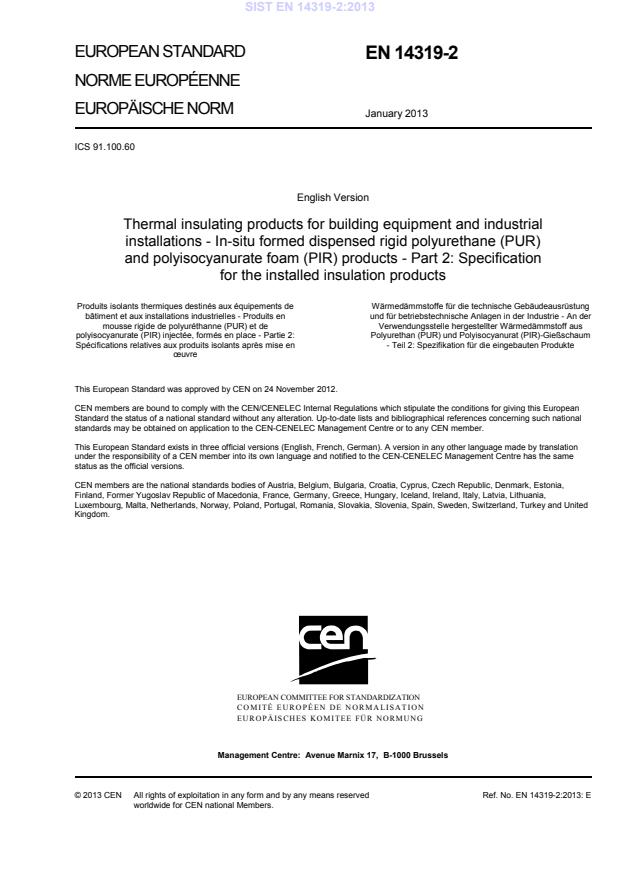
EUROPEAN STANDARD NORME EUROPÉENNE EUROPÄISCHE NORM
EN 14319-2
January 2013 ICS 91.100.60 English Version
Thermal insulating products for building equipment and industrial installations - In-situ formed dispensed rigid polyurethane (PUR) and polyisocyanurate foam (PIR) products - Part 2: Specification for the installed insulation products
Produits isolants thermiques destinés aux équipements de bâtiment et aux installations industrielles - Produits en mousse rigide de polyuréthanne (PUR) et de polyisocyanurate (PIR) injectée, formés en place - Partie 2: Spécifications relatives aux produits isolants après mise en œuvre
Wärmedämmstoffe für die technische Gebäudeausrüstung und für betriebstechnische Anlagen in der Industrie - An der Verwendungsstelle hergestellter Wärmedämmstoff aus Polyurethan (PUR) und Polyisocyanurat (PIR)-Gießschaum - Teil 2: Spezifikation für die eingebauten Produkte This European Standard was approved by CEN on 24 November 2012.
CEN members are bound to comply with the CEN/CENELEC Internal Regulations which stipulate the conditions for giving this European Standard the status of a national standard without any alteration. Up-to-date lists and bibliographical references concerning such national standards may be obtained on application to the CEN-CENELEC Management Centre or to any CEN member.
This European Standard exists in three official versions (English, French, German). A version in any other language made by translation under the responsibility of a CEN member into its own language and notified to the CEN-CENELEC Management Centre has the same status as the official versions.
CEN members are the national standards bodies of Austria, Belgium, Bulgaria, Croatia, Cyprus, Czech Republic, Denmark, Estonia, Finland, Former Yugoslav Republic of Macedonia, France, Germany, Greece, Hungary, Iceland, Ireland, Italy, Latvia, Lithuania, Luxembourg, Malta, Netherlands, Norway, Poland, Portugal, Romania, Slovakia, Slovenia, Spain, Sweden, Switzerland, Turkey and United Kingdom.
EUROPEAN COMMITTEE FOR STANDARDIZATION
COMITÉ EUROPÉEN DE NORMALISATION EUROPÄISCHES KOMITEE FÜR NORMUNG
Management Centre:
Avenue Marnix 17,
B-1000 Brussels © 2013 CEN All rights of exploitation in any form and by any means reserved worldwide for CEN national Members. Ref. No. EN 14319-2:2013: ESIST EN 14319-2:2013
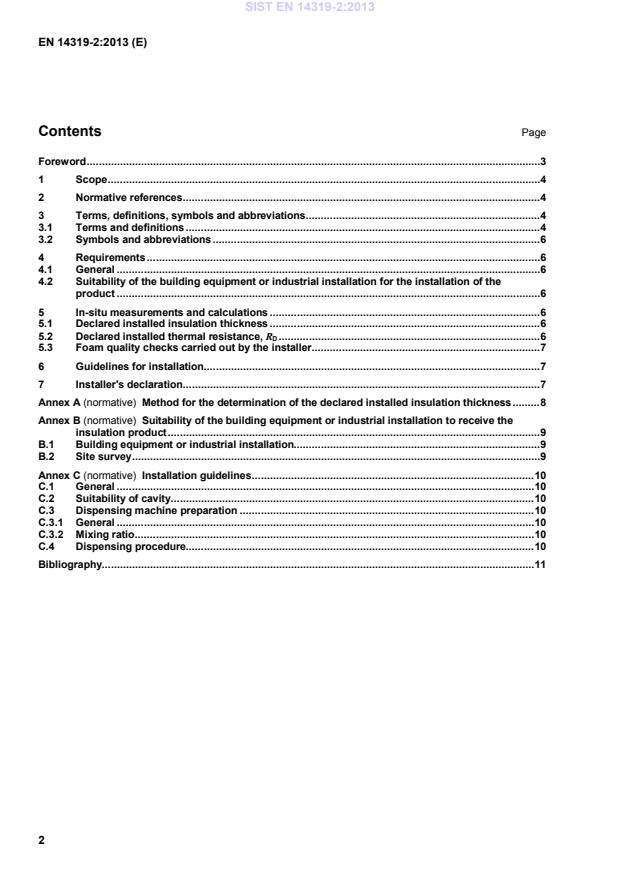
Method for the determination of the declared installed insulation thickness . 8 Annex B (normative)
Suitability of the building equipment or industrial installation to receive the insulation product . 9 B.1 Building equipment or industrial installation. 9 B.2 Site survey . 9 Annex C (normative)
Installation guidelines . 10 C.1 General . 10 C.2 Suitability of cavity . 10 C.3 Dispensing machine preparation . 10 C.3.1 General . 10 C.3.2 Mixing ratio . 10 C.4 Dispensing procedure . 10 Bibliography. 11
Part 2: Specification for the installed insulation products (the present document) According to the CEN/CENELEC Internal Regulations, the national standards organisations of the following countries are bound to implement this European Standard: Austria, Belgium, Bulgaria, Croatia, Cyprus, Czech Republic, Denmark, Estonia, Finland, Former Yugoslav Republic of Macedonia, France, Germany, Greece, Hungary, Iceland, Ireland, Italy, Latvia, Lithuania, Luxembourg, Malta, Netherlands, Norway, Poland, Portugal, Romania, Slovakia, Slovenia, Spain, Sweden, Switzerland, Turkey and the United Kingdom. SIST EN 14319-2:2013
...