


EN 13369:2023
(Main)Common rules for precast concrete products
General Information
- Abstract
This document provides the specifications, the basic performance criteria and the Assessment and Verification of Constancy of Performance (AVCP) for unreinforced, reinforced and prestressed precast concrete products made of compact light-, normal- and heavyweight concrete according to EN 206 with no appreciable amount of entrapped air other than entrained air. Concrete containing fibres for other than mechanical properties (steel, polymer or other fibres) is also covered. It does not cover precast reinforced components of lightweight aggregate concrete with open structure nor glass-fibre reinforced concrete.
It can also be used to specify products for which there is no standard. Not all of the specifications (Clause 4) of this document are relevant to all precast concrete products.
Some European product standards refer to this document. They can include specific provisions that take precedence over the provisions of this document.
- Status
- Published
- Publication Date
- 14-Nov-2023
- Technical Committee
- CEN/TC 229 - Precast concrete products
- Current Stage
- 6060 - Definitive text made available (DAV) - Publishing
- Start Date
- 15-Nov-2023
- Due Date
- 19-Sep-2023
- Completion Date
- 15-Nov-2023


Overview
EN 13369:2023 - Common rules for precast concrete products establishes the general specifications, performance criteria and Assessment and Verification of Constancy of Performance (AVCP) for precast concrete components. It applies to unreinforced, reinforced and prestressed precast products manufactured from compact light‑, normal‑ and heavyweight concrete in accordance with EN 206, including concrete containing fibres used for non‑mechanical purposes. This standard replaces SIST EN 13369:2018 and is aligned with EN 13369:2023.
The standard can be used to specify products that lack a dedicated product standard. Note: it does not cover precast reinforced lightweight aggregate concrete with open structure or glass‑fibre reinforced concrete. National product standards may include provisions that take precedence over EN 13369.
Key topics and technical requirements
- Scope and definitions - Terms, dimensions, tolerances, durability and mechanical properties for precast products.
- Specifications (Clause 4) - Material and component requirements (constituent materials, reinforcement, prestressing steel, inserts/connectors), production process and finished product criteria. Not all clause 4 items apply to every product.
- Production control - Requirements for concrete production, hardened concrete properties, reinforcement and prestressing operations.
- Finished product requirements - Geometrical properties, surface characteristics, mechanical resistance, fire reaction/resistance, acoustic and thermal properties, and durability.
- Test methods (Clause 5) - Standardized tests including compressive strength, water absorption, dry density and dimensional measurements.
- Assessment and Verification of Constancy of Performance (Clause 6) - AVCP procedures, product families, testing and compliance criteria, factory production control (FPC), initial inspection and continuous surveillance.
- Marking and technical documentation - Requirements for product marking and required information for conformity and use.
- Informative and normative annexes - Practical guidance on concrete cover for corrosion, water absorption test method, measurement of dimensions, prestressing losses, inspection schemes and documentation.
Practical applications and who uses it
SIST EN 13369 is essential for:
- Precast concrete manufacturers - to set up factory production control, tests and product specifications.
- Structural designers and engineers - to reference standardized material and geometric tolerances for design and durability checks.
- Specifiers and procurement teams - to prepare product requirements where no specific product standard exists.
- Notified bodies and conformity assessors - for AVCP, inspection schemes and audit testing.
- Contractors and quality inspectors - for acceptance testing, dimensional checks and installation documentation.
Keywords: precast concrete, precast concrete products, AVCP, factory production control, EN 206, durability, water absorption test, geometrical tolerances.
Related standards
- EN 206 (Concrete - Specification, performance, production and conformity) - referenced for concrete quality and production.
- Relevant European or national precast product standards that may refer to or take precedence over EN 13369.
Relations
- Effective Date
- 19-Jan-2023
- Effective Date
- 28-Jan-2026
- Effective Date
- 28-Jan-2026
- Refers
EN 12390-2:2019 - Testing hardened concrete - Part 2: Making and curing specimens for strength tests - Effective Date
- 28-Jan-2026
- Effective Date
- 28-Jan-2026
- Effective Date
- 28-Jan-2026
- Effective Date
- 28-Jan-2026
- Effective Date
- 28-Jan-2026
- Effective Date
- 28-Jan-2026
- Effective Date
- 28-Jan-2026
- Effective Date
- 28-Jan-2026
- Effective Date
- 28-Jan-2026
- Effective Date
- 28-Jan-2026
- Effective Date
- 28-Jan-2026
- Effective Date
- 28-Jan-2026
Get Certified
Connect with accredited certification bodies for this standard

DIBt (Deutsches Institut für Bautechnik)
German Institute for Building Technology.
DIN CERTCO
DIN Group product certification.

Aboma Certification B.V.
Specialized in construction, metal, and transport sectors.
Sponsored listings
Frequently Asked Questions
EN 13369:2023 is a standard published by the European Committee for Standardization (CEN). Its full title is "Common rules for precast concrete products". This standard covers: This document provides the specifications, the basic performance criteria and the Assessment and Verification of Constancy of Performance (AVCP) for unreinforced, reinforced and prestressed precast concrete products made of compact light-, normal- and heavyweight concrete according to EN 206 with no appreciable amount of entrapped air other than entrained air. Concrete containing fibres for other than mechanical properties (steel, polymer or other fibres) is also covered. It does not cover precast reinforced components of lightweight aggregate concrete with open structure nor glass-fibre reinforced concrete. It can also be used to specify products for which there is no standard. Not all of the specifications (Clause 4) of this document are relevant to all precast concrete products. Some European product standards refer to this document. They can include specific provisions that take precedence over the provisions of this document.
This document provides the specifications, the basic performance criteria and the Assessment and Verification of Constancy of Performance (AVCP) for unreinforced, reinforced and prestressed precast concrete products made of compact light-, normal- and heavyweight concrete according to EN 206 with no appreciable amount of entrapped air other than entrained air. Concrete containing fibres for other than mechanical properties (steel, polymer or other fibres) is also covered. It does not cover precast reinforced components of lightweight aggregate concrete with open structure nor glass-fibre reinforced concrete. It can also be used to specify products for which there is no standard. Not all of the specifications (Clause 4) of this document are relevant to all precast concrete products. Some European product standards refer to this document. They can include specific provisions that take precedence over the provisions of this document.
EN 13369:2023 is classified under the following ICS (International Classification for Standards) categories: 91.100.30 - Concrete and concrete products. The ICS classification helps identify the subject area and facilitates finding related standards.
EN 13369:2023 has the following relationships with other standards: It is inter standard links to EN 13369:2018, EN 12350-8:2019, EN 12350-12:2010, EN 12390-2:2019, EN 12350-2:2019, EN 13501-1:2018, EN 12350-7:2019, EN 1097-6:2022, EN 12504-1:2019, EN 12350-11:2010, EN 1992-1-1:2004/A1:2014, EN 1008:2002, EN 12350-5:2019, EN 12350-10:2010, EN 12390-3:2019. Understanding these relationships helps ensure you are using the most current and applicable version of the standard.
EN 13369:2023 is available in PDF format for immediate download after purchase. The document can be added to your cart and obtained through the secure checkout process. Digital delivery ensures instant access to the complete standard document.
Standards Content (Sample)
SLOVENSKI STANDARD
01-januar-2024
Nadomešča:
SIST EN 13369:2018
Splošna pravila za montažne betonske izdelke
Common rules for precast concrete products
Allgemeine Regeln für Betonfertigteile
Règles communes pour les produits préfabriqués en béton
Ta slovenski standard je istoveten z: EN 13369:2023
ICS:
91.100.30 Beton in betonski izdelki Concrete and concrete
products
2003-01.Slovenski inštitut za standardizacijo. Razmnoževanje celote ali delov tega standarda ni dovoljeno.
EN 13369
EUROPEAN STANDARD
NORME EUROPÉENNE
November 2023
EUROPÄISCHE NORM
ICS 91.100.30 Supersedes EN 13369:2018
English Version
Common rules for precast concrete products
Règles communes pour les produits préfabriqués en Allgemeine Regeln für Betonfertigteile
béton
This European Standard was approved by CEN on 28 August 2023.
CEN members are bound to comply with the CEN/CENELEC Internal Regulations which stipulate the conditions for giving this
European Standard the status of a national standard without any alteration. Up-to-date lists and bibliographical references
concerning such national standards may be obtained on application to the CEN-CENELEC Management Centre or to any CEN
member.
This European Standard exists in three official versions (English, French, German). A version in any other language made by
translation under the responsibility of a CEN member into its own language and notified to the CEN-CENELEC Management
Centre has the same status as the official versions.
CEN members are the national standards bodies of Austria, Belgium, Bulgaria, Croatia, Cyprus, Czech Republic, Denmark, Estonia,
Finland, France, Germany, Greece, Hungary, Iceland, Ireland, Italy, Latvia, Lithuania, Luxembourg, Malta, Netherlands, Norway,
Poland, Portugal, Republic of North Macedonia, Romania, Serbia, Slovakia, Slovenia, Spain, Sweden, Switzerland, Türkiye and
United Kingdom.
EUROPEAN COMMITTEE FOR STANDARDIZATION
COMITÉ EUROPÉEN DE NORMALISATION
EUROPÄISCHES KOMITEE FÜR NORMUNG
CEN-CENELEC Management Centre: Rue de la Science 23, B-1040 Brussels
© 2023 CEN All rights of exploitation in any form and by any means reserved Ref. No. EN 13369:2023 E
worldwide for CEN national Members.
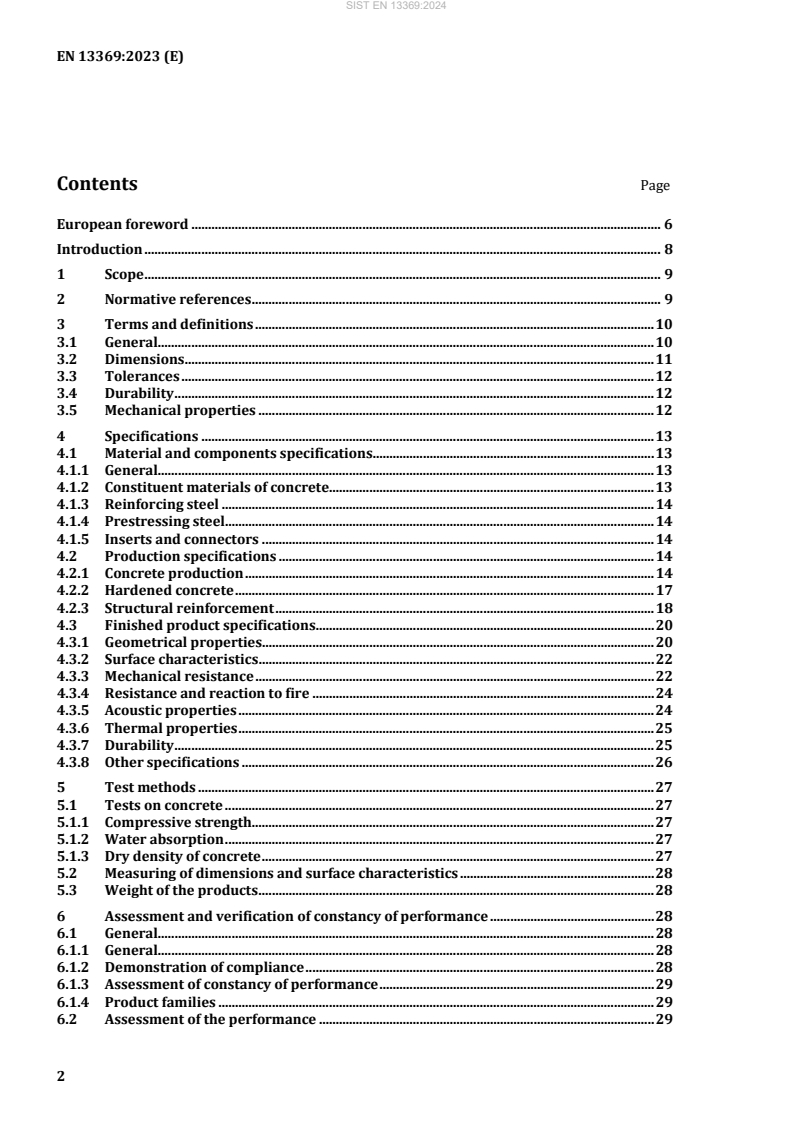
Contents Page
European foreword . 6
Introduction . 8
1 Scope . 9
2 Normative references . 9
3 Terms and definitions . 10
3.1 General. 10
3.2 Dimensions. 11
3.3 Tolerances . 12
3.4 Durability . 12
3.5 Mechanical properties . 12
4 Specifications . 13
4.1 Material and components specifications. 13
4.1.1 General. 13
4.1.2 Constituent materials of concrete. 13
4.1.3 Reinforcing steel . 14
4.1.4 Prestressing steel . 14
4.1.5 Inserts and connectors . 14
4.2 Production specifications . 14
4.2.1 Concrete production . 14
4.2.2 Hardened concrete . 17
4.2.3 Structural reinforcement . 18
4.3 Finished product specifications. 20
4.3.1 Geometrical properties. 20
4.3.2 Surface characteristics . 22
4.3.3 Mechanical resistance . 22
4.3.4 Resistance and reaction to fire . 24
4.3.5 Acoustic properties . 24
4.3.6 Thermal properties . 25
4.3.7 Durability . 25
4.3.8 Other specifications . 26
5 Test methods . 27
5.1 Tests on concrete . 27
5.1.1 Compressive strength. 27
5.1.2 Water absorption . 27
5.1.3 Dry density of concrete . 27
5.2 Measuring of dimensions and surface characteristics . 28
5.3 Weight of the products . 28
6 Assessment and verification of constancy of performance . 28
6.1 General. 28
6.1.1 General. 28
6.1.2 Demonstration of compliance . 28
6.1.3 Assessment of constancy of performance . 29
6.1.4 Product families . 29
6.2 Assessment of the performance . 29
6.2.1 General . 29
6.2.2 Testing and compliance criteria. 30
6.3 Factory production control . 30
6.3.1 General . 30
6.3.2 Organization . 31
6.3.3 Control system . 31
6.3.4 Document control . 31
6.3.5 Process control . 31
6.3.6 Inspection and testing . 31
6.3.7 Non-compliant products . 32
6.3.8 Compliance criteria. 33
6.3.9 Indirect or alternative test method . 33
6.3.10 Initial inspection of factory and of FPC . 33
6.3.11 Continuous surveillance of FPC . 34
6.3.12 Procedure for modifications . 34
7 Marking . 34
8 Technical documentation . 35
Annex A (informative) Concrete cover as regard to corrosion . 36
A.1 Minimum concrete cover for base conditions . 36
A.2 Alternative conditions . 37
Annex B (informative) Concrete strength quality control . 38
B.1 Statistical representative values . 38
B.2 Compliance criteria for potential strength . 38
B.3 Direct structural strength . 38
B.4 Indirect structural strength . 38
B.5 Direct assessment of possibly non-conforming units . 39
Annex C (informative) Reliability considerations . 41
C.1 General . 41
C.2 Reduction based on quality control and reduced tolerances . 41
C.3 Reduction based on using reduced or measured geometrical parameters in design 42
C.4 Reduction based on assessment of concrete strength in finished structure . 42
C.5 Reduction of γ based on control of self-weight . 43
G
Annex D (normative) Inspection schemes . 44
D.1 General . 44
D.2 Equipment inspection . 44
D.3 Inspection of incoming materials . 46
D.4 Process inspection. 48
D.5 Finished product inspection . 52
D.6 Switching rules . 52
Annex E (informative) Assessment of compliance . 54
E.1 General . 54
E.1.1 General remark . 54
E.1.2 Compliance of factory quality system. 54
E.1.3 Compliance of the product. 54
E.2 Initial inspection . 54
E.3 Continuous surveillance . 54
E.4 Audit testing . 55
Annex F (normative) Test of water absorption . 56
F.1 Method . 56
F.2 Sampling . 56
F.3 Materials . 58
F.4 Apparatus . 59
F.5 Preparation . 59
F.6 Procedure . 59
F.7 Results . 59
Annex G (informative) Measurement of dimensions . 60
G.1 General. 60
G.2 Length, height, width and thickness . 60
G.3 Warp and straightness . 60
G.4 Out of squareness . 61
G.5 Surface characteristics . 61
Annex H (informative) Prestressing losses . 66
H.1 General. 66
H.2 Calculation of losses (general method). 66
H.2.1 Immediate losses . 66
H.2.2 Time dependent losses after transfer of the prestressing force . 66
H.3 Simplified method . 67
Annex I (informative) Technical documentation . 68
I.1 General. 68
I.2 Product documentation . 68
I.3 Production documentation . 68
I.4 Erection documentation . 69
Annex J (informative) Properties of indented bars and wire . 70
Annex K (informative) Resistance to fire: recommendations for the use of EN 1992-1-2 . 71
K.1 Use of tabulated data . 71
K.2 Use of calculation methods . 71
Annex L (informative) Survey of type testing . 72
Annex M (informative) Performance-based approach for precast concrete products . 74
M.1 Introduction . 74
M.2 Equivalent Durability Procedure . 74
M.3 Exposure Resistance Classes . 75
M.4 Specifications to implement PBA for precast concrete products . 75
Bibliography . 76
European foreword
This document (EN 13369:2023) has been prepared by Technical Committee CEN/TC 229 “Precast
concrete products”, the secretariat of which is held by AFNOR.
This European Standard shall be given the status of a national standard, either by publication of an
identical text or by endorsement, at the latest by May 2024 and conflicting national standards shall be
withdrawn at the latest by May 2024.
Attention is drawn to the possibility that some of the elements of this document may be the subject of
patent rights. CEN shall not be held responsible for identifying any or all such patent rights.
This document supersedes EN 13369:2018.
The main changes compared to the previous edition are listed below:
a) normative references have been updated taking into account the amendment A2 of EN 206;
b) the specifications regarding the concrete strength at the end of curing were revised;
c) Annex A was revised with the deletion of environmental conditions classes;
d) the vocabulary in Annex D was revised to comply with the Construction Product Regulation;
e) Annex H on prestressing losses was revised;
f) an informative Annex related to the performance-based approach was added.
EN 13369 is a common reference for the following group of specific product standards prepared by
Technical Committee CEN/TC 229:
— EN 1168, Precast concrete products — Hollow core slabs;
— EN 12737, Precast concrete products — Floor slats for livestock;
— EN 12794, Precast concrete products — Foundation piles;
— EN 12839, Precast concrete products — Elements for fences;
— EN 12843, Precast concrete products — Masts and poles;
— EN 13198, Precast concrete products — Street furniture and garden products;
— EN 13224, Precast concrete products — Ribbed floor elements;
— EN 13225, Precast concrete products — Linear structural elements;
— EN 13693, Precast concrete products — Special roof elements;
— EN 13747, Precast concrete products — Floor plates for floor systems;
— EN 13748-1, Terrazzo tiles — Part 1: Terrazzo tiles for internal use;
— EN 13748-2, Terrazzo tiles — Part 2: Terrazzo tiles for external use;
— EN 13978-1, Precast concrete products — Precast concrete garages — Part 1: Requirements for
reinforced garages monolithic or consisting of single sections with room dimensions;
— EN 14843, Precast concrete products — Stairs;
— EN 14844, Precast concrete products — Box culverts;
— EN 14991, Precast concrete products — Foundation elements;
— EN 14992, Precast concrete products — Wall elements;
— EN 15037-1, Precast concrete products — Beam-and-block floor systems — Part 1: Beams;
— EN 15037-2, Precast concrete products — Beam-and-block floor systems — Part 2: Concrete blocks;
— EN 15037-3, Precast concrete products — Beam-and-block floor systems — Part 3: Clay blocks;
— EN 15037-4, Precast concrete products — Beam-and-block floor systems — Part 4: Expanded
polystyrene blocks;
— EN 15037-5, Precast concrete products — Beam-and-block floor systems — Part 5: Lightweight blocks
for simple formwork;
— EN 15050, Precast concrete products — Bridge elements;
— EN 15258, Precast concrete products — Retaining wall elements;
— EN 15435, Precast concrete products — Normal weight and lightweight concrete shuttering blocks —
product properties and performances;
— EN 15498, Precast concrete products — Wood-chip concrete shuttering blocks — Product properties
and performances.
Any feedback and questions on this document should be directed to the users’ national standards body.
A complete listing of these bodies can be found on the CEN website.
According to the CEN-CENELEC Internal Regulations, the national standards organizations of the
following countries are bound to implement this European Standard: Austria, Belgium, Bulgaria, Croatia,
Cyprus, Czech Republic, Denmark, Estonia, Finland, France, Germany, Greece, Hungary, Iceland, Ireland,
Italy, Latvia, Lithuania, Luxembourg, Malta, Netherlands, Norway, Poland, Portugal, Republic of North
Macedonia, Romania, Serbia, Slovakia, Slovenia, Spain, Sweden, Switzerland, Türkiye and the United
Kingdom.
Introduction
This document is intended to outline the general common specifications applicable to a large variety of
precast concrete products manufactured in a factory environment. It acts as a reference standard for
other standards to enable a more consistent approach to standardization in the field of precast concrete
products and to reduce the variations brought about by a large number of standards produced in parallel
by different groups of experts. At the same time, it allows those experts the flexibility to include variations
in specific product standards where they are required.
This document has been produced as part of the total CEN programme for construction and refers to the
relevant specifications of associated standards EN 206 for concrete and the EN 1992 series for the design
of concrete structures. The installation of some precast concrete products is dealt with by EN 13670.
As it is not a harmonized standard, it is not allowed to be used on its own for the purpose of CE marking
of precast concrete products.
The design of precast concrete products should be verified to ensure the fitness of their properties for
the particular application, particular attention being paid to design co-ordination with other parts of the
construction.
1 Scope
This document provides the specifications, the basic performance criteria and the Assessment and
Verification of Constancy of Performance (AVCP) for unreinforced, reinforced and prestressed precast
concrete products made of compact light-, normal- and heavyweight concrete according to EN 206 with
no appreciable amount of entrapped air other than entrained air. Concrete containing fibres for other
than mechanical properties (steel, polymer or other fibres) is also covered. It does not cover precast
reinforced components of lightweight aggregate concrete with open structure nor glass-fibre reinforced
concrete.
It can also be used to specify products for which there is no standard. Not all of the specifications
(Clause 4) of this document are relevant to all precast concrete products.
Some European product standards refer to this document. They can include specific provisions that take
precedence over the provisions of this document.
2 Normative references
The following documents are referred to in the text in such a way that some or all of their content
constitutes requirements of this document. For dated references, only the edition cited applies. For
undated references, the latest edition of the referenced document (including any amendments) applies.
EN 206:2013+A2:2021, Concrete - Specification, performance, production and conformity
EN 934-2, Admixtures for concrete, mortar and grout - Part 2: Concrete admixtures - Definitions,
requirements, conformity, marking and labelling
EN 1008, Mixing water for concrete - Specification for sampling, testing and assessing the suitability of
water, including water recovered from processes in the concrete industry, as mixing water for concrete
EN 1097-6, Tests for mechanical and physical properties of aggregates - Part 6: Determination of particle
density and water absorption
EN 1992-1-1:2004, Eurocode 2: Design of concrete structures - Part 1-1: General rules and rules for
buildings
EN 12350-2, Testing fresh concrete - Part 2: Slump test
EN 12350-4, Testing fresh concrete - Part 4: Degree of compactability
EN 12350-5, Testing fresh concrete - Part 5: Flow table test
EN 12350-6, Testing fresh concrete - Part 6: Density
EN 12350-7, Testing fresh concrete - Part 7: Air content - Pressure methods
EN 12350-8, Testing fresh concrete - Part 8: Self-compacting concrete - Slump-flow test
EN 12350-9, Testing fresh concrete - Part 9: Self-compacting concrete - V-funnel test
EN 12350-10, Testing fresh concrete - Part 10: Self-compacting concrete - L box test
EN 12350-11, Testing fresh concrete - Part 11: Self-compacting concrete - Sieve segregation test
As impacted by EN 1992-1-1:2004/AC:2010 and EN 1992-1-1:2004/A1:2014.
EN 12350-12, Testing fresh concrete - Part 12: Self-compacting concrete - J-ring test
EN 12390-1, Testing hardened concrete - Part 1: Shape, dimensions and other requirements for specimens
and moulds
EN 12390-2, Testing hardened concrete - Part 2: Making and curing specimens for strength tests
EN 12390-3, Testing hardened concrete - Part 3: Compressive strength of test specimens
EN 12390-7, Testing hardened concrete - Part 7: Density of hardened concrete
EN 12504-1, Testing concrete in structures - Part 1: Cored specimens - Taking, examining and testing in
compression
EN 13501-1, Fire classification of construction products and building elements - Part 1: Classification using
data from reaction to fire tests
EN ISO 717-1, Acoustics - Rating of sound insulation in buildings and of building elements - Part 1: Airborne
sound insulation (ISO 717-1)
EN ISO 717-2, Acoustics - Rating of sound insulation in buildings and of building elements - Part 2: Impact
sound insulation (ISO 717-2)
EN ISO 10456, Building materials and products - Hygrothermal properties -Tabulated design values and
procedures for determining declared and design thermal values (ISO 10456)
ASTM C173/C173M - 10b, Standard Test Method for Air Content of Freshly Mixed Concrete by the
Volumetric Method
3 Terms and definitions
For the purposes of this document, the following terms and definitions apply.
ISO and IEC maintain terminology databases for use in standardization at the following addresses:
— ISO Online browsing platform: available at https://www.iso.org/obp/
— IEC Electropedia: available at https://www.electropedia.org/
3.1 General
3.1.1
precast concrete product
product which is made of concrete and is manufactured in accordance with this document or a specific
product standard in a place different from the final destination of use, protected from adverse weather
conditions during production and which is the result of an industrial process under a factory production
control system and with the possibility of sorting before delivery
Note 1 to entry: In relevant European Standards, the shorter term “Precast product” is often used.
3.1.2
concrete cover
distance between the surface of the reinforcement closest to the nearest concrete surface (including links
and stirrups and surface reinforcement where relevant) and the nearest concrete surface
[SOURCE: EN 1992-1-1:2004]
3.1.3
concrete family
group of concrete compositions for which a reliable relationship between relevant properties is
established and documented
[SOURCE: EN 206:2013+A2:2021, 3.1.1.2]
3.1.4
tendon
prestressing unit (wire, strand or bar) subjected to pre-tensioning
3.1.5
lightweight concrete
3 3
concrete with a closed structure and with an oven-dry density of 800 kg/m to 2 000 kg/m
3.1.6
normal weight concrete
3 3
concrete with an oven-dry density of 2 000 kg/m to 2 600 kg/m
3.1.7
heavyweight concrete
concrete with an oven-dry density of more than 2 600 kg/m
3.1.8
product-type
set of representative performance levels or classes of construction product, in relation to its
characteristics, produced using a given combination of raw materials or other elements in a specific
production process
3.1.9
reclaimed crushed aggregate
aggregate gained by crushing hardened concrete that has not been previously used in construction
[SOURCE: EN 206:2013+A2:2021]
3.1.10
recycled aggregate
aggregate resulting from the processing of inorganic material previously used in construction
[SOURCE: EN 206:2013+A2:2021]
3.2 Dimensions
3.2.1
principal dimensions
length, width, depth or thickness
3.2.2
nominal dimension
dimension declared in the technical documentation and targeted at manufacture
3.3 Tolerances
3.3.1
tolerance
sum of the absolute values of the upper and the lower permitted deviation
3.3.2
deviation
difference between an actual measure and the corresponding nominal dimension
3.4 Durability
3.4.1
durability
ability of a precast concrete product to satisfy, with anticipated maintenance, the design performance
requirements during its design working life under the influence of the expected environmental actions
3.4.2
design working life
assumed period for which a structure or part of it is to be used for its intended purpose with anticipated
maintenance but without major repair being necessary
3.4.3
environmental conditions
physical or chemical impacts to which the precast concrete product is exposed and which result in effects
on the concrete or reinforcement or embedded metal that are not considered as loads in structural design
3.4.4
ambient conditions
hygrothermic conditions in the factory which result in effects on the hardening process of the concrete
3.5 Mechanical properties
3.5.1
potential strength
compressive concrete strength derived from tests on cubes or cylinders moulded and cured in laboratory
conditions in accordance with EN 12390-2
3.5.2
structural strength
compressive concrete strength derived from tests on specimens (drilled cores or cut prisms) taken from
the precast concrete product (direct structural strength) or derived from tests on moulded specimens
cured in the same ambient conditions as the product itself (indirect structural strength)
3.5.3
characteristic strength
value of strength below which 5 % of the population of all possible strength determinations of the volume
of concrete under consideration are expected to fall
4 Specifications
4.1 Material and components specifications
4.1.1 General
Only materials with established suitability shall be used.
For a particular material, the establishment of suitability may be based on a European Standard which
refers specifically to the use of this material in concrete or in precast concrete products; in absence of a
European Standard, it may also result, under the same conditions, from an ISO Standard.
Where this material is not covered by a European or ISO Standard, or if it deviates from the specifications
of these standards, the establishment of suitability may be based on:
— the provisions valid in the place of use of the precast concrete product which refer specifically to the
use of this material in concrete or in precast concrete products; or
— a European Technical Assessment specifically for the use of this material in concrete or precast
concrete products.
4.1.2 Constituent materials of concrete
4.1.2.1 General
EN 206:2013+A2:2021, 5.1 shall apply. When relevant, the following additional provisions may be used.
4.1.2.2 Reclaimed crushed aggregates and recycled coarse aggregates
4.1.2.2.1 General
Reclaimed crushed aggregates and recycled aggregates to be used for concrete, mixed with or without
natural aggregates, shall not adversely alter the rate of setting and hardening of concrete, nor shall it be
detrimental to the durability of the precast concrete product in the end-use conditions.
NOTE Other provisions valid in the place of use can apply.
4.1.2.2.2 Reclaimed aggregates
Reclaimed aggregates may be used for concrete provided it is only used internally by the manufacturer.
They shall not be added in quantities greater than 5 % by mass of the total aggregate if they aren’t
properly separated in function of their particle size.
Reclaimed aggregates may be used up to 20 % as coarse aggregates and up to 10 % as fine aggregates
provided that:
a) they come from a concrete with strength class at least equal to the required strength class of the new
concrete product;
b) they are properly separated in function of their particle size;
c) they are stored and handled so that their properties do not change significantly and are not subject
to contamination.
Reclaimed aggregates used in higher percentages shall be treated as recycled aggregates.
4.1.2.2.3 Recycled aggregates
Fine recycled aggregates coming from an external source shall not be used.
Coarse recycled aggregates may be used following the recommendations given in EN 206:2013+A2:2021,
E.3.
4.1.3 Reinforcing steel
Characteristics of reinforcing steel (bars, coils and welded fabric) can be found in EN 1992-1-1:2004, 3.2.
They should be determined using EN 10080.
These characteristics may also be determined according to European Technical Assessments or
provisions valid in the place of use of the product.
NOTE Recommendations on indented bars and wires are given in Annex J.
4.1.4 Prestressing steel
Characteristics of prestressing steel (wire, bars and strand) can be found in EN 1992-1-1:2004, 3.3.
They should be determined using EN 10138-1, EN 10138-2, EN 10138-3 and EN 10138-4.
These characteristics may also be determined according to European Technical Assessments or
provisions valid in the place of use of the product.
4.1.5 Inserts and connectors
Mechanical inserts and connectors shall:
a) resist the design actions;
b) have the necessary ductility.
Permanent connecting parts and fasteners shall maintain these properties for the design working life of
the precast concrete product.
Provisions valid in the place of use of the product shall be taken into account.
NOTE Recommendations for the design of some fastenings can be found in EN 1992-4; recommendations for
the design of lifting and handling devices can be found in CEN/TR 15728 and verification method in EN 13155.
When independently placed on the market, lifting devices are covered by Directive 2006/42/EC.
4.2 Production specifications
4.2.1 Concrete production
4.2.1.1 General
For concrete composition, type of cement, use of aggregates, additions and admixtures, and for resistance
to alkali-silica reaction, chloride content, air content and concrete temperature, EN 206:2013+A2:2021,
5.2 and 5.3 shall apply.
For specification of concrete EN 206 shall apply.
NOTE When concrete is specified by the manufacturer, basic requirements (EN 206:2013+A2:2021, 6.2.2) are
given in the design documentation and additional specifications (EN 206:2013+A2:2021, 6.2.3) are included only
when relevant. Characteristics related to the concrete casting are not relevant for precast concrete elements.
4.2.1.2 Placing and compaction of concrete
Concrete shall be placed and compacted so as to retain no appreciable amount of entrapped air other
than entrained air (e.g. to achieve sufficient frost resistance) to avoid detrimental segregation and to
ensure the proper embedding of the reinforcement.
4.2.1.3 Curing (protection against drying out)
The concrete shall be protected during curing so that loss in strength and cracking due to temperature
and shrinkage and that, if relevant, detrimental effects on durability, are avoided.
All surfaces of newly cast concrete may be protected by one of the methods listed in Table 1 or by any
other method applicable in the place of use, unless it is shown by tests and inspection on the finished
product or on representative samples, that other means are relevant in the production environment.
Table 1 — Protection against drying out
Method Typical means of protection
A - Without addition of — keeping the concrete in an environment with a relative humidity
water above 65 % for CEM I and CEM II/A, above 75 % for all the other types of
binders;
— keeping the formwork in place;
— covering the concrete surface with vapour-resistant sheets
B - Keep the concrete — maintaining wet coverings on the concrete surface;
moist by addition of water
— keeping the concrete surface visibly wet by spraying with water
C – Use of curing Curing compounds used shall conform to provisions valid in the place of
compounds use
Other means than those defined in Table 1 may be employed if the value of the water absorption of the
concrete, measured according to the test procedure defined in Annex F, does not exceed 10 % (in relative
proportion) of the value of water absorption of the concrete complying with the specifications in Table 2.
The water absorption test is run on (30 ± 1) mm thick samples that include the surface exposed to the
environment.
For methods A and B, the protection shall be maintained until the compressive strength at the end of
curing fc,cure related to the surface zone is equal to or greater than the value defined in Table 2 for the
corresponding exposure class on the place of use.
NOTE Curing requirements can be subject to other provisions valid in the place of use.
For design working life of more than 50 years, or for specific local environmental conditions, other values
may be given following the provisions valid in the place of use.
The measure of the mean compressive strength f shall be done on concrete samples that are
c,cure
submitted to the same protection against drying out as the product.
The degree of hardening in Table 2 may either be measured by testing a concrete sample or estimated by
calculation using a hardening law based on initial type testing or the maturity concept.
The test result shall be obtained from an individual specimen or the average of the results when two or
more specimens made from one sample are tested at the same age.
Table 2 — Minimum f at the end of protection against drying out
c,cure
Compressive strength Exposure class on the place of use
class
X0, XC1 XC2, XC3, XC4, XD1, XD3, XS2, XS3, XF2, XF3,
XD2, XF1, XS1 XF4, XA1, XA2, XA3
a b c c
C20/25, C25/30,
12 /15 35 % of f 60 % of f
ck ck
C30/37
a b
C35/45, C40/50,
20 /25
C45/55, C50/60,
C55/67
c
C60/75, C70/85,
35 % of f
ck
C80/95, C90/105,
C100/115
a
cylinder.
b
cube.
c
f characteristic compressive strength of the concrete at the age of 28 days targeted by the manufacturer.
ck
4.2.1.4 Accelerated hydration by heat treatment
Where heat treatment at atmospheric pressure is applied to concrete during production in order to
accelerate its hardening, it shall be demonstrated by initial testing that the required strength is achieved
for each concrete family concerned.
— Depending on material and climatic conditions, more restricting specifications may apply to the heat
treatment of outdoor products in certain areas according to provisions valid in the place of use. The
f
...