


EN 1865-2:2024
(Main)Patient handling equipment used in ambulances - Part 2: Power assisted stretcher
General Information
- Abstract
This document specifies minimum requirements for the design and performance of power assisted stretchers used in road ambulances for the treatment and transportation of patients. It aims to ensure patient safety and minimize the physical effort required by staff operating the equipment.
- Status
- Published
- Publication Date
- 04-Jun-2024
- Technical Committee
- CEN/TC 239 - Rescue systems
- Current Stage
- 6060 - Definitive text made available (DAV) - Publishing
- Start Date
- 05-Jun-2024
- Due Date
- 14-Mar-2024
- Completion Date
- 05-Jun-2024
- Directive
- Harmonized Standard2017/745 - Regulation (EU) 2017/745 of the European Parliament and of the Council of 5 April 2017 on medical devices, amending Directive 2001/83/EC, Regulation (EC) No 178/2002 and Regulation (EC) No 1223/2009 and repealing Council Directives 90/385/EEC and 93/42/EECOJ Ref: 2025/681, OJ, OJ L, OJ L, 2025/681 OJ Date: 09-Apr-2025
Buy Documents


Overview
EN 1865-2:2024 is the CEN European standard that specifies minimum design and performance requirements for power assisted stretchers used in ambulances. The standard aims to ensure patient safety and to reduce the physical effort required by ambulance crews during patient handling, loading/unloading and transport. It supersedes EN 1865-2:2010+A1:2015 and forms part of the EN 1865 series on patient handling equipment.
Key topics and technical requirements
- Scope and purpose: Requirements cover design, performance, safety, compatibility with vehicle loading systems and reduction of operational risk.
- Dimensions: Nominal stretcher length approx. 1 950 mm and width approx. 550 mm; maximum unloaded lying-part height to the loading assembly is limited (300 mm), with specific provisions for monoblock undercarriages.
- Mass limits:
- Monoblock (integrated) stretcher + undercarriage: ≤ 75 kg (excluding mattress and restraints).
- Detachable stretcher + undercarriage combined: ≤ 81 kg; detachable stretcher part generally ≤ 23 kg (exceptions if not intended for manual lifting).
- Combined stretcher + loading system (no manual lifting required): max may be increased to 95 kg.
- Loading capacity: Minimum rated loading capacity increased to 200 kg (label required).
- Frame and construction: Lightweight, non‑twisting frame with radiused corners; ability to lock and secure against lateral, longitudinal and vertical movement; surfaces resistant to water, scratches and disinfectants.
- Lying‑part materials: Must be bacterial/fungal resistant, stain‑resistant, washable, waterproof and petrol/oil resistant.
- Restraint systems: Patient restraints mandatory for transported patients; quick‑release and compatible with patient treatment.
- Undercarriage and wheels: Minimum wheel diameter 100 mm, at least two 360° swivel wheels at foot end and at least two wheels with brakes; variable height carrying rated load.
- Power and controls: Requirements for power source and powered movements to assist loading/unloading and reduce manual lifting (detailed in the standard).
- Testing and marking: Includes tests for permanent deformation (frame and lying area), fixation in vehicle, torsional resistance and wheel splaying; marking and user information requirements are specified. Annex ZA maps compliance to EU Medical Device Regulation requirements.
Applications and users
- Ambulance and emergency vehicle manufacturers integrating powered patient-handling systems.
- Medical device and stretcher manufacturers designing, testing and certifying power assisted stretchers.
- Procurement teams and hospital/EMS managers specifying ambulance equipment.
- Conformity assessment bodies and test laboratories performing compliance and safety testing.
- Regulators and standards committees aligning ambulance equipment with MDR and vehicle standards.
Related standards
- EN 1865 series (Parts 1–7)
- EN 1789 (road ambulances)
- EN 60601-1-2, EN 62366-1, EN ISO 15223-1, EN ISO 20417, EN 597-1 (referenced normative documents)
Keywords: EN 1865-2:2024, power assisted stretcher, ambulance stretcher, patient handling equipment, loading capacity 200 kg, CEN standard, medical device regulation.
Relations
- Effective Date
- 19-Jan-2023
- Effective Date
- 09-Feb-2026
- Effective Date
- 09-Feb-2026
- Refers
EN 62366-1:2015 - Medical devices - Part 1: Application of usability engineering to medical devices - Effective Date
- 09-Feb-2026
- Effective Date
- 09-Feb-2026
- Effective Date
- 28-Jan-2026
- Effective Date
- 28-Jan-2026
- Effective Date
- 28-Jan-2026
- Effective Date
- 28-Jan-2026
- Effective Date
- 28-Jan-2026
- Effective Date
- 28-Jan-2026
- Referred By
EN 13976-2:2011 - Rescue systems - Transportation of incubators - Part 2: System requirements - Effective Date
- 28-Jan-2026
- Effective Date
- 28-Jan-2026
Buy Documents
Get Certified
Connect with accredited certification bodies for this standard

BSI Group
BSI (British Standards Institution) is the business standards company that helps organizations make excellence a habit.

TÜV Rheinland
TÜV Rheinland is a leading international provider of technical services.

TÜV SÜD
TÜV SÜD is a trusted partner of choice for safety, security and sustainability solutions.
Sponsored listings
Frequently Asked Questions
EN 1865-2:2024 is a standard published by the European Committee for Standardization (CEN). Its full title is "Patient handling equipment used in ambulances - Part 2: Power assisted stretcher". This standard covers: This document specifies minimum requirements for the design and performance of power assisted stretchers used in road ambulances for the treatment and transportation of patients. It aims to ensure patient safety and minimize the physical effort required by staff operating the equipment.
This document specifies minimum requirements for the design and performance of power assisted stretchers used in road ambulances for the treatment and transportation of patients. It aims to ensure patient safety and minimize the physical effort required by staff operating the equipment.
EN 1865-2:2024 is classified under the following ICS (International Classification for Standards) categories: 11.160 - First aid. The ICS classification helps identify the subject area and facilitates finding related standards.
EN 1865-2:2024 has the following relationships with other standards: It is inter standard links to EN 1865-2:2010+A1:2015, EN 60601-1-2:2015, EN 60601-1-2:2015/A1:2021, EN 62366-1:2015, EN 62366-1:2015/A1:2020, EN ISO 15223-1:2021, EN 597-1:2015, EN 1789:2020+A1:2023, EN ISO 20417:2021, EN 13718-2:2008, EN 1789:2007+A1:2010, EN 13976-2:2011, EN 14931:2006. Understanding these relationships helps ensure you are using the most current and applicable version of the standard.
EN 1865-2:2024 is associated with the following European legislation: EU Directives/Regulations: 2017/745; Standardization Mandates: M/575, M/575 Amd 2. When a standard is cited in the Official Journal of the European Union, products manufactured in conformity with it benefit from a presumption of conformity with the essential requirements of the corresponding EU directive or regulation.
EN 1865-2:2024 is available in PDF format for immediate download after purchase. The document can be added to your cart and obtained through the secure checkout process. Digital delivery ensures instant access to the complete standard document.
Standards Content (Sample)
SLOVENSKI STANDARD
01-september-2024
Oprema za ravnanje s pacienti v reševalnih vozilih - 2. del: Nosila z zložljivim
podvozjem
Patient handling equipment used in ambulances - Part 2: Power assisted stretcher
Krankentransportmittel im Krankenkraftwagen - Teil 2: Kraftunterstützte Krankentrage
Spécifications d'équipements pour le transport de patient dans les ambulances routières
- Partie 2: Brancard motorisé
Ta slovenski standard je istoveten z: EN 1865-2:2024
ICS:
11.160 Prva pomoč First aid
43.160 Vozila za posebne namene Special purpose vehicles
2003-01.Slovenski inštitut za standardizacijo. Razmnoževanje celote ali delov tega standarda ni dovoljeno.
EN 1865-2
EUROPEAN STANDARD
NORME EUROPÉENNE
June 2024
EUROPÄISCHE NORM
ICS 11.160 Supersedes EN 1865-2:2010+A1:2015
English Version
Patient handling equipment used in ambulances - Part 2:
Power assisted stretcher
Équipements pour le transport de patients dans les Krankentransportmittel im Krankenkraftwagen -
ambulances - Partie 2 : Brancard motorisé Teil 2: Kraftunterstützte Krankentrage
This European Standard was approved by CEN on 29 April 2024.
CEN members are bound to comply with the CEN/CENELEC Internal Regulations which stipulate the conditions for giving this
European Standard the status of a national standard without any alteration. Up-to-date lists and bibliographical references
concerning such national standards may be obtained on application to the CEN-CENELEC Management Centre or to any CEN
member.
This European Standard exists in three official versions (English, French, German). A version in any other language made by
translation under the responsibility of a CEN member into its own language and notified to the CEN-CENELEC Management
Centre has the same status as the official versions.
CEN members are the national standards bodies of Austria, Belgium, Bulgaria, Croatia, Cyprus, Czech Republic, Denmark, Estonia,
Finland, France, Germany, Greece, Hungary, Iceland, Ireland, Italy, Latvia, Lithuania, Luxembourg, Malta, Netherlands, Norway,
Poland, Portugal, Republic of North Macedonia, Romania, Serbia, Slovakia, Slovenia, Spain, Sweden, Switzerland, Türkiye and
United Kingdom.
EUROPEAN COMMITTEE FOR STANDARDIZATION
COMITÉ EUROPÉEN DE NORMALISATIO N
EUROPÄISCHES KOMITEE FÜR NORMUN G
CEN-CENELEC Management Centre: Rue de la Science 23, B-1040 Brussels
© 2024 CEN All rights of exploitation in any form and by any means reserved Ref. No. EN 1865-2:2024 E
worldwide for CEN national Members.
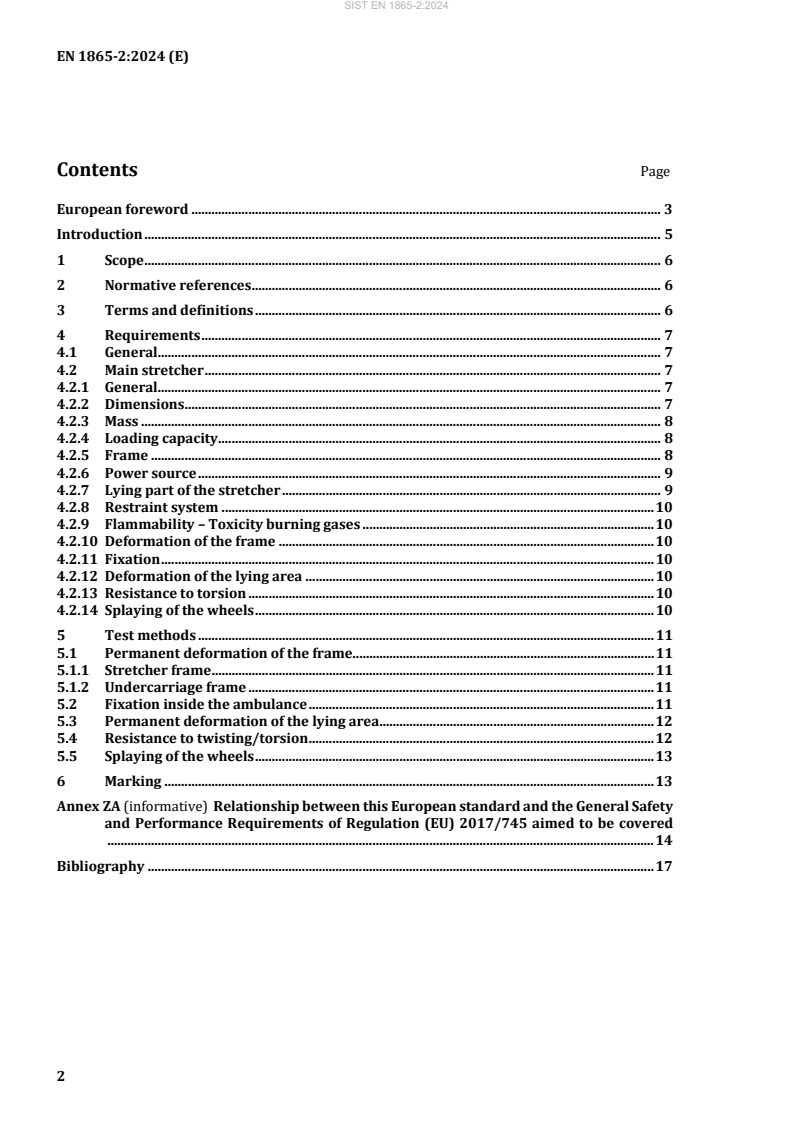
Contents Page
European foreword . 3
Introduction . 5
1 Scope . 6
2 Normative references . 6
3 Terms and definitions . 6
4 Requirements . 7
4.1 General. 7
4.2 Main stretcher . 7
4.2.1 General. 7
4.2.2 Dimensions. 7
4.2.3 Mass . 8
4.2.4 Loading capacity . 8
4.2.5 Frame . 8
4.2.6 Power source . 9
4.2.7 Lying part of the stretcher . 9
4.2.8 Restraint system . 10
4.2.9 Flammability – Toxicity burning gases . 10
4.2.10 Deformation of the frame . 10
4.2.11 Fixation . 10
4.2.12 Deformation of the lying area . 10
4.2.13 Resistance to torsion . 10
4.2.14 Splaying of the wheels . 10
5 Test methods . 11
5.1 Permanent deformation of the frame. 11
5.1.1 Stretcher frame . 11
5.1.2 Undercarriage frame . 11
5.2 Fixation inside the ambulance . 11
5.3 Permanent deformation of the lying area . 12
5.4 Resistance to twisting/torsion . 12
5.5 Splaying of the wheels . 13
6 Marking . 13
Annex ZA (informative) Relationship between this European standard and the General Safety
and Performance Requirements of Regulation (EU) 2017/745 aimed to be covered
................................................................................................................................................................... 14
Bibliography . 17
European foreword
This document (EN 1865-2:2024) has been prepared by Technical Committee CEN/TC 239 “Rescue
systems”, the secretariat of which is held by DIN.
This European Standard shall be given the status of a national standard, either by publication of an
identical text or by endorsement, at the latest by December 2024, and conflicting national standards shall
be withdrawn at the latest by December 2024.
Attention is drawn to the possibility that some of the elements of this document may be the subject of
patent rights. CEN shall not be held responsible for identifying any or all such patent rights.
This document supersedes EN 1865-2:2010+A1:2015.
This European Standard is a part of EN 1865, Patient handling equipment used in ambulances, which
consists of the following parts:
— Part 1: General stretcher systems and patient handling equipment (foreseen for revision);
— Part 2: Power assisted stretcher (the present document);
— Part 3: Heavy duty stretcher (foreseen for revision);
— Part 4: Foldable patient transfer chair (foreseen for revision);
— Part 5: Stretcher support (foreseen for revision);
— Part 6: Powered chairs (under new development);
— Part 7: Isolation transport system (preliminary work item under development).
Compared to EN 1865-2:2010+A1:2015, the following main technical changes were made:
a) title changed from “Patient handling equipment used in road ambulances” to “Patient handling
equipment used in ambulances”;
b) normative references updated;
c) Annex ZA revised to show relationship to Medical Device Regulations (MDR) instead of Medical
Device Directive (MDD);
d) new definition for loading system (3.2) included;
e) requirements for mass (4.2.3), power source (4.2.6) and restraint system (4.2.8) revised;
f) loading capacity (4.2.4) from 150 kg to 200 kg increased;
g) new Clause 5 for testing included.
This document has been prepared under a standardization request addressed to CEN by the European
Commission. The Standing Committee of the EFTA States subsequently approves these requests for its
Member States.
For the relationship with EU Legislation, see informative Annex ZA, which is an integral part of this
document.
Any feedback and questions on this document should be directed to the users’ national standards body.
A complete listing of these bodies can be found on the CEN website.
According to the CEN-CENELEC Internal Regulations, the national standards organisations of the
following countries are bound to implement this European Standard: Austria, Belgium, Bulgaria, Croatia,
Cyprus, Czech Republic, Denmark, Estonia, Finland, France, Germany, Greece, Hungary, Iceland, Ireland,
Italy, Latvia, Lithuania, Luxembourg, Malta, Netherlands, Norway, Poland, Portugal, Republic of North
Macedonia, Romania, Serbia, Slovakia, Slovenia, Spain, Sweden, Switzerland, Türkiye and the United
Kingdom.
Introduction
In this document, reference is made to EN 1789:2020+A1:2023, which specifies design requirements and
test methods for road ambulances, which are relevant for checking requirements for such handling
equipment.
1 Scope
This document specifies minimum requirements for the design and performance of power assisted
stretchers used in road ambulances for the treatment and transportation of patients. It aims to ensure
patient safety and minimize the physical effort required by staff operating the equipment.
2 Normative references
The following documents are referred to in the text in such a way that some or all of their content
constitutes requirements of this document. For dated references, only the edition cited applies. For
undated references, the latest edition of the referenced document (including any amendments) applies.
EN 597-1:2015, Furniture — Assessment of the ignitability of mattresses and upholstered bed bases —
Part 1: Ignition source smouldering cigarette
EN 1789:2020+A1:2023, Medical vehicles and their equipment — Road ambulances
EN 60601-1-2:2015, Medical electrical equipment — Part 1-2: General requirements for basic safety and
essential performance — Collateral Standard: Electromagnetic disturbances — Requirements and tests
(IEC 60601-1-2:2014 )
EN 62366-1:2015, Medical devices — Application of usability engineering to medical devices
(IEC 62366-1:2015 )
EN ISO 15223-1:2021, Medical devices — Symbols to be used with information to be supplied by the
manufacturer — Part 1: General requirements (ISO 15223-1:2021)
EN ISO 20417:2021, Medical devices — Information to be supplied by the manufacturer (ISO 20417:2021,
Corrected version 2021-12)
3 Terms and definitions
For the purposes of this document, the following terms and definitions apply.
ISO and IEC maintain terminology databases for use in standardization at the following addresses:
— ISO Online browsing platform: available at https://www.iso.org/obp/
— IEC Electropedia: available at https://www.electropedia.org/
3.1
power assisted stretcher
device designed for the conveyance of sick and/or injured persons or those in labour in transit in a
recumbent position in safety and in comfort whilst facilitating treatment and providing powered
movements in the operation of the stretcher to reduce the physical effort required by operatives
As impacted by EN 60601-1-2:2015/A1:2021.
As impacted by IEC 60601-1-2:2014/AMD1:2020.
As impacted by EN 60601-1-2:2015/AC:2015, EN 60601-1-2:2015/AC:2016-09 and
EN 60601-1-2:2015/A1:2020.
As impacted by IEC 62366-1:2015/COR1:2016 and IEC 62366-1:2015/AMD1:2020.
4 Requirements
4.1 General
When operated and maintained in accordance with the manufacturer's instructions, power assisted
stretchers shall not present any high level of risk. Any identified risk shall be reduced as far as possible.
Power assisted stretchers shall also:
— allow patients to be secured so that any movement during ambulance transport is minimized;
— be free of sharp edges that could cause injury to persons or damage to other equipment on board.
The minimum radius should be 0,5 mm.
For all patients transported in the patient compartment, patient restraint-systems shall be available. All
patient restraint-systems shall have quick release systems.
Patient restraint-systems for all patient handling equipment shall secure the patient, but at the same time
shall permit treatment of the patient.
The lying-sitting part shall be made of a strong material which is bacterial resistant, fungal resistant, stain
resistant, putrid resistant, easy to clean, washable, waterproof and petrol-oil resistant.
4.2 Main stretcher
4.2.1 General
The main stretcher shall consist of a stretcher part that can be used either alone or in combination with
an integrated or detachable undercarriage.
For assisting the loading and unloading process, the stretcher shall incorporate a loading system installed
on the vehicle and / or on the stretcher device itself.
The power assisted stretcher and its loading system shall be compatible. It physically shall support the
crew, so no manual lifting should be done to load and unload the stretcher under normal daily use.
4.2.2 Dimensions
Dimensions shall be measured from the outermost edges:
+120
length:
(1 950 ) mm;
−50
width: +60
(550 ) mm;
−20
height: maximum 300 mm from loading holding assembly to unloaded lying part. This
height dimension does not apply to stretchers with monoblock undercarriages. If
a monoblock is not available, the stretcher shall be constructed such that it is
detachable from the undercarriage. Where a stretcher support is used the
measurement shall be taken from the top surface of the stretcher support to the
lying part of the stretcher.
— Undercarriage: length and width of the frame of the undercarriage when located in the
ambulance shall not exceed length and width of the stretcher.
4.2.3 Mass
The complete mass of a stretcher with integrated undercarriage system (monoblock), excluding the
mattress and patient restraints, shall not be more than 75 kg.
The complete mass of a detachable stretcher and undercarriage system combined, excluding the mattress
and patient restraints, shall not be more than 81 kg.
— The detachable stretcher part shall not be more than 23 kg.
— The detachable stretcher part may exceed 23 kg, if its main intention is not to be used for manual
lifting or manual carrying purposes.
Where the stretcher is a combined stretcher and loading system, therefore requiring no additional lifting
devices or manual lifting to load it into the ambulance, then the maximum mass of
...
SLOVENSKI STANDARD
01-september-2024
Oprema za ravnanje s pacienti v reševalnih vozilih - 2. del: Nosila z zložljivim
podvozjem
Patient handling equipment used in ambulances - Part 2: Power assisted stretcher
Krankentransportmittel im Krankenkraftwagen - Teil 2: Kraftunterstützte Krankentrage
Spécifications d'équipements pour le transport de patient dans les ambulances routières
- Partie 2: Brancard motorisé
Ta slovenski standard je istoveten z: EN 1865-2:2024
ICS:
11.160 Prva pomoč First aid
43.160 Vozila za posebne namene Special purpose vehicles
2003-01.Slovenski inštitut za standardizacijo. Razmnoževanje celote ali delov tega standarda ni dovoljeno.
EN 1865-2
EUROPÄISCHE NORM
EUROPEAN STANDARD
Juni 2024
NORME EUROPÉENNE
ICS 11.160 Ersetzt EN 1865-2:2010+A1:2015
Deutsche Fassung
Patiententransportmittel im Rettungsdienstfahrzeug - Teil 2:
Kraftunterstützte Krankentrage
Patient handling equipment used in ambulances - Part Équipements pour le transport de patients dans les
2: Power assisted stretcher ambulances - Partie 2 : Brancard motorisé
Diese Europäische Norm wurde vom CEN am 29. April 2024 angenommen.
Die CEN-Mitglieder sind gehalten, die CEN/CENELEC-Geschäftsordnung zu erfüllen, in der die Bedingungen festgelegt sind, unter
denen dieser Europäischen Norm ohne jede Änderung der Status einer nationalen Norm zu geben ist. Auf dem letzten Stand
befindliche Listen dieser nationalen Normen mit ihren bibliographischen Angaben sind beim CEN-CENELEC-Management-
Zentrum oder bei jedem CEN-Mitglied auf Anfrage erhältlich.
Diese Europäische Norm besteht in drei offiziellen Fassungen (Deutsch, Englisch, Französisch). Eine Fassung in einer anderen
Sprache, die von einem CEN-Mitglied in eigener Verantwortung durch Übersetzung in seine Landessprache gemacht und dem
Management-Zentrum mitgeteilt worden ist, hat den gleichen Status wie die offiziellen Fassungen.
CEN-Mitglieder sind die nationalen Normungsinstitute von Belgien, Bulgarien, Dänemark, Deutschland, Estland, Finnland,
Frankreich, Griechenland, Irland, Island, Italien, Kroatien, Lettland, Litauen, Luxemburg, Malta, den Niederlanden, Norwegen,
Österreich, Polen, Portugal, der Republik Nordmazedonien, Rumänien, Schweden, der Schweiz, Serbien, der Slowakei, Slowenien,
Spanien, der Tschechischen Republik, der Türkei, Ungarn, dem Vereinigten Königreich und Zypern.
EUROPÄISCHES KOMITEE FÜR NORMUNG
EUROPEAN COMMITTEE FOR STANDARDIZATION
COMITÉ EUROPÉEN DE NORMALISATION
CEN-CENELEC Management-Zentrum: Rue de la Science 23, B-1040 Brüssel
© 2024 CEN Alle Rechte der Verwertung, gleich in welcher Form und in welchem Ref. Nr. EN 1865-2:2024 D
Verfahren, sind weltweit den nationalen Mitgliedern von CEN
vorbehalten.
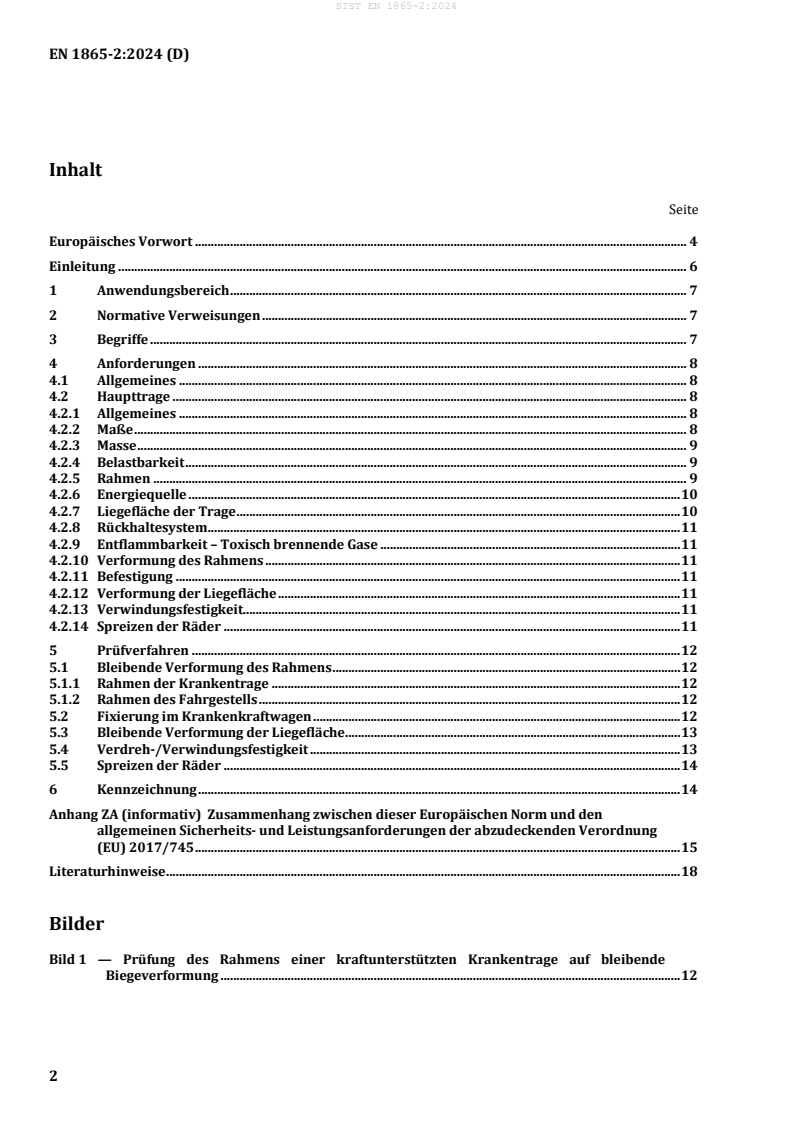
Inhalt
Seite
Europäisches Vorwort . 4
Einleitung . 6
1 Anwendungsbereich . 7
2 Normative Verweisungen . 7
3 Begriffe . 7
4 Anforderungen . 8
4.1 Allgemeines . 8
4.2 Haupttrage . 8
4.2.1 Allgemeines . 8
4.2.2 Maße . 8
4.2.3 Masse . 9
4.2.4 Belastbarkeit . 9
4.2.5 Rahmen . 9
4.2.6 Energiequelle . 10
4.2.7 Liegefläche der Trage . 10
4.2.8 Rückhaltesystem . 11
4.2.9 Entflammbarkeit – Toxisch brennende Gase . 11
4.2.10 Verformung des Rahmens . 11
4.2.11 Befestigung . 11
4.2.12 Verformung der Liegefläche . 11
4.2.13 Verwindungsfestigkeit. 11
4.2.14 Spreizen der Räder . 11
5 Prüfverfahren . 12
5.1 Bleibende Verformung des Rahmens . 12
5.1.1 Rahmen der Krankentrage . 12
5.1.2 Rahmen des Fahrgestells . 12
5.2 Fixierung im Krankenkraftwagen . 12
5.3 Bleibende Verformung der Liegefläche . 13
5.4 Verdreh-/Verwindungsfestigkeit . 13
5.5 Spreizen der Räder . 14
6 Kennzeichnung . 14
Anhang ZA (informativ) Zusammenhang zwischen dieser Europäischen Norm und den
allgemeinen Sicherheits- und Leistungsanforderungen der abzudeckenden Verordnung
(EU) 2017/745 . 15
Literaturhinweise . 18
Bilder
Bild 1 — Prüfung des Rahmens einer kraftunterstützten Krankentrage auf bleibende
Biegeverformung . 12
Bild 2 — Prüfung der Liegefläche einer kraftunterstützten Krankentrage auf bleibende
Verformung . 13
Bild 3 — Prüfung einer kraftunterstützten Krankentrage auf Verwindung . 13
Tabellen
Tabelle ZA.1 — Übereinstimmung zwischen dieser Europäischen Norm und Anhang I der
Verordnung (EU) 2017/745 [OJ L 117] und System- oder Prozessanforderungen,
einschließlich der sich auf Qualitätsmanagementsysteme, Risikomanagement,
Überwachungssysteme nach dem Verkauf, klinische Untersuchungen, klinische
Bewertung oder klinische Weiterverfolgung nach dem Verkauf beziehenden . 15
Tabelle ZA.2 — Maßgebliche grundlegende Gesundheits- und Sicherheitsanforderungen aus der
Richtlinie 2006/42/EG über Maschinen, die in diesem Dokument abgedeckt sind (nach
Artikel 1, Ziffer 12 der Verordnung (EU) 2017/745) . 17
Europäisches Vorwort
Dieses Dokument (EN 1865-2:2024) wurde vom Technischen Komitee CEN/TC 239 „Rettungssysteme“
erarbeitet, dessen Sekretariat von DIN gehalten wird.
Diese Europäische Norm muss den Status einer nationalen Norm erhalten, entweder durch Veröffentlichung
eines identischen Textes oder durch Anerkennung bis Dezember 2024, und etwaige entgegenstehende
nationale Normen müssen bis Dezember 2024 zurückgezogen werden.
Es wird auf die Möglichkeit hingewiesen, dass einige Elemente dieses Dokuments Patentrechte berühren
können. CEN ist nicht dafür verantwortlich, einige oder alle diesbezüglichen Patentrechte zu identifizieren.
Dieses Dokument ersetzt EN 1865-2:2010+A1:2015.
Diese Europäische Norm ist ein Teil der EN 1865, Patiententransportmittel im Rettungsdienstfahrzeug, welche
aus den folgenden Teilen besteht:
Teil 1: Allgemeine Krankentragesysteme und Krankentransportmittel (zur Revision vorgesehen);
Teil 2: Kraftunterstützte Krankentrage (dieses Dokument);
Teil 3: Schwerlastkrankentrage (zur Revision vorgesehen);
Teil 4: Klappbare Patiententragesessel (zur Revision vorgesehen);
Teil 5: Festlegungen zur Krankentrageaufnahme (zur Revision vorgesehen);
Teil 6: Kraftunterstützte Krankenstühle (neuer Teil in Bearbeitung);
Teil 7: System für den isolierten Transport (vorläufiger neuer Teil in Bearbeitung).
Im Vergleich zu EN 1865-2:2010+A1:2015 wurden die folgenden wesentlichen technischen Änderungen
vorgenommen:
a) Haupttitel von „Krankentransportmittel im Krankenkraftwagen“ in „Patiententransportmittel im
Rettungsdienstfahrzeug“ geändert;
b) Aktualisierung der normativen Verweisungen;
c) Anhang ZA überarbeitet, um den Zusammenhang zu den Vorschriften für Medizinprodukte (MDR) anstatt
zur Richtlinie über Medizinprodukte (MDD) aufzuzeigen;
N1
d) neue Definition für das Beladesystem (3.2) aufgenommen ;
e) Anforderungen für Masse (4.2.3), Energiequelle (4.2.6) und Rückhaltesystem (4.2.8) überarbeitet;
f) Belastbarkeit (4.2.4) von 150 kg auf 200 kg erhöht;
g) neuer Abschnitt 5 für Prüfung aufgenommen.
N1 Nationale Fußnote: Diese Definition wurde im Zuge der Norm-Entwurfsphase gestrichen.
Dieses Dokument wurde im Rahmen eines Normungsauftrages erarbeitet, den die Europäische Kommission
CEN erteilt hat. Der Ständige Ausschuss der EFTA-Staaten genehmigt anschließend diese Aufträge für die
Mitgliedsstaaten.
Zum Zusammenhang mit EU-Rechtsvorschriften siehe informativen Anhang ZA, der Bestandteil dieses
Dokuments ist.
Rückmeldungen oder Fragen zu diesem Dokument sollten an das jeweilige nationale Normungsinstitut des
Anwenders gerichtet werden. Eine vollständige Liste dieser Institute ist auf den Internetseiten von CEN
abrufbar.
Entsprechend der CEN-CENELEC-Geschäftsordnung sind die nationalen Normungsinstitute der folgenden
Länder gehalten, diese Europäische Norm zu übernehmen: Belgien, Bulgarien, Dänemark, Deutschland, die
Republik Nordmazedonien, Estland, Finnland, Frankreich, Griechenland, Irland, Island, Italien, Kroatien,
Lettland, Litauen, Luxemburg, Malta, Niederlande, Norwegen, Österreich, Polen, Portugal, Rumänien,
Schweden, Schweiz, Serbien, Slowakei, Slowenien, Spanien, Tschechische Republik, Türkei, Ungarn,
Vereinigtes Königreich und Zypern.
Einleitung
In diesem Dokument wird auf EN 1789:2020+A1:2023 Bezug genommen, die die Anforderungen an die
Ausführung und an die Prüfverfahren für Krankenkraftwagen festlegt, die zur Überprüfung der
Anforderungen an solche Transportmittel wichtig sind.
1 Anwendungsbereich
Dieses Dokument legt die Mindestanforderungen an die Ausführung und Gebrauchstauglichkeit von
kraftunterstützten Krankentragen fest, die im Krankenkraftwagen für die Behandlung und den Transport von
Patienten verwendet werden. Ziel ist es, die Sicherheit der Patienten zu gewährleisten und die körperliche
Anstrengung des Personals bei der Bedienung der Transportmittel zu minimieren.
2 Normative Verweisungen
Die folgenden Dokumente werden im Text in solcher Weise in Bezug genommen, dass einige Teile davon oder
ihr gesamter Inhalt Anforderungen des vorliegenden Dokuments darstellen. Bei datierten Verweisungen gilt
nur die in Bezug genommene Ausgabe. Bei undatierten Verweisungen gilt die letzte Ausgabe des in Bezug
genommenen Dokuments (einschließlich aller Änderungen).
EN 597-1:2015, Möbel — Bewertung der Entzündbarkeit von Matratzen und gepolsterten Bettböden — Teil 1:
Glimmende Zigarette als Zündquelle
EN 1789:2020+A1:2023, Rettungsdienstfahrzeuge und deren Ausrüstung — Krankenkraftwagen
EN 60601-1-2:2015, Medizinische elektrische Geräte — Teil 1-2: Allgemeine Festlegungen für die Sicherheit
einschließlich der wesentlichen Leistungsmerkmale — Ergänzungsnorm: Elektromagnetische Störgrößen —
Anforderungen und Prüfungen (IEC 60601-1-2:2014 )
EN 62366-1:2015, Medizinprodukte — Teil 1: Anwendung der Gebrauchstauglichkeit auf Medizinprodukte
(IEC 62366-1:2015 )
EN ISO 15223-1:2021, Medizinprodukte — Symbole zur Verwendung im Rahmen der vom Hersteller
bereitzustellenden Informationen — Teil 1: Allgemeine Anforderungen (ISO 15223-1:2021)
EN ISO 20417:2021, Medizinprodukte — Anforderungen an vom Hersteller bereitzustellende Informationen
(ISO 20417:2021, korrigierte Fassung 2021-12)
3 Begriffe
Für die Anwendung dieser Norm gelten die folgenden Begriffe.
ISO und IEC stellen terminologische Datenbanken für die Verwendung in der Normung unter den folgenden
Adressen bereit:
ISO Online Browsing Platform: verfügbar unter https://www.iso.org/obp
IEC Electropedia: verfügbar unter https://www.electropedia.org/
3.1
kraftunterstützte Krankentrage
Transportmittel für den sicheren und bequemen Transport von kranken und/oder verletzten Personen oder
von Personen, die sich in den Wehen befinden, in liegender Position, wobei die Behandlung erleichtert wird
1 Geändert durch EN 60601-1-2:2015/A1:2021.
2 Geändert durch IEC 60601-1-2:2014/AMD1:2020.
3 Geändert durch EN 60601-1-2:2015/AC:2015, EN 60601-1-2:2015/AC:2016-09 und EN 60601-1-2:2015/A1:2020.
4 Geändert durch IEC 62366-1:2015/COR1:2016 und IEC 62366-1:2015/AMD1:2020.
und beim Bedienen der Krankentrage kraftunterstützte Bewegungen ermöglicht, um die körperliche
Anstrengung des Personals zu verringern
4 Anforderungen
4.1 Allgemeines
Kraftunterstützte Krankentragen dürfen keine hohen Sicherheitsrisiken aufweisen, wenn sie entsprechend
den Anweisungen des Herstellers betätigt und gewartet werden. Jedes festgestellte Sicherheitsrisiko muss
weitestgehend verringert werden.
Kraftunterstützte Krankentragen müssen:
ermöglichen, dass der Patient so gesichert ist, dass während des Transports in Rettungsfahrzeugen
jegliche Bewegung minimiert wird, und
frei von scharfen Kanten oder Verformungen sein, die Schäden an Personen oder an sich an Bord des
Fahrzeugs befindlichen Betriebsmitteln verursachen könnten. Der Mindestradius sollte 0,5 mm betragen.
Für alle Patienten, die im Krankenraum befördert werden, müssen Patientenrückhaltesysteme vorhanden
sein. Alle Patientenrückhaltesysteme müssen über ein Schnellöffnungssystem verfügen.
Alle Patientenrückhaltesysteme müssen den Patienten sichern, aber gleichzeitig seine Behandlung
ermöglichen.
Die Liege-/Sitzfläche muss aus strapazierfähigem Material hergestellt sein, das gegen Bakterien, Pilze, Flecken
und Fäulnis unempfindlich, pflegeleicht, abwaschbar, wasserfest und mineralölbeständig ist.
4.2 Haupttrage
4.2.1 Allgemeines
Die Haupttrage muss aus einer Krankentrage bestehen, die entweder allein oder mit einem eingebauten oder
abnehmbaren Fahrgestell verwendet werden kann.
Zur Unterstützung des Be- und Entladevorgangs muss die Krankentrage ein am Fahrzeug und/oder an der
Krankentrage angebrachtes Beladesystem aufweisen.
Die kraftunterstützte Krankentrage und ihr Beladesystem müssen kompatibel sein. Sie muss das Personal
physisch unterstützen, so dass bei normalem täglichem Gebrauch kein manuelles Heben zum Be- und Entladen
der Trage erforderlich sein sollte.
4.2.2 Maße
Die Maße müssen von den äußersten Kanten gemessen werden:
+120
Länge:
(1 950 ) mm;
−50
+60
Breite:
(550 ) mm;
−20
Höhe: höchstens 300 mm von der Tragenaufnahme bis zur unbelasteten Liegefläche. Diese
Höhe gilt nicht für Krankentragen mit einteiligem Fahrgestell. Ist eine einteilige
Ausführung nicht verfügbar, muss die Krankentrage so ausgeführt sein, dass sie vom
Fahrgestell abgenommen werden kann. Wenn eine Krankentrageaufnahme
verwendet wird, muss die Höhe von der höchsten Stelle der Krankentrageaufnahme
bis zur Liegefläche der Krankentrage gemessen werden.
Fahrgestell: Länge und Breite des Rahmens vom Fahrgestell dürfen bei Anordnung im
Rettungsdienstfahrzeug die Länge und Breite der Krankentrage nicht überschreiten.
4.2.3 Masse
Die Gesamtmasse einer Krankentrage mit integriertem Fahrgestellsystem (einteili
...