


EN 16951-1:2018
(Main)Railway applications - Track - Noise barriers and related devices acting on airborne sound propagation - Procedures for assessing long term performance - Part 1: Acoustic characteristics
General Information
- Abstract
This European Standard specifies requirements for assessing the working life and provides the relevant exposure conditions.
Standards of construction and any material tests conducted should provide evidence of resistance to specified conditions selected from the following:
I. Chemical Agents Location dependent
II. De-icing salt Location/climate dependent
III. Dirty water/dust Location/climate dependent
IV. Dew Climate dependent
V. Freeze/thaw Climate dependent
VI. Cold Climate dependent
VII. Heat Climate dependent
VIII. UV Radiation Climate dependent
IX. Traffic Vibration Location dependent
X. Biological Process Climate dependent
XI. Ozone Location dependent
XII. Water Climate dependent
XIII. Water spray (Wet/dry) Location dependent
NOTE Combinations of different materials are worth a special attention, whether inside a single device or in combination with other devices (for example: a combination of different acoustic elements or another combination of acoustic and structural elements).
- Status
- Published
- Publication Date
- 29-May-2018
- Withdrawal Date
- 29-Nov-2018
- Technical Committee
- CEN/TC 256 - Railway applications
- Drafting Committee
- CEN/TC 256/WG 40 - Noise barriers
- Current Stage
- 9093 - Decision to confirm - Review Enquiry
- Start Date
- 03-Dec-2023
- Completion Date
- 23-Sep-2026

Overview
EN 16951-1:2018 (CEN) - “Railway applications - Track - Noise barriers and related devices acting on airborne sound propagation - Procedures for assessing long term performance - Part 1: Acoustic characteristics” defines how to assess the long-term acoustic performance (working life) of railway noise barriers and related devices. The standard sets out the exposure conditions and the durability evidence that manufacturers, specifiers and infrastructure managers must use to declare and verify acoustic performance over time.
Key topics and requirements
- Scope: Specifies requirements for assessing the acoustic working life and relevant environmental exposure conditions for noise barriers, claddings and related acoustic elements.
- Environmental exposures: Tests and material standards must address location- and climate-dependent agents including: chemical agents, de-icing salt, dirty water/dust, dew, freeze/thaw, cold, heat, UV radiation, traffic vibration, biological processes, ozone, water and water spray. The standard highlights the importance of combined-material interactions and electrolytic or chemical corrosion risks.
- Declared acoustic performance: Manufacturers must declare the acoustic characteristics (DL, DLR, DLRI, DLSI as applicable from EN 16272 series) to be maintained at the end of the declared working life under specified exposure classes.
- Design and installation: Design must avoid water retention, allow for dimensional changes from humidity/temperature/UV, and consider different working lives for structural vs acoustic elements.
- Documentation and reporting: Evaluation reports shall include product geometry, materials, manufacturing tolerances, measures against ageing, declared working lives, and installation/maintenance manuals. An independent evaluating body must sign the report.
- Normative references: EN 60721-3-4 (environmental classification) is referenced; Annex A maps appropriate EN 60721 exposure classes for line‑side use. Annex B points to material standards where applicable.
Applications and users
- Who uses it: Noise barrier manufacturers, railway infrastructure owners/operators, acoustic consultants, design engineers, testing laboratories, procurement/specification teams, and maintenance planners.
- Practical uses:
- Specify required durability and acoustic performance for new barrier systems.
- Validate manufacturer claims on long-term sound absorption and insulation.
- Guide material selection and jointing details to prevent ageing and corrosion.
- Prepare installation and maintenance instructions to achieve declared working life.
Related standards
- EN 16272 series (acoustic test methods: intrinsic absorption, airborne sound insulation, noise spectra and ratings)
- EN 16727 series (non-acoustic mechanical performance and safety)
- EN 16951-2 (Part 2: Non-acoustic characteristics)
- EN 60721-3-4 (environmental classification)
EN 16951-1:2018 is essential for ensuring durable, verifiable acoustic performance of railway noise barriers and for aligning procurement, testing and lifecycle maintenance with recognized European practice.
Relations
- Effective Date
- 09-Feb-2026
- Effective Date
- 28-Jan-2026
- Effective Date
- 28-Jan-2026
- Effective Date
- 28-Jan-2026
- Effective Date
- 28-Jan-2026
- Effective Date
- 28-Jan-2026
- Effective Date
- 28-Jan-2026
- Effective Date
- 28-Jan-2026
- Effective Date
- 28-Jan-2026
- Effective Date
- 28-Jan-2026
Get Certified
Connect with accredited certification bodies for this standard

Zavod za gradbeništvo Slovenije (ZAG) - Inšpekcija
ZAG inspection body for construction products, structures, and materials.
Sponsored listings
Frequently Asked Questions
EN 16951-1:2018 is a standard published by the European Committee for Standardization (CEN). Its full title is "Railway applications - Track - Noise barriers and related devices acting on airborne sound propagation - Procedures for assessing long term performance - Part 1: Acoustic characteristics". This standard covers: This European Standard specifies requirements for assessing the working life and provides the relevant exposure conditions. Standards of construction and any material tests conducted should provide evidence of resistance to specified conditions selected from the following: I. Chemical Agents Location dependent II. De-icing salt Location/climate dependent III. Dirty water/dust Location/climate dependent IV. Dew Climate dependent V. Freeze/thaw Climate dependent VI. Cold Climate dependent VII. Heat Climate dependent VIII. UV Radiation Climate dependent IX. Traffic Vibration Location dependent X. Biological Process Climate dependent XI. Ozone Location dependent XII. Water Climate dependent XIII. Water spray (Wet/dry) Location dependent NOTE Combinations of different materials are worth a special attention, whether inside a single device or in combination with other devices (for example: a combination of different acoustic elements or another combination of acoustic and structural elements).
This European Standard specifies requirements for assessing the working life and provides the relevant exposure conditions. Standards of construction and any material tests conducted should provide evidence of resistance to specified conditions selected from the following: I. Chemical Agents Location dependent II. De-icing salt Location/climate dependent III. Dirty water/dust Location/climate dependent IV. Dew Climate dependent V. Freeze/thaw Climate dependent VI. Cold Climate dependent VII. Heat Climate dependent VIII. UV Radiation Climate dependent IX. Traffic Vibration Location dependent X. Biological Process Climate dependent XI. Ozone Location dependent XII. Water Climate dependent XIII. Water spray (Wet/dry) Location dependent NOTE Combinations of different materials are worth a special attention, whether inside a single device or in combination with other devices (for example: a combination of different acoustic elements or another combination of acoustic and structural elements).
EN 16951-1:2018 is classified under the following ICS (International Classification for Standards) categories: 93.100 - Construction of railways. The ICS classification helps identify the subject area and facilitates finding related standards.
EN 16951-1:2018 has the following relationships with other standards: It is inter standard links to EN IEC 60721-3-4:2019, EN ISO 17225-2:2021, EN ISO 17225-6:2014, EN 16272-5:2023, EN ISO 17225-2:2014, EN ISO 17225-6:2021, EN ISO 17225-1:2021, EN 16272-6:2023, EN ISO 17225-1:2014, EN ISO 17225-8:2023. Understanding these relationships helps ensure you are using the most current and applicable version of the standard.
EN 16951-1:2018 is available in PDF format for immediate download after purchase. The document can be added to your cart and obtained through the secure checkout process. Digital delivery ensures instant access to the complete standard document.
Standards Content (Sample)
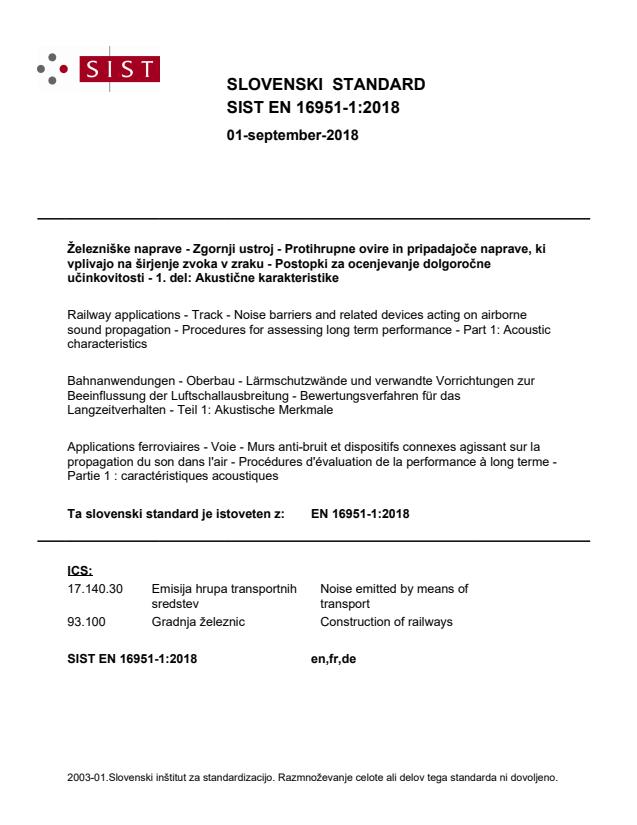
2003-01.Slovenski inštitut za standardizacijo. Razmnoževanje celote ali delov tega standarda ni dovoljeno.RURþQHBahnanwendungen - Oberbau - Lärmschutzwände und verwandte Vorrichtungen zur Beeinflussung der Luftschallausbreitung - Bewertungsverfahren für das Langzeitverhalten - Teil 1: Akustische MerkmaleApplications ferroviaires - Voie - Murs anti-bruit et dispositifs connexes agissant sur la propagation du son dans l'air - Procédures d'évaluation de la performance à long terme - Partie 1 : caractéristiques acoustiquesRailway applications - Track - Noise barriers and related devices acting on airborne sound propagation - Procedures for assessing long term performance - Part 1: Acoustic characteristics93.100Gradnja železnicConstruction of railways17.140.30Emisija hrupa transportnih sredstevNoise emitted by means of transportICS:Ta slovenski standard je istoveten z:EN 16951-1:2018SIST EN 16951-1:2018en,fr,de01-september-2018SIST EN 16951-1:2018SLOVENSKI
STANDARD
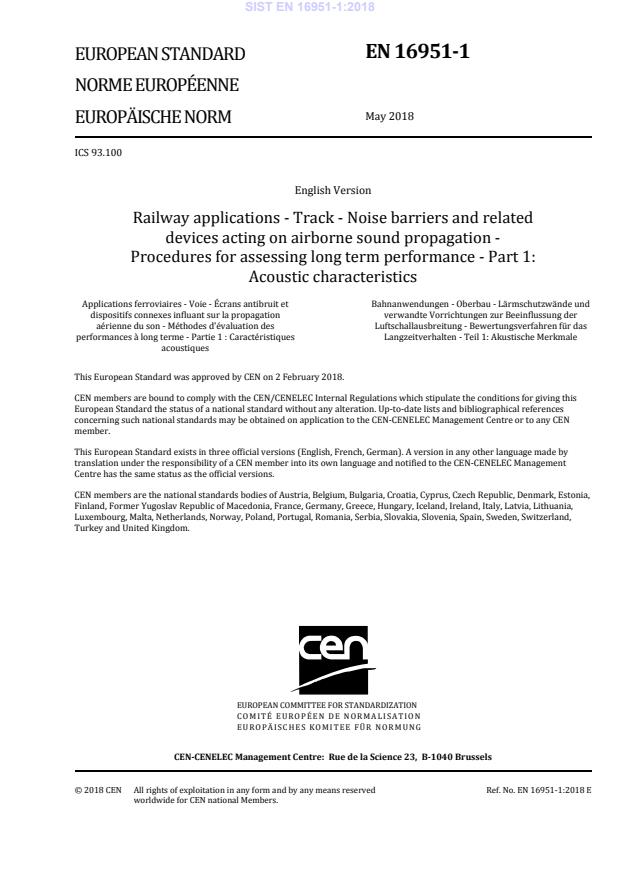
EUROPEAN STANDARD NORME EUROPÉENNE EUROPÄISCHE NORM
EN 16951-1
May
t r s z ICS
{ uä s r r English Version
Railway applications æ Track æ Noise barriers and related devices acting on airborne sound propagation æ Procedures for assessing long term performance æ Part
sã Acoustic characteristics Applications ferroviaires æ Voie æ Écrans antibruit et dispositifs connexes influant sur la propagation aérienne du son æ Méthodes d 5évaluation des performances à long terme æ Partie
s ã Caractéristiques acoustiques
Bahnanwendungen æ Oberbau æ Lärmschutzwände und verwandte Vorrichtungen zur Beeinflussung der Luftschallausbreitung æ Bewertungsverfahren für das Langzeitverhalten æ Teil
sã Akustische Merkmale This European Standard was approved by CEN on
t February
t r s zä
egulations which stipulate the conditions for giving this European Standard the status of a national standard without any alterationä Upætoædate lists and bibliographical references concerning such national standards may be obtained on application to the CENæCENELEC Management Centre or to any CEN memberä
translation under the responsibility of a CEN member into its own language and notified to the CENæCENELEC Management Centre has the same status as the official versionsä
CEN members are the national standards bodies of Austriaá Belgiumá Bulgariaá Croatiaá Cyprusá Czech Republicá Denmarká Estoniaá Finlandá Former Yugoslav Republic of Macedoniaá Franceá Germanyá Greeceá Hungaryá Icelandá Irelandá Italyá Latviaá Lithuaniaá Luxembourgá Maltaá Netherlandsá Norwayá Polandá Portugalá Romaniaá Serbiaá Slovakiaá Sloveniaá Spainá Swedená Switzerlandá Turkey and United Kingdomä
EUROPEAN COMMITTEE FOR STANDARDIZATION COMITÉ EUROPÉEN DE NORMALISATION EUROPÄISCHES KOMITEE FÜR NORMUNG
CEN-CENELEC Management Centre:
Rue de la Science 23,
B-1040 Brussels
t r s z CEN All rights of exploitation in any form and by any means reserved worldwide for CEN national Membersä Refä Noä EN
s x { w sæ sã t r s z ESIST EN 16951-1:2018
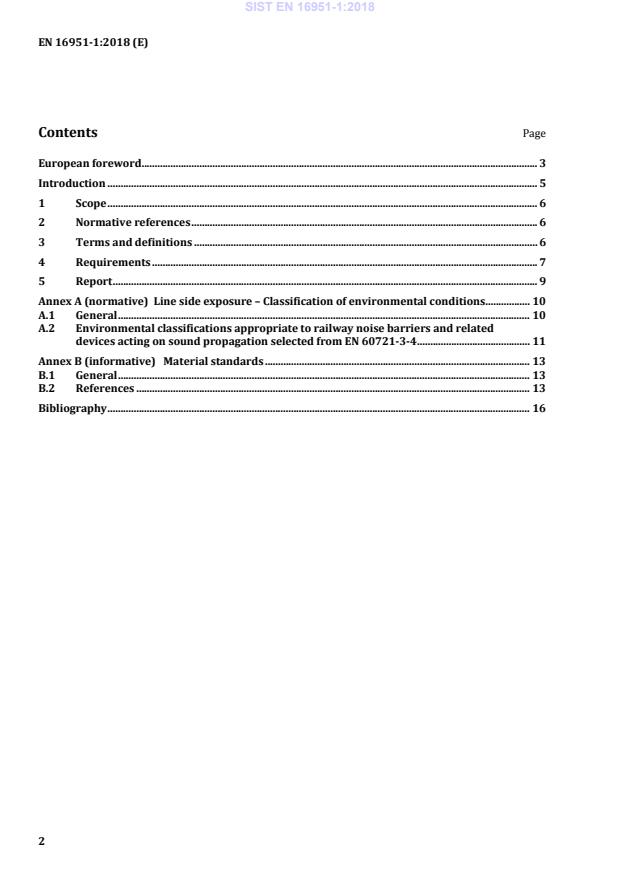
Line side exposure – Classification of environmental conditions . 10 A.1 General . 10 A.2 Environmental classifications appropriate to railway noise barriers and related devices acting on sound propagation selected from EN 60721-3-4 . 11 Annex B (informative)
Material standards . 13 B.1 General . 13 B.2 References . 13 Bibliography . 16
...