


EN 12797:2000/A1:2003
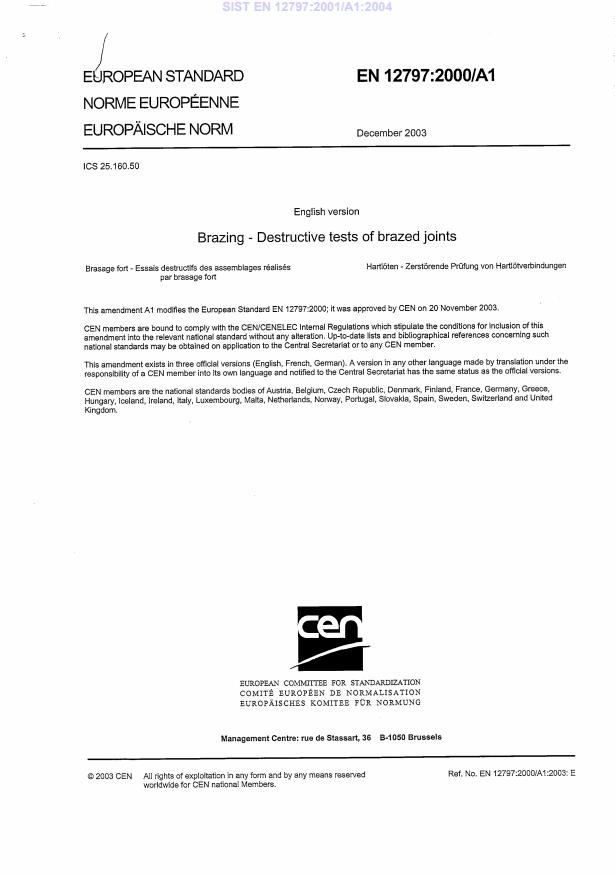
(Amendment)Brazing - Destructive tests of brazed joints
General Information
- Abstract
This European Standard describes destructive test procedures and test piece types necessary to perform the tests on brazed joints.
Brazed joints are used in a wide variety of assemblies and the design requirements placed upon these joints will also vary widely; there will usually be some level of strength required but this may not be explicitly stated and is frequently of minor importance compared to some
other criterion, e.g. hermeticity. It follows that a test which measures strength may be totally irrelevant in assessing a joint for a particular application where strength is a minor consideration. This situation is made more complicated because brazed joints are almost
invariably designed to be loaded in shear and the dimensions of the joint affect the shear strength to a much greater extent than they do the tensile strength. The tests described in this standard have been used successfully to give information on specific properties and where such information is needed, it is recommended that one of them be specified. It is vital to recognise that for many fabrications none of these tests will be suitable and specific tests will have to be devised, which do yield the requisite information (which may be qualitative rather then quantitative). The destructive test methods described are as follows: a) shear tests (see clause 4); b) tensile tests (see clause 5); c) metallographic examination (see clause 6); d) hardness tests (see clause 7); e) peel test (see clause 8); f) bend tests (see clause 9).
Details of burst tests are not included as these are not commonly used on brazed joints. The type of test piece described for each test can be quoted or incorporated in engineering applications standards that deal with brazed assemblies. The results of the tests are used:
1) to determine basic data regarding filler metal performance; 2) to arrive at optimum brazing designs (including gaps) and brazing
procedures...(Truncated)
- Status
- Published
- Publication Date
- 09-Dec-2003
- Withdrawal Date
- 29-Jun-2004
- Technical Committee
- CEN/TC 121 - Welding
- Drafting Committee
- CEN/TC 121/WG 20 - Brazing
- Current Stage
- 6060 - Definitive text made available (DAV) - Publishing
- Start Date
- 10-Dec-2003
- Completion Date
- 10-Dec-2003
- Directive
- Not Harmonized97/23/EC - Pressure equipment

Overview
EN 12797:2000/A1:2003 (Brazing - Destructive tests of brazed joints) is a European Standard published by CEN that specifies destructive test procedures and test-piece types for assessing brazed joints. The standard describes commonly used laboratory tests that provide quantitative and qualitative information on joint performance, but it also emphasizes that not all fabrications are suited to these tests and that tailored test methods may be needed for specific applications.
Key topics and requirements
- Scope and purpose: Defines destructive test methods appropriate for brazed assemblies and the test-piece geometries that can be quoted in application standards.
- Destructive test methods covered:
- Shear tests (clause 4) - assess joint behavior under shear loading (brazed joints are frequently designed to carry shear loads).
- Tensile tests (clause 5) - evaluate tensile strength of the brazed joint.
- Metallographic examination (clause 6) - microstructural analysis of joint and filler metal interaction.
- Hardness tests (clause 7) - measure hardness of joint regions and filler metal.
- Peel test (clause 8) - determine resistance to peeling or separation at an interface.
- Bend tests (clause 9) - evaluate ductility and toughness of the joint under bending.
- Exclusions: Burst tests are not included because they are not commonly applied to brazed joints.
- Limitations: The standard warns that a strength-measuring test may be irrelevant where other criteria (e.g., hermeticity) are more important, and that joint geometry strongly influences shear vs. tensile performance. Users should select the test that yields the required information or devise specific tests where necessary.
Practical applications
- Material suppliers and filler-metal manufacturers use test results to determine basic data on filler metal performance.
- Design engineers apply test outcomes to optimize brazing design, joint gaps, and brazing procedures.
- Quality engineers and testing laboratories use standardised destructive methods for validation, failure analysis, and routine qualification of brazed assemblies.
- Manufacturers of heat exchangers, automotive components, HVAC systems, and gas-tight assemblies benefit from choosing appropriate destructive tests to verify joint integrity and process control.
- The standard is particularly useful where quantitative mechanical data (shear/tensile strength, hardness) or metallographic evidence is required.
Related standards
- EN 12797 can be referenced or incorporated into broader engineering application standards dealing with brazed assemblies.
- National adoptions (e.g., SIST EN 12797:2001/A1:2004) represent country-level implementations of the same CEN standard.
Keywords: brazing standard, destructive tests, brazed joints, EN 12797, shear test, tensile test, metallography, hardness test, peel test, bend test, filler metal performance, brazing design.
Relations
- Effective Date
- 28-Jan-2026
- Effective Date
- 28-Jan-2026
- Effective Date
- 22-Dec-2008
Get Certified
Connect with accredited certification bodies for this standard

DVS-ZERT GmbH
German welding certification society.
CARES (UK Certification Authority for Reinforcing Steels)
UK certification for reinforcing steels and construction.
EWF/IIW (European/International Welding Federation)
International welding personnel certification.
Sponsored listings
Frequently Asked Questions
EN 12797:2000/A1:2003 is a amendment published by the European Committee for Standardization (CEN). Its full title is "Brazing - Destructive tests of brazed joints". This standard covers: This European Standard describes destructive test procedures and test piece types necessary to perform the tests on brazed joints. Brazed joints are used in a wide variety of assemblies and the design requirements placed upon these joints will also vary widely; there will usually be some level of strength required but this may not be explicitly stated and is frequently of minor importance compared to some other criterion, e.g. hermeticity. It follows that a test which measures strength may be totally irrelevant in assessing a joint for a particular application where strength is a minor consideration. This situation is made more complicated because brazed joints are almost invariably designed to be loaded in shear and the dimensions of the joint affect the shear strength to a much greater extent than they do the tensile strength. The tests described in this standard have been used successfully to give information on specific properties and where such information is needed, it is recommended that one of them be specified. It is vital to recognise that for many fabrications none of these tests will be suitable and specific tests will have to be devised, which do yield the requisite information (which may be qualitative rather then quantitative). The destructive test methods described are as follows: a) shear tests (see clause 4); b) tensile tests (see clause 5); c) metallographic examination (see clause 6); d) hardness tests (see clause 7); e) peel test (see clause 8); f) bend tests (see clause 9). Details of burst tests are not included as these are not commonly used on brazed joints. The type of test piece described for each test can be quoted or incorporated in engineering applications standards that deal with brazed assemblies. The results of the tests are used: 1) to determine basic data regarding filler metal performance; 2) to arrive at optimum brazing designs (including gaps) and brazing procedures...(Truncated)
This European Standard describes destructive test procedures and test piece types necessary to perform the tests on brazed joints. Brazed joints are used in a wide variety of assemblies and the design requirements placed upon these joints will also vary widely; there will usually be some level of strength required but this may not be explicitly stated and is frequently of minor importance compared to some other criterion, e.g. hermeticity. It follows that a test which measures strength may be totally irrelevant in assessing a joint for a particular application where strength is a minor consideration. This situation is made more complicated because brazed joints are almost invariably designed to be loaded in shear and the dimensions of the joint affect the shear strength to a much greater extent than they do the tensile strength. The tests described in this standard have been used successfully to give information on specific properties and where such information is needed, it is recommended that one of them be specified. It is vital to recognise that for many fabrications none of these tests will be suitable and specific tests will have to be devised, which do yield the requisite information (which may be qualitative rather then quantitative). The destructive test methods described are as follows: a) shear tests (see clause 4); b) tensile tests (see clause 5); c) metallographic examination (see clause 6); d) hardness tests (see clause 7); e) peel test (see clause 8); f) bend tests (see clause 9). Details of burst tests are not included as these are not commonly used on brazed joints. The type of test piece described for each test can be quoted or incorporated in engineering applications standards that deal with brazed assemblies. The results of the tests are used: 1) to determine basic data regarding filler metal performance; 2) to arrive at optimum brazing designs (including gaps) and brazing procedures...(Truncated)
EN 12797:2000/A1:2003 is classified under the following ICS (International Classification for Standards) categories: 25.160.50 - Brazing and soldering. The ICS classification helps identify the subject area and facilitates finding related standards.
EN 12797:2000/A1:2003 has the following relationships with other standards: It is inter standard links to EN 14276-1:2006+A1:2011, EN 14276-1:2020, EN 12797:2000. Understanding these relationships helps ensure you are using the most current and applicable version of the standard.
EN 12797:2000/A1:2003 is associated with the following European legislation: EU Directives/Regulations: 97/23/EC; Standardization Mandates: M/071. When a standard is cited in the Official Journal of the European Union, products manufactured in conformity with it benefit from a presumption of conformity with the essential requirements of the corresponding EU directive or regulation.
EN 12797:2000/A1:2003 is available in PDF format for immediate download after purchase. The document can be added to your cart and obtained through the secure checkout process. Digital delivery ensures instant access to the complete standard document.
Standards Content (Sample)
SLOVENSKI STANDARD
01-junij-2004
Trdo spajkanje - Porušitveno preskušanje spajkanih spojev
Brazing - Destructive tests of brazed joints
Hartlöten - Zerstörende Prüfung von Hartlötverbindungen
Brasage fort - Essais destructifs des assemblages réalisés par brasage fort
Ta slovenski standard je istoveten z: EN 12797:2000/A1:2003
ICS:
25.160.50 Trdo in mehko lotanje Brazing and soldering
2003-01.Slovenski inštitut za standardizacijo. Razmnoževanje celote ali delov
...