


EN 1991-1-8:2026
(Main)Eurocode 1 - Actions on structures - Part 1-8: Actions from waves and currents on coastal structures
General Information
- Abstract
1.1 Scope of EN 1991 1 8
(1) EN 1991 1 8 gives principles and rules to determine the values of wave and current actions on structures and civil engineering works in the coastal zone, i.e. works connected to, or in close vicinity to the shore.
NOTE 1 Provisions in EN 1991 1 8 are limited to hydrodynamic actions that can be directly quantified in terms of wave and/or current induced pressures and associated forces and moments on structures or structural parts.
NOTE 2 As opposed to offshore conditions, waves or currents in the coastal zone are generally affected by the presence of the seabed or shore.
NOTE 3 The coastal zone is typically defined as the area between the shoreline and the deep-water limit.
(2) EN 1991 1 8 describes the principles for defining the hydrodynamic conditions to be used for design, including sea water levels.
(3) EN 1991 1 8 addresses specifically actions from currents and waves on the following structure types:
— cylindrical structures;
— subsea pipelines;
— suspended decks;
— vertical face structures;
— permanently moored floating structures.
NOTE 1 Additional guidance can be needed for:
— moored structures in the coastal zone for renewable energy production or related to oil and gas production or processing;
— moored structures spanning areas with variable wave and current states (e.g. floating aquaculture farms or floating bridges).
NOTE 2 For hydraulic pressures caused by quasi-static water levels, and ground water, see EN 1997 (all parts).
(4) Actions addressed in EN 1991 1 8 do not cover:
— hydraulic resonance in sheltered areas or basins (phenomena also known as harbour resonance);
— translation waves, e.g. tsunamis;
— waves and currents induced by maritime operations, i.e. vessel wake, berthing and mooring;
— hydrodynamic actions induced by earthquakes;
— ice-induced pressures and forces;
— coastal structures where flood risk and/or erosion or sediment management is the dominant function.
1.2 Assumptions
(1) The assumptions given in EN 1990 apply to this document.
(2) In addition, it is assumed that actions from waves and currents on coastal structures are determined by personnel appropriately qualified and experienced in the following fields:
a) physical coastal environment including physics of waves and currents, statistical properties and propagation of such;
b) marine hydrodynamics, wave and current interaction with structures in general and wave and current actions on structures in the coastal zone including i) fixed structures, and ii) floating structures;
c) advanced methods including probabilistic methodology and physical model testing.
- Status
- Published
- Publication Date
- 17-Mar-2026
- Technical Committee
- CEN/TC 250 - Structural Eurocodes
- Current Stage
- 6060 - Definitive text made available (DAV) - Publishing
- Start Date
- 18-Mar-2026
- Due Date
- 11-Sep-2024
- Completion Date
- 18-Mar-2026

Overview
EN 1991-1-8:2026 (Eurocode 1 – Actions on structures – Part 1-8: Actions from waves and currents on coastal structures) is a European standard developed by CEN. It sets out principles and rules for determining the values of hydrodynamic actions-such as those induced by wave and current pressures-on structures and civil engineering works in the coastal zone. This standard is a vital part of the Eurocode suite, aimed at ensuring the safety, durability, and resilience of coastal infrastructure.
The scope of EN 1991-1-8 covers the assessment of hydrodynamic actions directly related to wave and current induced forces, distinguishing coastal conditions from offshore environments. The standard addresses water level definitions, probabilistic approaches for extreme events, and guidance on the interaction of waves and currents with various types of structures near shorelines.
Key Topics
EN 1991-1-8 addresses a broad range of crucial subjects for coastal engineering and civil infrastructure, including:
- Design Principles: Guidance on defining hydrodynamic conditions, including sea water levels, for reliable and safe structural design.
- Types of Structures Covered:
- Cylindrical structures (e.g., piles, columns)
- Subsea pipelines
- Suspended decks
- Vertical face structures (such as seawalls)
- Permanently moored floating structures
- Assessment Methods: Covers design approaches such as semi-probabilistic, reliability-based, and risk-informed decision making. Also includes testing assisted by physical models.
- Action Modelling: Classification and modelling of actions from waves and currents, including metocean parameters and representative load values.
- Hydrodynamic Conditions: Outlines procedures for evaluating metocean data, water levels (tides, surges), extreme value analysis, and wave and current transformation in the nearshore zone.
- Design for Different Structures: Specific sections for breakwaters (mound, vertical, composite), embankments (revetments, seawalls), and floating structures.
- Exclusions: Does not cover hydraulic resonance, translation waves (e.g., tsunamis), vessel-induced actions, earthquake-induced forces, ice actions, or cases where flood risk and sediment management dominate.
Applications
The practical value of EN 1991-1-8 is significant for coastal engineering and resilient infrastructure design, particularly where accurate calculation of wave and current actions is critical. Key applications include:
- Design of Coastal Protection: Informing the structural safety of sea defenses such as seawalls, dikes, and breakwaters.
- Offshore and Near-Shore Facilities: Assisting with the safe design of energy installations, marine terminals, floating bridges, and aquaculture farms near the coast.
- Subsea Installations: Supporting the integrity assessment of pipelines and cables exposed to coastal hydrodynamic forces.
- Infrastructure Adaptation to Climate Change: Providing methodologies for factoring in sea level variations and increasing storminess in design.
- Verification and Model Testing: Serving as a reference for advanced physical model testing and numerical simulations in coastal project development.
Related Standards
To ensure comprehensive coverage of coastal and structural engineering requirements, EN 1991-1-8 interacts with several related standards:
- EN 1990: Basis of structural design-providing general design assumptions and safety principles.
- EN 1997 (all parts): Geotechnical design-essential for understanding hydraulic pressures and groundwater effects beyond direct wave and current actions.
- Other Eurocode 1 Parts: Covering actions such as wind, snow, and thermal effects, which may combine with hydrodynamic actions in multi-hazard environments.
By adopting EN 1991-1-8:2026, engineers and designers can better ensure the safety, durability, and sustainability of coastal infrastructure, improving resilience against the increasing hazards posed by waves and currents along Europe’s coastlines. This standard is essential for compliance, best practices, and risk management in modern coastal civil engineering.
Relations
- Effective Date
- 09-Sep-2026
- Effective Date
- 24-Jun-2026
- Effective Date
- 19-May-2026
- Effective Date
- 29-Apr-2026
- Effective Date
- 29-Apr-2026
- Effective Date
- 29-Apr-2026
- Effective Date
- 29-Apr-2026
- Effective Date
- 29-Apr-2026
- Referred By
EN 1993-1-11:2026 - Eurocode 3 - Design of steel structures - Part 1-11: Tension components - Effective Date
- 29-Apr-2026
- Referred By
EN 1994-2:2026 - Eurocode 4 - Design of composite steel and concrete structures - Part 2: Bridges - Effective Date
- 29-Apr-2026
- Referred By
EN 1993-3:2026 - Eurocode 3 - Design of steel structures - Part 3: Towers, masts and chimneys - Effective Date
- 29-Apr-2026
- Referred By
EN 1993-6:2026 - Eurocode 3 - Design of steel structures - Part 6: Crane supporting structures - Effective Date
- 29-Apr-2026
- Effective Date
- 08-Apr-2026
- Effective Date
- 25-Mar-2026
- Effective Date
- 25-Mar-2026
Get Certified
Connect with accredited certification bodies for this standard

DIBt (Deutsches Institut für Bautechnik)
German Institute for Building Technology.
DIN CERTCO
DIN Group product certification.

Aboma Certification B.V.
Specialized in construction, metal, and transport sectors.
Sponsored listings
Frequently Asked Questions
EN 1991-1-8:2026 is a draft published by the European Committee for Standardization (CEN). Its full title is "Eurocode 1 - Actions on structures - Part 1-8: Actions from waves and currents on coastal structures". This standard covers: 1.1 Scope of EN 1991 1 8 (1) EN 1991 1 8 gives principles and rules to determine the values of wave and current actions on structures and civil engineering works in the coastal zone, i.e. works connected to, or in close vicinity to the shore. NOTE 1 Provisions in EN 1991 1 8 are limited to hydrodynamic actions that can be directly quantified in terms of wave and/or current induced pressures and associated forces and moments on structures or structural parts. NOTE 2 As opposed to offshore conditions, waves or currents in the coastal zone are generally affected by the presence of the seabed or shore. NOTE 3 The coastal zone is typically defined as the area between the shoreline and the deep-water limit. (2) EN 1991 1 8 describes the principles for defining the hydrodynamic conditions to be used for design, including sea water levels. (3) EN 1991 1 8 addresses specifically actions from currents and waves on the following structure types: — cylindrical structures; — subsea pipelines; — suspended decks; — vertical face structures; — permanently moored floating structures. NOTE 1 Additional guidance can be needed for: — moored structures in the coastal zone for renewable energy production or related to oil and gas production or processing; — moored structures spanning areas with variable wave and current states (e.g. floating aquaculture farms or floating bridges). NOTE 2 For hydraulic pressures caused by quasi-static water levels, and ground water, see EN 1997 (all parts). (4) Actions addressed in EN 1991 1 8 do not cover: — hydraulic resonance in sheltered areas or basins (phenomena also known as harbour resonance); — translation waves, e.g. tsunamis; — waves and currents induced by maritime operations, i.e. vessel wake, berthing and mooring; — hydrodynamic actions induced by earthquakes; — ice-induced pressures and forces; — coastal structures where flood risk and/or erosion or sediment management is the dominant function. 1.2 Assumptions (1) The assumptions given in EN 1990 apply to this document. (2) In addition, it is assumed that actions from waves and currents on coastal structures are determined by personnel appropriately qualified and experienced in the following fields: a) physical coastal environment including physics of waves and currents, statistical properties and propagation of such; b) marine hydrodynamics, wave and current interaction with structures in general and wave and current actions on structures in the coastal zone including i) fixed structures, and ii) floating structures; c) advanced methods including probabilistic methodology and physical model testing.
1.1 Scope of EN 1991 1 8 (1) EN 1991 1 8 gives principles and rules to determine the values of wave and current actions on structures and civil engineering works in the coastal zone, i.e. works connected to, or in close vicinity to the shore. NOTE 1 Provisions in EN 1991 1 8 are limited to hydrodynamic actions that can be directly quantified in terms of wave and/or current induced pressures and associated forces and moments on structures or structural parts. NOTE 2 As opposed to offshore conditions, waves or currents in the coastal zone are generally affected by the presence of the seabed or shore. NOTE 3 The coastal zone is typically defined as the area between the shoreline and the deep-water limit. (2) EN 1991 1 8 describes the principles for defining the hydrodynamic conditions to be used for design, including sea water levels. (3) EN 1991 1 8 addresses specifically actions from currents and waves on the following structure types: — cylindrical structures; — subsea pipelines; — suspended decks; — vertical face structures; — permanently moored floating structures. NOTE 1 Additional guidance can be needed for: — moored structures in the coastal zone for renewable energy production or related to oil and gas production or processing; — moored structures spanning areas with variable wave and current states (e.g. floating aquaculture farms or floating bridges). NOTE 2 For hydraulic pressures caused by quasi-static water levels, and ground water, see EN 1997 (all parts). (4) Actions addressed in EN 1991 1 8 do not cover: — hydraulic resonance in sheltered areas or basins (phenomena also known as harbour resonance); — translation waves, e.g. tsunamis; — waves and currents induced by maritime operations, i.e. vessel wake, berthing and mooring; — hydrodynamic actions induced by earthquakes; — ice-induced pressures and forces; — coastal structures where flood risk and/or erosion or sediment management is the dominant function. 1.2 Assumptions (1) The assumptions given in EN 1990 apply to this document. (2) In addition, it is assumed that actions from waves and currents on coastal structures are determined by personnel appropriately qualified and experienced in the following fields: a) physical coastal environment including physics of waves and currents, statistical properties and propagation of such; b) marine hydrodynamics, wave and current interaction with structures in general and wave and current actions on structures in the coastal zone including i) fixed structures, and ii) floating structures; c) advanced methods including probabilistic methodology and physical model testing.
EN 1991-1-8:2026 is classified under the following ICS (International Classification for Standards) categories: 91.010.30 - Technical aspects. The ICS classification helps identify the subject area and facilitates finding related standards.
EN 1991-1-8:2026 has the following relationships with other standards: It is inter standard links to EN 19100-1:2026, EN 16432-4:2026, CLC/TS 50711:2026, EN 1994-1-1:2026, EN 1993-4-1:2026, EN 1994-1-2:2026, EN 1993-4-2:2026, EN 1993-2:2026, EN 1993-1-11:2026, EN 1994-2:2026, EN 1993-3:2026, EN 1993-6:2026, EN 1995-2:2026, EN 1538:2010+A1:2015, EN 1999-1-1:2023. Understanding these relationships helps ensure you are using the most current and applicable version of the standard.
EN 1991-1-8:2026 is associated with the following European legislation: EU Directives/Regulations: 305/2011; Standardization Mandates: M/515. When a standard is cited in the Official Journal of the European Union, products manufactured in conformity with it benefit from a presumption of conformity with the essential requirements of the corresponding EU directive or regulation.
EN 1991-1-8:2026 is available in PDF format for immediate download after purchase. The document can be added to your cart and obtained through the secure checkout process. Digital delivery ensures instant access to the complete standard document.
Standards Content (Sample)
SLOVENSKI STANDARD
oSIST prEN 1991-1-8:2024
01-junij-2024
Evrokod 1 - Vplivi na konstrukcije - 1-8. del: Vplivi valov in tokov na obalne
konstrukcije
Eurocode 1 - Actions on structures - Part 1-8: Actions from waves and currents on
coastal structures
Eurocode 1 - Einwirkungen auf Tragwerke - Teil 1-8: Einwirkungen durch Wellen und
Strömungen auf Küstenbauwerke
Eurocode 1 - Actions sur les structures - Partie 1-8 : Actions des vagues et des courants
sur les structures côtières
Ta slovenski standard je istoveten z: prEN 1991-1-8
ICS:
91.010.30 Tehnični vidiki Technical aspects
oSIST prEN 1991-1-8:2024 en,fr,de
2003-01.Slovenski inštitut za standardizacijo. Razmnoževanje celote ali delov tega standarda ni dovoljeno.
oSIST prEN 1991-1-8:2024
oSIST prEN 1991-1-8:2024
DRAFT
EUROPEAN STANDARD
prEN 1991-1-8
NORME EUROPÉENNE
EUROPÄISCHE NORM
March 2024
ICS 91.010.30
English Version
Eurocode 1 - Actions on structures - Part 1-8: Actions from
waves and currents on coastal structures
Eurocode 1 - Actions sur les structures - Partie 1-8 : Eurocode 1 - Einwirkungen auf Tragwerke - Teil 1-8:
Actions des vagues et des courants sur les structures Allgemeine Einwirkungen - Einwirkungen durch
côtières Wellen und Strömungen auf Küstenbauwerke
This draft European Standard is submitted to CEN members for enquiry. It has been drawn up by the Technical Committee
CEN/TC 250.
If this draft becomes a European Standard, CEN members are bound to comply with the CEN/CENELEC Internal Regulations
which stipulate the conditions for giving this European Standard the status of a national standard without any alteration.
This draft European Standard was established by CEN in three official versions (English, French, German). A version in any other
language made by translation under the responsibility of a CEN member into its own language and notified to the CEN-CENELEC
Management Centre has the same status as the official versions.
CEN members are the national standards bodies of Austria, Belgium, Bulgaria, Croatia, Cyprus, Czech Republic, Denmark, Estonia,
Finland, France, Germany, Greece, Hungary, Iceland, Ireland, Italy, Latvia, Lithuania, Luxembourg, Malta, Netherlands, Norway,
Poland, Portugal, Republic of North Macedonia, Romania, Serbia, Slovakia, Slovenia, Spain, Sweden, Switzerland, Türkiye and
United Kingdom.
Recipients of this draft are invited to submit, with their comments, notification of any relevant patent rights of which they are
aware and to provide supporting documentation.
Warning : This document is not a European Standard. It is distributed for review and comments. It is subject to change without
notice and shall not be referred to as a European Standard.
EUROPEAN COMMITTEE FOR STANDARDIZATION
COMITÉ EUROPÉEN DE NORMALISATION
EUROPÄISCHES KOMITEE FÜR NORMUNG
CEN-CENELEC Management Centre: Rue de la Science 23, B-1040 Brussels
© 2024 CEN All rights of exploitation in any form and by any means reserved Ref. No. prEN 1991-1-8:2024 E
worldwide for CEN national Members.
oSIST prEN 1991-1-8:2024
prEN 1991-1-8:2024 (E)
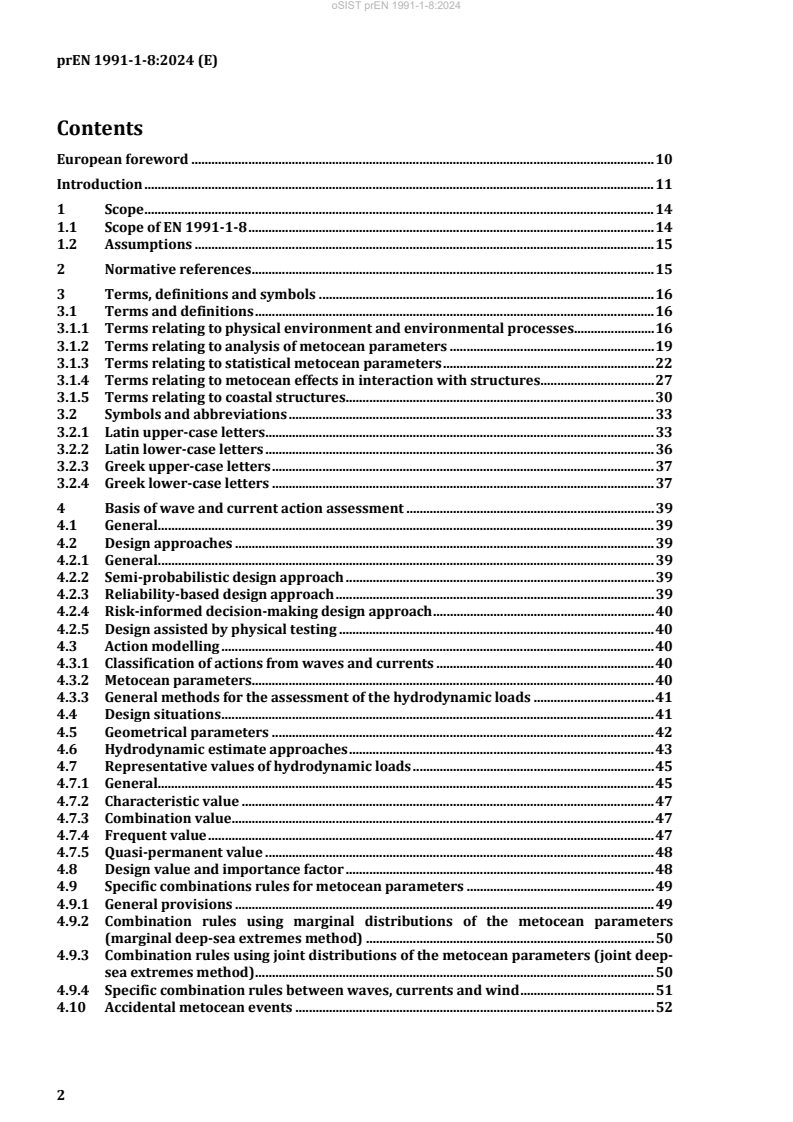
Contents
European foreword . 10
Introduction . 11
1 Scope . 14
1.1 Scope of EN 1991-1-8 . 14
1.2 Assumptions . 15
2 Normative references . 15
3 Terms, definitions and symbols . 16
3.1 Terms and definitions . 16
3.1.1 Terms relating to physical environment and environmental processes. 16
3.1.2 Terms relating to analysis of metocean parameters . 19
3.1.3 Terms relating to statistical metocean parameters . 22
3.1.4 Terms relating to metocean effects in interaction with structures . 27
3.1.5 Terms relating to coastal structures . 30
3.2 Symbols and abbreviations . 33
3.2.1 Latin upper-case letters . 33
3.2.2 Latin lower-case letters . 36
3.2.3 Greek upper-case letters . 37
3.2.4 Greek lower-case letters . 37
4 Basis of wave and current action assessment . 39
4.1 General. 39
4.2 Design approaches . 39
4.2.1 General. 39
4.2.2 Semi-probabilistic design approach . 39
4.2.3 Reliability-based design approach . 39
4.2.4 Risk-informed decision-making design approach . 40
4.2.5 Design assisted by physical testing . 40
4.3 Action modelling . 40
4.3.1 Classification of actions from waves and currents . 40
4.3.2 Metocean parameters. 40
4.3.3 General methods for the assessment of the hydrodynamic loads . 41
4.4 Design situations . 41
4.5 Geometrical parameters . 42
4.6 Hydrodynamic estimate approaches . 43
4.7 Representative values of hydrodynamic loads . 45
4.7.1 General. 45
4.7.2 Characteristic value . 47
4.7.3 Combination value . 47
4.7.4 Frequent value . 47
4.7.5 Quasi-permanent value . 48
4.8 Design value and importance factor . 48
4.9 Specific combinations rules for metocean parameters . 49
4.9.1 General provisions . 49
4.9.2 Combination rules using marginal distributions of the metocean parameters
(marginal deep-sea extremes method) . 50
4.9.3 Combination rules using joint distributions of the metocean parameters (joint deep-
sea extremes method) . 50
4.9.4 Specific combination rules between waves, currents and wind . 51
4.10 Accidental metocean events . 52
oSIST prEN 1991-1-8:2024
prEN 1991-1-8:2024 (E)
5 Hydrodynamic conditions . 53
5.1 General . 53
5.1.1 Metocean design description . 53
5.1.2 Metocean data . 53
5.1.3 Wave and current interactions with structures . 53
5.2 Design event probability and extreme values analysis . 54
5.2.1 General . 54
5.2.2 Extreme value analysis . 55
5.3 Water levels . 56
5.3.1 Design water level . 56
5.3.2 Water level measurements . 56
5.3.3 Tides . 56
5.3.4 Surges . 57
5.4 Waves . 57
5.4.1 General . 57
5.4.2 Wave set-up . 58
5.4.3 Frequency and directional distribution of waves . 58
5.4.4 Spectral wave description . 58
5.4.5 Storm-representative wave parameters . 59
5.4.6 Wave data sources . 59
5.4.7 Wave transformation . 60
5.4.8 Wave data for extreme value analysis . 61
5.4.9 Nearshore wave processes . 61
5.4.10 Regular wave theories . 62
5.4.11 Wave shape and kinematics . 62
5.4.12 Long waves . 64
5.5 Currents . 65
5.5.1 General . 65
5.5.2 Current data sources . 65
5.5.3 Current velocity and profile . 66
5.6 Climate change . 66
6 Wave and current actions on fixed cylindrical structures and suspended decks . 67
6.1 General . 67
6.1.1 Applications . 67
6.1.2 Principles for assessing actions from waves and currents . 68
6.1.3 Conditions for disregarding actions from waves and currents . 69
6.1.4 Current actions . 69
6.1.5 Wave and current actions on cylinders from non- breaking waves . 70
6.1.6 Wave and current actions from breaking waves . 72
6.1.7 Slamming actions from waves . 72
6.1.8 Wave actions on small diameter pipelines . 72
6.1.9 Current and wave induced vibrations . 72
6.1.10 Seabed scour at cylinders due to waves and currents . 72
6.2 Current actions on slender structures . 72
6.3 Wave Actions on slender bodies . 73
6.3.1 Wave actions on single slender cylinder . 73
6.3.2 Wave actions on clusters of circular cylinders . 75
6.4 Wave Actions on large volume bodies . 75
6.5 Wave Impact and slamming actions . 76
6.5.1 Wave slamming on slender structures . 76
6.5.2 Wave in deck forces and air gap . 76
6.5.3 Dynamic amplification and vibrations . 76
oSIST prEN 1991-1-8:2024
prEN 1991-1-8:2024 (E)
6.6 Wave actions on pipelines and subsea structures . 76
6.7 Vortex induced vibration (VIV) of pipelines . 77
7 Wave and current actions on mound breakwaters . 77
7.1 Introduction and structure types . 77
7.2 Design approach for wave and current actions on mound breakwaters . 78
7.2.1 General. 78
7.2.2 Return periods for the verification of serviceability limit states . 79
7.2.3 Return periods for the verification of ultimate limit states . 81
7.3 Wave and current actions . 83
7.3.1 General. 83
7.3.2 Wave action on the seaward slope . 83
7.3.3 Wave actions on the seaward toe . 83
7.3.4 Wave overtopping. 84
7.3.5 Wave action on the rear armour slope. 84
7.3.6 Wave action on geotechnical member . 84
7.3.7 Wave actions on roundheads . 85
7.3.8 Wave action on breakwater crest and crown walls. 85
7.3.9 Wave and current action on filter layers and underlayers . 86
7.3.10 Wave action related to stresses in armour units. 86
7.3.11 Wave and current actions related to local seabed scour . 86
8 Wave and current actions on vertical face breakwaters . 86
8.1 Introduction and structure types . 86
8.2 Design approach for wave and current actions on vertical face breakwaters . 87
8.3 Hydrodynamic loads due to waves and currents . 88
8.3.1 Types of wave actions . 88
8.3.2 Wave pressure, uplift, and buoyancy . 88
8.3.3 Wave overtopping. 89
8.3.4 Effect of wave action on geotechnical failure . 89
8.3.5 Wave and current actions related to local seabed scour . 89
9 Wave and current actions on composite breakwaters . 89
9.1 Introduction and structure types . 89
9.2 Design approach for wave and current actions on composite breakwaters . 90
9.3 Wave and current actions on vertical-composite breakwaters . 90
9.3.1 Main types of wave action . 90
9.3.2 Wave overtopping. 91
9.3.3 Wave action on mound filter layers . 91
9.3.4 Wave action on prefabricated armour units . 91
9.3.5 Effect of wave action on geotechnical failure . 91
9.3.6 Wave and current actions at the vertical face toe . 91
9.3.7 Wave and current actions on the seaward toe of the mound . 91
9.4 Wave and current actions on horizontal-composite breakwaters . 92
9.4.1 Main types of wave action . 92
9.4.2 Wave overtopping. 92
9.4.3 Effect of wave action on geotechnical failure . 92
9.4.4 Wave action on roundheads . 92
9.4.5 Wave action on breakwater crest . 92
9.4.6 Wave action on filter layers . 92
9.4.7 Wave action related to stresses in armour units. 93
9.4.8 Wave and current actions related to local seabed scour . 93
10 Wave and current actions on coastal embankments . 94
10.1 Introduction and structure types . 94
oSIST prEN 1991-1-8:2024
prEN 1991-1-8:2024 (E)
10.2 Design approach of wave and current actions on coastal embankments . 94
10.3 Revetments . 95
10.3.1 Type of wave and current actions . 95
10.3.2 Wave action on seaward slope . 95
10.3.3 Wave action on seaward toe . 96
10.3.4 Wave overtopping . 96
10.3.5 Effect of wave action on geotechnical failure . 96
10.3.6 Wave and current actions related to local seabed scour . 96
10.4 Seawalls . 96
10.4.1 Types of wave and current actions . 96
10.4.2 Wave reflection . 97
10.4.3 Wave actions on seaward toe . 97
10.4.4 Wave overtopping . 97
10.4.5 Wave-induced forces . 97
10.4.6 Seabed scour due to waves and currents . 98
11 Wave and current actions on floating structures . 98
11.1 Definitions and types of floating structures . 98
11.2 Wave actions on floating structures . 101
11.2.1 General . 101
11.2.2 Analytical approach . 101
11.2.3 Numerical modelling approach . 102
11.2.4 Physical modelling approach . 103
11.3 Current actions on floating structures . 103
11.4 Physical modelling approach . 104
12 Wave and current action assessment assisted by physical model testing . 104
12.1 General . 104
12.2 Purposes of testing . 104
12.3 Organization of a physical model study . 105
12.4 Physical model concept and layout . 105
12.4.1 Input data . 105
12.4.2 Contents of the modelling methodology (test plan) . 107
12.4.3 Scaling laws and model scale . 108
12.4.4 Choice of a facility . 109
12.4.5 Model layout . 110
12.4.6 Construction of the model: bathymetry and tested structure . 111
12.4.7 Measurement equipment . 112
12.4.8 Installation and calibration of the instrumentation . 113
12.4.9 Validation of input conditions . 113
12.5 Model testing . 114
12.5.1 General . 114
12.5.2 Wave and current generation procedure . 114
12.5.3 Data acquisition and processing . 115
12.5.4 Analysis of hydraulic measurements . 115
12.5.5 Analysis of wave overtopping . 116
12.5.6 Assessment of stability of rubble mound structures . 116
12.5.7 Analysis of pressure and load measurements . 116
12.5.8 Assessment of floating structures motions and of forces on mooring equipment . 117
12.6 Reporting of test results . 117
12.7 Miscellaneous . 117
12.7.1 Inherent model uncertainty and model setup effects . 117
12.7.2 Minimizing model scale effects . 118
12.7.3 Instrument accuracy . 118
oSIST prEN 1991-1-8:2024
prEN 1991-1-8:2024 (E)
13 Wave and current actions in reliability analysis . 118
13.1 Introduction . 118
13.2 Probability models for wave and current actions on coastal structures . 119
13.3 Extrapolation of exceedance probability . 120
13.4 Target reliability . 120
13.5 Resilience . 121
Annex A (informative) Additional guidance on environmental sea conditions . 122
A.1 Use of this annex . 122
A.2 Scope and field of application . 122
A.3 Water levels . 122
A.3.1 Tide levels . 122
A.3.2 Design water levels . 122
A.4 Waves . 123
A.4.1 Short-term wave condition . 123
A.4.2 Wave climate (long-term) statistics . 128
A.4.3 Extreme wave statistics . 129
A.4.4 Wave kinematics . 131
A.4.5 Wave transformations . 133
A.5 Currents . 133
A.5.1 General. 133
A.5.2 Stretching of current to wave surface . 134
A.5.3 Numerical simulation of current flows – current hindcast . 136
A.5.4 Current properties . 136
Annex B (informative) Additional guidance for fixed cylindrical structures and suspended
decks . 138
B.1 Use of this annex . 138
B.2 Scope and field of application . 138
B.3 Classification. 138
B.4 Principles of design . 139
B.4.1 General. 139
B.4.2 Storm-representative wave approach . 140
B.5 Wave and current actions on structures . 141
B.5.1 General. 141
B.5.2 Waves and current actions on slender structures . 141
B.5.3 Waves actions on large volume bodies . 148
B.6 Seabed scour at cylinders due to waves and currents . 150
B.7 Clusters of cylinders . 150
B.8 Long-crested and short-crested wave action . 151
B.9 Wave impact and slamming actions . 151
B.9.1 General. 151
B.9.2 Slamming actions on vertical and inclined cylinders on uniformly sloping or
horizontal bottoms . 152
B.9.3 Wave actions, including slamming actions, on vertical cylinders on reefs and shoals
................................................................................................................................................................ 154
B.9.4 Wave-in-deck forces . 154
B.9.5 Air gap calculations and recommendations . 156
B.9.6 Dynamic amplification and vibrations . 157
B.10 Subsea pipelines . 158
B.11 Vortex induced vibration of pipelines . 160
B.12 Tools to support design . 161
B.12.1 Numerical models . 161
B.12.2 Model tests . 162
oSIST prEN 1991-1-8:2024
prEN 1991-1-8:2024 (E)
Annex C (informative) Additional guidance for mound breakwaters . 163
C.1 Use of this annex . 163
C.2 Scope and field of application . 163
C.3 Conventional mound breakwaters . 164
C.3.1 Failure modes . 164
C.3.2 Fault tree . 165
C.3.3 Design approaches and formulae . 167
C.3.4 Wave action on the seaward rock-armoured slope . 169
C.3.5 Wave action on the seaward slope of artificial units . 169
C.3.6 Wave actions on the seaward toe. 169
C.3.7 Wave run-up and wave overtopping . 170
C.3.8 Wave action on the rear armour slope . 170
C.3.9 Wave actions on roundheads . 171
C.3.10 Wave action on crown walls . 171
C.3.11 Local seabed and underlayers erosion . 171
C.4 Berm breakwaters . 172
C.4.1 Introduction . 172
C.4.2 Failure modes . 172
C.4.3 Fault tree . 173
C.4.4 Design approach and formulae . 173
C.4.5 Wave action on the seaward face . 173
C.4.6 Rear side stability . 173
C.4.7 Stability and reshaping of the berm breakwater head . 174
C.4.8 Wave overtopping . 174
C.4.9 Abrasion and crushing of stones . 174
C.4.10 Local scour and scour protection . 175
C.5 Low-crested and submerged mound breakwaters . 175
C.5.1 Failure modes . 175
C.5.2 Fault tree . 175
C.5.3 Design approach and formulae . 175
C.5.4 Wave action on the seaward rock-armoured slope . 175
C.5.5 Wave action on the crest and rear armour slope . 176
C.5.6 Wave overtopping in low-crested mound breakwaters . 176
C.5.7 Wave transmission . 176
C.6 Qualitative cumulative damage assessment of mound breakwaters loaded by waves
and currents . 176
Annex D (informative) Additional guidance for vertical face and composite breakwaters
................................................................................................................................................................ 178
D.1 Use of this annex . 178
D.2 Scope and field of application .
...