


EN 71-5:2025
(Main)Safety of toys - Part 5: Chemical toys (sets) other than experimental sets
General Information
- Abstract
This document specifies requirements and test methods for toy materials (substances and mixtures) used in chemical toys (sets) other than experimental sets. These substances and mixtures are:
- those classified as dangerous by the EU legislation applying to dangerous substances and dangerous mixtures [5];
- substances and mixtures which in excessive amounts could harm the health of the children using them and which are not classified as dangerous by the above-mentioned legislation; and
- any other chemical substance(s) and mixture(s) delivered with the chemical toy.
NOTE The terms "substance" and "mixture" are defined in the REACH regulation No. (EC)1907/2006 and in the CLP regulation (EC) No. 1272/2008.
Additionally, requirements are specified for markings, warnings, safety rules, contents list, instructions for use and first aid information.
This document applies to:
- plaster of Paris (gypsum) moulding sets;
- oven-hardening plasticised PVC modelling clay sets;
- polystyrene granules sets;
- embedding sets;
- adhesives, paints, lacquers, varnishes, thinners and cleaning agents (solvents), supplied or recommended in model sets;
- slime kits.
- Status
- Published
- Publication Date
- 09-Dec-2025
- Technical Committee
- CEN/TC 52 - Safety of toys
- Drafting Committee
- CEN/TC 52/WG 5 - Safety of toys - Chemical toys
- Current Stage
- 6060 - Definitive text made available (DAV) - Publishing
- Start Date
- 10-Dec-2025
- Due Date
- 24-Oct-2025
- Completion Date
- 10-Dec-2025

Overview
EN 71-5:2025 - Safety of toys: Part 5 - Chemical toys (sets) other than experimental sets is a CEN standard that specifies safety requirements and test methods for chemical toy materials (substances and mixtures) supplied with toys. The standard covers chemicals that are legally classified as dangerous under EU legislation, substances that may harm children in excessive amounts even if not classified as dangerous, and any other chemicals delivered with the toy. It also mandates marking, warnings, safety rules, contents lists, instructions for use and first‑aid information.
Keywords: EN 71-5:2025, safety of toys, chemical toys, toy safety, CEN, REACH, CLP
Key Topics
- Scope and definitions
- Applicability to plaster of Paris moulding sets, oven‑hardening plasticised PVC modelling clay sets, polystyrene granules sets, embedding sets, model adhesives/paints/varnishes/thinners/cleaning agents, and slime kits.
- Alignment with REACH (EC 1907/2006) and CLP (EC 1272/2008) definitions for “substance” and “mixture.”
- Marking and information
- Requirements for primary packaging, individual containers, contents lists, safety rules, minimum age and adult supervision advice, and first‑aid instructions.
- Chemical limits and hazards
- Controls on substances classified as dangerous, and on ingredients that can be harmful in excessive amounts.
- Test methods (selected)
- Determination of plasticisers in oven‑hardening PVC modelling clays.
- Emission testing for benzene, toluene and xylenes from PVC/clay and polystyrene granules.
- Styrene content measurement in polystyrene granules.
- Determination of organic solvents and combined approaches for plasticisers and film‑forming agents.
- Supporting annexes
- Environmental, health and safety precautions for analytical methods; validation guidance and rationale; relationship to EU Toy Safety Directive (2009/48/EC).
Applications
EN 71-5:2025 is used to ensure chemical safety and regulatory compliance for:
- Toy and kit manufacturers developing chemical toys (plaster sets, slime kits, modelling clays, craft/scale model sets).
- Product designers and formulators assessing ingredient selection and limits.
- Test laboratories performing the specified chemical analyses and emissions testing.
- Compliance officers, importers and retailers preparing labeling, instructions, safety warnings and documentation for market access in the EU.
- Regulatory authorities and notified bodies assessing conformity with Toy Safety Directive requirements.
Related standards
- Other parts of the EN 71 series (e.g., EN 71‑1, EN 71‑2, EN 71‑3, EN 71‑4, EN 71‑7) and CEN technical reports (CEN/TRs) referenced for warnings, age determination and related test methods.
- European legislation: REACH (EC 1907/2006), CLP (EC 1272/2008) and Directive 2009/48/EC (Toy Safety Directive).
Using EN 71-5:2025 helps stakeholders manage chemical risks in toys, produce compliant labeling and instructions, and plan appropriate laboratory testing to demonstrate safety for children.
Relations
- Effective Date
- 20-Sep-2023
- Effective Date
- 28-Jan-2026
- Effective Date
- 28-Jan-2026
- Effective Date
- 28-Jan-2026
- Effective Date
- 28-Jan-2026
- Effective Date
- 10-Feb-2026
- Referred By
EN 71-9:2005+A1:2007 - Safety of toys - Part 9: Organic chemical compounds - Requirements - Effective Date
- 28-Jan-2026
Frequently Asked Questions
EN 71-5:2025 is a standard published by the European Committee for Standardization (CEN). Its full title is "Safety of toys - Part 5: Chemical toys (sets) other than experimental sets". This standard covers: This document specifies requirements and test methods for toy materials (substances and mixtures) used in chemical toys (sets) other than experimental sets. These substances and mixtures are: - those classified as dangerous by the EU legislation applying to dangerous substances and dangerous mixtures [5]; - substances and mixtures which in excessive amounts could harm the health of the children using them and which are not classified as dangerous by the above-mentioned legislation; and - any other chemical substance(s) and mixture(s) delivered with the chemical toy. NOTE The terms "substance" and "mixture" are defined in the REACH regulation No. (EC)1907/2006 and in the CLP regulation (EC) No. 1272/2008. Additionally, requirements are specified for markings, warnings, safety rules, contents list, instructions for use and first aid information. This document applies to: - plaster of Paris (gypsum) moulding sets; - oven-hardening plasticised PVC modelling clay sets; - polystyrene granules sets; - embedding sets; - adhesives, paints, lacquers, varnishes, thinners and cleaning agents (solvents), supplied or recommended in model sets; - slime kits.
This document specifies requirements and test methods for toy materials (substances and mixtures) used in chemical toys (sets) other than experimental sets. These substances and mixtures are: - those classified as dangerous by the EU legislation applying to dangerous substances and dangerous mixtures [5]; - substances and mixtures which in excessive amounts could harm the health of the children using them and which are not classified as dangerous by the above-mentioned legislation; and - any other chemical substance(s) and mixture(s) delivered with the chemical toy. NOTE The terms "substance" and "mixture" are defined in the REACH regulation No. (EC)1907/2006 and in the CLP regulation (EC) No. 1272/2008. Additionally, requirements are specified for markings, warnings, safety rules, contents list, instructions for use and first aid information. This document applies to: - plaster of Paris (gypsum) moulding sets; - oven-hardening plasticised PVC modelling clay sets; - polystyrene granules sets; - embedding sets; - adhesives, paints, lacquers, varnishes, thinners and cleaning agents (solvents), supplied or recommended in model sets; - slime kits.
EN 71-5:2025 is classified under the following ICS (International Classification for Standards) categories: 97.200.50 - Toys. The ICS classification helps identify the subject area and facilitates finding related standards.
EN 71-5:2025 has the following relationships with other standards: It is inter standard links to EN 71-5:2015, EN ISO 3219-2:2021, EN ISO 22854:2025, EN ISO 3696:1995, EN ISO 3104:2023, CEN/CLC Guide 14:2009, EN 71-9:2005+A1:2007. Understanding these relationships helps ensure you are using the most current and applicable version of the standard.
EN 71-5:2025 is associated with the following European legislation: EU Directives/Regulations: 2009/48/EC; Standardization Mandates: M/589. When a standard is cited in the Official Journal of the European Union, products manufactured in conformity with it benefit from a presumption of conformity with the essential requirements of the corresponding EU directive or regulation.
EN 71-5:2025 is available in PDF format for immediate download after purchase. The document can be added to your cart and obtained through the secure checkout process. Digital delivery ensures instant access to the complete standard document.
Standards Content (Sample)
SLOVENSKI STANDARD
01-marec-2026
Nadomešča:
SIST EN 71-5:2015
Varnost igrač - 5. del: Kemijske igrače (kompleti), razen kompletov za kemijske
poskuse
Safety of toys - Part 5: Chemical toys (sets) other than experimental sets
Sicherheit von Spielzeug - Teil 5: Chemisches Spielzeug (Sets) ausgenommen
Experimentierkästen
Sécurité des jouets - Partie 5 : Jouets chimiques (coffrets) autres que les coffrets
d'expériences
Ta slovenski standard je istoveten z: EN 71-5:2025
ICS:
97.200.50 Igrače Toys
2003-01.Slovenski inštitut za standardizacijo. Razmnoževanje celote ali delov tega standarda ni dovoljeno.
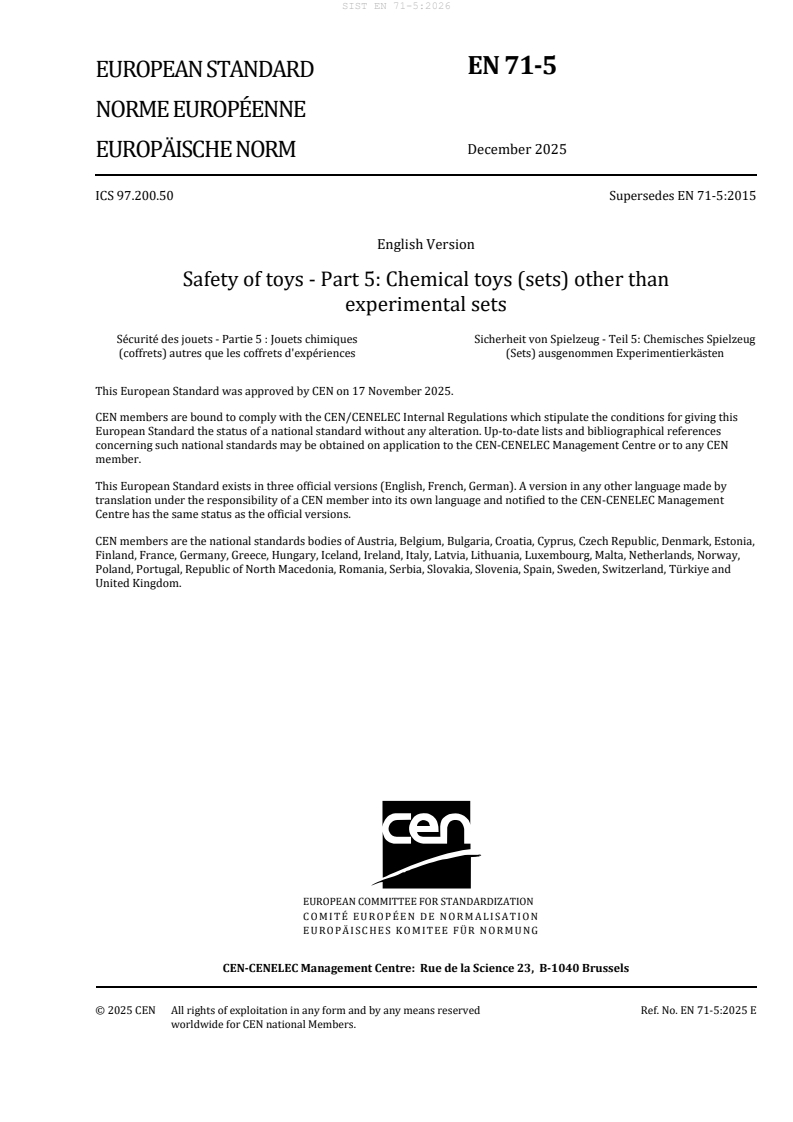
EN 71-5
EUROPEAN STANDARD
NORME EUROPÉENNE
December 2025
EUROPÄISCHE NORM
ICS 97.200.50 Supersedes EN 71-5:2015
English Version
Safety of toys - Part 5: Chemical toys (sets) other than
experimental sets
Sécurité des jouets - Partie 5 : Jouets chimiques Sicherheit von Spielzeug - Teil 5: Chemisches Spielzeug
(coffrets) autres que les coffrets d'expériences (Sets) ausgenommen Experimentierkästen
This European Standard was approved by CEN on 17 November 2025.
CEN members are bound to comply with the CEN/CENELEC Internal Regulations which stipulate the conditions for giving this
European Standard the status of a national standard without any alteration. Up-to-date lists and bibliographical references
concerning such national standards may be obtained on application to the CEN-CENELEC Management Centre or to any CEN
member.
This European Standard exists in three official versions (English, French, German). A version in any other language made by
translation under the responsibility of a CEN member into its own language and notified to the CEN-CENELEC Management
Centre has the same status as the official versions.
CEN members are the national standards bodies of Austria, Belgium, Bulgaria, Croatia, Cyprus, Czech Republic, Denmark, Estonia,
Finland, France, Germany, Greece, Hungary, Iceland, Ireland, Italy, Latvia, Lithuania, Luxembourg, Malta, Netherlands, Norway,
Poland, Portugal, Republic of North Macedonia, Romania, Serbia, Slovakia, Slovenia, Spain, Sweden, Switzerland, Türkiye and
United Kingdom.
EUROPEAN COMMITTEE FOR STANDARDIZATION
COMITÉ EUROPÉEN DE NORMALISATION
EUROPÄISCHES KOMITEE FÜR NORMUNG
CEN-CENELEC Management Centre: Rue de la Science 23, B-1040 Brussels
© 2025 CEN All rights of exploitation in any form and by any means reserved Ref. No. EN 71-5:2025 E
worldwide for CEN national Members.
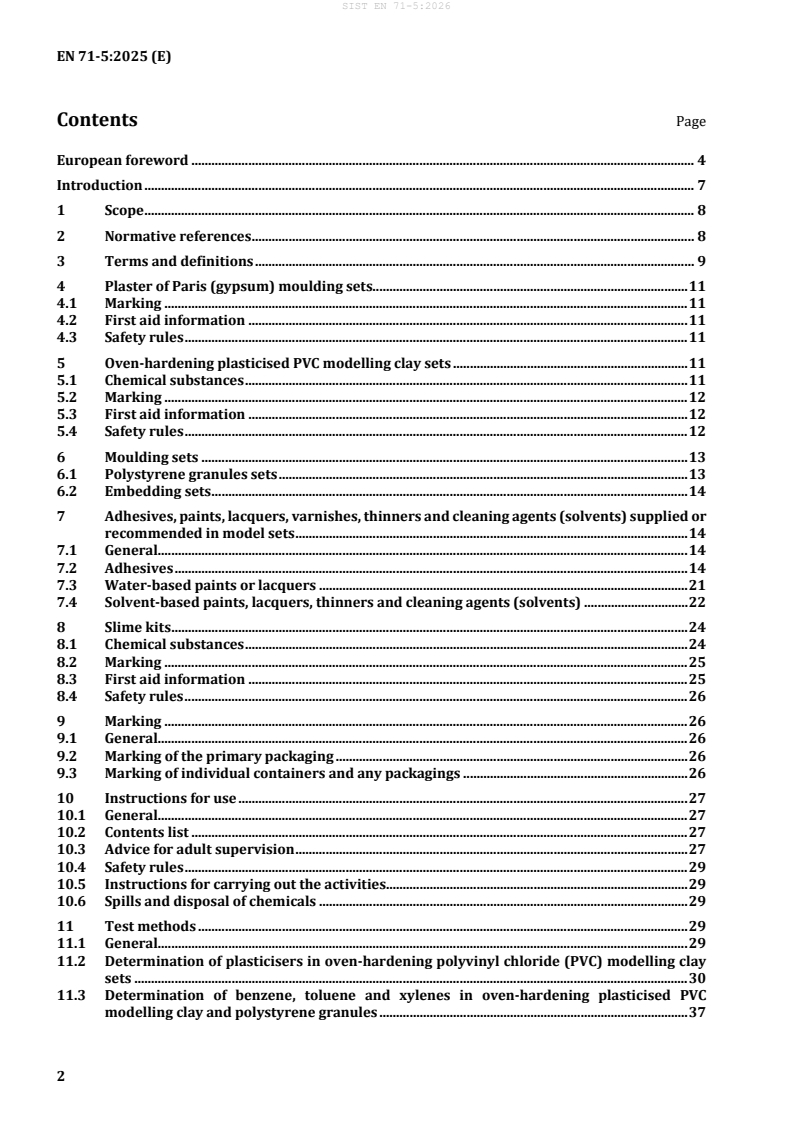
Contents Page
European foreword . 4
Introduction . 7
1 Scope . 8
2 Normative references . 8
3 Terms and definitions . 9
4 Plaster of Paris (gypsum) moulding sets. 11
4.1 Marking . 11
4.2 First aid information . 11
4.3 Safety rules . 11
5 Oven-hardening plasticised PVC modelling clay sets . 11
5.1 Chemical substances . 11
5.2 Marking . 12
5.3 First aid information . 12
5.4 Safety rules . 12
6 Moulding sets . 13
6.1 Polystyrene granules sets . 13
6.2 Embedding sets . 14
7 Adhesives, paints, lacquers, varnishes, thinners and cleaning agents (solvents) supplied or
recommended in model sets . 14
7.1 General. 14
7.2 Adhesives . 14
7.3 Water-based paints or lacquers . 21
7.4 Solvent-based paints, lacquers, thinners and cleaning agents (solvents) . 22
8 Slime kits . 24
8.1 Chemical substances . 24
8.2 Marking . 25
8.3 First aid information . 25
8.4 Safety rules . 26
9 Marking . 26
9.1 General. 26
9.2 Marking of the primary packaging . 26
9.3 Marking of individual containers and any packagings . 26
10 Instructions for use . 27
10.1 General. 27
10.2 Contents list . 27
10.3 Advice for adult supervision . 27
10.4 Safety rules . 29
10.5 Instructions for carrying out the activities . 29
10.6 Spills and disposal of chemicals . 29
11 Test methods . 29
11.1 General. 29
11.2 Determination of plasticisers in oven-hardening polyvinyl chloride (PVC) modelling clay
sets . 30
11.3 Determination of benzene, toluene and xylenes in oven-hardening plasticised PVC
modelling clay and polystyrene granules . 37
11.4 Determination of styrene content in polystyrene granules . 41
11.5 Determination of organic solvents . 43
11.6 Combined approach for the determination of plasticisers in solvent-based adhesives and
in solvent-based paints or lacquers, film-forming agents in paints and lacquers and
modifiers in solvent-based paints or lacquers . 64
Annex A (informative) Environmental, health and safety precautions for using the methods of
analysis . 75
Annex B (informative) Organic solvents . 76
Annex C (informative) Validation of test methods . 78
Annex D (informative) Background and rationale for this European Standard . 79
D.1 General remark . 79
D.2 Primary packaging (4.1; 5.2; 6.1.2; 7.2.1.2.2; 7.2.2.6; 7.3.2; 7.4.3; 8.2, 9.2) . 79
D.3 Minimum age (4.1; 5.2; 6.1.2; 6.2.2; 7.2.1.2.3; 7.2.1.3.3; 7.2.2.6; 7.3.3; 7.4.3, 8.2) . 80
D.4 Benzene (5.1, Table 2; 7.2.2.4, Table 11; 7.4.1, Table 15) . 80
D.5 Preservatives (6.2.1; 7.2.1.1; 7.3.1, 8.1). 80
D.6 Guidance on giving adequate advice for adult supervision (10.3) . 80
Annex E (normative) Non-exhaustive list of colourants which need to be in compliance with both
the general and specific purity requirements . 81
Annex F (normative) Booster substances . 87
Annex ZA (informative) Relationship between this European Standard and the essential
requirements of Directive 2009/48/EC aimed to be covered . 88
Bibliography . 89
European foreword
This document (EN 71-5:2025) has been prepared by Technical Committee CEN/TC 52 “Safety of toys”,
the secretariat of which is held by DS.
This European Standard shall be given the status of a national standard, either by publication of an
identical text or by endorsement, at the latest by June 2026 and conflicting national standards shall be
withdrawn at the latest by December 2026.
Attention is drawn to the possibility that some of the elements of this document may be the subject of
patent rights. CEN shall not be held responsible for identifying any or all such patent rights.
This document supersedes EN 71-5:2015.
This document has been prepared under a standardization request addressed to CEN by the European
Commission. The Standing Committee of the EFTA States subsequently approves these requests for its
Member States.
For the relationship with EU Legislation, see informative Annex ZA, which is an integral part of this
document.
Additional information on the background and rationale for various requirements of this document is
given in Annex D.
This document constitutes the fifth part of the EN 71 series of standards on safety of toys.
EN 71, Safety of toys, consists of the following parts:
— Part 1: Mechanical and physical properties;
— Part 2: Flammability;
— Part 3: Migration of certain elements;
— Part 4: Experimental sets for chemistry and related activities;
— Part 5: Chemical toys (sets) other than experimental sets (this document);
— Part 7: Finger paints — Requirements and test methods;
— Part 8: Activity toys for domestic use;
— Part 10: Organic chemical compounds — Sample preparation and extraction;
— Part 11: Organic chemical compounds — Methods of analysis;
— Part 12: N-Nitrosamines and N-nitrosatable substances;
— Part 13: Olfactory board games, cosmetic kits and gustative games;
— Part 14: Trampolines for domestic use;
— Part 15: Formamide in foam toy materials (content);
— Part 16: Certain chlorinated phosphorus flame retardants (TCEP, TCPP, TDCP) in toy materials;
— Part 17: Certain isothiazolinones (MIT, CIT, BIT) in aqueous toy materials;
— Part 18: Phenol in aqueous (content) and polymeric (migration) toy materials;
— Part 19: Migration of bisphenol A from toy materials;
— Part 20: Microbiological safety of toys containing accessible aqueous media.
It is up to the user of the standard to determine whether or not a toy is included in the scope of several of
the above parts of the EN 71 series, and to apply each applicable standard accordingly. Normative
references from one part of the EN 71 series to another, are therefore normally not provided in the
individual parts.
NOTE 1 In addition to the above parts of EN 71, the following deliverables have been published:
— CEN/TR 15071, Safety of toys — National translations of warnings and instructions for use in the EN 71 series,
— CEN/TR 15371 (all parts), Safety of toys — Interpretations,
— CEN/TR 16918, Safety of toys — Children's mouthing behaviour in contact with toys,
— CEN/TR 17695, Safety of toys — Mechanical and physical properties — Guidance on categorization of projectile
toys within EN 71-1,
— CEN/TS 17973, Safety of toys — Categorization of slime type materials,
— CEN/TR 18217, Safety of toys — Migration of certain elements from polymers,
— CEN/TR 18240: Safety of toys — Mechanical and physical properties — Guidance on the requirements for food-
imitating toys in EN 71-1, and
— CEN ISO/TR 8124-8, Safety of toys — Part 8: Age determination - First age grade for the appropriate play of toys.
NOTE 2 Words in italics (apart from document titles) are defined in Clause 3 (Terms and definitions).
The following significant changes have been implemented in this new edition:
Clause/Paragraph/ Change
Table/Figure
3 New terms “slime kit”, “preservative” and “booster substance” have been
added.
8 A new clause with requirements for slime kits was added.
10.3 The advice for adult supervision has been slightly revised and e.g. also
includes specific requirements on advice for adult supervision for certain
slime kits.
10.4 The safety rules have been slightly revised.
Annex D A new rationale (D.6) including guidance on giving adequate advice for adult
supervision has been added. The rationale on primary packaging (D.2) has
been slightly revised.
Clause/Paragraph/ Change
Table/Figure
Annex E A new annex with a non-exhaustive list of colourants which need to be in
compliance with both the general and specific purity requirements has been
added.
Annex F A new annex on booster substances has been added. References to this annex
have been added in the subclauses of those chemical toys for which
preservatives and consequently booster substances are of relevance.
Any feedback and questions on this document should be directed to the users’ national standards body.
A complete listing of these bodies can be found on the CEN website.
According to the CEN-CENELEC Internal Regulations, the national standards organizations of the
following countries are bound to implement this European Standard: Austria, Belgium, Bulgaria, Croatia,
Cyprus, Czech Republic, Denmark, Estonia, Finland, France, Germany, Greece, Hungary, Iceland, Ireland,
Italy, Latvia, Lithuania, Luxembourg, Malta, Netherlands, Norway, Poland, Portugal, Republic of North
Macedonia, Romania, Serbia, Slovakia, Slovenia, Spain, Sweden, Switzerland, Türkiye and the United
Kingdom.
Introduction
This document is intended to reduce the risks which can present health hazards to a child when the
chemical toys are used as intended or in a foreseeable way, bearing in mind the behaviour of children.
When using these chemical toys, potential risks should be kept to a minimum by inclusion of appropriate
information to give special attention to possible hazards, risks and other problems.
Chemical Abstract Service Registry Number (CAS) and European Inventory of Existing Chemical
Substances Number (EINECS) given in various tables are provided for information purposes only.
1 Scope
This document specifies requirements and test methods for toy materials (substances and mixtures) used
in chemical toys (sets) other than experimental sets. These substances and mixtures are:
— those classified as dangerous by the EU legislation applying to dangerous substances and dangerous
mixtures [5];
— substances and mixtures which in excessive amounts could harm the health of the children using
them and which are not classified as dangerous by the above-mentioned legislation; and
— any other chemical substance(s) and mixture(s) delivered with the chemical toy.
NOTE The terms “substance” and “mixture” are defined in the REACH regulation No. (EC)1907/2006 and in
the CLP regulation (EC) No. 1272/2008.
Additionally, requirements are specified for markings, warnings, safety rules, contents list, instructions
for use and first aid information.
This document applies to:
— plaster of Paris (gypsum) moulding sets;
— oven-hardening plasticised PVC modelling clay sets;
— polystyrene granules sets;
— embedding sets;
— adhesives, paints, lacquers, varnishes, thinners and cleaning agents (solvents), supplied or
recommended in model sets;
— slime kits.
2 Normative references
The following documents are referred to in the text in such a way that some or all of their content
constitutes requirements of this document. For dated references, only the edition cited applies. For
undated references, the latest edition of the referenced document (including any amendments) applies.
EN ISO 3104:2023, Petroleum products — Transparent and opaque liquids — Determination of kinematic
viscosity and calculation of dynamic viscosity (ISO 3104:2023)
EN ISO 3219-2:2021, Rheology — Part 2: General principles of rotational and oscillatory rheometry
(ISO 3219-2:2021)
EN ISO 3696:1995, Water for analytical laboratory use — Specification and test methods (ISO 3696:1987)
EN ISO 22854:2025, Liquid petroleum products — Determination of hydrocarbon types and oxygenates in
automotive-motor gasoline and in ethanol (E85) automotive fuel — Multidimensional gas chromatography
method (ISO 22854:2025)
3 Terms and definitions
For the purposes of this document, the following terms and definitions apply.
ISO and IEC maintain terminology databases for use in standardization at the following addresses:
— ISO Online browsing platform: available at https://www.iso.org/obp/
— IEC Electropedia: available at https://www.electropedia.org/
3.1
chemical toy
toy intended for the direct handling of chemical substances and mixtures and which is used in a manner
appropriate to a given age-group and under the supervision of an adult
[SOURCE: EN 71-4:2020+A1:2025, 3.1]
3.2
experimental set
chemical toy where the experimental and explorative character in playing with single chemical
substances and mixtures along strict instructions dominates over the creative ideas of the user
[SOURCE: EN 71-4:2020+A1:2025, 3.2]
3.3
plaster of Paris (gypsum) moulding set
toy containing moulds into which a mixture of water and gypsum is poured and allowed to harden
EXAMPLE Plaster of Paris (gypsum) moulding sets are for example used for preparing figures and plates.
Note 1 to entry: The gypsum consists predominantly of calcium sulphate hemihydrate CaSO4 · 0,5 H2O.
3.4
oven-hardening plasticised PVC modelling clay set
toy to be used for creating all kinds of figures, brooches, fashion jewellery, etc. prepared by hardening in
the oven at temperatures between 100 °C and 130 °C
3.5
polystyrene granules set
toy to be used in substitution of ceramic materials to create decorative articles or models by fusion of a
polymer by heating in an oven up to a maximum of 180 °C
3.6
embedding set
toy to be used to preserve certain products in a transparent material
3.7
model set
product used to assemble and coat models which are supplied with or recommend adhesives, paints,
lacquers, varnishes, thinners and cleaning agents (solvents)
EXAMPLE Examples for these models are motorcars, aeroplanes, houses and ships.
3.8
adhesive
non-metallic substance capable of joining materials by surface bonding (adhesion) and the bond
possessing adequate internal strength (cohesion)
3.9
water-based paint or lacquer
water-based pigmented material which when applied in a liquid form to a surface, forms after a time a
dry adherent film or coating
3.10
solvent-based paint or lacquer
solvent-based pigmented material which when applied in a liquid form to a surface, forms after a time a
dry adherent film or coating
3.11
varnish
low viscosity lacquer
3.12
thinners and cleaning agents (solvents)
product which are intended to obtain the required viscosity of paints and lacquers and to clean tools and
brushes
3.13
slime kit
toy containing materials intended to prepare a slime or a slime type product which is intended for play
use
Note 1 to entry: Slime kits comprise of sets for the preparation of play slimes, based on e.g. boron as element for
crosslinking as well as other compounds which exhibit “slimy” behaviour. Slime kits can contain liquid materials as
well as solid materials, e.g. powders or particle-based material.
Note 2 to entry: The purpose of slime kits is to create a play slime by mixing component ingredients. It is not the
intention of a slime kit to be used in an experimental or scientific way.
3.14
preservative
substance that prevents the growth of undesirable micro-organisms
[SOURCE: EN 71-7:2025, 3.8]
3.15
booster substance
substance used for increasing the efficacy of preservatives
[SOURCE: EN 71-7:2025, 3.11]
4 Plaster of Paris (gypsum) moulding sets
4.1 Marking
The primary packaging shall in addition to the marking required in Clause 9 bear the following:
“Warning. Not suitable for children under (*) years. For use under adult supervision. Read the
instructions before use, follow them and keep them for reference.”.
(*) The age shall not be below 5 years.
4.2 First aid information
The instructions for use shall in addition to the general first aid information in 10.2 d) contain the
following:
— “In case of eye contact: Wash out eye with plenty of water, holding eye open. Seek immediate medical
advice.”;
— “If swallowed: Wash out mouth with water, drink some fresh water. Do not induce vomiting. Seek
immediate medical advice.”.
4.3 Safety rules
The instructions for use shall in addition to the rules required in 10.4 contain the following safety rules:
— “Do not place the material in the mouth.”;
— “Do not inhale dust or powder.”;
NOTE Basically plaster of Paris (gypsum) is not a harmful material, but if the powder is inhaled or swallowed,
it can form hard clots in the lungs or in the stomach.
— “Do not apply to the body.”.
5 Oven-hardening plasticised PVC modelling clay sets
5.1 Chemical substances
These modelling clay sets shall consist of PVC (polyvinylchloride) and plasticisers and may contain
modifiers, fillers (e.g. China clay) and colourants. Only plasticisers given in Table 1 shall be used.
The maximum content of plasticisers in the mixture shall not exceed 30 % (mass fraction).
The vinyl chloride monomer content shall be below 1 mg/kg (see [9]).
Table 1 — Plasticisers in oven-hardening plasticised PVC modelling clay sets
Chemical substance CAS-Number
Adipic acid polyesters various
Alkylsulfonic acid esters (C to C ) of phenol 91082–17–6
12 20
Di-isononyl cyclohexane-1,2-dicarboxylate (DINCH) 166412–78–8
Tributyl acetylcitrate 77–90–7
Tris(2-ethylhexyl) acetylcitrate 144–15–0
Modelling clay material shall meet the limits for the substances specified in Table 2 (see [6]).
Table 2 — Limits for certain substances in oven-hardening plasticised PVC modelling clay and
polystyrene granules
Substance Limit
mg/kg
Benzene 5
Toluene 15
Xylenes 25
5.2 Marking
The primary packaging shall in addition to the marking required in Clause 9 bear the following warning:
“Warning. Not suitable for children under (*) years. For use under adult supervision. Read the
instructions before use, follow them and keep them for reference.”.
(*) The age shall not be below 8 years.
5.3 First aid information
The instructions for use shall in addition to the general first aid information in 10.2 d) contain the
following:
— “In case of accidental overheating and inhalation of poisonous gases: Remove person to fresh air and
seek immediate medical advice.”.
5.4 Safety rules
The instructions for use shall in addition to the rules required in 10.4 contain the following safety rules:
— “Do not place the material in the mouth.”;
— “Do not exceed a hardening temperature of 130 °C or harmful gases may be produced.”;
— “Do not exceed a hardening time of 30 minutes.”;
— “The hardening process is not part of the function of the toy and should be carried out by the
supervising adult.”;
— “Use a domestic oven thermometer, e.g. bimetal, to measure the temperature.”;
— “Do not use a glass thermometer.”;
— “Do not heat the material and cook food at the same time in a domestic oven”;
— “Do not use a microwave oven.”.
6 Moulding sets
6.1 Polystyrene granules sets
6.1.1 Chemical substances
These sets shall contain uncoloured and coloured polystyrene granules in accordance with Table 3.
Table 3 — Polystyrene
Chemical substance CAS-Number EINECS-Number
Polystyrene with monomer content of styrene ≤ 500 mg/kg 9003–53–6 —
Additional limits for substances in polystyrene granules sets are specified in Table 2 (see [6]).
6.1.2 Marking
The primary packaging shall in addition to the marking required in Clause 9 bear the following warning:
“Warning. Not suitable for children under (*) years. For use under adult supervision. Read the
instructions before use, follow them and keep them for reference.”.
(*) The age shall not be below 10 years.
6.1.3 First aid information
The instructions for use shall in addition to the general first aid information in 10.2 d) contain the
following:
— “In case of accidental overheating and inhalation of poisonous gases: Remove person to fresh air and
seek immediate medical advice.”.
6.1.4 Safety rules
The instructions for use shall in addition to the rules required in 10.4 contain the following safety rules:
— “Do not exceed a melting temperature of 180 °C.”;
— “The melting process is not part of the function of the toy and should be carried out by the supervising
adult.”;
— “Use a domestic oven thermometer, e.g. bimetal, to measure the temperature.”;
— “Do not swallow material.”;
— “Do not heat the material and cook food at the same time in a domestic oven.”;
— “Do not use a glass thermometer.”;
— “Do not exceed the maximum recommended processing period.”;
— “Do not use a microwave oven.”.
6.2 Embedding sets
6.2.1 General
Only preservatives permitted for use in food (see [7]) and/or cosmetics, except those preservatives which
are only allowed in cosmetic products that are rinsed off after use, (see [8]) shall be used. The
combination of preservatives with booster substances is permitted. Only booster substances specified in
Annex F shall be used.
Other substances classified as dangerous substances (see [5]) shall not be used in embedding sets.
NOTE Substances such as gelatine or agar could be utilized with suitable preservation.
6.2.2 Marking
The primary packaging shall in addition to the marking required in Clause 9 bear the following warning:
“Warning. Not suitable for children under (*) years. For use under adult supervision. Read the
instructions before use, follow them and keep them for reference.”.
(*) The age shall not be below 5 years.
The name(s) of any preservative(s) used shall be indicated on the primary packaging.
6.2.3 First aid information
The instructions for use shall in addition to the general first aid information in 10.2 d) contain the
following:
— “If swallowed: Wash out mouth with water, drink some fresh water. Do not induce vomiting. Seek
immediate medical advice.”.
6.2.4 Safety rules
The instructions for use shall in addition to the rules required in 10.4 contain the following safety rule:
— “Do not place the material in the mouth.”.
7 Adhesives, paints, lacquers, varnishes, thinners and cleaning agents (solvents)
supplied or recommended in model sets
7.1 General
Adhesives, paints, lacquers, varnishes, thinners and cleaning agents (solvents) supplied in model sets shall
comply with the requirements in Clause 7. The instructions included in the set shall mention only
adhesives, paints, lacquers, varnishes, thinners and cleaning agents (solvents) that comply with the
requirements in Clause 7.
7.2 Adhesives
7.2.1 Water-based adhesives
7.2.1.1 General
Water-based adhesives shall consist of water and of basic materials in accordance with Table 4 and may
contain:
— special materials in accordance with Table 5 or Table 7;
— preservatives (also in combination with booster substances in accordance with Annex F) permitted
for use in food (see [7]) and/or cosmetics, except those preservatives which are only allowed in
cosmetic products that are rinsed off after use, (see [8]);
— fillers; and/or
— modifiers.
Table 4 — Basic materials for adhesives, paints or lacquers
Chemical substance CAS-Number EINECS-Number
Acrylic homo and copolymers — —
Hydrophilic polyurethane containing neither free
— —
isocyanate-groups nor aromatic amino-compounds
Polymers and copolymers of monomers permitted for
— —
materials intended to come into contact with food
Polyvinyl homo and copolymers — —
Poly (vinyl alcohol) 9002–89–5 209–183–3
Polyvinylpyrrolidone homo and copolymers — —
The basic materials shall be appropriate for food contact (see [9]). The migration solvent shall be water,
grade 3 in accordance with EN ISO 3696:1995. The contact time shall be approximately 60 min at
approximately 40 °C.
7.2.1.2 Liquid adhesives for paper and wood
7.2.1.2.1 General
Special materials for adhesives for paper and wood shall be in accordance with Table 5.
Table 5 — Special materials for adhesives for paper and wood and water-based paints and
lacquers
Chemical substance CAS-Number EINECS-Number
Cellulose ethers (e.g. carboxymethylcellulose, methylcellulose) 9004–67–5 —
Dextrin 9004–53–9 232–675–4
Gum arabic 9000–01–5 232–519–5
Starch or modified starch 9005–25–8 232–679–6
Special additives for adhesives for paper and wood shall be in accordance with Table 6.
Table 6 — Special additives for liquid adhesives for paper and wood
Chemical substance CAS-Number EINECS-Number
a
Butyl glycolate (Butyl hydroxyacetate) 7397–62–8 230–991–7
b
Caprolactam 105–60–2 203–313–2
Glycerol 56–81–5 200–289–5
Polyacrylamide 9003–05–8 —
Poly (acrylic acid) 9003–01–4 —
Polyethylene glycol 25322–68–3 —
Poly (methacrylic acid) 25087–27–7 —
Polypropylene glycol 25322–69–4 —
Sodium salts of fatty acids (C upwards) — —
Sorbitol 50–70–4 200–061–5
c
2-(2-Butoxyethoxy) ethyl acetate 124–17–4 204–685–9
Xylitol 87–99–0 201–788–0
a
The maximum content of butyl glycolate shall be less than 3 % (mass fraction).
b
The maximum content of caprolactam shall be less than 5 % (mass fraction).
c
The maximum content of 2-(2-butoxyethoxy) ethyl acetate shall be less than 3 % (mass fraction).
The polymers given in Table 6 shall be appropriate for food contact (see [9]). The migration solvent shall
be water grade 3 in accordance with EN ISO 3696:1995. The contact time shall be approximately 60 min
at approximately 40 °C.
7.2.1.2.2 Maximum content of individual containers and any packaging
The maximum content of individual containers and any packaging for water-based adhesives in a set shall
not exceed 100 ml.
7.2.1.2.3 Marking
The adhesive container shall in addition to the marking required in Clause 9 bear the following warnings:
“Warning. Not suitable for children under (*) years. For use under adult supervision.”.
(*) The age shall not be below 5 years.
The name(s) of any preservative(s) used shall be indicated on the primary packaging.
7.2.1.2.4 First aid information
The instructions for use shall in addition to the general first aid information in 10.2 d) contain the
following:
— “In case of skin contact: Wash affected area with plenty of water.”;
— “In case of eye contact: Wash out eye with plenty of water, holding eye open. Seek immediate medical
advice.”.
7.2.1.3 Adhesive sticks and pastes for paper
7.2.1.3.1 General
Special materials and special additives for adhesive sticks and pastes for paper shall be in accordance
with Table 5, Table 6 and Table 7.
Table 7 — Special material for adhesive sticks and pastes for paper
Chemical substance CAS-Number EINECS-Number
Acrylic homo and copolymers — —
Hydrophilic polyurethane containing neither free
— —
isocyanate-groups nor aromatic amino-compounds
Polymers and copolymers of monomers permitted for
— —
materials intended to come into contact with food
Polyvinyl homo and copolymers — —
Poly (vinyl alcohol) 9002–89–5 209–183–3
Polyvinylpyrrolidone homo and copolymers — —
Dextrin 9004–53–9 232–675–4
Starch or modified starch 9005–25–8 232–679–6
The special materials shall be appropriate for food contact (see [9]). The migration solvent shall be water
grade 3 in accordance with EN ISO 3696:1995. The contact time shall be approximately 60 min at
approximately 40 °C.
7.2.1.3.2 Maximum content of individual containers and any packaging
The maximum content of individual containers and any packaging for adhesive sticks in a set shall not
exceed 50 g.
7.2.1.3.3 Marking
The packaging, if any, or the adhesive stick container shall in addition to the marking in Clause 9 bear the
following warning:
“Warning. Not suitable for children under (*) years. For use under adult supervision.”.
(*) The age shall not be below 3 years.
7.2.1.3.4 First aid information
The instructions for use shall in addition to the general first aid information in 10.2 d) contain the
following:
— “In case of skin contact: Wash affected area with plenty of water.”;
— “In case of eye contact: Wash out eye with plenty of water, holding eye open. Seek immediate medical
advice.”.
7.2.2 Solvent-based adhesives
7.2.2.1 General
Solvent-based adhesives shall consist of:
— basic material in accordance with Table 4 or the relevant subclauses under 7.2.2; and/or
— special materials in accordance with Table 5 and Table 7; and/or
— substances from Tables 6 and 11 with the limits given there; and/or
— fillers; and/or
— modifiers with a maximum content of 3 % (mass fraction) in the final adhesive; and/or
— plasticisers
o which shall be appropriate for food contact (see [9]) or be in accordance with Table 12; and
o which shall have a maximum plasticiser content of 8 % (mass fraction) in the final adhesive.
For solvent-based adhesives containing petroleum fractions, the n-hexane content shall not exceed 0,5 %
(mass fraction).
The final mixture containing petroleum fractions shall not be classified with H372.
NOTE The classifications are detailed in Regulation (EC) No. 1272/2008 [5].
The following substances and their derivatives shall not be used:
— BADGE - 2,2-bis(4-hydroxyphenyl)propane diglycidyl ether, Bisphenol-A diglycidyl ether (CAS No.
1675–54–3);
— BFDGE - bis(hydroxyphenyl)methane diglycidyl ether, Bisphenol-F diglycidyl ether (CAS No. 39817–
09–9);
— NOGE - Novolac glycidyl ethers (CAS No. 28064–14–4 and CAS No. 9003–36–5).
7.2.2.2 Multi-purpose adhesives
Basic materials for multi-purpose adhesives shall be in accordance with Table 8.
Table 8 — Basic materials for multi-purpose adhesives
Chemical substance CAS-Number EINECS-Number
Acrylic homo and copolymers — —
Cellulose nitrate 9004–70–0 —
Polyvinyl homo and copolymers — —
Vinyl acetate homo and copolymers — —
7.2.2.3 Contact adhesives
Basic materials for contact adhesives shall be in accordance with Table 9.
Table 9 — Basic materials for contact adhesives
Chemical substance CAS-Number EINECS-Number
Polymers and copolymers of monomers permitted for
— —
materials intended to come into contact with food
Poly(chlorobutadiene) 9010–98–4 —
Polyurethane 73561–64–5 —
7.2.2.4 Special adhesives
Basic materials for special adhesives shall be in accordance with Table 10.
Table 10 — Basic materials for special adhesives
Chemical substance CAS-Number EINECS-Number
Acrylic homo and copolymers — —
Polymers and copolymers of monomers permitted for
— —
materials intended to come into contact with food
Polystyrene 9003–53–6 —
Vinyl chloride copolymers — —
The basic materials shall be appropriate for food contact (see [9]). The migration solvent shall be water,
grade 3 in accordance with EN ISO 3696:1995. The contact time shall be approximately 60 min at
approximately 40 °C.
Table 11 — Solvents in solvent-based adhesives
Chemical substance/mixture CAS-Number EINECS-Number
Acetone (Dimethyl ketone) 67–64–1 200–662–2
a
Cyclohexane 110–82–7 203–806–2
Pentan-3-one (Diethyl ketone) 96–22–0 202–490–3
Ethyl acetate 141–78–6 205–500–4
Ethanol (Ethyl alcohol) 64–17–5 200–578–6
Isopropyl acetate 108–21–4 203–561–1
Propan-2-ol (Isopropyl alcohol) 67–63–0 200–661–7
Methyl acetate 79–20–9 201–185–2
Butan-2-one (Methyl ethyl ketone) 78–93–3 201–159–0
3-Methylbutan-2-one (Methyl isopropyl ketone) 563–80–4 209–264–3
n-Butyl acetate 123–86–4 204–658–1
n-Propyl acetate 109–60–4 203–686–1
b
1-Methoxypropan-2-ol 107–98–2 203–539–1
1,1-Dimethoxyethane 534–15–6 208–589–8
c
Petroleum fraction (35 to 160) °C 64742–89–8 265–192–2
Hydrocarbons, C9 –C16, hydrotreated, dearomatized 93763–35–0 297–854–1
a
The maximum content of cyclohexane shall be less than 3 % (mass fraction).
b
The maximum content of 1-methoxypropan-2-ol shall be less than 20 % (mass fraction).
c
The maximum content of benzene shall be less than 0,1 % (mass fraction).
If the product contains Petroleum fraction (35 to 160) °C, the viscosity of the product shall exceed
20,5 mm /s when tested in accordance with EN ISO 3104:2023 or EN ISO 3219-2:2021.
Table 12 — Plasticisers in solvent-based adhesives, solvent-based paints and lacquers
Plasticiser CAS-Number
Tributyl acetylcitrate 77–90–7
Tri(2-ethylhexyl) acetylcitrate 144–15–0
Alkylsulfonic acid esters (C to C ) of phenol 91082–17–6
12 20
Adipic acid polyesters various
Di-isononyl cyclohexane-1,2-dicarboxylate (DINCH) 166412–78–8
7.2.2.5 Maximum content of individual containers and any packaging
The maximum content of individual containers and any packaging for solvent-based adhesives in a set
shall not exceed 15 g.
7.2.2.6 Marking
The primary packaging of the set shall in addition to the marking required in Clause 9 bear the following
warning:
“Warning. Not suitable for children under (*) years. For use under adult supervision. Read the
instructions before use, follow them and keep them for reference.”.
(*) The age shall not be below 8 years.
The individual container shall be marked in accordance with 9.3.
7.2.2.7 First aid information
The instructions for use shall in addition to the general first aid information in 10.2 d) contain the
following:
— “In case of skin contact: Wash affected area with plenty of water.”;
— “In case of eye contact: Wash out eye with plenty of water, holding eye open. Seek immediate medical
advice.”;
— “In case of inhalation: Remove person to fresh air.”.
7.2.2.8 Safety rules
The instructions for use shall in addition to the rules required in 10.4 contain the following safety rules:
— “Keep away from ignition sources.”;
— “Do not allow adhesive to come into contact with the skin, the eyes and the mouth.”;
— “Do not swallow material.”;
— “Do not inhale fumes.”.
7.3 Water-based paints or lacquers
7.3.1 General
Water-based paints or lacquers shall consist of water and of basic materials in accordance with Table 4
and may contain
— special materials in accordance with Table 5;
— special additives in accordance with Table 6;
— organic solvents and film-forming agents in accordance with Table 13 with a content not exceeding
6 % (mass fraction);
— colouring agents;
— preservatives (also in combination with booster substances in accordance with Annex F) permitted
for use in food (see [7]) and/or cosmetics, except those preservatives which are only allowed in
cosmetic products that are rinsed off after use
...