


EN 14195:2005
(Main)Metal framing components for gypsum plasterboard systems - Definitions, requirements and test methods
General Information
- Abstract
This European Standard specifies the characteristics of metal framing components intended to be used in building construction works in conjunction with gypsum plasterboard conforming to prEN 520 where the assembly is non-loadbearing. These include, for example, partitions, wall and ceiling linings and the cladding of beams, columns, ducts and lift shafts.
It covers the following performance characteristics : reaction to fire, flexural (yield) strength to be measured according to the corresponding European test methods.
It defines the reference test methods for technical specifications.
It provides for the evaluation of conformity of the product to this European Standard.
This EN also covers additional technical characteristics that are of importance for the use and acceptance of the product by the construction industry and the reference tests for these characteristics.
A method of designation has been incorporated to cover the multiplicity of metal sections currently in use, without recourse to a means of rationalisation of their shape, profile or dimensions.
This standard does not cover load-bearing steel framing components.
- Status
- Withdrawn
- Publication Date
- 08-Feb-2005
- Withdrawal Date
- 22-Sep-2026
- Technical Committee
- CEN/TC 241 - Gypsum and gypsum based products
- Drafting Committee
- CEN/TC 241/WG 3 - Board products
- Current Stage
- 9960 - Withdrawal effective - Withdrawal
- Start Date
- 17-Dec-2014
- Completion Date
- 23-Sep-2026
- Directive
- Harmonized Standard305/2011 - Regulation (eu) No 305/2011 of the European Parliament and of the Council of 9 march 2011 laying down harmonised conditions for the marketing of construction products and repealing council directive 89/106/eecOJ Ref: C, C 259 OJ Date: 08-Aug-2014
Not Harmonized89/106/EEC - Construction productsOJ Ref: C, C 319 OJ Date: 14-Dec-2005

Relations
- Effective Date
- 24-Dec-2014
- Effective Date
- 28-Jan-2026
- Effective Date
- 28-Jan-2026
- Effective Date
- 28-Jan-2026
- Effective Date
- 28-Jan-2026
- Effective Date
- 08-Jun-2022
Get Certified
Connect with accredited certification bodies for this standard

DIBt (Deutsches Institut für Bautechnik)
German Institute for Building Technology.
DIN CERTCO
DIN Group product certification.

Element Materials Technology
Materials testing and product certification.
Sponsored listings
Frequently Asked Questions
EN 14195:2005 is a standard published by the European Committee for Standardization (CEN). Its full title is "Metal framing components for gypsum plasterboard systems - Definitions, requirements and test methods". This standard covers: This European Standard specifies the characteristics of metal framing components intended to be used in building construction works in conjunction with gypsum plasterboard conforming to prEN 520 where the assembly is non-loadbearing. These include, for example, partitions, wall and ceiling linings and the cladding of beams, columns, ducts and lift shafts. It covers the following performance characteristics : reaction to fire, flexural (yield) strength to be measured according to the corresponding European test methods. It defines the reference test methods for technical specifications. It provides for the evaluation of conformity of the product to this European Standard. This EN also covers additional technical characteristics that are of importance for the use and acceptance of the product by the construction industry and the reference tests for these characteristics. A method of designation has been incorporated to cover the multiplicity of metal sections currently in use, without recourse to a means of rationalisation of their shape, profile or dimensions. This standard does not cover load-bearing steel framing components.
This European Standard specifies the characteristics of metal framing components intended to be used in building construction works in conjunction with gypsum plasterboard conforming to prEN 520 where the assembly is non-loadbearing. These include, for example, partitions, wall and ceiling linings and the cladding of beams, columns, ducts and lift shafts. It covers the following performance characteristics : reaction to fire, flexural (yield) strength to be measured according to the corresponding European test methods. It defines the reference test methods for technical specifications. It provides for the evaluation of conformity of the product to this European Standard. This EN also covers additional technical characteristics that are of importance for the use and acceptance of the product by the construction industry and the reference tests for these characteristics. A method of designation has been incorporated to cover the multiplicity of metal sections currently in use, without recourse to a means of rationalisation of their shape, profile or dimensions. This standard does not cover load-bearing steel framing components.
EN 14195:2005 is classified under the following ICS (International Classification for Standards) categories: 77.140.70 - Steel profiles; 91.100.10 - Cement. Gypsum. Lime. Mortar. The ICS classification helps identify the subject area and facilitates finding related standards.
EN 14195:2005 has the following relationships with other standards: It is inter standard links to EN 14195:2014, EN 10346:2015, EN ISO 6892-1:2019, EN 13501-1:2018, CEN/TR 16239:2011, EN 14195:2005/AC:2006. Understanding these relationships helps ensure you are using the most current and applicable version of the standard.
EN 14195:2005 is associated with the following European legislation: EU Directives/Regulations: 305/2011, 89/106/EEC; Standardization Mandates: M/106. When a standard is cited in the Official Journal of the European Union, products manufactured in conformity with it benefit from a presumption of conformity with the essential requirements of the corresponding EU directive or regulation.
EN 14195:2005 is available in PDF format for immediate download after purchase. The document can be added to your cart and obtained through the secure checkout process. Digital delivery ensures instant access to the complete standard document.
Standards Content (Sample)
2003-01.Slovenski inštitut za standardizacijo. Razmnoževanje celote ali delov tega standarda ni dovoljeno.Metal framing components for gypsum plasterboard systems - Definitions, requirements and test methodsPHWRGHEléments d'ossature métalliques pour systemes en plaques de plâtre - Définitions, exigences et méthodes d'essaiMetallprofile für Unterkonstruktionen von Gipsplattensystemen - Begriffe, Anforderungen und PrüfverfahrenTa slovenski standard je istoveten z:EN 14195:2005SIST EN 14195:2005en91.100.1077.140.70ICS:SLOVENSKI
STANDARDSIST EN 14195:200501-april-2005
EUROPEAN STANDARDNORME EUROPÉENNEEUROPÄISCHE NORMEN 14195February 2005ICS 77.140.70; 91.100.10English versionMetal framing components for gypsum plasterboard systems -Definitions, requirements and test methodsEléments d'ossature métalliques pour systèmes en plaquesde plâtre - Définitions, exigences et méthodes d'essaiMetallprofile für Unterkonstruktionen für GipsplattenSystemen - Begriffe, Anforderungen und PrüfverfahrenThis European Standard was approved by CEN on 10 June 2004.CEN members are bound to comply with the CEN/CENELEC Internal Regulations which stipulate the conditions for giving this EuropeanStandard the status of a national standard without any alteration. Up-to-date lists and bibliographical references concerning such nationalstandards may be obtained on application to the Central Secretariat or to any CEN member.This European Standard exists in three official versions (English, French, German). A version in any other language made by translationunder the responsibility of a CEN member into its own language and notified to the Central Secretariat has the same status as the officialversions.CEN members are the national standards bodies of Austria, Belgium, Cyprus, Czech Republic, Denmark, Estonia, Finland, France,Germany, Greece, Hungary, Iceland, Ireland, Italy, Latvia, Lithuania, Luxembourg, Malta, Netherlands, Norway, Poland, Portugal, Slovakia,Slovenia, Spain, Sweden, Switzerland and United Kingdom.EUROPEAN COMMITTEE FOR STANDARDIZATIONCOMITÉ EUROPÉEN DE NORMALISATIONEUROPÄISCHES KOMITEE FÜR NORMUNGManagement Centre: rue de Stassart, 36
B-1050 Brussels© 2005 CENAll rights of exploitation in any form and by any means reservedworldwide for CEN national Members.Ref. No. EN 14195:2005: E
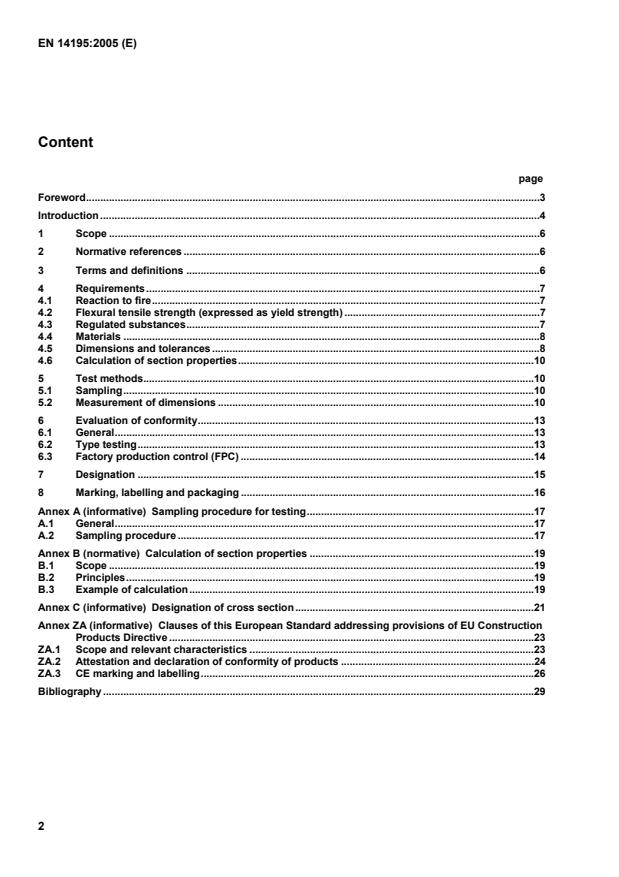
Sampling procedure for testing.17 A.1 General.17 A.2 Sampling procedure.17 Annex B (normative)
Calculation of section properties.19 B.1 Scope.19 B.2 Principles.19 B.3 Example of calculation.19 Annex C (informative)
Designation of cross section.21 Annex ZA (informative)
Clauses of this European Standard addressing provisions of EU Construction Products Directive.23 ZA.1 Scope and relevant characteristics.23 ZA.2 Attestation and declaration of conformity of products.24 ZA.3 CE marking and labelling.26 Bibliography.29
Diagram 1 – Family of gypsum products
Diagram 2 – Family of ancillary products Metal framing components are profiled steel sections cold formed from low carbon steel strip coated in zinc, aluminium - zinc or zinc - aluminium. The design and properties of metal components make them suitable for the construction of non-loadbearing partitions, wall and ceiling linings where they provide the framing members to support the gypsum plasterboards.
It covers the following performance characteristics: reaction to fire, flexural (yield) strength to be measured according to the corresponding European test methods. It defines the reference test methods for technical specifications. It provides for the evaluation of conformity of the product to this document. This EN also covers additional technical characteristics that are of importance for the use and acceptance of the product by the construction industry and the reference tests for these characteristics. A method of designation has been incorporated to cover the multiplicity of metal sections currently in use, without recourse to a means of rationalisation of their shape, profile or dimensions.
This document does not cover load-bearing steel framing components and metal framing components for suspended ceilings according to EN 13964. 2 Normative references The following referenced documents are indispensable for the application of this document. For dated references, only the edition cited applies. For undated references, the latest edition of the referenced document (including any amendments) applies. EN 10002-1, Metallic materials - Tensile testing - Part 1: Method of test at ambient temperature. EN 10326, Continuously hot-dip coated strip and sheet of structural steel – Technical delivery conditions. EN 10327, Continuously hot-dip coated strip and sheet of low carbon steels for cold forming – Technical delivery conditions. EN 13501-1, Fire classification of construction products and building elements — Part 1: Classification using test data from reaction to fire tests.
3 Terms and definitions For the purposes of this document, the following terms and definitions apply. 3.1 non-loadbearing element element which does not transfer vertical forces and whose contribution to the stability of the building is not taken into account 3.2 metal section corrosion protected steel member, cold rolled to form profiles (see examples in Annex C)
1) See Commission Decision 96/603/EC, as amended.
EN 10326 EN 10327 NOTE 1 Z means zinc, ZA means zinc/aluminium, AZ means aluminium/zinc. NOTE 2 The figures give the total coating weight in g/m2.
4.5 Dimensions and tolerances 4.5.1 General No individual measurement shall lie outside the stated tolerances. 4.5.2 Thickness The nominal thickness and tolerance shall be stated by the producer of the section. The thickness of metal shall be measured as described in 5.2.3.1 and compared with the nominal thickness.
4.5.3 Length of section The nominal length of the section shall be stated by the producer.
The length shall be measured as described in 5.2.3.2 and compared with the nominal length. The tolerances shall conform to Table 2. Table 2 — Tolerance for length Length in mm Tolerance in mm Up to 3 000 ± 3 Between 3 000 and 5 000 ± 4 Over 5 000 ± 5
Figure 1 — Angular dimension 4.5.8 Straightness of the section The straightness of the section shall be measured in accordance with 5.2.3.4 and shall not deviate from the flat surface by more than L/400 (where L is the nominal length in mm). 4.5.9 Twist of section The maximum twist of the section shall be measured in accordance with 5.2.3.7. If h is the gap and W is the nominal width of the section (see Figure 7), the relation h/W shall not exceed 0,1.
Figure 2 — Revolving arm protractor for accurate measurement of angles 5.2.3.4 Straightness Place the specimen on the flat surface and use the metal rule to measure the maximum deviation from the plane of the flat surface. Rotate the specimen through 90° about its longitudinal axis and repeat the measurement. Record the results for straightness to the nearest 1,0 mm. 5.2.3.5 Web width of section Place the specimen on the flat surface with the web uppermost.
Select three positions not closer than 150 mm from the end of the section. Using the slide calliper measure the specimen on the outside in the position shown in the diagram (see Figures 3, 4 and 5). The measurements shall be taken as close to the bends as possible. Record the results for width to the nearest 1 mm.
Key → Point where measurement is to be taken Figure 3 — C – Section
Key → Point where measurement is to be taken Figure 4 — U - Section
Key 1 To eliminate the effect of the curve, measurements shall be taken at the point where the prolongations of the web and the edge meet Figure 5 — Measurement with bends 5.2.3.6 Width of flange Place the specimen on the flat surface, with the flange to be measured uppermost. Measure the flange using the slide calliper in three positions not closer than 150 mm from the ends of the section (see Figure 6). Record the results for width to the nearest 0,1 mm.
Key 1 Measuring width of flange between two bends 2 Measuring width of flange between bend and cut edge Figure 6 — Width of flange
Figure 7 — Measurement of twist of section 6 Evaluation of conformity 6.1 General The compliance of metal framing components with the requirements of this document and with the stated values (including classes) shall be demonstrated by: Initial Type Testing (ITT); Factory Production Control by the producer (FPC). For the purposes of testing, metal framing components may be grouped into families, where it is considered that the selected property is common to all metal framing components within that family. The decision on those products or properties which fall within a family shall be made by the producer. 6.2 Type testing 6.2.1 General Sampling and testing shall be in accordance with Clause 5. The results of all type tests shall be recorded and held by the producer for at least 5 years. 6.2.2 Initial type testing Initial type testing shall be performed to show conformity with this document.
Initial type testing shall be performed at the beginning of the production of a new metal framing components type (unless it is a member of a family previously tested) or at the beginning of a new method of production (where this may significantly affect the stated properties).
...