


EN 15625:2008+A1:2010
(Main + Amendment)Railway applications - Braking - Automatic variable load sensing devices
General Information
- Abstract
This European Standard applies to automatic variable load sensing devices designed to continuously sense the load of a railway vehicle and provide a signal that can be used by a relay valve for the automatic variation of the air pressure used for brake application, thereby adjusting the brake force accordingly to achieve the required brake performance.
This European Standard specifies the requirements for the design, dimensions, manufacture and testing of automatic variable load sensing devices.
- Status
- Withdrawn
- Publication Date
- 05-Oct-2010
- Withdrawal Date
- 22-Sep-2026
- Technical Committee
- CEN/TC 256 - Railway applications
- Drafting Committee
- CEN/TC 256/SC 3/WG 24 - Components
- Current Stage
- 9960 - Withdrawal effective - Withdrawal
- Start Date
- 10-Feb-2021
- Completion Date
- 23-Sep-2026
- Directive
- Not Harmonized2008/57/EC - DIRECTIVE 2008/57/EC OF THE EUROPEAN PARLIAMENT AND OF THE COUNCIL of 17 June 2008 on the interoperability of the rail system within the Community (Recast)OJ Ref: C, C 214 OJ Date: 20-Jul-2011


Relations
- Merged From
EN 15625:2008/FprA1 - Railway applications - Braking - Automatic variable load sensing devices - Effective Date
- 18-Jan-2023
- Effective Date
- 14-Aug-2010
- Effective Date
- 17-Feb-2021
- Effective Date
- 25-Aug-2026
- Effective Date
- 09-Feb-2026
- Effective Date
- 09-Feb-2026
- Effective Date
- 09-Feb-2026
- Effective Date
- 28-Jan-2026
- Effective Date
- 28-Jan-2026
- Effective Date
- 28-Jan-2026
Get Certified
Connect with accredited certification bodies for this standard

IRIS Certification (UNIFE)
International Railway Industry Standard certification.

TÜV SÜD Rail GmbH
TÜV SÜD railway certification services.

Bureau Veritas Railway Certification
Railway and transportation certification.
Sponsored listings
Frequently Asked Questions
EN 15625:2008+A1:2010 is a standard published by the European Committee for Standardization (CEN). Its full title is "Railway applications - Braking - Automatic variable load sensing devices". This standard covers: This European Standard applies to automatic variable load sensing devices designed to continuously sense the load of a railway vehicle and provide a signal that can be used by a relay valve for the automatic variation of the air pressure used for brake application, thereby adjusting the brake force accordingly to achieve the required brake performance. This European Standard specifies the requirements for the design, dimensions, manufacture and testing of automatic variable load sensing devices.
This European Standard applies to automatic variable load sensing devices designed to continuously sense the load of a railway vehicle and provide a signal that can be used by a relay valve for the automatic variation of the air pressure used for brake application, thereby adjusting the brake force accordingly to achieve the required brake performance. This European Standard specifies the requirements for the design, dimensions, manufacture and testing of automatic variable load sensing devices.
EN 15625:2008+A1:2010 is classified under the following ICS (International Classification for Standards) categories: 45.060.01 - Railway rolling stock in general. The ICS classification helps identify the subject area and facilitates finding related standards.
EN 15625:2008+A1:2010 has the following relationships with other standards: It is inter standard links to EN 15625:2008/FprA1, EN 15625:2008, EN 15625:2021, ISO 8573-1:2001, EN 60721-3-5:1997, EN 50125-1:2014, EN 61373:1999, EN 14478:2005, EN ISO 228-1:2003, EN 15611:2020. Understanding these relationships helps ensure you are using the most current and applicable version of the standard.
EN 15625:2008+A1:2010 is associated with the following European legislation: EU Directives/Regulations: 2008/57/EC; Standardization Mandates: M/334. When a standard is cited in the Official Journal of the European Union, products manufactured in conformity with it benefit from a presumption of conformity with the essential requirements of the corresponding EU directive or regulation.
EN 15625:2008+A1:2010 is available in PDF format for immediate download after purchase. The document can be added to your cart and obtained through the secure checkout process. Digital delivery ensures instant access to the complete standard document.
Standards Content (Sample)
2003-01.Slovenski inštitut za standardizacijo. Razmnoževanje celote ali delov tega standarda ni dovoljeno.Železniške naprave - Zavore - Naprave za samodejno zaznavanje spremembe obtežbeBahnanwendungen - Bremse - Automatisch kontinuierlich wirkende LasterfassungseinrichtungenApplications ferroviaires - Freinage - Dispositifs de pesée variable automatiquesRailway applications - Braking - Automatic variable load sensing devices45.040Materiali in deli za železniško tehnikoMaterials and components for railway engineeringICS:Ta slovenski standard je istoveten z:EN 15625:2008+A1:2010SIST EN 15625:2009+A1:2011en,fr,de01-april-2011SIST EN 15625:2009+A1:2011SLOVENSKI
STANDARD
EUROPEAN STANDARD NORME EUROPÉENNE EUROPÄISCHE NORM
EN 15625:2008+A1
October 2010 ICS 45.060.01 Supersedes EN 15625:2008English Version
Railway applications - Braking - Automatic variable load sensing devices
Applications ferroviaires - Freinage - Dispositifs de pesée variable automatiques
Bahnanwendungen - Bremse - Automatisch kontinuierlich wirkende Lasterfassungseinrichtungen This European Standard was approved by CEN on 13 September 2008 and includes Amendment 1 approved by CEN on 30 August 2010.
CEN members are bound to comply with the CEN/CENELEC Internal Regulations which stipulate the conditions for giving this European Standard the status of a national standard without any alteration. Up-to-date lists and bibliographical references concerning such national standards may be obtained on application to the CEN Management Centre or to any CEN member.
This European Standard exists in three official versions (English, French, German). A version in any other language made by translation under the responsibility of a CEN member into its own language and notified to the CEN Management Centre has the same status as the official versions.
CEN members are the national standards bodies of Austria, Belgium, Bulgaria, Croatia, Cyprus, Czech Republic, Denmark, Estonia, Finland, France, Germany, Greece, Hungary, Iceland, Ireland, Italy, Latvia, Lithuania, Luxembourg, Malta, Netherlands, Norway, Poland, Portugal, Romania, Slovakia, Slovenia, Spain, Sweden, Switzerland and United Kingdom.
EUROPEAN COMMITTEE FOR STANDARDIZATION
COMITÉ EUROPÉEN DE NORMALISATION EUROPÄISCHES KOMITEE FÜR NORMUNG
Management Centre:
Avenue Marnix 17,
B-1000 Brussels © 2010 CEN All rights of exploitation in any form and by any means reserved worldwide for CEN national Members. Ref. No. EN 15625:2008+A1:2010: ESIST EN 15625:2009+A1:2011
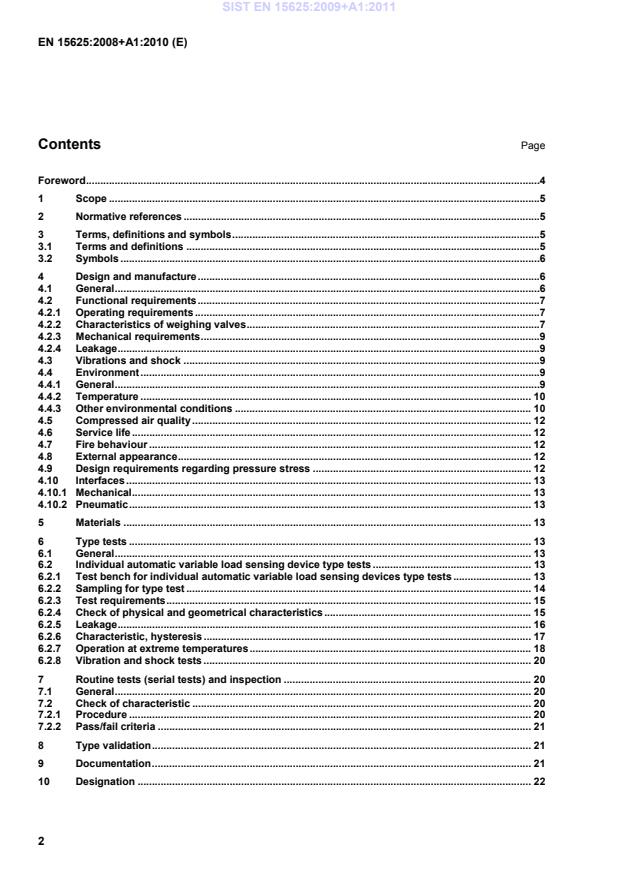
Assessment of an automatic variable load sensing device when fitted to a vehicle. 23A.1 Vehicle assessment – Testing set up . 23A.2 Design acceptance testing set up . 23A.3 Running tests . 23A.3.1 General . 23A.3.2 Pneumatic automatic variable load sensing device – Air consumption . 23A.3.3 Automatic variable load sensing device – Output signal variation . 24Annex ZA (informative)
!!!!Relationship between this European Standard and the Essential Requirements of EU Directive 2008/57/EC of the European Parliament and of the Council of 17 June 2008 on the interoperability of the rail system within the Community (Recast)"""" . 25!!!!deleted text"""" Bibliography . 31 SIST EN 15625:2009+A1:2011
Key 1 automatic variable load sensing device 2 F, mechanical force, generated by a share of the vehicle weight 3 supply pressure, typically taken from the distributor auxiliary reservoir 4 Lcp, output signal pressure Figure 1 — Principles of operation of the automatic variable load sensing device 4.2.2 Characteristics of weighing valves Two characteristics of weighing valves are defined: type 1: (0,8 ± 0,1) bar/10 kN (see Figure 2); type 3: (1,0 ± 0,1) bar/10 kN (see Figure 3). The characteristics for type 1 and type 3 shall be tested in accordance with 6.2.6. NOTE These types are recommended for new interoperable freight wagons. For applications other than interoperable freight wagons other characteristics may be used by agreement between the manufacturer and the customer.
Key 1 characteristic (nominal value) 2 upper limit of tolerance 3 lower limit of tolerance Figure 2 — Characteristic of the automatic variable load sensing device type 1
Key 1 characteristic (nominal value) 2 upper limit of tolerance 3 lower limit of tolerance Figure 3 — Characteristic of the automatic variable load sensing device type 3 SIST EN 15625:2009+A1:2011
70 °C without any deviation from the technical requirements specified in Clause 4; at – 40 °C ≤ environmental temperature < – 25 °C with allowed deviation from the technical requirements specified in this European Standard but without affecting the function of the automatic variable load sensing device. Deviations from the technical requirement when testing at extremes are defined in 6.2.7. The purchaser can specify higher or lower extreme temperature limit values if operational constraints demand it. In this case the temperature limit values used in the extreme temperature tests of 6.2.7 shall be changed accordingly. 4.4.3 Other environmental conditions 4.4.3.1 General The following environmental conditions shall be considered in the design of the automatic variable load sensing device. It shall be demonstrated that these environmental conditions have been taken into account in the design of the automatic variable load sensing device. It is sufficient for the supplier to make a declaration of conformity stating how the environmental conditions in the following clauses have been taken into account. If not specifically required to be tested as part of the type testing requirements in Clause 6, suitable tests and/or design assessments considering the effect of the following environmental conditions on the automatic variable load sensing device, shall be used in the development/design proving of the automatic variable load sensing device, prior to type testing. 4.4.3.2 Altitude The automatic variable load sensing device shall be able to operate without restrictions up to an altitude of 2 000 m. 4.4.3.3 Humidity The following external humidity levels shall be considered: yearly average: ≤ 75 % relative humidity; on 30 days in the year continuously: between 75 % and 95 % relative humidity; on the other days occasionally: between 95 % and 100 % relative humidity; maximum absolute humidity: 30 g/m3 occurring in tunnels. An operationally caused infrequent and slight moisture condensation shall not lead to any malfunction or failure. SIST EN 15625:2009+A1:2011
...